Results by title
103 books match the query 'Conversations' and 16 start with t

Talkin' With Your Mouth Full
Conversations with the Videos of Steve FaginSteve Fagin, ed.
Duke University Press, 1998
Combining elements of criticism with various modes of artistic expression, these responses take the form of reviews, letters, interviews, and in one case an imaginary TV programming schedule. Interspersed with—and sometimes literally interrupting—the video scripts, these contributions interact with one another on multiple levels and complement Fagin’s scripts. Historical, political, and theoretical issues dovetail, ricochet, and interplay in this book, revealing a multiplicity of voices, concerns, and cultural revelations.
Unique in its structure and intellectual approach, Talkin’ with Your Mouth Full will appeal equally to those who have seen Fagin’s videos and those who have not. Students of art history and cultural critique, and anyone interested in the ongoing dialogue between artists and theorists, will find particular value in this book.
Contributors. Gregg Bordowitz, Constance DeJong, Leslie Dick, Steve Fagin, Barry Gifford, Victoria Gill, Bill Horrigan, Bertha Jottar, Ivone Margulies, Patricia Mellencamp, Margaret Morse, Constance Penley, Vicente L. Rafael, Mark Rappaport, Andrew Ross, Vivian Sobchack, Trinh T. Minh-ha, John Welchman, Peter Wollen
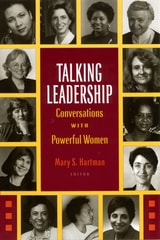
Talking Leadership
Conversations with Powerful WomenHartman, Mary
Rutgers University Press, 1999
Talking Leadership presents a though-provoking look at differences and commonalities in the lives and leadership approaches of some of today's outstanding women in areas ranging from philanthropy to politics, and from business to academia. Regardless of their backgrounds and areas of expertise, these women are committed to social change--change that includes improving women's lives and options.
Well beyond personal details and entertaining anecdotes, these conversations capture a variety of fascinating experiences and insights reflecting what it is like to be a woman and a major leader in America at the close of the twentieth century. Many of these women hold positions in which womanhood sets them apart--not infrequently in uncomfortable ways. Talking Leadership gives testimony not only to how far women have come, but also how far they still have to go to claim their places as leaders.
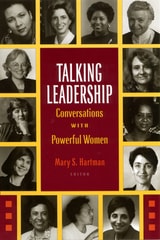
Talking Leadership
Conversations with Powerful WomenHartman, Mary
Rutgers University Press, 1999
Whether we love it, hate it, or use it just to pass the time, most adults in the United States are watching more television than ever, up to four hours a day by some estimates. Our devotion to commercial television gives it unprecedented power in our lives.
Advertisers and television executives want us to spend as much time as we can in front of our sets, for it is access to our brains that they buy and sell. Yet the most important effect of television may be one that no one intends-accelerated destruction of the natural environment.
Consuming Environments explores how, with its portrayal of a world of simulated abundance, television has nurtured a culture of consumerism and overconsumption. The average person in the US consumers more than twice the grain and ten times the oil of a citizen of Brazil or Indonesia. And people in less industrialized countries suffer while their resources while their resources are commandeered to support comfortable lifestyles in richer nations.
Using detailed examples illustrated with images from actual commercials, news broadcasts, and television shows, and authors demonstrate how ads and programs are put together in complex way s to manipulate viewers, and they offer specific ways to counteract the effects of TV and overconsumption's assault on the environment.
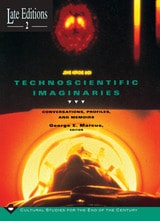
Technoscientific Imaginaries
Conversations, Profiles, and MemoirsEdited by George E. Marcus
University of Chicago Press, 1995
In these penetrating essays, twenty-four distinguished contributors from a broad range of fields present the voices of the scientists themselves—through interviews, conversations, and memoirs. We hear from Lithuanian physicists who discuss science after Communism and their own fantasies about what Western science is; a Japanese-American woman struggling with her ambivalence over designing nuclear weapons; political activists in India who examine relations among science, environmental politics, and government ideology in the aftermath of the Bhopal disaster; and many others, including biologists, physicians, corporate researchers, and scientists working with virtual reality and other cutting-edge technologies.
The contributors to this volume are Mario Biagioli, Maria E. Carson, Gary Lee Downey, Joseph Dumit, Michael M. J. Fischer, Mary-Jo DelVecchio Good, Hugh Gusterson, Diana L. L. Hill, James Holston, Herbert C. Hoover, Jr., Gudrun Klein, Leszek Koczanowicz, Irene Kuter, Kim Laughlin, Rita Linggood, George E. Marcus, Kathryn Milun, Livia Polanyi, Christopher Pound, Simon Powell, Paul Rabinow, Kathleen Stewart, Allucquere Rosanne Stone, and Sharon Traweek.
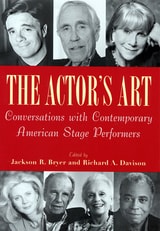
The Actor's Art
Conversations with Contemporary American Stage PerformersDavison, Richard A
Rutgers University Press, 2001
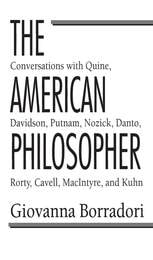
The American Philosopher
Conversations with Quine, Davidson, Putnam, Nozick, Danto, Rorty, Cavell, MacIntyre, KuhnGiovanna Borradori
University of Chicago Press, 1993
Giovanna Borradori, in her substantial introduction, explains the history of the analytic movement in America and the home-grown reaction against it. In the late nineteenth and early twentieth centuries, American philosophy was a socially engaged interdisciplinary enterprise. In transcendentalism and pragmatism, then the dominant currents in American thought, philosophy was connected to history, psychology, and public issues. But in the 1930s, the imported European movement of logical positivism redefined philosophical discourse in terms of mathematical logic and theory of language. Under the influence of this analytic view, American philosophy became a professionalized discipline, divorced from public debate and intellectual history and antagonistic to the other, more humanistic tradition of continental thought.
The American Philosopher explores the opposition between analytic and continental thought and shows how recent American work has begun to bridge the gap between the two traditions. Through a reexamination of pragmatism, and through an attempt to understand philosophy in a more hermeneutical way, the participants narrow the distance between America's distinctly scientific philosophy and Europe's more literary approach.
Moving beyond classical analytic philosophy, the participants confront each other on a number of topics. The logico-linguistic orientations of Quine and Davidson come up against the more discursive, interdisciplinary agendas of Rorty, Putnam, and Cavell. Nozick's theory of pluralist anarchism goes face-to-face with the aesthetic neo-foundationalism of Danto. And Kuhn's hypothesis of paradigm shifts is measured against MacIntyre's ethics of "virtues."
Borradori's conversations offer an unconventional portrait of the way philosophers think about their work; scholars and students will not be its only beneficiaries, so will everyone who wonders about the current state of American philosophy.
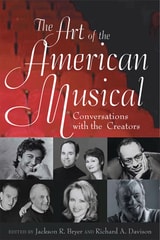
The Art of the American Musical
Conversations With the CreatorsBryer, Jackson R
Rutgers University Press, 2019
Musical theater has captivated American audiences from its early roots in burlesque stage productions and minstrel shows to the million-dollar industry it has become on Broadway today. What is it about this truly indigenous American art form that has made it so enduringly popular? How has it survived, even thrived, alongside the technology of film and the glitz and glamour of Hollywood? Will it continue to evolve and leave its mark on the twenty-first century?
Bringing together exclusive and previously unpublished interviews with nineteen leading composers, lyricists, librettists, directors, choreographers, and producers from the mid-1900s to the present, this book details the careers of the individuals who shaped this popular performance art during its most prolific period. The interviewees discuss their roles in productions ranging from On the Town (1944) and Finian's Rainbow (1947) to The Producers (2001) and Bounce (2003).
Readers are taken onto the stage, into the rehearsals, and behind the scenes. The nuts and bolts, the alchemy, and the occasional agonies of the collaborative process are all explored. In their discussions, the artists detail their engagements with other creative forces, including such major talents as Leonard Bernstein, Jerome Robbins, Bob Fosse, Liza Minnelli, Judy Garland, Barbra Streisand, Jule Styne, Richard Rodgers and Oscar Hammerstein, Alan Jay Lerner, Zero Mostel, and Gwen Verdon. They speak candidly about their own work and that of their peers, their successes and failures, the creative process, and how a show progresses from its conception through rehearsals and tryouts to opening night.
Taken together, these interviews give fresh insight into what Oscar Hammerstein called "a nightly miracle"—the creation of the American musical.

The Boy Is Gone
Conversations with a Mau Mau GeneralLaura Lee P. Huttenbach
Ohio University Press, 2015
A story with the power to change how people view the last years of colonialism in East Africa, The Boy Is Gone portrays the struggle for Kenyan independence in the words of a freedom fighter whose life spanned the twentieth century’s most dramatic transformations. Born into an impoverished farm family in the Meru Highlands, Japhlet Thambu grew up wearing goatskins and lived to stand before his community dressed for business in a pressed suit, crisp tie, and freshly polished shoes. For most of the last four decades, however, he dressed for work in the primary school classroom and on his lush tea farm.
The General, as he came to be called from his leadership of the Mau Mau uprising sixty years ago, narrates his life story in conversation with Laura Lee Huttenbach, a young American who met him while backpacking in Kenya in 2006. A gifted storyteller with a keen appreciation for language and a sense of responsibility as a repository of his people’s history, the General talks of his childhood in the voice of a young boy, his fight against the British in the voice of a soldier, and his long life in the voice of shrewd elder. While his life experiences are his alone, his story adds immeasurably to the long history of decolonization as it played out across Africa, Asia, and the Americas.
The Changing Face of Economics
Conversations with Cutting Edge EconomistsDavid Colander, Richard P. F. Holt, and J. Barkley Rosser, Jr.
University of Michigan Press, 2004
The interviews and commentary together demonstrate that economics is currently undergoing a fundamental shift in method and is moving away from traditional neoclassical economics into a dynamic set of new methods and approaches. These new approaches include work in behavioral economics, experimental economics, evolutionary game theory and ecological approaches, complexity and nonlinear dynamics, methodological analysis, and agent-based modeling.
David E. Colander is Professor of Economics, Middlebury College.
J. Barkley Rosser, Jr., is Professor of Economics and Kirby L. Kramer Jr. Professor of Business Administration, James Madison University.
Richard P. F. Holt is Professor of Churchill Honors and Economics, Southern Oregon University.
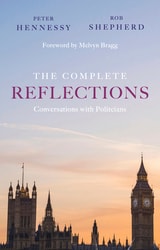
The Complete Reflections
Conversations with PoliticiansPeter Hennessy and Robert Shepherd
Haus Publishing, 2020
In The Complete Reflections, Peter Hennessy and Robert Shepherd provide not only an overview of the past three decades of British politics but also delve into the minds of those at the forefront of public life during times of great change. Hennessy’s deep knowledge and understanding of the lives and motivations of his interviewees, along with the obvious esteem in which they hold their interlocutor, leads to frank and revealing conversations in which the subject is not an object but an equal, giving these exchanges a unique veracity. The results are portraits of high authority, in which interviews become the chronicles that endure above all others—nothing less than the first draft of history.
The Historian behind the History
Conversations with Southern HistoriansMegan L. Bever
University of Alabama Press, 2014
The historians and their main topics include:
Richard J. M. Blackett on antebellum and African American history
Dan T. Carter on Reconstruction, Civil Rights, and George Wallace
Pete Daniel on the New Deal and the Cold War South
Laura F. Edwards on the Early Republic, the Civil War, Reconstruction, and women’s history
William W. Freehling on the antebellum South
Gary W. Gallagher on the Civil War
Glenda Elizabeth Gilmore on Jim Crow
James M. McPherson on the Civil War
Theodore Rosengarten on the Depression
J. Mills Thornton III on the antebellum South
In his introduction, award-winning author and historian George C. Rable draws together the multifaceted themes of these interviews, offering a compelling overview of the nature of the field. Edited by Megan L. Bever and Scott A. Suarez, The Historian behind the History offers critical insights about the craft and professional life of the historian.

The Philadelphia Connection
Conversations with PlaywrightsB. J. Burton
Intellect Books, 2015
The Playwright at Work
ConversationsRosemarie Tichler
Northwestern University Press, 2012
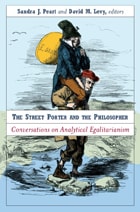
The Street Porter and the Philosopher
Conversations on Analytical EgalitarianismSandra J. Peart and David M. Levy, editors
University of Michigan Press, 2009
Adam Smith, asserting the common humanity of the street porter and the philosopher, articulated the classical economists' model of social interactions as exchanges among equals. This model had largely fallen out of favor until, recently, a number of scholars in the avant-garde of economic thought rediscovered it and rechristened it "analytical egalitarianism." In this volume, Sandra J. Peart and David M. Levy bring together an impressive array of authors to explore the ramifications of this analytical ideal and to discuss the ways in which an egalitarian theory of individuality can enable economists to reconcile ideas from opposite ends of the political spectrum.
"The analytical egalitarianism project that Peart and Levy have advanced has come to occupy a prominent place in the current agenda of historians of economic thought."
---Ross Emmett, Associate Professor of Economics and Co-Director of the Michigan Center for Innovation and Economic Prosperity, Michigan State University
"These essays and dialogs from the Summer Institute would make Adam Smith, economist and moral philosopher, proud."
---J. Daniel Hammond, Hultquist Family Professor of Economics, Wake Forest University
With essays by:
- James M. Buchanan, Alfred Nobel Memorial Prize in Economic Sciences recipient (1985) and Professor Emeritus, George Mason University and Virginia Polytechnic and State University
- Juan Pablo Couyoumdijian, Universidad del Desearrollo, Chile
- Tyler Cowen, George Mason University
- Eric Crampton, University of Canterbury, New Zealand
- Andrew Farrant, Dickinson College
- Samuel Hollander, Professor Emeritus, University of Toronto
- M. Ali Khan, Johns Hopkins University
- Thomas Leonard, Princeton University
- Deirdre McCloskey, University of Illinois, Chicago
- Leonidas Montes, Dean of School of Government, Universidad Adolfo Ibañez, Chile
- Maria Pia Paganelli, Yeshiva University and New York University
- Warren J. Samuels, Professor Emeritus, Michigan State University
- Eric Schliesser, VENI post-doctoral research fellow, Leiden University, and University of Amsterdam
- Gordon Tullock, George Mason University
Sandra J. Peart is Dean of the Jepson School of Leadership Studies, University of Richmond, Virginia.
David M. Levy is Professor of Economics at George Mason University (GMU) and Research Associate at the Center for Study of Public Choice at GMU.
They are Co-Directors of George Mason University's Summer Institute for the Preservation of the History of Economics.
The Telling Distance
Conversations with the American DesertBruce Berger
University of Arizona Press, 1990
The Wise Body
Conversations with Experienced DancersJacky Lansley and Fergus Early
Intellect Books, 2011