Results by title
158 books match the query 'Cultural assimilation' and 18 start with t
The American Dream in Vietnamese
Nhi T. Lieu
University of Minnesota Press, 2010
Lieu examines how live music variety shows and videos, beauty pageants, and Web sites created by and for Vietnamese Americans contributed to the shaping of their cultural identity. She shows how popular culture forms repositories for conflicting expectations of assimilation, cultural preservation, and invention, alongside gendered and classed dimensions of ethnic and diasporic identity.
The American Dream in Vietnamese demonstrates how the circulation of images manufactured by both Americans and Vietnamese immigrants serves to produce these immigrants’ paradoxical desires. Within these desires and their representations, Lieu finds the dramatization of the community’s struggle to define itself against the legacy of the refugee label, a classification that continues to pathologize their experiences in American society.

The Angel and Beehive
THE MORMON STRUGGLE WITH ASSIMILATIONArmand L. Mauss
University of Illinois Press, 1994
This retrenchment among Mormons is the main theme of Mauss's book, which analyzes the last forty years of Mormon history from a sociological perspective. At the official ecclesiastical level, Mauss finds, the retrenchment can be seen in the greatly increased centralization of bureaucratic control and in renewed emphases on obedience to modern prophets, on genealogy and vicarious temple work, and on traditional family life; retrenchment is also apparent in extensive formal religious indoctrination by full-time professionals and in increased sophistication and intensity of proselytizing.
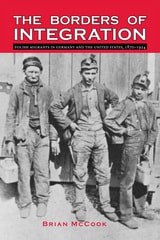
The Borders of Integration
Polish Migrants in Germany and the United States, 1870–1924Brian McCook
Ohio University Press, 2011
The issues of immigration and integration are at the forefront of contemporary politics. Yet debates over foreign workers and the desirability of their incorporation into European and American societies too often are discussed without a sense of history. McCook’s examination questions static assumptions about race and white immigrant assimilation a hundred years ago, highlighting how the Polish immigrant experience is relevant to present-day immigration debates on both sides of the Atlantic. Further, his research shows the complexity of attitudes toward immigration in Germany and the United States, challenging historical myths surrounding German national identity and the American “melting pot.”
In a comparative study of Polish migrants who settled in the Ruhr Valley and northeastern Pennsylvania, McCook shows that in both regions, Poles become active citizens within their host societies through engagement in social conflict within the public sphere to defend their ethnic, class, gender, and religious interests. While adapting to the Ruhr and northeastern Pennsylvania, Poles simultaneously retained strong bonds with Poland, through remittances, the exchange of letters, newspapers, and frequent return migration. In this analysis of migration in a globalizing world, McCook highlights the multifaceted ways in which immigrants integrate into society, focusing in particular on how Poles created and utilized transnational spaces to mobilize and attain authentic and more permanent identities grounded in newer broadly conceived notions of citizenship.
The Changing Face of World Cities
Young Adult Children of Immigrants in Europe and the United StatesMaurice Crul
Russell Sage Foundation, 2013
The Creation of an Ethnic Identity
Being Swedish American in the Augustana Synod, 1860-1917Dag Blanck
Southern Illinois University Press, 2006
Analyzing the development of a Swedish American identity
The Creation of an Ethnic Identity: Being Swedish American in the Augustana Synod, 1860–1917 analyzes how Swedish American identity was constructed, maintained, and changed in the late nineteenth and early twentieth centuries. The Augustana Synod, the largest religious-based organization created by Swedish immigrants in the United States, played an important role in establishing what it meant to be Swedish American.
In this study, author Dag Blanck poses three fundamental questions: How did an ethnic identity develop in the Augustana Synod? What was that identity? Why was an ethnic identity formed? Based on primary sources formerly unknown or neglected, The Creation of an Ethnic Identity examines the Lutheran Augustana Synod, Augustana College, and the Augustana Book Concern to provide insights into how ethnic identity is constructed within a major religious body, a central educational institution, and a major publishing house.
Starting from the concept of ethnicity as something created or invented, Blanck goes on to explore how it was possible for a white European immigrant group like the Swedes to use its ethnicity as a tool of integration into American society. The nature of their ethnicity, says Blanck, was both determined by their cultural origins and also the values and nature of American society as they perceived it. Becoming Swedish American was also a way of becoming American.
The volume, which is augmented by illustrations, integrates the most critical scholarship on immigration and ethnicity over the past half century and provides a strong argument about how ethnicity is shaped over time within an immigrant group.

The Exile Mission
The Polish Political Diaspora and Polish Americans, 1939–1956Anna D. Jaroszynska-Kirchmann
Ohio University Press, 2009
At midcentury, two distinct Polish immigrant groups—those Polish Americans who were descendants of economic immigrants from the turn of the twentieth century and the Polish political refugees who chose exile after World War II and the communist takeover in Poland—faced an uneasy challenge to reconcile their concepts of responsibility toward the homeland.
The new arrivals did not consider themselves simply as immigrants, but rather as members of the special category of political refugees. They defined their identity within the framework of the exile mission, an unwritten set of beliefs, goals, and responsibilities, placing patriotic work for Poland at the center of Polish immigrant duties.
In The Exile Mission, an intriguing look at the interplay between the established Polish community and the refugee community, Anna Jaroszyńska–Kirchmann presents a tale of Polish Americans and Polish refugees who, like postwar Polish exile communities all over the world, worked out their own ways to implement the mission’s main goals. Between the outbreak of World War II and 1956, as Professor Jaroszyńska–Kirchmann demonstrates, the exile mission in its most intense form remained at the core of relationships between these two groups.
The Exile Mission is a compelling analysis of the vigorous debate about ethnic identity and immigrant responsibility toward the homeland. It is the first full–length examination of the construction and impact of the exile mission on the interactions between political refugees and established ethnic communities.
The Great Confusion in Indian Affairs
Native Americans and Whites in the Progressive EraBy Tom Holm
University of Texas Press, 2005
The United States government thought it could make Indians "vanish." After the Indian Wars ended in the 1880s, the government gave allotments of land to individual Native Americans in order to turn them into farmers and sent their children to boarding schools for indoctrination into the English language, Christianity, and the ways of white people. Federal officials believed that these policies would assimilate Native Americans into white society within a generation or two. But even after decades of governmental efforts to obliterate Indian culture, Native Americans refused to vanish into the mainstream, and tribal identities remained intact.
This revisionist history reveals how Native Americans' sense of identity and "peoplehood" helped them resist and eventually defeat the U.S. government's attempts to assimilate them into white society during the Progressive Era (1890s-1920s). Tom Holm discusses how Native Americans, though effectively colonial subjects without political power, nonetheless maintained their group identity through their native languages, religious practices, works of art, and sense of homeland and sacred history. He also describes how Euro-Americans became increasingly fascinated by and supportive of Native American culture, spirituality, and environmental consciousness. In the face of such Native resiliency and non-Native advocacy, the government's assimilation policy became irrelevant and inevitably collapsed. The great confusion in Indian affairs during the Progressive Era, Holm concludes, ultimately paved the way for Native American tribes to be recognized as nations with certain sovereign rights.
The Great Disappearing Act
Germans in New York City, 1880-1930Christina A. Ziegler-McPherson
Rutgers University Press, 2022
This study examines these questions in relation to the German immigrant community in New York City between 1880-1930, and seeks to understand how German-American New Yorkers assimilated into the larger American society in the early twentieth century.
By the turn of the twentieth century, New York City was one of the largest German-speaking cities in the world and was home to the largest German community in the United States. This community was socio-economically diverse and increasingly geographically dispersed, as upwardly mobile second and third generation German Americans began moving out of the Lower East Side, the location of America’s first Kleindeutschland (Little Germany), uptown to Yorkville and other neighborhoods. New York’s German American community was already in transition, geographically, socio-economically, and culturally, when the anti-German/One Hundred Percent Americanism of World War I erupted in 1917.
This book examines the structure of New York City’s German community in terms of its maturity, geographic dispersal from the Lower East Side to other neighborhoods, and its ultimate assimilation to the point of invisibility in the 1920s. It argues that when confronted with the anti-German feelings of World War I, German immigrants and German Americans hid their culture – especially their language and their institutions – behind closed doors and sought to make themselves invisible while still existing as a German community.
But becoming invisible did not mean being absorbed into an Anglo-American English-speaking culture and society. Instead, German Americans adopted visible behaviors of a new, more pluralistic American culture that they themselves had helped to create, although by no means dominated. Just as the meaning of “German” changed in this period, so did the meaning of “American” change as well, due to nearly 100 years of German immigration.
The Heartland of U.S. Empire
Race, Region, and the Queer Filipinx MidwestThomas Xavier Sarmiento
Temple University Press, 2026
Examining Filipinx cultural representations in the Midwest since the early twentieth century, Thomas Sarmiento shrewdly considers the impact of American exceptionalism and U.S. imperialism in a region where white, middle class, heterosexual, and Christian is the norm. The Heartland of U.S. Empire offers a cogent analysis of the 1904 St. Louis World’s Fair and its infamous Philippine Exhibit alongside minor museum displays and archives of Midwesterners in the Philippines. Sarmiento also considers the “exile literature” of Filipino/American writer Bienvenido Santos as well as the TV shows Glee and Superstore, which provide mainstream visibility of the queer Filipinx Midwest.
He employs a queer, decolonial Filipinx methodology that traces how narratives of America’s heartland position Filipinxs in the region as nonnormative due to their racial, gender, sexual, and national statuses. The Heartland of U.S. Empire locates queer Filipinxs in the geographic center of the nation and at the center of cultural narratives, thereby mapping alternative images of diasporic Filipinx identity and experience alongside U.S. regional and national identities, histories, and realities.
In the series Asian American History and Culture
The Immigrant Kitchen
Food, Ethnicity, and DiasporaVivian Nun Halloran
The Ohio State University Press, 2016
The Immigrant Kitchen describes how these memoirs function as a complex and engaging mass media genre that caters to multiple reading constituencies. Specifically, they entertain readers with personal anecdotes and recollections, teach new culinary skills through recipes, share insight into different cultural mores through ethnographic and reportorial discussions of life in other countries, and attest to the impact that an individual’s legal immigration into the United States continues to have down through the generations of his or her American-born families.

The Invisible Jewish Budapest
Metropolitan Culture at the Fin de SiècleMary Gluck
University of Wisconsin Press, 2019
Famed for its cosmopolitan culture and vibrant nightlife, Budapest owed much to its Jewish population. Indeed, it was Jews who helped shape the city's complex urban modernity between 1867 and 1914. Yet these contributions were often unacknowledged, leading to a metaphoric, if not literal, invisible status for many of Budapest's Jews.
In the years since, particularly between the wars, anti-Semites within and outside Budapest sought to further erase Jewish influences in the city. Appellations such as the "sinful city" and "Judapest" left a toxic inheritance that often inhibited serious conversation or scholarly research on the subject.
Into this breach strides Mary Gluck, whose goal is no less than to retrieve the lost contours of Jewish Budapest. She delves into the popular culture of the city's coffee houses, music halls, and humor magazines to uncover the enormous influence of assimilated Jews in creating modernist Budapest. She explores the paradox of this culture, which was Jewish-identified yet lacked a recognizable Jewish face. Because much of the Jewish population embraced and promoted a secular, metropolitan culture, their influence as Jews was both profound and invisible.
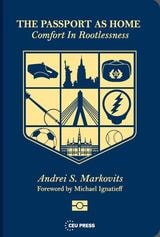
The Passport as Home
Comfort in RootlessnessAndrei S. Markovits
Central European University Press, 2021
A Scholar's Quest for Home and Identity
Experience the remarkable story of a Romanian-born, Hungarian-speaking Jewish professor. From Vienna to Columbia and Harvard, he navigates a life marked by rootlessness, seeking comfort and purpose. His journey unfolds against the backdrop of five decades, two continents, and significant political and cultural changes.
As we follow his pursuit of a home, we gain insight into the critical developments of post-1945 Europe and America. Markovits's emigration experiences, first from Romania to Vienna and later from Vienna to New York, shed light on the challenges he faced.
His journey offers a panoramic view of the forces shaping the latter half of the 20th century. Despite America's flaws, he finds it a beacon of academic excellence, intellectual openness, cultural diversity, and religious tolerance—qualities that Europe lacked.
Explore the complexities of identity, culture, and the universal search for belonging in this captivating narrative.

The Polish Hearst
Ameryka-Echo and the Public Role of the Immigrant PressAnna D. Jaroszynska-Kirchmann
University of Illinois Press, 2015
Anna D. Jaroszyńska-Kirchmann mines seven decades' worth of thoughts expressed by Ameryka-Echo readers to chronicle the ethnic press's role in the immigrant experience. Open and unedited debate harkened back to homegrown journalistic traditions, and Jaroszyńska-Kirchmann opens up the nuances of an editorial philosophy that cultivated readers as content creators. As she shows, ethnic publications in the process forged immigrant social networks and pushed notions of education and self-improvement throughout Polonia. Paryski, meanwhile, built a publishing empire that earned him the nickname ""The Polish Hearst.""
Detailed and incisive, The Polish Hearst opens the door on the long-overlooked world of ethnic publishing and the amazing life of one of its towering figures.
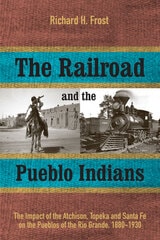
The Railroad and the Pueblo Indians
The Impact of the Atchison, Topeka and Santa Fe on the Pueblos of the Rio Grande, 1880-1930Richard H. Frost
University of Utah Press, 2015
The Pueblo communities responded variously, though mostly conservatively to sustain their traditional communities. This book spotlights two very different responses. Santo Domingo's reaction was hostile, but Laguna chose accommodation. These reactions reveal previously overlooked aspects of these pueblos’ histories that provide compelling reasons behind their varying responses. The book also analyzes the self-contradictory nature of Pueblo constitutional law from 1876 to 1913 and describes conflicted Bureau of Indian Affairs treatment of the Pueblos in the late nineteenth and early twentieth centuries. Each in turn had fateful consequences.
The Struggle for Inclusion
Muslim Minorities and the Democratic EthosElisabeth Ivarsflaten and Paul M. Sniderman
University of Chicago Press, 2022
Notwithstanding the turbulence and violence of the last decade over issues of immigration and of Muslims in the West, the results of this study demonstrate that the largest number of citizens in contemporary liberal democracies are more open to inclusion of Muslims than has been recognized. Not less important, the book reveals limits on inclusion that follow from the friction between liberal democratic values. This pioneering work thus brings to light both pathways to progress and polarization traps.
To Die in this Way
Nicaraguan Indians and the Myth of Mestizaje, 1880-1965Jeffrey L. Gould
Duke University Press, 1998
Through interviews with indigenous peoples and records of the elite discourse that suppressed the expression of cultural differences and rationalized the destruction of Indian communities, Gould tells a story of cultural loss. Land expropriation and coerced labor led to cultural alienation that shamed the indigenous population into shedding their language, religion, and dress. Beginning with the 1870s, Gould historicizes the forces that prompted a collective movement away from a strong identification with indigenous cultural heritage to an “acceptance” of a national mixed-race identity.
By recovering a significant part of Nicaraguan history that has been excised from the national memory, To Die in This Way critiques the enterprise of third world nation-building and thus marks an important step in the study of Latin American culture and history that will also interest anthropologists and students of social and cultural historians.
Transnational Construction of Mayanness
Reading Modern Mesoamerica through US ArchivesFernando Armstrong-Fumero
University Press of Colorado, 2023
Contributors tap documentary, ethnographic, and ethnoarchaeological sources from North America to expand established categories of fieldwork and archival research conducted within the national spaces of Mexico and Central America. A particularly rich and diverse set of case studies interrogate the historical processes that remove sources from their place of production in the “field” to the US, challenge the conventional wisdom regarding the geography of data sources that are available for research, and reveal a range of historical relationships that enabled US actors to shape the historical experience of Maya-speaking peoples.
The Transnational Construction of Mayanness offers rich insight into transnational relations and suggests new avenues of research that incorporate an expanded corpus of materials that embody the deep-seated relationship between Maya-speaking peoples and various gringo interlocutors. The work is an important bridge between Mayanist anthropology and historiography and broader literatures in American, Atlantic, and Indigenous studies.
Contributors: David Carey, M. Bianet Castellanos, Matilde Córdoba Azcárate, Lydia Crafts, John Gust, Julio Cesar Hoil Gutierréz, Jennifer Mathews, Matthew Watson

Turkish Berlin
Integration Policy and Urban SpaceAnnika Marlen Hinze
University of Minnesota Press, 2013
The integration of immigrants into a larger society begins at the local level. Turkish Berlin reveals how integration has been experienced by second-generation Turkish immigrant women in two neighborhoods in Berlin, Germany. While the neighborhoods are similar demographically, the lived experience of the residents is surprisingly different.
Informed by first-person interviews with both public officials and immigrants, Annika Marlen Hinze makes clear that local integration policies—often created by officials who have little or no contact with immigrants—have significant effects on the assimilation of outsiders into a community and a society. Focusing on the Turkish neighborhoods of Kreuzberg and Neukölln, Hinze shows how a combination of local policy making and grassroots organizing have contributed to one neighborhood earning a reputation as a hip, multicultural success story and the other as a rougher neighborhood featuring problem schools and high rates of unemployment. Aided by her interviews, she describes how policy makers draw from their imaginations of urban space, immigrants, and integration to develop policies that do not always take social realities into consideration. She offers useful examples of how official policies can actually exacerbate the problems they are trying to help solve and demonstrates that a powerful history of grassroots organizing and resistance can have an equally strong impact on political outcomes.
Employing spatial theory as a tool for understanding the complex processes of integration, Hinze asks two related questions: How do immigrants perceive themselves and their experiences in a new culture? And how are immigrants conceived of by politicians and policy makers? Although her research highlights the German–Turk experience in Berlin, her answers have implications that resonate far beyond the city’s limits.