Results by title
65 books match the query 'Difference' and 16 start with t

Tactical Inclusion
Difference and Vulnerability in U.S. Military AdvertisingJeremiah Favara
University of Illinois Press, 2024
Compelling and eye-opening, Tactical Inclusion combines original analysis with personal experience to chart advertising’s role in building the all-volunteer military.
Talking about Race
Community Dialogues and the Politics of DifferenceKatherine Cramer Walsh
University of Chicago Press, 2007
It is a perennial question: how should Americans deal with racial and ethnic diversity? More than 400 communities across the country have attempted to answer it by organizing discussions among diverse volunteers in an attempt to improve race relations. In Talking about Race, Katherine Cramer Walsh takes an eye-opening look at this strategy to reveal the reasons behind the method and the effects it has in the cities and towns that undertake it.
With extensive observations of community dialogues, interviews with the discussants, and sophisticated analysis of national data, Walsh shows that while meeting organizers usually aim to establish common ground, participants tend to leave their discussions with a heightened awareness of differences in perspective and experience. Drawing readers into these intense conversations between ordinary Americans working to deal with diversity and figure out the meaning of citizenship in our society, she challenges many preconceptions about intergroup relations and organized public talk. Finally disputing the conventional wisdom that unity is the only way forward, Walsh prescribes a practical politics of difference that compels us to reassess the place of face-to-face discussion in civic life and the critical role of conflict in deliberative democracy.

Territories of Difference
Place, Movements, Life, RedesArturo Escobar
Duke University Press, 2008
Escobar illuminates many interrelated dynamics, including the Colombian government’s policies of development and pluralism that created conditions for the emergence of black and indigenous social movements and those movements’ efforts to steer the region in particular directions. He examines attempts by capitalists to appropriate the rainforest and extract resources, by developers to set the region on the path of modernist progress, and by biologists and others to defend this incredibly rich biodiversity “hot-spot” from the most predatory activities of capitalists and developers. He also looks at the attempts of academics, activists, and intellectuals to understand all of these complicated processes. Territories of Difference is Escobar’s effort to think with Afro-Colombian intellectual-activists who aim to move beyond the limits of Eurocentric paradigms as they confront the ravages of neoliberal globalization and seek to defend their place-based cultures and territories.

The Cinema Makers
Public Life and the Exhibition of Difference in South-Eastern and Central Europe since the 1960sAnna Schober
Intellect Books, 2013
The Cinema Makers investigates how cinema spectators in southeastern and central European cities became cinema makers through such practices as squatting in existing cinema spaces, organizing cinema "events," writing about film, and making films themselves. Drawing on a corpus of interviews with cinema activists in Germany, Austria, and the former Yugoslavia, Anna Schober compares the activities and artistic productions they staged in cities such as Vienna, Cologne, Munich, Berlin, Hamburg, Ljubljana, Belgrade, Novi Sad, Subotica, Zagreb, and Sarajevo. The resulting study illuminates the differences and similarities in the development of political culture—and cinema’s role in that development—in European countries with pluralist-democratic, one-party socialist, and post-socialist traditions.
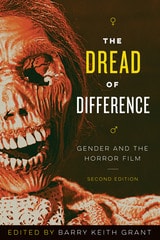
The Dread of Difference
Gender and the Horror FilmEdited by Barry Keith Grant
University of Texas Press, 2015
“The Dread of Difference is a classic. Few film studies texts have been so widely read and so influential. It’s rarely on the shelf at my university library, so continuously does it circulate. Now this new edition expands the already comprehensive coverage of gender in the horror film with new essays on recent developments such as the Hostel series and torture porn. Informative and enlightening, this updated classic is an essential reference for fans and students of horror movies.”—Stephen Prince, editor of The Horror Film and author of Digital Visual Effects in Cinema: The Seduction of Reality
“An impressive array of distinguished scholars . . . gazes deeply into the darkness and then forms a Dionysian chorus reaffirming that sexuality and the monstrous are indeed mated in many horror films.”—Choice
“An extremely useful introduction to recent thinking about gender issues within this genre.”—Film Theory
The Exhaustion of Difference
The Politics of Latin American Cultural StudiesAlberto Moreiras
Duke University Press, 2001
What, asks Moreiras, is the function of critical reason in the present moment? What is regionalistic knowledge in the face of globalization? Can regionalistic knowledge be an effective tool for a critique of contemporary reason? What is the specificity of Latin Americanist reflection and how is it situated to deal with these questions? Through examinations of critical regionalism, restitutional excess, the historical genealogy of Latin American subalternism, testimonio literature, and the cultural politics of magical realism, Moreiras argues that while cultural studies is increasingly institutionalized and in danger of reproducing the dominant ideologies of late capitalism, it is also ripe for giving way to projects of theoretical reformulation. Ultimately, he claims, critical reason must abandon its allegiance to aesthetic-historicist projects and the destructive binaries upon which all cultural theories of modernity have been constructed.
The Exhaustion of Difference makes a significant contribution to the rethinking of Latin American cultural studies.
The OLD STORY, WITH A DIFFERENCE
Pickwick’s VisionJulian Wolfreys
The Ohio State University Press, 2006
The Old Story, with a Difference: Pickwick’s Vision explores in radically different ways from most approaches to nineteenth-century studies the tropes and metaphors of vision in Dickens’ first novel, The Pickwick Papers. Julian Wolfreys provides a close reading of Dickens’ Pickwick Papers and argues that this novel is an exemplary text for the re-consideration of concepts such as literature, history, the novel, and the whole notion of Victorian studies. True to the purpose of the Victorian Critical Interventions Series, Wolfreys challenges scholars to rethink the use of a canonical text in Victorian literature.
Challenging the commonplaces of historicist criticism, and demonstrating the need for a return to close reading, The Old Story, with a Difference presents a reading of the novel grounded in the twinned rigors of materialist historiography and theoretical inflections tending toward attentiveness to epistemological and linguistic concerns. Through such an orientation, Wolfreys unpacks the relation between the tropes of visuality and matters of memory, history, and the necessity of fiction to bear witness to the cultures, past and present, from which literature becomes generated and which it mediates. In doing so, he situates an argument for rethinking Dickens’ novel as the inaugural novel of Victorian fiction par excellence, in that novel’s efforts to remain open to the traces of the past in particular ways.
The Old Story, with a Difference holds profound implications for the study not only of Dickens’ works but Victorian literature and culture in general. Provocative and inventive, this ambitious analysis will challenge, goad, and invite the reader to return to acts of materialist reading informed by ethical and ideological urgency, rather than relapsing into the commonplaces of humanist cliché.
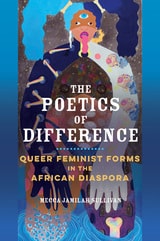
The Poetics of Difference
Queer Feminist Forms in the African DiasporaMecca Jamilah Sullivan
University of Illinois Press, 2021
From Audre Lorde, Ntozake Shange, and Bessie Head, to Zanele Muholi, Suzan-Lori Parks, and Missy Elliott, Black women writers and artists across the African Diaspora have developed nuanced and complex creative forms. Mecca Jamilah Sullivan ventures into the unexplored spaces of black women’s queer creative theorizing to learn its languages and read the textures of its forms. Moving beyond fixed notions, Sullivan points to a space of queer imagination where black women invent new languages, spaces, and genres to speak the many names of difference. Black women’s literary cultures have long theorized the complexities surrounding nation and class, the indeterminacy of gender and race, and the multiple meanings of sexuality. Yet their ideas and work remain obscure in the face of indifference from Western scholarship.
Innovative and timely, The Poetics of Difference illuminates understudied queer contours of black women’s writing.
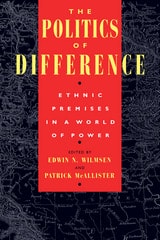
The Politics of Difference
Ethnic Premises in a World of PowerEdited by Edwin N. Wilmsen and Patrick McAllister
University of Chicago Press, 1996
This volume examines cases ranging from the well-publicized ethnonationalism of Bosnia and post-Apartheid South Africa to ethnic conflicts in Belgium and Sri Lanka. Distinguished international scholars including John Comaroff, Stanley J. Tambiah, and Ernesto Laclau argue that continued acceptance of imposed ethnic terms as the most appropriate vehicle for collective self-identification and social action legitimizes the conditions of inequality that give rise to them in the first place.
This ambitious attempt to explain the inadequacies of current approaches to power and ethnicity forges more realistic alternatives to the volatile realities of social difference.
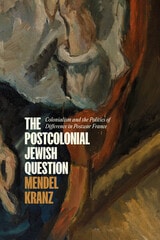
The Postcolonial Jewish Question
Colonialism and the Politics of Difference in Postwar FranceMendel Kranz
University of Chicago Press, 2026
A history of how decolonization shaped Jewish political identity in late-twentieth-century France.
In The Postcolonial Jewish Question, Mendel Kranz shows how France’s colonial history fundamentally shaped contemporary debates among Jews in France about racism, discrimination, and minority politics during the late twentieth century. As the wider country confronted the legacies of the Holocaust and the decline of its colonial empire, Jewish thinkers questioned the boundaries of their own political identity and challenged prevailing paradigms of Western universalism. This book traces how prominent and lesser-known thinkers—including Albert Memmi, Emmanuel Levinas, Alain Finkielkraut, and Wladimir Rabi—as well as organizations like the Colloque des intellectuels juifs de langue française engaged with issues of oppression, nationhood, and communal identity, and the ways that colonialism and its afterlives shaped those discussions. Kranz reveals how the Jewish question itself changed shape through confrontations with postcolonial politics. In doing so, he calls for a reassessment of the parameters of the Jewish question amid colonialism’s enduring legacies in the present.

The Right to Difference
French Universalism and the JewsMaurice Samuels
University of Chicago Press, 2016
Samuels demonstrates that Jewish difference has always been essential to the elaboration of French universalism, whether as its foil or as proof of its reach. He traces the development of this discourse through key moments in French history, from debates over granting Jews civil rights during the Revolution, through the Dreyfus Affair and Vichy, and up to the rise of a “new antisemitism” in recent years. By recovering the forgotten history of a more open, pluralistic form of French universalism, Samuels points toward new ways of moving beyond current ethnic and religious dilemmas and argues for a more inclusive view of what constitutes political discourse in France.
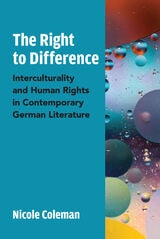
The Right to Difference
Interculturality and Human Rights in Contemporary German LiteratureNicole Coleman
University of Michigan Press, 2021
The Right to Difference examines novels that depict human rights violations in order to explore causes of intergroup violence within diverse societies, using Germany as a test case. In these texts, the book shows that an exaggeration of difference between minority and majority groups leads to violence. Germany has become increasingly diverse over the past decades due to skilled labor migration and refugee movements. In light of this diversity, this book’s approach transcends a divide between migrant and post-migrant German literature on the one hand and a national literature on the other hand. Addressing competing definitions of national identity as well as the contest between cultural homogeneity and diversity, the author redefines the term “intercultural literature.” It becomes not a synonym for authors who do not belong to a national literature, such as migrant writers, but a way of reading literature with an intercultural lens.
This book builds a theory of intercultural literature that focuses on the multifaceted nature of identity, in which ethnicity represents only one of many characteristics defining individuals. To develop intercultural competence, one needs to adopt a complex image of individuals that allows for commonalities and differences by complicating the notion of sharp contrasts between groups. Revealing the affective allegiances formed around other characteristics (gender, profession, personal motivations, relationships, and more) allows for similarities that grouping into large, homogeneous, and seemingly exclusive entities conceals. Eight novels analyzed in this book remember and reveal human rights violations, such as genocide, internment and torture, violent expulsion, the reasons for fleeing a country, dangerous flight routes and the difficulty of settling in a new country. Some of these novels allow for affective identification with diverse characters and cast the protagonists as individuals with plural perspectives and identities rather than monolithic members of one large national or ethnic group, whereas others emphasize the commonalities of all people.
Ultimately, the author makes the case for German Studies to contribute to an antiracist approach to diversity by redefining what it means to be German and establishing difference as a fundamental human right.
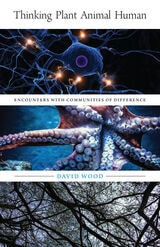
Thinking Plant Animal Human
Encounters with Communities of DifferenceDavid Wood
University of Minnesota Press, 2020
Collected essays by a leading philosopher situating the question of the animal in the broader context of a relational ontology
There is a revolution under way in our thinking about animals and, indeed, life in general, particularly in the West. The very words man, animal, and life have turned into flimsy conceptual husks—impediments to thinking about the issues in which they are embroiled. David Wood was a founding member of the early 1970s Oxford Group of philosophers promoting animal rights; he also directed Ecology Action (UK). Thinking Plant Animal Human is the first collection of this major philosopher’s influential essays on “animals,” bringing together his many discussions of nonhuman life, including the classic “Thinking with Cats.”
Exploring our connections with cats, goats, and sand crabs, Thinking Plant Animal Human introduces the idea of “kinnibalism” (the eating of mammals is eating our own kin), reflects on the idea of homo sapiens, and explores the place of animals both in art and in children’s stories. Finally, and with a special focus on trees, the book delves into remarkable contemporary efforts to rescue plants from philosophical neglect and to rethink and reevaluate their status. Repeatedly bubbling to the surface is the remarkable strangeness of other forms of life, a strangeness that extends to the human.
Wood shows that the best way of resisting simplistic classification is to attend to our manifold relationships with other living beings. It is not anthropocentric to focus on such relationships; they cast light in complex ways on the living communities of which we are part, and exploring them recoils profoundly on our understanding of ourselves.
Toni Morrison
PLAYING WITH DIFFERENCELucille P. Fultz
University of Illinois Press, 2003
Transformative Political Leadership
Making a Difference in the Developing WorldRobert I. Rotberg
University of Chicago Press, 2012
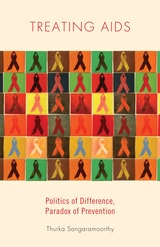
Treating AIDS
Politics of Difference, Paradox of PreventionSangaramoorthy, Thurka
Rutgers University Press, 2014
Sangaramoorthy documents in detail the work of AIDS prevention programs and their effect on the health and well-being of Haitians, a transnational community long plagued by the stigma of being stereotyped in public discourse as disease carriers. By tracing the ways in which public knowledge of AIDS prevention science circulates from sites of surveillance and regulation, to various clinics and hospitals, to the social worlds embraced by this immigrant community, she ultimately demonstrates the ways in which AIDS prevention programs help to reinforce categories of individual and collective difference, and how they continue to sustain the persistent and pernicious idea of race and ethnicity as risk factors for the disease.