Results by title
374 books match the query 'Economic History' and 111 start with t
Tax Haven Ireland
Brian O’ Boyle
Pluto Press, 2021
Tax Haven Ireland uncovers the central players in this process and exposes the coverups employed by the Irish state, with the help of accountants, lawyers, and financial services companies. From the lucrative internet porn industry to corruption in the property market, this issue distorts the economy across the state and in the wider international system, and its history runs deep, going back the country’s origins as a British colonial outpost.
Today, in the wake of Brexit and in the shadow of yet another economic crash, what can be done to prevent such dangerous behaviour and reorganize our economies to invest in the people? Can Ireland – and all of us – build an alternative economy based on fairness and democratic values?
Technology and the Resilience of Metropolitan Regions
Edited by Michael E. Pagano
University of Illinois Press, 2015
In this new collection, Michael A. Pagano curates engagement with such questions by public intellectuals, stakeholders, academics, policy analysts, and citizens. Each essay explores issues related to the impact and opportunities technology provides in government and citizenship, health care, workforce development, service delivery to citizens, and metropolitan growth. As the authors show, rapidly emerging technologies and access to such technologies shape the ways people and institutions interact in the public sphere and private marketplace. The direction of metropolitan growth and development, in turn, depends on access to appropriate technology scaled and informed by the individual, household, and community needs of the region.
Contributors include Randy Blankenhorn, Bénédicte Callan, Jane Fountain, Sandee Kastrul, Karen Mossberger, Dan O'Neil, Michelle Russell, Alfred Tatum, Stephanie Truchan, Darrel West, and Howard Wial.
Technology, Productivity, and Economic Growth
Edited by Susanto Basu, Lucy Eldridge, John Haltiwanger, and Erich Strassner
University of Chicago Press, 2025
A wide-reaching exploration of how technological advancements influence and shape productivity and economic growth.
Current technological developments in several industries, such as the rise of artificial intelligence and innovations associated with the green energy transition, are likely to have significant and wide-ranging effects. This volume explores the implications of rapid changes in advanced technology and considers how to conceptualize and model these advances and improve measures of productivity and economic growth. The study of these issues is facilitated both by new methods for using and integrating disparate data sources and by the availability of new data sources. The chapters in this volume leverage these developments to offer fresh insights into long-standing issues in productivity analysis and technological change.
The Age of Economic Measurement
2001 Supplement, Volume 33Judy Klein and Mary S. Morgan
Duke University Press, 0
The Agrarian Dispute
The Expropriation of American-Owned Rural Land in Postrevolutionary MexicoJohn J. Dwyer
Duke University Press, 2008
Dwyer weaves together elite and subaltern history and highlights the intricate relationship between domestic and international affairs. Through detailed studies of land redistribution in Baja California and Sonora, he demonstrates that peasant agency influenced the local application of Cárdenas’s agrarian reform program, his regional state-building projects, and his relations with the United States. Dwyer draws on a broad array of official, popular, and corporate sources to illuminate the motives of those who contributed to the agrarian dispute, including landless fieldworkers, indigenous groups, small landowners, multinational corporations, labor leaders, state-level officials, federal policymakers, and diplomats. Taking all of them into account, Dwyer explores the circumstances that spurred agrarista mobilization, the rationale behind Cárdenas’s rural policies, the Roosevelt administration’s reaction to the loss of American-owned land, and the diplomatic tactics employed by Mexican officials to resolve the international conflict.

The Bank War
Andrew Jackson, Nicholas Biddle, and the Fight for American FinancePaul Kahan
Westholme Publishing, 2022
Late one night in July 1832,Martin Van Buren rushed to the White House where he found an ailing President Andrew Jackson weakened but resolute. Thundering against his political antagonists, Jackson bellowed: “The Bank, Mr. Van Buren, is trying to kill me, but I shall kill it!”With those famous words, Jackson formally declared “war” against the Second Bank of the United States and its president Nicholas Biddle. The Bank of the United States, which held the majority of Federal monies, had been established as a means of centralizing and stabilizing American currency and the economy, particularly during the country’s vulnerable early years. Jackson and his allies viewed the bank as both elitist and a threat to states’ rights. Throughout his first term, Jackson had attacked the bank viciously but failed to take action against the institution. Congress’ decision to recharter the bank forced Jackson to either make good on his rhetoric and veto the recharter or sign the recharter bill and be condemned as a hypocrite.
In The Bank War: Andrew Jackson, Nicholas Biddle, and the Fight for American Finance, historian Paul Kahan explores one of the most important and dramatic events in American political and economic history, from the idea of centralized banking and the First Bank of the United States to Jackson’s triumph, the era of “free banking,” and the creation of the Federal Reserve System. Relying on a range of primary and secondary source material, the book also shows how the Bank War was a manifestation of the debates that were sparked at the Constitutional Convention—the role of the executive branch and the role of the federal government in American society—debates that endure to this day as philosophical differences that often divide the United States.

The Barbaric Counter Revolution
Cause and CureBy W. W. Rostow
University of Texas Press, 1983
In the 1980s, troubled Americans saw interest rates in the United States climb to an alltime high, unemployment grow to over 10 percent, the federal deficit reach near monumental proportions, and the world economy as a whole fall stagnant.
Why did a once booming world economy give way to stagflation? Economist W. W. Rostow finds the roots of the problem in the phenomenon he terms the Barbaric Counter-Revolution—the effort to wring inflation out of the economic system by the rigorous application of a restricted rate of increase in the money supply. This policy was launched by the Carter administration in October 1979, reinforced by President Reagan in mid 1980, and abandoned in August 1982. In the end, it provided the United States with no mechanism for rapid recovery that did not bring with it a return to high interest rates, resumed inflation, and, soon, another recession.
In what he terms a Civilized Synthesis, Rostow sets forth a series of new policies that would permit rapid, sustained growth with inflation under control. He argues that fiscal and monetary policy must be joined by an incomes policy that would gear the rate of increase of wages and salaries to the average rate of increase in productivity. He explores how this could be accomplished within the context of American politics and existing institutions. Finally, Rostow identifies four directions for investment that, together, would yield economic and social benefits.
The Best Way to Rob a Bank is to Own One
How Corporate Executives and Politicians Looted the S&L IndustryBy William K. Black
University of Texas Press, 2013
In this expert insider’s account of the savings and loan debacle of the 1980s, William Black lays bare the strategies that corrupt CEOs and CFOs—in collusion with those who have regulatory oversight of their industries—use to defraud companies for their personal gain. Recounting the investigations he conducted as Director of Litigation for the Federal Home Loan Bank Board, Black fully reveals how Charles Keating and hundreds of other S&L owners took advantage of a weak regulatory environment to perpetrate accounting fraud on a massive scale. In the new afterword, he also authoritatively links the S&L crash to the business failures of 2008 and beyond, showing how CEOs then and now are using the same tactics to defeat regulatory restraints and commit the same types of destructive fraud.
Black uses the latest advances in criminology and economics to develop a theory of why “control fraud”—looting a company for personal profit—tends to occur in waves that make financial markets deeply inefficient. He also explains how to prevent such waves. Throughout the book, Black drives home the larger point that control fraud is a major, ongoing threat in business that requires active, independent regulators to contain it. His book is a wake-up call for everyone who believes that market forces alone will keep companies and their owners honest.
The Big Reset Revised Edition
War on Gold and the Financial EndgameWillem Middelkoop
Amsterdam University Press, 2016
- James Rickards on the first edition. Rickards is the author of The Death of Money and Currency Wars, a National Bestseller.
A system reset seems imminent. The world's financial system will need to find a new anchor before the year 2020. Since the beginning of the credit crisis, the US realized the dollar will lose its role as the world's reserve currency, and has been planning for a monetary reset. According to Willem Middelkoop, this reset will be designed to keep the US in the driver's seat, allowing the new monetary system to include significant roles for other currencies such as the euro and China's renminbi.
PREPARE FOR THE COMING RESET
In all likelihood gold will be re-introduced as one of the pillars of this next phase in the global financial system. The prediction is that gold could be revalued at $ 7,000 per troy ounce. By looking past the American 'smokescreen' surrounding gold and the dollar long ago, China and Russia have been accumulating massive amounts of gold reserves, positioning themselves for a more prominent role in the future to come. The reset will come as a shock to many. The Big Reset will help everyone who wants to be fully prepared.
This fully revised edition of Middelkoop's book takes into account developments since its original publication, which have only strengthened the case for the coming return of gold.

The Black Death in Egypt and England
A Comparative StudyBy Stuart J. Borsch
University of Texas Press, 2005
Throughout the fourteenth century AD/eighth century H, waves of plague swept out of Central Asia and decimated populations from China to Iceland. So devastating was the Black Death across the Old World that some historians have compared its effects to those of a nuclear holocaust. As countries began to recover from the plague during the following century, sharp contrasts arose between the East, where societies slumped into long-term economic and social decline, and the West, where technological and social innovation set the stage for Europe's dominance into the twentieth century. Why were there such opposite outcomes from the same catastrophic event?
In contrast to previous studies that have looked to differences between Islam and Christianity for the solution to the puzzle, this pioneering work proposes that a country's system of landholding primarily determined how successfully it recovered from the calamity of the Black Death. Stuart Borsch compares the specific cases of Egypt and England, countries whose economies were based in agriculture and whose pre-plague levels of total and agrarian gross domestic product were roughly equivalent. Undertaking a thorough analysis of medieval economic data, he cogently explains why Egypt's centralized and urban landholding system was unable to adapt to massive depopulation, while England's localized and rural landholding system had fully recovered by the year 1500.
The Black Tax
150 Years of Theft, Exploitation, and Dispossession in AmericaAndrew W. Kahrl
University of Chicago Press, 2024
American taxation is unfair, and it is most unfair to the very people who critically need its support. Not only do taxpayers with fewer resources—less wealth, power, and land—pay more than the well-off, but they are forced to fight for their rights within an unjust system that undermines any attempts to improve their position or economic standing. In The Black Tax, Andrew W. Kahrl reveals the shocking history and ruinous consequences of inequitable and predatory tax laws in this country—above all, widespread and devastating racial dispossession.
Throughout the twentieth century, African Americans acquired substantial amounts of property nationwide. But racist practices, obscure processes, and outright theft diminished their holdings and their power. Of these, Kahrl shows, few were more powerful, or more quietly destructive, than property taxes. He examines all the structural features and hidden traps within America’s tax system that have forced Black Americans to pay more for less and stripped them of their land and investments, and he reveals the staggering cost. The story of America’s now enormous concentration of wealth at the top—and the equally enormous absence of wealth among most Black households—has its roots here.
Kahrl exposes the painful history of these practices, from Reconstruction up to the present, and tells, for the first time, the story of Black Americans’ experiences as taxpayers and their fight for a more fair and equitable system for raising and spending the public’s money. This is a history that deepens our understanding of the disadvantages and persistent inequalities that African American households continue to face and reveals hidden engines of economic inequality in America. Detailing the hows and whys of America’s profoundly unequal tax system, The Black Tax equips readers with the knowledge needed to combat inequality and injustice today.

The Black Tax
150 Years of Theft, Exploitation, and Dispossession in AmericaAndrew W. Kahrl
University of Chicago Press, 2024
Revealing a history that is deep, broad, and infuriating, The Black Tax casts a bold light on the racist practices long hidden in the shadows of America’s tax regimes.
American taxation is unfair, and it is most unfair to the very people who critically need its support. Not only do taxpayers with fewer resources—less wealth, power, and land—pay more than the well-off, but they are forced to fight for their rights within an unjust system that undermines any attempts to improve their position or economic standing. In The Black Tax, Andrew W. Kahrl reveals the shocking history and ruinous consequences of inequitable and predatory tax laws in this country—above all, widespread and devastating racial dispossession.
Throughout the twentieth century, African Americans acquired substantial amounts of property nationwide. But racist practices, obscure processes, and outright theft diminished their holdings and their power. Of these, Kahrl shows, few were more powerful, or more quietly destructive, than property taxes. He examines all the structural features and hidden traps within America’s tax system that have forced Black Americans to pay more for less and stripped them of their land and investments, and he reveals the staggering cost. The story of America’s now enormous concentration of wealth at the top—and the equally enormous absence of wealth among most Black households—has its roots here.
Kahrl exposes the painful history of these practices, from Reconstruction up to the present, and tells, for the first time, the story of Black Americans’ experiences as taxpayers and their fight for a more fair and equitable system for raising and spending the public’s money. This is a history that deepens our understanding of the disadvantages and persistent inequalities that African American households continue to face and reveals hidden engines of economic inequality in America. Detailing the hows and whys of America’s profoundly unequal tax system, The Black Tax equips readers with the knowledge needed to combat inequality and injustice today.
The Bourgeois Virtues
Ethics for an Age of CommerceDeirdre Nansen McCloskey
University of Chicago Press, 2006
McCloskey’s sweeping, charming, and even humorous survey of ethical thought and economic realities—from Plato to Barbara Ehrenreich—overturns every assumption we have about being bourgeois. Can you be virtuous and bourgeois? Do markets improve ethics? Has capitalism made us better as well as richer? Yes, yes, and yes, argues McCloskey, who takes on centuries of capitalism’s critics with her erudition and sheer scope of knowledge. Applying a new tradition of “virtue ethics” to our lives in modern economies, she affirms American capitalism without ignoring its faults and celebrates the bourgeois lives we actually live, without supposing that they must be lives without ethical foundations.
High Noon, Kant, Bill Murray, the modern novel, van Gogh, and of course economics and the economy all come into play in a book that can only be described as a monumental project and a life’s work. The Bourgeois Virtues is nothing less than a dazzling reinterpretation of Western intellectual history, a dead-serious reply to the critics of capitalism—and a surprising page-turner.

The British Way to Recovery
Plans and Policies in Great Britain, Australia, and CanadaHerbert Heaton
University of Minnesota Press, 1934
The Business State
Empire and Big Business in the Twentieth-Century British StateIan Kumekawa
University of Chicago Press, 2027
Narrates how big business guided policy and expanded the state in early twentieth-century Britain.
During World War I, British businessmen streamed into government service. When Britain faced unprecedented economic challenges after the war’s end, civil servants turned to the same businessmen with whom they had worked. The result was a durable public-private network of both bureaucrats and executives: the business state.
In this book, Ian Kumekawa throws light on the previously obscured and hidden world of the business state and the economic thinking of its administrators. He breaks new methodological ground by treating the state and business together as a single entity. Twentieth-century states, he argues, were porous networks in which lines between business and governance were not clearly defined. In liberal democracies, the term “business-friendly” has long been understood as synonymous with laissez-faire. The Business State explores the historical limits of that assumption by focusing on Britain, the self-identified small, liberal state par excellence. In doing so, the book shows how a liberal democracy was effectively co-opted by private interests and explores how actively assisting big business became not just acceptable—but a political necessity.

The Cancer Stage of Capitalism
From Crisis to CureJohn McMurtry
Pluto Press, 2013
The Cancer Stage of Capitalism is a modern classic of critical philosophy and political economy, renowned for its depth and comprehensive research. It provides a step by step diagnosis of the continuing economic collapse in the US and Europe and has had an enormous influence on new visions of economic alternatives.
John McMurtry argues that our world disorder of unending crises is the predictable result of a cancerous economic system multiplying out of all control and destroying ecological, social and organic life - a process he describes as 'global ecogenocide'. In this updated edition he explains the ‘social immune response’ required to fight the ‘macro cancer’, something which has already been shown in developments such as the Occupy movement and the democratic social transformation of Latin America.
In an official global culture increasingly destructive of life, this book shows the necessity and possibility of building a sustainable society based on a universal commitment to life and nature.
The Capital Order
How Economists Invented Austerity and Paved the Way to FascismClara E. Mattei
University of Chicago Press, 2022
"A must-read, with key lessons for the future."—Thomas Piketty
A groundbreaking examination of austerity’s dark intellectual origins.
For more than a century, governments facing financial crisis have resorted to the economic policies of austerity—cuts to wages, fiscal spending, and public benefits—as a path to solvency. While these policies have been successful in appeasing creditors, they’ve had devastating effects on social and economic welfare in countries all over the world. Today, as austerity remains a favored policy among troubled states, an important question remains: What if solvency was never really the goal?
In The Capital Order, political economist Clara E. Mattei explores the intellectual origins of austerity to uncover its originating motives: the protection of capital—and indeed capitalism—in times of social upheaval from below.
Mattei traces modern austerity to its origins in interwar Britain and Italy, revealing how the threat of working-class power in the years after World War I animated a set of top-down economic policies that elevated owners, smothered workers, and imposed a rigid economic hierarchy across their societies. Where these policies “succeeded,” relatively speaking, was in their enrichment of certain parties, including employers and foreign trade interests, who accumulated power and capital at the expense of labor. Here, Mattei argues, is where the true value of austerity can be observed: its insulation of entrenched privilege and its elimination of all alternatives to capitalism.
Drawing on newly uncovered archival material from Britain and Italy, much of it translated for the first time, The Capital Order offers a damning and essential new account of the rise of austerity—and of modern economics—at the levers of contemporary political power.
The Changing Face of Economics
Conversations with Cutting Edge EconomistsDavid Colander, Richard P. F. Holt, and J. Barkley Rosser, Jr.
University of Michigan Press, 2004
The interviews and commentary together demonstrate that economics is currently undergoing a fundamental shift in method and is moving away from traditional neoclassical economics into a dynamic set of new methods and approaches. These new approaches include work in behavioral economics, experimental economics, evolutionary game theory and ecological approaches, complexity and nonlinear dynamics, methodological analysis, and agent-based modeling.
David E. Colander is Professor of Economics, Middlebury College.
J. Barkley Rosser, Jr., is Professor of Economics and Kirby L. Kramer Jr. Professor of Business Administration, James Madison University.
Richard P. F. Holt is Professor of Churchill Honors and Economics, Southern Oregon University.
The Constitution of Liberty
The Definitive EditionF. A. Hayek
University of Chicago Press, 2011
From the $700 billion bailout of the banking industry to president Barack Obama’s $787 billion stimulus package to the highly controversial passage of federal health-care reform, conservatives and concerned citizens alike have grown increasingly fearful of big government. Enter Nobel Prize–winning economist and political theorist F. A. Hayek, whose passionate warning against empowering states with greater economic control, The Road to Serfdom, became an overnight sensation last summer when it was endorsed by Glenn Beck. The book has since sold over 150,000 copies.
The latest entry in the University of Chicago Press’s series of newly edited editions of Hayek’s works, The Constitution of Liberty is, like Serfdom, just as relevant to our present moment. The book is considered Hayek’s classic statement on the ideals of freedom and liberty, ideals that he believes have guided—and must continue to guide—the growth of Western civilization. Here Hayek defends the principles of a free society, casting a skeptical eye on the growth of the welfare state and examining the challenges to freedom posed by an ever expanding government—as well as its corrosive effect on the creation, preservation, and utilization of knowledge. In opposition to those who call for the state to play a greater role in society, Hayek puts forward a nuanced argument for prudence. Guided by this quality, he elegantly demonstrates that a free market system in a democratic polity—under the rule of law and with strong constitutional protections of individual rights—represents the best chance for the continuing existence of liberty.
Striking a balance between skepticism and hope, Hayek’s profound insights are timelier and more welcome than ever before. This definitive edition of The Constitution of Liberty will give a new generation the opportunity to learn from his enduring wisdom.
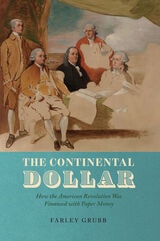
The Continental Dollar
How the American Revolution Was Financed with Paper MoneyFarley Grubb
University of Chicago Press, 2023
The Continental Dollar is a revelatory history of how the fledgling United States paid for its first war. Farley Grubb upends the common telling of this story, in which the United States printed cross-colony money, called Continentals, to serve as an early fiat currency—a currency that is not tied to a commodity like gold, but rather to a legal authority. As Grubb details, the Continental was not a fiat currency, but a “zero-coupon bond”—a wholly different species of money. As bond payoffs were pushed into the future, the money’s value declined, killing the Continentals’ viability years before the Revolutionary War would officially end.
Drawing on decades of exhaustive mining of eighteenth-century records, The Continental Dollar is an essential origin story of the early American monetary system, promising to serve as the benchmark for critical work for decades to come.
The Credit Crunch
Housing Bubbles, Globalisation and the Worldwide Economic CrisisGraham Turner
Pluto Press, 2008
This book argues that the current financial turmoil signals a crisis in globalisation that will directly challenge the free market economic model.
Graham Turner shows that the housing bubbles in the West were deliberately created to mask the damage inflicted by companies shifting production abroad in an attempt to boost profits. As these bubbles burst, economic growth in many developed countries will inevitably tumble. The Japanese crisis of the 1990s shows that banks and governments may struggle to contain the fallout. The problem has not been limited to the US, UK and Europe: housing bubbles have become endemic across wide swathes of emerging market economies. As the West slides, these countries will see an implosion of their credit bubbles too, shaking their faith in the free market.
Turner is an experienced and successful economic forecaster, whose opinions are sought by large international banks and top financial journalists. Drawing from his first hand experience of the Japanese property crash of the 1990s, he presents his analysis in a clear and persuasive style, showing that the end of housing market growth spells disaster for neoliberal globalisation.
The Cult of Statistical Significance
How the Standard Error Costs Us Jobs, Justice, and LivesStephen T. Ziliak and Deirdre N. McCloskey
University of Michigan Press, 2010
“McCloskey and Ziliak have been pushing this very elementary, very correct, very important argument through several articles over several years and for reasons I cannot fathom it is still resisted. If it takes a book to get it across, I hope this book will do it. It ought to.”
—Thomas Schelling, Distinguished University Professor, School of Public Policy, University of Maryland, and 2005 Nobel Prize Laureate in Economics
“With humor, insight, piercing logic and a nod to history, Ziliak and McCloskey show how economists—and other scientists—suffer from a mass delusion about statistical analysis. The quest for statistical significance that pervades science today is a deeply flawed substitute for thoughtful analysis. . . . Yet few participants in the scientific bureaucracy have been willing to admit what Ziliak and McCloskey make clear: the emperor has no clothes.”
—Kenneth Rothman, Professor of Epidemiology, Boston University School of Health
The Cult of Statistical Significance shows, field by field, how “statistical significance,” a technique that dominates many sciences, has been a huge mistake. The authors find that researchers in a broad spectrum of fields, from agronomy to zoology, employ “testing” that doesn’t test and “estimating” that doesn’t estimate. The facts will startle the outside reader: how could a group of brilliant scientists wander so far from scientific magnitudes? This study will encourage scientists who want to know how to get the statistical sciences back on track and fulfill their quantitative promise. The book shows for the first time how wide the disaster is, and how bad for science, and it traces the problem to its historical, sociological, and philosophical roots.
Stephen T. Ziliak is the author or editor of many articles and two books. He currently lives in Chicago, where he is Professor of Economics at Roosevelt University. Deirdre N. McCloskey, Distinguished Professor of Economics, History, English, and Communication at the University of Illinois at Chicago, is the author of twenty books and three hundred scholarly articles. She has held Guggenheim and National Humanities Fellowships. She is best known for How to Be Human* Though an Economist (University of Michigan Press, 2000) and her most recent book, The Bourgeois Virtues: Ethics for an Age of Commerce (2006).
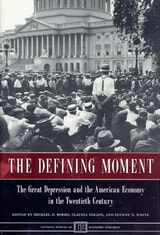
The Defining Moment
The Great Depression and the American Economy in the Twentieth CenturyEdited by Michael D. Bordo, Claudia Goldin, and Eugene N. White
University of Chicago Press, 1997
The essays consider whether New Deal-style legislation continues to operate today as originally envisioned, whether it altered government and the economy as substantially as did policies inaugurated during World War II, the 1950s, and the 1960s, and whether the legislation had important precedents before the Depression, specifically during World War I. Some chapters find that, surprisingly, in certain areas such as labor organization, the 1930s responses to the Depression contributed less to lasting change in the economy than a traditional view of the time would suggest. On the whole, however, these essays offer testimony to the Depression's legacy as a "defining moment." The large role of today's government and its methods of intervention—from the pursuit of a more active monetary policy to the maintenance and extension of a wide range of insurance for labor and business—derive from the crisis years of the 1930s.
The Diplomacy of Trade and Investment
American Economic Expansion in the Hemisphere, 1865-1900David M. Pletcher
University of Missouri Press, 1998
The move to encourage trade with Canada and Mexico during the 1990s, culminating with the negotiation of the North American Free Trade Agreement (NAFTA), has had a long background extending as far back as the late eighteenth century. American trade with both Canada and Latin America rapidly increased during the last third of the nineteenth century as a result of burgeoning industry and agriculture in the United States. The Diplomacy of Trade and Investment is the first detailed examination of the economic and political forces behind this rapid growth and their effect on government policy.
Based on a thorough examination of government documents, congressional debates and reports, private papers of government and business leaders, and newspapers, David M. Pletcher begins this monumental study with a comprehensive survey of U.S. trade following the Civil War. He goes on to outline the problems of building a coherent trade policy toward Canada, Mexico, Central America, the Caribbean, and South America. The study concludes by analyzing a series of abortive trade reform efforts and examining the effects of the Spanish-American War.
Pletcher rejects the long-held belief that American business and government engaged in a deliberate, consistent drive for economic hegemony in the hemisphere during the late 1800s. Instead he finds that the American government improvised and experimented with ways to further trade expansion. But American businessmen were often more interested in domestic trade than in trade with foreign markets. In fact, many of them resisted efforts to lower the American tariff or otherwise encourage American trade abroad.
The combination of traditionalist and revisionist insight with Pletcher's own deep knowledge and research provides the reader with a comprehensive new interpretation of hemispheric trade expansion at the end of the nineteenth century.

The Disordered Police State
German Cameralism as Science and PracticeAndre Wakefield
University of Chicago Press, 2009
Probing the relationship between German political economy and everyday fiscal administration, The Disordered Police State focuses on the cameral sciences—a peculiarly German body of knowledge designed to train state officials—and in so doing offers a new vision of science and practice during the seventeenth and eighteenth-centuries. Andre Wakefield shows that the cameral sciences were at once natural, technological, and economic disciplines, but, more important, they also were strategic sciences, designed to procure patronage for their authors and good publicity for the German principalities in which they lived and worked. Cameralism, then, was the public face of the prince's most secret affairs; as such, it was an essentially dishonest enterprise.
In an entertaining series of case studies on mining, textiles, forestry, and universities, Wakefield portrays cameralists in their own gritty terms. The result is a revolutionary new understanding about how the sciences created and maintained an image of the well-ordered police state in early modern Germany. In raising doubts about the status of these German sciences of the state, Wakefield ultimately questions many of our accepted narratives about science, culture, and society in early modern Europe.
The Economic History of American Inequality
New Evidence and PerspectivesEdited by Martha J. Bailey, Leah Platt Boustan, and William J. Collins
University of Chicago Press, 2025
A meticulous examination of the history and roots of economic inequality within the United States.
This volume refines and extends the economic history literature on economic inequality in the United States. Economic inequality manifests itself on various dimensions, including access to resources and economic security, as well as access to education and opportunities for migration, marriage, and other important life decisions. Measuring inequality and studying its variation over time and in response to economic shocks such as recessions and wars deepen our understanding of how the economy operates and can inform the design of public policies. The studies in this compendium present comprehensive evidence on income distribution during the nineteenth and early twentieth centuries, drawing on new data on wages and prices. They also consider disparities in economic well-being that are reflected in outcomes other than wage and salary income, such as homeownership and marriage. The volume also presents new evidence on the effects of income inequality on social outcomes. It concludes with an intellectual history of “human capital,” a core concept in the economic analysis of the underpinnings of labor market inequality.
The Economic History of Singapore
Keen Meng Choy and Ichiro Sugimoto
National University of Singapore Press, 2026
What explains Singapore’s economic success? What are the factors behind the many changes it has negotiated over the centuries, first as a regional trading port in the fourteenth century, then as an entrepôt and staple port in the British empire, and finally moving to independence, export-led industrialization, and global-city status as one of the world's most prosperous economies? This comprehensive economic history of Singapore is the first to integrate a long-term view, taking a narrative but analytical approach. At the same time, the book does not lose sight of individuals, firms, and families, and the way economic changes have affected the well-being of Singapore’s people. The Economic History of Singapore also considers recent challenges faced by the country, such as balancing the needs of the nation-state and the global city and managing worsening income distribution.
The Economic Rise of the Czech Lands 1
From the 1750s to the End of World War IEdited by Zdenek Jindra and Ivan Jakubec
Karolinum Press, 2019

The Economics of François Quesnay
Gianni Vaggi
Duke University Press, 1987
The Economy and Material Culture of Russia, 1600-1725
Richard Hellie
University of Chicago Press, 1999
Impressive in scope and data analysis, Economy and Material Culture of Russia, 1600-1725 will be an invaluable resource and reference work for all readers interested in economic history and the history of material culture. Since there is no comparable one-volume work for any other society at any other time in history, Hellie's is a truly unique and profound achievement.
The Economy of British West Florida, 1763-1783
Robin F. A. Fabel
University of Alabama Press, 1988
The untold economic story of Britain’s Gulf Coast frontier.
This is the first book-length investigation of the economy of British West Florida and the extent to which it was economically viable given that it had been an economic failure for Spain. In it, author Robin Fabel explores both the territory's economy and history but also analyzes previously neglected but key aspects of British West Florida, including the maritime life of the province, the institution of slavery, and the potentially great immigration scheme sponsored by the Company of Military Adventures.
The British divided Florida into two colonies: East Florida and West Florida. West Florida comprised the area between the Apalachicola, Chattahoochee, and Mississippi rivers, and from the Gulf of Mexico north to thirty-two degrees twenty-eight minutes north latitude, roughly the latitude of modern-day Jackson, MS and Montgomery, AL. In the geographic center of the colony were Mobile, Alabama and Pensacola, Floriday. British West Florida included parts of the states of Alabama, Florida, Louisiana, and Mississippi and existed from 1763 until 1783 at the end of the American Revolutionary War.
Fabel contrasts the founding of Georgia, where slaves were initially excluded, with West Florida, where the slave trade became important economically. The British believed that only enslaved Blacks could labor successfully in the hot climate. Fabel gives an account of how owners employed enslaved people, how rare it was for slaves to be emancipated, and the passage of slave laws for West Florida. Fabel also explores British West Florida’s trade with Native Americans and the Caribbean islands, as well as the colony's relationships with neighboring Spanish and French communities.
Fabel's work offers an engaging and accessible account of the history of an expansive region of colonial North America during a fluid period of colonial history before American independence.
The Effects of U.S. Trade Protection and Promotion Policies
Edited by Robert C. Feenstra
University of Chicago Press, 1997
The volume concludes that some policies can act to both protect imports and promote exports, that the threat of protectionist policies can often have effects that are as pronounced as their implementation, and that regulatory policy has as great an impact on trade and investment patterns as does trade policy itself. It will be of crucial interest to international trade economists, policy specialists, and political scientists.

The Effortless Economy of Science?
Philip Mirowski
Duke University Press, 2004
Mirowski contends that neoclassical economists have persistently presumed and advanced an “effortless economy of science,” a misleading model of a self-sufficient and conceptually self-referential social structure that transcends market operations in pursuit of absolute truth. In the stunning essays collected here, he presents a radical critique of the ways that neoclassical economics is used to support, explain, and legitimate the current social practices underlying the funding and selection of “successful” science projects. He questions a host of theories, including the portraits of science put forth by Karl Popper, Michael Polanyi, and Thomas Kuhn. Among the many topics he examines are the social stabilization of quantitative measurement, the repressed history of econometrics, and the social construction of the laws of supply and demand and their putative opposite, the gift economy. In The Effortless Economy of Science? Mirowski moves beyond grand abstractions about science, truth, and democracy in order to begin to talk about the way science is lived and practiced today.
The Ends of Freedom
Reclaiming America's Lost Promise of Economic RightsMark Paul
University of Chicago Press, 2023
Since the Founding, Americans have debated the true meaning of freedom. For some, freedom meant the provision of life’s necessities, those basic conditions for the “pursuit of happiness.” For others, freedom meant the civil and political rights enumerated in the Bill of Rights and unfettered access to the marketplace—nothing more. As Mark Paul explains, the latter interpretation—thanks in large part to a particularly influential cadre of economists—has all but won out among policymakers, with dire repercussions for American society: rampant inequality, endemic poverty, and an economy built to benefit the few at the expense of the many.
In this book, Paul shows how economic rights—rights to necessities like housing, employment, and health care—have been a part of the American conversation since the Revolutionary War and were a cornerstone of both the New Deal and the Civil Rights Movement. Their recuperation, he argues, would at long last make good on the promise of America’s founding documents. By drawing on FDR’s proposed Economic Bill of Rights, Paul outlines a comprehensive policy program to achieve a more capacious and enduring version of American freedom. Among the rights he enumerates are the right to a good job, the right to an education, the right to banking and financial services, and the right to a healthy environment.
Replete with discussions of some of today’s most influential policy ideas—from Medicare for All to a federal job guarantee to the Green New Deal—The Ends of Freedom is a timely and urgent call to reclaim the idea of freedom from its captors on the political right—to ground America’s next era in the country’s progressive history and carve a path toward a more economically dynamic and equitable nation.
The Evolution of Retirement
An American Economic History, 1880-1990Dora L. Costa
University of Chicago Press, 1998
The Federal Landscape
An Economic History of the Twentieth-Century WestGerald D. Nash
University of Arizona Press, 1999
Historian Gerald D. Nash has written the first account of the epic growth of the economy of the American West during the twentieth century, showing how national interests shaped the West over the course of the past hundred years. In a book written for a broad readership, he tells the story of how America’s hinterland became the most dynamic and rapidly growing part of the country.
The Federal Landscape relates how in the nineteenth century the West was largely developed by individual enterprise but how in the twentieth Washington, D.C., became the central player in shaping the region. Nash traces the development of this process during the Progressive Era, World War I, the New Deal, World War II, the affluent postwar years, and the cold-war economy of the 1950s. He analyzes the growth of western cities and the emergence of environmental issues in the 1960s, the growth of a vibrant Mexican-U.S. border economy, and the impact of large-scale immigration from Latin America and Asia at century’s end.
Although specialists have studied many particular facets of western growth, Nash has written the only book to provide a much-needed overview of the subject. By addressing subjects as diverse as public policy, economic development, environmental and urban issues, and questions of race, class, and gender, he puts the entire federal landscape in perspective and shows how the West was really won.
The Federal Reserve
A New HistoryRobert L. Hetzel
University of Chicago Press, 2022
In The Federal Reserve: A New History, Robert L. Hetzel draws on more than forty years of experience as an economist in the central bank to trace the influences of the Fed on the American economy. Comparing periods in which the Fed stabilized the economy to those when it did the opposite, Hetzel tells the story of a century-long pursuit of monetary rules capable of providing for economic stability.
Recast through this lens and enriched with archival materials, Hetzel’s sweeping history offers a new understanding of the bank’s watershed moments since 1913. This includes critical accounts of the Great Depression, the Great Inflation, and the Great Recession—including how these disastrous events could have been avoided.
A critical volume for a critical moment in financial history, The Federal Reserve is an expert, sweeping account that promises to recast our understanding of the central bank in its second century.
The First Wall Street
Chestnut Street, Philadelphia, and the Birth of American FinanceRobert E. Wright
University of Chicago Press, 2005
The First Wall Street recounts the fascinating history of Chestnut Street and its forgotten role in the birth of American finance. According to Robert E. Wright, Philadelphia, known for its cultivation of liberty and freedom, blossomed into a financial epicenter during the nation's colonial period. The continent's most prodigious minds and talented financiers flocked to Philly in droves, and by the eve of the Revolution, the Quaker City was the most financially sophisticated region in North America. The First Wall Street reveals how the city played a leading role in the financing of the American Revolution and emerged from that titanic struggle with not just the wealth it forged in the crucible of war, but an invaluable amount of human capital as well.
This capital helped make Philadelphia home to the Bank of the United States, the U.S. Mint, an active securities exchange, and several banks and insurance companies—all clustered in or around Chestnut Street. But as the decades passed, financial institutions were lured to New York, and by the late 1820s only the powerful Second Bank of the United States upheld Philadelphia's financial stature. But when Andrew Jackson vetoed its charter, he sealed the fate of Chestnut Street forever—and of Wall Street too.
Finely nuanced and elegantly written, The First Wall Street will appeal to anyone interested in the history of the United States and the origins of its unrivaled economy.
The Fiscal Fed
How the US Central Bank Funds GovernmentWill Bateman
University of Chicago Press, 2026
A revelatory history of how the Federal Reserve finances American power.
Central banks, we are told, are economic superpowers that must remain independent of modern democratic governments. The US Federal Reserve’s presumed insulation from politics affords it autonomy and credibility to control inflation and promote economic stability—or so the story goes.
In The Fiscal Fed, Will Bateman offers a deeply sourced, empirical history that shows the Fed’s primary function is actually, and has always been, fiscal—sustaining the market for Treasury borrowing that makes up the difference between federal spending and federal revenue. Bateman combs Fed meeting transcripts, staff notes, financial accounts, and legal documents to trace loans and public-debt purchases since the central bank’s founding. The result is a milestone work that reveals how, for most of the Fed’s history, its transactions were aimed at government financing—either by providing cheap credit to close budget gaps or by manipulating yields on government debt. The Fed’s support for government finance is a feature, not a bug, of American economic institutions.
The Fortunes of Liberalism
Essays on Austrian Economics and the Ideal of FreedomF. A. Hayek
University of Chicago Press, 1991
The Reagan and Thatcher "revolutions." The collapse of Eastern Europe dramatically captured in the tearing down of the Berlin Wall. F. A. Hayek, "grand old man of capitalism" and founder of the classical liberal, free-market revival which ignited and inspired these world events, forcefully predicted their occurrence in writings such as The Road to Serfdom, first published in 1944.
Hayek's well-known social and political philosophy—in particular his long-held pessimistic view of the prospects of socialism, irrefutably vindicated by the recent collapse of the Eastern bloc—is fully grounded in the Austrian approach to economics. In this new collection, Hayek traces his intellectual roots to the Austrian school, the century-old tradition founded at the University of Vienna by Carl Menger, and links it to the modern rebirth of classical liberal or libertarian thought.
As Hayek reminds us, the cornerstone of modern economics—the theory of value and price—"represents a consistent continuation of the fundamental principles handed down by the Vienna school." Here, in this first modern collection of essays on the Austrian school by one of its preeminent figures, is the genesis of this tradition and its place in intellectual history.
Reflections on Hayek's days as a young economic theorist in Vienna, his opening address to the inaugural meeting of the Mont Pèlerin Society, and essays on former teachers and other leading figures in the Austrian school are included in volume 4. Two hitherto unavailable memoirs, "The Economics of the 1920s as Seen from Vienna," published here for the first time, and "The Rediscovery of Freedom: Personal Recollections," available for the first time in English, make this collection invaluable for Hayek scholars.
Hayek's writings continue to provide an invaluable education in a subject which is nothing less than the development of the modern world.
The Golden Leaf
How Tobacco Shaped Cuba and the Atlantic WorldCharlotte Cosner
Vanderbilt University Press, 2015
Through the rise and fall of empires, ideologies, and economies, tobacco grown on the tiny island of Cuba has remained an enduring symbol of pleasure and extravagance. Cultivated as one of the first reliable commodities for those inhabitants who remained after conquistadors moved on in search of a mythical wellspring of gold, tobacco quickly became crucial to the support of the swelling Spanish Empire in the seventeenth and eighteenth centuries. Eventually, however, tobacco became one of the final stabilizing forces in the empire, and it ultimately proved more resilient than the best laid plans of kings and queens. Tobacco, and those whose livelihoods depended on it, shrugged off the Empire's collapse and pressed on into the twentieth century as an economic force any state or political power must reckon with.
Cosner explores the history of this golden leaf through the personal narratives of farmers, bureaucrats, and laborers, all struggling to build an independent and lucrative economic engine. Through conquest, rebellion, colonial and imperial schemes, and the eventual Communist revolution, Cuban tobacco and cigars became a luxury item that commanded loyalty that defied mere borders or embargoes. Ultimately, The Golden Leaf is a story of two carefully cultivated products: Cuban tobacco, and its lofty reputation.
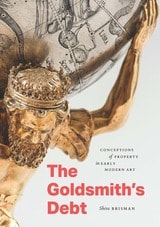
The Goldsmith's Debt
Conceptions of Property in Early Modern ArtShira Brisman
University of Chicago Press, 2026
In the sixteenth century, German goldsmiths played a unique role in articulating property claims and social values. These artisans shaped precious metals into visible expressions of domination, subordination, and obligation. The objects they crafted played a major role in the practices of exchange and inheritance that were reconfiguring a tumultuous economic landscape. Cities commissioned goldsmiths to transform revenue into goblets that could be given as diplomatic gifts or reconverted into currency in times of war, and courts used serving implements as promises of credit.
With The Goldsmith’s Debt, art historian Shira Brisman offers the first book-length study of the Nuremberg goldsmith Christoph Jamnitzer (1563–1618), who created elaborate gilded silver drinking cups that he crafted into unexpected forms, with designs ranging from racialized heads to mining scenes. Considering how works of art can shape a social order, Brisman explores what Jamnitzer’s etchings and goblets reveal about how goldsmiths shared ideas and how their patrons used commissioned works to legitimize their claims over land and the rights of others. Drawing on a range of textual and material evidence—including commentaries on Roman and customary laws, wills and civic statutes, printed designs, and firsthand study of lidded cups in dozens of major European institutions—this unprecedented study places the goldsmith at the heart of the era’s arguments about how people and lands should be subjugated. Brisman reveals the insidious side of these objects that were often used to advance socially conservative agendas, and she presents radical proposals for addressing inequity in the world of ornament prints.
The Great Depression in Eastern Europe
Klaus Richter
Central European University Press, 2025
The Great Enrichment
A New History of American Growth and Inequality, 1865–1945Vincent Geloso
University of Chicago Press, 2027
A revelatory economic history of America's Gilded Age—and how it wasn't just the Robber Barons who benefited.
The Gilded Age, spanning the late nineteenth and early twentieth centuries, was when Americans got rich. Or, rather, some Americans got rich. Because as much as the era is synonymous with staggering economic growth, it also doubles as America’s cautionary tale for the perils of leaving rich people and institutions unregulated. It was the time of extractive industrialists, worker exploitation, stifled economic mobility, and racial exclusion—lessons that the United States learned the hard way.
Vincent Geloso contests this traditional narrative by revisiting the math in this new empirical account of the Gilded Age. The Great Enrichment is an economic history of America’s rise to affluence, a period that doubled as a remarkable rise of the country’s economic floor. The conventional contrast of Robber Barons against huddled masses is, in Geloso’s analysis, unsubstantiated by economic data. The Gilded Age was the first egalitarian enrichment that humanity witnessed—a time when both rich and poor benefited in ways that were seismic, albeit unequal. Yet the net result was a great leap forward, not the lamentable birth of modern inequality.
Geloso marshals an expanded set of economic measures to account for factors not typically included in the Gilded Age economic story. The Great Enrichment sets a new standard for empirical history in one of America’s most consequential—and perhaps misunderstood—periods.
The Great Inflation
The Rebirth of Modern Central BankingEdited by Michael D. Bordo and Athanasios Orphanides
University of Chicago Press, 2013
The Growth of Economic Thought, 3rd ed.
Henry W. Spiegel
Duke University Press, 1991
From reviews of previous editions:
“The history of economic thought to end all histories of economic thought.”—Robert D. Patton, Journal of Economic Literature
“The book is in the grand tradition of the history of doctrines. It is a history of economic thought broadly conceived—and superbly written to boot. It is not to much to say that Spiegel’s book will become and remain a leading text in the field.”—Warren J. Samuels, Social Science
The author conveys the essence of an idea simply and clearly, yet in a graceful style.”—William F. Kennedy, Journal of Economic Literature
The Half-Life of Deindustrialization
Working-Class Writing about Economic RestructuringSherry Lee Linkon
University of Michigan Press, 2018
Through analysis of poetry, fiction, creative nonfiction, film, and drama, The Half-Life of Deindustrialization shows why people and communities cannot simply “get over” the losses of economic restructuring. The past provides inspiration and strength for working-class people, even as the contrast between past and present highlights what has been lost in the service economy. The memory of productive labor and stable, proud working-class communities shapes how people respond to contemporary economic, social, and political issues. These stories can help us understand the resentment, frustration, pride, and persistence of the American working class.
The History of Capitalism in Mexico
Its Origins, 1521–1763By Enrique Semo
University of Texas Press, 1992
What lies at the center of the Mexican colonial experience? Should Mexican colonial society be construed as a theoretical monolith, capitalist from its inception, or was it essentially feudal, as traditional historiography viewed it? In this pathfinding study, Enrique Semo offers a fresh vision: that the conflicting social formations of capitalism, feudalism, and tributary despotism provided the basic dynamic of Mexico's social and economic development.
Responding to questions raised by contemporary Mexican society, Semo sees the origin of both backwardness and development not in climate, race, or a heterogeneous set of unrelated traits, but rather in the historical interaction of each social formation. In his analysis, Mexico's history is conceived as a succession of socioeconomic formations, each growing within the "womb" of its predecessor. Semo sees the task of economic history to analyze each of these formations and to construct models that will help us understand the laws of its evolution. His premise is that economic history contributes to our understanding of the present not by formulating universal laws, but by studying the laws of development and progression of concrete economic systems.
The History of Capitalism in Mexico opens with the Conquest and concludes with the onset of the profound socioeconomic transformation of the last fifty years of the colony, a period clearly representing the precapitalist phase of Mexican development. In the course of his discussion, Semo addresses the role of dependency—an important theoretical innovation—and introduces the concept of tributary despotism, relating it to the problems of Indian society and economy. He also provides a novel examination of the changing role of the church throughout Mexican colonial history. The result is a comprehensive picture, which offers a provocative alternative to the increasingly detailed and monographic approach that currently dominates the writing of history.
Originally published as Historia del capitalismo en México in 1973, this classic work is now available for the first time in English. It will be of interest to specialists in Mexican colonial history, as well as to general readers.

The Industrialization of São Paulo, 1800-1945
By Warren Dean
University of Texas Press, 1969
São Paulo is one of the few places in the underdeveloped world where an advanced industrial system has grown out of a tropical raw-material-exporting economy. By 1960 there were 830,000 industrial workers in the state, producing $3.3 billion worth of goods. It had become Latin America’s largest industrial center.
This is a study of the early years of manufacturing in São Paulo: how it was influenced by the growth and decline of the coffee trade; where it found its markets, its credit, and its labor force; and how it confronted the competition of imports. The principal focus, however, is on the manufacturers themselves, whose perceptions of their opportunities determined how industrialization was brought about. Warren Dean discusses their social origins, their connections with other sectors of the elite, their attitudes toward workers and consumers, and their view of the potentialities of economic development. He analyzes the political activities of the manufacturers, to discover both how they promoted their interests and how they confronted the larger challenge of social and political transformation.
Paradoxically, the industrialization of São Paulo is not a “success story” of private entrepreneurship. Until after World War II manufacturing grew quite slowly, and its hallmarks were always low productivity, technical backwardness, and consumer hostility. More than half of the state’s present large-scale factory production and nearly all of its heavy industry was built by foreign capital or state enterprise, not by privately owned firms. Dean shows that this outcome is partly a consequence of the historical experience of domestic manufacture.
Throughout the book the author points out the “peculiar articulations” of the industrial system of São Paulo—the significant social and political interests that determined what kinds of development were possible. The result is an exposition of an unusual case study in twentieth-century economic development.
The Insatiability of Human Wants
Economics and Aesthetics in Market SocietyRegenia Gagnier
University of Chicago Press, 2000
The Insatiability of Human Wants begins during a key transitional moment in aesthetic and economic theory, 1871, when both disciplines underwent a turn from production to consumption models. In economics, an emphasis on the theory of value and the social relations between land, labor, and capital gave way to more individualistic models of consumerism. Similarly, in aesthetics, theories of artistic production or creativity soon bowed to models of taste, pleasure, and reception.
Using these developments as a point of departure, Gagnier deftly traces the shift in Western thought from models of production to consumption. From its exploration of early market logic and Kantian thought to its look at the aestheticization of homelessness and our own market boom, The Insatiability of Human Wants invites us to contemplate alternative interpretations of economics, aesthetics, and history itself.