Results by title
64 books match the query 'Ecuador' and 13 start with t
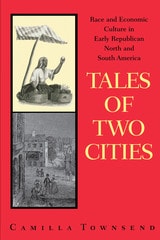
Tales of Two Cities
Race and Economic Culture in Early Republican North and South AmericaBy Camilla Townsend
University of Texas Press, 2000
With a common heritage as former colonies of Europe, why did the United States so outstrip Latin America in terms of economic development in the nineteenth century? In this innovative study, Camilla Townsend challenges the traditional view that North Americans succeeded because of better attitudes toward work—the Protestant work ethic—and argues instead that they prospered because of differences in attitudes towards workers that evolved in the colonial era.
Townsend builds her study around workers' lives in two very similar port cities in the 1820s and 1830s. Through the eyes of the young Frederick Douglass in Baltimore, Maryland, and an Indian woman named Ana Yagual in Guayaquil, Ecuador, she shows how differing attitudes towards race and class in North and South America affected local ways of doing business. This empirical research significantly clarifies the relationship between economic culture and racial identity and its long-term effects.
The CIA in Ecuador
Marc Becker
Duke University Press, 2021
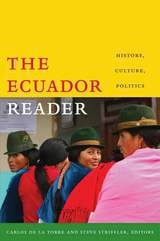
The Ecuador Reader
History, Culture, PoliticsCarlos de la Torre and Steve Striffler, eds.
Duke University Press, 2008
The voices and creations of Ecuadorian politicians, writers, artists, scholars, activists, and journalists fill the Reader, from José María Velasco Ibarra, the nation’s ultimate populist and five-time president, to Pancho Jaime, a political satirist; from Julio Jaramillo, a popular twentieth-century singer, to anonymous indigenous women artists who produced ceramics in the 1500s; and from the poems of Afro-Ecuadorians, to the fiction of the vanguardist Pablo Palacio, to a recipe for traditional Quiteño-style shrimp. The Reader includes an interview with Nina Pacari, the first indigenous woman elected to Ecuador’s national assembly, and a reflection on how to balance tourism with the protection of the Galápagos Islands’ magnificent ecosystem. Complementing selections by Ecuadorians, many never published in English, are samples of some of the best writing on Ecuador by outsiders, including an account of how an indigenous group with non-Inca origins came to see themselves as definitively Incan, an exploration of the fascination with the Andes from the 1700s to the present, chronicles of the less-than-exemplary behavior of U.S. corporations in Ecuador, an examination of Ecuadorians’ overseas migration, and a look at the controversy surrounding the selection of the first black Miss Ecuador.
The FBI in Latin America
The Ecuador FilesMarc Becker
Duke University Press, 2017
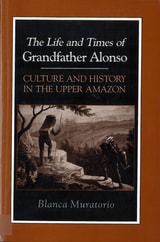
The Life and Times of Grandfather Alonso
Culture and History in the Upper AmazonMuratorio, Blanca
Rutgers University Press, 1991
In Blanca Muratorio's book, we are introduced to Rucuyaya Alonso, an elderly Quichua Indian of the Upper Ecuadorean Amazon. Alonso is a hunter, but like most Quichuas, he has done other work as well, bearing loads, panning gold, tapping rubber trees, and working for Shell Oil. He tells of his work, his hunting, his marriage, his fights, his fears, and his dreams. His story covers about a century because he incorporates the oral tradition of his father and grandfather along with his own memories. Through his life story, we learn about the social and economic life of that region.
Chapters of Alonso's life history and oral tradition alternate with chapters detailing the history of the world around him--the domination of missionaries, the white settlers' expropriation of land, the debt system workers were subjected to, the rubber boom, the world-wide crisis of the 1930s, and the booms and busts of the international oil market. Muratorio explains the larger social, economic, and ideological bases of white domination over native peoples in Amazonia. She shows how through everyday actions and thoughts, the Quichua Indians resisted attacks against their social identity, their ethnic dignity, and their symbolic systems. They were far from submissive, as they have often been portrayed.
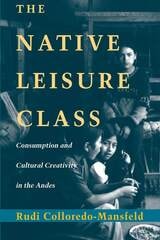
The Native Leisure Class
Consumption and Cultural Creativity in the AndesRudi Colloredo-Mansfeld
University of Chicago Press, 1999
Tracing the connections among newly invented craft traditions, social networks, and consumption patterns, Rudi Colloredo-Mansfeld highlights the way ethnic identities and class cultures materialize in a sensual world that includes luxurious woven belts, powerful stereos, and garlic roasted cuyes (guinea pigs). Yet this case reaches beyond the Andes. He shows how local and global interactions intensify the cultural expression of the world's emerging "native middle classes," at times leaving behind those unable to afford the new trappings of indigenous identity.
Colloredo-Mansfeld also comments on his experiences working as an artist in Otavalo. His drawings, along with numerous photographs, animate this engaging study in economic anthropology.

The Panama Hat Trail
Tom Miller
University of Arizona Press, 1986
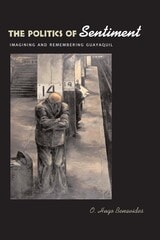
The Politics of Sentiment
Imagining and Remembering GuayaquilBy O. Hugo Benavides
University of Texas Press, 2006
Between 1890 and 1930, the port city of Guayaquil, Ecuador, experienced a liberal revolution and a worker's movement—key elements in shaping the Ecuadorian national identity. In this book, O. Hugo Benavides examines these and other pivotal features in shaping Guayaquilean identity and immigrant identity formation in general in transnational communities such as those found in New York City.
Turn-of-the-century Ecuador witnessed an intriguing combination of transformations: the formation of a national citizenship; extension of the popular vote to members of a traditional underclass of Indians and those of African descent; provisions for union organizing while entering into world market capitalist relations; and a separation of church and state that led to the legalization of secular divorces. Assessing how these phenomena created a unique cultural history for Guayaquileans, Benavides reveals not only a specific cultural history but also a process of developing ethnic attachment in general. He also incorporates a study of works by Medardo Angel Silva, the Afro-Ecuadorian poet whose singular literature embodies the effects of Modernism's arrival in a locale steeped in contradictions of race, class, and sexuality.
Also comprising one of the first case studies of Raymond Williams's hypothesis on the relationship between structures of feeling and hegemony, this is an illuminating illustration of the powerful relationships between historically informed memories and contemporary national life.
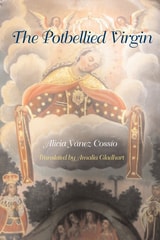
The Potbellied Virgin
By Alicia Yánez Cossío
University of Texas Press, 2006
In an unnamed town in the Ecuadorian Andes, a small wooden icon—La Virgen Pipona (the Potbellied Virgin)—conceals the documents that define the town's social history. That history recently has been dominated by the women of the Benavides family, a conservative clan and, not coincidentally, the caretakers of the Virgin. Their rivals are the Pandos, a family led by four old men who spend their days smoking in the park across from the Virgin's cathedral and offering revisionist versions of local and national events. When a military skirmish threatens the Virgin (and the secret in her famous belly), the Benavides women must scramble to preserve their place as local matriarchs—without alerting the old Pandos to the opportunity that might enable them to finally supplant their rivals.
One of Ecuador's foremost contemporary writers, Alicia Yánez Cossío illuminates the complexity of Andean society by placing disenfranchised players such as women and Amerindians onstage with traditional powers such as the military and the church. Folk wisdom, exemplified in The Potbellied Virgin by the beautifully translated proverbs so popular with the Benavideses and the Pandos alike, stands up to historical record. Such inclusiveness ultimately allows the whole truths of Yánez Cossío's subjects to emerge. Only the second of her novels to be translated into English, The Potbellied Virgin (La cofradía del mullo del vestido de la Virgen Pipona) is a funny, focused portrait of Ecuadorian life in the twentieth century.
The Prism of Human Rights
Seeking Justice amid Gender Violence in Rural EcuadorKarin Friederic
Rutgers University Press, 2023
The Small Matter of Suing Chevron
Suzana Sawyer
Duke University Press, 2022

Theories of Dependent Foreign Policy and the Case of Ecuador in the 1980s
Jeanne A. K. Hey
Ohio University Press, 1995
How do economic weakness and dependence influence foreign policy decisions and behavior in third world countries? Theories in Dependent Foreign Policy examines six foreign policy theories: compliance, consensus, counterdependence, realism, leader preferences and domestic politics, and each is applied to a series of case studies of Ecuador’s foreign policy during the 1980s under two regimes: Osvaldo Hurtado (1981-1984) and his successor León Febres Cordero (1984-1988).
Hey shows that Ecuador during this period represented the third world in many ways. It was a new democracy, having just emerged from years of military rule, extremely indebted to the West, and dependent on primary product export economy that relied heavily on importers, especially the United States.
Jeanne Hey finds that some of the most popular and enduring theories in western research, such as realism and compliance, poorly account for Ecuadorian foreign policy. She explains that poor countries like Ecuador have substantial foreign policy latitude in the diplomatic area. Drawing on archival research and interviews with policy makers including Presidents Hurtado and Febres Cordero, Dr. Hey convincingly argues that many of the traditional foreign policy theories do not “fit” dependent states, and inadequately account for the complexity of foreign policy in the third world.

Traces Behind the Esmeraldas Shore
Warren DeBoer
University of Alabama Press, 1996
Although long famous for its antiquities—notably intricate goldwork, elaborate pottery, and earthen mounds—the Santiago-Cayapas region of coastal Ecuador has been relatively neglected from the standpoint of scientific archaeology. Until recently, no sound chronology was available, and even the approximate age of the region's most impressive monument, the large and much-looted site of La Tolita, remained in doubt.
Building on evidence obtained during the last decade, this book documents an eventful prehistory for Santiago-Cayapas that spans three millennia. A highlight of this prehistory was the reign of La Tolita as a regional center from 200 B.C. to A.D. 350. Archaeological data from
La Tolita's hinterland indicate a complex and changing social landscape in which La Tolita's hegemony was never absolute nor uncontested.
Abundantly illustrated and written in a crisp, witty, and occasionally irreverent style, Traces Behind the Esmeraldas Shore will stimulate debate and rankle interpretive conventions about those social formations that archaeologists gloss as 'chiefdoms.'