55 books match the query 'Education and state' and 9 start with t
cover of Teaching Marianne and Uncle Sam: Public Education, State Centralization, and Teacher Unionism in France and the United States

Teaching Marianne and Uncle Sam

Public Education, State Centralization, and Teacher Unionism in France and the United States

Nicholas Toloudis

Temple University Press, 2012

Offering the first systematic, comparative examination of the origins of teachers’ unions in two countries—France and the United States—Teaching Marianne and Uncle Sam shows how teachers’ unions came into existence not because of the willful efforts of particular actors, but over the course of decades of conflict over the proper role of professional educators in public politics.

Nicholas Toloudis traces teacher unionism back to the first efforts of governments to centralize public education. He carefully documents how centralization created new understandings of the role of teachers in their societies and generated new sources of conflict within teachers’ corps. Using rare archival source materials, Toloudis illustrates how these internal conflicts became salient in teachers’ battles with governments over their legitimate right to exist as collective claim-makers within the polity.

In the series Politics, History, and Social Change, edited by John C. Torpey
[more]
cover of The Autocratic Academy: Reenvisioning Rule within America's Universities

The Autocratic Academy

Reenvisioning Rule within America's Universities

Timothy V. Kaufman-Osborn

Duke University Press, 2023
Critics of contemporary US higher education often point to the academy’s “corporatization” as one of its defining maladies. However, in The Autocratic Academy Timothy V. Kaufman-Osborn argues that American colleges and universities have always been organized as corporations in which the power to rule is legally vested in and monopolized by antidemocratic governing boards. This institutional form, Kaufman-Osborn contends, is antithetical to the free inquiry that defines the purpose of higher education. Tracing the history of the American academy from the founding of Harvard (1636), through the Supreme Court’s Dartmouth v. Woodward ruling (1819), and into the twenty-first century, Kaufman-Osborn shows how the university’s autocratic legal constitution is now yoked to its representation on the model of private property. Explaining why appeals to the cause of shared governance cannot succeed in wresting power from the academy’s autocrats, Kaufman-Osborn argues that American universities must now be reincorporated in accordance with the principles of democratic republicanism. Only then can the academy’s members hold accountable those chosen to govern and collectively determine the disposition of higher education’s unique public goods.
[more]
cover of The Crucible of Desegregation: The Uncertain Search for Educational Equality

The Crucible of Desegregation

The Uncertain Search for Educational Equality

R. Shep Melnick

University of Chicago Press, 2023

Examines the patchwork evolution of school desegregation policy.

In 1954, the Supreme Court delivered the landmark decision of Brown v. Board of Education—establishing the right to attend a desegregated school as a national constitutional right—but the decision contained fundamental ambiguities. The Supreme Court has never offered a clear definition of what desegregation means or laid out a framework for evaluating competing interpretations. In The Crucible of Desegregation, R. Shep Melnick examines the evolution of federal school desegregation policy from 1954 through the termination of desegregation orders in the first decades of the twenty-first century, combining legal analysis with a focus on institutional relations, particularly the interactions between federal judges and administrators. Melnick argues that years of ambiguous, inconsistent, and meandering Court decisions left lower court judges adrift, forced to apply contradictory Supreme Court precedents in a wide variety of highly charged political and educational contexts. As a result, desegregation policy has been a patchwork, with lower court judges playing a crucial role and with little opportunity to analyze what worked and what didn’t. The Crucible of Desegregation reveals persistent patterns and disagreements that continue to roil education policy.
[more]
cover of The Elusive Ideal: Equal Educational Opportunity and the Federal Role in Boston's Public Schools, 1950-1985

The Elusive Ideal

Equal Educational Opportunity and the Federal Role in Boston's Public Schools, 1950-1985

Adam R. Nelson

University of Chicago Press, 2005

In recent years, federal mandates in education have become the subject of increasing debate. Adam R. Nelson's The Elusive Ideal—a postwar history of federal involvement in the Boston public schools—provides lessons from the past that shed light on the continuing struggles of urban public schools today. This far-reaching analysis examines the persistent failure of educational policy at local, state, and federal levels to equalize educational opportunity for all. Exploring deep-seated tensions between the educational ideals of integration, inclusion, and academic achievement over time, Nelson considers the development and implementation of policies targeted at diverse groups of urban students, including policies related to racial desegregation, bilingual education, special education, school funding, and standardized testing.

An ambitious study that spans more than thirty years and covers all facets of educational policy, from legal battles to tax strategies, The Elusive Ideal provides a model from which future inquiries will proceed. A probing and provocative work of urban history with deep relevance for urban public schools today, Nelson's book reveals why equal educational opportunity remains such an elusive ideal.
[more]
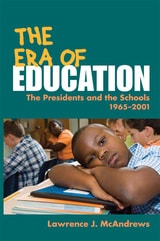
cover of The Era of Education: The Presidents and the Schools, 1965-2001

The Era of Education

The Presidents and the Schools, 1965-2001

Lawrence J. McAndrews

University of Illinois Press, 2005
This study of educational policy from Lyndon Johnson through Bill Clinton focuses on three specific issues--public school aid, non-public (especially Catholic) school aid, and school desegregation--that speak to the proper role of the federal government in education as well as to how education issues embody larger questions of opportunity, exclusion, and equality in American society. Lawrence J. McAndrews traces the evolution of policy as each president developed (or avoided developing) a stance toward these issues and discusses the repercussions and implications of policy decisions for the educational community over nearly four decades.
 
[more]
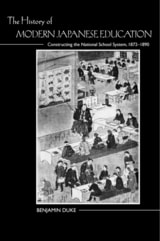
cover of The History of Modern Japanese Education: Constructing the National School System, 1872-1890

The History of Modern Japanese Education

Constructing the National School System, 1872-1890

Duke, Benjamin

Rutgers University Press, 2014
The History of Modern Japanese Education is the first account in English of the construction of a national school system in Japan, as outlined in the 1872 document, the Gakusei. Divided into three parts tracing decades of change, the book begins by exploring the feudal background for the Gakusei during the Tokugawa era which produced the initial leaders of modern Japan. Next, Benjamin Duke traces the Ministry of Education's investigations of the 1870s to determine the best western model for Japan, including the decision to adopt American teaching methods. He then goes on to cover the eventual "reverse course" sparked by the Imperial Household protest that the western model overshadowed cherished Japanese traditions. Ultimately, the 1890 Imperial Rescript on Education integrated Confucian teachings of loyalty and filial piety with Imperial ideology, laying the moral basis for a western-style academic curriculum in the nation's schools.
[more]
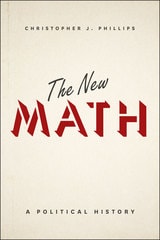
cover of The New Math: A Political History

The New Math

A Political History

Christopher J. Phillips

University of Chicago Press, 2014

An era of sweeping cultural change in America, the postwar years saw the rise of beatniks and hippies, the birth of feminism, and the release of the first video game. It was also the era of new math. Introduced to US schools in the late 1950s and 1960s, the new math was a curricular answer to Cold War fears of American intellectual inadequacy. In the age of Sputnik and increasingly sophisticated technological systems and machines, math class came to be viewed as a crucial component of the education of intelligent, virtuous citizens who would be able to compete on a global scale.

In this history, Christopher J. Phillips examines the rise and fall of the new math as a marker of the period’s political and social ferment. Neither the new math curriculum designers nor its diverse legions of supporters concentrated on whether the new math would improve students’ calculation ability. Rather, they felt the new math would train children to think in the right way, instilling in students a set of mental habits that might better prepare them to be citizens of modern society—a world of complex challenges, rapid technological change, and unforeseeable futures. While Phillips grounds his argument in shifting perceptions of intellectual discipline and the underlying nature of mathematical knowledge, he also touches on long-standing debates over the place and relevance of mathematics in liberal education. And in so doing, he explores the essence of what it means to be an intelligent American—by the numbers.
[more]
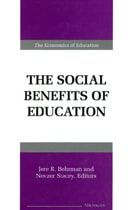
cover of The Social Benefits of Education

The Social Benefits of Education

Jere R. Behrman and Nevzer Stacey, Editors

University of Michigan Press, 1997
For decades, the primary argument in justifying education has been based on its direct economic effects. Yet education also provides "social benefits" for individuals and society at large, including a better way of taking care of ourselves, and consequently creating a better society to live in. Though it is difficult to quantify these social benefits, a more systematic analysis would improve our understanding of the full effects of education and provide a basis for considering related policies. The Office of Research of the United States Department of Education commissioned a series of papers on measuring these effects of education.
Those papers, revised and updated, are collected here. Kenneth J. Arrow provides perspective on education and preference formation, and Jere R. Behrman considers general conceptual and measurement issues in assessing the social benefits of education and policies related to education. These issues are taken up by experts in four fields--health, parenting, the environment, and crime. Themes addressed include measurement issues regarding what we mean by education and its benefits; basic analytical issues in assessing the impact of education on these social benefits using behavioral data; and whether the social benefits of education justify public policy interventions.
Jere R. Behrman is William R. Kenan Jr. Professor of Economics, University of Pennsylvania. Nevzer G. Stacey is Senior Research Analyst, Office of Educational Research, U.S. Department of Education.
[more]
cover of The Struggling State: Nationalism, Mass Militarization, and the Education of Eritrea

The Struggling State

Nationalism, Mass Militarization, and the Education of Eritrea

Jennifer Riggan

Temple University Press, 2016

A 2003 law in Eritrea—a notoriously closed-off, heavily militarized, and authoritarian country—mandated an additional year of school for all children and stipulated that the classes be held at Sawa, the nation’s military training center. As a result, educational institutions were directly implicated in the making of soldiers, putting Eritrean teachers in the untenable position of having to navigate between their devotion to educating the nation and their discontent with their role in the government program of mass militarization.
 
In her provocative ethnography, The Struggling State, Jennifer Riggan examines the contradictions of state power as simultaneously oppressive to and enacted by teachers. Riggan, who conducted participant observation with teachers in and out of schools, explores the tenuous hyphen between nation and state under lived conditions of everyday authoritarianism.
 
The Struggling State shows how the hopes of Eritrean teachers and students for the future of their nation have turned to a hopelessness in which they cannot imagine a future at all.
[more]