Results by title
271 books match the query 'Employment' and 33 start with t

Taking Time
Mindy Fried
Temple University Press, 1998
This timely book provides an inside look at life in a major U.S. corporation, focusing on the impact of workplace culture on the use of parental leave and those who use it. Fried begins by describing why parental leave is critical to making parenting the job of both parents in two-parent families. She examines the varied experiences of different levels of workers in how parental leave policy is used.
The author tells a rich and textured tale of day-to-day life in the skyscraper offices of a large corporation. How people dress, what their offices look like, which cafeteria they eat in, how the supervisors and supervised talk -- all these things are part of the fabric of corporate culture that Fried describes.
Most of us live in work cultures that value overtime. Fried argues that, as a "time policy" parental leave clashes with the powerful norm that corporate employees must work long and hard. Taking time for parenting -- a job that is devalued in our culture -- may be perceived as "taking time away" from the company, and, in particular, from the company's productivity.
Texas Mexican Americans and Postwar Civil Rights
By Maggie Rivas-Rodriguez
University of Texas Press, 2015
Thai Women in the Global Labor Force
Consuming Desires, Contested SelvesMills, Mary Beth
Rutgers University Press, 1999
Mills describes the environments from which these women left, as well as the urban landscape they now call home. Hence, she examines key aspects of rural Thai community life, such as local consumption practices, gender roles, and the familial tensions that are often the catalyst to labor migration. Then she focuses on the city and the underlying tensions of urban employment as migrants pursue newly imagined identities as modern women, while still upholding economic and moral responsibilities to rural kin.

The Accidental Equalizer
How Luck Determines Pay after CollegeJessi Streib
University of Chicago Press, 2023
As a gateway to economic opportunity, a college degree is viewed by many as America’s great equalizer. And it’s true: wealthier, more connected, and seemingly better-qualified students earn exactly the same pay as their less privileged peers. Yet, the reasons why may have little to do with bootstraps or self-improvement—it might just be dumb luck. That’s what sociologist Jessi Streib proposes in The Accidental Equalizer, a conclusion she reaches after interviewing dozens of hiring agents and job-seeking graduates.
Streib finds that luck shapes the hiring process from start to finish in a way that limits class privilege in the job market. Employers hide information about how to get ahead and force students to guess which jobs pay the most and how best to obtain them. Without clear routes to success, graduates from all class backgrounds face the same odds at high pay. The Accidental Equalizer is a frank appraisal of how this “luckocracy” works and its implications for the future of higher education and the middle class. Although this system is far from eliminating American inequality, Streib shows that it may just be the best opportunity structure we have—for better and for worse.
The Black Worker
Race, Labor, and Civil Rights Since EmancipationEdited by Eric Arnesen
University of Illinois Press, 2006
Uniting the latest scholarship on race, labor, and civil rights, The Black Worker aims to establish the richness of the African American working-class experience, and the indisputable role of black workers in shaping the politics and history of labor and race in the United States.
To capture the complexity of African Americans’ experiences in the workplace, this reader examines workers engaged in a wide array of jobs, including sharecropping, coal mining, domestic service, longshoring, automobile manufacturing, tobacco processing, railroading, prostitution, lumbering, and municipal employment. The essays’ subjects include black migration, strikebreaking, black conservatism, gender, and the multiple forms of employment discrimination in the South and North. Other contributions deal explicitly with state policy and black workers during the transition from slavery to freedom, World Wars I and II, and the 1960s.
The variety of challenges made by these workers, both quiet and overt, served as clear reminders to the supporters of white supremacy that, despite their best efforts through violence, fraud, and the law, as long as they insisted on racial inequality, the “race question” would never be fully resolved.
Contributors: Eric Arnesen, Beth Tompkins Bates, Cynthia M. Blair, Tera W. Hunter, William Powell Jones, Brian Kelly, Robert Korstad, Nelson Lichtenstein, Joseph A. McCartin, Steven A. Reich, Leslie A. Schwalm, Nan Elizabeth Woodruff
The Black Youth Employment Crisis
Edited by Richard B. Freeman and Harry J. Holzer
University of Chicago Press, 1986
The contributors identify primary determinants on both the demand and supply sides of the market and provide new information on important aspects of the problem, such as drug use, crime, economic incentives, and attitudes among the unemployed. Their studies reveal that, contrary to popular assumptions, no single factor is the predominant cause of black youth employment problems. They show, among other significant factors, that where female employment is high, black youth employment is low; that even in areas where there are many jobs, black youths get relatively few of them; that the perceived risks and rewards of crime affect decisions to work or to engage in illegal activity; and that churchgoing and aspirations affect the success of black youths in finding employment.
Altogether, these papers illuminate a broad range of economic and social factors which must be understood by policymakers before the black youth employment crisis can be successfully addressed.

The Business of Charity
The Woman's Exchange Movement, 1832-1900Kathleen Waters Sander
University of Illinois Press, 1998
In the nineteenth century, Woman's Exchanges formed a vast national network that created economic alternatives for financially vulnerable women in a world that permitted few respectable employment options. Many remain in business.
Kathleen Waters Sander delves into the history of Woman's Exchanges and looks at the women who led the organizations—and those who used them to stave off poverty. One of the nation's oldest continuously operating voluntary movements, Exchanges like the Philadelphia Ladies' Depository and the Dorcas Society were fashionable, popular shops where women who had fallen on hard times could sustain themselves. By selling their handiwork on consignment, they not only earned money but avoided the stigma of seeking public employment. As Sander shows, Exchanges evolved into an important forum for entrepreneurial growth. They also provide an example of how women used the voluntary sector, which had so successfully served as a conduit for their political and social reforms, to advance opportunities for economic independence.
The Chicago Guide to Landing a Job in Academic Biology
C. Ray Chandler, Lorne M. Wolfe, and Daniel E. L. Promislow
University of Chicago Press, 2007
An academic career in the biological sciences typically demands well over a decade of technical training. So it’s ironic that when a scholar reaches the most critical stage in that career—the search for a job following graduate work—he or she receives little or no formal preparation. Instead, students are thrown into the job market with only cursory guidance on how to search for and land a position.
Now there’s help. Carefully, clearly, and with a welcome sense of humor, The Chicago Guide to Landing a Job in Academic Biology leads graduate students and postdoctoral fellows through the perils and rewards of their first job search. The authors—who collectively have for decades mentored students and served on hiring committees—have honed their advice in workshops at biology meetings across the country. The resulting guide covers everything from how to pack an overnight bag without wrinkling a suit to selecting the right job to apply for in the first place. The authors have taken care to make their advice useful to all areas of academic biology—from cell biology and molecular genetics to evolution and ecology—and they give tips on how applicants can tailor their approaches to different institutions from major research universities to small private colleges.
With jobs in the sciences ever more difficult to come by, The Chicago Guide to Landing a Job in Academic Biology is designed to help students and post-docs navigate the tricky terrain of an academic job search—from the first year of a graduate program to the final negotiations of a job offer.
The Chicano Worker
By Vernon M. Briggs, Jr., Walter Fogel, and Fred H. Schmidt
University of Texas Press, 1977
The Chicano Worker is an incisive analysis of the labor-market experiences of Mexican American workers in the late twentieth century. The authors—each established in the fields of labor economics and research on Chicano workers—describe the major employment patterns of the Chicano labor force and discuss the historical and institutional factors determining these patterns. This work speaks to the continuing widespread public interest in Mexican immigration, migrant farm labor, unionization of farm workers, Chicano education and training needs, and the legacy of discriminatory treatment against Chicanos. The authors treat the convergence of these issues and their public policy implications.
Drawing from census data as well as other sources, The Chicano Worker reports on Chicano unemployment, labor-force participation, occupational and industrial distributions of employment, and various indices of earnings. It also deals with such issues as history, family size, health, and culture. The Chicano Worker is likely to open new areas of interest, discussion, and criticism concerning Chicanos in the United States.
The Civilian Conservation Corps in Nevada
From Boys to MenRenée Corona Kolvet
University of Nevada Press, 2015
The Civilian Conservation Corps in Nevada is the first comprehensive history of the Nevada CCC, a program designed to help the nation get back on its feet, and of the “boys” who did so much to restore Nevada’s lands and resources. The book is based on extensive research in private manuscript collections, unpublished memoirs, CCC inspectors’ reports, and other records. The book also includes period photographs depicting the Nevada CCC and its activities.
The Confederate Negro
Virginia's Craftsmen and Military Laborers, 1861-1865James H. Brewer
University of Alabama Press, 2007
A superb work in the social history of American industry
A Gettysburg College "Top 200 Civil War Books" selection
Mayflower Award Winner for 1970
The Cost of Being a Girl
Working Teens and the Origins of the Gender Wage GapYasemin Besen-Cassino
Temple University Press, 2017
The gender wage gap is one of the most persistent problems of labor markets and women’s lives.
Most approaches to explaining the gap focus on adult employment despite the fact that many Americans begin working well before their education is completed. In her critical and compelling new book, The Cost of Being a Girl, Yasemin Besen-Cassino examines the origins of the gender wage gap by looking at the teenage labor force, where comparisons between boys and girls ought to show no difference, but do.
Besen-Cassino’s findings are disturbing. Because of discrimination in the market, most teenage girls who start part-time work as babysitters and in other freelance jobs fail to make the same wages as teenage boys who move into employee-type jobs. The “cost” of being a girl is also psychological; when teenage girls work retail jobs in the apparel industry, they have lower wages and body image issues in the long run.
Through in-depth interviews and surveys with workers and employees, The Cost of Being a Girl puts this alarming social problem—which extends to race and class inequality—in to bold relief. Besen-Cassino emphasizes that early inequalities in the workplace ultimately translate into greater inequalities in the overall labor force.

The Economics of Discrimination
Gary S. Becker
University of Chicago Press, 1971
Mr. Becker's work confronts the economic effects of discrimination in the market place because of race, religion, sex, color, social class, personality, or other non-pecuniary considerations. He demonstrates that discrimination in the market place by any group reduces their own real incomes as well as those of the minority.
The original edition of The Economics of Discrimination was warmly received by economists, sociologists, and psychologists alike for focusing the discerning eye of economic analysis upon a vital social problem—discrimination in the market place.
"This is an unusual book; not only is it filled with ingenious theorizing but the implications of the theory are boldly confronted with facts. . . . The intimate relation of the theory and observation has resulted in a book of great vitality on a subject whose interest and importance are obvious."—M.W. Reder, American Economic Review
"The author's solution to the problem of measuring the motive behind actual discrimination is something of a tour de force. . . . Sociologists in the field of race relations will wish to read this book."—Karl Schuessler, American Sociological Review

The First Year Out
Understanding American Teens after High SchoolTim Clydesdale
University of Chicago Press, 2007
Wild parties, late nights, and lots of sex, drugs, and alcohol. Many assume these are the things that define an American teenager’s first year after high school. But the reality is really quite different. As Tim Clydesdale reports in The First Year Out, teenagers generally manage the increased responsibilities of everyday life immediately after graduation effectively. But, like many good things, this comes at a cost.
Tracking the daily lives of fifty young people making the transition to life after high school, Clydesdale reveals how teens settle into manageable patterns of substance use and sexual activity; how they meet the requirements of postsecondary education; and how they cope with new financial expectations. Most of them, we learn, handle the changes well because they make a priority of everyday life. But Clydesdale finds that teens also stow away their identities—religious, racial, political, or otherwise—during this period in exchange for acceptance into mainstream culture. This results in the absence of a long-range purpose for their lives and imposes limits on their desire to understand national politics and global issues, sometimes even affecting the ability to reconstruct their lives when tragedies occur.
The First Year Out is an invaluable resource for anyone caught up in the storm and stress of working with these young adults.

The Future Academic Librarians Toolkit
FindingMegan Hodge
Assoc of College & Research Libraries, 2019

The Inclusive Corporation
A Disability Handbook for Business ProfessionalsGriff Hogan
Ohio University Press, 2003
The Inclusive Corporation succinctly presents disability-related information and resources that business managers need, and does so in a way that is highly readable and easy to use. The book is respectful and understanding of business requirements, while at the same time conveying a comprehensive knowledge of disability issues.
Matters of legal compliance, social responsibility, recruitment, diversity, employee supervision, customer service, product design and marketing — all are dealt with in The Inclusive Corporation. The result of the author's many years of experience working with businesses to improve their ability to include disabled people both as customers and employees, The Inclusive Corporation will be welcomed by people with disabilities and by business professionals nationwide.
The Lavender Scare
The Cold War Persecution of Gays and Lesbians in the Federal GovernmentDavid K. Johnson
University of Chicago Press, 2003
Historian David K. Johnson here relates the frightening, untold story of how, during the Cold War, homosexuals were considered as dangerous a threat to national security as Communists. Charges that the Roosevelt and Truman administrations were havens for homosexuals proved a potent political weapon, sparking a "Lavender Scare" more vehement and long-lasting than McCarthy's Red Scare. Relying on newly declassified documents, years of research in the records of the National Archives and the FBI, and interviews with former civil servants, Johnson recreates the vibrant gay subculture that flourished in New Deal-era Washington and takes us inside the security interrogation rooms where thousands of Americans were questioned about their sex lives. The homosexual purges ended promising careers, ruined lives, and pushed many to suicide. But, as Johnson also shows, the purges brought victims together to protest their treatment, helping launch a new civil rights struggle.
The Lavender Scare shatters the myth that homosexuality has only recently become a national political issue, changing the way we think about both the McCarthy era and the origins of the gay rights movement. And perhaps just as importantly, this book is a cautionary tale, reminding us of how acts taken by the government in the name of "national security" during the Cold War resulted in the infringement of the civil liberties of thousands of Americans.
The Lavender Scare
The Cold War Persecution of Gays and Lesbians in the Federal GovernmentDavid K. Johnson
University of Chicago Press, 2023
In The Lavender Scare, David K. Johnson tells the frightening story of how, during the Cold War, homosexuals were considered as dangerous a threat to national security as Communists. Charges that the Roosevelt and Truman administrations were havens for homosexuals proved a potent political weapon, sparking a “Lavender Scare” more vehement and long-lasting than Joseph McCarthy’s Red Scare. Drawing on declassified documents, years of research in the records of the National Archives and the FBI, and interviews with former civil servants, Johnson recreates the vibrant gay subculture that flourished in midcentury Washington and takes us inside the security interrogation rooms where anti-homosexual purges ruined the lives and careers of thousands of Americans. This enlarged edition of Johnson’s classic work of history—the winner of numerous awards and the basis for an acclaimed documentary broadcast on PBS—features a new epilogue, bringing the still-relevant story into the twenty-first century.

The Motherlode
Why Most US Mothers Will Find Themselves Financially Supporting Their ChildrenJennifer L. Glass
Russell Sage Foundation, 2026
Despite cultural scripts that continue to view fathers as the primary breadwinners in their families, there has been a striking escalation of mothers’ assumption of that role. Over the last twenty years, the rate at which mothers become the primary breadwinner has increased by almost 50 percent and an astonishing 70 percent of American mothers can expect to become the primary earner for their household for at least a year before their first child turns eighteen. In The Motherlode, sociologist Jennifer L. Glass traces the rise of mothers as the primary financial providers for their children, investigates the causes of this increase, and evaluates the consequences of this shift for mothers and families.
Glass finds the swift increase of fiscal responsibility for children by their mothers is occurring in households of all racial backgrounds and across the educational spectrum. This increase is not due to more divorces or relationship breakups. In fact, the most rapid growth in mothers’ financial responsibility for the household has come from married mothers, not single mothers, and about half of contemporary mom-breadwinners have spouses or romantic partners living in the home. Nor is it due to a narrowing of the gender pay gap or mothers’ ability to out-earn their partners—the bulk of breadwinning mothers see large financial losses or are better off financially but still living in poverty when they become the primary earner. Instead, this rise is due to broader, long-term changes in the economy, which have led to less job security and wage stagnation for all workers.
The increase of mothers’ financial obligations to their children has occurred at the same time that nonfinancial responsibilities for children has increased—more time is dedicated to identifying, evaluating, and obtaining goods and services for children, including healthcare and schooling. There has not been a corresponding increase in support for mothers by their employers, the government, or fathers. This leaves mothers with greater burdens of both financial support and nonmonetary care for their children, which increases the number of children that are vulnerable to dependency on their mothers’ earnings and intermittent poverty. While this rise in maternal breadwinning is unlikely to decline anytime soon, Glass suggests policies that could provide mothers with more support, such as enacting labor protections for care occupations dominated by women and federal paid family and medical leave and providing federally funded, wraparound, non-means-tested systems of childcare.
The Motherlode is an illuminating and in-depth examination of the surprisingly pervasive phenomenon of maternal breadwinning in American society.
The Needle's Eye
Women and Work in the Age of RevolutionMarla R. Miller
University of Massachusetts Press, 2006
In this book, Marla R. Miller illuminates the significance of women's work in the clothing trades of the early Republic. Drawing on diaries, letters, reminiscences, ledgers, and material culture, she explores the contours of working women's lives in rural New England, offering a nuanced view of their varied ranks and roles—skilled and unskilled, black and white, artisanal and laboring—as producers and consumers, clients and craftswomen, employers and employees. By plumbing hierarchies of power and skill, Miller explains how needlework shaped and reflected the circumstances of real women's lives, at once drawing them together and setting them apart.
The heart of the book brings into focus the entwined experiences of six women who lived in and around Hadley, Massachusetts, a thriving agricultural village nestled in a bend in the Connecticut River about halfway between the Connecticut and Vermont borders. Miller's examination of their distinct yet overlapping worlds reveals the myriad ways that the circumstances of everyday lives positioned women in relationship to one another, enlarging and limiting opportunities and shaping the trajectories of days, years, and lifetimes in ways both large and small. The Needle's Eye reveals not only how these women thought about their work, but how they thought about their world.

The Ordeal of the Jungle
Race and the Chicago Federation of Labor, 1903–1922David Bates
Southern Illinois University Press, 2019
By organizing workers into neighborhood locals, which connected workplace struggles to ethnic and religious identities, the CFL facilitated a surge in the organization’s membership, particularly among African American workers, and afforded the federation the opportunity to aggressively confront employers. The CFL’s innovative structure, however, was ultimately its demise. Linking union locals to neighborhoods proved to be a form of de facto segregation. Over time union structures, rank-and-file conflicts, and employer resistance combined to turn the union’s hopeful calls for solidarity into animosity and estrangement. Tensions were exacerbated by violent shop floor confrontations and exploded in the bloody 1919 Chicago Race Riot. By the early 1920s, the CFL had collapsed.
The Ordeal of the Jungle explores the choices of a variety of people while showing a complex, overarching interplay of black and white workers and their employers. In addition to analyzing union structures and on-the-ground relations between workers, Bates synthesizes and challenges previous scholarship on interracial organizing to explain the failure of progressive unionism in Chicago.

The Proletarian Gamble
Korean Workers in Interwar JapanKen C. Kawashima
Duke University Press, 2009
Kawashima draws on previously unseen archival materials from interwar Japan as he describes how Korean migrants struggled against various recruitment practices, unfair and discriminatory wages, sudden firings, racist housing practices, and excessive bureaucratic red tape. Demonstrating that there was no single Korean “minority,” he reveals how Koreans exploited fellow Koreans and how the stratification of their communities worked to the advantage of state and capital. However, Kawashima also describes how, when migrant workers did organize—as when they became involved in Rōsō (the largest Korean communist labor union in Japan) and in Zenkyō (the Japanese communist labor union)—their diverse struggles were united toward a common goal. In The Proletarian Gamble, his analysis of the Korean migrant workers' experiences opens into a much broader rethinking of the fundamental nature of capitalist commodity economies and the analytical categories of the proletariat, surplus populations, commodification, and state power.

The Red Riviera
Gender, Tourism, and Postsocialism on the Black SeaKristen Ghodsee
Duke University Press, 2005
Interspersed throughout The Red Riviera are vivid examinations of the lives of Bulgarian women, including a waitress, a tour operator, a chef, a maid, a receptionist, and a travel agent. Through these women’s stories, Ghodsee describes their employment prior to 1989 and after. She considers the postsocialist forces that have shaped the tourist industry over the past fifteen years: the emergence of a new democratic state, the small but increasing interest of foreign investors and transnational corporations, and the proliferation of ngos. Ghodsee suggests that many of the ngos, by insisting that Bulgarian women are necessarily disenfranchised, ignore their significant professional successes.

The Second Great Emancipation
The Mechanical Cotton Picker, Black Migration, and How They Shaped the Modern SouthDonald Holley
University of Arkansas Press, 2000
In The Second Great Emancipation, Donald Holley uses statistical and narrative analysis to demonstrate that farm mechanization occurred in the Delta region of Arkansas, Louisiana, and Mississippi after the region’s population of farm laborers moved away for new opportunities. Rather than pushing labor off the land, Holley argues, the mechanical cotton picker enabled the continuation of cotton cultivation in the post-plantation era, opening the door for the civil rights movement, while ushering a period of prosperity into the South.
The Urban Crisis
Linking Research to ActionBurton Weisbrod and James C. Worthy
Northwestern University Press, 1997
The Youth Labor Market Problem
Its Nature, Causes, and ConsequencesEdited by Richard B. Freeman and David A. Wise
University of Chicago Press, 1982

Their Time Has Come
Youth with Disabilities on the Cusp of AdulthoodLeiter, Valerie
Rutgers University Press, 2012
In Their Time Has Come, Valerie Leiter argues that there are crucial missing links between federal disability policies and the lives of young people. Youth and their parents struggle to gather information about the resources that disability policies have created, and youth are not typically prepared to use their disability rights effectively. Her argument is based on thorough examination of federal disability policy and interviews with young people with disabilities, their parents, and rehabilitation professionals. Attention is given to the diversity of expectations, the resources available to them, and the impact of federal policy and public and private attitudes on their transition to adulthood.
Trade and Employment in Developing Countries, Volume 1
Individual StudiesEdited by Anne O. Krueger, Hal B. Lary, Terry Monson, and Narongchai Akrasanee
University of Chicago Press, 1980
Ten countries are studied: Brazil, Chile, Colombia, Indonesia, the Ivory Coast, Pakistan, South Korea, Thailand, Tunisia, and Uruguay. The contributors to the volume analyze the link between trade strategies and employment within a common framework, and the analyses of trade policy include the level and structure of protection, the relation of trade policy to labor demand, the labor intensiveness of trade, and the extent of distortions in factor markets and their effects on trade.
Trade and Employment in Developing Countries, Volume 2
Factor Supply and SubstitutionEdited by Anne O. Krueger
University of Chicago Press, 1982
Trade and Employment in Developing Countries, Volume 3
Synthesis and ConclusionsAnne O. Krueger
University of Chicago Press, 1988

Transborder Lives
Indigenous Oaxacans in Mexico, California, and OregonLynn Stephen
Duke University Press, 2007
Stephen weaves the personal histories and narratives of indigenous transborder migrants together with explorations of the larger structures that affect their lives. Taking into account U.S. immigration policies and the demands of both commercial agriculture and the service sectors, she chronicles how migrants experience and remember low-wage work in agriculture, landscaping, and childcare and how gender relations in Oaxaca and the United States are reconfigured by migration. She looks at the ways that racial and ethnic hierarchies inherited from the colonial era—hierarchies that debase Mexico’s indigenous groups—are reproduced within heterogeneous Mexican populations in the United States. Stephen provides case studies of four grass-roots organizations in which Mixtec migrants are involved, and she considers specific uses of digital technology by transborder communities. Ultimately Stephen demonstrates that transborder migrants are reshaping notions of territory and politics by developing creative models of governance, education, and economic development as well as ways of maintaining their cultures and languages across geographic distances.
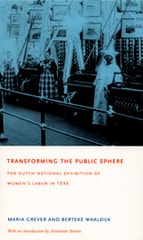
Transforming the Public Sphere
The Dutch National Exhibition of Women’s Labor in 1898Maria Grever and Berteke Waaldijk
Duke University Press, 2004
A comprehensive social history, Transforming the Public Sphere describes the planning and construction of the Exhibition of Women’s Labor and the event itself—the sights, the sounds, and the smells—as well as the role of exhibitions in late-nineteenth-century public culture. The authors discuss how the 1898 exhibition displayed the range and variety of women’s economic, intellectual, and artistic roles in Dutch culture, including their participation in such traditionally male professions as engineering, diamond-cutting, and printing and publishing. They examine how people and goods from the Dutch colonies were represented, most notably in an extensive open-air replica of a “Javanese village.” Grever and Waaldijk reveal the tensions the exhibition highlighted: between women of different economic classes; between the goal of equal rights for women and the display of imperial subjects and spoils; and between socialists and feminists, who competed fiercely with one another for working women’s support. Transforming the Public Sphere explores an event that served as the dress rehearsal for advances in women’s public participation during the twentieth century.
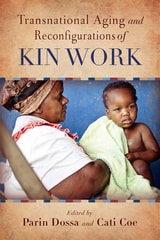
Transnational Aging and Reconfigurations of Kin Work
Dossa, Parin
Rutgers University Press, 2017