Results by title
425 books match the query 'Ethics' and 116 start with t
The Aesthetics of Meaning and Thought
The Bodily Roots of Philosophy, Science, Morality, and ArtMark Johnson
University of Chicago Press, 2018
This book gathers the best of philosopher Mark Johnson’s essays addressing questions of our embodiment as they deal with aesthetics—which, he argues, we need to rethink so that it takes into account the central role of body-based meaning. Viewed that way, the arts can give us profound insights into the processes of meaning making that underlie our conceptual systems and cultural practices. Johnson shows how our embodiment shapes our philosophy, science, morality, and art; what emerges is a view of humans as aesthetic, meaning-making creatures who draw on their deepest physical processes to make sense of the world around them.
The Altruism Reader
Selections from Writings on Love, Religion, and ScienceThomas Oord
Templeton Press, 2007
This anthology brings together, for the first time, leading essays and book chapters from theologians, philosophers, and scientists on their research on ethics, altruism, and love. Because the general consensus today is that scholarship in moral theory requires empirical research, the arguments of the leading scholars presented in this book will be fundamental to those examining issues in love, ethics, religion, and science.
The first half of The Altruism Reader offers essential selections from religious texts, leading contemporary scholars, and cutting-edge ethicists. Buddhism, Christianity, Hinduism, Islam, and Judaism are represented. Among the highly respected writers are Thomas Aquinas, the Dalai Lama, Thich Nhat Hanh, John Polkinghorne, Stephen Pope, Louis Fischer, Amira Shamma Abdin, Katharine Doob Sakenfeld, and Daniel Day Williams.
The book’s second half features primary readings on love and altruism from the sciences. Here the focus is on anthropology, psychology, sociology, biology, and neurology, with material written by Daniel C. Batson, David Sloan Wilson, Robert Wright, Stephen G. Post, Robert Axelrod, Richard Dawkins, Holmes Rolston III, and other renowned scientists and philosophers.
“Virtually all people act—and often talk—as if they have some clue about love. We speak about loving food, falling in love, loving God, feeling loved, and loving a type of music. We say that love hurts, love waits, love stinks, and love means never having to say you’re sorry. We use the word and its derivatives in a wide variety of ways . . . . My definition of love is this: To love is to act intentionally, in sympathetic response to others (including God), to promote well-being.” —Thomas Jay Oord

The American Moralist
On Law, Ethics, And GovernmentGeorge Anastaplo
Ohio University Press, 1994

The Art of Living in Avant-Garde Paris
Ethics and Self-Making in Dada, Simultanism, and SurrealismRachel Silveri
University of Chicago Press, 2026
With The Art of Living in Avant-Garde Paris, Rachel Silveri takes a fresh look at the desire to unify art and life, an ambition long regarded as foundational to the European historical avant-gardes. She reveals how many early twentieth-century artists saw their own everyday lives—their bodies, identities, and relationships—as a type of creative material and a central component to their avant-garde practice. These artists abandoned traditional forms of artmaking and venues of art viewing, instead aspiring to integrate art with everyday life, creating an “art of living.”
Considering Tristan Tzara’s performances of Dadaist identity, Sonia Delaunay’s simultaneous fashions and self-branding, and the collective endeavor to open and operate the Surrealist Research Bureau, Silveri offers a new narrative about how the artists of interwar Paris developed experiential life practices that resisted dominant forms of “lifestyle” and normative discourses surrounding gender, ethnicity, and office work. This book argues that ethical questions of “How should I live?” and “How should I relate to others?” were as important to the avant-garde as politics, and that aspirations to change the world played out in daily practices of self-making.
The Art of Time
Levinas, Ethics, and the Contemporary Peninsular NovelNina L. Molinaro
Bucknell University Press, 2019
Academicians and journalists in Spain and abroad have recently fastened on an emerging cluster of peninsular writers who, they argue, pertain to a discernible literary generation, provisionally referred to as Generación X. These writers are distinct from their predecessors; they and their literary texts are closely related to the specific socio-political and historical circumstances in Spain and their novels relate stories of more and less proximity, more and less responsibility, and more and less temporality. In short, they trace the temporal movement of alterity through narrative.
Published by Bucknell University Press. Distributed worldwide by Rutgers University Press.
The Best Effect
Theology and the Origins of ConsequentialismRyan Darr
University of Chicago Press, 2023
Consequentialism—the notion that we can judge an action by its effects alone—has been among the most influential approaches to ethics and public policy in the Anglophone world for more than two centuries. In The Best Effect, Ryan Darr argues that consequentialist ethics is not as secular or as rational as it is often assumed to be. Instead, Darr describes the emergence of consequentialism in the seventeenth century as a theological and cosmological vision and traces its intellectual development and eventual secularization across several centuries. The Best Effect reveals how contemporary consequentialism continues to bear traces of its history and proposes in its place a more expansive vision for teleological ethics.

The Best of All Possible Worlds
Mathematics and DestinyIvar Ekeland
University of Chicago Press, 2006
Optimists believe this is the best of all possible worlds. And pessimists fear that might really be the case. But what is the best of all possible worlds? How do we define it? Is it the world that operates the most efficiently? Or the one in which most people are comfortable and content? Questions such as these have preoccupied philosophers and theologians for ages, but there was a time, during the seventeenth and eighteenth centuries, when scientists and mathematicians felt they could provide the answer.
This book is their story. Ivar Ekeland here takes the reader on a journey through scientific attempts to envision the best of all possible worlds. He begins with the French physicist Maupertuis, whose least action principle asserted that everything in nature occurs in the way that requires the least possible action. This idea, Ekeland shows, was a pivotal breakthrough in mathematics, because it was the first expression of the concept of optimization, or the creation of systems that are the most efficient or functional. Although the least action principle was later elaborated on and overshadowed by the theories of Leonhard Euler and Gottfried Leibniz, the concept of optimization that emerged from it is an important one that touches virtually every scientific discipline today.
Tracing the profound impact of optimization and the unexpected ways in which it has influenced the study of mathematics, biology, economics, and even politics, Ekeland reveals throughout how the idea of optimization has driven some of our greatest intellectual breakthroughs. The result is a dazzling display of erudition—one that will be essential reading for popular-science buffs and historians of science alike.
The Big Data Agenda
Data Ethics and Critical Data StudiesAnnika Richterich
University of Westminster Press, 2018
This book highlights that the capacity for gathering, analysing, and utilising vast amounts of digital (user) data raises significant ethical issues. Annika Richterich provides a systematic contemporary overview of the field of critical data studies that reflects on practices of digital data collection and analysis. The book assesses in detail one big data research area: biomedical studies, focused on epidemiological surveillance. Specific case studies explore how big data have been used in academic work.
The Big Data Agenda concludes that the use of big data in research urgently needs to be considered from the vantage point of ethics and social justice. Drawing upon discourse ethics and critical data studies, Richterich argues that entanglements between big data research and technology/ internet corporations have emerged. In consequence, more opportunities for discussing and negotiating emerging research practices and their implications for societal values are needed.
An electronic version of this book is freely available, thanks to the support of libraries working with Knowledge Unlatched. KU is a collaborative initiative designed to make high quality books Open Access for the public good. More information about the initiative and details about KU's Open Access programme can be found at www.knowledgeunlatched.org.

The Burden of Responsibility
Blum, Camus, Aron, and the French Twentieth CenturyTony Judt
University of Chicago Press, 1998
Through the prism of the lives of Leon Blum, Albert Camus, and Raymond Aron, Judt examines pivotal issues in the history of contemporary French society—antisemitism and the dilemma of Jewish identity, political and moral idealism in public life, the Marxist moment in French thought, the traumas of decolonization, the disaffection of the intelligentsia, and the insidious quarrels rending Right and Left. Judt focuses particularly on Blum's leadership of the Popular Front and his stern defiance of the Vichy governments, on Camus's part in the Resistance and Algerian War, and on Aron's cultural commentary and opposition to the facile acceptance by many French intellectuals of communism's utopian promise. Severely maligned by powerful critics and rivals, each of these exemplary figures stood fast in their principles and eventually won some measure of personal and public redemption.
Judt constructs a compelling portrait of modern French intellectual life and politics. He challenges the conventional account of the role of intellectuals precisely because they mattered in France, because they could shape public opinion and influence policy. In Blum, Camus, and Aron, Judt finds three very different men who did not simply play the role, but evinced a courage and a responsibility in public life that far outshone their contemporaries.
"An eloquent and instructive study of intellectual courage in the face of what the author persuasively describes as intellectual irresponsibility."—Richard Bernstein, New York Times

The Company Doctor
Risk, Responsibility, and Corporate ProfessionalismElaine Draper
Russell Sage Foundation, 2003
The Creativity Complex
Art, Tech, and the Seduction of an IdeaShannon Steen
University of Michigan Press, 2023
“Creativity” is a word that excites and dazzles us. It promises brilliance and achievement, a shield against conformity, a channel for innovation across the arts, sciences, technology, and education, and a mechanism for economic revival and personal success. But it has not always evoked these ideas. The Creativity Complex traces the history of how creativity has come to mean the things it now does, and explores the ethical implications of how we use this term today for both the arts and for the social world more broadly. Richly researched, the book explores how creativity has been invoked in arenas as varied as Enlightenment debates over the nature of cognition, Victorian-era intelligence research, the Cold War technology race, contemporary K-12 education, and even modern electoral politics. Ultimately, The Creativity Complex asks how our ideas about creativity are bound up with those of self-fulfillment, responsibility, and the individual, and how these might seduce us into joining a worldview and even a set of social imperatives that we might otherwise find troubling.

The Decision Between Us
Art and Ethics in the Time of ScenesJohn Paul Ricco
University of Chicago Press, 2014
Laying out this theory of “unbecoming community” in modern and contemporary art, literature, and philosophy, and calling our attention to such things as blank sheets of paper, images of unmade beds, and the spaces around bodies, The Decision Between Us opens in 1953, when Robert Rauschenberg famously erased a drawing by Willem de Kooning, and Roland Barthes published Writing Degree Zero, then moves to 1980 and the “neutral mourning” of Barthes’ Camera Lucida, and ends in the early 1990s with installations by Felix Gonzalez-Torres. Offering surprising new considerations of these and other seminal works of art and theory by Jean Genet, Marguerite Duras, and Catherine Breillat, The Decision Between Us is a highly original and unusually imaginative exploration of the spaces between us, arousing and evoking an infinite and profound sense of sharing in scenes of passionate, erotic pleasure as well as deep loss and mourning.
The Dialectical Necessity of Morality
An Analysis and Defense of Alan Gewirth's Argument to the Principle of Generic ConsistencyDeryck Beyleveld
University of Chicago Press, 1991
Beyleveld then classifies all the criticisms that Gewirth's argument has received and measures them against his reconstruction of the argument. The overall result is an immensely rich picture of the argument, in which all of its complex issues and key moves are clearly displayed and its validity can finally be discerned.
The comprehensiveness of Beyleveld's treatment provides ready access to the entire debate surrounding the foundational argument of Reason and Morality. It will be required reading for all who are interested in Gewirth's theory and deontological ethics and will be of central importance to moral and legal theorists.
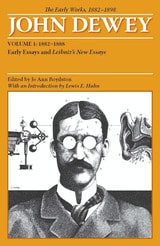
The Early Works of John Dewey, Volume 1, 1882 - 1898
Early Essays and Leibniz's New Essays, 1882-1888John Dewey. Edited by Jo Ann Boydston
Southern Illinois University Press, 2008
Volume 1 of “The Early Works of John Dewey, 1882–1898” is entitled “Early Essays and Leibniz’s New Essays Concerning the Human Understanding, 1882–1888.” Included here are all Dewey’s earliest writings, from his first published article through his book on Leibniz.
The materials in this volume provide a chronological record of Dewey’s early development—beginning with the article he sent to the Journal of Speculative Philosophy in 1881 while he was a high-school teacher in Oil City, Pennsylvania, and closing with his widely-acclaimed work on Leibniz in the Grigg’s Series of German Philosophical Classics, written when he was an Assistant Professor at the University of Michigan. During these years between 1882 and 1888, Dewey’s life course was established: he decided to follow a career in philosophy, completed doctoral studies at Johns Hopkins University, became an Instructor at the University of Michigan, was promoted to Assistant Professor, and accepted a position as Chairman of the Department of Philosophy at the University of Minnesota. With the publication of Psychology, he became well known among scholars in this country; a series of articles in the British journal Mind brought him prominence in British philosophical circles. His articles were abstracted in the Revue philosophique.
None of the articles collected in this volume was reprinted during the author’s lifetime. For the first time, it is now possible for Dewey scholars to study consecutively in one publication all the essays which originally appeared in many periodicals.
The Early Works of John Dewey, Volume 2, 1882 - 1898
Psychology, 1887John Dewey. Edited by Jo Ann Boydston
Southern Illinois University Press, 2008
With an original publication date of 1887, Psychology us Volume 2 of "The Early Works." It appears first in the series to introduce scholars and general readers to the use of modern textual criticism in a work outside the literary field. Designed as a "scholar's reading edition," the volumes presents the text of Dewey's work as the author intended, clear of editorial footnotes. All apparatus is conveniently arranged in appendix form. As evidence of its wide adoption and use as a college textbook, Psychology had a publishing history of twenty-six printings. For two of the reprintings, Dewey made extensive revisions in content to incorporate developments in the field of psychology as well as in his own thinking. The textual appendices include a thorough tabulation of these changes and detailed evidence for editorial decisions.
In recognition of the high quality and scholarly standards of the textual editing, this edition of Psychology is the first nonliterary work awarded the Seal of the Modern Language Association Center for Editions of American Authors. By applying to the work of a philosopher the procedures used in modern textual editions of American writers such as Hawthorne, the Southern Illinois University Dewey edition is establishing a pattern for future collected editions of the writings of American philosophers.
At the time Dewey wrote Psychology, the relation between psychology and philosophy was in dispute, and he attempted to incorporate the new physiological psychology represented by G. Stanley Hall into the philosophical system and ethics of George Sylvester Morris. He wrote in May, 1886, that he wanted his textbook in psychology to be one "with the greatest possible unity of principle, so that without ceasing to be a psychology, it shall be an introduction to philosophy in general." His goal, expressed in these terms, foreshadowed the direction of his work in the years that followed, with its continuing emphasis on the interrelations among the various disciplines rather than on separate specializations. In his long and fruitful professional career, this was to be his only attempt to treat the whole field of psychology systematically. Although he maintained a lively interest in psychology, that interest was expressed in connection with his writing in other areas such as ethics, education, logic, social philosophy and aesthetics.
The Early Works of John Dewey, Volume 3, 1882 - 1898
Essays and Outlines of a Critical Theory of Ethics, 1889-1892John Dewey. Edited by Jo Ann Boydston
Southern Illinois University Press, 2008
This third volume in the definitive edition of Dewey’s early work opens with his tribute to George Sylvester Morris, the former teacher who had brought Dewey to the University of Michigan. Morris’s death in 1889 left vacant the Department of Philosophy chairmanship and led to Dewey’s returning to fill that post after a year’s stay at Minnesota.
Appearing here, among all his writings from 1889 through 1892, are Dewey’s earliest comprehensive statements on logic and his first book on ethics. Dewey’s marked copy of the galley-proof for his important article “The Present Position of Logical Theory,” recently discovered among the papers of the Open Court Publishing Company, is used as the basis for the text, making available for the first time his final changes and corrections.
The textual studies that make The Early Works unique among American philosophical editions are reported in detail. One of these, “A Note on Applied Psychology,” documents the fact that Dewey did not co-author this book frequently attributed to him. Six brief unsigned articles written in 1891 for a University of Michigan student publication, the Inlander, have been identified as Dewey’s and are also included in this volume. In both style and content, these articles reflect Dewey’s conviction that philosophy should be used as a means of illuminating the contemporary scene; thus they add a new dimension to present knowledge of his early writing.
The Early Works of John Dewey, Volume 4, 1882 - 1898
Early Essays and The Study of Ethics, A Syllabus, 1893-1894John Dewey. Edited by Jo Ann Boydston
Southern Illinois University Press, 2008
Volume 4 of’ “The Early Works” series covers the period of Dewey’s last year and one-half at the University of Michigan and his first half-year at the University of Chicago. In addition to sixteen articles the present volume contains Dewey’s reviews of six books and three articles, verbatim reports of three oral statements made by Dewey, and a full-length book, The Study of Ethics.
Like its predecessors in this series, this volume presents a “clear text,” free of interpretive or reference material. Apparatus, including references, corrections, and emendations, is confined to appendix material. Fredson Bowers, the Consulting Textual Editor, has provided an essay on the textual principles and procedures, and Wayne A. R. Leys, Professor of Philosophy at Southern Illinois University, has written an Introduction discussing the relationship between Dewey’s writings of this period and his later work. That Dewey’s scholarship and writing was at an especially high level during 1893 and 1894 may be considered an index to the significance of this two-year period.
The Early Works of John Dewey, Volume 5, 1882 - 1898
Early Essays, 1895-1898John Dewey. Edited by Jo Ann Boydston
Southern Illinois University Press, 2008
This fifth and concluding volume of “The Early Works of John Dewey” is the only one of the series made up entirely of essays. The appearance during the four-year period, 1895–98, of thirty-eight items amply indicates that Dewey continued to maintain a high level of published output. These were the years of Dewey’s most extensive work and involvement at the University of Chicago.
Like its predecessors in this series, this volume presents a “clear text,” free of interpretive or reference material. Apparatus, including references, corrections, and emendations, is confined to appendix material. Fredson Bowers, the Consulting Textual Editor, has provided an essay on the textual principles and procedures, and William P. McKenzie, Professor of Philosophy and Education at Southern Illinois University, has written an introduction identifying the thread connecting the apparently diffuse material in the many articles of this volume—Dewey’s attempt to unite philosophy with psychology and sociology and with education.
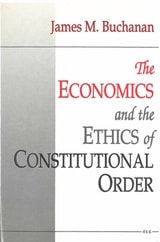
The Economics and the Ethics of Constitutional Order
James M. Buchanan
University of Michigan Press, 1991
The Ecosystem Approach in Anthropology serves as a foundational methodology guide for modern ecological and environmental anthropology. The book advocates for a rigorous, integrative approach to studying human societies by framing them as deeply interconnected components of larger biological ecosystems. Moran gathers a diverse cohort of leading researchers to demonstrate how abstract ecosystem concepts can be translated into concrete, empirical field practices across varying environments, ranging from tropical rainforests to arid landscapes. By bridging the gap between cultural anthropology and natural sciences like ecology, soil science, and demography, the volume offers critical frameworks for quantifying energy flows, resource consumption, and human-environmental feedback loops, making it an indispensable resource for analyzing complex social-ecological systems and anthropogenic environmental changes.

The Economics and the Ethics of Constitutional Order
James M. Buchanan
University of Michigan Press, 1991
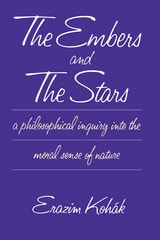
The Embers and the Stars
Erazim Kohák
University of Chicago Press, 1987
"Those who share Kohák's concern to understand nature as other than a mere resource or matter in motion will find his temporally oriented interpretation of nature instructive. It is here in particular that Kohák turns moments of experience to account philosophically, turning what we habitually overlook or avoid into an opportunity and basis for self-knowledge. This is an impassioned attempt to see the vital order of nature and the moral order of our humanity as one."—Ethics
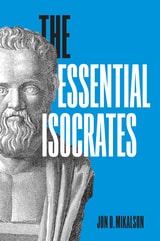
The Essential Isocrates
Jon D. Mikalson
University of Texas Press, 2022
The Essential Isocrates is a comprehensive introduction to Isocrates, one of ancient Greece’s foremost orators. Jon D. Mikalson presents Isocrates largely in his own words, with original English translations of selections of his writings on his life and times and on morality, religion, philosophy, rhetoric, education, political theory, and Greek and Athenian history. In Mikalson’s treatment, Isocrates receives his due not only as a major thinker but as one whose work has resonated across time, influencing even modern education practices and theory.
Isocrates wrote extensively about Athens in the fourth century BCE and before, and his speeches, letters, and essays provide a trove of insights concerning the intellectual, political, and social currents of his time. Mikalson details what we know about Isocrates’s long, eventful, and complicated life, and much can be gleaned on the personal level from his own writings, as Isocrates was one of the most introspective authors of the Classical Period. By collecting the most representative and important passages of Isocrates’s writings, arranging them topically, and placing them in historical context, The Essential Isocrates invites general and expert readers alike to engage with one of antiquity’s most compelling men of ideas.

The Ethical Case against Animal Experiments
Andrew Linzey, Clair Linzey
University of Illinois Press, 2018
The Ethical Case against Animal Experiments begins with the Oxford Centre for Animal Ethics's groundbreaking and comprehensive ethical critique of the practice of animal experiments. A second section offers original writings that engage with, and elaborate on, aspects of the Oxford Centre report. The essayists explore historical, philosophical, and personal perspectives that range from animal experiments in classical times to the place of necessity in animal research to one researcher's painful journey from researcher to opponent.
A devastating look at a contemporary moral crisis, The Ethical Case against Animal Experiments melds logic and compassion to mount a powerful challenge to human cruelty.
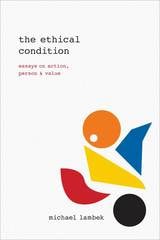
The Ethical Condition
Essays on Action, Person, and ValueMichael Lambek
University of Chicago Press, 2015
Organized chronologically, the essays begin among Malagasy speakers on the island of Mayotte and in northwest Madagascar. Building from ethnographic accounts there, they synthesize Aristotelian notions of practical judgment and virtuous action with Wittgensteinian notions of the ordinariness of ethical life and the importance of language, everyday speech, and ritual in order to understand how ethics are lived. They illustrate the multiple ways in which ethics informs personhood, character, and practice; explore the centrality of judgment, action, and irony to ethical life; and consider the relation of virtue to value. The result is a fully fleshed-out picture of ethics as a deeply rooted aspect of the human experience.
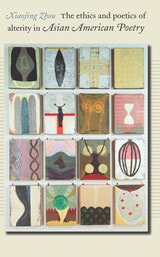
The Ethics and Poetics of Alterity in Asian American Poetry
Xiaojing Zhou
University of Iowa Press, 2006
Poetry by Asian American writers has had a significant impact on the landscape of contemporary American poetry, and a book-length critical treatment of Asian American poetry is long overdue. In this groundbreaking book, Xiaojing Zhou demonstrates how many Asian American poets transform the conventional “I” of lyric poetry—based on the traditional Western concept of the self and the Cartesian “I”—to enact a more ethical relationship between the “I” and its others.
Drawing on Emmanuel Levinas’s idea of the ethics of alterity—which argues that an ethical relation to the other is one that acknowledges the irreducibility of otherness—Zhou offers a reconceptualization of both self and other. Taking difference as a source of creativity and turning it into a form of resistance and a critical intervention, Asian American poets engage with broader issues than the merely poetic. They confront social injustice against the other and call critical attention to a concept of otherness which differs fundamentally from that underlying racism, sexism, and colonialism. By locating the ethical and political questions of otherness in language, discourse, aesthetics, and everyday encounters, Asian American poets help advance critical studies in race, gender, and popular culture as well as in poetry.
The Ethics and Poetics of Alterity is not limited, however, to literary studies: it is an invaluable response to the questions raised by increasingly globalized encounters across many kinds of boundaries.
The Poets
Marilyn Chin, Kimiko Hahn, Myung Mi Kim, Li Young Lee, Timothy Liu, David Mura, and John Yau
The Ethics and Politics of Speech
Communication and Rhetoric in the Twentieth CenturyPat J. Gehrke
Southern Illinois University Press, 2009
In The Ethics and Politics of Speech, Pat J. Gehrke provides an accessible yet intensive history of the speech communication discipline during the twentieth century. Drawing on several previously unpublished or unexamined sources—including essays, conference proceedings, and archival documents—Gehrke traces the evolution of communication studies and the dilemmas that often have faced academics in this field. In his examination, Gehrke not only provides fresh perspectives on old models of thinking; he reveals new methods for approaching future studies of ethical and political communication.
Gehrke begins his history with the first half of the twentieth century, discussing the development of a social psychology of speech and an ethics based on scientific principles, and showing the importance of democracy to teaching and scholarship at this time. He then investigates the shift toward philosophical—especially existential—ways of thinking about communication and ethics starting in the 1950s and continuing through the mid-1970s, a period associated with the rise of rhetoric in the discipline. In the chapters covering the last decades of the twentieth century, Gehrke demonstrates how the ethics and politics of communication were directed back onto the practices of scholarship within the discipline, examining the increased use of postmodern and poststructuralist theories, as well as the new trend toward writing original theory, rather than reinterpreting the past. In offering a thorough history of rhetoric studies, Gehrke sets the stage for new questions and arguments, ultimately emphasizing the deeply moral and political implications that by nature embed themselves in the field of communication.
More than simply a history of the discipline's major developments, The Ethics and Politics of Speech is an account of the philosophical and moral struggles that have faced communication scholars throughout the last century. As Gehrke explores the themes and movements within rhetoric and speech studies of the past, he also provides a better understanding of the powerful forces behind the forging of the field. In doing so, he reveals history’s potential to act as a vehicle for further academic innovation in the future.

The Ethics of Autobiography
Replacing the Subject in Modern SpainAngel G. Loureiro
Vanderbilt University Press, 2000
To address this oversight, Loureiro draws from his own experiences as well as from a wide range of previous theoretical works on autobiography, especially from the writings of Emmanuel Levinas, who believed that the self does not begin as a self-positing consciousness but as a response to an address from the other. On this basis, Loureiro then brilliantly traces the complex interplays between the political, discursive, rhetorical, and ethical dimensions of autobiography.
After laying out these theoretical foundations, Loureiro puts them to work in analyzing four of the most fascinating autobiographies written by Spanish exiles: The Life of Joseph Blanco White, who lived from 1775 to 1841, Memoria de la Melancolia by Maria Teresa Leon (1904-1988), Coto vedado and En los reinos de taifa by Juan Goytisolo (born 1931), and Literature or Life by Jorge Semprun (born 1923). The lives of these authors, all of whom were exiled for political reasons, were disrupted by some of the most crucial events in Spain's tortuous road to modernity and democracy.
The book closes with a discussion of why there have been so few critical examinations of autobiographies written in modern Spain. Loureiro proposes that, even in today's Spain, stifling social and political forces smother ethical responsibility, which is an essential ingredient in creating autobiographies that dare to be more than a humdrum inventory of personal recollections. Only in exile have Spanish authors seemed able to find the conditions to write their lives in a truly responsible manner. This answer to a call that grounds the subject in an other is ultimately the only form of truth available in autobiography.
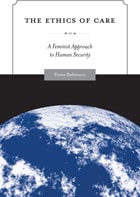
The Ethics of Care
A Feminist Approach to Human SecurityFiona Robinson
Temple University Press, 2011
In The Ethics of Care, Fiona Robinson demonstrates how the responsibilities of sustaining life are central to the struggle for basic human security. She takes a unique approach, using a feminist lens to challenge gender biases in rights-based, individualist approaches.Robinson's thorough and impassioned consideration of care in both ethical and practical terms provides a starting point for understanding and addressing the material, emotional and psychological conditions that create insecurity for people. The Ethics of Careexamines “care ethics” and “security” at the theoretical level and explores the practical implications of care relations for security in a variety of contexts: women's labor in the global economy, humanitarian intervention and peace building, healthcare, and childcare.
Theoretically-innovative and policy-relevant, this critical analysis demonstrates the need to understand the obstacles and inequalities that obstruct the equitable and adequate delivery of care around the world.

The Ethics of Earth Art
Amanda Boetzkes
University of Minnesota Press, 2010
The Ethics of History
John McCumber
Northwestern University Press, 2004
The Ethics of Intensity in American Fiction
By Anthony Channell Hilfer
University of Texas Press, 1981
Drawing upon the philosophical theories of William James, Dewey, and Mead and focusing upon major works by Whitman, Stein, Howells, Dreiser, and Henry James, Anthony Hilfer explores how these authors have structured their characters' consciousness, their purpose in doing so, and how this presentation controls the reader's moral response.
Hilfer contends that there was a significant change in the mode of character presentation in American literature of the late nineteenth and early twentieth centuries. The self defined in terms of a Victorian ethic and judged adversely for its departures from that code shifted to the self defined in terms of emotional intensity and judged adversely for its failures of nerve. In the first mode, characters are almost always wrong to yield to desire; in the second, characters are frequently wrong not to and, in fact, are seen less as the sum of their ethical choices than as the process of their longings.
His conclusion: modern fiction is as overbalanced toward pathos as Victorian fiction was toward ethos. but the continued dialectic between the two is a tension that ought not be resolved.
The Ethics of Oneness
Emerson, Whitman, and the Bhagavad GitaJeremy David Engels
University of Chicago Press, 2021
In The Ethics of Oneness, Jeremy David Engels reads the Bhagavad Gita alongside the works of American thinkers Ralph Waldo Emerson and Walt Whitman. Drawing on this rich combination of traditions, Engels presents the notion that individuals are fundamentally interconnected in their shared divinity. In other words, everything is one. If the lessons of oneness are taken to heart, particularly as they were expressed and celebrated by Whitman, and the ethical challenges of oneness considered seriously, Engels thinks it is possible to counter the pervasive and problematic American ideals of hierarchy, exclusion, violence, and domination.
The Ethics of Organ Transplantation
Steven J. Jensen
Catholic University of America Press, 2011
The Ethics of Persuasion
Derrida's Rhetorical LegaciesBrooke Rollins
The Ohio State University Press, 2020
Drawing on Derrida’s (non)definition of ethics and his pointed accounts of performativity, Rollins argues that this vital ethical component of many ancient theories, practices, and pedagogies of persuasion has been undertheorized for more than two millennia. Through deconstructive readings of some of these texts, she shows us that we are not simply sovereign beings who both wield and guard against linguistic techniques of rule. Our persuasive endeavors, rather, are made possible by an ethics—an always prior encounter with otherness that interrupts self-presence.
The Ethics of Postmodernity
Current Trends in Continental ThoughtGary B. Madison and Marty Fairbarn
Northwestern University Press, 1997
Contributors include Barry Allen, Caroline Bayard, Robert Bernasconi, Thomas W. Busch, M.C. Dillon, Marty Fairbairn, Paul Fairfield, Morny Joy, Richard Kearney, Gary B. Madison, Joseph Margolis, Tom Rockmore, Charles E. Scott, Evan Simpson, and Mark Williams.
The Ethics of Space
Homelessness and Squatting in Urban EnglandSteph Grohmann
HAU, 2020
Set against the backdrop of economic crisis, austerity, and a disintegrating British state, Steph Grohmann tells the story of a flourishing squatter community in the city of Bristol and how it was eventually outlawed by the state. The first ethnography of homelessness done by a researcher who was formally homeless throughout fieldwork, this volume explores the intersection between spatial existence, subjectivity, and ethics. The result is a book that rethinks how ethical views are shaped and constructed through our own spatial existences.

The Ethics of St. Thomas Aquinas
Happiness, Natural Law, and the VirtuesLeo Elders
Catholic University of America Press, 2019
The Ethics of Swagger
Prizewinning African American Novels, 1977–1993Michael DeRell Hill
The Ohio State University Press, 2013

The Ethics of Witnessing
The Holocaust in Polish Writers' Diaries from Warsaw, 1939-1945Rachel Feldhay Brenner
Northwestern University Press, 2014
Winner, 2015 USC Book Award in Literary and Cultural Studies, for outstanding monograph published on Russia, Eastern Europe or Eurasia in the fields of literary and cultural studies
The Ethics of Witnessing investigates the reactions of five important Polish diaristswriters—Jaroslaw Iwaszkiewicz, Maria Dabrowska, Aurelia Wylezynska, Zofia Nalkowska, and Stanislaw Rembek—during the period when the Nazis persecuted and murdered Warsaw’s Jewish population. The responses to the Holocaust of these prominent prewar authors extended from insistence on empathic interaction with victims to resentful detachment from Jewish suffering. Whereas some defied the dehumanization of the Jews and endeavored to maintain intersubjective relationships with the victims they attempted to rescue, others selfdeceptively evaded the Jewish plight. The Ethics of Witnessing examines the extent to which ideologies of humanism and nationalism informed the diarists’ perceptions, proposing that the reality of the Final Solution exposed the limits of both orientations and ultimately destroyed the ethical landscape shaped by the Enlightenment tradition, which promised the equality and fellowship of all human beings.
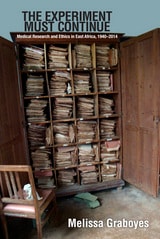
The Experiment Must Continue
Medical Research and Ethics in East Africa, 1940–2014Melissa Graboyes
Ohio University Press, 2015
The Experiment Must Continue is a beautifully articulated ethnographic history of medical experimentation in East Africa from 1940 through 2014. In it, Melissa Graboyes combines her training in public health and in history to treat her subject with the dual sensitivities of a medical ethicist and a fine historian. She breathes life into the fascinating histories of research on human subjects, elucidating the hopes of the interventionists and the experiences of the putative beneficiaries.
Historical case studies highlight failed attempts to eliminate tropical diseases, while modern examples delve into ongoing malaria and HIV/AIDS research. Collectively, these show how East Africans have perceived research differently than researchers do and that the active participation of subjects led to the creation of a hybrid ethical form.
By writing an ethnography of the past and a history of the present, Graboyes casts medical experimentation in a new light, and makes the resounding case that we must readjust our dominant ideas of consent, participation, and exploitation. With global implications, this lively book is as relevant for scholars as it is for anyone invested in the place of medicine in society.

The Foundations of Natural Morality
On the Compatibility of Natural Rights and the Natural LawS. Adam Seagrave
University of Chicago Press, 2014
With The Foundations of Natural Morality, S. Adam Seagrave addresses this controversy, offering an entirely new account of natural morality that compellingly unites the concepts of natural law and natural rights. Seagrave agrees with Strauss that the idea of natural rights is distinctly modern and does not derive from traditional natural law. Despite their historical distinctness, however, he argues that the two ideas are profoundly compatible and that the thought of John Locke and Thomas Aquinas provides the key to reconciling the two sides of this long-standing debate. In doing so, he lays out a coherent concept of natural morality that brings together thinkers from Plato and Aristotle to Hobbes and Locke, revealing the insights contained within these disparate accounts as well as their incompleteness when considered in isolation. Finally, he turns to an examination of contemporary issues, including health care, same-sex marriage, and the death penalty, showing how this new account of morality can open up a more fruitful debate.

The Fragile We
Ethical Implications Of Heidegger's "Being and Time"Lawrence Vogel
Northwestern University Press, 1994
In The Fragile "We": Ethical Implications of Heidegger's "Being and Time," Lawrence Vogel presents three interpretations of authentic existence—the existentialist, the historicist, and the cosmopolitan—each of which is a plausible version of the personal ideal depicted in Being and Time. He then draws parallels between these interpretations and three moments in the contemporary liberal-communitarian debate over the relationship of the "I" and the "We." His book contributes both to a diagnosis of what there is about Being and Time that invites moral nihilism and to a sense of how fundamental ontology might be recast so that "the other" is accorded an appropriate place in an account of human existence.

The Genesis of Values
Hans Joas
University of Chicago Press, 2001

The Global Guide to Animal Protection
Edited by Andrew Linzey
University of Illinois Press, 2013
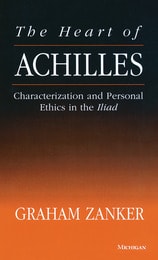
The Heart of Achilles
Characterization and Personal Ethics in the IliadGraham Zanker
University of Michigan Press, 1996
"[Zanker] investigates altruistic behavior in the epic with professional sophistication but in a way that makes his investigation available to a wide audience from undergraduates to advanced scholars. . . . [A] very useful interpretative study." --Choice
Graham Zanker is Senior Lecturer in Classics, University of Canterbury, New Zealand.
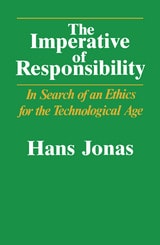
The Imperative of Responsibility
In Search of an Ethics for the Technological AgeHans Jonas
University of Chicago Press, 1984
Hans Jonas here rethinks the foundations of ethics in light of the awesome transformations wrought by modern technology: the threat of nuclear war, ecological ravage, genetic engineering, and the like. Though informed by a deep reverence for human life, Jonas's ethics is grounded not in religion but in metaphysics, in a secular doctrine that makes explicit man's duties toward himself, his posterity, and the environment. Jonas offers an assessment of practical goals under present circumstances, ending with a critique of modern utopianism.
The Journal of Clinical Ethics, volume 34 number 1 (Spring 2023)
The University of Chicago Press
University of Chicago Press Journals, 2023
The Journal of Clinical Ethics, volume 34 number 2 (Summer 2023)
The University of Chicago Press
University of Chicago Press Journals, 2023
The Journal of Clinical Ethics, volume 34 number 3 (Fall 2023)
The University of Chicago Press
University of Chicago Press Journals, 2023
The Journal of Clinical Ethics, volume 34 number 4 (Winter 2023)
The University of Chicago Press
University of Chicago Press Journals, 2023