Results by title
52 books match the query 'Fish' and 10 start with t
The Albatross and the Fish
Linked Lives in the Open SeasBy Robin W. Doughty and Virginia Carmichael
University of Texas Press, 2011
Breeding on remote ocean islands and spending much of its life foraging for food across vast stretches of seemingly empty seas, the albatross remains a legend for most people. And yet, humans are threatening the albatross family to such an extent that it is currently the most threatened bird group in the world. In this extensively researched, highly readable book, Robin W. Doughty and Virginia Carmichael tell the story of a potentially catastrophic extinction that has been interrupted by an unlikely alliance of governments, conservation groups, and fishermen.
Doughty and Carmichael authoritatively establish that the albatross's fate is linked to the fate of two of the highest-value table fish, Bluefin Tuna and Patagonian Toothfish, which are threatened by unregulated commercial harvesting. The authors tell us that commercial fishing techniques are annually killing tens of thousands of albatrosses. And the authors explain how the breeding biology of albatrosses makes them unable to replenish their numbers at the rate they are being depleted. Doughty and Carmichael set the albatross's fate in the larger context of threats facing the ocean commons, ranging from industrial overfishing to our habit of dumping chemicals, solid waste, and plastic trash into the open seas. They also highlight the efforts of dedicated individuals, environmental groups, fishery management bodies, and governments who are working for seabird and fish conservation and demonstrate that these efforts can lead to sustainable solutions for the iconic seabirds and the entire ocean ecosystem.
The Alewives' Tale
The Life History and Ecology of River Herring in the NortheastBarbara Brennessel
University of Massachusetts Press, 2014
The Alewives' Tale describes the plight of alewives and blueback herring, two fish species that have similar life histories and are difficult to distinguish by sight. Collectively referred to as river herring, they have been economically important since colonial times as food, fertilizer, and bait. In recent years they have attracted much attention from environmentalists, especially as attempts are being made, on and beyond Cape Cod, to restore the rivers, streams, ponds, lakes, and estuaries that are crucial for their reproduction and survival.
Brennessel provides an overview of the biology of the fish—from fertilized eggs to large schools of adults that migrate in the Atlantic Ocean—while describing the habitats at different stages of their life history. She explores the causes of the dramatic decline of river herring since the mid-twentieth century and the various efforts to restore these iconic fish to the historic populations that treated many onlookers to spectacular inland migrations each spring.
The Biology of Sharks and Rays
A. Peter Klimley
University of Chicago Press, 2013
The book will be a useful textbook for advanced ichthyology students as well as an encyclopedic source for those seeking a greater understanding of these fascinating creatures.
The Freshwater Mussels of Ohio
G. Thomas Watters, Michael A. Hoggarth, and David H. Stansbery
The Ohio State University Press, 2009
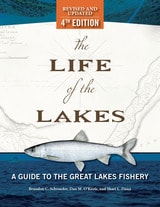
The Life of the Lakes, 4th Ed.
A Guide to the Great Lakes FisheryBrandon C. Schroeder, Dan M. O'Keefe, and Shari L. Dann
University of Michigan Press, 2019
Now in its fourth edition, The Life of the Lakes examines the complex portrait of the Great Lakes fishery, including the history of the fishery’s exploitation and management, the current health of the Lakes, and the outlook for the future. Featuring more graphics, photos, and illustrations than ever, all printed in full color, the new edition of this engaging book is a perfect resource for general readers, teachers, and students looking for an easy-to-follow guide to the Great Lakes fishery. This book is published in collaboration with Michigan Sea Grant (www.michiganseagrant.org), a cooperative program of the University of Michigan and Michigan State University.
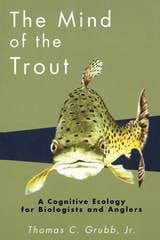
The Mind of the Trout
A Cognitive Ecology for Biologists and AnglersThomas C. Grubb, Jr.
University of Wisconsin Press, 2003
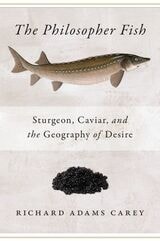
The Philosopher Fish
Sturgeon, Caviar, and the Geography of DesireRichard Adams Carey
Brandeis University Press, 2024
From the acclaimed eco-journalist Rick Carey comes a fascinating chronicle of a fast-disappearing fish—and of the people whose lives and livelihoods depend on it. Since the days of the Persian Empire, caviar has trumpeted status, wealth, prestige, and sex appeal. In this remarkable journey to caviar’s source, Carey immerses himself in the world of the sturgeon, the fish that lays these golden eggs. The sturgeon has a fascinating biological past—and a very uncertain future. Sturgeon populations worldwide have declined seventy percent in the last twenty years. Meanwhile, the beluga sturgeon, producer of the most coveted caviar, has climbed to number four on the World Wildlife Fund’s most-endangered species list. A high-stakes cocktail of business, crime, diplomacy, technology, and the dilemmas of conservation, The Philosopher Fish is the epic story of a 250-million-year-old fish struggling to survive.
This new edition includes new chapters bringing up to date the story of this elusive and mysterious fish, and the people involved with both preserving and exploiting it.
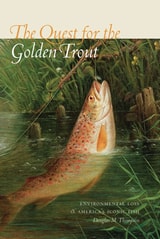
The Quest for the Golden Trout
Environmental Loss and America’s Iconic FishDouglas M. Thompson
University Press of New England, 2013
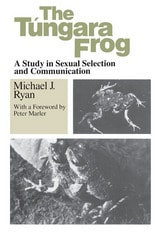
The Tungara Frog
A Study in Sexual Selection and CommunicationMichael J. Ryan
University of Chicago Press, 1985
In TheTúngara Frog, the most detailed and informative single study available of frogs and their reproductive behavior, Michael J. Ryan demonstrates the interplay of sexual and natural selection. Using techniques from ethology, behavioral ecology, sensory physiology, physiological ecology, and theoretical population genetics in his research, Ryan shows that large males with low-frequency calls mate most successfully. He examines in detail a number of explanations for the females' preferences, and he considers possible evolutionary forces leading to the males' success.
Though certain vocalizations allow males to obtain mates and thus should be favored by sexual selection, this study highlights two important costs of such sexual displays: the frogs expand considerable energy in their mating calls, and they advertise their whereabouts to predators. Ryan considers in detail how predators, especially the frige-lipped bat (Trachops cirrhosus), affect the evolution of the túngara frog's calls.
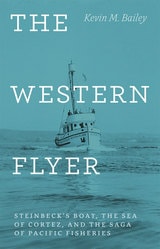
The Western Flyer
Steinbeck's Boat, the Sea of Cortez, and the Saga of Pacific FisheriesKevin M. Bailey
University of Chicago Press, 2015
In this book, Kevin M. Bailey resurrects this forgotten witness to the changing tides of Pacific fisheries. He draws on the Steinbeck archives, interviews with family members of crew, and more than three decades of working in Pacific Northwest fisheries to trace the depletion of marine life through the voyages of a single ship. After Steinbeck and his friend Ed Ricketts—a pioneer in the study of the West Coast’s diverse sea life and the inspiration behind “Doc” in Cannery Row—chartered the boat for their now-famous 1940 expedition, the Western Flyer returned to its life as a sardine seiner in California. But when the sardine fishery in Monterey collapsed, the boat moved on: fishing for Pacific ocean perch off Washington, king crab in the Bering Sea off Alaska, and finally wild Pacific salmon—all industries that would also face collapse.
As the Western Flyer herself faces an uncertain future—a businessman has bought her, intending to bring the boat to Salinas, California, and turn it into a restaurant feature just blocks from Steinbeck’s grave—debates about the status of the California sardine, and of West Coast fisheries generally, have resurfaced. A compelling and timely tale of a boat and the people it carried, of fisheries exploited, and of fortunes won and lost, The Western Flyer is environmental history at its best: a journey through time and across the sea, charting the ebb and flow of the cobalt waters of the Pacific coast.