Results by title
52 books match the query 'Foreign speakers' and 13 start with t
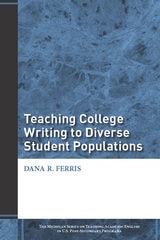
Teaching College Writing to Diverse Student Populations
Dana R. Ferris
University of Michigan Press, 2013
Statistical and anecdotal evidence documents that even states with relatively little ethnic or cultural diversity are beginning to notice and ask questions about long-term resident immigrants in their classes. As shifts in student population become more widespread, there is an even greater need for second language specialists, composition specialists, program administrators, and developers in colleges and universities to understand and adapt to the needs of the changing student audience(s).
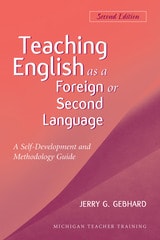
Teaching English as a Foreign or Second Language, Second Edition
A Teacher Self-Development and Methodology GuideJerry G. Gebhard
University of Michigan Press, 2006
The second edition of Teaching English as a Foreign or Second Language includes a wider range of examples to coincide with a variety of teaching contexts-from K-12 schools, to university intensive language programs and refugee programs. It is also updated with discussions of technology throughout, and it considers ways in which technology can be used in teaching language skills. Sources for further study are included in each chapter and in the appendixes.
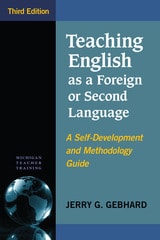
Teaching English as a Foreign or Second Language, Third Edition
A Self-Development and Methodology GuideJerry G. Gebhard
University of Michigan Press, 2017
This edition has the same three major sections: (1) Self-Development, Exploration, and Settings; (2) Principles of EFL/ESL Teaching; and (3) Teaching Language Skills. New to this edition are:
- a chapter on digital literacy, technology, and teaching
- the addition of technology issues as they relate to the teaching of the various skills in Part 3
- discussions of task-based teaching, student presentations, how corpus linguistics can inform teaching, metacognitive reading strategies, collaborative writing, assessing writing, and the teaching of grammar.
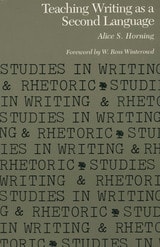
Teaching Writing as a Second Language
Alice S. Horning. Foreword by W. Ross Winterowd
Southern Illinois University Press, 1986
Classrooms filled with glassy-eyed students provide an experiential base for Alice S. Horning’s new comprehensive theory about basic writers.
Horning explores the theory of writing acquisition in detail. Her examination of spoken and written language and redundancy give a theoretical base to her argument that academic discourse is a separate linguistic system characterized by particular psycholinguistic features. She proposes that basic writers learn to write as other learners master a second language because for them, academic written English is a whole new language.
She explores the many connections to be found in second language acquisition research to the teaching and learning of writing and gives special attention to the interlanguage hypothesis, pidginization theory, and the Monitor theory. She also addresses the role of affective factors (feelings, attitudes, emotions, and motivation) in the success or failure of writing students.
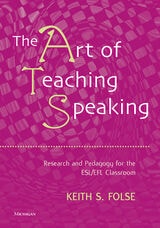
The Art of Teaching Speaking
Research and Pedagogy for the ESL/EFL ClassroomKeith S. Folse
University of Michigan Press, 2006
*Which tasks or activities really help build speaking fluency?
*What does the research show regarding speaking activities?
*What mistakes do ESL teachers often make in speaking activity design?
In this highly accessible and practical resource, Keith S. Folse provides a wealth of information to help ESL/EFL teachers design and use speaking tasks that will actually improve students' speaking fluency. The book presents and discusses the relevant research and assessment issues and includes case studies from twenty different settings and classrooms around the world so that readers learn from others about the problems and successes of using various speaking activities.
Teachers will find the chapters on Twenty Successful Activities and Ten Unsuccessful Activities particularly valuable. The successful activities are provided for classroom use and are reproducible. The book also contains five appendixes that explain what teachers need to know about vocabulary, pronunciation, and grammar and how they affect the teaching of speaking. Samples of successful lesson plans and a list of resources useful for teaching speaking are also included.
Keith S. Folse, Ph.D., is Coordinator, TESOL Programs, University of Central Florida (Orlando). He is the author of Vocabulary Myths (University of Michigan Press, 2004) and more than 35 second language textbooks, including texts on grammar, reading, speaking, listening, and writing.
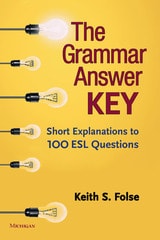
The Grammar Answer Key
Short Explanations to 100 ESL QuestionsKeith S. Folse
University of Michigan Press, 2018
The 100 questions are organized into 12 chapters on topics that teachers and students can relate to well: adjectives, articles, clauses, connectors, gerunds and infinitives, prepositions, pronouns, pronunciation, subject-verb agreement, suffixes, verbs, and vocabulary-grammar connections. The number of questions in each chapter ranges from 3 to 13 and is based on the questions submitted. Each chapter begins with a short overview of the topic that features key terminology and a chart explaining three common ESL errors.
Each question is presented in a box and is followed by an "answer" that can inform instruction, often in chart format. Examples of questions are:
- How do you know if a word is an adjective?
- Can I say the Monday or the January?
- Do you say on July or in July?
- I received an email from someone that said “Greetings from my wife and I.” Is this right? Why?
- How do I know which way to pronounce the -ed at the end of a word?
- Which verb tenses are the most common in English? Which ones should I study?
- Why do you say turn on the light instead of turn the light?
- In my language, we have one word for make and do. In English, when should I use make and when should I use do?
The book is the ideal teacher resource and professional development tool.
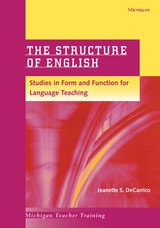
The Structure of English
Studies in Form and Function for Language TeachingJeanette S. DeCarrico
University of Michigan Press, 2000
With an emphasis on discourse function throughout, students are never expected to rely on lists of unrelated, constructed example sentences. Rather, when major points of grammar are presented, the structures are illustrated with rich, "real world" contexts excerpted from literature (mostly American), including novels, short stories, poems, essays, and drama. Exercises in the companion workbook are likewise based on naturally occurring stretches of discourse.
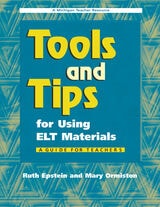
Tools and Tips for Using ELT Materials
A Guide for TeachersRuth Epstein and Mary Ormiston
University of Michigan Press, 2007
The book begins by addressing basic considerations in selecting and designing materials for classroom use. Textbooks themselves are covered in depth, which is very helpful for teachers choosing or assessing a textbook. An abundance of information is provided on how to use written texts from different genres (including teacher- and student-created texts), teacher-created resources, audio-visual aids, computers and the Internet, and how to provide community and service learning.
This resource aims to help instructors choose the most effective, appropriate, and flexible materials for their students and their programs. Teachers and teachers-in-training will find this to be a practical and comprehensive guide to integrating ELT materials and resources into a curriculum.
Translingual Dispositions
The Affordances of Globalized Approaches to the Teaching of WritingAllana Frost
University Press of Colorado, 2020
Translingual Pedagogical Perspectives
Engaging Domestic and International Students in the Composition ClassroomJulia Kiernan
Utah State University Press, 2021
The book showcases concrete and adaptable writing assignments from a variety of learning environments in postsecondary, English-medium writing classrooms, writing centers, and writing programs populated by monolingual and multilingual students. By providing descriptive and reflective examples of how understanding translanguaging can influence pedagogy, Translingual Pedagogical Perspectives fills the gap between theoretical inquiry surrounding translanguaging and existing translingual pedagogical models for writing classrooms and programs.
Additional appendixes provide a variety of readings, exercises, larger assignments, and other entry points, making Translingual Pedagogical Perspectives useful for instructors and graduate students interested in engaging translingual theories in their classrooms.
Contributors: Daniel V. Bommarito, Mark Brantner, Tania Cepero Lopez, Emily Cooney, Norah Fahim, Ming Fang, Gregg Fields, Mathew Gomes, Thomas Lavalle, Esther Milu, Brice Nordquist, Ghanashyam Sharma, Naomi Silver, Bonnie Vidrine-Isbell, Xiqiao Wang, Dan Zhu
Treatment of Error in Second Language Student Writing
Dana R. Ferris
University of Michigan Press, 2002
Unlike a teachers' manual or a handbook that purports to give all the answers needed, Ferris's research-based volume offers a solid scholarly foundation for the practical ideas presented together with an abundance of illustrative sample texts. This book will be a rich resource in language teaching methodology courses, but experienced teachers too will no doubt benefit from the depth and breadth of Ferris's coverage of various error response techniques as well as of the research that motivates those techniques.
Ferris offers a realistic, well-reasoned account of what second language (L2) writing teacher--or teachers with L2 students in their classes--need to know about error and how to put what they know to use. She persuasively addresses the fundamental error treatment questions that plague novice and expert writing specialists alike: What types of errors should teachers respond to? When should we respond to them? What are the most efficacious ways of responding to them? And ultimately, what role should error treatment play in the teaching of the process of writing?
Treatment of Error in Second Language Student Writing, Second Edition
Dana R. Ferris
University of Michigan Press, 2011
Treatment of Error offers a realistic, well-reasoned account of what teachers of multilingual writers need to know about error and how to put what they know to use. As in the first edition, Ferris again persuasively addresses the fundamental error treatment questions that plague novice and expert writing specialists alike: What types of errors should teachers respond to? When should we respond to them? What are the most efficacious ways of responding to them? And ultimately, what role should error treatment play in the teaching of the process of writing?
The second edition improves upon the first by exploring changes in the field since 2002, such as the growing diversity in what is called “L2 writers,” the blurring boundaries between “native” and “non-native” speakers of English, the influence of genre studies and corpus linguistics on the teaching of writing, and the need the move beyond “error” to “second language development” in terms of approaching students and their texts. It also explores what teacher preparation programs need to do to train teachers to treat student error.
The second edition features
* an updating of the literature in all chapters
* a new chapter on academic language development
* a postscript on how to integrate error treatment/language development suggestions in Chapters 4-6 into a writing class syllabus
* the addition of discussion/analysis questions at the end of each chapter, plus suggested readings, to make the book more useful in pedagogy or teacher development workshops
Tutoring Second Language Writers
Shanti Bruce
Utah State University Press, 2015
Tutoring Second Language Writers, a complete update of Bruce and Rafoth’s 2009 ESL Writers, is a guide for writing center tutors that addresses the growing need for tutors who are better prepared to work with the increasingly international population of students seeking guidance at the writing center.
Drawing upon philosopher John Dewey’s belief in reflective thinking as a way to help build new knowledge, the book is divided into four parts. Part 1: Actions and Identities is about creating a proactive stance toward language difference, thinking critically about labels, and the mixed feelings students may have about learning English. Part 2: Research Opportunities demonstrates writing center research projects and illustrates methods tutors can use to investigate their questions about writing center work. Part 3: Words and Passages offers four personal stories of inquiry and discovery, and Part 4: Academic Expectations describes some of the challenges tutors face when they try to help writers meet readers’ specific expectations.
Advancing the conversations tutors have with one another and their directors about tutoring second language writers and writing, Tutoring Second Language Writers engages readers with current ideas and issues that highlight the excitement and challenge of working with those who speak English as a second or additional language.
Contributors include Jocelyn Amevuvor, Rebecca Day Babcock, Valerie M. Balester, Shanti Bruce, Frankie Condon, Michelle Cox, Jennifer Craig, Kevin Dvorak, Paula Gillespie, Glenn Hutchinson, Pei-Hsun Emma Liu, Bobbi Olson, Pimyupa W. Praphan, Ben Rafoth, Jose L. Reyes Medina, Guiboke Seong, and Elizabeth (Adelay) Witherite.