Results by title
74 books match the query 'Friendship' and 20 start with t

Tampico
A NovelBy Toby Olson
University of Texas Press, 2008
Four old men—John, Gino, Larry, and Frank—have been warehoused at "the Manor," a long-eroded home for the forgotten. The men take turns telling stories, stalling death as they relive pivotal parts of their pasts. Outside, the cliff crumbles and a lighthouse slips toward the sea.
John, in particular, enthralls the others with his tale of Tampico, Mexico, where he met an Indian woman named Chepa who owned a house at the edge of a mountain wilderness. She was his first love—and his first lesson in the dangers of foreign intrigue. But his is not the only memory haunted by mysteries born in Mexico. Sick of waiting for death, stirred by the shifting ground beneath their feet, the Manor's residents finally resolve to quit that place and head out for Tampico.
With inexorable pull, and exquisite scenes that could only come from Toby Olson, Tampico celebrates a sublime band of calaveras, "those skeleton messengers of mortality," who seek self-discovery even as their lives are ending.

The Complex Friendships of Alexander the Great
Loyalty, Love, Advantage, and IntrigueJoseph Roisman
University of Texas Press, 2026
A first-of-its-kind study of Alexander the Great that examines the diverse manifestations and pivotal role of friendship in his campaigns, decisions, and enduring legacy.
Modern scholarship has illuminated nearly every aspect of Alexander the Great’s life and campaigns––but Joseph Roisman turns to a dimension of Alexander’s world that has yet to receive sustained analysis: the structure and function of friendship in the king’s regime. In this first-of-its-kind study, The Complex Friendships of Alexander the Great explores the central role friendship played in Alexander’s social, political, and cultural world. Moving beyond utilitarian perspectives, Roisman shows that friendship with the king involved affective, noninstrumental bonds that shaped his decisions, successes, and failures.
Using Aristotle’s philosophy of friendship as a starting point, Roisman examines the making, breaking, and remaking of bonds with Macedonian companions, including his closest allies, as well as with foreigners encountered during his campaigns. The book concludes with the first comprehensive list of Alexander’s friends drawn from ancient sources. Combining meticulous scholarship with new interpretive insight, this study reevaluates how we understand Alexander the Great’s leadership, social networks, and legacy.

The Converse of the Pen
Acts of Intimacy in the Eighteenth-Century Familiar LetterBruce Redford
University of Chicago Press, 1987
Redford examines six masters of the "talking letter": Lady Mary Wortley Montagu, William Cowper, Thomas Gray, Horace Walpole, James Boswell, and Samuel Johnson. All seek the paradoxical goal of artful spontaneity. Each exploits the distinctive resources of the eighteenth-century letter writer: a flexible conversational manner, a repertoire of literary and social allusion, a flair for dramatic impersonation. The voices of these letter writers "make distance, presence," in Samuel Richardson's phrase, by devising substitutes for gesture, vocal inflection, and physical context, turning each letter into a performance—an act. The resulting verbal constructs create a mysterious tension between the claims of fact and the possibilities of art. Redford recovers a neglected literary form and makes possible a deeper understanding of major eighteenth-century writers who devoted much of their talent and time to "the converse of the pen."
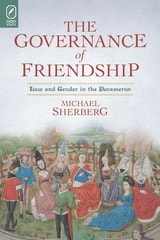
The Governance of Friendship
Law and Gender in the DecameronMichael Sherberg
The Ohio State University Press, 2011
Through a series of close readings at all three levels of the text—the author’s statements, the frame narrative, and the stories themselves—Sherberg shows how Boccaccio exposes and explores gender tensions rooted in a notion of the patriarchal household, which finds its own rationale in the natural-law postulate of the inferiority of women. Relying on the writings of the great twentieth-century legal theorist Hans Kelsen, Sherberg demonstrates how through the complex architecture of the Decameron Boccaccio dismantles the logic of natural law, exposing it instead as a rhetoric used by men to justify their control of women.
The Governance of Friendship aims well to advance our understanding of Boccaccio as an intellectual: not only steeped in the key texts of his time, but also at the forefront of critical thinking about such issues as law and gender which will play out over the coming centuries and beyond.

The House on the Beach
A NovelBy Juan García Ponce
University of Texas Press, 1994
Like waves ebbing and flowing, love surges and subsides among four friends who share a vacation at the house on the beach. As they navigate the seas of love and friendship, jealousy and unfaithfulness, Elena, Marta, Eduardo, and Rafael are swept up in the opposing currents that flow between security and personal freedom, marriage and sexual liberation, family and work, provincial and city life, and traditional and unconventional gender roles.
This deceptively simple novel, published in Mexico in 1966 as La casa en la playa and here translated into English for the first time, is an important work by one of Mexico's, and indeed Latin America's, major writers of the twentieth century. Juan García Ponce helped Mexican arts and letters break out of the ossified styles and themes of the post-Revolutionary "Mexican School" with works that explore the conflict between individual desire and the demands of family and work. Written at a turning point in his career, The House on the Beach foreshadows his embrace of the erotic encounter as a means of undermining rigid, socially constructed personal identity. It supports feminist views and probes deeply into the contradictions, backwardness, and progress of modern Mexican society.

The Intimate Frontier
Friendship and Civil Society in Northern New SpainIgnacio Martínez
University of Arizona Press, 2019
Spaniards living in the isolated borderlands region of colonial Sonora were keen to develop an ideologically relevant and socially acceptable form of friendship with Indigenous people that could act as a functional substitute for civil law and governance, thereby regulating Native behavior. But as frontier society grew in complexity and sophistication, Indigenous and mixed-raced people also used the language of friendship and the performance of emotion for their respective purposes, in the process becoming skilled negotiators to meet their own best interests.
In northern New Spain, friendships were sincere and authentic when they had to be and cunningly malleable when the circumstances demanded it. The tenuous origins of civil society thus developed within this highly contentious social laboratory in which friendships (authentic and feigned) set the social and ideological parameters for conflict and cooperation. Far from the coffee houses of Restoration London or the lecture halls of the Republic of Letters, the civil society illuminated by Martínez stumbled forward amid the ambiguities and contradictions of colonialism and the obstacles posed by the isolation and violence of the Sonoran Desert.

The Journey Home
By Dermot Bolger
University of Texas Press, 2008
2008 — Finalist, ForeWord Magazine Book of the Year Awards, Fiction Category
Young Francis Hanrahan dreams desperately of a life different from that of his country-born, suburban-living parents. On his first day at his first job Francis makes his first real friend. Shay, a would-be older brother, introduces "Hano" to Dublin's appealingly seedy after-hours bars and drug-fueled parties. They are joined by Cait, a troubled teenager who spends her days in a stupor. But the noir thrills of underground Dublin cannot conceal the unemployment, corruption, and violence strangling the city. The Plunkett brothers, masters of "the subtle everyday corruption on which a dynasty was built" will use the friends—with tragic results.
Torn between his friends, his family, and his own ideals, Hano ultimately falls victim to these powerful forces and commits a heinous crime. He flees through the countryside with Cait, wondering, as he narrates the events that set him on this path, if there is a home at the end of it.
Controversial for its gritty portrait of Dublin in the 1980s, The Journey Home is Dermot Bolger's unflinching look at the personal cost of social progress, and those, innocent or not, lost during the journey.
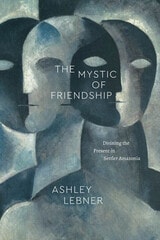
The Mystic of Friendship
Divining the Present in Settler AmazoniaAshley Lebner
University of Chicago Press, 2025
On Brazil’s Amazonian frontier, settlers pursue land and opportunity, but they also gather for prayer and pilgrimage, yearning for a deep relationship with God and one another. In this book, anthropologist Ashley Lebner examines how everyday religious practices and feelings, what she calls a mystic of friendship, shape and sustain colonization in the Amazon.
Lebner invites us to a stretch of highway in Pará, Brazil, where violent colonization coexists with prophetic dreams, Afro-Brazilian prayers, and emerging evangelicalism. She shows how, amid political tensions and physical hardship, settlers believe that the violence they experience and enact derives from the bestial nature of earthly life that must be overcome. In exposing a longing for divinely-infused friendship that animates colonization, Lebner offers a powerful new perspective on the forces driving colonialism as much as religious and political expression.
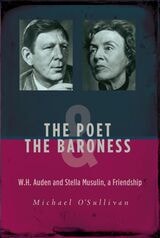
The Poet & the Baroness
W.H. Auden and Stella Musulin, a FriendshipMichael O'Sullivan
Central European University Press, 2023
For long periods in history, the Austrian capital found itself on the geographical edge of western civilisation. Yet from the 18th century on, Vienna has been a vibrant centre of European culture. This city is the scene of the formidable meeting of the two outstanding intellectuals that are at the core of this book.
The warm relationship between W.H. Auden, the celebrated British-American poet (1907–1973), and his fellow expatriate, the Welsh-Austrian journalist, translator and writer Stella Musulin (1915–1996) lasted while Auden resided in the nearby small town of Kirchstetten starting in 1958. It was here that the poet was laid to rest in the autumn of 1973. This book is based on the unpublished letters of Auden to Musulin and her private journals.
The study of this inspiring material yields new insights into Auden’s last, prolific, creative period and underscores the ‘Austrian Auden.’ In addition, Michael O’Sullivan pays tribute to the closest ‘Austrian’ friend of the poet. Baroness Stella von Musulin was an intellectual whose two books for Faber & Faber are acknowledged as classics: Vienna in the Age of Metternich and Austria: People & Landscape (with a foreword by Auden). The author situates the close relationship of two individuals in the context of Austria’s complex political, social, and cultural history in the Cold War years.

The Root of Friendship
Anthony T. Flood
Catholic University of America Press, 2014

The Temple of Fame and Friendship
Portraits, Music, and History in the C. P. E. Bach CircleAnnette Richards
University of Chicago Press, 2020
One of the most celebrated German composers of the eighteenth century, C. P. E. Bach spent decades assembling an extensive portrait collection of some four hundred music-related items—from oil paintings to engraved prints. The collection was dispersed after Bach’s death in 1788, but with Annette Richards’s painstaking reconstruction, the portraits once again present a vivid panorama of music history and culture, reanimating the sensibility and humor of Bach’s time. Far more than a mere multitude of faces, Richards argues, the collection was a major part of the composer’s work that sought to establish music as an object of aesthetic, philosophical, and historical study.
The Temple of Fame and Friendship brings C. P. E. Bach’s collection to life, giving readers a sense of what it was like for visitors to tour the portrait gallery and experience music in rooms thick with the faces of friends, colleagues, and forebears. She uses the collection to analyze the “portraitive” aspect of Bach’s music, engaging with the influential theories of Swiss physiognomist Johann Caspar Lavater. She also explores the collection as a mode of cultivating and preserving friendship, connecting this to the culture of remembrance that resonates in Bach’s domestic music. Richards shows how the new music historiography of the late eighteenth century, rich in anecdote, memoir, and verbal portrait, was deeply indebted to portrait collecting and its negotiation between presence and detachment, fact and feeling.

The Two Gentlemen of Verona
William Shakespeare
Arizona Center for Medieval and Renaissance Studies, 2023
In one of his earliest plays, Two Gentlemen of Verona, Shakespeare began exploring themes of love and friendship that became the focus of some of his greatest works. Amelia Roper’s translation focuses on how the verse sounds—the feeling of the words as spoken by an actor and listened to by an audience. This version offers a new sort of life to the play, letting audiences feel like they’re truly hearing it as Shakespeare’s audience might have more than four hundred years ago.
This translation of Two Gentlemen of Verona was written as part of the Oregon Shakespeare Festival’s Play On! project, which commissioned new translations of thirty-nine Shakespeare plays. These translations present the work of “The Bard” in language accessible to modern audiences while never losing the beauty of Shakespeare’s verse. Enlisting the talents of a diverse group of contemporary playwrights, screenwriters, and dramaturges from diverse backgrounds, this project reenvisions Shakespeare for the twenty-first century. These volumes make these works available for the first time in print—a new First Folio for a new era.

The Wallpaper Fox
A NovelMorris Philipson
University of Chicago Press, 2000
"Philipson gives us a very believable portrait of a marriage. He also gives us no easy answers . . . and best of all, real storytelling." —Publishers Weekly
"This solid and serious novel emerges as not just an expose of what really goes on behind the well-groomed facades of the affluent, but a thoughtful exploration of character and the efficacy of moral action in forming and reforming it." —Jane Larkin Crain, New York Times Book Review
"A swift, no-fudging narrative by a writer it is always rewarding to rediscover." —Sophie Wilkins, National Review
"An extraordinary novel, fascinating, compelling, and totally disconcerting." —Fort Worth Star-Telegram
"Has the drama, intelligence and moral force of an American Howards End."-Cynthia Ozick

The Work of Friendship
In Memoriam Alan Bray, Volume 10Jody Greene , ed.
Duke University Press, 0
Contributors to the collection include some of the most prominent scholars in the field of early modern sexualities. They think expansively about Bray’s impact on their own work and, most importantly, test the applicability of his theories (that same-sex desire has a history that can be reconstructed and that the actual object of study is difficult to capture, as its expression varies radically across cultures and societies) in areas where they have not been previously employed. Two essays in this collection explore friendships or intimacies between women or between men and women—topics Bray did not pursue extensively. Others deal with locations outside Bray’s heavily English focus, including France, the Netherlands, Belgium, and Luxembourg, or apply his theories to periods beyond the Renaissance. Additionally, the issue includes a review of Bray’s The Friend, published posthumously, and an assessment of his scholarly career from his earliest writings to this final work.
Contributors. George Chauncey, Carla Freccero, Jonathan Goldberg, Jody Greene, George E. Haggerty, Jeffrey Masten, Jeffrey Merrick, Stephen Orgel, Laurie Shannon, Valerie Traub

Thomas Wolfe
Memoir of a FriendshipBy Robert Raynolds
University of Texas Press, 1965

Through the Boondocks and Back
A NovellaAlex DiFrancesco
Northwestern University Press, 2027
A queer, rollicking retelling of The Odyssey
Zane Viaggio’s life has been fraught since leaving New York City for Cleveland. Uprooted and missing his life in the city, he escapes into parties and pills. When he wakes up vomiting several days in a row, he’s convinced by his three drag queen roommates and his best trans-femme friend to get a pregnancy test, learning that not only is he pregnant, but pregnant in an Ohio that has just outlawed abortion. Zane must then embark on an epic journey around Lake Erie and its surrounding towns on a stolen jet ski to find the man who impregnated him, get the money to go back to New York City for an abortion, and get his life back to normal. In this queer and trans retelling of The Odyssey, Zane encounters all sorts of strange and challenging characters—including one-eyed cats, force-femmed prophets, and his own chosen family—who help him discover that, perhaps, finding home is the greatest journey of all.
Timon of Athens
William Shakespeare
Arizona Center for Medieval and Renaissance Studies, 2021
Never performed in Shakespeare’s lifetime, Timon of Athens presents an intriguing puzzle for contemporary audiences. The disjointed plot and many gaps in the story have led scholars to believe it was a collaboration between Shakespeare and Thomas Middleton, a younger writer known for his satires, and productions for decades have faced choices about the most effective way to present the play. In this translation, Cavander acts as a third playwright in this collaborative process. Wrangling the voices of Shakespeare and Middleton on the page, Cavander unveils poetic lines and phrases that have sat stubbornly in the cobwebs, cutting these voices through the time barrier and into the world as we know it.
This translation was written as part of the Oregon Shakespeare Festival’s Play On! project, which commissioned new translations of thirty-nine Shakespeare plays. These translations present the work of "The Bard" in language accessible to modern audiences while never losing the beauty of Shakespeare’s verse. These volumes make these works available for the first time in print—a new First Folio for a new era.

To Be Marquette
Sharon Dilworth
Carnegie Mellon University Press, 2024
Arriving in Marquette for her freshman year at Northern Michigan University, Molly enrolls in Dr. Robinson’s ecology studies class, hoping to learn more about the natural world and how to protect the planet from human impact. She befriends her classmates, Dr. Robinson’s Crusoes, who share her love of hiking, camping, and building bonfires on the shores of Lake Superior.
Together, Molly and the Crusoes protest the development of Project ELF, a Navy program that is installing a series of extremely low-frequency transmitters across the Great Lakes. The US government claims Project ELF will help the country defend itself in the event of a nuclear invasion, but Upper Peninsula residents fear the communications lines will disrupt the natural environment that they hold sacred.
Initially preoccupied with the contingencies of freshman year—roommate problems, dormitory life, and dating—Molly begins to sense that the Project ELF protests may mask a more problematic dynamic between the students and faculty. As she struggles to find her purpose, Molly uncovers layers of lies and misunderstandings about campus life, Project ELF, and her time in Marquette that make her question her place in the community.
As in other notable campus novels, like Donna Tartt’s The Secret History or Elif Batuman’s The Idiot, Sharon Dilworth’s To Be Marquette portrays an undergraduate narrator groping for meaning in a world where personal transformation takes place alongside conflicting cultural paradigms.

Tortilleras Negotiating Intimacy
Love, Friendship, and Sex in Queer Mexico CityAnahi Russo Garrido
Rutgers University Press, 2020

Two Toms
Lessons from a Shoshone DoctorThomas H. Johnson
University of Utah Press, 2011
In 1969, Tom Wesaw was an 83-year-old Shoshone doctor and religious leader on the Wind River Reservation in Wyoming. He could no longer drive, which posed problems in making house calls. The arrival of young anthropologist Tom Johnson changed that. Johnson would drive Wesaw, and cook, pump water, and build fires for sweat lodges. In exchange, the elder Tom would show the younger Tom his work. The two were together so often that the people of Wind River began to refer to them affectionately by one name: Two Toms. By the light of the lamp Wesaw gave him, Johnson would write down what he learned. The Shoshone doctor wanted his student to share everything he saw and heard. Now, in Two Toms: Lessons from a Shoshone Doctor, he has.