Results by title
93 books match the query 'Genocide & War Crimes' and 28 start with t
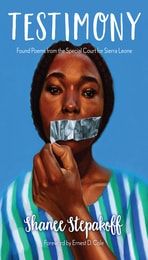
Testimony
Found Poems from the Special Court for Sierra LeoneShanee Stepakoff
Bucknell University Press, 2021
Sierra Leone’s devastating civil war barely caught the attention of Western media, but it raged on for over a decade, bringing misery to millions of people in West Africa from 1991 to 2002. The atrocities committed in this war and the accounts of its survivors were duly recorded by international organizations, but they run the risk of being consigned to dusty historical archives.
Derived from public testimonies at a UN-backed war crimes tribunal in Freetown, this remarkable poetry collection aims to breathe new life into the records of Sierra Leone’s civil war, delicately extracting heartbreaking human stories from the morass of legal jargon. By rendering selected trial transcripts in poetic form, Shanee Stepakoff finds a novel way to communicate not only the suffering of Sierra Leone’s people, but also their courage, dignity, and resilience. Her use of innovative literary techniques helps to ensure that the voices of survivors are not forgotten, but rather heard across the world.
This volume also includes an introduction that explores how the genre of “found poetry” can serve as a uniquely powerful means through which writers may bear witness to atrocity. This book’s unforgettable excavation and shaping of survivor testimonies opens new possibilities for speaking about the unspeakable.
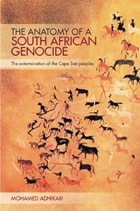
The Anatomy of a South African Genocide
The Extermination of the Cape San PeoplesMohamed Adhikari
Ohio University Press, 2011
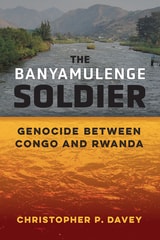
The Banyamulenge Soldier
Genocide between Congo and RwandaChristopher P. Davey
University of Michigan Press, 2025
Challenging the preconceived perpetrator and victim categories with a forward-thinking approach using the concept of genocide narrative identity—meaning a narrative identity shaped by experiences of social destruction or uses of genocide as a concept—Christopher P. Davey reveals how the stories we tell about ourselves shapes who we are. He shows that Banyamulenge experiences of genocide between Congo and Rwanda are layered around agencies of victimhood and perpetration of genocide. Using soldier and other community narratives, Davey examines the subjective nature of genocide in perception of an event, strategic deployment of the label, and in the (re)shaping of social worlds inhabited by this community and therefore impacting others in Congo and Rwanda. The Banyamulenge Soldier offers an insider view of the historical dynamics of current conflicts in South Kivu while adding to our understanding of relational genocide theory.
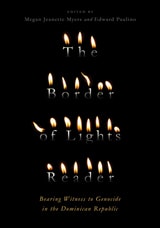
The Border of Lights Reader
Bearing Witness to Genocide in the Dominican RepublicMegan Jeanette Myers
Amherst College Press, 2021
"By bringing together in one volume poetry, visual arts, literary analysis, in-depth interviews and historical analysis this volume will provide its readers with a comprehensive view of the causes and the aftermath of the massacre." —Ramón Antonio Victoriano-Martínez, University of British Columbia
Contributions by Julia Alvarez, Amanda Alcántara, DeAndra Beard, Nancy Betances, Jésula Blanc, Matías Bosch Carcuro, Cynthia Carrión, Raj Chetty, Catherine DeLaura, Magaly Colimon, Juan Colón, Robin Maria DeLugan, Lauren Derby, Rosa Iris Diendomi Álvarez, Polibio Díaz, Rana Dotson, Rita Dove, Rhina P. Espaillat, Maria Cristina Fumagalli, Saudi García, Scherezade García, Juan Carlos González Díaz, Kiran C. Jayaram, Pierre Michel Jean, Nehanda Loiseau Julot, Jake Kheel, Carlos Alomia Kollegger, Jackson Lorrain “Jhonny Rivas”, Radio Marién, Padre Regino Martínez Bretón, Sophie Maríñez, April J. Mayes, Jasminne Mendez, Komedi Mikal PGNE, Osiris Mosquea, Megan Jeanette Myers, Rebecca Osborne, Ana Ozuna, Edward Paulino, John Presimé, Laura Ramos, Amaury Rodríguez, Doña Carmen Rodríguez de Paulino, The DREAM Project, Silvio Torres-Saillant, Ilses Toribio, Deisy Toussaint, Évelyne Trouillot, Richard Turits, William Vazquez, Chiqui Vicioso, Bridget Wooding, and Óscar Zazo.
The Complexity of Evil
Perpetration and GenocideTimothy Williams
Rutgers University Press, 2021
Download the open access ebook here.
The Deoliwallahs
The True Story of the 1962 Chinese Indian InternmentJoy Ma
Rutgers University Press, 2026
The Deoliwallahs sheds light on a lesser-known chapter of Indian history—the internment of Chinese Indians following the 1962 Sino-Indian War. During the war, around 3,000 Indians of Chinese descent were detained in a camp in Deoli, Rajasthan, under suspicion of espionage. Many of these individuals had deep roots in India, with families that had lived there for generations. The book recounts their harrowing experiences, including abrupt arrests, harsh conditions in the camp, and the emotional toll of being ostracized by their own country.
Alternating between historical context and the personal stories of survivors, authors Joy Ma and Dilip D'Souza weave together a compelling and emotional account of a nearly forgotten community of people interned against their will. The book draws parallels with other instances of internment, such as the Japanese American experience during World War II, highlighting the universal themes of identity, citizenship, and the consequences of fear-driven policies.
A documentary, Voices of Deoli (2025), directed by Lulu Men with author Joy Ma serving as executive producer, along with Michael Cheng and Neela D’Souza, also shares the stories of survivors and, like the book, serves as a powerful reminder of the fragility of rights and the impact of prejudice.
The Dilemma of Dominic Ongwen
From Child Soldier to the International Criminal CourtKjell Anderson
Rutgers University Press, 2027
Dominic Ongwen was abducted by Joseph Kony's Lord's Resistance Army while walking to school at the age of nine. He later rose through its ranks committing, and ultimately being convicted by the International Criminal Court (ICC) of, many of the same crimes of which he was once a victim. The Dilemma of Dominic Ongwen tells this extraordinary story through the voices of those who knew him best: family members, fighters, commanders, “wives,” victims, and trial participants. Their testimonies, gathered in Uganda and The Hague, form the backbone of a narrative that interlaces survivor accounts with legal analysis and vivid excerpts from the ICC trial. The book offers a rare, human-centered lens on international justice, illuminating the dilemmas of prosecuting a former child soldier for mass atrocities. It provides indispensable insights for scholars of international criminal law, transitional justice, political violence, trauma, and human rights.

The Dying Sahara
US Imperialism and Terror in AfricaJeremy Keenan
Pluto Press, 2013
In The Dark Sahara (Pluto, 2009), Jeremy Keenan exposed the collusion between the US and Algeria in fabricating terrorism to justify a new ‘Saharan front’ in Washington’s War on Terror. Now, in The Dying Sahara, he reveals how the designation of the region as a ‘Terror Zone’ has destroyed the lives and livelihoods of thousands of innocent people.
Beginning in 2004, with what local people called the US ‘invasion’ of the Sahel, The Dying Sahara shows how repressive, authoritarian regimes - cashing in on US terrorism ‘rents’ - provoked Tuareg rebellions in both Niger and Mali. Further, he argues that US activity has unleashed a new, narco-trafficking branch of Al-Qaeda.
Keenan's chillingly detailed research shows that the US and its new combatant African command (AFRICOM) have created instability in a region the size of western Europe.
The End of Jewish Modernity
Enzo Traverso
Pluto Press, 2016
Previously a beacon for critical thinking in the Western world, the mainstream of Jewish thought has, since the end of the war, undergone a conservative turn. With great sensitivity and nuance, Traverso traces this development to the virtual destruction of European Jewry by the Nazis, and the establishment of the United States and Israel as the new poles of Jewish communal life. This is a compelling narrative, hinged upon a highly original discussion of Hannah Arendt's writings on Jewishness and politics.
With provocative chapters on the relationship between antisemitism and Islamophobia, the ascendance of Zionism, and the new 'civil religion of the Holocaust', The End of Jewish Modernity is both an elegy to a lost tradition and an intellectual history of the present.
The Futures of Reparations in Latin America
Imagination, Translation, and BelongingPiergiorgio Di Giminiani
Rutgers University Press, 2026
The Guantanamo Files
The Stories of the 774 Detainees in America's Illegal PrisonAndy Worthington
Pluto Press, 2007
Deprived of the safeguards of the Geneva Conventions, and, for the most part, sold to the Americans by their allies in Afghanistan and Pakistan, the detainees have struggled for five years to have their stories heard. Looking in detail at the circumstances of their capture, and at the coercive interrogations and unsubstantiated allegations that have been used to justify their detention. Stories of torture in Afghanistan and Guantanamo are uncovered, as well as new information about the process of 'extraordinary rendition' that underpins the US administration's 'war on terror'.
Who will speak for the 773 men who have been held in Guantanamo? This passionate and brilliantly detailed book brings their stories to the world for the first time.
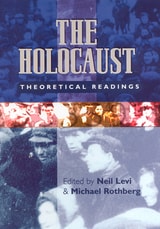
The Holocaust
Theoretical ReadingsLevi, Neil
Rutgers University Press, 2003
This agenda-setting reader brings together both classic and new writings to demonstrate how concerns arising from the Nazi genocide shaped contemporary literary and cultural theory. Wide in its thematic scope, it covers such vital questions as:
- Authenticity and experience
- Memory and trauma
- Historiography and the philosophy of history
- Fascism and Nazi anti-Semitism
- Representation and identity formation
- Race, gender, and genocide
- Implications of the Holocaust for theories of the unconscious, ethics, politics, and aesthetics
The readings, which are fully contextualized by a general introduction, section introductions, and bibliographical notes, represent the work of many influential writers and theorists, including Theodor Adorno, Giorgio Agamben, Hannah Arendt, Jean Baudrillard, Zygmunt Bauman, Walter Benjamin, Cathy Caruth, Jacques Derrida, Shoshana Felman, Saul Friedlander, Paul Gilroy, Lawrence Langer, Emmanuel Levinas, Primo Levi, Jean-François Lyotard, Hayden White, and James E. Young. This multidisciplinary anthology will be welcomed by students and scholars of the Holocaust.
The Indescribable and the Undiscussable
Reconstructing Human Discourse after TraumaDan Bar-On
Central European University Press, 1998
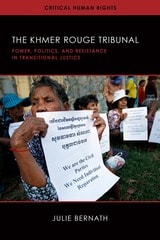
The Khmer Rouge Tribunal
Power, Politics, and Resistance in Transitional JusticeJulie Bernath
University of Wisconsin Press, 2023
Here, Julie Bernath takes a different tack, deliberately decentering the trials in an effort to understand the ECCC in its particular context—and, by extension, the degree to which notions of transitional justice generally must be understood in particular social, cultural, and political contexts. She focuses on “sites of resistance” to the ECCC, including not only members of the elite political class but also citizens who do not, for a variety of tangled reasons, participate in the tribunal—and even resistance from victims of the regime and participants in the trials. Bernath demonstrates that the ECCC both shapes and is shaped by long-term contestation over Cambodia’s social, economic, and political transformations, and thereby argues that transitional justice must be understood locally rather than as a homogenous good that can be implanted by international actors.
The Politics of Annihilation
A Genealogy of GenocideBenjamin Meiches
University of Minnesota Press, 2019
How did a powerful concept in international justice evolve into an inequitable response to mass suffering?
For a term coined just seventy-five years ago, genocide has become a remarkably potent idea. But has it transformed from a truly novel vision for international justice into a conservative, even inaccessible term? The Politics of Annihilation traces how the concept of genocide came to acquire such significance on the global political stage. In doing so, it reveals how the concept has been politically contested and refashioned over time. It explores how these shifts implicitly impact what forms of mass violence are considered genocide and what forms are not.
Benjamin Meiches argues that the limited conception of genocide, often rigidly understood as mass killing rooted in ethno-religious identity, has created legal and political institutions that do not adequately respond to the diversity of mass violence. In his insistence on the concept’s complexity, he does not undermine the need for clear condemnations of such violence. But neither does he allow genocide to become a static or timeless notion. Meiches argues that the discourse on genocide has implicitly excluded many forms of violence from popular attention including cases ranging from contemporary Botswana and the Democratic Republic of Congo, to the legacies of colonial politics in Haiti, Canada, and elsewhere, to the effects of climate change on small island nations.
By mapping the multiplicity of forces that entangle the concept in larger assemblages of power, The Politics of Annihilation gives us a new understanding of how the language of genocide impacts contemporary political life, especially as a means of protesting the social conditions that produce mass violence.
The Politics of Genocide
From the Genocide Convention to the Responsibility to ProtectJeffrey S. Bachman
Rutgers University Press, 2022
The Politics of Lists
Bureaucracy and Genocide under the Khmer RougeJames A. Tyner
West Virginia University Press, 2018
2019 Julian Minghi Distinguished Book Award winner
Scholars from a number of disciplines have, especially since the advent of the war on terror, developed critical perspectives on a cluster of related topics in contemporary life: militarization, surveillance, policing, biopolitics (the relation between state power and physical bodies), and the like. James A. Tyner, a geographer who has contributed to this literature with several highly regarded books, here turns to the bureaucratic roots of genocide, building on insight from Hannah Arendt, Zygmunt Bauman, and others to better understand the Khmer Rouge and its implications for the broader study of life, death, and power.
The Politics of Lists analyzes thousands of newly available Cambodian documents both as sources of information and as objects worthy of study in and of themselves. How, Tyner asks, is recordkeeping implicated in the creation of political authority? What is the relationship between violence and bureaucracy? How can documents, as an anonymous technology capable of conveying great force, be understood in relation to newer technologies like drones? What does data create and what does it destroy? Through a theoretically informed, empirically grounded study of the Khmer Rouge security apparatus, Tyner shows that lists and telegrams have often proved as deadly as bullet and bombs.
The Privatisation of Israeli Security
Shir Hever
Pluto Press, 2017
The Ruins of Ani
A Journey to Armenia's Medieval Capital and its LegacyKrikor Balakian
Rutgers University Press, 2019
From the tenth to the thirteenth centuries, the city of Ani was the jewel of the Armenian kingdom, renowned far and wide for its magnificent buildings. Known as the city of 1001 churches, Ani was a center for artistic innovation, and its architecture is a potential missing link between Byzantine and Gothic styles. By the fifteenth century, Ani was virtually abandoned, its stunning buildings left to crumble. Yet its ruins have remained a symbol of cultural accomplishment that looms large in the Armenian imagination.
The Ruins of Ani is a unique combination of history, art criticism, and travel memoir that takes readers on a thousand-year journey in search of past splendors. Today, Ani is a popular tourist site in Turkey, but the city has been falsified in its presentation by the Turkish government in order to erase Armenian history in the wake of the Armenian Genocide. This timely publication also raises questions about the preservation of major historic monuments in the face of post atrocity campaigns of cultural erasure.
Originally written by young priest Krikor Balakian in 1910, just a few years before the Armenian genocide, this book offers a powerful and poignant counterpart to Balakian’s acclaimed genocide memoir Armenian Golgotha. This new translation by the author’s great-nephew, Pulitzer Prize-winning poet Peter Balakian, eloquently renders the book’s vivid descriptions and lyrical prose into English. Including a new introduction that explores Ani’s continued relevance in the twenty-first century, The Ruins of Ani will give readers a new appreciation for this lost city’s status as a pinnacle of both Armenian civilization and human achievement.
The Second Palestinian Intifada
A Chronicle of a People's StruggleRamzy Baroud
Pluto Press, 2006
Ramzy Baroud is a veteran journalist and former producer for Al-Jazeera TV. This is his comprehensive account of the momentous events of the last five years which shaped the political landscape not only of Palestine and Israel but of the entire Middle East region.
Addressing the most controversial issues, including the alarming escalation in suicide bombings, and the construction of the Separation Wall, he reports on the huge rate of unemployment and hunger in the Occupied Territories -- statistics so critical that NGOs compare their magnitude to African nations such as the Congo. From the brutality of the Israeli army to the ever-compromising nature of the Palestinian Authority, few are spared Baroud’s thoughtful critique.
The book is clear and concise, with one chapter dedicated to the major events of each year, and includes a comprehensive timeline.
The Soviet Union and the Gutting of the UN Genocide Convention
Anton Weiss-Wendt
University of Wisconsin Press, 2017
Based on extensive archival research, Anton Weiss-Wendt reveals in detail how the political aims of the superpowers rendered the convention a weak instrument for addressing abuses against human rights. The Kremlin viewed the genocide treaty as a political document and feared repercussions. What the Soviets wanted most was to keep the subjugation of Eastern Europe and the vast system of forced labor camps out of the genocide discourse. The American Bar Association and Senate Committee on Foreign Relations, in turn, worried that the Convention contained vague formulations that could be used against the United States, especially in relation to the plight of African Americans. Sidelined in the heated discussions, Weiss-Wendt shows, were humanitarian concerns for preventing future genocides.
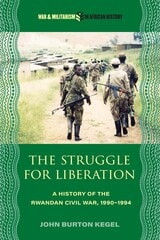
The Struggle for Liberation
A History of the Rwandan Civil War, 1990-1994John Burton Kegel
Ohio University Press, 2025
The story of the Rwandan Genocide has been told many times by scholars and journalists. Over the course of a hundred days in the spring and summer of 1994, about eight hundred thousand Tutsi and moderate Hutu were murdered by their extremist Hutu compatriots. Those hundred days were the final phase of a four-year civil war, also known as the Struggle for Liberation, which formed the immediate context of the genocide. Though scholars have researched preparations for the genocide and the international community’s role in it, none has placed the Struggle for Liberation at the heart of the narrative. However, the preparation of the genocide, the rise and fall of the moderate opposition, the degradation of the Forces armées rwandaises (FAR) from a respected fighting force to a genocidal militia, the role of the international community, the Arusha negotiations, and the execution of the genocide all took place in the context of that war. John Burton Kegel contends that the Struggle for Liberation forms the bedrock of any genuine understanding of Rwanda between 1990 and 1994, and indeed beyond. The Struggle for Liberation, which eventually led to the genocide, was fought between the FAR and the civilians and soldiers of the Rwandan Patriotic Front (RPF) and its armed wing, the Rwandan Patriotic Army (RPA). The civil war started on October 1, 1990, when the RPF entered Rwanda from Uganda, where Rwandan refugees had lived throughout the Great Lakes region since roughly 1959. This book traces the history of those refugees—and Rwanda’s deeper Hutu-Tutsi divide—from the precolonial period up to 1990. It also provides a wholly new take on how the disciplined RPF, which rules Rwanda to this day, was born and organized.
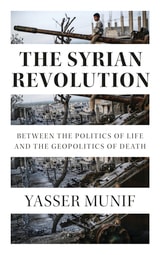
The Syrian Revolution
Between the Politics of Life and the Geopolitics of DeathYasser Munif
Pluto Press, 2020
Having lived in Syria for over fifteen years, Yasser Munif is expert in exploring the micropolitics of revolutionary forces. He uncovers how cities are managed, how precious food is distributed and how underground resistance thrives in regions controlled by regime forces. In contrast, the macropolitics of the elite Syrian regime are undemocratic, destructive and counter-revolutionary. Regional powers, Western elites, as well as international institutions choose this macropolitical lens to apprehend the Syrian conflict. By doing so, they also choose to ignore the revolutionaries' struggles.
By looking at the interplay between the two sides, case studies of Aleppo and Manbij and numerous firsthand interviews, Yasser Munif shows us that this macro and geopolitical authoritarianism only brings death, and that by looking at the smaller picture - the local, the grassroots, the revolutionaries - we can see the politics of life emerge.
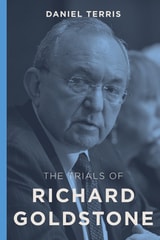
The Trials of Richard Goldstone
Terris, Daniel
Rutgers University Press, 2019
The Trials of Richard Goldstone tells the story of this extraordinary individual and the price he paid for his convictions. It describes how Goldstone, working as a judge in apartheid South Africa, helped to undermine this unjust system and later, at Nelson Mandela’s request, led a commission that investigated cases of racial violence and intimidation. It also considers the international renown he received as the chief United Nations prosecutor for war crimes committed in Rwanda and the former Yugoslavia, the first tribunals to try political and military leaders on charges of genocide. Finally, it explores how Goldstone became a controversial figure in the wake of the Jewish jurist’s powerful, but flawed, investigation of Israel for alleged war crimes in Gaza.
Richard Goldstone’s dramatic life story reveals that even in a world rife with prejudice, nationalism, and contempt for human rights, one courageous man can advance the cause of justice.
The United States and the Armenian Genocide
History, Memory, PoliticsJulien Zarifian
Rutgers University Press, 2024
This is the first book to examine how and why the United States refused to acknowledge the Armenian Genocide until the early 2020s. Although the American government expressed sympathy towards the plight of the Armenians in the 1910s and 1920s, historian Julien Zarifian explores how, from the 1960s, a set of geopolitical and institutional factors soon led the United States to adopt a policy of genocide non-recognition which it would cling to for over fifty years, through Republican and Democratic administrations alike. He describes the forces on each side of this issue: activists from the US Armenian diaspora and their allies, challenging Cold War statesmen worried about alienating NATO ally Turkey and dealing with a widespread American reluctance to directly confront the horrors of the past. Drawing from congressional records, rare newspapers, and interviews with lobbyists and decision-makers, he reveals how genocide recognition became such a complex, politically sensitive issue.
The West Bank Wall
Unmaking PalestineRay Dolphin
Pluto Press, 2006
Israel claims it is a security measure to protect Israeli citizens from terrorist attacks. Opponents point to the serious impact on the rights of Palestinians, depriving them of their land, mobility and access to health and educational services.
This book explores the Palestinian experience of the Wall in their international context. What are the real intentions behind the Israeli security argument? Is it a means of securing territory permanently through an illegal annexation of East Jerusalem? The West Bank Wall is a cutting account of the impact of the wall and how it affects prospects of a future peace in the Middle East.
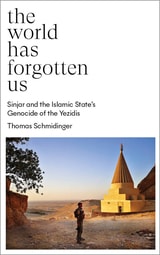
The World Has Forgotten Us
Sinjar and the Islamic State’s Genocide of the YezidisThomas Schmidinger
Pluto Press, 2022
The persecution of the Yezidis, a religious community originating in Upper Mesopotamia, has been ongoing since at least the 10th century. On 3 August 2014, Islamic State attacked the Yezidi community in Sinjar, Kurdistan. Thousands were enslaved or killed in this genocide, and 100,000 people fled to Mount Sinjar, permanently exiled from their homes.
Here, Thomas Schmidinger talks to the Yezidis in Iraq who tell the history of their people, why the genocide happened and how it affects their lives today. This is the first full account of these events, as told by the Yezidis in their own words, to be published in English.
The failure of the Kurdistan Peshmerga of the PDK in Iraq to protect the Yezidis is explored, as is the crucial support given by the Syrian-Kurdish YPG. This multi-faceted and important history brings the fight and trauma of the Yezidis back into focus, calling for the world to remember their struggle.
Torture, Humiliate, Kill
Inside the Bosnian Serb Camp SystemHikmet Karcic
University of Michigan Press, 2022
Half a century after the Holocaust, on European soil, Bosnian Serbs orchestrated a system of concentration camps where they subjected their Bosniak Muslim and Bosnian Croat neighbors to torture, abuse, and killing. Foreign journalists exposed the horrors of the camps in the summer of 1992, sparking worldwide outrage. This exposure, however, did not stop the mass atrocities. Hikmet Karčić shows that the use of camps and detention facilities has been a ubiquitous practice in countless wars and genocides in order to achieve the wartime objectives of perpetrators. Although camps have been used for different strategic purposes, their essential functions are always the same: to inflict torture and lasting trauma on the victims.
Torture, Humiliate, Kill develops the author’s collective traumatization theory, which contends that the concentration camps set up by the Bosnian Serb authorities had the primary purpose of inflicting collective trauma on the non-Serb population of Bosnia and Herzegovina. This collective traumatization consisted of excessive use of torture, sexual abuse, humiliation, and killing. The physical and psychological suffering imposed by these methods were seen as a quick and efficient means to establish the Serb “living space.” Karčić argues that this trauma was deliberately intended to deter non-Serbs from ever returning to their pre-war homes. The book centers on multiple examples of experiences at concentration camps in four towns operated by Bosnian Serbs during the war: Prijedor, Bijeljina, Višegrad, and Bileća. Chosen according to their political and geographical position, Karčić demonstrates that these camps were used as tools for the ethno-religious genocidal campaign against non-Serbs. Torture, Humiliate, Kill is a thorough and definitive resource for understanding the function and operation of camps during the Bosnian genocide.