Results by title
98 books match the query 'Government' and 27 start with t

The American Moralist
On Law, Ethics, And GovernmentGeorge Anastaplo
Ohio University Press, 1994
The Collected Works of William Howard Taft, Volume VIII
“Liberty under Law” and Selected Supreme Court OpinionsFrancis Graham Lee
Ohio University Press, 2004
William Howard Taft’s presidency (1909-1913), succeeding Theodore Roosevelt’s, was mired in bitter partisan fighting, and Taft sometimes blundered politically. However, this son of Cincinnati assumed his true calling when President Warren G. Harding appointed him to the U.S. Supreme Court in 1921. Taft remains the only person to have served both as president of the United States and as chief justice of the Supreme Court.
The Collected Works of William Howard Taft, Volume VIII, consists of “Liberty under Law” and selected Supreme Court opinions, among the most instructive accomplishments of Taft’s ten years at the helm of the court. The writings reveal the sober judgments of a federalist who viewed state regulation with suspicion, championed national government, and saw an independent and powerful judiciary as the bulwark protecting the “vested rights” that the framers of the U.S. Constitution sought to guarantee.
Whatever his failings as a politician, Taft was an intellectual powerhouse who knew how to use the law as a lever to encourage society to move toward more stable and productive ends. Although Taft is considered an average president at best, historians and political scientists rank him among fifteen “near greats” who have served on the high court. His ability and his love for the law shine through in Volume VIII, the concluding volume of The Collected Works of William Howard Taft. As Taft reportedly said to President Harding upon his appointment as chief justice, “I love judges and I love courts. They are my ideals on earth of what we shall meet afterward in heaven under a just God.”
The Constitution of the United States
A Primer for the PeopleDavid P. Currie
University of Chicago Press, 2000
A masterly introduction to the United States Constitution, this slim book leads the reader through a concise overview of the document's individual articles and amendments. With clear and accessible language, Currie then examines each of the three branches of the federal government and explains the relation between the federal and state governments. He analyzes those constitutional provisions that are designed to protect citizens from governmental interference, such as the due process and equal protection clauses and the confusing first amendment provisions respecting the separation of church and state, and includes discussions of judicial review and freedom of speech and of the press.
A sympathetic yet critical guide, Currie's book enables students and laypersons to understand one of the cornerstones of the Western political tradition. The second edition, along with an updated chronology and bibliography, incorporates the Supreme Court decisions over the past decade that have affected constitutional interpretation.
"Superb . . . highly recommended for those seeking a reliable, understandable, and useful introduction to our constitution."—Appellate Practice Journal and Update
The Educator's Guide to Texas School Law
Eleventh EditionJim Walsh and Sarah Orman
University of Texas Press, 2026
A new edition of the most authoritative guide to Texas school law.
Over the past five years, the US Supreme Court, the White House, and the Texas legislature have collectively been responsible for seismic changes in the landscape of education in the Lone Star State. The eleventh edition of The Educator's Guide to Texas School Law is your up-to-date resource for understanding what the law is and what it means for effective school operations.
Intended for educators, school board members, attorneys, and taxpayers, the eleventh edition offers a comprehensive review of the evolving legal structure of schooling in Texas. Jim Walsh and Sarah Orman highlight pressing issues that educators encounter daily: What are teachers’ and students’ free speech rights? What about due process and religious exercise? Exactly how are teachers hired, and under what circumstances can they be fired? The Educators’ Guide also explains the role of the school board and important dimensions of school district governance, including procurement and compliance with the Open Meetings Act. This latest edition focuses intensively on recent areas of reform, including parents’ rights, special-needs law, and education savings accounts. More essential than ever, the Educator’s Guide provides clarity in uncertain times.
The Educator's Guide to Texas School Law
Ninth EditionBy Jim Walsh, Laurie Maniotis, and Frank Kemerer
University of Texas Press, 2018
Much has changed in the area of school law since the first edition of The Educator’s Guide was published in 1986. This new ninth edition offers an authoritative source on all major dimensions of Texas school law through the 2017 legislative sessions. Intended for educators, school board members, interested attorneys, and taxpayers, the ninth edition explains what the law is and what the implications are for effective school operations. It is designed to help professional educators avoid expensive and time-consuming lawsuits by taking effective preventive action. It is an especially valuable resource for school law courses and staff development sessions.
The ninth edition begins with a review of the legal structure of the Texas school system, incorporating recent innovative features such as charter schools and districts of innovation. Successive chapters address attendance, the instructional program, service to students with special needs, the rights of public school employees, the role of religion, student discipline, governmental transparency, privacy, parent rights, and the parameters of legal liability for schools and school personnel. The book includes discussion of major federal legislation, such as the Individuals with Disabilities Education Act, the Family Educational Rights and Privacy Act, Section 504 of the Rehabilitation Act of 1973, and the Every Student Succeeds Act. On the state level, the book incorporates new laws pertaining to cyberbullying and inappropriate relationships between students and employees. Key points are illustrated through case law, and a complete index of case citations is included.
The Educator's Guide to Texas School Law
Tenth EditionJim Walsh and Sarah Orman
University of Texas Press, 2022
Much has changed in the area of school law since the first edition of The Educator’s Guide to Texas School Law was published in 1986. This new tenth edition of The Educator’s Guide offers an authoritative source on Texas school law through the 2021 legislative sessions. Intended for educators, school board members, attorneys, and taxpayers, it explains what the law is and what the implications are for effective school operations; it helps professional educators avoid expensive and time-consuming lawsuits by taking effective preventive action; and it serves as a highly valuable resource for school law courses and staff development sessions.
The tenth edition begins with a review of the legal structure of the Texas school system, incorporating recent features such as charter schools and districts of innovation, then addresses the instructional program, service to students with special needs, the rights of public school employees, the role of religion, student discipline, governmental transparency, privacy, parental rights, and the parameters of legal liability for schools and school personnel. The book includes discussion of major federal legislation, such as the Individuals with Disabilities Education Act, the Family Educational Rights and Privacy Act, Section 504 of the Rehabilitation Act of 1973, and Title IX. On the state level, the book incorporates laws pertaining to cyberbullying, inappropriate relationships between students and employees, and human sexuality instruction.
The Fourth Amendment
Original Understandings and Modern PolicingMichael J.Z. Mannheimer
University of Michigan Press, 2023
Police are required to obey the law. While that seems obvious, courts have lost track of that requirement due to misinterpreting the two constitutional provisions governing police conduct: the Fourth and Fourteenth Amendments. The Fourth Amendment forbids "unreasonable searches and seizures" and is the source of most constitutional constraints on policing. Although that provision technically applies only to the federal government, the Fourteenth Amendment, ratified in the wake of the Civil War, has been deemed to apply the Fourth Amendment to the States.
This book contends that the courts’ misinterpretation of these provisions has led them to hold federal and state law enforcement mistakenly to the same constitutional standards. The Fourth Amendment was originally understood as a federalism, or “states’ rights,” provision that, in effect, required federal agents to adhere to state law when searching or seizing. Thus, applying the same constraint to the States is impossible. Instead, the Fourteenth Amendment was originally understood in part as requiring that state officials (1) adhere to state law, (2) not discriminate, and (3) not be granted excessive discretion by legislators. These principles should guide judicial review of modern policing. Instead, constitutional constraints on policing are too strict and too forgiving at the same time. In this book, Michael J.Z. Mannheimer calls for a reimagination of what modern policing could look like based on the original understandings of the Fourth and Fourteenth Amendments.
The Future of Healthcare Reform in the United States
Edited by Anup Malani and Michael H. Schill
University of Chicago Press, 2015
In the years since the passage of the Patient Protection and Affordable Care Act (PPACA, or, colloquially, Obamacare), most of the discussion about it has been political. But as the politics fade and the law's many complex provisions take effect, a much more interesting question begins to emerge: How will the law affect the American health care regime in the coming years and decades?
This book brings together fourteen leading scholars from the fields of law, economics, medicine, and public health to answer that question. Taking discipline-specific views, they offer their analyses and predictions for the future of health care reform. By turns thought-provoking, counterintuitive, and even contradictory, the essays together cover the landscape of positions on the PPACA's prospects. Some see efficiency growth and moderating prices; others fear a strangling bureaucracy and spiraling costs. The result is a deeply informed, richly substantive discussion that will trouble settled positions and lay the groundwork for analysis and assessment as the law's effects begin to become clear.

The Government and Politics of the European Union
Neill Nugent
Duke University Press, 0
There have been many developments within the European Union since the last edition of this volume. In May 2004, the EU increased in size from fifteen to twenty-five member states, and, in so doing, became a pan-European, rather than Western European, organization. The following month, national leaders reached agreement on the contents of the long-discussed and exhaustively negotiated Constitutional Treaty only to see the fruits of their labors rejected in 2005 by voters in France and the Netherlands. These are only the most obvious manifestations of a constantly evolving integration process addressed throughout the book. Every chapter has been extensively revised since the last edition.
The Government and Politics of the European Union also includes reflections on the conceptual and theoretical tools used to analyze the integration process and the EU, as well as on the factors likely to influence the Union’s future development.
The Government of Beans
Regulating Life in the Age of MonocropsKregg Hetherington
Duke University Press, 2020
The Government of Desire
A Genealogy of the Liberal SubjectMiguel de Beistegui
University of Chicago Press, 2018
By critically exploring Foucault’s claim that Western civilization is a civilization of desire, de Beistegui crafts a provocative and original genealogy of this shift in thinking. He shows how the relationship between identity, desire, and government has been harnessed and transformed in the modern world, shaping our relations with others and ourselves, and establishing desire as an essential driving force for the constitution of a new and better social order. But is it? The Government of Desire argues that this is precisely what a contemporary politics of resistance must seek to overcome. By questioning the supposed universality of a politics based on recognition and the economic satisfaction of desire, de Beistegui raises the crucial question of how we can manage to be less governed today, and explores contemporary forms of counter-conduct.
Drawing on a host of thinkers from philosophy, political theory, and psychoanalysis, and concluding with a call for a sovereign and anarchic form of desire, The Government of Desire is a groundbreaking account of our freedom and unfreedom, of what makes us both governed and ungovernable.
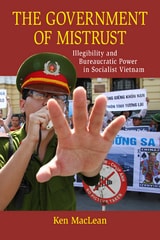
The Government of Mistrust
Illegibility and Bureaucratic Power in Socialist VietnamKen MacLean
University of Wisconsin Press, 2013
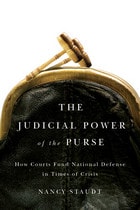
The Judicial Power of the Purse
How Courts Fund National Defense in Times of CrisisNancy Staudt
University of Chicago Press, 2011
Congress and the president are not the only branches that deal with fiscal issues in times of war. In this innovative book, Nancy Staudt focuses on the role of federal courts in fiscal matters during warfare and high-cost national defense emergencies. There is, she argues, a judicial power of the purse that becomes evident upon examining the budgetary effects of judicial decision making. The book provides substantial evidence that judges are willing—maybe even eager—to redirect private monies into government hands when the country is in peril, but when the judges receive convincing cues that ongoing wartime activities undermine the nation’s interests, they are more likely to withhold funds from the government by deciding cases in favor of private individuals and entities who show up in court.
In stark contrast with conventional legal, political, and institutional thought that privileges factors associated with individual preferences, The Judicial Power of the Purse sheds light on environmental factors in judicial decision making and will be an excellent read for students of judicial behavior in political science and law.
The Mormon Hierarchy
Extensions of PowerD. Michael Quinn
Signature Books, 1997
But by interviewing former church aides, examining hundreds of diaries, and drawing from his own past experience as an insider within the Latter-day Saint historical department, D. Michael Quinn presents a fuller view. His extensive research documents how the governing apostles, seventies, and presiding bishops are likely to be at loggerheads, as much as united. These strong-willed, independent men–like directors of a large corporation or supreme court justices–lobby among their colleagues, forge alliances, out-maneuver opponents, and broker compromises.
There is more: clandestine political activities, investigative and punitive actions by church security forces, personal “loans” from church coffers (later written off as bad debts), and other privileged power-vested activities. Quinn considers the changing role and attitude of the leadership toward visionary experiences, the momentous events which have shaped quorum protocol and doctrine, and day-to-day bureaucratic intrigue from the time of Brigham Young to the dawn of the twenty-first century.
The hierarchy seems at root well-intentioned and even at times aggressive in fulfilling its stated responsibility, which is to expedite the Second Coming. Where they have become convinced that God has spoken, they have set aside personal differences, offered unqualified support, and spoken with a unified voice. This potential for change, when coupled with the tempering effect of competing viewpoints, is something Quinn finds encouraging about Mormonism. But one should not assume that these men are infallible or work in anything approaching uninterrupted unanimity.
The Mormon Hierarchy
Origins of PowerD. Michael Quinn
Signature Books, 1994
Not until seven years later did Mormons first learn that authority had been restored by angels or of the need for a hierarchy mirroring the Pauline model. That same year (1835) a Quorum of Twelve Apostles was organized, but their jurisdiction was limited to areas outside established stakes (dioceses). Stakes were led by a president, who oversaw spiritual development, and by a bishop, who supervised temporal needs.
At Smith’s martyrdom in 1844, the church had five leading quorums of authority. The most obvious successor to Smith, Illinois stake president William Marks, opposed the secret rites of polygamy, anointing, endowments, and the clandestine political activity that had characterized the church in Illinois. The secret Council of Fifty had recently ordained Smith as King on Earth and sent ambassadors abroad to form alliances against the United States.
The majority of church members knew nothing of these developments, but they followed Brigham Young, head of the Quorum of the Twelve, who spoke forcefully and moved decisively to eliminate contenders for the presidency. He continued to build on Smith’s political and doctrinal innovations and social stratification. Young’s twentieth-century legacy is a well-defined structure without the charismatic spontaneity or egalitarian chaos of the early church.
Historian D. Michael Quinn examines the contradictions and confusion of the first two tumultuous decades of LDS history. He demonstrates how events and doctrines were silently, retroactively inserted into the published form of scriptures and records to smooth out the stormy, haphazard development. The bureaucratization of Mormonism was inevitable, but the manner in which it occurred was unpredictable and will be, for readers, fascinating.
The Mormon Hierarchy
Wealth and Corporate PowerD. Michael Quinn
Signature Books, 2017
Early in the twentieth century, it was possible for Latter-day Saints to have lifelong associations with businesses managed by their leaders or owned and controlled by the church itself. For example, one could purchase engagement rings from Daynes Jewelry, honeymoon at the Hotel Utah, and venture off on the Union Pacific Railroad, all partially owned and run by church apostles.
Families could buy clothes at Knight Woolen Mills. The husband might work at Big Indian Copper or Bullion-Beck, Gold Chain, or Iron King mining companies. The wife could shop at Utah Cereal Food and buy sugar supplied by Amalgamated or U and I Sugar, beef from Nevada Land and Livestock, and vegetables from the Growers Market. They might take their groceries home in parcels from Utah Bag Co. They probably read the Deseret News at home under a lamp plugged into a Utah Power and Light circuit. They could take out a loan from Zion’s Co-operative and insurance from Utah Home and Fire.
The apostles had a long history of community involvement in financial enterprises to the benefit of the general membership and their own economic advantage. This volume is the result of the author’s years of research into LDS financial dominance from 1830 to 2010.
The Plan for Perpetual Peace, On the Government of Poland, and Other Writings on History and Politics
Jean-Jacques Rousseau
Dartmouth College Press, 2011
The Policy Dilemma
Federal Crime Policy and the Law Enforcement Assistance Administration, 1968-1978Malcolm Feeley
University of Minnesota Press, 1981
The Political Centrist
John Lawrence Hill
Vanderbilt University Press, 2009
Centrists reject each of these fragmented and polarized approaches to politics. We believe that government has a role to play in structuring social and economic opportunities and in reinforcing basic moral norms, yet we are deeply troubled by ever-expanding government. We reject libertarianism, left-liberalism, and the various schools of conservatism as a model for government.
Part I of The Political Centrist briefly traces the trajectory of the liberal and conservative traditions. It argues that modern liberalism is an unprincipled fusion of classical liberal and socialist ideals while modern conservatism is an untenable hybrid of economic liberalism and social conservatism. Part II offers a centrist approach to many of the most contentious contemporary political and social issues. Those include:
-- abortion
-- affirmative action
-- the death penalty
-- gay marriage
-- illegal immigration
-- judicial activism
-- the relationship of religion and politics
-- the role of government in the economy
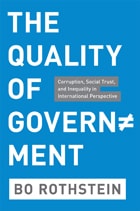
The Quality of Government
Corruption, Social Trust, and Inequality in International PerspectiveBo Rothstein
University of Chicago Press, 2011
The Role of Government in the History of Economic Thought
2005 Supplement, Volume 37Steven G. Medema and Peter Boettke
Duke University Press, 0
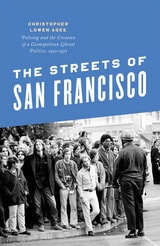
The Streets of San Francisco
Policing and the Creation of a Cosmopolitan Liberal Politics, 1950-1972Christopher Lowen Agee
University of Chicago Press, 2014
The Streets of San Francisco uncovers the seldom reported, street-level interactions between police officers and San Francisco residents and finds that police discretion was the defining feature of mid-century law enforcement. Postwar police officers enjoyed great autonomy when dealing with North Beach beats, African American gang leaders, gay and lesbian bar owners, Haight-Ashbury hippies, artists who created sexually explicit works, Chinese American entrepreneurs, and a wide range of other San Franciscans. Unexpectedly, this police independence grew into a source of both concern and inspiration for the thousands of young professionals streaming into the city's growing financial district. These young professionals ultimately used the issue of police discretion to forge a new cosmopolitan liberal coalition that incorporated both marginalized San Franciscans and rank-and-file police officers. The success of this model in San Francisco resulted in the rise of cosmopolitan liberal coalitions throughout the country, and today, liberal cities across America ground themselves in similar understandings of democracy, emphasizing both broad diversity and strong policing.
The Supreme Court Review, 2022
Edited by David A. Strauss, Geoffrey R. Stone, Justin Driver, and William Baude
University of Chicago Press Journals, 2023
Since it first appeared in 1960, the Supreme Court Review has won acclaim for providing a sustained and authoritative survey of the implications of the Court's most significant decisions. SCR is an in-depth annual critique of the Supreme Court and its work, analyzing the origins, reforms, and modern interpretations of American law. SCR is written by and for legal academics, judges, political scientists, journalists, historians, economists, policy planners, and sociologists.
The Three Ages of Government
From the Person, to the Group, to the WorldJos C.N. Raadschelders
University of Michigan Press, 2020
The Unruly Everyday
Urban Housing in Russia’s Long Revolutionary PeriodDeirdre Ruscitti Harshman
University of Wisconsin Press, 2027
As a result of mass urbanization from the late nineteenth century onward, an acute housing shortage in Russia and the associated “housing question” rapidly grew to such a large scale that no single group was able to tackle it in its entirety. Complicated, ideologically fraught negotiations and solutions emerged, failed, and occasionally partially succeeded over time. The Unruly Everyday unearths and detangles the contours of this history, exploring what it tells us not just about Soviet and Russian housing but about the messy process by which society changes.
Beyond tracing contestations about housing in particular, Deirdre Ruscitti Harshman explores how the concept of the “everyday” was used to critique the limitations of the present and to imagine alternatives. She argues that the ways various groups worked, sometimes collaboratively and sometimes contentiously, through these negotiations transcended neat pre- and postrevolutionary binaries, in terms of both chronology and ideology. The issues and local responses remained largely the same no matter what type of central government controlled the Kremlin. Critically, the housing problem was instead addressed by the development of various forms of local power—whose very existence and capacities undermine the perception of both tsarist and Soviet Russia as autocratic, highly centralized states.
To the Promised Land
A History of Government and Politics in OregonTom Marsh
Oregon State University Press, 2012
From Jason Lee’s first letter urging Congress to take possession of the Oregon Country to John Kitzhaber’s precedent-setting third term as governor, from the land frauds of the early 20th century to the state’s land-use planning goals, from the Beach Bill to the Bottle Bill, this book tells Oregon’s story.
Featuring interesting trivia, historical photographs, and biographical sketches of key politicians, To the Promised Land is an essential volume for readers interested in Oregon’s history.
Town in the Empire
Government, Politics, and Society in Seventeenth Century PopayánBy Peter Marzahl
University of Texas Press, 1979
During the seventeenth century, many of the fundamental characteristics of Spanish America were established. Peter Marzahl adds significantly to our understanding of this period with this study of Popayán, a town in what was then part of New Granada and is now Colombia. New Granada was something of a backwater of the empire, but very likely Popayán was more typical of everyday colonial life than the major centers that have drawn most attention from historians.
In the first part of his study, Marzahl describes both town and region, depicts economic activities (agriculture, gold mining, trade), and analyzes urban and rural society. Of particular interest is his discussion of the complex interaction among the different ethnic groups: Spaniards, Mestizos, Indians, and Blacks. In the longer second part he presents a detailed account of the makeup and operations of the town councils. His extensive research in primary sources makes possible a thorough examination of Popayán's administration and politics and their relationship to economic and social patterns. He also describes the councils' relations with the provincial governors, the viceregal authorities in Bogotá, and the Church. Because this study treats a neglected period and region and, in so doing, offers fresh materials and insights, it is an important contribution to our knowledge and comprehension of colonial Spanish America.