Results by title
56 books match the query 'Government, Resistance to' and 11 start with t

Terrorism for Humanity
Inquiries in Political PhilosophyTed Honderich
Pluto Press, 2003
Terrorism on Trial
Political Violence and Abolitionist FuturesNicole Nguyen
University of Minnesota Press, 2023
A landmark sociological examination of terrorism prosecution in United States courts
Rather than functioning as a final arbiter of justice, U.S. domestic courts are increasingly seen as counterterrorism tools that can incapacitate terrorists, maintain national security operations domestically, and produce certain narratives of conflict. Terrorism on Trial examines the contemporary role that these courts play in the global war on terror and their use as a weapon of war: hunting, criminalizing, and punishing entire communities in the name of national security.
Nicole Nguyen advocates for a rethinking of popular understandings of political violence and its root causes, encouraging readers to consider anti-imperial abolitionist alternatives to the criminalization, prosecution, and incarceration of individuals marked as real or perceived terrorists. She exposes how dominant academic discourses, geographical imaginations, and social processes have shaped terrorism prosecutions, as well as how our fundamental misunderstanding of terrorism has led to punitive responses that do little to address the true sources of violence, such as military interventions, colonial occupations, and tyrannical regimes. Nguyen also explores how these criminal proceedings bear on the lives of defendants and families, seeking to understand how legal processes unevenly criminalize and disempower communities of color.
A retheorization of terrorism as political violence, Terrorism on Trial invites readers to carefully consider the role of power and politics in the making of armed resistance, addressing the root causes of political violence, with a goal of building toward a less violent and more liberatory world.

The Aftermath of War
Jean-Paul Sartre
Seagull Books, 2008
The Betrayal of Dissent
Beyond Orwell, Hitchens and the New American CenturyScott Lucas
Pluto Press, 2004
political writer, and the standard-bearer of honesty and decency for the honourable 'Left'. In this controversial polemic, Scott Lucas argues that the exaltation of Orwell, far from upholding dissent against the State, has sought to quash such opposition. Indeed, Orwell has become the icon of those who, in the pose of the contrarian, try to silence public opposition to US and U K foreign policy in the 'War on Terror'.
Lucas's lively and readable critique of public intellectuals including Christopher Hitchens, Michael Walzer, David Aaronovitch, and Johann Hari – who have all invoked Orwellian honesty and decency to shut down dissent – will appeal to anyone disillusioned with the wars in Afghanistan and Iraq.
Lucas contends that these leading journalists and commentators have used Orwell to justify their own political transition from radicals to upholders of the establishment. All of them play influential roles in supporting the UK and US governments' charge that opponents of war -- and those who question the motives behind American foreign policy and its implementation -- should be condemned as 'appeasers of mass murder'.
This controversial book shows how Orwell has been used since 9/11 to justify, in the guise of independent thought, the suppression of dissent. We must rescue ourselves from Orwell and from those who take on his guise so, as Lucas puts it, our ‘silencing is… vital to a "manufacture of consent" for the wars which are supposedly being fought in our name and for our good’.

The Reappeared
Argentine Former Political PrisonersPark, Rebekah
Rutgers University Press, 2014
The Rise of the Masses
Spontaneous Mobilization and Contentious PoliticsBenjamin Abrams
University of Chicago Press, 2023
Between 15 and 26 million Americans participated in protests surrounding the murders of George Floyd, Ahmaud Arbery, Breonna Taylor, and others as part of the Black Lives Matter protests in 2020, which is only one of the most recent examples of an immense mobilization of citizens around a cause. In The Rise of the Masses, sociologist Benjamin Abrams addresses why and how people spontaneously protest, riot, and revolt en masse. While most uprisings of such a scale require tremendous resources and organizing, this book focuses on cases where people with no connection to organized movements take to the streets, largely of their own accord. Looking to the Arab Spring, Occupy Wall Street, and the Black Lives Uprising, as well as the historical case of the French Revolution, Abrams lays out a theory of how and why massive mobilizations arise without the large-scale planning that usually goes into staging protests.
Analyzing a breadth of historical and regional cases that provide insight into mass collective behavior, Abrams draws on first-person interviews and archival sources to argue that people organically mobilize when a movement speaks to their pre-existing dispositions and when structural and social conditions make it easier to get involved—what Abrams terms affinity-convergence theory. Shedding a light on the drivers behind large spontaneous protests, The Rise of the Masses offers a significant theory that could help predict movements to come.

The Time of Liberty
Popular Political Culture in Oaxaca, 1750–1850Peter Guardino
Duke University Press, 2005
Guardino makes extensive use of archival materials, including judicial transcripts and newspaper accounts, to illuminate the dramatic contrasts between the local politics of the city and of the countryside, describing in detail how both sets of citizens spoke and acted politically. He contends that although it was the elites who initiated the national change to republicanism, the transition took root only when engaged by subalterns. He convincingly argues that various aspects of the new political paradigms found adherents among even some of the most isolated segments of society and that any subsequent failure of electoral politics was due to an absence of pluralism rather than a lack of widespread political participation.

Theatres of Struggle and the End of Apartheid
Belinda Bozzoli
Ohio University Press, 2004
A compelling study of the origins and trajectory of one of the legendary black uprisings against apartheid, Theatres of Struggle and the End of Apartheid draws on insights gained from the literature on collective action and social movements. It delves into the Alexandra Rebellion of 1986 to reveal its inner workings.
Belinda Bozzoli’s aim is to examine how the residents of Alexandra, a poverty-stricken segregated township in Johannesburg, manipulated and overturned the meanings of space, time, and power in their sequestered world. She explains how they used political theater to convey, stage, and dramatize their struggle and how young and old residents generated differing ideologies and tactics, giving rise to a distinct form of generational politics.
Theatres of Struggle and the End of Apartheid asks the reader to enter into the world of the rebels and to confront the moral complexity and social duress they experienced as they invented new social forms and violently attacked old ones. It is an important study of collective action that will be of great interest to sociologists and to scholars of Africa, particularly to those interested in the antiapartheid struggle.
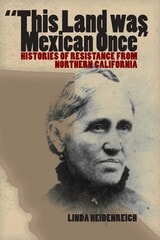
This Land Was Mexican Once
Histories of Resistance from Northern CaliforniaBy Linda Heidenreich
University of Texas Press, 2007
The territory of Napa County, California, contains more than grapevines. The deepest roots belong to Wappo-speaking peoples, a group whose history has since been buried by the stories of Spanish colonizers, Californios (today's Latinos), African Americans, Chinese immigrants, and Euro Americans. Napa's history clearly is one of co-existence; yet, its schoolbooks tell a linear story that climaxes with the arrival of Euro Americans. In "This Land was Mexican Once," Linda Heidenreich excavates Napa's subaltern voices and histories to tell a complex, textured local history with important implications for the larger American West, as well.
Heidenreich is part of a new generation of scholars who are challenging not only the old, Euro-American depiction of California, but also the linear method of historical storytelling—a method that inevitably favors the last man writing. She first maps the overlapping histories that comprise Napa's past, then examines how the current version came to dominate—or even erase—earlier events. So while history, in Heidenreich's words, may be "the stuff of nation-building," it can also be "the stuff of resistance." Chapters are interspersed with "source breaks"—raw primary sources that speak for themselves and interrupt the linear, Euro-American telling of Napa's history. Such an inclusive approach inherently acknowledges the connections Napa's peoples have to the rest of the region, for the linear history that marginalizes minorities is not unique to Napa. Latinos, for instance, have populated the American West for centuries, and are still shaping its future. In the end, "This Land was Mexican Once" is more than the story of Napa, it is a multidimensional model for reflecting a multicultural past.
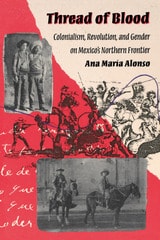
Thread of Blood
Colonialism, Revolution, and Gender on Mexico's Northern FrontierAna María Alonso
University of Arizona Press, 1995
The author demonstrates that a distinct kind of frontier serrano society was generated in Namiquipa between the mid-18th and mid-19th centuries. In exchange for keeping the Apaches at bay, colonists were provided with arms and land grants. At the same time, they developed a gendered sense of ethnic identity that equated honor with land, autonomy, and a kind of masculinity that distinguished the "civilized" colonist from the "barbarous" Indian. While this identity was itself ordered hierarchically between men and women, and between "Hispanic" and "Indian," it also provided serranos with a sense of pride and dignity that was not directly associated with wealth.
After the defeat of the Apaches, and with increased state control during the last decades of the Porfiriato, the serranos on the frontier were transformed from bulwarks of order to victims of progress. The expansion of capitalism and the manipulation of local political office by men no longer accountable to communal norms eroded the legitimacy of both powerholders and the central state. In response, serranos constructed an ideology of history based on past notions of masculine honor and autonomy. This ideology motivated their confrontations with the Mexican state during the 1890s and also served as the force behind their mobilization in the 1910 revolution.

To Shake Their Guns in the Tyrant's Face
Libertarian Political Violence and the Origins of the Militia MovementRobert H. Churchill
University of Michigan Press, 2011
After the bombings of Oklahoma City in 1995, most Americans were shocked to discover that tens of thousands of their fellow citizens had banded together in homegrown militias. Within the next few years, numerous studies and media reports appeared revealing the unseen world of the American militia movement, a loose alliance of groups with widely divergent views. Not surprisingly, it was the movement’s most extreme voices that attracted the lion's share of attention.
In reality the militia movement was neither as irrational nor as new as it was portrayed in the press, Robert Churchill writes. What bound the movement together was the shared belief that citizens have a right, even a duty, to take up arms against wanton exercise of unconstitutional power by the federal government. Many were motivated to join the movement by what they saw as a rise in state violence, illustrated by the government assaults at Ruby Ridge, Idaho in 1992, and Waco, Texas in 1993. It was this perception and the determination to deter future state violence, Churchill argues, that played the greatest role in the growth of the American militia movement.
Churchill uses three case studies to illustrate the origin of some of the core values of the modern militia movement: Fries' Rebellion in Pennsylvania at the end of the eighteenth century, the Sons of Liberty Conspiracy in Civil War-era Indiana and Illinois, and the Black Legion in Michigan and Ohio during the Depression. Building on extensive interviews with militia members, the author places the contemporary militia movement in the context of these earlier insurrectionary movements that, animated by a libertarian interpretation of the American Revolution, used force to resist the authority of the federal government.
A historian of early America, Robert H. Churchill has published numerous articles on American political violence and the right to keep and bear arms. He is currently Associate Professor of History at the University of Hartford.
"This book is about how we think about the past, how cultural memories are formed and evolve, and how these memories then come to impact current understandings of issues. Churchill provides an enlightening analysis of the ideology, structure, and purpose of the militia movement. Where much scholarship has categorized it as a cohesive, single movement, Churchill begins the process of unraveling its complexity."
---Steve Chermak, Michigan State University
"To Shake Their Guns in the Tyrant's Face addresses an area---the relationship of American political violence to American ideology---that is of growing importance and that is commanding an ever increasing audience, and it does so in a way like nothing else in the field."
---David Williams, Indiana University Bloomington