1441 books match the query 'Great Britain' and 342 start with t
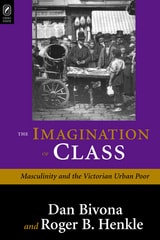
cover of THE IMAGINATION OF CLASS: MASCULINITY AND THE VICTORIAN URBAN POOR

THE IMAGINATION OF CLASS

MASCULINITY AND THE VICTORIAN URBAN POOR

Dan Bivona and Roger B. Henkle

The Ohio State University Press, 2006

A fascinating meld of two scholars’ research and conclusions, The Imagination of Class is a synthetic journey through middle-class Victorian discourse posed by poverty in the midst of plenty—but not that alone. Rather Dan Bivona and Roger B. Henkle argue that the representation of abject poverty in the nineteenth century also displaced anxieties aroused by a variety of challenges to Victorian middle class masculinity. The book’s main argument, in fact, is that the male middle class imagery of urban poverty in the Victorian age presents a complex picture, one in which anxieties about competition, violence, class-based resentment, individuality, and the need to differentiate oneself from the scions of inherited wealth influence mightily the ways in which the urban poor are represented. In the representations themselves, the urban poor are alternately envisioned as sentimentalized (and feminized) victims who stimulate middle class affective response, as the objects of the professionalized discourses of the social sciences (and social services), and as an often hostile social force resistant to the “culturalizing,” taming processes of a maternalist social science.

Through carefully nuanced discussions of a variety of Victorian novelists, journalists, and sociological investigators (some well known, like Dickens, and others less well known, like Masterman and Greenwood), the book offers new insight into the role played by the imagination of the urban poor in the construction of Victorian middle class masculinity. Whereas many scholars have discussed the feminization of the poor, virtually no one has addressed how the poor have served as a site at which middle class men fashioned their own class and gender identity.
[more]
cover of THE NOVEL AND THE MENAGERIE: TOTALITY, ENGLISHNESS, AND EMPIRE

THE NOVEL AND THE MENAGERIE

TOTALITY, ENGLISHNESS, AND EMPIRE

KURT KOENIGSBERGER

The Ohio State University Press, 2007
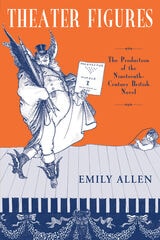
The first comprehensive account of the relation of collections of imperial beasts to narrative practices in England, The Novel and the Menagerie explores an array of imaginative responses to the empire as a dominant, shaping factor in English daily life. Kurt Koenigsberger argues that domestic English novels and collections of zoological exotica (especially zoos, circuses, traveling menageries, and colonial and imperial exhibitions) share important aesthetic strategies and cultural logics: novels about English daily life and displays featuring collections of exotic animals both strive to relate Englishness to a larger empire conceived as an integrated whole.
 
Koenigsberger’s investigations range from readings of novels by authors such as Charles Dickens, Virginia Woolf, Salman Rushdie, and Angela Carter to analyses of ballads, handbills, broadsides, and memoirs of showmen. Attending closely to the collective English practices of imagining and delineating the empire as a whole, The Novel and the Menagerie works at the juncture of literary criticism, colonial discourse studies, and cultural analysis to historicize the notion of totality in the theory and practice of the English novel. In exploring the shapes of the novel in England and of the English institutions that collected exotic animals, it offers fresh readings of familiar literary texts and opens up new ways of understanding the character of imperial Englishness across the nineteenth and twentieth centuries.
[more]
cover of THEATER FIGURES: The Production of the Nineteenth-Century British Novel

THEATER FIGURES

The Production of the Nineteenth-Century British Novel

Emily Allen

The Ohio State University Press, 2003

[more]
cover of Talking History: Seminar Culture at the Institute of Historical Research, 1921–2021

Talking History

Seminar Culture at the Institute of Historical Research, 1921–2021

Edited by David Manning

University of London Press, 2024

Since its founding in 1921, the Institute of Historical Research (IHR) at the University of London has seen students and teachers come together, socially and intellectually, to engage in lively academic seminars. But for what purpose and with what value?

Talking History provides a defence of the seminar as a central element in historians' teaching, research and sense of community. Covering a range of the IHR’s long-running seminar series, which are differentiated by historical period, region and/or theme, the book presents the seminars as a local, national and international hub for scholarship that emerges from and is sustained by the ongoing learning practices of historians as scholars and people. Talking History bears witness to a seminar culture of evolving, multifarious synergies between teaching, researching and learning, historiography and participation — intertextual, interpersonal, intergenerational and intercultural. Viewed as such, the seminars constitute a living tradition, stimulating and incorporating dynamic change over time to contribute not just to the development of historiography but intellectual life more generally, often in conversation with major political events and cultural phenomena.

This original and significant book therefore reflects upon, and gives further expression to, the ongoing evolution of historical research and its role in wider society today.
[more]
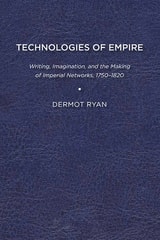
cover of Technologies of Empire: Writing, Imagination, and the Making of Imperial Networks, 1750–1820

Technologies of Empire

Writing, Imagination, and the Making of Imperial Networks, 1750–1820

Dermot Ryan

University of Delaware Press, 2013

Technologies of Empire looks at the ways in which writers of the long eighteenth century treat writing and imagination as technologies that can produce rather than merely portray empire. Authors ranging from Adam Smith to William Wordsworth consider writing not as part of a larger logic of orientalism that represents non-European subjects and spaces in fixed ways, but as a dynamic technology that organizes these subjects and transforms these spaces. Technologies of Empire reads the imagination as an instrument that works in tandem with writing, expanding and consolidating the networks of empire. Through readings across a variety of genres, ranging from Smith’s The Wealth of Nations and Edmund Burke’s Reflections on the Revolution in France to Maria Edgeworth’s Irish fiction and Wordsworth’s epic poetry, this study offers a new account of writing’s role in empire-building and uncovers a genealogy of the romantic imagination that is shot through by the imperatives of imperialism.

Published by University of Delaware Press. Distributed worldwide by Rutgers University Press.
 
[more]
cover of Tell Me Lies: Propaganda and Media Distortion in the Attack on Iraq

Tell Me Lies

Propaganda and Media Distortion in the Attack on Iraq

Edited by David Miller

Pluto Press, 2003

Did the US and UK governments lie about weapons of mass destruction to promote an attack on Iraq?

Did the media hold them to account or act as cheerleaders for war?

Tell me Lies reveals the systematic propaganda used by both the US and UK governments to convince us of the 'threat' from Iraq. It shows how we were deliberately misled into a war that has resulted in a humanitarian disaster in Iraq and threatens to create further instability and resentment of the US and UK throughout the Middle East.

Written by some of the world's leading journalists and commentators, it's a scathing indictment of the role of the mainstream media in legitimising government actions and undermining dissent. Critics, activists and journalists from both sides of the Atlantic explore alternatives such as the internet and Al Jazeera and provide analysis and guidance on resisting the media war.

Contributors include John Pilger, Noam Chomsky, Robert Fisk, Edward Herman, Mark Thomas, Mark Steel, Phillip Knightley, Tim Llewelyn (BBC Middle East Correspondent), Abdul Hadi Jiad (Iraqi journalist sacked by the BBC before the war), David Cromwell and David Edwards (Media Lens), Mark Curtis, John Stauber and Sheldon Rampton (PR Watch, and co-authors of Weapons of Mass Deception and Toxic Sludge is Good For You), Pat Holland, Norman Solomon (columnist and director of the Institute for Public Accuracy), Nancy Snow (California State University, Fullerton, author of Propaganda Inc. and Information War), Doug Kellner (UCLA), Julian Petley, Yvonne Ridley (Aljazeera.net and author of In the Hands of the Taliban), Tim Gopsill (Campaign for Press and Broadcasting Freedom), Faisal Bodi (UK Guardian, Aljazeera.net), Alistair Alexander (Stop the War Coalition), Greg Philo (Glasgow University Media Group), Steve Dorrill, Andy Rowell, Granville Williams and cartoonists Steve Bell, Steve Caplin and Polyp.
[more]
cover of Telling Time: Clocks, Diaries, and English Diurnal Form, 1660-1785

Telling Time

Clocks, Diaries, and English Diurnal Form, 1660-1785

Stuart Sherman

University of Chicago Press, 1997

A revolution in clock technology in England during the 1660s allowed people to measure time more accurately, attend to it more minutely, and possess it more privately than previously imaginable. In Telling Time, Stuart Sherman argues that innovations in prose emerged simultaneously with this technological breakthrough, enabling authors to recount the new kind of time by which England was learning to live and work.

Through brilliant readings of Samuel Pepys's diary, Joseph Addison and Richard Steele's daily Spectator, the travel writings of Samuel Johnson and James Boswell, and the novels of Daniel Defoe and Frances Burney, Sherman traces the development of a new way of counting time in prose—the diurnal structure of consecutively dated installments—within the cultural context of the daily institutions which gave it form and motion. Telling Time is not only a major accomplishment for seventeenth- and eighteenth-century literary studies, but it also makes important contributions to current discourse in cultural studies.
[more]
cover of Temple of Science: The Pre-Raphaelites and Oxford University Museum of Natural History

Temple of Science

The Pre-Raphaelites and Oxford University Museum of Natural History

John Holmes

Bodleian Library Publishing, 2020
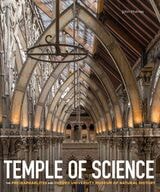
Built between 1855 and 1860, the Oxford University Museum of Natural History is the extraordinary result of close collaboration between artists and scientists. The architect Benjamin Woodward consulted with two groups on the design and decoration of the building: a panel of Oxford scientists and dons, and the society of artists known as the Pre-Raphaelite Brotherhood. The museum's decorative art was modeled on the Pre-Raphaelites' principle of meticulous observation of nature, itself indebted to science. The structure was an experiment in using architecture and art to communicate natural history, modern science, and natural theology.  Temple of Science sets out the history of the campaign to build the museum before taking the reader on a tour of the art found in the museum itself. It looks at the façade and the central court, the natural history carvings and marble columns illustrating different geological strata, and the meticulously carved sculptures of influential scientists. With unique insights and lavish illustrations, Temple of Science tells the story of one of the most remarkable collaborations between scientists and artists in European art.
[more]
cover of Temptation in the Archives: Essays in Golden Age Dutch Culture

Temptation in the Archives

Essays in Golden Age Dutch Culture

Lisa Jardine

University College London, 2015
Temptation in the Archives is a collection of essays by Lisa Jardine, that takes readers on a journey through the Dutch Golden Age. Through the study of such key figures as Sir Constantjin Huygens, a Dutch polymath and diplomat, we begin to see the Anglo-Dutch cultural connections that formed during this period against the backdrop of unfolding political events in England.Temptation in the Archives paints a picture of a unique relationship between the Netherlands and England in the 17th century forged through a shared experience – and reveals the lessons we can learn from it today.
[more]
cover of Tempting All the Gods: Joseph P. Kennedy, Ambassador to Great Britain, 1938–1940

Tempting All the Gods

Joseph P. Kennedy, Ambassador to Great Britain, 1938–1940

Jane Karoline Vieth

Michigan State University Press, 2021
Tempting All the Gods is a detailed study of Joseph P. Kennedy’s diplomatic career in London. It examines Kennedy’s role as ambassador to the Court of St. James’s from 1938–1940, a crucial time in world history. It describes his attitudes toward American foreign policy before the outbreak of war and after the war began, explains why he held those views, and assesses their impact on Anglo-American relations. It also looks at the diplomatic background against which he worked, at the political philosophies and personalities of the statesmen with whom he dealt, and at his relations with them, particularly President Franklin Roosevelt and British Prime Ministers Neville Chamberlain and Winston Churchill. Here the reader will find a meticulously researched account of Kennedy’s career based on the latest evidence available, providing a current and balanced historical reassessment. Scholars will be able to study Kennedy’s diplomatic career within the broader context of international relations and also to gain a fuller understanding of his view of his own motives and policies, including an understanding of why the ambassadorship was the greatest achievement—with the poorest outcome—in the varied life of an intensely ambitious man who was dedicated foremost to family, friends, and fortune. This book will prove significant to students of Anglo-American relations and of World War II, and to the general public, with its enduring fascination with the Kennedy family.
[more]
cover of Ten Books That Shaped the British Empire: Creating an Imperial Commons

Ten Books That Shaped the British Empire

Creating an Imperial Commons

Antionette Burton and Isabel Hofmeyr, eds.

Duke University Press, 2014

Combining insights from imperial studies and transnational book history, this provocative collection opens new vistas on both fields through ten accessible essays, each devoted to a single book. Contributors revisit well-known works associated with the British empire, including Charlotte Brontë's Jane Eyre, Thomas Macaulay's History of England, Charles Pearson's National Life and Character, and Robert Baden-Powell's Scouting for Boys. They explore anticolonial texts in which authors such as C. L. R. James and Mohandas K. Gandhi chipped away at the foundations of imperial authority, and they introduce books that may be less familiar to students of empire. Taken together, the essays reveal the dynamics of what the editors call an "imperial commons," a lively, empire-wide print culture. They show that neither empire nor book were stable, self-evident constructs. Each helped to legitimize the other.

Contributors. Tony Ballantyne, Elleke Boehmer, Catherine Hall, Isabel Hofmeyr, Aaron Kamugisha, Marilyn Lake, Charlotte Macdonald, Derek Peterson, Mrinalini Sinha, Tridip Suhrud, André du Toit
[more]
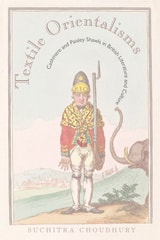
cover of Textile Orientalisms: Cashmere and Paisley Shawls in British Literature and Culture

Textile Orientalisms

Cashmere and Paisley Shawls in British Literature and Culture

Suchitra Choudhury

Ohio University Press, 2023
The first major study of Cashmere and Paisley shawls in nineteenth-century British literature, this book shows how they came to represent both high fashion and the British Empire. During the late eighteenth century, Cashmere shawls from the Indian subcontinent began arriving in Britain. At first, these luxury goods were tokens of wealth and prestige. Subsequently, affordable copies known as “Paisley” shawls were mass-produced in British factories, most notably in the Scottish town of the same name. Textile Orientalisms is the first full-length study of these shawls in British literature of the extended nineteenth century. Attentive to the juxtaposition of objects and their descriptions, the book analyzes the British obsession with Indian shawls through a convergence of postcolonial, literary, and cultural theories. Surveying a wide range of materials—plays, poems, satires, novels, advertisements, and archival sources—Suchitra Choudhury argues that while Cashmere and Paisley shawls were popular accoutrements in Romantic and Victorian Britain, their significance was not limited to fashion. Instead, as visible symbols of British expansion, for many imaginative writers they emerged as metaphorical sites reflecting the pleasures and anxieties of the empire. Attentive to new theorizations of history, fashion, colonialism, and gender, the book offers innovative readings of works by Sir Walter Scott, Wilkie Collins, William Thackeray, Frederick Niven, and Elizabeth Inchbald. In determining a key status for shawls in nineteenth-century literature, Textile Orientalisms reformulates the place of fashion and textiles in imperial studies. The book’s distinction rests primarily on three accounts. First, in presenting an original and extended discussion of Cashmere and Paisley shawls, Choudhury offers a new way of interpreting the British Empire. Second, by tracing how shawls represented the social and imperial experience, she argues for an associative link between popular consumption and the domestic experience of colonialism on the one hand and a broader evocation of texts and textiles on the other. Finally, discussions about global objects during the Victorian period tend to overlook that imperial Britain not only imported goods but also produced their copies and imitations on an industrial scale. By identifying the corporeal tropes of authenticity and imitation that lay at the heart of nineteenth-century imaginative production, Choudhury’s work points to a new direction in critical studies.
[more]
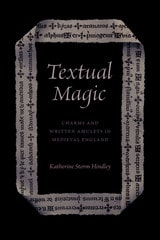
cover of Textual Magic: Charms and Written Amulets in Medieval England

Textual Magic

Charms and Written Amulets in Medieval England

Katherine Storm Hindley

University of Chicago Press, 2023

An expansive consideration of charms as a deeply integrated aspect of the English Middle Ages.
 

Katherine Storm Hindley explores words at their most powerful: words that people expected would physically change the world. Medieval Europeans often resorted to the use of spoken or written charms to ensure health or fend off danger. Hindley draws on an unprecedented archive of more than a thousand such charms from medieval England—more than twice the number gathered, transcribed, and edited in previous studies and including many texts still unknown to specialists on this topic. Focusing on charms from 1100 to 1350 CE as well as previously unstudied texts in Latin, French, and English, Hindley addresses important questions of how people thought about language, belief, and power. She describes seven hundred years of dynamic, shifting cultural landscapes, where multiple languages, alphabets, and modes of transmission gained and lost their protective and healing power. Where previous scholarship has bemoaned a lack of continuity in the English charms, Hindley finds surprising links between languages and eras, all without losing sight of the extraordinary variety of the medieval charm tradition: a continuous, deeply rooted part of the English Middle Ages.
[more]
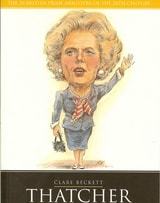
cover of Thatcher

Thatcher

Clare Beckett

Haus Publishing, 2006

Britain's first woman prime minister, friend of Ronald Reagan and the longest serving head of government in the 20th century (1979-90), but also the only one to be removed from office in peacetime by pressure from within her own party
[more]
cover of The 1922 General Election Reconsidered: High Politics and the Birth of the Modern British Election

The 1922 General Election Reconsidered

High Politics and the Birth of the Modern British Election

G.H. Bennett

University of London Press, 2025

Revisiting the high-stakes politics of 1922, G.H. Bennett unveils how one election transformed Britain’s electoral system and redefined party alliances for decades to come.

The 1922 General Election was more than just another political contest; it was the turning point that shaped the modern British electoral landscape. In The 1922 General Election Reconsidered, G.H. Bennett revisits this pivotal moment with fresh insight, drawing on newly available archival materials and digitized resources to decipher the high-stakes maneuvering and backroom negotiations that defined the campaign. Covering the dramatic collapse of the Lloyd George coalition and the intricate web of party alliances and local political machinations, this book captures the election in unprecedented detail.

Bennett studies the key players and the seismic shifts that emerged in the wake of the vote. He also looks into how informal cooperation between parties blurred political lines and how media speculation shaped public perceptions. By placing the election in both its immediate and long-term context,  The 1922 General Election Reconsidered is a compelling reconsideration of an often-overlooked moment in British political history that continues to influence elections a century later.
[more]
cover of The Age of Nightmare: The Gothic and British Culture, 1750–1900

The Age of Nightmare

The Gothic and British Culture, 1750–1900

Jeremy Black

St. Augustine's Press, 2022

Historian Jeremy Black is comprehensive, as ever, but in his treatment of the British Gothic novel his greatest service is the preservation of the detail––namely, the human impetus behind art that is often undervalued. Gothic novelists were purposeful, thoughtful, and engaged questions and feelings that ultimately shaped a century of culture. Black notes that the Gothic novel is also very much about "morality and deploying history accordingly." The true interest of the Gothic novel is more remarkable than it is grisly: the featured darkness and macabre are not meant to usurp heroism and purity, but will fall hard under the over-ruling hand of Providence and certainty of retribution. 

Black's understanding of the Gothic writer is a remarkable contribution to the legacy of British literature and the novel at large. Once again, in Black thoroughness meets fidelity and the reader is overcome with his own insights into the period on the merit of Black's efforts. 

In The Weight of Words Series, Black is devoted to the preservation of the memory of British literary genius, and in so doing he is carving out a niche for himself. As in the Gothic novel where landscapes give quarter to influences that seem to interact with the human fates that freely wander in, reading Black is an experience of suddenly finding oneself in possession of an education, and his allure takes a cue from the horrific Gothic tempt. 
[more]
cover of The Age of Noise in Britain: Hearing Modernity

The Age of Noise in Britain

Hearing Modernity

James G Mansell

University of Illinois Press, 2017
Sound transformed British life in the "age of noise" between 1914 and 1945. The sonic maelstrom of mechanized society bred anger and anxiety and even led observers to forecast the end of civilization. The noise was, as James G. Mansell shows, modernity itself, expressed in aural form, with immense implications for the construction of the self. Tracing the ideas, feelings, and representations prompted by life in early twentieth century Britain, Mansell examines how and why sound shaped the self. He works at the crux of cultural and intellectual history, analyzing the meanings that were attached to different types of sound, who created these typologies and why, and how these meanings connected to debates about modernity. From traffic noise to air raids, everyday sounds elicited new ways of thinking about being modern. Each individual negotiated his or her own subjective meanings through hopes or fears for sound. As Mansell considers the different ways Britons heard their world, he reveals why we must take sound into account in our studies of cultural and social history.
[more]
cover of The Animal Within: Masculinity and the Gothic

The Animal Within

Masculinity and the Gothic

Cyndy Hendershot

University of Michigan Press, 1998

As Cyndy Hendershot demonstrates, the Gothic is more a mode than a rigid historical period, an "invasive" tendency that reveals the imaginative limits of social realities and literary techniques far beyond its origins in late eighteenth century Britain. And as she demonstrates in this first scholarly treatment of its kind, one of the continuing obsessions of the Gothic mode is masculinity. Masculinity is in some sense a Gothic castle of the imagination, haunted by fears of the body, science, and angry colonial subjects.
The book's keen critical insight, meticulous close readings and cross-cultural comparisons interrogate the historically situated function of masculinity in texts and films that range across the two-hundred year history of the Gothic. Matthew Lewis's The Monk is compared to Philip Kaufman's Invasion of the Body Snatchers to reveal the "hauntedness" of the male body. Hawthorne's short story "The Birthmark" is juxtaposed with J. S. Le Fanu's "Green Tea" to ground the fantastic qualities of the scientific imagination. Conrad's Heart of Darkness converses with Jean Rhys's Wide Sargasso Sea about the nature of imperialism. And Jane Campion's film The Piano is figured as an imaginative foray into new forms of masculinity. Utilizing the insights of Lacanian theory, Hendershot demonstrates how the Gothic realm of ghosts, demons, and hidden passages continues to suggest alternative realities to claustrophobic cultural imaginations.
"Masculinity and the Gothic combines solid literary critical insight and close readings in a detailed and lively survey of various manifestations of the gothic within British and American cultural traditions, and admirably explores the connections between various cultural discourses. It will make a fine complement to the numerous recent publications of issues of femininity in the gothic." --Sharon Willis, University of Rochester
Cyndy Hendershot is Assistant Professor of English, Arkansas State University.
[more]
cover of The Appropriated Voice: Narrative Authority in Conrad, Forster, and Woolf

The Appropriated Voice

Narrative Authority in Conrad, Forster, and Woolf

Bette London

University of Michigan Press, 1990
The Appropriated Voice: Narrative Authority in Conrad, Forster, and Woolf reassesses questions of voice in three central modernist texts: Heart of Darkness, A Passage to India, and To the Lighthouse. Representing voice as the site of a struggle articulated on a number of fronts, Bette London challenges traditional assumptions about voice as a reliable marker of individuality, originality, self-identity, and aesthetic autonomy—assumptions reinforced in the recent reconstructions of modernism in postmodernism’s discourses.Drawing upon narrative theory, cultural criticism, and cultural ethnography, as well as feminist theory, London provides a sophisticated critique of the conventional categories at work in both traditional and revisionist criticism. Her method reveals the narrative and cultural appropriations through which modernism speaks, and produces what might be called modernism’s other ideology: its performance of its own political and aesthetic complicities; its display of its own second-handedness.The book is a contribution to contemporary theoretical debates as well as to the scholarship pertaining to Conrad, Forster, and Woolf.
[more]
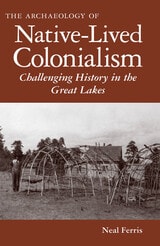
cover of The Archaeology of Native-Lived Colonialism: Challenging History in the Great Lakes

The Archaeology of Native-Lived Colonialism

Challenging History in the Great Lakes

Neal Ferris

University of Arizona Press, 2009

Colonialism may have significantly changed the history of North America, but its impact on Native Americans has been greatly misunderstood. In this book, Neal Ferris offers alternative explanations of colonial encounters that emphasize continuity as well as change affecting Native behaviors. He examines how communities from three aboriginal nations in what is now southwestern Ontario negotiated the changes that accompanied the arrival of Europeans and maintained a cultural continuity with their pasts that has been too often overlooked in conventional “master narrative” histories of contact.

In reconsidering Native adaptation and resistance to colonial British rule, Ferris reviews five centuries of interaction that are usually read as a single event viewed through the lens of historical bias. He first examines patterns of traditional lifeway continuity among the Ojibwa, demonstrating their ability to maintain seasonal mobility up to the mid-nineteenth century and their adaptive response to its loss. He then looks at the experience of refugee Delawares, who settled among the Ojibwa as a missionary-sponsored community yet managed to maintain an identity distinct from missionary influences. And he shows how the archaeological history of the Six Nations Iroquois reflected patterns of negotiating emergent colonialism when they returned to the region in the 1780s, exploring how families managed tradition and the contemporary colonial world to develop innovative ways of revising and maintaining identity.

The Archaeology of Native-Lived Colonialism convincingly utilizes historical archaeology to link the Native experience of the eighteenth and nineteenth centuries to the deeper history of sixteenth- and seventeenth-century interactions and with pre-European times. It shows how these Native communities succeeded in retaining cohesiveness through centuries of foreign influence and material innovations by maintaining ancient, adaptive social processes that both incorporated European ideas and reinforced historically understood notions of self and community.

[more]
cover of The Arrival of the Fittest: Biology's Imaginary Futures, 1900–1935

The Arrival of the Fittest

Biology's Imaginary Futures, 1900–1935

Jim Endersby

University of Chicago Press, 2025

In the early twentieth century, varied audiences took biology out of the hands of specialists and transformed it into mass culture, transforming our understanding of heredity in the process.
 
In the early twentieth century communities made creative use of the new theories of heredity in circulation at the time, including the now largely forgotten mutation theory of Hugo de Vries. Science fiction writers, socialists, feminists, and utopians are among those who seized on the amazing possibilities of rapid and potentially controllable evolution. De Vries’s highly respected scientific theory only briefly captured the attention of the scientific community, but its many fans appropriated it for their own wildly imaginative ends. Writers from H.G. Wells and Edith Wharton to Charlotte Perkins Gilman, J.B.S. Haldane, and Aldous Huxley created a new kind of imaginary future, which Jim Endersby calls the biotopia. It took the ambiguous possibilities of biology—utopian and dystopian—and reimagined them in ways that still influence the public’s understanding of the life sciences. The Arrival of the Fittest recovers the fascinating, long-forgotten origins of ideas that have informed works of fiction from Brave New World to the X-Men movies, all while reflecting on the lessons—positive and negative—that this period might offer us.
[more]
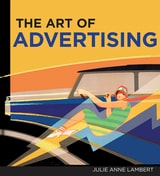
cover of The Art of Advertising, The

The Art of Advertising, The

Julie Anne Lambert

Bodleian Library Publishing, 2020

Advertisers in the nineteenth and early twentieth century pushed the boundaries of printing, manipulated language, inspired a new form of art and exploited many formats, including calendars, bookmarks and games. This collection of essays examines the extent to which these standalone advertisements – which have survived by chance and are now divorced from their original purpose – provide information not just on the sometimes bizarre products being sold, but also on class, gender, Britishness, war, fashion and shopping. Starting with the genesis of an advertisement through the creation of text, image, print and format, the authors go on to examine the changing profile of the consumer, notably the rise of the middle classes, and the way in which manufacturers and retailers identified and targeted their markets. Finally, they look at advertisements as documents that both reveal and conceal details about society, politics and local history. Copiously illustrated from the world-renowned John Johnson Collection of Printed Ephemera and featuring work by influential illustrators John Hassall and Dudley Hardy, this attractive book invites us to consider both the intended and unintended messages of the advertisements of the past.
[more]
cover of The Assault on Universities: A Manifesto for Resistance

The Assault on Universities

A Manifesto for Resistance

Edited by Michael Bailey and Des Freedman

Pluto Press, 2011

With funding cuts well under way and many institutions already promising to charge the maximum £9,000 yearly tuition fee, university education for the majority is under threat. This book exposes the true motives behind the government's programme and provides the analytical tools to fight it.

Widespread student protests and occupations, often supported by staff, unions and society at large, show the public's opposition to funding cuts and fee increases. The contributors to this sharp, well-written collection, many of whom are active participants in the anti-cuts movement, outline what's at stake and why it matters. They argue that university education is becoming increasingly skewed towards vocational degrees, which devalues the arts and social sciences – subjects that allow creativity and political inquiry to flourish.

Released at the beginning of the new academic year, this book will be at the heart of debates around the future of higher education in the UK and beyond, inspiring both new and seasoned activists in the fight for the soul of our universities.
[more]
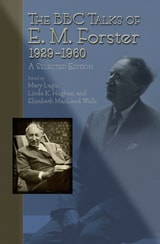
cover of The BBC Talks of E.M. Forster, 1929-1960: A Selected Edition

The BBC Talks of E.M. Forster, 1929-1960

A Selected Edition

Edited by Mary Lago, Linda K. Hughes & Elizabeth MacLeod Walls

University of Missouri Press, 2008

Spanning three decades and a host of subjects, E. M. Forster’s radio broadcasts for the BBC were a major contribution to British cultural history, yet today they are rarely acknowledged by scholars of his life and work. But in their day they reached a larger audience than his fiction and established him as a household figure not only in Britain but also in the farthest reaches of its Empire.

As a frequent contributor to the BBC, Forster generally adhered to literary topics but did not shy away from social commentary. This book offers a new appreciation of his vitality and public importance through seventy annotated broadcasts that present him not only as a literary critic but also as a political activist, an advocate for India, and a wary yet cooperative ally of a colonialist government during World War II.

Gathering material either not in print or, if recast as essays, widely scattered, The BBC Talks of E. M. Forster reveals aspects of Forster’s intellect that have been given short shrift in previous studies. Nearly half the scripts date from 1941 to 1945 and provide an eyewitness account of war from a distinguished perspective. Forster comments on how the arts gallantly survived the blitz—even taking his listeners to the theater as bombing threats loom—and in other cases protests government interference in private life or the limits on free expression caused by the wartime paper shortage.

In these scripts, Forster casts a cosmopolitan eye on contemporary literature from James Joyce to John Steinbeck and provides early exposure for young writers and composers. He also enlarges the scope of European art by pairing Jane Austen or C. S. Lewis with Indian writers and offers pointed comments on contemporary literati such as Aldous Huxley and T. S. Eliot. Annotations to each piece identify Forster’s references and trace his revisions from script to broadcast, while the book’s introduction places his emergence as a distinctive radio voice within the historical, creative, and institutional contexts of broadcasting in his day.

This significant body of writing, too long overlooked, traces Forster’s evolution from novelist to adroit cultural critic and shows how a man who was never comfortable with machines played an important role in shaping a new medium. The BBC Talks of E. M. Forster situates Forster as one of the most poignant voices of the twentieth century as it offers new insight into a nation transfigured by war.
[more]
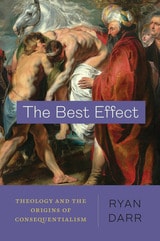
cover of The Best Effect: Theology and the Origins of Consequentialism

The Best Effect

Theology and the Origins of Consequentialism

Ryan Darr

University of Chicago Press, 2023

A theological history of consequentialism and a fresh agenda for teleological ethics.
 

Consequentialism—the notion that we can judge an action by its effects alone—has been among the most influential approaches to ethics and public policy in the Anglophone world for more than two centuries. In The Best Effect, Ryan Darr argues that consequentialist ethics is not as secular or as rational as it is often assumed to be. Instead, Darr describes the emergence of consequentialism in the seventeenth century as a theological and cosmological vision and traces its intellectual development and eventual secularization across several centuries. The Best Effect reveals how contemporary consequentialism continues to bear traces of its history and proposes in its place a more expansive vision for teleological ethics.

[more]
cover of The Blitz Companion: Aerial Warfare, Civilians and the City since 1911

The Blitz Companion

Aerial Warfare, Civilians and the City since 1911

Mark Clapson

University of Westminster Press, 2019

The Blitz Companion offers a unique overview of a century of aerial warfare, its impact on cities and the people who lived in them. It tells the story of aerial warfare from the earliest bombing raids and in World War 1 through to the London Blitz and Allied bombings of Europe and Japan. These are compared with more recent American air campaigns over Cambodia and Vietnam in the 1960s and 1970s, the NATO bombings during the Balkan Wars of the 1990s, and subsequent bombings in the aftermath of 9/11. Beginning with the premonitions and predictions of air warfare and its terrible consequences, the book focuses on air raids precautions, evacuation and preparations for total war, and resilience, both of citizens and of cities. The legacies of air raids, from reconstruction to commemoration, are also discussed. While a key theme of the book is the futility of many air campaigns, care is taken to situate them in their historical context. The Blitz Companion also includes a guide to documentary and visual resources for students and general readers. Uniquely accessible, comparative and broad in scope this book draws key conclusions about civilian experience in the twentieth century and what these might mean for military engagement and civil reconstruction processes once conflicts have been resolved.
[more]
cover of The Bloodless Revolution: England, 1688

The Bloodless Revolution

England, 1688

Stuart E. Prall

University of Wisconsin Press, 1985

The Glorious Revolution of 1688 represented a crucial turning point in modern British history by decisively shifting political power from the monarchy to Parliament. In this cogent study, first published in 1972, Stuart Prall offers a well-balanced account of the Revolution, its roots, and its consequences. The events of 1688, Prall argues, cannot be viewed in isolation. Examining the tempestuous half-century that preceded and precipitated William and Mary’s accession, he provides a comprehensive overview of the Revolution’s context and of its historical meaning.

“[Prall] insists that the Revolution of 1688 was the culmination of a long crisis begun back in 1640, and the revolution settlement was the resolution of problems which the Puritan Revolution and the Restoration had left unsolved.  This is an admirable combination of analysis, commentary upon views of historians, and chronological narrative, starting with the Restoration in 1660 and continuing through the Act of Settlement in 1701.”—Choice
[more]
cover of The Body in Mystery: The Political Theology of the Corpus Mysticum in the Literature of Reformation England

The Body in Mystery

The Political Theology of the Corpus Mysticum in the Literature of Reformation England

Jennifer R. Rust

Northwestern University Press, 2013
In The Body in Mystery, Jennifer R. Rust engages the political concept of the mystical body of the commonwealth, the corpus mysticum of the medieval church. Rust argues that the communitarian ideal of sacramental sociality had a far longer afterlife than has been previously assumed. Reviving a critical discussion of the German historian Ernst Kantorowicz’s 1957 masterwork, The King’s Two Bodies: A Study in Mediaeval Political Theology, Rust brings to bear the latest scholarship. Her book expands the representation of the corpus mysticum through a range of literary genres as well as religious polemics and political discourses. Rust reclaims the concept as an essential category of social value and historical understanding for the imaginative life of literature from Reformation England. The Body in Mystery provides new ways of appreciating the always rich and sometimes difficult continuities between the secular and sacred in early modern England, and between the premodern and early modern periods.
[more]
cover of The Book of Merlyn: The Conclusion to The Once and Future King

The Book of Merlyn

The Conclusion to The Once and Future King

By T. H. White, foreword by Gregory Maguire, prologue by Sylvia Townsend Warner, illustrations by Trevor Stubley

University of Texas Press, 2018

This magical account of King Arthur’s last night on earth, rediscovered in a collection of T. H. White’s papers at the Harry Ransom Center at the University of Texas at Austin, spent twenty-six weeks on the New York Times bestseller list following its publication in 1977. While preparing for his final, fatal battle with his bastard son, Mordred, Arthur returns to the Animal Council with Merlyn, where the deliberations center on ways to abolish war. More self-revealing than any other of White’s books, Merlyn shows his mind at work as he agonized over whether to join the fight against Nazi Germany while penning the epic that would become The Once and Future King. The Book of Merlyn has been cited as a major influence by such illustrious writers as Kazuo Ishiguro, J. K. Rowling, Helen Macdonald, Neil Gaiman, and Lev Grossman.

“Arriving from beyond the curve of time and apparently from the grave, The Book of Merlyn stirs its own pages, saying, wait: you didn’t get the whole story. . . . It gives us a final glimpse of those two immortal characters, Wart and Merlyn, up close, slo-mo, with a considered and affectionate scrutiny. The book is an elegiac posting from a master storyteller of the twentieth century. Its reissue in our next century is just as welcome as when it first arrived forty years ago. . . . Certainly the moral questions about the military use of force perplex the world still. . . . The efficacy of treaties, the trading of insults among the potentates of the day, the testing of weapons, the weaponizing of trade—these strategies are still front and center. Rather terrifyingly so. We do well to revisit what that old schoolteacher of children, Merlyn, has been trying to point out to us about power and responsibility.”
—Gregory Maguire, from the foreword
[more]
cover of The Book of the Play: Playwrights, Stationers, and Readers in Early Modern England

The Book of the Play

Playwrights, Stationers, and Readers in Early Modern England

Marta Straznicky

University of Massachusetts Press, 2006

The Book of the Play is a collection of essays that examines early modern drama in the context of book history. Focusing on the publication, marketing, and readership of plays opens fresh perspectives on the relationship between the cultures of print and performance and more broadly between drama and the public sphere. Marta Straznicky's introduction offers a survey of approaches to the history of play reading in this period, and the collection as a whole consolidates recent work in textual, bibliographic, and cultural studies of printed drama.

Individually, the essays advance our understanding of play reading as a practice with distinct material forms, discourses, social settings, and institutional affiliation. Part One, “Real and Imagined Communities,” includes four essays on play-reading communities and the terms in which they are distinguished from the reading public at large. Cyndia Clegg surveys the construction of readers in prefaces to published plays; Lucy Munro traces three separate readings of a single play, Edward Sharpham's The Fleer; Marta Straznicky studies women as readers of printed drama; and Elizabeth Sauer describes how play reading was mobilized for political purposes in the period of the Civil War. 

In Part Two, “Play Reading and the Book Trade,” five essays consider the impact of play reading on the public sphere through the lens of publishing practices. Zachary Lesser offers a revisionist account of black-letter typeface and the extent to which it may be understood as an index of popular culture; Alan Farmer examines how the emerging news trade of the 1620s and 1630s affected the marketing of printed drama; Peter Berek traces the use of generic terms on title pages of plays to reveal their intersection with the broader culture of reading; Lauren Shohet demonstrates that the Stuart masque had a parallel existence in the culture of print; and Douglas Brooks traces the impact print had on eclipsing performance as the medium in which the dramatist could legitimately lay claim to having authored his text.

The individual essays focus on selected communities of readers, publication histories, and ideologies and practices of reading; the collection as a whole demonstrates the importance of textual production and reception to understanding the place of drama in the early modern public sphere.

[more]
cover of The Born in the Spring: A Collection of Spring Wildflowers

The Born in the Spring

A Collection of Spring Wildflowers

June Carver Roberts

Ohio University Press, 2024
A must for flower and art lovers, Born in the Spring is a unique collection of line drawings and magnificent watercolors of spring wildflowers. All of the drawings and paintings were done from living plants, in minute detail, with complete botanical accuracy. There are over 90 illustrations, 46 of which are in full color. The text accompanying each plate enables the reader to easily locate the flower in its natural setting. The text also includes the origins of the common and botanical names, and bits of history and lore connected with the flowers. Some are hardy aliens that have come from all over the world, while others are fragile natives described by the earliest settlers; some are now becoming rare.
[more]
cover of The Briny South: Displacement and Sentiment in the Indian Ocean World

The Briny South

Displacement and Sentiment in the Indian Ocean World

Nienke Boer

Duke University Press, 2023

In The Briny South Nienke Boer examines the legal and literary narratives of enslaved, indentured, and imprisoned individuals crossing the Indian Ocean to analyze the formation of racialized identities in the imperial world. Drawing on court records, ledgers, pamphlets, censors’ reports, newsletters, folk songs, memoirs, and South African and South Asian works of fiction and autobiography, Boer theorizes the role of sentiment and the depiction of emotions in the construction of identities of displaced peoples across the Indian Ocean. From Dutch East India Company rule in the seventeenth and eighteenth centuries to early apartheid South Africa, Boer shows how colonial powers and settler states mediated and manipulated subaltern expressions of emotion as a way to silence racialized subjects and portray them as inarticulately suffering. In this way, sentiment operated in favor of the powerful rather than as an oppositional weapon of the subaltern. By tracing the entwinement of displacement, race, and sentiment, Boer frames the Indian Ocean as a site of subjectification with a long history of transnational connection—and exploitation.
[more]
cover of The British Army of the Rhine: Turning Nazi Enemies into Cold War Partners

The British Army of the Rhine

Turning Nazi Enemies into Cold War Partners

Peter Speiser

University of Illinois Press, 2016

Between 1945 and 1957, West Germany made a dizzying pivot from Nazi bastion to Britain's Cold War ally against the Soviet Union. Successive London governments, though often faced with bitter public and military opposition, tasked the British Army of the Rhine (BAOR) to serve as a protecting force while strengthening West German integration into the Western defense structure.

Peter Speiser charts the BAOR's fraught transformation from occupier to ally by looking at the charged nexus where British troops and their families interacted with Germany's civilian population. Examining the relationship on many levels, Speiser ranges from how British mass media representations of Germany influenced BAOR troops to initiatives taken by the Army to improve relations. He also weighs German perceptions, surveying clashes between soldiers and civilians and comparing the popularity of the British services with that of the other occupying powers. As Speiser shows, the BAOR's presence did not improve the relationship between British servicemen and the German populace, but it did prevent further deterioration during a crucial and dangerous period of the early Cold War.

An incisive look at an under-researched episode, The British Army of the Rhine sheds new light on Anglo-German diplomatic, political, and social relations after 1945, and evaluates their impact on the wider context of European integration in the postwar era.
[more]
cover of The British Blues Network: Adoption, Emulation, and Creativity

The British Blues Network

Adoption, Emulation, and Creativity

Andrew Kellett

University of Michigan Press, 2017

Beginning in the late 1950s, an influential cadre of young, white, mostly middle-class British men were consuming and appropriating African-American blues music, using blues tropes in their own music and creating a network of admirers and emulators that spanned the Atlantic. This cross-fertilization helped create a commercially successful rock idiom that gave rise to some of the most famous British groups of the era, including The Rolling Stones, The Yardbirds, Eric Clapton, and Led Zeppelin. What empowered these white, middle-class British men to identify with and claim aspects of the musical idiom of African-American blues musicians? The British Blues Network examines the role of British narratives of masculinity and power in the postwar era of decolonization and national decline that contributed to the creation of this network, and how its members used the tropes, vocabulary, and mythology of African-American blues traditions to forge their own musical identities.

 
[more]
cover of The British Prime Minister, 2nd ed.

The British Prime Minister, 2nd ed.

Anthony King

Duke University Press, 1985

The British prime minister is universally acknowledged to be the most powerful single individual in the British system of government, but very little is known about what goes on behind the closed door at #10 Downing Street. As Anthony King points out, there are few articles—let alone books—on the prime ministership available to students of British politics either in the UK or the US. As the preface to the American edition states, while the British prime minister and the American president "do resemble each other in some ways, it is important right at the start to recognize the profound differences between them."
[more]
cover of The British Way to Recovery: Plans and Policies in Great Britain, Australia, and Canada

The British Way to Recovery

Plans and Policies in Great Britain, Australia, and Canada

Herbert Heaton

University of Minnesota Press, 1934
The British Way to Recovery was first published in 1934. Minnesota Archive Editions uses digital technology to make long-unavailable books once again accessible, and are published unaltered from the original University of Minnesota Press editions.An answer to President Roosevelt’s question – “Did England let nature take its course?”This book is rich in parallels between problems faced very early in the British nations and those that arose somewhat later in the United States. Six of the eight chapters deal with England, her search for solutions, and the outcome of her experiments, providing an illuminating background for similar American policies. A chapter apiece is given to Australia, “first in and first out” of the depression, and to Canada, whose geographical and political nearness makes her recovery program of particular interest to the United States.Professor Heaton enjoys the distinction of having lived and worked in each of the countries of which he writes. He was born a Yorkshireman, was educated at the Universities of Leeds and Birmingham, and taught economics at Birmingham. In Australia he lectured on economics and history at the Universities of Tasmania and Adelaide. Then he went to Queen’s University, Canada, from which he came to the University of Minnesota.
[more]
cover of The Burdens of Intimacy: Psychoanalysis and Victorian Masculinity

The Burdens of Intimacy

Psychoanalysis and Victorian Masculinity

Christopher Lane

University of Chicago Press, 1998

Why does passion bewilder and torment so many Victorian protagonists? And why do so many literary characters experience moments of ecstasy before their deaths? In this original study, Christopher Lane shows why Victorian fiction conveys both the pleasure and anguish of intimacy. Examining works by Bulwer-Lytton, Swinburne, Schreiner, Hardy, James, Santayana, and Forster, he argues that these writers struggled with aspects of psychology that were undermining the utilitarian ethos of the Victorian age.

Lane discredits the conservative notion that Victorian literature expresses only a demand for repression and moral restraint. But he also refutes historicist and Foucauldian approaches, arguing that they dismiss the very idea of repression and end up denouncing psychoanalysis as complicit in various kinds of oppression. These approaches, Lane argues, reduce Victorian literature to a drama about politics, power, and the ego. Striving instead to reinvigorate discussions of fantasy and the unconscious, Lane offers a clear, often startling account of writers who grapple with the genuine complexities of love, desire, and friendship.
[more]
cover of The Burning of His Majesty's Schooner Gaspee: An Attack on Crown Rule Before the American Revolution

The Burning of His Majesty's Schooner Gaspee

An Attack on Crown Rule Before the American Revolution

Steven Park

Westholme Publishing, 2016

Considered One of the First Acts of Rebellion to British Authority Over the American Colonies, a Fresh Account Placing the Incident into Historical Context
Between the Boston Massacre in 1770 and the Boston Tea Party in 1773—a period historians refer to as “the lull”—a group of prominent Rhode Islanders rowed out to His Majesty’s schooner Gaspee,which had run aground six miles south of Providence while on an anti-smuggling patrol. After threatening and shooting its commanding officer, the raiders looted the vessel and burned it to the waterline. Despite colony-wide sympathy for the June 1772 raid, neither the government in Providence nor authorities in London could let this pass without a response. As a result, a Royal Commission of Inquiry headed by Rhode Island governor Joseph Wanton zealously investigated the incident. In The Burning of His Majesty’s Schooner Gaspee: An Attack on Crown Rule Before the American Revolution, historian Steven Park reveals that what started out as a customs battle over the seizure of a prominent citizen’s rum was soon transformed into the spark that re-ignited Patriot fervor. The significance of the raid was underscored by a fiery Thanksgiving Day sermon given by a little-known Baptist minister in Boston. His inflammatory message was reprinted in several colonies and was one of the most successful pamphlets of the pre-Independence period. The commission turned out to be essentially a sham and made the administration in London look weak and ineffective. In the wake of the Gaspee affair, Committees of Correspondence soon formed in all but one of the original thirteen colonies, and later East India Company tea would be defiantly dumped into Boston Harbor.

[more]
cover of The Business State: Empire and Big Business in the Twentieth-Century British State

The Business State

Empire and Big Business in the Twentieth-Century British State

Ian Kumekawa

University of Chicago Press, 2027

Narrates how big business guided policy and expanded the state in early twentieth-century Britain.

During World War I, British businessmen streamed into government service. When Britain faced unprecedented economic challenges after the war’s end, civil servants turned to the same businessmen with whom they had worked. The result was a durable public-private network of both bureaucrats and executives: the business state.

In this book, Ian Kumekawa throws light on the previously obscured and hidden world of the business state and the economic thinking of its administrators. He breaks new methodological ground by treating the state and business together as a single entity. Twentieth-century states, he argues, were porous networks in which lines between business and governance were not clearly defined. In liberal democracies, the term “business-friendly” has long been understood as synonymous with laissez-faire. The Business State explores the historical limits of that assumption by focusing on Britain, the self-identified small, liberal state par excellence. In doing so, the book shows how a liberal democracy was effectively co-opted by private interests and explores how actively assisting big business became not just acceptable—but a political necessity.
[more]
cover of The Callendar Effect: The Life and Work of Guy Stewart Callendar (1898-1964)

The Callendar Effect

The Life and Work of Guy Stewart Callendar (1898-1964)

James Rodger Fleming

American Meteorological Society, 2007
This is the untold story of the remarkable scientist who established the carbon dioxide theory of climate change. Guy Stewart Callendar discovered that global warming could be brought about by increases in the concentration of atmospheric carbon dioxide due to human activities, primarily through burning fossil fuels. He did this in 1938! Using never-before-published original scientific correspondence, notebooks, family letters, and photographs, science historian James Rodger Fleming introduces us to one of Britain’s leading engineers and explains his life and work through two World Wars to his continuing legacy as the scientist who established The Callendar Effect.
[more]
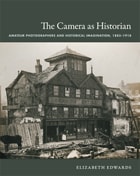
cover of The Camera as Historian: Amateur Photographers and Historical Imagination, 1885-1918

The Camera as Historian

Amateur Photographers and Historical Imagination, 1885-1918

Elizabeth Edwards

Duke University Press, 2012
In the late nineteenth century and early twentieth, hundreds of amateur photographers took part in the photographic survey movement in England. They sought to record the material remains of the English past so that it might be preserved for future generations. In The Camera as Historian, the groundbreaking historical and visual anthropologist Elizabeth Edwards works with an archive of nearly 55,000 photographs taken by 1,000 photographers, mostly unknown until now. She approaches the survey movement and its social and material practices ethnographically. Considering how the amateur photographers understood the value of their project, Edwards links the surveys to concepts of leisure, understandings of the local and the national, and the rise of popular photography. Her examination of how the photographers negotiated between scientific objectivity and aesthetic responses to the past leads her to argue that the survey movement was as concerned with the conditions of its own modernity and the creation of an archive for an anticipated future as it was nostalgic about the imagined past. Including more than 120 vibrant images, The Camera as Historian offers new perspectives on the forces that shaped Victorian and Edwardian Britain, as well as on contemporary debates about cultural identity, nationality, empire, material practices, and art.
[more]
cover of The Capital Order: How Economists Invented Austerity and Paved the Way to Fascism

The Capital Order

How Economists Invented Austerity and Paved the Way to Fascism

Clara E. Mattei

University of Chicago Press, 2022

A Financial Times Best Book of the Year

"A must-read, with key lessons for the future."—Thomas Piketty

A groundbreaking examination of austerity’s dark intellectual origins. 


For more than a century, governments facing financial crisis have resorted to the economic policies of austerity—cuts to wages, fiscal spending, and public benefits—as a path to solvency. While these policies have been successful in appeasing creditors, they’ve had devastating effects on social and economic welfare in countries all over the world. Today, as austerity remains a favored policy among troubled states, an important question remains: What if solvency was never really the goal? 

In The Capital Order, political economist Clara E. Mattei explores the intellectual origins of austerity to uncover its originating motives: the protection of capital—and indeed capitalism—in times of social upheaval from below. 

Mattei traces modern austerity to its origins in interwar Britain and Italy, revealing how the threat of working-class power in the years after World War I animated a set of top-down economic policies that elevated owners, smothered workers, and imposed a rigid economic hierarchy across their societies. Where these policies “succeeded,” relatively speaking, was in their enrichment of certain parties, including employers and foreign trade interests, who accumulated power and capital at the expense of labor. Here, Mattei argues, is where the true value of austerity can be observed: its insulation of entrenched privilege and its elimination of all alternatives to capitalism. 

Drawing on newly uncovered archival material from Britain and Italy, much of it translated for the first time, The Capital Order offers a damning and essential new account of the rise of austerity—and of modern economics—at the levers of contemporary political power.
[more]
cover of The Centenary Edition of the Works of Nathaniel Hawthorne: Vol. XIX, The Consular Letters, 1853–1855

The Centenary Edition of the Works of Nathaniel Hawthorne

Vol. XIX, The Consular Letters, 1853–1855

Nathaniel Hawthorne

The Ohio State University Press, 1988
"Because it represents the first scholarly effort to establish texts as close as possible to the intentions of the author, this Centenary Edition makes obsolete all previous editions, notorious for their textual corruption. An eminent staff . . . has analyzed and synthesized the evidence of all MSS and worthwhile printed editions. Each volume includes a well documented introduction concerning such matters as circumstances leading to composition and history of publication as well as textual notes on alterations in the MSS, editorial emendations, etc." --Choice "The Centenary Edition, which has been producing weighty volumes of definitively edited texts of Hawthorne for a full generation, is now the sine qua non of Hawthorne scholarship. As an example of editorial care and research thoroughness it has been a model for the profession and as a physical object a model for publishers. In addition to the immensely important achievement of producing fully accurate texts of the romances, tales, and sketches, the Centenary editors have made available, for the very first time, all of the various Notebooks and letters. For the letters, especially, the wait has been long but the result is gratifying. Reading straight through the Centenary's six volumes of letters is a self-indulgent pleasure that brings us markedly closer to the man than we can get in any other way." --American Literature Representing decades of work, this is the definitive edition of Hawthorne's works. Each volume includes comprehensive notes and explanatory material. I: The Scarlet Letter $62.95 cloth 0-8142-0059-1 II: The House of the Seven Gables $69.95 cloth 0-8142-0060-5 III: The Blithedale Romance and Fanshawe $72.95 cloth 0-8142-0061-3 IV: The Marble Faun $83.95 cloth 0-8142-0062-1 V: Our Old Home $72.95 cloth 0-8142-0002-8 VI: True Stories from History and Biography $72.95 cloth 0-8142-0157-1 VII: A Wonder Book and Tanglewood Tales $72.95 cloth 0-8142-0158-X VIII: The American Notebooks $98.95 cloth 0-8142-0159-8 IX: Twice-told Tales $83.95 cloth 0-8142-0202-0 X: Mosses from an Old Manse $83.95 cloth 0-8142-0203-9 XI: The Snow Image and Uncollected Tales $72.95 cloth 0-8142-0204-7 XII: The American Claimant Manuscripts $83.95 cloth 0-8142-0251-9 XIII: The Elixir of Life Manuscripts $98.95 cloth 0-8142-0252-7 XIV: The French and Italian Notebooks $98.95 cloth 0-8142-0256-X XV: The Letters, 1813-1843 $98.95 cloth 0-8142-0363-9 XVI: The Letters, 1843-1853 $98.95 cloth 0-8142-0364-7 XVII: The Letters, 1853-1856 $83.95 cloth 0-8142-0365-5 XVIII: The Letters, 1857-1864 $98.95 cloth 0-8142-0383-3 XIX: The Consular Letters, 1853-1855 $83.95 cloth 0-8142-0384-1 XX: The Consular Letters, 1856-1857 $83.95 cloth 0-8142-0462-7 XXI: The English Notebooks, 1853-1856 $98.95 cloth 0-8142-0670-0 XXII: The English Notebooks, 1856-1860 $98.95 cloth 0-8142-0671-9 XXIII: Miscellaneous Prose and Verse $98.95 cloth 0-8142-0644-1
[more]
cover of The Centenary Edition of the Works of Nathaniel Hawthorne: Vol. XX, The Consular Letters, 1856–1857

The Centenary Edition of the Works of Nathaniel Hawthorne

Vol. XX, The Consular Letters, 1856–1857

Nathaniel Hawthorne

The Ohio State University Press, 1988

"Because it represents the first scholarly effort to establish texts as close as possible to the intentions of the author, this Centenary Edition makes obsolete all previous editions, notorious for their textual corruption. An eminent staff . . . has analyzed and synthesized the evidence of all MSS and worthwhile printed editions. Each volume includes a well documented introduction concerning such matters as circumstances leading to composition and history of publication as well as textual notes on alterations in the MSS, editorial emendations, etc." --Choice "The Centenary Edition, which has been producing weighty volumes of definitively edited texts of Hawthorne for a full generation, is now the sine qua non of Hawthorne scholarship. As an example of editorial care and research thoroughness it has been a model for the profession and as a physical object a model for publishers. In addition to the immensely important achievement of producing fully accurate texts of the romances, tales, and sketches, the Centenary editors have made available, for the very first time, all of the various Notebooks and letters. For the letters, especially, the wait has been long but the result is gratifying. Reading straight through the Centenary's six volumes of letters is a self-indulgent pleasure that brings us markedly closer to the man than we can get in any other way." --American Literature Representing decades of work, this is the definitive edition of Hawthorne's works. Each volume includes comprehensive notes and explanatory material. I: The Scarlet Letter $62.95 cloth 0-8142-0059-1 II: The House of the Seven Gables $69.95 cloth 0-8142-0060-5 III: The Blithedale Romance and Fanshawe $72.95 cloth 0-8142-0061-3 IV: The Marble Faun $83.95 cloth 0-8142-0062-1 V: Our Old Home $72.95 cloth 0-8142-0002-8 VI: True Stories from History and Biography $72.95 cloth 0-8142-0157-1 VII: A Wonder Book and Tanglewood Tales $72.95 cloth 0-8142-0158-X VIII: The American Notebooks $98.95 cloth 0-8142-0159-8 IX: Twice-told Tales $83.95 cloth 0-8142-0202-0 X: Mosses from an Old Manse $83.95 cloth 0-8142-0203-9 XI: The Snow Image and Uncollected Tales $72.95 cloth 0-8142-0204-7 XII: The American Claimant Manuscripts $83.95 cloth 0-8142-0251-9 XIII: The Elixir of Life Manuscripts $98.95 cloth 0-8142-0252-7 XIV: The French and Italian Notebooks $98.95 cloth 0-8142-0256-X XV: The Letters, 1813-1843 $98.95 cloth 0-8142-0363-9 XVI: The Letters, 1843-1853 $98.95 cloth 0-8142-0364-7 XVII: The Letters, 1853-1856 $83.95 cloth 0-8142-0365-5 XVIII: The Letters, 1857-1864 $98.95 cloth 0-8142-0383-3 XIX: The Consular Letters, 1853-1855 $83.95 cloth 0-8142-0384-1 XX: The Consular Letters, 1856-1857 $83.95 cloth 0-8142-0462-7 XXI: The English Notebooks, 1853-1856 $98.95 cloth 0-8142-0670-0 XXII: The English Notebooks, 1856-1860 $98.95 cloth 0-8142-0671-9 XXIII: Miscellaneous Prose and Verse $98.95 cloth 0-8142-0644-1
[more]
cover of The Centenary Edition of the Works of Nathaniel Hawthorne: Vol. XXI, the English Notebooks, 1853–1856

The Centenary Edition of the Works of Nathaniel Hawthorne

Vol. XXI, the English Notebooks, 1853–1856

Nathaniel Hawthorne

The Ohio State University Press, 1997
"Because it represents the first scholarly effort to establish texts as close as possible to the intentions of the author, this Centenary Edition makes obsolete all previous editions, notorious for their textual corruption. An eminent staff . . . has analyzed and synthesized the evidence of all MSS and worthwhile printed editions. Each volume includes a well documented introduction concerning such matters as circumstances leading to composition and history of publication as well as textual notes on alterations in the MSS, editorial emendations, etc." --Choice "The Centenary Edition, which has been producing weighty volumes of definitively edited texts of Hawthorne for a full generation, is now the sine qua non of Hawthorne scholarship. As an example of editorial care and research thoroughness it has been a model for the profession and as a physical object a model for publishers. In addition to the immensely important achievement of producing fully accurate texts of the romances, tales, and sketches, the Centenary editors have made available, for the very first time, all of the various Notebooks and letters. For the letters, especially, the wait has been long but the result is gratifying. Reading straight through the Centenary's six volumes of letters is a self-indulgent pleasure that brings us markedly closer to the man than we can get in any other way." --American Literature Representing decades of work, this is the definitive edition of Hawthorne's works. Each volume includes comprehensive notes and explanatory material. I: The Scarlet Letter $62.95 cloth 0-8142-0059-1 II: The House of the Seven Gables $69.95 cloth 0-8142-0060-5 III: The Blithedale Romance and Fanshawe $72.95 cloth 0-8142-0061-3 IV: The Marble Faun $83.95 cloth 0-8142-0062-1 V: Our Old Home $72.95 cloth 0-8142-0002-8 VI: True Stories from History and Biography $72.95 cloth 0-8142-0157-1 VII: A Wonder Book and Tanglewood Tales $72.95 cloth 0-8142-0158-X VIII: The American Notebooks $98.95 cloth 0-8142-0159-8 IX: Twice-told Tales $83.95 cloth 0-8142-0202-0 X: Mosses from an Old Manse $83.95 cloth 0-8142-0203-9 XI: The Snow Image and Uncollected Tales $72.95 cloth 0-8142-0204-7 XII: The American Claimant Manuscripts $83.95 cloth 0-8142-0251-9 XIII: The Elixir of Life Manuscripts $98.95 cloth 0-8142-0252-7 XIV: The French and Italian Notebooks $98.95 cloth 0-8142-0256-X XV: The Letters, 1813-1843 $98.95 cloth 0-8142-0363-9 XVI: The Letters, 1843-1853 $98.95 cloth 0-8142-0364-7 XVII: The Letters, 1853-1856 $83.95 cloth 0-8142-0365-5 XVIII: The Letters, 1857-1864 $98.95 cloth 0-8142-0383-3 XIX: The Consular Letters, 1853-1855 $83.95 cloth 0-8142-0384-1 XX: The Consular Letters, 1856-1857 $83.95 cloth 0-8142-0462-7 XXI: The English Notebooks, 1853-1856 $98.95 cloth 0-8142-0670-0 XXII: The English Notebooks, 1856-1860 $98.95 cloth 0-8142-0671-9 XXIII: Miscellaneous Prose and Verse $98.95 cloth 0-8142-0644-1
[more]
cover of The Challenge of Hegemony: Grand Strategy, Trade, and Domestic Politics

The Challenge of Hegemony

Grand Strategy, Trade, and Domestic Politics

Steven E. Lobell

University of Michigan Press, 2005

The Challenge of Hegemony explains how international forces subtly influence foreign, economic, and security policies of declining world powers. Using detail-rich case studies, this sweeping study integrates domestic and systemic policy to explain these countries' grand strategies. The book concludes with a discussion of the implications for the future of American foreign policy.

"His conceptually rigorous and tightly reasoned study . . . reminds us that power is never value neutral but organizes commercial systems in liberal or imperial terms."
---Perspectives on Politics

"Lobell's book is tightly written, nicely argued and thoroughly researched to a fault. He seems to delight in historical detail. The complexity of his approach is refreshing."
---International Affairs

"The Challenge of Hegemony is a pleasure to read. It is both theoretically sophisticated and empirically rich."
---International Studies Review

"The Challenge of Hegemony offers a compelling reinterpretation of key historical cases and provides wise guidance as to how the United States should wield its power today."
--Charles A. Kupchan, Council on Foreign Relations

"Lobell demonstrates clearly how the international environment confronting great powers interacts with their domestic political coalitions to produce different grand strategies. Through a masterful sweep of history, Lobell shows us the alternative trajectories before the United States today."
--David A. Lake, University of California, San Diego
[more]
cover of The Changing Pattern of Black Politics in Britain

The Changing Pattern of Black Politics in Britain

Kalbir Shukra

Pluto Press, 1998
[more]
cover of The Chartist Imaginary: Literary Form in Working-Class Political Theory and Practice

The Chartist Imaginary

Literary Form in Working-Class Political Theory and Practice

Margaret A. Loose

The Ohio State University Press, 2014

Can imaginative literature change the political and social history of a class or nation? In The Chartist Imaginary: Literary Form in Working-Class Political Theory and Practice, Margaret Loose turns to the Chartist Movement—Britain’s first mass working-class movement, dating from the 1830s to the 1840s—and argues that, based on literature by members of the movement, the answer to that question is a resounding “yes.” Chartist writing awakened workers’ awareness of discord between professed ideals and reality; exercised their conceptual powers (literary and social); and sharpened their appetite for more knowledge, intellectual power, dignity, and agency in the present to fashion a utopian future. Igniting such self-respecting, politically transfigurative energy was a unique kind of agency Loose calls “the Chartist imaginary.” In examining the Chartist movement, Loose balances the nervous projections of canonical Victorian writers against a consideration of the ways that laborers represented Chartism’s aims and tactics.
 
The Chartist Imaginary offers close readings of poems and fiction by Chartist figures from Ernest Jones and Thomas Cooper to W. J. Linton, Thomas Martin Wheeler, and Gerald Massey. It also draws on extensive archival research to examine, for the first time, working-class female Chartist poets Mary Hutton, E. L. E., and Elizabeth La Mont. Focusing on the literary form of these works, Loose strongly argues for the political power of the aesthetic in working-class literature.
 
[more]
cover of The Circuit of Apollo: Eighteenth-Century Women’s Tributes to Women

The Circuit of Apollo

Eighteenth-Century Women’s Tributes to Women

Laura Runge

University of Delaware Press, 2019

Written by a combination of established scholars and new critics in the field, the essays collected in Circuit of Apollo attest to the vital practice of commemorating women’s artistic and personal relationships. In doing so, they illuminate the complexity of female friendships and honor as well as the robust creativity and intellectual work contributed by women to culture in the long eighteenth century. Women’s tributes to each other sometimes took the form of critical engagement or competition, but they always exposed the feminocentric networks of artistic, social, and material exchange women created and maintained both in and outside of London. This volume advocates for a new perspective for researching and teaching early modern women that is grounded in admiration.

Published by University of Delaware Press. Distributed worldwide by Rutgers University Press.
 
[more]
cover of The College Graces of Oxford and Cambridge

The College Graces of Oxford and Cambridge

Compiled by Reginald H. Adams

Bodleian Library Publishing, 2013

The custom of formal dining at Oxford and Cambridge dates back to the earliest days of college life. Before each dinner, according to ancient statutes, grace must be said in Latin, and, although the text and nature of grace for each college has changed over the years, the tradition itself remains current to this day.

Following a historical introduction, The College Graces of Oxford and Cambridge reproduces in chronological order the full Latin texts of all the graces alongside facing English-language translations. Also included are the special graces reserved for feast days, as well as an explanation of some of the traditions that accompany them, including the trumpeters that summon students to dinner to the use of the Sconce Cup and the Rose Bowl.

From the twelfth-century monastic texts and the two-word graces of the nineteenth century to the new graces written for the modern age, this meticulous collection reveals how the tradition of the Latin grace has survived and evolved over the centuries and offers a rare glimpse inside the private halls of Oxford and Cambridge.

[more]