Results by title
28 books match the query 'Playing'
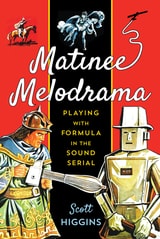
Matinee Melodrama
Playing with Formula in the Sound SerialHiggins, Scott
Rutgers University Press, 2016
Matinee Melodrama is the first book about the adventure serial as a distinct artform, one that uniquely encouraged audience participation and imaginative play. Media scholar Scott Higgins proposes that the serial’s incoherent plotting and reliance on formula, far from being faults, should be understood as some of its most appealing attributes, helping to spawn an active fan culture. Further, he suggests these serials laid the groundwork not only for modern-day cinematic blockbusters like Star Wars and Raiders of the Lost Ark, but also for all kinds of interactive media that combine spectacle, storytelling, and play.
As it identifies key elements of the serial form—from stock characters to cliffhangers—Matinee Melodrama delves deeply into questions about the nature of suspense, the aesthetics of action, and the potentials of formulaic narrative. Yet it also provides readers with a loving look at everything from Zorro’s Fighting Legion to Daredevils of the Red Circle, conveying exactly why these films continue to thrill and enthrall their fans.
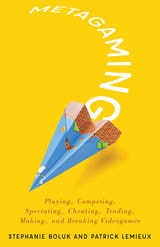
Metagaming
Playing, Competing, Spectating, Cheating, Trading, Making, and Breaking VideogamesStephanie Boluk
University of Minnesota Press, 2017
The greatest trick the videogame industry ever pulled was convincing the world that videogames were games rather than a medium for making metagames. Elegantly defined as “games about games,” metagames implicate a diverse range of practices that stray outside the boundaries and bend the rules: from technical glitches and forbidden strategies to Renaissance painting, algorithmic trading, professional sports, and the War on Terror. In Metagaming, Stephanie Boluk and Patrick LeMieux demonstrate how games always extend beyond the screen, and how modders, mappers, streamers, spectators, analysts, and artists are changing the way we play.
Metagaming uncovers these alternative histories of play by exploring the strange experiences and unexpected effects that emerge in, on, around, and through videogames. Players puzzle through the problems of perspectival rendering in Portal, perform clandestine acts of electronic espionage in EVE Online, compete and commentate in Korean StarCraft, and speedrun The Legend of Zelda in record times (with or without the use of vision). Companies like Valve attempt to capture the metagame through international e-sports and online marketplaces while the corporate history of Super Mario Bros. is undermined by the endless levels of Infinite Mario, the frustrating pranks of Asshole Mario, and even Super Mario Clouds, a ROM hack exhibited at the Whitney Museum of American Art.
One of the only books to include original software alongside each chapter, Metagaming transforms videogames from packaged products into instruments, equipment, tools, and toys for intervening in the sensory and political economies of everyday life. And although videogames conflate the creativity, criticality, and craft of play with the act of consumption, we don’t simply play videogames—we make metagames.
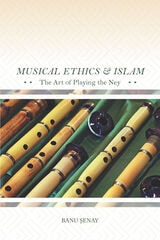
Musical Ethics and Islam
The Art of Playing the NeyBanu Senay
University of Illinois Press, 2020
Banu Şenay documents the years-long training required to become a neyzen—a player of the ney. The process holds a transformative power that invites students to create a new way of living that involves alternative relationships with the self and others, changing perceptions of the city, and a dedication to craftsmanship. Şenay visits reed harvesters and travels from studios to workshops to explore the practical processes of teaching and learning. She also becomes an apprentice ney-player herself, exploring the desire for spirituality that encourages apprentices and masters alike to pursue ney music and its scaffolding of Islamic ethics and belief.

Next Time on Dragon Ball
Playing with a Manga and Anime FranchiseVincent Haddad
University of Minnesota Press, 2026
How media production and fan play interact to shape the aesthetics of a global anime franchise
Since its debut in 1984, Dragon Ball has become one of the most popular, influential, and lucrative media franchises in the world. In Next Time on Dragon Ball, Vincent Haddad investigates how the franchise has maintained huge global demand despite its formulaic plotlines. Examining its exhaustive repetition of storytelling forms across comics, TV series, games, and merchandise, Haddad argues that the convergence of play, fandom, and narrative made Dragon Ball an unlikely success—and a harbinger of broader shifts in the media landscape of franchises from the 1980s to the present.
Haddad conceives of Dragon Ball as a “franchise toy,” a corporate media property that is constantly remixed by its fans in ways that its owners resist but also ultimately embrace: appropriation is essential to the franchise’s popularity. Over the past forty years, Haddad argues, Dragon Ball’s deployment of familiar tropes, cultural references, and narrative forms—from classical Chinese stories and the films of Bruce Lee and Jackie Chan to American franchises like Superman and Star Wars—has invited unique transcultural play. Through diverse examples of how fans use its characters as “playthings,” Haddad shows how Dragon Ball travels across international networked fandoms, highlighting the queer, gendered, and racialized dimensions of this play.
Parsing the dynamics of “sites of conflict” between authorized media and fan content, Next Time on Dragon Ball illuminates how fan engagement across the Americas changes the parameters of what a manga and anime franchise is and can be.
Retail e-book files for this title are screen-reader friendly with images accompanied by short alt text and/or extended descriptions.
Playing With Fire
Feminist Thought And Activism Through Seven Lives In IndiaSangtin Sangtin Writers
University of Minnesota Press, 2006
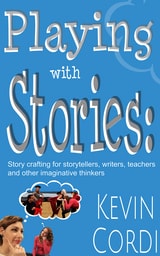
Playing With Stories
Story crafting for storytellers, writers, teachers and other imaginative thinkersKevin D. Cordi, Ph.D.
Parkhurst Brothers, Inc., 2014
Despite that the world around me does not value play, in my creative life, play is necessary. In fact, I have discovered it is the real work I do as an artist and teacher. As a storyteller, writer, teacher, and imaginative thinker, it is play that has produced the most desired results in my life, in my work, and especially, in my creativity. It is in play that we experience who we are and we begin to extend our choices. Play is not consciously prepared; discovery that happens in the moment. It invites reflection. In fact, Plato once shared, “You can discover more about a person in an hour of play than in a year of conversation.”
In this book, you will discover new ways to work with your story craft and find new story direction using play. Indeed, play is a meaningful way to create and learn.
In both childhood and adult play, the imagination plays a central role in the meaning making process. Although there are many types of play: school-based, recess, sports, this work is rooted in play inviting the writer, storyteller, or imaginative thinker to make choices as they work to create meaning in their work.
I will share how collaborative play can increase your choices when making a story. You will find not only exercises to build your story making and telling skills, but pedagogy of practice to use when called to create story.

Playing from Memory
David Milofsky
University Press of Colorado, 1999
Ben Seidler, an intense, passionately committed violist, is at the height of his career as a member of the Casa Bella Quartet, one of the foremost string quartets in the nation. His gifts as a concert artist had always been intuitive, but love did not come so easily. It took determination to win the hand of his wife, Dory, who was reluctant to set aside her ambitions of becoming an artist.
Their marriage is at once complex and ordinary, balancing the rigors of long rehearsal sessions against the daily round of family life with their two sons. Then suddenly the rhythm of their lives is shattered when Ben falls victim to multiple sclerosis. Stubbornly independent, Ben refuses to rely on others until necessity forces him to see that there are things beyond his control. Through a new closeness with his aging father, his older son, and, most importantly, Dory, he learns to accept help and to appreciate human frailty and affection.
As Ben's health declines, Dory is forced to resume her career and compete in a world dominated by men, and to re-examine her feelings and commitment to her husband. As their lives change, so does their marriage, and Ben and Dory forge a new kind of love, a fierce love that sustains them through everything.

Playing in Time
Essays, Profiles, and Other True StoriesCarlo Rotella
University of Chicago Press, 2012
Rotella is best known for his writings on boxing, and his essays here do not disappoint. It’s a topic that he turns to for its colorful characters, compelling settings, and formidable life lessons both in and out of the ring. He gives us tales of an older boxer who keeps unretiring and a welterweight who is “about as rich and famous as a 147-pound fighter can get these days,” and a hilarious rumination on why Muhammad Ali’s phrase “I am the greatest” began appearing (in the mouth of Epeus) in translations of The Iliad around 1987. His essays on blues, crime and science fiction writers, and urban spaces are equally and deftly engaging, combining an artist’s eye for detail with a scholar’s sense of research, whether taking us to visit detective writer George Pelecanos or to dance with the proprietress of the Baby Doll Polka Club next to Midway Airport in Chicago.
Rotella’s essays are always smart, frequently funny, and consistently surprising. This collection will be welcomed by his many fans and will bring his inimitable style and approach to an even wider audience.

Playing in the Shadows
Fictions of Race and Blackness in Postwar Japanese LiteratureWilliam Bridges
University of Michigan Press, 2020

Playing the Archive
From the Opies to the Digital PlaygroundEdited by Andrew Burn, John Potter, Kate Cowan, and Julia Bishop
University College London, 2025
Playing the Archive: From the Opies to the Digital Playground revisits the trailblazing work of Iona and Peter Opie, who documented children’s playground games, rhymes, and traditions in mid-20th century Britain, and brings their research into the digital age. Through a major new study, this book explores how children’s play has evolved, drawing on fresh ethnographic research, digital storytelling, and interactive media to compare past and present-day playground cultures.
By making the Opie Archive publicly accessible and involving children through digital interfaces, the project opens up new ways of understanding play as a dynamic, ever-changing practice. The chapters offer novel theoretical insights into the shifting landscapes of play, considering the role of archives and digital media in shaping children’s cultural expressions. Playing the Archive questions stereotypes about childhood in the digital era, positioning children as active creators of their own play cultures.
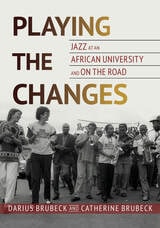
Playing the Changes
Jazz at an African University and on the RoadDarius Brubeck and Catherine Brubeck
University of Illinois Press, 2024
Catherine and Darius Brubeck’s 1983 move to South Africa launched them on a journey that helped transform jazz education. Blending biography with storytelling, the pair recount their time at the University of KwaZulu-Natal, where they built a pioneering academic program in jazz music and managed and organized bands, concerts, and tours around the world.
The Brubecks and the musicians faced innumerable obstacles, from the intensification of apartheid and a lack of resources to the hardscrabble lives that forced even the most talented artists to the margins. Building a program grounded in multi-culturalism, Catherine and Darius encouraged black and white musicians to explore and expand the landscape of South African jazz together Their story details the sometimes wily, sometimes hilarious problem-solving necessary to move the institution forward while offering insightful portraits of South African jazz players at work, on stage, and providing a soundtrack to the freedom struggle and its aftermath.
Frank and richly detailed, Playing the Changes provides insiders’ accounts of how jazz intertwined with struggle and both expressed and resisted the bitter unfairness of apartheid-era South Africa.

Playing the Fool
Subversive Laughter in Troubled TimesRalph Lerner
University of Chicago Press, 2009
The role of the fool is to provoke the powerful to question their convictions, preferably while avoiding a beating. Fools accomplish this not by hectoring their audience, but by broaching sensitive topics indirectly, often disguising their message in a joke or a tale. Writers and thinkers throughout history have adopted the fool’s approach, and here Ralph Lerner turns to six of them—Thomas More, Francis Bacon, Robert Burton, Pierre Bayle, Benjamin Franklin, and Edward Gibbon—to elucidate the strategies these men employed to persuade the heedless, the zealous, and the overly confident to pause and reconsider.
As Playing the Fool makes plain, all these men lived through periods marked by fanaticism, particularly with regard to religion and its relation to the state. In such a troubled context, advocating on behalf of skepticism and against tyranny could easily lead to censure, or even, as in More’s case, execution. And so, Lerner reveals, these serious thinkers relied on humor to move their readers toward a more reasoned understanding of the world and our place in it. At once erudite and entertaining, Playing the Fool is an eloquently thought-provoking look at the lives and writings of these masterly authors.
Playing the Other
Gender and Society in Classical Greek LiteratureFroma I. Zeitlin
University of Chicago Press, 1995
Zeitlin demonstrates the indispensable workings of gender as a major factor in Greek social, religious, and cultural practices and in more abstract ideas about nature and culture, public and private, citizen and outsider, self and other, and mortal and immortal. Focusing on the prominence of female figures in these male authored texts, she enlarges our perspective on critical components of political order and civic identity by including issues of sexuality, the body, modes of male and female maturation, and speculations about parentage, kinship, and reproductive strategies. Along with considerations of genre, poetics, and theatrical mimesis, she points to the powerful mythmaking capacities of Greek culture for creating memorable paradigms and dramatic scenarios that far exceed simple notions of male and female opposition and predictable enforcement of social norms. Consisting of both new and revised essays, Playing the Other is a wide-ranging account of a central category of Greek literature by a scholar who pioneered an approach to classics through the perspective of gender.
Playing the Past
History and Nostalgia in Video GamesZach Whalen
Vanderbilt University Press, 2008
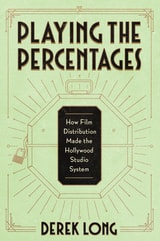
Playing the Percentages
How Film Distribution Made the Hollywood Studio SystemDerek Long
University of Texas Press, 2024
A history of film distribution in the United States from the 1910s to the 1930s, concentrating on booking, circuiting, and packaging marketing practices.
Told not as a “golden age” narrative of films, stars, or individual studios but as an economic history of the industry’s film distribution practices, Playing the Percentages is the story of how Hollywood’s vertically integrated studio system came to be. Studying the history of distribution during the growth of Hollywood, Derek Long makes a case for the domination of the studio system as the result of struggles over distribution practices.
Through a combination of archival research, critical surveys of the film industry trade press, and economic analysis, Long uncovers a complex and ever-shifting system of wrangling between distributors and exhibitors. Challenging the overemphasis within scholarship on “block booking” as a monolithic distribution mode, and attending to distribution practices beyond simple circulation, Long highlights the crucial changes in film distribution brought about by live theater, the rise of features, and the transition to sound. Playing the Percentages is a comprehensive history of film distribution in the United States during the silent era that illustrates the importance of power struggles between distributors and exhibitors over booking, pricing, and playing time.

Playing the Ponies and Other Medical Mysteries Solved
Stuart B. Mushlin, MD, FACP
Rutgers University Press, 2017
With over forty years of experience as a sought after diagnostician, Dr. Stuart Mushlin has cracked his share of medical mysteries, ones in which there are bigger gambles than playing the ponies at the track. Some of his patients show up with puzzling symptoms, calling for savvy medical detective work. Others seem to present cut-and-dry cases, but they turn out to be suffering from rare or serious conditions.
In Playing the Ponies and Other Medical Mysteries Solved, Dr. Mushlin shares some of the most intriguing cases he has encountered, revealing the twists and turns of each patient’s diagnosis and treatment process. Along the way, he imparts the secrets to his success as a medical detective—not specialized high-tech equipment, but time-honored techniques like closely observing, touching, and listening to patients. He also candidly describes cases where he got things wrong, providing readers with honest insights into both the joys and dilemmas of his job.
Dr. Mushlin does not just treat diseases; he treats people. And this is not just a book about the ailments he diagnosed; it is also about the scared, uncertain, ailing individuals he helped in the process. Filled with real-life medical stories you’ll have to read to believe, Playing the Ponies is both a suspenseful page-turner and a heartfelt reflection on a life spent caring for patients.
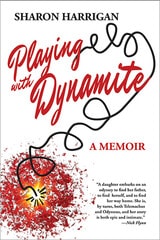
Playing with Dynamite
Sharon Harrigan
University of Wisconsin Press, 2017
Playing with Dynamite is about the family secrets that can distance us from each other and the honesty that can bring us closer. It’s about a daughter who goes looking for her father but finds her mother instead. It’s about memory and truth, grieving and growing, and what it means to go home again.

Playing with Earth and Sky
Astronomy, Geography, and the Art of Marcel DuchampJames Housefield
Dartmouth College Press, 2016

Playing with Feelings
Video Games and AffectAubrey Anable
University of Minnesota Press, 2018
How gaming intersects with systems like history, bodies, and code
Why do we so compulsively play video games? Might it have something to do with how gaming affects our emotions? In Playing with Feelings, scholar Aubrey Anable applies affect theory to game studies, arguing that video games let us “rehearse” feelings, states, and emotions that give new tones and textures to our everyday lives and interactions with digital devices. Rather than thinking about video games as an escape from reality, Anable demonstrates how video games—their narratives, aesthetics, and histories—have been intimately tied to our emotional landscape since the emergence of digital computers.
Looking at a wide variety of video games—including mobile games, indie games, art games, and games that have been traditionally neglected by academia—Anable expands our understanding of the ways in which these games and game studies can participate in feminist and queer interventions in digital media culture. She gives a new account of the touchscreen and intimacy with our mobile devices, asking what it means to touch and be touched by a game. She also examines how games played casually throughout the day create meaningful interludes that give us new ways of relating to work in our lives. And Anable reflects on how games allow us to feel differently about what it means to fail.
Playing with Feelings offers provocative arguments for why video games should be seen as the most significant art form of the twenty-first century and gives the humanities passionate, incisive, and daring arguments for why games matter.

Playing with Fish and Other Lessons from the North
Robert J. Wolfe
University of Arizona Press, 2006

Playing with History
American Identities and Children’s Consumer CultureMolly Rosner
Rutgers University Press, 2021
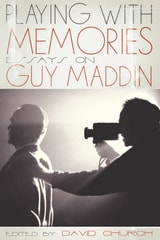
Playing with Memories
Essays on Guy MaddinDavid Church
University of Manitoba Press, 2009
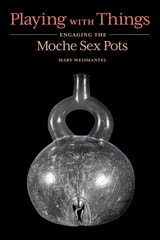
Playing with Things
Engaging the Moche Sex PotsBy Mary Weismantel
University of Texas Press, 2021
Winner, Association for Latin American Art-Arvey Foundation Book Award, 2022
More than a thousand years ago on the north coast of Peru, Indigenous Moche artists created a large and significant corpus of sexually explicit ceramic works of art. They depicted a diversity of sex organs and sex acts, and an array of solitary and interconnected human and nonhuman bodies. To the modern eye, these Moche “sex pots,” as Mary Weismantel calls them, are lively and provocative but also enigmatic creations whose import to their original owners seems impossible to grasp.
In Playing with Things, Weismantel shows that there is much to be learned from these ancient artifacts, not merely as inert objects from a long-dead past but as vibrant Indigenous things, alive in their own inhuman temporality. From a new materialist perspective, she fills the gaps left by other analyses of the sex pots in pre-Columbian studies, where sexuality remains marginalized, and in sexuality studies, where non-Western art is largely absent. Taking a decolonial approach toward an archaeology of sexuality and breaking with long-dominant iconographic traditions, this book explores how the pots "play jokes," "make babies," "give power," and "hold water,” considering the sex pots as actual ceramic bodies that interact with fleshly bodies, now and in the ancient past. A beautifully written study that will be welcomed by students as well as specialists, Playing with Things is a model for archaeological and art historical engagement with the liberating power of queer theory and Indigenous studies.

Shakespeare the Actor and the Purposes of Playing
Meredith Anne Skura
University of Chicago Press, 1993
Despite the obvious differences between our theater and Shakespeare's, sixteenth-century testimony suggests that the experience of acting has not changed much over the centuries. Beginning with a psychoanalytically informed account of acting today, Skura shows how this intense and ambivalent experience appears not only in literal references to acting in Shakespearean drama but also in recurring narrative concerns, details of language, and dramatic strategies used to engage the audience. Looking at the plays in the context of both public and private worlds outside the theater, Skura rereads the canon to identify new configurations in the plays and new ways of understanding theatrical self-consciousness in Renaissance England. Rich in theatrical, psychoanalytic, biographical, and historical insight, this book will be invaluable to students of Shakespeare and instructive to all readers interested in the dynamics of performance.
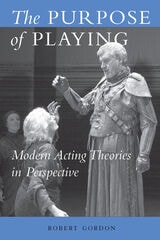
The Purpose of Playing
Modern Acting Theories in PerspectiveRobert Gordon
University of Michigan Press, 2006
“This analysis of major movements and figures from the early nineteenth century to the present is clear, thorough, and penetrating, and its scope across periods, countries, and styles is impressive.”
--Xerxes Mehta, University of Maryland-Baltimore County
Robert Gordon is Reader in Drama, Goldsmiths College, University of London.
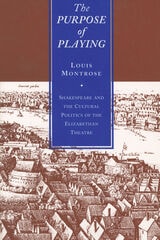
The Purpose of Playing
Shakespeare and the Cultural Politics of the Elizabethan TheatreLouis Montrose
University of Chicago Press, 1996
Montrose first locates the public and professional theater within the ideological and material framework of Elizabethan culture. He considers the role of the professional theater and theatricality in the cultural transformation that was concurrent with religious and socio-political change, and then concentrates upon the formal means by which Shakespeare's Elizabethan plays called into question the absolutist assertions of the Elizabethan state. Drawing dramatic examples from the genres of tragedy and history, Montrose finally focuses his cultural-historical perspective on A Midsummer Night's Dream.
The Purpose of Playing elegantly demonstrates how language and literary imagination shape cultural value, belief, and understanding; social distinction and interaction; and political control and contestation.
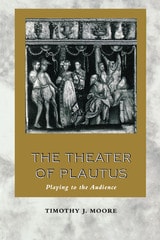
The Theater of Plautus
Playing to the AudienceBy Timothy J. Moore
University of Texas Press, 1998
The relationship between actors and spectators has been of perennial interest to playwrights. The Roman playwright Plautus (ca. 200 BCE) was particularly adept at manipulating this relationship. Plautus allowed his actors to acknowledge freely the illusion in which they were taking part, to elicit laughter through humorous asides and monologues, and simultaneously to flatter and tease the spectators.
These metatheatrical techniques are the focus of Timothy J. Moore's innovative study of the comedies of Plautus. The first part of the book examines Plautus' techniques in detail, while the second part explores how he used them in the plays Pseudolus, Amphitruo, Curculio, Truculentus, Casina, and Captivi. Moore shows that Plautus employed these dramatic devices not only to entertain his audience but also to satirize aspects of Roman society, such as shady business practices and extravagant spending on prostitutes, and to challenge his spectators' preconceptions about such issues as marriage and slavery. These findings forge new links between Roman comedy and the social and historical context of its performance.
Toni Morrison
PLAYING WITH DIFFERENCELucille P. Fultz
University of Illinois Press, 2003