Results by title
54 books match the query 'Great Plains' and 8 start with t
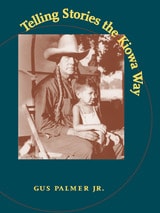
Telling Stories the Kiowa Way
Gus Palmer
University of Arizona Press, 2003
This book explores the traditional art of storytelling still practiced by Kiowas today as Gus Palmer shares conversations held with storytellers. Combining narrative, personal experience, and ethnography in an original and artful way, Palmer—an anthropologist raised in a traditional Kiowa family—shows not only that storytelling remains an integral part of Kiowa culture but also that narratives embedded in everyday conversation are the means by which Kiowa cultural beliefs and values are maintained.
Palmer's study features contemporary oral storytelling and other discourses, assembled over two and a half years of fieldwork, that demonstrate how Kiowa storytellers practice their art. Focusing on stories and their meaning within a narrative and ethnographic context, he draws on a range of material, including dream stories, stories about the coming of Táimê (the spirit of the Sun Dance) to the Kiowas, and stories of tricksters and tribal heroes. He shows how storytellers employ the narrative devices of actively participating in oral narratives, leaving stories wide open, or telling stories within stories. And he demonstrates how stories can reflect a wide range of sensibilities, from magical realism to gossip.
Firmly rooted in current linguistic anthropological thought, Telling Stories the Kiowa Way is a work of analysis and interpretation that helps us understand story within its larger cultural contexts. It combines the author's unique literary talent with his people's equally unique perspective on anthropological questions in a text that can be enjoyed on multiple levels by scholars and general readers alike.
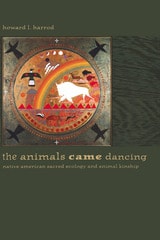
The Animals Came Dancing
Native American Sacred Ecology and Animal KinshipHoward L. Harrod
University of Arizona Press, 2000
Drawing on memories of Native Americans recorded by anthropologists, fur traders, missionaries, and other observers, Harrod examines cultural practices that flourished from the mid-eighteenth to the mid-nineteenth century. He reconstructs the complex rituals of Plains peoples, which included buffalo hunting ceremonies employing bundles or dancing, and rituals such as the Sun Dance for the renewal of animals. In a closing chapter, Harrod examines the meanings of Indian-animal relations for a contemporary society that values human dominance over the natural world—one in which domestic animals are removed from our consciousness as a source of food, wild animals are managed for humans to "experience," and hunting has become a form of recreation. His meticulous scholarship re-imagines a vanished way of life, while his keen insights give voice to a hunger among many contemporary people for the recovery of a ritual relationship between themselves and the natural sources of their lives.
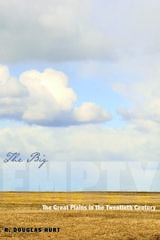
The Big Empty
The Great Plains in the Twentieth CenturyR. Douglas Hurt
University of Arizona Press, 2011
Using the voices of women homesteaders, agrarian socialists, Jewish farmers, Mexican meatpackers, New Dealers, and Native Americans, this book creates a sweeping survey of contested race relations, radical politics, and agricultural prosperity and decline during the twentieth century. This narrative shows that even though Great Plains history is fraught with personal and group tensions, violence, and distress, the twentieth century also brought about compelling social, economic, and political change.
The only book of its kind, this account will be of interest to historians studying the region and to anyone inspired by the story of the men and women who found an opportunity for a better life in the Great Plains.
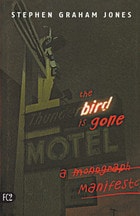
The Bird is Gone
A ManifestoStephen Graham Jones
University of Alabama Press, 2003
A lost pipe holds the power to rewrite a nation.
Cleverly blending alternate history, mystery, and indigenous resurgence, Stephen Graham Jones’s The Bird Is Gone unfolds in a transformed Great Plains where a visionary conservation act has made the land truly “Indian again.” Fourteen years later, a motley crew led by LP Deal converges in a bowling alley within Indian Territories, on a quest for a forgotten treaty pipe—sealed in a locker and flushed into oblivion—that could return all of America to Indigenous hands. Surreal, suspenseful, and richly original, this manifesto of resistance challenges readers to reconsider power, history, and the stakes of reclaiming a stolen world.
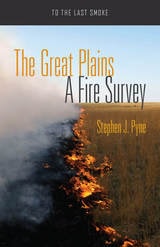
The Great Plains
A Fire SurveyStephen J. Pyne
University of Arizona Press, 2017
Early descriptions of the Great Plains often focus on a vast, grassy expanse that was either burnt or burning. The scene continued to burn until the land was plowed under or grazed away and broken by innumerable roads and towns. Yet, where the original landscape has persisted, so has fire, and where people have sought to restore something of that original setting, they have had to reinstate fire. This has required the persistence or creation of a fire culture, which in turn inspired schools of science and art that make the Great Plains today a regional hearth for American fire.
Volume 5 of To the Last Smoke introduces a region that once lay at the geographic heart of American fire, and today promises to reclaim something of that heritage. After all these years, the Great Plains continue to bear witness to how fires can shape contemporary life, and vice versa. In this collection of essays, Stephen J. Pyne explores how this once most regularly and widely burned province of North America, composed of various subregions and peoples, has been shaped by the flames contained within it and what fire, both tame and feral, might mean for the future of its landscapes.
Included in this volume:
- How wildland and rural fire have changed from the 19th century to the 21st century
- How fire is managed in the nation’s historic tallgrass prairies, from Texas to South Dakota, from Illinois to Nebraska
- How fire connects with other themes of Great Plains life and culture
- How and why Texas has returned to the national narrative of landscape fire
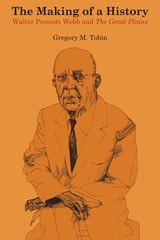
The Making of a History
Walter Prescott Webb and The Great PlainsBy Gregory M. Tobin
University of Texas Press, 1976
Walter Prescott Webb became one of the best known interpreters of the American West following the publication of The Great Plains in 1931. That book remained one of the outstanding studies of the region for decades and attracted considerable attention over the years for its unusual emphasis on the impact of geographic factors on the process of settlement. Using manuscript sources, some of which had not previously been available, Gregory M. Tobin has traced the elements that went into the planning and writing of The Great Plains and that account for its distinctive approach to the writing of a regional history.
Tobin emphasizes two aspects of Webb's life that molded the historian's outlook: his early family life and community connections in West Texas and his admiration for the ideas of scholar Lindley Miller Keasbey. Webb reacted strongly against the assumption that the only cultural values of any real worth emanated from the urban and sophisticated East; he was determined to write the history of his own people in a way that would reveal the scale of their anonymous contribution to American civilization. By reverting to Keasbey's stress on the relationship between natural environment and social institutions, Webb broadened his study to take in what he believed to be a distinct geographic environment. The result was The Great Plains, an assertion of individual and regional identity by a man with a personal stake in establishing the image of a distinctive Plains civilization.
Although The Making of a History is not a full biography of Walter Prescott Webb, it is the first biographically oriented study of a man regarded as one of the twentieth century's major western historians. It places his development within the framework of his intellectual and social setting and, in a sense, subjects his career to the same type of scrutiny that he advocated as the basis of the study of evolving cultures.
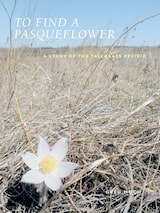
To Find a Pasqueflower
A Story of the Tallgrass PrairieGreg Hoch
University of Iowa Press, 2022
Hoch blends history, culture, and science into a unified narrative of the tallgrass prairie, with an emphasis on humans’ participation in its development and destruction. Hoch also demonstrates how variable and dynamic the prairie is, creating both challenges and opportunities for those who manage and restore and appreciate it.
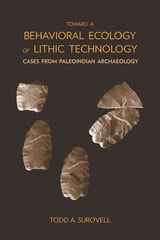
Toward a Behavioral Ecology of Lithic Technology
Cases from Paleoindian ArchaeologyTodd A. Surovell
University of Arizona Press, 2009
Because the fundamental processes of making, using, and discarding stone tools are, at root, exercises in problem solving, Todd Surovell asks what conditions favor certain technological solutions. Whether asking if a biface should be made thick or thin or if a flake should be saved or discarded, Surovell seeks answers that extend beyond a case-by-case analysis. One avenue for addressing these questions theoretically is formal mathematical modeling.
Here Surovell constructs a series of models designed to link environmental variability to human decision making as it pertains to lithic technology. To test the models, Surovell uses data from the analysis of more than 40,000 artifacts from five Rocky Mountain and Northern Plains Folsom and Goshen complex archaeological sites dating to the Younger Dryas stadial (ca. 12,600-11,500 years BP). The primary result is the production of powerful new analytical tools useful to the interpretation of archaeological assemblages.
Surovell's goal is to promote modeling and explore the general issues governing technological decisions. In this light, his models can be applied to any context in which stone tools are made and used.