Results by title
93 books match the query 'Historians' and 22 start with t
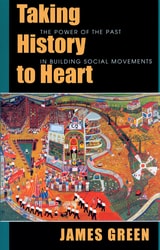
Taking History to Heart
The Power of the Past in Building Social MovementsJames Green
University of Massachusetts Press, 2000
Deftly blending autobiography and history, James Green here reflects on thirty years as an activist, educator, and historian. He recounts how he became deeply immersed in political protest and in recovering and preserving the history of progressive social movements, and how the two are linked. His book, written in an engaging and accessible style, tells powerful stories of people in struggle, framed by the personal account of his own development. As a historian, Green gives voice to generations of Americans who banded together to fight for social justice. His subjects range from the martyrs of the Haymarket tragedy to the Bread and Roses strikers of 1912, from depression-era struggles for democracy to the civil rights crusaders, from recent Rainbow Coalition campaigns to the latest union organizing drives. As an activist, Green describes how his participation in the civil rights and labor movements of our own time has transformed his life, first as a student and radical scholar in the 1960s, then as a public historian and teacher of working-class students. He also describes his efforts to break free from academic confinement and “tell movement stories in public,” in an attempt to offer hope and counsel to those still fighting for equality and fairness. He concludes with a revealing look at how awareness of past social activism has contributed to the revival of the labor movement during the last ten years, an effort in which Green has been vigorously engaged.
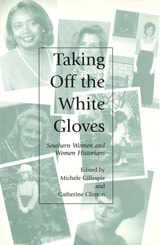
Taking Off the White Gloves
Southern Women and Women HistoriansEdited & Intro by Michele Gillespie & Catherine Clinton
University of Missouri Press, 1998
When southern women remove their gloves, they speak their minds. The ten timely and provocative essays in Taking Off the White Gloves represent the collective wisdom of some of the finest scholars on women's history in the American South. On the eve of the thirtieth anniversary of the Southern Association for Women Historians, this volume brings together some of the outstanding lectures delivered by distinguished members of the association over the past fifteen years.
Spanning four centuries of women's experiences in the South, the topics featured in Taking Off the White Gloves range from Native American sexuality and European conquest to woman suffrage in the South, from black women's protest history to the status of women in the historical profession at the end of the twentieth century.
Despite diverse subject matter, these rich essays share a number of important qualities. They take an integrative approach, combining literary analysis, social history, cultural interpretation, labor history, popular culture, and oral history. Embracing the distinctiveness of the southern past and women's experiences within that past, they also recognize the inextricability of critical categories such as sexuality and gender, race and gender, and women and work. Finally, these essays emphasize the authors' commitment to the belief that the personal is political; they reveal the subtle and not so subtle ways that women transform theory into practice.
Taking Off the White Gloves invites a new understanding of the complexities that surround the history of southern women across race, class, place, and time. A model of innovative and imaginative scholarly historical writing, this book provides fertile ground for young scholars and is sure to inspire new research. This thought- provoking volume has much to offer scholars and students, as well as the general reader.
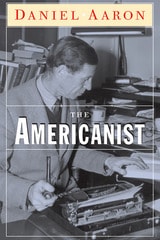
The Americanist
Daniel Aaron
University of Michigan Press, 2009
“I have read all of Daniel Aaron’s books, and admired them, but in The Americanist I believe he has composed an intellectual and social memoir for which he will be remembered. His self-portrait is marked by personal tact and admirable restraint: he is and is not its subject. The Americanist is a vision of otherness: literary and academic friends and acquaintances, here and abroad. Eloquently phrased and free of nostalgia, it catches a lost world that yet engendered much of our own.”
—Harold Bloom
“The Americanist is the absorbing intellectual autobiography of Daniel Aaron, who is the leading proponent and practitioner of American Studies. Written with grace and wit, it skillfully blends Daniel Aaron’s personal story with the history of the field he has done so much to create. This is a first-rate book by a first-rate scholar.”
—David Herbert Donald, Professor Emeritus, Harvard University
The Americanist is author and critic Daniel Aaron’s anthem to nearly a century of public and private life in America and abroad. Aaron, who is widely regarded as one of the founders of American Studies, graduated from the University of Michigan, received his Ph.D. from Harvard, and taught for over three decades each at Smith College and Harvard.
Aaron writes with unsentimental nostalgia about his childhood in Los Angeles and Chicago and his later academic career, which took him around the globe, often in the role of America’s accidental yet impartial critic. When Walt Whitman, whom Aaron frequently cites as a touchstone, wrote, “I am large, I contain multitudes,” he could have been describing Daniel Aaron—the consummate erudite and Renaissance individual whose allegiance to the truth always outweighs mere partisan loyalty.
Not only should Aaron’s book stand as a resplendent and summative work from one of the finest thinkers of the last hundred years, it also succeeds on its own as a first-rate piece of literature, on a par with the writings of any of its subjects. The Americanist is a veritable Who’s Who of twentieth-century writers Aaron interviewed, interacted with, or otherwise encountered throughout his life: Ralph Ellison, Robert Frost, Lillian Hellman, Richard Hofstadter, Alfred Kazin, Sinclair Lewis, Malcolm Muggeridge, John Crowe Ransom, Upton Sinclair, Edmund Wilson, Leonard Woolf, and W. B. Yeats, to name only a few.
Aaron’s frank and personal observations of these literary lights make for lively reading. As well, scattered throughout The Americanist are illuminating portraits of American presidents living and passed—miniature masterworks of astute political observation that offer dazzlingly fresh approaches to well-trod subjects.
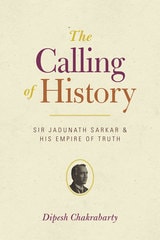
The Calling of History
Sir Jadunath Sarkar and His Empire of TruthDipesh Chakrabarty
University of Chicago Press, 2015
Through close readings of more than twelve hundred letters to and from Sarkar along with other archival documents, Dipesh Chakrabarty demonstrates that historians in colonial India formulated the basic concepts and practices of the field via vigorous—and at times bitter and hurtful—debates in the public sphere. He furthermore shows that because of its non-technical nature, the discipline as a whole remains susceptible to pressure from both the public and the academy even today. Methodological debates and the changing reputations of scholars like Sarkar, he argues, must therefore be understood within the specific contexts in which particular histories are written.
Insightful and with far-reaching implications for all historians, The Calling of History offers a valuable look at the double life of history and how tensions between its public and private sides played out in a major scholar’s career.
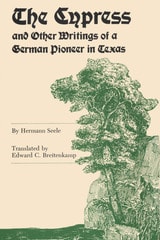
The Cypress and Other Writings of a German Pioneer in Texas
By Hermann Seele
University of Texas Press, 1979
When Hermann Seele anived in New Braunfels in 1845, the raw colony was plagued by poverty, disease, lack of food, and hostile Indians. This personal record of the Germans in Texas shows their evolution from struggling colonists to prosperous citizens.
From his viewpoint of a hardworking yet imaginative pioneer, Seele presents first a history of German immigration and settlement in Texas during the nineteenth century. Next, his autobiographical writings range from a "sentimental recollection" of his first Christmas Eve in Texas to his first day of teaching in New Braunfels, from accounts of the popular singing society to murder and justice along the Comal River. In addition, Seele's romantic novel, The Cypress, is a delightful though improbable tale of a traveling botanist, a chieftain's daughter, and a savage Indian cult.
Hermann Seele—farmer, lawyer, teacher, lay preacher, mayor, state representative, Civil War major, and editor—epitomizes the best of the German immigrants who established their communities as models of respectability and prosperity.
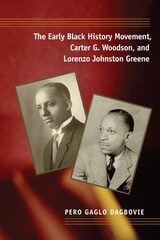
The Early Black History Movement, Carter G. Woodson, and Lorenzo Johnston Greene
Pero Gaglo Dagbovie
University of Illinois Press, 2007
The Education of Historians for Twenty-first Century
Thomas Bender, Philip M. Katz, Colin Palmer, and the Committee on Graduate Education (AHA)
University of Illinois Press, 2004
An examination and analysis of history education in American colleges and universities
In 1958, the American Historical Association began a study to determine the status and condition of history education in U.S. colleges and universities. Published in 1962 and addressing such issues as the supply and demand for teachers, student recruitment, and training for advanced degrees, that report set a lasting benchmark against which to judge the study of history thereafter. Now, more than forty years later, the AHA has commissioned a new report. The Education of Historians for the Twenty-first Century documents this important new study's remarkable conclusions.
Both the American academy and the study of history have been dramatically transformed since the original study, but doctoral programs in history have barely changed. This report from the AHA explains why and offers concrete, practical recommendations for improving the state of graduate education. The Education of Historians for the
Twenty-first Century stands as the first investigation of graduate training for historians in more than four decades and the best available study of doctoral education in any major academic discipline.
Prepared for the AHA by the Committee on Graduate Education, the report represents the combined efforts of a cross-section of the entire historical profession. It draws upon a detailed review of the existing studies and data on graduate education and builds upon this foundation with an exhaustive survey of history doctoral programs. This included actual visits to history departments across the country and consultations with scores of individual historians, graduate students, deans, academic and non-academic employers of historians, as well as other stakeholders in graduate education.
As the ethnic and gender composition of both graduate students and faculty has changed, methodologies have been refined and the domains of historical inquiry expanded. By addressing these revolutionary intellectual and demographic changes in the historical profession, The Education of Historians for the Twenty-first Century breaks important new ground. Combining a detailed historical snapshot of the profession with a rigorous analysis of these intellectual changes, this volume is ideally positioned as the definitive guide to strategic planning for history departments. It includes practical recommendations for handling institutional challenges as well as advice for everyone involved in the advanced training of historians, from department chairs to their students, and from university administrators to the AHA itself.
Although focused on history, there are lessons here for any department. The Education of Historians for the Twenty-first Century is a model for in-depth analysis of doctoral education, with recommendations and analyses that have implications for the entire academy. This volume is required reading for historians, graduate students, university administrators, or anyone interested in the future of higher education.
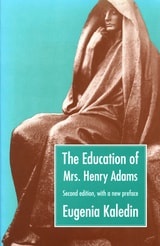
The Education of Mrs. Henry Adams
Eugenia Kaledin
University of Massachusetts Press, 1994
Marian Hooper Adams—Clover, as her friends called her—was an accomplished photographer and a witty, irreverent free spirit who moved easily within the cultural circles of nineteenth-century Boston. Why, then, in 1882, at the age of forty-two, did she swallow a lethal dose of potassium cyanide? And why did her husband of thirteen years fail even to mention her in his autobiography, The Education of Henry Adams?
These and other questions are explored in this first paperback edition of Eugenia Kaledin's pathbreaking biography. The book recreates the intense intellectual, cultural, and moral life of Boston and New England before, during, and after the Civil War and helps us to understand what could drive such a gifted, intelligent, and privileged woman to take her own life. Included is a portfolio of Adams's photographs of her husband and his famous circle.
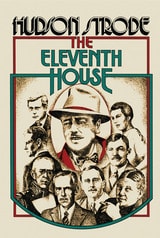
The Eleventh House
MemoirsHudson Strode, Introduction by Don Noble
University of Alabama Press, 1975
Why should Hudson Strode matter to readers today? Because his life was a masterclass in reinvention and a backstage pass to the Jazz Age’s wittiest salons. Strode wasn’t just a professor in Tuscaloosa; he was a cultural impresario who turned a modest Southern life into a global adventure. He taught generations of writers, staged Shakespeare with bravura, and wrote travel books that earned him a knighthood from the King of Sweden.
But the real allure? The gossip. Strode dined with Lady Astor, traded quips with H. L. Mencken, and sipped cocktails with Zelda and Scott Fitzgerald when they were the incandescent couple of the 1920s. He met Hemingway in Cuba, Robinson Jeffers in Carmel, and Isak Dinesen in Denmark—then wrote about them with candor and charm. His memoir brims with stories of literary giants, royal encounters, and the occasional eyebrow-raising escapade (ask him about the brothel in Birmingham).
For contemporary readers, The Eleventh House is both a captivating autobiography and a time capsule of ambition, art, and audacity. Strode’s world—where Southern gentility collided with European modernism and Jazz Age excess—feels startlingly relevant in an era obsessed with reinvention and celebrity culture. If you’ve ever wondered what it was like to gossip with the Fitzgeralds or watch the devil admire himself in a porch mirror, this memoir delivers.
Step inside Hudson Strode’s The Eleventh House. It’s witty, worldly, and just scandalous enough to keep you turning pages.
The Historian behind the History
Conversations with Southern HistoriansMegan L. Bever
University of Alabama Press, 2014
The historians and their main topics include:
Richard J. M. Blackett on antebellum and African American history
Dan T. Carter on Reconstruction, Civil Rights, and George Wallace
Pete Daniel on the New Deal and the Cold War South
Laura F. Edwards on the Early Republic, the Civil War, Reconstruction, and women’s history
William W. Freehling on the antebellum South
Gary W. Gallagher on the Civil War
Glenda Elizabeth Gilmore on Jim Crow
James M. McPherson on the Civil War
Theodore Rosengarten on the Depression
J. Mills Thornton III on the antebellum South
In his introduction, award-winning author and historian George C. Rable draws together the multifaceted themes of these interviews, offering a compelling overview of the nature of the field. Edited by Megan L. Bever and Scott A. Suarez, The Historian behind the History offers critical insights about the craft and professional life of the historian.
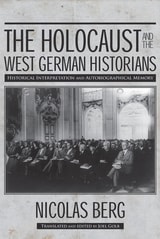
The Holocaust and the West German Historians
Historical Interpretation and Autobiographical MemoryNicolas Berg, Translated and edited by Joel Golb
University of Wisconsin Press, 2015
This English-language translation is also a shortened and reorganized edition, which includes a new introduction by Berg reviewing and commenting on the response to the German editions. Notably, in this American edition, discussion of historian Joseph Wulf and his colleague and fellow Holocaust survivor Léon Poliakov has been united in one chapter. And special care has been taken to make clear to English speakers the questions raised about German historiographical writing. Translator Joel Golb comments, "From 1945 to the present, the way historians have approached the Holocaust has posed deep-reaching problems regarding choice of language. . . . This book is consequently as much about language as it is about facts."
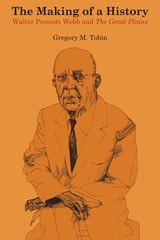
The Making of a History
Walter Prescott Webb and The Great PlainsBy Gregory M. Tobin
University of Texas Press, 1976
Walter Prescott Webb became one of the best known interpreters of the American West following the publication of The Great Plains in 1931. That book remained one of the outstanding studies of the region for decades and attracted considerable attention over the years for its unusual emphasis on the impact of geographic factors on the process of settlement. Using manuscript sources, some of which had not previously been available, Gregory M. Tobin has traced the elements that went into the planning and writing of The Great Plains and that account for its distinctive approach to the writing of a regional history.
Tobin emphasizes two aspects of Webb's life that molded the historian's outlook: his early family life and community connections in West Texas and his admiration for the ideas of scholar Lindley Miller Keasbey. Webb reacted strongly against the assumption that the only cultural values of any real worth emanated from the urban and sophisticated East; he was determined to write the history of his own people in a way that would reveal the scale of their anonymous contribution to American civilization. By reverting to Keasbey's stress on the relationship between natural environment and social institutions, Webb broadened his study to take in what he believed to be a distinct geographic environment. The result was The Great Plains, an assertion of individual and regional identity by a man with a personal stake in establishing the image of a distinctive Plains civilization.
Although The Making of a History is not a full biography of Walter Prescott Webb, it is the first biographically oriented study of a man regarded as one of the twentieth century's major western historians. It places his development within the framework of his intellectual and social setting and, in a sense, subjects his career to the same type of scrutiny that he advocated as the basis of the study of evolving cultures.
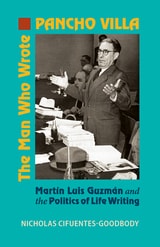
The Man Who Wrote Pancho Villa
Martin Luis Guzman and the Politics of Life WritingNicholas Cifuentes-Goodbody
Vanderbilt University Press, 2016
The Man Who Wrote Pancho Villa places Guzman's work in a biographical context, shedding light on the immediate motivations behind his writing in a given moment and the subsequent ways in which he rewrote or repackaged the material. Despite his efforts to establish a definitive reading of his life and literature, Guzman was unable to control that interpretation as audiences became less tolerant of the glaring omissions in his self-portrait.
The Man of Many Devices, Who Wandered Full Many Ways
Festschrift in Honor of János M. BakBalázs Nagy
Central European University Press, 1999
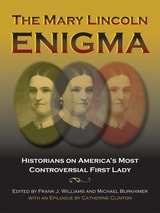
The Mary Lincoln Enigma
Historians on America's Most Controversial First LadyEdited by Frank J. Williams and Michael Burkhimer, with an Epilogue by Catherine Clinton
Southern Illinois University Press, 2012
Mary Lincoln is a lightning rod for controversy. Stories reveal widely different interpretations, and it is impossible to write a definitive version of her life that will suit everyone. The thirteen engaging essays in this collection introduce Mary Lincoln’s complex nature and show how she is viewed today.
The authors’ explanations of her personal and private image stem from a variety of backgrounds, and through these lenses—history, theater, graphic arts, and psychiatry—they present their latest research and assessments. Here they reveal the effects of familial culture and society on her life and give a broader assessment of Mary Lincoln as a woman, wife, and mother. Topics include Mary’s childhood in Kentucky, the early years of her marriage to Abraham, Mary’s love of travel and fashion, the presidential couple’s political partnership, and Mary’s relationship with her son Robert.
The fascinating epilogue meditates on Mary Lincoln’s universal appeal and her enigmatic personality, showcasing the dramatic differences in interpretations. With gripping prose and in-depth documentation, this anthology will capture the imagination of all readers.
University Press Books for Public and Secondary Schools 2013 edition
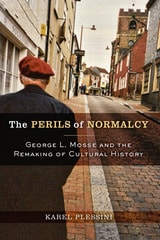
The Perils of Normalcy
George L. Mosse and the Remaking of Cultural HistoryKarel Plessini
University of Wisconsin Press, 2014
In this intellectual biography of George Mosse, Karel Plessini draws on all of Mosse's published and unpublished work to illuminate the origins and development of his groundbreaking methods of historical analysis and the close link between his life and work. He redefined the understanding of modern mass society and politics, masterfully revealing the powerful influence of conformity and political liturgies on twentieth-century history. Mosse warned against the dangers inherent in acquiescence, showing how identity creation and ideological fervor can climax in intolerance and mass murder—a message of continuing relevance.
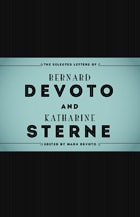
The Selected Letters of Bernard DeVoto and Katharine Sterne
Mark DeVoto
University of Utah Press, 2012
A busy man with a busy life, DeVoto found time to write and answer letters in abundance. In 1933 he received a fan letter from Katharine Sterne, a young woman hospitalized with tuberculosis; his reply touched off an extraordinary eleven-year correspondence. Sterne had graduated with honors from Wellesley College in 1928 and had served as an assistant art critic at the New York Times before her illness. Despite her enforced invalidism she maintained an active intellectual life. Sterne and DeVoto wrote to each other until her death in 1944, sometimes in many pages and as often as twice a week, exchanging opinions about life, literature, art, current events, family news, gossip, and their innermost feelings. DeVoto’s biographer, Wallace Stegner, states that in these letters DeVoto “expressed himself more intimately than in any other writings.” Although their correspondence amounted to more than 868 letters (and is virtually complete on both sides), DeVoto and Sterne never met, both of them doubtless realizing that physical remoteness permitted a psychological proximity that was deeply nourishing.
This volume contains 140 of their letters. They have been selected by DeVoto’s son Mark, who has also provided detailed notes clarifying ambiguities and obscure references. Readers will enjoy these letters for their wit and literary flair, but they will also gain insight into the cultural and historical crosscurrents of the 1930s and ’40s while taking an intimate and engaging look at a friendship forged entirely through words.
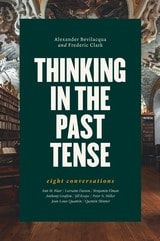
Thinking in the Past Tense
Eight ConversationsAlexander Bevilacqua and Frederic Clark
University of Chicago Press, 2019
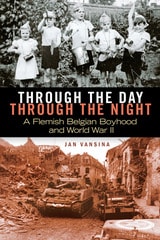
Through the Day, through the Night
A Flemish Belgian Boyhood and World War IIJan Vansina
University of Wisconsin Press, 2014
Within the vast literature on World War II, a much smaller body of work treats the everyday experiences of civilians, particularly in smaller countries drawn into the conflict. Recalling the war in Belgium from a child’s-eye perspective, Vansina describes pangs of hunger so great as to make him crave the bitter taste of cod-liver oil. He vividly remembers the shock of seeing severely wounded men on the grounds of a field hospital, the dangers of crossing fields and swimming in ponds strafed by planes, and his family’s interactions with occupying and escaping soldiers from both sides. After the war he recalls emerging numb from the cinema where he first saw the footage of the Nazi death camps, and he describes a new phase of unrest marked by looting, vigilante justice, and the country’s efforts at reunification.
Vansina, a historian and anthropologist best known for his insights into oral tradition and social memory, draws on his own memories and those of his siblings to reconstruct daily life in Belgium during a tumultuous era.
Best Special Interest Books, selected by the American Association of School Librarians
Best Books for General Audiences, selected by the Public Library Reviewers

To Remain Myself
The History of OnghokhamDavid Reeve
National University of Singapore Press, 2022

Tracking the Texas Ranger Historians
Bruce Glasrud
University of North Texas Press, 2024
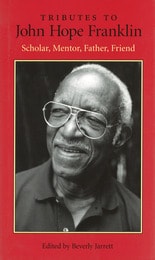
Tributes to John Hope Franklin
Scholar, Mentor, Father, FriendEdited by Beverly Jarrett
University of Missouri Press, 2003