143 books match the query 'History of doctrines' and 49 start with t
cover of Tertullian's Aduersus Iudaeos: A Rhetorical Analysis (NAPS Patristic Monograph Series, Volume 19)

Tertullian's Aduersus Iudaeos

A Rhetorical Analysis (NAPS Patristic Monograph Series, Volume 19)

Geoffrey D. Dunn

Catholic University of America Press, 2008
Geoffrey D. Dunn is the first scholar to use classical rhetoric as the interpretative tool for analyzing the question of the authorship of Aduersus Iudaeos. He argues that Tertullian structured this work according to the rules of classical rhetoric and employed arguments familiar to anyone with training in oratory
[more]
cover of The Antinomian Controversy, 1636-1638: A Documentary History

The Antinomian Controversy, 1636-1638

A Documentary History

David D. Hall, ed.

Duke University Press, 1990

The Antinomian controversy—a seventeenth-century theological crisis concerning salvation—was the first great intellectual crisis in the settlement of New England. Transcending the theological questions from which it arose, this symbolic controversy became a conflict between power and freedom of conscience. David D. Hall’s thorough documentary history of this episode sheds important light on religion, society, and gender in early American history.
This new edition of the 1968 volume, published now for the first time in paperback, includes an expanding bibliography and a new preface, treating in more detail the prime figures of Anne Hutchinson and her chief clerical supporter, John Cotton. Among the documents gathered here are transcripts of Anne Hutchinson’s trial, several of Cotton’s writings defending the Antinomian position, and John Winthrop’s account of the controversy. Hall’s increased focus on Hutchinson reveals the harshness and excesses with which the New England ministry tried to discredit her and reaffirms her place of prime importance in the history of American women.
[more]
cover of The Augustinian Person

The Augustinian Person

Peter Burnell

Catholic University of America Press, 2005
Through careful analysis of Augustine's writings, Burnell concludes that Augustine conceives of human nature as a unity at every level--socially, morally, and in basic constitution--despite very common objections that he fails to achieve such a conception
[more]
cover of The Bible and Early Trinitarian Theology

The Bible and Early Trinitarian Theology

Christopher A. Beeley

Catholic University of America Press, 2018

The past thirty years have seen an unprecedented level of interest in early Christian biblical interpretation, from major scholarly initiatives to more popular resources aimed at pastors and general readers. The fields of Biblical Studies and Patristics/Early Christian Studies each arrived at the study of early Christian biblical interpretation largely from their own standpoints, and they tend to operate in relative isolation from one another. This books aims to bring the two fields into closer conversation, in order to suggest new avenues into the study of the deeply biblical dimension of patristic theology as well as the contribution that patristic exegesis can make to contemporary views of how best to interpret the Bible.

Based on a multi-year consultation in the Society of Biblical Literature, The Bible and Early Trinitarian Theology features leading scholars from both fields, who bring new insights to the relationship between patristic exegesis and current strategies of biblical interpretation, specifically with reference to the doctrine of the Trinity. Following an account of how each field came to study patristic exegesis, the book offers new studies of Trinitarian theology in Old Testament, Johannine, and Pauline biblical texts and the patristic interpretation of them, combining the insights of modern historical criticism with classical historical theology. It promises to make a valuable contribution to both fields, suggesting several new avenue into the study of early biblical literature and the development of Trinitarian theology.
[more]
cover of The Birth of Purgatory

The Birth of Purgatory

Jacques Le Goff

University of Chicago Press, 1984
In The Birth of Purgatory, Jacques Le Goff, the brilliant medievalist and renowned Annales historian, is concerned not with theological discussion but with the growth of an idea, with the relation between belief and society, with mental structures, and with the historical role of the imagination. Le Goff argues that the doctrine of Purgatory did not appear in the Latin theology of the West before the late twelfth century, that the word purgatorium did not exist until then. He shows that the growth of a belief in an intermediate place between Heaven and Hell was closely bound up with profound changes in the social and intellectual reality of the Middle Ages. Throughout, Le Goff makes use of a wealth of archival material, much of which he has translated for the first time, inviting readers to examine evidence from the writings of great, obscure, or anonymous theologians.
[more]
cover of The Christology of Erasmus: Christ, Humanity, and Peace

The Christology of Erasmus

Christ, Humanity, and Peace

Terence J. Martin

Catholic University of America Press, 2024
Nothing is more central to the religious thinking of Erasmus of Rotterdam than the reality of Christ—in his eyes, that supreme revelation of divine mercy embodied in the life of Jesus of Nazareth to which Christian scriptures variously testify, but also the divine presence undergirding that life-centering ethic of love and peace, what Erasmus calls the “philosophy of Christ.” The purpose of this book is to distill the Christological elements from his vast corpus in a manner that shows the range, coherence, and value of Erasmus’ thinking on Christological questions. While Erasmus works within the broad parameters of orthodox teaching, his critical skills with languages, accent on rhetoric in theology, keen sense of irony, appreciation for the limits of human knowledge, incipient sense of history, emphasis on the welfare of humanity, and passionate defense of peace, give his work a distinctive stamp and thereby make a singular contribution to the history of Christology. What Erasmus contributes to discussions of the divinity of Christ is a counsel of restraint in metaphysical speculation, an accent on the revelatory breadth of the eternal Word of God, and an invitation to think of Christ incarnate as the eloquent oration of God. But the central impulse of the Christology of Erasmus is the affirmation of the full incarnation of Christ in human existence, abstaining as much as possible from docetic insulation of the divine from the struggles of human experience, in order to highlight the redemptive capacity of Christ for the transformation of human life. With that, the ethical capstone of Erasmus’ reflections on Christ centers on the responsibility to imitate Christ’s love for others, and thus for advancing the cause of peace in personal and social life. This books adds the voice of this remarkable Catholic humanist to the history of theological discussions in the early modern era, while also restoring its rightful place in the broader history of Christology.
[more]
cover of The Church of God in Jesus Christ : A Catholic Ecclesiology

The Church of God in Jesus Christ

A Catholic Ecclesiology

Roch A. Kereszty

Catholic University of America Press, 2019
Investigating Vatican II is a collection of Fr. Jared Wicks’ recent articles on Vatican II, and presents the Second Vatican Council as an event to which theologians contributed in major ways and from which Catholic theology can gain enormous insights. Taken as a whole, the articles take the reader into the theological dynamics of Vatican II at key moments in the Council’s historical unfolding. Wicks promotes a contemporary re-reception of Vatican II’s theologically profound documents, especially as they featured God’s incarnate and saving Word, laid down principles of Catholic ecumenical engagement, and articulated the church’s turn to the modern world with a new “face” of respect and dedication to service. From the original motivations of Pope John XXIII in convoking the Council, Investigating Vatican II goes on to highlight the profound insights offered by theologians who served behind the scenes as Council experts. In its chapters, the book moves through the Council’s working periods, drawing on the published and non-published records, with attention to the Council’s dramas, crises, and breakthroughs. It brings to light the bases of Pope Francis’s call for synodality in a listening church, while highlighting Vatican II’s mandate to all of prayerful biblical reading, for fostering a vibrant “joy in the Gospel.”
[more]
cover of The Consensus of the Church and Papal Infallibility: A Study in the Background of Vatican I

The Consensus of the Church and Papal Infallibility

A Study in the Background of Vatican I

Richard F. Costigan, S.J.

Catholic University of America Press, 2005
After a concise introduction that defines the two schools of theology, Richard Costigan examines the thought of nine major theologians on the subject: Bossuet, Tournely, Orsi, Ballerini, Bailly, Bergier, La Luzerne, Muzzarelli, and Perrone.
[more]
cover of The Didache: A Missing Piece of the Puzzle in Early Christianity

The Didache

A Missing Piece of the Puzzle in Early Christianity

Jonathan A. Draper

SBL Press, 2015

An intriguing dilemma for those who study ancient Christian contexts and literature

This edited volume includes essays and responses from specialists in the Didache and in early church history in general.

Features:

  • Strategies for understanding liturgical constructions and ritual worship found in the text
  • Studies that apply generally to the overall content and background of the Didache
  • Essays on the relationship between the Didache and scripture—particularly with respect to the Gospel of Matthew
[more]
cover of The Enlightenment and Original Sin

The Enlightenment and Original Sin

Matthew Kadane

University of Chicago Press, 2024

An eloquent microhistory that argues for the centrality of the doctrine of original sin to the Enlightenment.
 
What was the Enlightenment? This question has been endlessly debated. In The Enlightenment and Original Sin, historian Matthew Kadane advances the bold claim that the Enlightenment is best defined through what it set out to accomplish, which was nothing short of rethinking the meaning of human nature.
 
Kadane argues that this project centered around the doctrine of original sin and, ultimately, its rejection, signaling the radical notion that an inherently flawed nature can be overcome by human means. Kadane explores this and other wide-ranging themes through the story of a previously unknown figure, Pentecost Barker, an eighteenth-century purser and wine merchant. By examining Barker’s personal diary and extensive correspondence with a Unitarian minister, Kadane tracks the transformation of Barker’s consciousness from a Puritan to an Enlightenment outlook, revealing through one man’s journey the large-scale shifts in self-understanding whose philosophical reverberations have shaped debates on human nature for centuries.
[more]
cover of The Footsteps of Israel: Understanding Jews in Anglo-Saxon England

The Footsteps of Israel

Understanding Jews in Anglo-Saxon England

Andrew P. Scheil

University of Michigan Press, 2004
"This innovative, well-researched study looks at anti-Judaic rhetoric in the Old English and Latin texts of Anglo-Saxon England-a land lacking real Jews. The author isolates a common pool of inherited images for portraying the Jew, and teaches us to hear, especially in the vernacular, their increasingly dark and disturbing inflections." ---Roberta Frank, Yale University "The Footsteps of Israel is a fascinating study of a pervasive stereotype. Scheil's analysis of how Jews, with no real physical presence in Anglo-Saxon England, captured the imagination of writers of the period, is a superb achievement." ---Louise Mirrer, President and CEO, New-York Historical Society "The elegance of Scheil's prose weaves a unifying thread through the vast literary and historical tapestry he presents, moving with grace from Latin to Old English, from Bede to later authors, from Wordsworth and Blake to modern writers. He speaks elegantly of these texts' conversations with the past, and the Jews emerge as both enemies and spiritual antecedents of the 'New Israel' of Anglo-Saxon England." ---Stephen Spector, State University of New York, Stonybrook Jews are the omnipresent border-dwellers of medieval culture, a source of powerful metaphors active in the margins of medieval Christianity. This book outlines an important prehistory to later persecutions in England and beyond, yet it also provides a new understanding of the previously unrecognized roles Jews and Judaism played in the construction of social identity in early England. Andrew P. Scheil approaches the Anglo-Saxon understanding of Jews from a variety of directions, including a survey of the lengthy history of the ideology of England as the New Israel, its sources in late antique texts and its manifestation in both Old English and Latin texts from Anglo-Saxon England. In tandem with this perhaps more sympathetic understanding of the Jews is a darker vision of anti-Judaism, associating the Jews in an emotional fashion with the materiality of the body. In exploring the complex ramifications of this history, the author is the first to assemble and study references to Jews in Anglo-Saxon culture. For this reason, The Footsteps of Israel will be an important source for Anglo-Saxonists, scholars of late antiquity and the early Middle Ages, scholars of medieval antisemitism in general, students of Jewish history, and medievalists interested in cultural studies.
[more]
cover of The Godly Image: Christian Satisfaction in Aquinas

The Godly Image

Christian Satisfaction in Aquinas

Romanus Cessario

Catholic University of America Press, 2020
Christian satisfaction stands at the center of the Church’s teaching about salvation. Satisfaction pertains to studies about Christ, redemption, the Sacraments, and pastoral practice. The topic also enters into questions about God and the creature as well as about the divine mercy and providence. Somewhat neglected in the period after Vatican II, satisfaction now appears to scholars as the forgotten key to entering deeply into the mystery of Christ and his work. Seminarians especially will benefit from studying the place satisfaction holds in Catholic life. Further, ecumenical work requires a proper understanding of the place that satisfaction holds in Christian theology. Various factors operative since the sixteenth century have worked to displace satisfaction almost entirely from reformed practice and theology. To address such concerns, The Godly Image, has, over the past several decades and more, done a great deal to put satisfaction within its proper context of image-restoration. That is, to interpret satisfaction within the context of the divine mercy and not the divine justice. This unique contribution to satisfaction studies owes a great deal to the achievement of Saint Thomas Aquinas. In this sense, the book enacts a retrieval of the theology of the high classical period. Like much of Aquinas’s refined teaching, a proper understanding requires appeal to the commentatorial tradition that follows him. Interested students will find in this study the touchstones for further studies of these authors. The Godly Image aims also to distinguish the theology of Aquinas from that of the medieval author with whom the notion of satisfaction remains mostly identified, that is, Anselm of Canterbury. Although not a developed focus of the book’s contents, the attentive reader will recognize that Aquinas treats Saint Anselm with a reverential reading, even as the Common Doctor moves significantly away from interpretations of satisfaction that suggest that an angry God exacts from his innocent Son a painful substitutional penalty for a fallen human race.
[more]
cover of The Gospel of John Marrant: Conjuring Christianity in the Black Atlantic

The Gospel of John Marrant

Conjuring Christianity in the Black Atlantic

Alphonso F. Saville IV

Duke University Press, 2024
The Reverend John Marrant (1755–91) was North America’s first Black ordained minister and one of America’s earliest Black authors and preachers. In The Gospel of John Marrant, Alphonso F. Saville IV examines how Protestantism and West African indigenous religious practices deeply informed his life and ministry. Saville follows Marrant from his time evangelizing the Cherokee in Georgia to meeting with Black Freemasons in Boston to engaging with diasporic communities along the Eastern Seaboard and in England. Using the Black folk magic tradition of conjure as a lens for understanding Marrant’s religious imagination, Saville outlines the importance of Africana religious and cultural themes, symbols, and cosmologies in the biblical interpretation and ritual culture of early Black North American Christian communities. Marrant’s life and work, Saville contends, reveal the diverse religious cultures that contributed to the formation of African American Christianity and its evolution into a prominent institution during the colonial and early history of the United States. In so doing, he demonstrates the need to recenter both religion and Africa in the study of African American cultural and intellectual history.
[more]
cover of The Holy Spirit in Puritan Faith and Experience

The Holy Spirit in Puritan Faith and Experience

Geoffrey F. Nuttall

University of Chicago Press, 1992

Geoffrey F. Nuttall establishes the primacy of the doctrines of the Holy Spirit in seventeenth-century English Puritanism and demonstrates the continuity of the Reformation tradition from the more conservative views of Luther to the more radical interpretations of the Quakers. Nuttall illuminates prominent spokesmen, including Richard Sibbes, Richard Baxter, John Owen, Walter Cradock, Morgan Llwyd, and George Fox.

In a new Introduction, Peter Lake discusses the relevance of Nuttall's book to, and its influence on, major works in seventeenth-century English history written since 1946.
[more]
cover of The Idea of the Theater in Latin Christian Thought: Augustine to the Fourteenth Century

The Idea of the Theater in Latin Christian Thought

Augustine to the Fourteenth Century

Donnalee Dox

University of Michigan Press, 2004

"Through well-informed and nuanced readings of key documents from the fourth through fourteenth centuries, this book challenges historians' long-held beliefs about how concepts of Greco-Roman theater survived the fall of Rome and the Middle Ages, and contributed to the dramatic triumphs of the Renaissance. Dox's work is a significant contribution to the history of ideas that will change forever the standard narrative of the birth and development of theatrical activity in medieval Europe."
---Margaret Knapp, Arizona State University

"...an elegantly concise survey of the way classical notions of theater have been interpreted in the Latin Middle Ages. Dox convincingly demonstrates that far from there being a single 'medieval' attitude towards theater, there was in fact much debate about how theater could be understood to function within Christian tradition, even in the so-called 'dark ages' of Western culture. This book makes an innovative contribution to studies of the history of the theater, seen in terms of the history of ideas, rather than of practice."
---Constant Mews, Director, Centre for the Study of Religion & Theology, University of Monash, Australia

"In the centuries between St. Augustine and Bartholomew of Bruges, Christian thought gradually moved from a brusque rejection of classical theater to a progressively nuanced and positive assessment of its value. In this lucidly written study, Donnalee Dox adds an important facet to our understanding of the Christian reaction to, and adaptation of, classical culture in the centuries between the Church Fathers and the rediscovery of Aristotle."
---Philipp W. Rosemann, University of Dallas


This book considers medieval texts that deal with ancient theater as documents of Latin Christianity's intellectual history. As an exercise in medieval historiography, this study also examines biases in modern scholarship that seek links between these texts and performance practices. The effort to bring these texts together and place them in their intellectual contexts reveals a much more nuanced and contested discourse on Greco-Roman theater and medieval theatrical practice than has been acknowledged. The book is arranged chronologically and shows the medieval foundations for the Early Modern integration of dramatic theory and theatrical performance.

The Idea of the Theater in Latin Christian Thought will be of interest to theater historians, intellectual historians, and those who work on points of contact between the European Middle Ages and Renaissance. The broad range of documents discussed (liturgical treatises, scholastic commentaries, philosophical tracts, and letters spanning many centuries) renders individual chapters useful to philosophers, aestheticians, and liturgists as well as to historians and historiographers. For theater historians, this study offers an alternative reading of familiar texts which may alter our understanding of the emergence of dramatic and theatrical traditions in the West. Because theater is rarely considered as a component of intellectual projects in the Middle Ages, this study opens a new topic in the writing of medieval intellectual history.
[more]
cover of The Ideal Bishop

The Ideal Bishop

Michael G. Sirilla

Catholic University of America Press, 2017
St. Thomas Aquinas’s commentaries on the Pastoral Epistles are distinctive and overlooked theological resources, offering invaluable insights into the exercise of the episcopal office in bringing about the spiritual perfection of the faithful in Christ. The Ideal Bishop includes a review of the theology of the episcopacy found in St. Thomas’s principal contemporaries, including Peter Lombard, St. Albert the Great, and St. Bonaventure of Bagnoregio. The heart of this book is an examination of the theology and spirituality of the episcopacy found in the lectures on 1 Timothy, 2 Timothy, and Titus. Particular attention is devoted to Aquinas’s treatment of the nature, purpose, requisite virtues, disqualifying vice, special duties, and particular graces of the episcopal office.
[more]
cover of The Incarnate Lord

The Incarnate Lord

Thomas Josepth White, OP

Catholic University of America Press, 2015
The Incarnate Lord, then, considers central themes in Christology from a metaphysical perspective. Particular attention is given to the hypostatic union, the two natures of Christ, the knowledge and obedience of Jesus, the passion and death of Christ, his descent into hell, and resurrection. A central concern of the book is to argue for the perennial importance of ontological principles of Christology inherited from patristic and scholastic authors. However, the book also seeks to advance an interpretation of Thomistic Christology in a modern context. The teaching Aquinas, then, is central to the study, but it is placed in conversation with various modern theologians, such as Karl Barth, Karl Rahner and Hans Urs von Balthasar. Ultimately the goal of the work is to suggest how traditional Catholic theology might thrive under modern conditions, and also develop fruitfully from engaging in contemporary controversies.
[more]
cover of The Invention of Sodomy in Christian Theology

The Invention of Sodomy in Christian Theology

Mark D. Jordan

University of Chicago Press, 1997

In this startling original work of historical detection, Mark D. Jordan explores the invention of Sodomy by medieval Christendom, examining its conceptual foundations in theology and gauging its impact on Christian sexual ethics both then and now. This book is for everyone involved in the ongoing debate within organized religions and society in general over moral judgments of same-sex eroticism.

"A crucial contribution to our understanding of the tortured and tortuous relationship between men who love men, and the Christian religion—indeed, between our kind and Western society as a whole. . . . The true power of Jordan's study is that it gives back to gay and lesbian people our place in history and that it places before modern theologians and church leaders a detailed history of fear, inconsistency, hatred and oppression that must be faced both intellectually and pastorally."—Michael B. Kelly, Screaming Hyena

"[A] detailed and disturbing tour through the back roads of medieval Christian thought."—Dennis O'Brien, Commonweal

"Being gay and being Catholic are not necessarily incompatible modes of life, Jordan argues. . . . Compelling and deeply learned."—Virginia Quarterly Review
[more]
cover of The Irreducibility of the Human Person: A Catholic Synthesis

The Irreducibility of the Human Person

A Catholic Synthesis

Mark K. Spencer

Catholic University of America Press, 2022
Catholic philosophical anthropologists have defended views of the human person on which we are irreducible to anything non-personal. For example, it is not the case that we are nothing but matter, souls, or parts of society. But many Catholic anthropologies have overlooked ways in which we are irreducible and so have not given an adequate account of the uniqueness of each human person. This book presents a philosophical portrait of human persons that depicts each way in which we are irreducible, with the goal of guiding the reader to perceive, wonder at, and love all the unique features of human persons. It builds this portrait by showing how claims from many strands of the Catholic tradition can be synthesized. These strands include Thomism, Scotism, phenomenology, personalism, nouvelle théologie, analytic philosophy, and Greek and Russian thought. The book focuses on how these traditions’ claims are grounded in experience and on how they help us to perceive irreducible features of persons. While many metaphysical claims about persons are defended, the picture of persons that ultimately emerges is one on which persons are best grasped not through abstract concepts but through aesthetic perception and love, as unique kinds of beauty. This book also explores irreducible features of our subjectivity, senses, intellect, freedom, and affections, and of our souls, bodies, and activities. It includes discussions of divine simplicity and causality, and of the nature of angels, matter, organisms, and artifacts, all of which must be understood to fully grasp our irreducibility. In showing how to synthesize various traditions’ claims, the book also offers new solutions to a number of debates in Catholic philosophy. These include debates over natural law, the natural desire to see God, the separated soul, integralism and personalism, idealist and realist phenomenology, and scholastic accounts of the act of existence.
[more]
cover of The Megachurch and the Mainline: Remaking Religious Tradition in the Twenty-first Century

The Megachurch and the Mainline

Remaking Religious Tradition in the Twenty-first Century

Stephen Ellingson

University of Chicago Press, 2007

Religious traditions provide the stories and rituals that define the core values of church members. Yet modern life in America can make those customs seem undesirable, even impractical. As a result, many congregations refashion church traditions so they may remain powerful and salient. How do these transformations occur? How do clergy and worshipers negotiate which aspects should be preserved or discarded?

Focusing on the innovations of several mainline Protestant churches in the San Francisco Bay Area, Stephen Ellingson’s The Megachurch and the Mainline provides new understandings of the transformation of spiritual traditions. For Ellingson, these particular congregations typify a new type of Lutheranism—one which combines the evangelical approaches that are embodied in the growing legion of megachurches with American society’s emphasis on pragmatism and consumerism. Here Ellingson provides vivid descriptions of congregations as they sacrifice hymns in favor of rock music and scrap traditional white robes and stoles for Hawaiian shirts, while also making readers aware of the long history of similar attempts to Americanize the Lutheran tradition.

This is an important examination of a religion in flux—one that speaks to the growing popularity of evangelicalism in America.

[more]
cover of The Millenarian World of Early Mormonism

The Millenarian World of Early Mormonism

Grant Underwood

University of Illinois Press, 1994

The most detailed study yet of early Mormon thought about the "end times," The Millenarian World of Early Mormonism shows how early LDS interpretation of the Bible and the Book of Mormon affected, and was affected by, Mormon millennial doctrines. Grant Underwood provides the first comprehensive linkage of the history of early Mormonism and millennial thought, reassessing Mormonism's relationship to the dominant culture and placing Mormon millennial thought in the broader context of Judeo-Christian ideas about the end of the world.

"A model of first-rate scholarship and balanced interpretation; it has much to say not only to those interested in Mormon history but also to anyone seeking to understand the role of millenarian ideas in the American experience." -- Michael Barkun, Journal of American History
"No serious student of early Mormon history should fail to read this book." -- L. B. Tipson, Choice
"A signal contribution to Mormon studies. Anyone who wishes to explore the core of the Mormon identity in the nineteenth century will have to come to terms with this book." -- Richard T. Hughes, author of Reviving the Ancient Faith: The Story of Churches of Christ in America
[more]
cover of The Miracles of St. John of Capistran

The Miracles of St. John of Capistran

Stanko Andric

Central European University Press, 2000

Religious history and, in particular, the history of the cult of saints and their miracles has recently become one of the most popular fields of historical investigation. Together with continuing interest in the related ecclesiastic motivations and the well organized craft of hagiography, this new interest might be explained by the marvellously rich details of thousands of witness accounts testifying to the miraculous help they received from the saint in times of desparate need. These accounts provide an unparalleled insight into the history of everyday life and into the various hardships, illnesses, hopes dreams and anxieties during the late medieval and early modern period.

Only two records exist on the history of the medieval Hungarian kingdom- the thirteenth century canonization trial of St. Margaret of Hungary and the miracle collections promoting the canonization of St. John of Capistran, the victorious Crusader at Belgrade in 1456, who died thereafter in Ilok (a city located on the periphery of western Christianity in Croatia). Based on a careful study of the widely scattered manuscripts on Capistranean miracles and with the help of a microscopic philological analysis, the author has managed to reconstruct, for the first time, one of the most complex miracle collections in the history of medieval hagiography.

Covering the recording of the first miracle series by the urban notaries of Ilok, the local hagiographer of Ilok Franciscans (John Geszti), the vicar general of the Hungarian province (Stephen Varsányi), and a number of subsequent editions and amplifications of this material recycling into the canonization campaign of St. John of Capistran and the miracles he himself recorded, The Miracles of St. John of Capistran, is an outstanding debut by a representative of a new generation of Central European medievalists.
[more]
cover of The Mystery of Communion

The Mystery of Communion

Giulio Maspero

St. Augustine's Press, 2020

Dr. Giulio Maspero is a priest, theologian and physicist who in this work embarks on a study of the Trinity––the Christian triune God––and in a single narrative pieces together the classical metaphysics, revealed truths and Patristic apologetic theology that directed the development of Trinitarian dogma. Maspero views the importance of this project from several perspectives. It connects us both exegetically and in fellowship to Christianity’s Jewish roots and the living God of shared Scripture. It introduces the reader to a deeper understanding of the historical development of the Trinity, which is especially engaging given the formidable minds and arguments involved in this history, particularly on the part of the Cappadocian Fathers: Gregory of Nyssa, Gregory of Nanzianzus and Basil the Great. Maspero also notes that knowing the Trinity better will offer greater insight into papal descriptions of the human family as necessarily rooted in a Trinitarian foundation, a “communion of persons in the image of the union of the Father, the Son and the Holy Spirit.” 

An approach to Trinitarian theology often favors overly technical language, or undue triteness. Maspero succeeds in leading both scholar and student to see how the unfolding of the mystery of the Trinity and its dogmatic development is a discovery of the “mystery from which all true love flows” in history. This discovery is only possible because of God’s self-revelation and immanence––that is, his heart and his “within.” The revelation of his being wholly and eternally Father and Son and the Love between them has made a more complete unity know to humanity through the perfect unity of divine communion. The foundation of all being and reality is this communion of love, personal unity that is given in relation and not in spite of relation. After a career of studying theology and theoretical physics, Maspero is especially keen on emphasizing the radical nature of this concept. It is an extension of Greek philosophy but ripped open and assigned immeasurable new value in communion and relation. 

The brevity of this work limits the amount of citations and textual references given, and Maspero instead urges the reader to study the book alongside Scripture. His manner of writing respects the impossibility of speaking of God in his immanence, but he nonetheless carves out a place for the Trinity in the human intellect, a place where the Jewish and Christian God might be encountered. As Maspero observes, truth is found in the personal dimension, but “just as in the use of a map for a journey, the cognitive grasp of the Trinity is to prevent us from getting lost, to keep us from reducing and simplifying the Trinity into something we understand merely on a natural level.” A highlight of this work is Maspero’s reliance on Mary, Theotokos, in his presentation of Trinitarian theology, the person who first opened herself to this manner of thinking.
[more]
cover of The Mystery of Union with God

The Mystery of Union with God

Bernhard Blankenhorn

Catholic University of America Press, 2015
The Mystery of Union with God offers the most extensive, systematic analysis to date of how Albert and Thomas interpreted and transformed the Dionysian Moses "who knows God by unknowing." It shows Albert's and Thomas's philosophical and theological motives to place limits on Dionysian apophatism and to reintegrate mediated knowledge into mystical knowing. The author surfaces many similarities in the two Dominicans' mystical doctrines and exegesis of Dionysius. This work prepares the way for a new consideration of Albert the Great as the father of Rhineland Mysticism. The original presentation of Aquinas's theology of the Spirit's seven gifts breaks new ground in theological scholarship. Finally, the entire book lays out a model for the study of mystical theology from a historical, philosophical and doctrinal perspective.
[more]
cover of The One Christ

The One Christ

David Vincent Meconi

Catholic University of America Press, 2013
By treating Augustine's passages on deification both chronologically and constructively, Meconi situates Augustine in a long chorus of Christian pastors and theologians who understand the essence of Christianity as the human person's total and transformative union with God.
[more]
cover of The One Creator God in Thomas Aquinas and Contemporary Theology

The One Creator God in Thomas Aquinas and Contemporary Theology

Michael J. Dodds, OP

Catholic University of America Press, 2020
This book provides a fundamental introduction to Aquinas's theology of the One Creator God. Aimed at making that thought accessible to contemporary audiences, it gives a basic explanation of his theology while showing its compatibility with contemporary science and its relevance to current theological issues. Opening with a brief account of Aquinas’s life, it then describes the purpose and nature of the Summa Theologica and gives a short review of current varieties of Thomism. Without neglecting other works, it then focuses primarily on the discussion of the One God in the first part of the Summa Theologica. God's transcendence and immanence is a recurrent theme in that discussion. Evidence of God's immanent causality in the natural world grounds Aquinas's five arguments for the existence of God (the Five Ways) which then open onto God's transcendence. The subsequent discussion of the divine attributes builds on the modes of God's causality established in the Five Ways. It also shows the need for a language of analogy to preserve God's transcendence and prevent us from reducing God to the level of creatures, even as qualities such as "goodness" and "love," which we first know from creatures, are applied to God. The discussion of God's providence and governance establishes that the transcendent Creator God is most intimately present in creation. God acts in all creatures in a way that does not diminish their proper causality, but is rather its source. As there is no contradiction between God's transcendence and immanence, so there is no competition between the primary causality of God and the secondary causality of creatures. Empirical science, which is limited by its method to the secondary causality of creatures, is shown to be compatible with the broader discipline of theology which also embraces the primary causality of the Creator.
[more]
cover of The One, the Many, and the Trinity: Joseph A. Bracken and the Challenge of Process Metaphysics

The One, the Many, and the Trinity

Joseph A. Bracken and the Challenge of Process Metaphysics

Marc A. Pugliese

Catholic University of America Press, 2011
The One, the Many, and the Trinity analyzes perhaps the most ambitious and robust system of process thought developed from a Roman Catholic perspective, that of Joseph A. Bracken,
[more]
cover of The Opuscula and the Dispute with Pyrrhus: The Theological and Polemical Works

The Opuscula and the Dispute with Pyrrhus

The Theological and Polemical Works

Kevin M. St. Maximus the Confessor

Catholic University of America Press, 2026
Maximus the Confessor (d. 662), regarded by certain of his contemporaries as a sword of division, has become a bridge between East and West in our time. He lived at a time of theological and political upheaval, coming under intense scrutiny from imperial authorities in the final decades of his life. His conflict with Constantinople led him to engage in a theological and polemical campaign to equip his associates around the Mediterranean to respond to certain innovative doctrines. Maximus saw these new teachings as disconnected from the thought of the approved Fathers and theologically linked with prior heresies. This volume contains significant theological and polemical works— The Small Theological and Polemical Works, also known as the Opuscula, and the Dispute with Pyrrhus—refuting monenergism and monotheletism, the notions that Christ had only one activity or only one will. The Small Theological and Polemical Works are offered here for the first time in a complete English translation, built upon critical scholarship from the past century with key additions from Sergey Epifanovich included. Regarded as the most iconic work associated with Maximus, the famed Dispute with Pyrrhus, the deposed Patriarch of Constantinople, took place in Carthage in July 645. The record of this dialogue reflects Maximus’s mature Christology, while it is also a noteworthy prelude to his journey to Rome, where he worked with Pope Martin at the 649 Lateran Synod, uniting their voices and sealing their fates.
[more]
cover of The Origins of Catholic Evolutionism, 1831-1950

The Origins of Catholic Evolutionism, 1831-1950

Kenneth W. Kemp

Catholic University of America Press, 2025
The history of the Catholic Church’s response to evolutionary biology has often been badly misrepresented as antagonistic. In fact, its response is better characterized as a long process of accommodation. This work is a comprehensive introduction to the work of the Catholic scientists and theologians who worked out the details of that accommodation. Few Catholics found the evolutionary origin of plant and animal species theologically objectionable. None thought that evolutionary processes provided a sufficient account of the origin of the first human beings. Catholics differed over whether those processes played a role in the origin of the first human body. Catholic evolutionism began with the work of four nineteenth-century scientists who might be called the pioneers of Catholic evolutionism—Belgian geologist Jean-Baptiste d’Omalius d’Halloy, English anatomist George Mivart, Italian anatomist Filippo De Filippi, and French paleontologist Albert Gaudry. The next generations of Catholic evolutionists, writing in the period from about 1890 -1940, included scientists (Jesuit entomologists Erich Wasmann and Felix Rüschkamp) as well as priests who focused more exclusively on the question of compatibility (Dalmace Leroy, John Zahm, Henry de Dorlodot, and Ernest Messenger). Among the scientists might also be included French paleontologist Pierre Teilhard de Chardin, who made some contributions to the general idea of the compatibility of evolutionary biology and Catholic theology, but who eventually veered off in the direction of a comprehensive evolutionary theology of nature the details of which are beyond the scope of this book. Catholic anti-evolutionists made efforts to have the Church prohibit works of Catholic evolutionism that, in their judgment gave evolutionary processes too great a rôle in the formation of the human body or that relied on problematic principles of hermeneutics. Efforts on the former front were eventually blocked by Pope Pius XI. The first magisterial statement on the question came, however, only in 1950, with Pope Pius XII’s encyclical Humani generis, which provisionally declared the orthodoxy of evolutionary accounts of the origin of the human body. In addition to providing details about Catholic evolutionists and the magisterium, the book also reviews the treatment of the new ideas in Catholic encyclopedias, periodicals, and textbooks. Although written in the first instance as a work of scholarship, the book was also written with attention to the needs of scientists, priests, and members of the general public who are interested in the question.
[more]
cover of The Pastoral Theology of the Early Church

The Pastoral Theology of the Early Church

Andrew J. Summerson

Catholic University of America Press, 2026
The experience of the pastoral leaders of the Early Church is wide and deep. In loving obedience to Christ’s command to make disciples, they expand into geographical locations both urban and rural, across linguistic and social boundaries. Their views are refined by the fires of martyrdom, purified by asceticism, and perfected by the pressures that the care of souls lays upon them. Their preaching, teaching, and witness is hard won by these experiences. To fail to engage with them impoverishes the Christian imagination that aims to answer the “how” and “why” of pastoral care. The Pastoral Theology of the Early Church proposes a selection of these early guides in pastoral theology for Christian leaders, both present and future. The selection of Greek, Latin, and Syriac authors from the first millennium treats themes as broad as Christian Initiation, the Church’s relationship to public officials, and the care owed to the families of infants who have died. The Pastoral Theology of the Early Church will aid students preparing for ministry and as well as seasoned pastors and pastoral ministers by offering a close look at the early Church’s perennial wisdom in action across differing pastoral contexts. Scholars and interested readers of the early Church will benefit from the surprising, varied situations and themes these leaders tackled head on for the sake of the Gospel.
[more]
cover of The Philosophy of Hegel as a Doctrine of the Concreteness of God and Humanity: Volume One: The Doctrine of God

The Philosophy of Hegel as a Doctrine of the Concreteness of God and Humanity

Volume One: The Doctrine of God

I. A. Il’in, Translated by Philip T. Grier

Northwestern University Press, 2010

This landmark two-volume translation from Russian of The Philosophy of Hegel as a Doctrine of the Concreteness of God and Humanity marks the first appearance in English of any of the works of Russian philosopher Ivan Aleksandrovich Il’in (Ilyin). Originally published in 1918, on the eve of the Russian civil war, Il'in's commentary on Hegel marked both an apogee of Russian Silver Age philosophy and a significant manifestation of the resurgence of interest in Hegel that began in the early twentieth century.

A. F. Losev accurately observed in the same year it appeared: “Neither the study of Hegel nor the study of contemporary Russian philosophical thought is any longer thinkable without this book of I. A. Il’in’s.” Some Hegel scholars may know this work through the abridged translation into German that Il’in produced himself in 1946. However, that edition omitted most of the original volume two. Noted Hegel scholar Philip T. Grier’s edition—with an introduction setting Il’in’s work in its proper historical, cultural, and philosophical contexts and annotation throughout—represents the first opportunity for non-Russian-speaking readers to acquaint themselves with the full scope of Il’in’s still provocative interpretation of Hegel.

Volume 1 is "The Doctrine of God." Volume 2 is "The Doctrine of Humanity."
[more]
cover of The Philosophy of Hegel as a Doctrine of the Concreteness of God and Humanity: Volume Two: The Doctrine of Humanity

The Philosophy of Hegel as a Doctrine of the Concreteness of God and Humanity

Volume Two: The Doctrine of Humanity

I. A. Il’in, Translated by Philip T. Grier

Northwestern University Press, 2011

The publication of volume 2 of Philip T. Grier’s translation of The Philosophy of Hegel as a Doctrine of the Concreteness of God and Humanity completes the first appearance in English of any of the works of Russian philosopher I. A. Il’in (Ilyin).

Most of the contents of volume 2 will be unknown even to those who have read the 1946 German version prepared by Il’in, because in that version he omitted eight of the original ten chapters. These omitted chapters provide an extended reflection on the central categories of Hegel’s moral, legal, and political philosophies, as well as of the philosophy of history. The topics examined are, in order: freedom, humanity, will, right, morality, ethical life, personhood and its virtue, and the state. Contained within these chapters are some notably insightful expositions of core doctrines in Hegel’s philosophy.

Il’in’s colleague A. F. Losev accurately observed in the same year the text first appeared: “Neither the study of Hegel nor the study of contemporary Russian philosophical thought is any longer thinkable without this book of I. A. Il’in’s.”
[more]
cover of The Philosophy of Punishment and the History of Political Thought

The Philosophy of Punishment and the History of Political Thought

Edited by Peter Karl Koritansky

University of Missouri Press, 2011

What does the institution of punishment look like in an ideal political system? Is punishment merely an exercise of violence of the strong against the weak? And what does the phenomenon of revealed religion add to the understanding of punishment? These are some of the many questions contemplated in The Philosophy of Punishment and the History of Political Thought, which provides a provocative exploration of the contributions of nine major thinkers and traditions regarding the question of punitive justice.

For the last half century, the philosophical debates over punishment have been deadlocked at two schools of thought: Utilitarianism and Retributivism. In his introduction, Koritansky provides an overview of the stymied debate by analyzing H. L. A. Hart’s argument for a philosophy unifying the theories of Utilitarianism and Retributivism. While Koritansky allows that both theories have contributed substantially to the contemporary understanding of punishment, he points out that Hart’s lack of success in combining these theories proves that both are less than ideal. From this starting point, Koritansky urges transcendence from these two theories in order to respond to new developments and circumstances surrounding the enactment of punishment today.

Conveniently divided into three sections, the book explores pagan and Christian premodern thought; early modern thought, culminating in chapters on Kant and classic Utilitarianism; and postmodern thought as exemplified in the theories of Nietzsche and Foucault. In all, the essays probe the work of Plato, Saint Augustine, Saint Thomas Aquinas, Thomas Hobbes, Immanuel Kant, Cesere Beccaria, Jeremy Bentham, John Stuart Mill, Friedrich Nietzsche, and Michel Foucault. 

These essays devoted to the philosophy of punishment from the perspective of political thought delve deep into key contributions from thinkers of all eras to help further debates on punishment, provide the history of political thought in order to trace changes and effects on future theories, as well as expose the roots of the two prevailing schools of thought. This collection will engage all social scientists interested in the issue of punishment and energize the ongoing debate surrounding this complex issue.
[more]
cover of The Poisoned Chalice: Eucharistic Grape Juice and Common-Sense Realism in Victorian Methodism

The Poisoned Chalice

Eucharistic Grape Juice and Common-Sense Realism in Victorian Methodism

Jennifer L. Woodruff Tait

University of Alabama Press, 2011

Examines the introduction of grape juice into the celebration of Holy Communion in the late 19th century Methodist Episcopal Church and reveals how a 1,800-year-old practice of using fermented communion wine became theologically incomprehensible in a mere forty years

This work examines the introduction of grape juice into the celebration of Holy Communion in the late 19th century Methodist Episcopal Church and reveals how a 1,800-year-old practice of using fermented communion wine became theologically incomprehensible in a mere forty years. Through study of denominational publications, influential exegetical works, popular fiction and songs, and didactic moral literature, Jennifer Woodruff Tait charts the development of opposing symbolic associations for wine and grape juice. She argues that 19th century Methodists, steeped in Baconian models of science and operating from epistemological presuppositions dictated by common-sense realism, placed a premium on the ability to perceive reality accurately in order to act morally. They therefore rejected any action or substance that dulled or confused the senses (in addition to alcohol, this included “bad” books, the theatre, stimulants, etc., which were all seen as unleashing unchecked, ungovernable thoughts and passions incompatible with true religion). 
 
This outlook informed Methodist opposition to many popular amusements and behaviors, and they decided to place on the communion table a substance scientifically and theologically pure. Grape juice was considered holy because it did not cloud the mind, and new techniques—developed by Methodist laymen Thomas and Charles Welch—permitted the safe bottling and shipment of the unfermented juice.
 
Although Methodists were not the only religious group to oppose communion wine, the experience of this broadly based and numerous denomination illuminates similar beliefs and actions by other groups.
[more]
cover of The Pope's Body

The Pope's Body

Agostino Paravicini-Bagliani

University of Chicago Press, 2000

In contrast to the role traditionally fulfilled by secular rulers, the pope has been perceived as an individual person existing in a body subject to decay and death, yet at the same time a corporeal representation of Christ and the Church, eternity and salvation. Using an array of evidence from the eleventh through the fifteenth centuries, Agostino Paravicini- Bagliani addresses this paradox. He studies the rituals, metaphors, and images of the pope's body as they developed over time and shows how they resulted in the expectation that the pope's body be simultaneously physical and metaphorical. Also included is a particular emphasis on the thirteenth century when, during the pontificate of Boniface VIII (1294-1303), the papal court became the focus of medicine and the natural sciences as physicians devised ways to protect the pope's health and prolong his life.

Masterfully translated from the Italian, this engaging history of the pope's body provides a new perspective for readers to understand the papacy, both historically and in our own time.
[more]
cover of The Power of God: Dynamis in Gregory of Nyssa's Trinitarian Theology

The Power of God

Dynamis in Gregory of Nyssa's Trinitarian Theology

Michel René Barnes

Catholic University of America Press, 2001
This study will be useful for those who study the development of the doctrine of the Trinity, as well as those who are interested in the role of scriptural and philosophical resources in Christian theology. Fi
[more]
cover of The Predestination of Humans: Augustinus, <i>Tome III, Book IX</i>

The Predestination of Humans

Augustinus, <i>Tome III, Book IX</i>

Cornelius Jansen

Catholic University of America Press, 2022
No other theological text polarized the early modern Catholic world as much as Cornelius Jansen's Augustinus. In it the erudite bishop not only reconstructed St. Augustine's teaching on grace and free will, but also boldly claimed that his views were in line with the Council of Trent and the Society of Jesus. For Jansen the latter had marginalized the Church Father's doctrine on divine predestination by overemphasizing human free will. Published after his death in 1640, Jansen's work drew a large crowd of followers and inspired an Augustinian reform movement. Its papal condemnation unintentionally spread this theology, but stifled an impassionate, academic engagement with the Augustinus. This first-ever translation of some of its central chapters enables historians, philosophers and theologians to finally engage with the founding text of Jansenism.
[more]
cover of The Question of God in Heidegger's Phenomenology

The Question of God in Heidegger's Phenomenology

George Kovacs

Northwestern University Press, 1990
Several philosophers have developed theological perspectives out of Heidegger's ontology. Yet the question of God in Heidegger's thought itself has never received full elucidation. In this revealing new study, George Kovacs poses the problem of analyzing the idea of God as a process of questioning and thus subjects Heidegger's phenomenological existentialism to a process of exposition Heidegger himself employed.
[more]
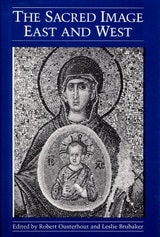
cover of The Sacred Image East and West

The Sacred Image East and West

Edited by Robert Ousterhout and Leslie Brubaker

University of Illinois Press, 1995
A new generation of American medieval art historians explores how sacred images were perceived during the Middle Ages in Byzantium and Europe. The essays cover a full range of images, including panel paintings, altarpieces, manuscripts, and wall paintings, and a rich variety of socioreligious settings, private, monastic, and imperial. Also examined are the differences between images produced for a single viewer and those produced for communities; images produced for private contemplation or devotion and those functioned within a liturgical setting; and the varying ways in which sacred images affected women and men, religious and secular communities, rulers and ruled.
 
[more]
cover of The Spectral Jew: Conversion and Embodiment in Medieval Europe

The Spectral Jew

Conversion and Embodiment in Medieval Europe

Steven F. Kruger

University of Minnesota Press, 2006

Medieval European culture encompassed Judaic, Christian, Muslim, and pagan societies, forming a complex matrix of religious belief, identity, and imagination. Through incisive readings of a broad range of medieval texts and informed by poststructuralist, queer, and feminist theories, The Spectral Jew traces the Jewish presence in Western Europe to show how the body, gender, and sexuality were at the root of the construction of medieval religious anxieties, inconsistencies, and instabilities. 

Looking closely at how medieval Jewish and Christian identities are distinguished from each other, yet intimately intertwined, Kruger demonstrates how Jews were often corporealized in ways that posited them as inferior to Christians—archaic and incapable of change—even as the two mutually shaped each other. But such attempts to differentiate Jews and Christians were inevitably haunted by the knowledge that Christianity had emerged out of Judaism and was, in its own self-understanding, a community of converts. 

Examining the points of contact between Christian and Jewish communities, Kruger discloses the profound paradox of the Jew as different in all ways, yet capable of converting to fully Christian status. He draws from central medieval authors and texts such as Peter Damian, Guibert of Nogent, the Barcelona Disputation, and the Hebrew chronicles of the First Crusade, as well as lesser known writings such as the disputations of Ceuta, Majorca, and Tortosa and the immensely popular Dialogues of Peter Alfonsi. 

By putting the conversion narrative at the center of this analysis, Kruger exposes it as a disruption of categories rather than a smooth passage and reveals the prominent role Judaism played in the medieval Christian imagination. 

Steven F. Kruger is professor of English and medieval studies at Queens College and the Graduate Center, CUNY. He is author of several books and editor with Glenn Burger of Queering the Middle Ages (Minnesota, 2001).
[more]
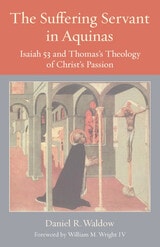
cover of The Suffering Servant in Aquinas: Isaiah 53 and Thomas's Theology of Christ's Passion

The Suffering Servant in Aquinas

Isaiah 53 and Thomas's Theology of Christ's Passion

Daniel R. Waldow

Catholic University of America Press, 2024
The “Suffering Servant” text of Isaiah 53 is a perennial topic of debate within Jewish and Christian biblical theology. Is the Suffering Servant an individual, a group, or both? How and why did he suffer? What role did God play in his suffering? How is his suffering related to human salvation? The answers to these questions often divide Jewish and Christian readers of Scripture as well as Christians across different denominations. In particular, Isaiah 53 tends to inform different Christian accounts of the origin, nature, and saving value of Christ’s Passion. The Suffering Servant in Aquinas contributes to the debate on the meaning of Isaiah 53 and its bearing upon the Passion of Christ by examining how St. Thomas Aquinas engaged this biblical text. This book examines every explicit reference to Isaiah 53 that Aquinas makes in his biblical commentaries, Commentary on the Sentences, Summa Theologiae, and Opuscula. It analyzes how and why Aquinas interprets Isaiah 53 in the ways that he does. It focuses especially upon how Aquinas draws upon Isaiah 53 to shed light on the saving mystery of Christ’s Passion. Readers will see how Aquinas articulates the relationship between God’s will and Christ’s suffering, the diverse forms of Christ’s pain, the degree to which the Passion can be considered a “punishment,” and the saving functions of the Passion as example, merit, satisfaction, and sacrifice. This book makes an original contribution to the growing field of Biblical Thomism. It examines Aquinas’s exegetical methods as well as the role of Scripture within his speculative theology. And it properly contextualizes Aquinas’s exegesis by considering the differences between his Latin version of Isaiah 53 and contemporary renderings of Hebrew and Greek versions. Readers will see that Aquinas’s Christological interpretations of Isaiah 53 are both exegetically intriguing and theologically rich.
[more]
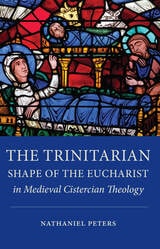
cover of The Trinitarian Shape of the Eucharist in Medieval Cistercian Theology

The Trinitarian Shape of the Eucharist in Medieval Cistercian Theology

Nathaniel Peters

Catholic University of America Press, 2026
William of Saint-Thierry, Isaac of Stella, and Baldwin of Forde created a distinctly Cistercian body of Eucharistic theology in the twelfth century. In this book, Nathaniel Peters offers a scholarly account of that theology and examines the connection between medieval Trinitarian and Eucharistic theology. These Cistercian authors thought that the character of God as a Trinity of persons united in essence provides the structure of the economy of salvation—especially its turning point, the Eucharist. They saw the Eucharist as the place where the ontological union of the Incarnation becomes intimate, personal, and communal. In the Eucharist, God the Father draws those who receive to himself by uniting them to the body and blood of the Son. This unity brings an increase of unity with the Holy Spirit. Once united to the Son and Spirit, the faithful are united to the Father. The Eucharist also connects the meditation, sacrifices, and offering of their own lives to the life of Christ, with which they are offered to the Father. Chapter 1 examines the thought of William of Saint-Thierry, who has the most developed understanding of Eucharistic presence, conversion, and reception. It also treats the connections William draws between Eucharistic reception and meditation on scripture and the passion of Christ. Chapter 2 treats Isaac of Stella, who uses more intellectualist imagery and imagery of the mystical body of Christ. Chapter 3 studies Baldwin of Forde, who argues that the term transubstantiation best describes Eucharistic conversion and emphasizes reception by faith in the truth about Christ. Chapter 5 offers a brief conclusion, with reference to later thinkers who explore the Trinitarian shape of the Eucharist in similar ways.
[more]
cover of The Trinitarian Theology of Basil of Caesarea: A Synthesis of Greek Thought and Biblical Truth

The Trinitarian Theology of Basil of Caesarea

A Synthesis of Greek Thought and Biblical Truth

Stephen M. Hildebrand

Catholic University of America Press, 2007
This book explores Basil's Trinitarian thought as the meeting place of the worlds within which he lived, that of ancient Greek culture and learning, and that of Christian faith lived in the liturgy and expressed in the Scripture.
[more]
cover of The Trinity: An Introduction to Catholic Doctrine on the Triune God

The Trinity

An Introduction to Catholic Doctrine on the Triune God

Gilles Emery

Catholic University of America Press, 2011
No description available
[more]
cover of The Trinity: On the Nature and Mystery of the One God

The Trinity

On the Nature and Mystery of the One God

Thomas Joseph White, OP

Catholic University of America Press, 2021
The Trinity is the central mystery of the Christian faith. What can we say about the divine nature, and what does it mean to say that God is Father, Son, Holy Spirit, three persons who are one in being? In this book, best selling author Thomas Joseph White, OP, examines the development of early Christian reflection on the Trinity, arguing that essential contributions of Patristic theology are preserved and expanded in the thought of Thomas Aquinas. By focusing on Aquinas’ theology of the divine nature as well as his treatment of divine personhood, White explores in depth the mystery of Trinitarian monotheism. The Trinity: On the Nature and Mystery of the One God also engages with influential proposals of modern theologians on major topics such as Trinitarian creation, Incarnation and crucifixion, and presents creative engagements with these topics. Ultimately any theology of the cross is also a theology of the Trinity, and this book seeks to illustrate how the human life, death, and resurrection of Jesus reveal the inner life of God as Trinity.
[more]
cover of Three Christological Treatises

Three Christological Treatises

Catholic University of America Press, 2014
Twenty-nine in all, these letters cover all but three of Cyril's years as a bishop. The first twelve were published in 2009 (Fathers of the Church 118). The present volume completes the set. Festal letters were used in Alexandria primarily to announce the beginning of Lent and the date of Easter. They also served a catechetical purpose, however, allowing the Patriarch an annual opportunity to write pastorally not just about issues facing the entire see, but also about the theological issues of the day. Thus, in these letters we catch a glimpse of Cyril the pastor writing about complex theology in an uncomplicated way. These letters also illuminate other realities of the ancient church in Alexandria, especially the relationship with the Jewish community and the rising influence of asceticism.
[more]
cover of To Stir a Restless Heart

To Stir a Restless Heart

Jacob W. Wood

Catholic University of America Press, 2019
To Stir a Restless Heart tells for the first time the story of how Thomas Aquinas conversed with his contemporaries about the dynamics of human nature’s longing for God, and documents how he deliberately utilized Greek, Arabic, Hebrew, and Latin sources to develop a version of Aristotelian natural desire that was uniquely Augustinian: natural desire seeks the complete fulfillment of human nature “insofar as is possible,” and so comes to rest in the highest end that God offers to it. Depending on whether God offers the free gift of grace to humanity, one and the same natural desire can come to rest in knowing God through creatures or seeing God directly.
[more]
cover of Tradition and the Rule of Faith in the Early Church

Tradition and the Rule of Faith in the Early Church

Ronnie J. Rombs

Catholic University of America Press, 2011
Tradition and the rule of faith are particularly apt themes for this collection of studies. The essays are written in honor of Joseph T. Lienhard, S.J., renowned American patristic scholar whose research and writings have focused on this particular theme.
[more]
cover of Trinitarian Ecclesiology: Charles Journet, the Divine Missions, and the Mystery of the Church

Trinitarian Ecclesiology

Charles Journet, the Divine Missions, and the Mystery of the Church

John F. O'Neill

Catholic University of America Press, 2023

Venerable Fulton Sheen once famously said that “There are not one hundred people in the United States who hate the Catholic Church, but there are millions who hate what they wrongly perceive the Catholic Church to be – which is, of course, quite a different thing.” What is the true understanding of the mystery of the Church? In Lumen Gentium, the Church famously identifies herself as the sacrament of salvation, and various attempts have been made at developing an ecclesiology rooted in this idea. Another approach, nevertheless, prominent in the opening chapter of Lumen Gentium, is the relation of the Church to the Trinity in light of the divine missions, especially those of the Incarnation and Pentecost. Trinitarian Ecclesiology is an example of this approach to the mystery of the Church that places the divine missions at the head and the heart of the work. The order of Journet's work is based on the four causes of the Church. Journet situates the treatise on the hierarchy in its proper place as belonging to the efficient cause of the Church in order to treat the more central mystery of the Church in her formal and material causes, namely the sanctifying gift of fully Christic charity and its visible manifestation. While Journet’s magisterial work may already be identified as a Trinitarian Ecclesiology, recent research into the Trinitarian theology of St. Thomas Aquinas has deepened our understanding of his teaching, particularly in the way that creatures can relate to the divine persons in the divine missions. With a clearer understanding of the relation of creatures to the divine persons rooted in grace and its effects, a deeper vision of the mystery of the Church emerges, one that sees the Church as the visible mission of the Holy Spirit, inseparably joined with the visible mission of the Son in the Incarnation. The Great Mystery of Christ and the Church is the unity of the visible missions of the Son and the Spirit who have been sent into the world for our salvation.
[more]