72 books match the query 'Honor' and 10 start with t
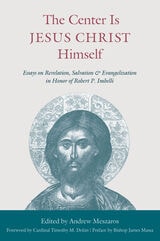
cover of The Center is Jesus Christ Himself: Essays on Revelation, Salvation, and Evangelization in Honor of Robert P. Imbelli

The Center is Jesus Christ Himself

Essays on Revelation, Salvation, and Evangelization in Honor of Robert P. Imbelli

Andrew Meszaros

Catholic University of America Press, 2021
The polarization in the Church today can be traced back to a more fundamental crisis in theology, one which has failed to connect our mundane experiences and the mysteries of the Christian faith with the person of Jesus Christ. Ecclesial discourse on the so-called ‘hot- button issues’ of the day too often take place without considering the foundation and goal of the Church. And this is unfortunately due to a similar tendency in the academic theology that informs that ecclesial discourse. In short, much of post-conciliar Catholic theology is adrift, floating aimlessly away from the center of the Christian faith, who is Christ. The Center is Jesus Christ Himself is a collection of essays which anchor theological reflection in Jesus Christ. These diverse essays share a unified focal point, but engage with a variety of theological subdisciplines (e.g., dogmatic, moral, Biblical, etc.), areas (e.g., Christology, Pneumatology, missiology, etc.), and periods (e.g., patristic, medieval, and modern). Given the different combinations of sub-disciplines, areas, and periods, theology is susceptible to fragmentation when it is not held together by some principle of unity. A theology in which the person of Jesus Christ serves as that principle of unity is a Christocentric theology. Together, the essays illustrate not only what Christocentric theology looks like, but also what the consequences are when Christ is dislodged from the center, whether by a conspicuous silence on, or by a relativization of, his unique salvific mission. The volume is published in honor of Emeritus Professor of Systematic Theology at Boston College, Rev. Dr. Robert P. Imbelli, who dedicated his teaching and writing to bringing Christ back to the center of Catholic theological discourse.
[more]
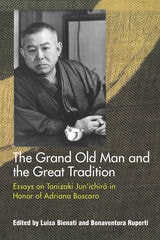
cover of The Grand Old Man and the Great Tradition: Essays on Tanizaki Jun’ichiro in Honor of Adriana Boscaro

The Grand Old Man and the Great Tradition

Essays on Tanizaki Jun’ichiro in Honor of Adriana Boscaro

Luisa Bienati and Bonaventura Ruperti, Editors

University of Michigan Press, 2009
In 1995, on the thirtieth anniversary of Tanizaki Jun’ichirō’s death, Adriana Boscaro organized an international conference in Venice that had an unusally lasting effect on the study of this major Japanese novelist. Thanks to Boscaro’s energetic commitment, Venice became a center for Tanizaki studies that produced two volumes of conference proceedings now considered foundational for all scholarly works on Tanizaki. In the years before and after the Venice Conference, Boscaro and her students published an abundance of works on Tanizaki and translations of his writings, contributing to his literary success in Italy and internationally.
The Grand Old Man and the Great Tradition honors Boscaro’s work by collecting nine essays on Tanizaki’s position in relation to the “great tradition” of Japanese classical literature. To open the collection, Edward Seidensticker contributes a provocative essay on literary styles and the task of translating Genji into a modern language. Gaye Rowley and Ibuki Kazuko also consider Tanizaki’s Genji translations, from a completely different point of view, documenting the author’s three separate translation efforts. Aileen Gatten turns to the influence of Heian narrative methods on Tanizaki’s fiction, arguing that his classicism, far from being superficial, “reflects a deep sensitivity to Heian narrative.” Tzevetana Kristeva holds a different perspective on Tanizaki’s classicism, singling out specific aspects of Tanizaki’s eroticism as the basis of comparison.
The next two essays emphasize Tanizaki’s experimental engagement with the classical literary genres—Amy V. Heinrich treats the understudied poetry, and Bonaventura Ruperti considers a 1933 essay on performance arts. Taking up cinema, Roberta Novelli focuses on the novel Manji, exploring how it was recast for the screen by Masumura Yasuzō. The volume concludes with two contributions interpreting Tanizaki’s works in the light of Western and Meiji literary traditions: Paul McCarthy considers Nabokovas a point of comparison, and Jacqueline Pigeot conducts a groundbreaking comparison with a novel by Natsume Sōseki.
[more]
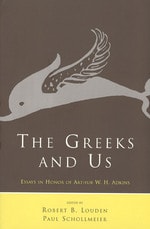
cover of The Greeks and Us: Essays in Honor of Arthur W. H. Adkins

The Greeks and Us

Essays in Honor of Arthur W. H. Adkins

Edited by Robert B. Louden and Paul Schollmeier

University of Chicago Press, 1996

Arthur W. H. Adkins's writings have sparked debates among a wide range of scholars over the nature of ancient Greek ethics and its relevance to modern times. Demonstrating the breadth of his influence, the essays in this volume reveal how leading classicists, philosophers, legal theorists, and scholars of religion have incorporated Adkins's thought into their own diverse research.

The timely subjects addressed by the contributors include the relation between literature and moral understanding, moral and nonmoral values, and the contemporary meaning of ancient Greek ethics. The volume also includes an essay from the late Adkins himself illustrating his methodology in an analysis of the "Speech of Lysias" in Plato's Phaedrus.

The Greeks and Us will interest all those concerned with how ancient moral values do or do not differ from our own.

Contributors include Arthur W. H. Adkins, Stephanie Nelson, Martha C. Nussbaum, Paul Schollmeier, James Boyd White, Bernard Williams, and Lee Yearley.

Commentaries by Wendy Doniger, Charles M. Gray, David Grene, Robert B. Louden, Richard Posner, and Candace Vogler.

[more]
cover of The Quest for Authority and Honor in the American Professions, 1750-1900

The Quest for Authority and Honor in the American Professions, 1750-1900

Samuel Haber

University of Chicago Press, 1991

With the decline in the size of our industrial work force and the rise of the service occupations, the professions today are prominent models for a singular kind of social position. The professions and "professionalism" seem to offer an escape from vexing supervision at work as well as from some of the depersonalization and uncertainty of markets and bureaucracies. In taking account of our hunger for professional status and privileges, Samuel Haber presents the first synthetic history of major professions in America. His account emphasizes the substance of each profession's work experience, told from the vantage point of the doctors, lawyers, ministers, and their emulators whose work gave them a high sense of purpose and a durable sense of community.

Contrary to those who regard the professions as exemplary and up-to-date specimens of social modernization or economic monopoly, Haber argues that they bring both preindustrial and predemocratic ideals and standards into our modern world. He proposes that the values embedded in the professions—authority and honor, fused with duty and responsibility—have their origins in the class position and occupational prescriptions of eighteenth-century English gentlemen. Such an argument has implications for the understanding of American society; it underscores the cumulative and variegated nature of our culture and suggests the drawbacks of trying to describe society as a system. It also accords with Haber's endeavor to write a history that rescues for description and analysis mixed motives, composite conditions, and persons and parties acting upon contradictory explanatory schemes.

Haber traces the cultural evolution of the professions through three stages—establishment (1750-1830), disestablishment (1830-1880), and reestablishment (1880-1900). He shows that when the gentlemanly class declined in the United States, the professions maintained status even in somewhat hostile settings. The professions thus came to be seen as a middle way between the pursuits of laborers and those of capitalists. Massive in scale and ambition, this book will have a formidable impact among scholars newly attuned to the history of American middle-class culture.
[more]
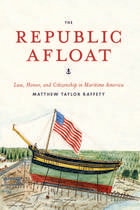
cover of The Republic Afloat: Law, Honor, and Citizenship in Maritime America

The Republic Afloat

Law, Honor, and Citizenship in Maritime America

Matthew Taylor Raffety

University of Chicago Press, 2013
In the years before the Civil War, many Americans saw the sea as a world apart, an often violent and insular culture governed by its own definitions of honor and ruled by its own authorities. The truth, however, is that legal cases that originated at sea had a tendency to come ashore and force the national government to address questions about personal honor, dignity, the rights of labor, and the meaning and privileges of citizenship, often for the first time. By examining how and why merchant seamen and their officers came into contact with the law, Matthew Taylor Raffety exposes the complex relationship between brutal crimes committed at sea and the development of a legal consciousness within both the judiciary and among seafarers in this period.


The Republic Afloat tracks how seamen conceived of themselves as individuals and how they defined their place within the United States. Of interest to historians of labor, law, maritime culture, and national identity in the early republic, Raffety’s work reveals much about the ways that merchant seamen sought to articulate the ideals of freedom and citizenship before the courts of the land—and how they helped to shape the laws of the young republic.

[more]
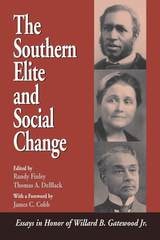
cover of The Southern Elite and Social Change: Essays in Honor of Willard B. Gatewood, Jr.

The Southern Elite and Social Change

Essays in Honor of Willard B. Gatewood, Jr.

Randy Finley

University of Arkansas Press, 2002
Elites have shaped southern life and communities, argues the distinguished historian Willard Gatewood. These essays—written by Gatewood's colleagues and former students in his honor—explore the influence of particular elites in the South from the American Revolution to the Little Rock integration crisis. They discuss not only the power of elites to shape the experiences of the ordinary people, but the tensions and negotiations between elites in a particular locale, whether those elites were white or black, urban or rural, or male or female. Subjects include the particular kinds of power available to black elites in Savannah, Georgia, during the American Revolution; the transformation of a southern secessionist into an anti-slavery activist during the Civil War; a Tenessee "aristocrat of color" active in politics from Reconstruction to World War II; middle-class Southern women, both black and white, in the New Deal and the Little Rock integration crisis; and the different brands of paternalism in Arkansas plantations during the Jacksonian and Jim Crow eras and in the postwar Georgia carpet industry.
[more]
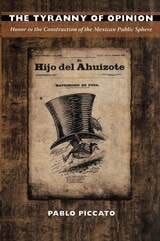
cover of The Tyranny of Opinion: Honor in the Construction of the Mexican Public Sphere

The Tyranny of Opinion

Honor in the Construction of the Mexican Public Sphere

Pablo Piccato

Duke University Press, 2010

In the mid-to-late nineteenth century, as Mexico emerged out of decades of civil war and foreign invasion, a modern notion of honor—of one’s reputation and self-worth—became the keystone in the construction of public culture. Mexicans gave great symbolic, social, and material value to honor. Only honorable men could speak in the name of the public. Honor earned these men, and a few women, support and credit, and gave civilian politicians a claim to authority after an era dominated by military heroism.

Tracing how notions of honor changed in nineteenth-century Mexico, Pablo Piccato examines legislation, journalism, parliamentary debates, criminal defamation cases, personal stories, urban protests, and the rise and decline of dueling in the 1890s. He highlights the centrality of notions of honor to debates over the nature of Mexican liberalism, describing how honor helped to define the boundaries between public and private life; balance competing claims of free speech, public opinion, and the protection of individual reputations; and motivate politicians, writers, and other men to enter public life. As Piccato explains, under the authoritarian rule of Porfirio Díaz, the state became more active in the protection of individual reputations. It implemented new restrictions on the press. This did not prevent people from all walks of life from defending their honor and reputations, whether in court or through violence. The Tyranny of Opinion is a major contribution to a new understanding of Mexican political history and the evolution of Mexican civil society.
[more]
cover of The Ways That Often Parted: Essays in Honor of Joel Marcus

The Ways That Often Parted

Essays in Honor of Joel Marcus

Lori Baron

SBL Press, 2018

Focused studies on the historical interactions and formations of Judaism and Christianity

This volume of essays, from an internationally renowned group of scholars, challenges popular ways of understanding how Judaism and Christianity came to be separate religions in antiquity. Essays in the volume reject the belief that there was one parting at an early point in time and contest the argument that there was no parting until a very late date. The resulting volume presents a complex account of the numerous ways partings occurred across the ancient Mediterranean spanning the first four centuries CE.

Features:

  • Case studies that explore how Jews and Christians engaged in interaction, conflict, and collaboration
  • Examinations of the gospels, Paul’s letters, the book of James, as well as rabbinic and noncanonical Christian texts
  • New evidence for historical reconstructions of how Christianity came on the world scene
    [more]
    cover of Truth Matters: Essays in Honor of Jacques Maritain (American Maritain Association Publications)

    Truth Matters

    Essays in Honor of Jacques Maritain (American Maritain Association Publications)

    John G. Trapani Jr.

    Catholic University of America Press, 2004

    [more]
    cover of Tulipmania: Money, Honor, and Knowledge in the Dutch Golden Age

    Tulipmania

    Money, Honor, and Knowledge in the Dutch Golden Age

    Anne Goldgar

    University of Chicago Press, 2007

    In the 1630s the Netherlands was gripped by tulipmania: a speculative fever unprecedented in scale and, as popular history would have it, folly. We all know the outline of the story—how otherwise sensible merchants, nobles, and artisans spent all they had (and much that they didn’t) on tulip bulbs. We have heard how these bulbs changed hands hundreds of times in a single day, and how some bulbs, sold and resold for thousands of guilders, never even existed. Tulipmania is seen as an example of the gullibility of crowds and the dangers of financial speculation.
               
    But it wasn’t like that. As Anne Goldgar reveals in Tulipmania, not one of these stories is true. Making use of extensive archival research, she lays waste to the legends, revealing that while the 1630s did see a speculative bubble in tulip prices, neither the height of the bubble nor its bursting were anywhere near as dramatic as we tend to think. By clearing away the accumulated myths, Goldgar is able to show us instead the far more interesting reality: the ways in which tulipmania reflected deep anxieties about the transformation of Dutch society in the Golden Age.
               
    “Goldgar tells us at the start of her excellent debunking book: ‘Most of what we have heard of [tulipmania] is not true.’. . . She tells a new story.”—Simon Kuper, Financial Times
    [more]