85 books match the query 'Humanities' and 13 start with t
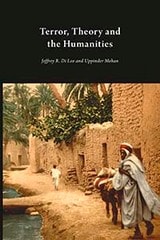
cover of Terror, Theory and the Humanities

Terror, Theory and the Humanities

Jeffrey R. Di Leo and Uppinder Mehan, editors

Michigan Publishing Services, 2012
The events of September 11, 2001, have had a strong impact on theory and the humanities. They call for a new philosophy, as the old philosophy is inadequate to account for them. They also call for reflection on theory, philosophy, and the humanities in general. While the recent location and killing of Osama bin Laden, the leader of al-Qaeda, in Pakistan on May 2, 2011—almost ten years after he and his confederates carried out the 9/11 attacks—may have ended the “war on terror,” it has not ended the journey to understand what it means to be a theorist in the age of phobos nor the effort to create a new philosophy that measures up with life in the new millennium. It is in the spirit of hope—the hope that theory will help us to understand the age of terror—that the essays in this collection are presented.
[more]
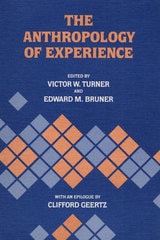
cover of The Anthropology of Experience

The Anthropology of Experience

Edited by Victor W. Turner and Edward M. Bruner

University of Illinois Press, 1986

Fourteen authors, including many of the best-known scholars in the field,
explore how people actually experience their culture and how those experiences are expressed in forms as varied as narrative, literary work, theater, carnival, ritual, reminiscence, and life review. Their studies will be
of special interest for anyone working in anthropological theory, symbolic
anthropology, and contemporary social and cultural anthropology, and useful as well for other social scientists, folklorists, literary theorists, and philosophers.
 
[more]
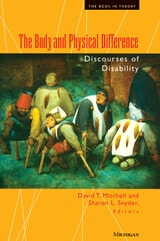
cover of The Body and Physical Difference: Discourses of Disability

The Body and Physical Difference

Discourses of Disability

David T. Mitchell and Sharon L. Snyder, Editors

University of Michigan Press, 1997

For years the subject of human disability has engaged those in the biological, social and cognitive sciences, while at the same time, it has been curiously neglected within the humanities. The Body and Physical Difference seeks to introduce the field of disability studies into the humanities by exploring the fantasies and fictions that have crystallized around conceptions of physical and cognitive difference. Based on the premise that the significance of disabilities in culture and the arts has been culturally vexed as well as historically erased, the collection probes our society's pathological investment in human variability and "aberrancy." The contributors demonstrate how definitions of disability underpin fundamental concepts such as normalcy, health, bodily integrity, individuality, citizenship, and morality--all terms that define the very essence of what it means to be human.
The book provides a provocative range of topics and perspectives: the absence of physical "otherness" in Ancient Greece, the depiction of the female invalid in Victorian literature, the production of tragic innocence in British and American telethons, the reconstruction of Civil War amputees, and disability as the aesthetic basis for definitions of expendable life within the modern eugenics movement. With this new, secure anchoring in the humanities, disability studies now emerges as a significant strain in contemporary theories of identity and social marginality.
Moving beyond the oversimplication that disabled people are marginalized and made invisible by able-ist assumptions and practices, the contributors demonstrate that representation is founded upon the perpetual exhibition of human anomalies. In this sense, all art can be said to migrate toward the "freakish" and the "grotesque." Such a project paradoxically makes disability the exception and the rule of the desire to represent that which has been traditionally out-of-bounds in polite discourse.
The Body and Physical Difference has relevance across a wide range of academic specialties such as cultural studies, the sociology of medicine, history, literature and medicine, the allied health professions, rehabilitation, aesthetics, philosophical discourses of the body, literary and film studies, and narrative theory.
David T. Mitchell is Assistant Professor of English, Northern Michigan University. Sharon L. Snyder teaches film and literature at Northern Michigan University.
[more]
cover of The Concept of the Social in Uniting the Humanities and Social Sciences

The Concept of the Social in Uniting the Humanities and Social Sciences

Michael E. Brown

Temple University Press, 2015

In this book, Michael Brown provides original and critical analysis of the state of the social sciences and the humanities. He examines the different disciplines that address human affairs--from sociology, philosophy, political science, and anthropology to the humanities in general--to understand their common ground. He probes the ways in which we investigate the meaning of individuality in a society for which individuals are not the agents of the activities in which they participate, and he develops a critical method for studying the relations among activities, objects, and situations.


The Concept of the Social in Uniting the Humanities and Social Sciences restores the centrality of sociality to all disciplines that provide for and depend on the social dimension of human life. Ultimately, he establishes a theory of the unity of the human sciences that will surely make readers rethink the current state and future of theory in those fields for years to come.
 
[more]
cover of The Future without a Past: The Humanities in a Technological Society

The Future without a Past

The Humanities in a Technological Society

John Paul Russo

University of Missouri Press, 2005
In The Future without a Past, John Paul Russo goes beyond currently given reasons for the decline of the humanities and searches out its root causes in the technologization of everyday life. His main premise is that we are undergoing a transformation at the hands of technological imperatives such as rationalization, universalism, monism, and autonomy. The relation between ourselves and nature has altered to such a degree that we no longer live in a natural environment but in a technological one. According to Russo, technological values have actually eroded human values instead of being “humanized” by them.
            What are the implications of this shift for the humanities, traditionally seen as safeguards of the human? Russo addresses this question by situating the decline of the humanities within the larger social and historical panorama. He explores how technological values have infiltrated the humanities to the point of weakening their instruction and undermining their force; at the same time, he shows how the humanities have confronted these trends and can continue to do so. Russo believes that if we understand how technology “works” and the nature of its powers, we will then know in which realms it must be accepted and where it should be resisted.
            Russo outlines the components of the technological system and examines their impact on the educational system. He also discusses the loss of historical memory, including the so-called loss of the self and the transformation of the library. He studies the parallels between technological and literary values in criticism and theory, concluding with an analysis of the fiction of Don DeLillo, one of the most prominent contemporary novelists. DeLillo’s exploration of technology in American life, matched by a powerful critique of it from a broadly humanistic and religious perspective, serves to summarize the themes of the book as a whole.    
            The Future without a Past will appeal to scholars and students of literary studies, intellectual and cultural history, philosophy, ethics, media studies, and American studies, as well as to general readers who are seeking deeper insights into today’s cultural debates.
[more]
cover of The Humanities and the Dream of America

The Humanities and the Dream of America

Geoffrey Galt Harpham

University of Chicago Press, 2011

In this bracing and original book, Geoffrey Galt Harpham argues that today’s humanities are an invention of the American academy in the years following World War II, when they were first conceived as an expression of American culture and an instrument of American national interests. The humanities portray a “dream of America” in two senses: they represent an aspiration of Americans since the first days of the Republic for a state so secure and prosperous that people could enjoy and appreciate culture for its own sake; and they embody in academic terms an idealized conception of the American national character.  Although they are struggling to retain their status in America, the concept of the humanities has spread to other parts of the world and remains one of America's most distinctive and valuable contributions to higher education.


The Humanities and the Dream of America explores a number of linked problems that have emerged in recent years: the role, at once inspiring and disturbing, played by philology in the formation of the humanities; the reasons for the humanities’ perpetual state of “crisis”; the shaping role of philanthropy in the humanities; and the new possibilities for literary study offered by the subject of pleasure. Framed by essays that draw on Harpham’s pedagogical experiences abroad and as a lecturer at the U.S. Air Force Academy, as well as his vantage as director of the National Humanities Center, this book provides an essential perspective on the history, ideology, and future of this important topic.

[more]
cover of The Humanities in Precollegiate Education

The Humanities in Precollegiate Education

Edited by Benjamin Ladner

University of Chicago Press, 1984
[more]
cover of The Humanities in the Age of Information and Post-Truth

The Humanities in the Age of Information and Post-Truth

Edited by Ignacio López-Calvo and Christina Lux

Northwestern University Press, 2019

The essays in The Humanities in the Age of Information and Post-Truth represent a defense of the social function of the humanities in today's society. Edited by Ignacio López-Calvo and Christina Lux, the volume explains different ways in which the humanities and the arts, beyond their intrinsic and nonfunctional value, may be a valuable tool in our search for social justice, human empathy, freedom, and peace, all the while helping us answer many of the twenty-first century's big questions. Some essays explore the ways in which the humanities may help us imagine a different, more just world, and articulate politically effective mechanisms to achieve such goals. Others address the place of the humanities and the arts amid the ontological and epistemological uncertainties constantly produced in a fast-changing world. 

While the reader may suspect that these types of lucubration are a desperate reaction to decreased public funding for the humanities worldwide, a decreased enrollment of students, or anxiety over the future of our profession, there is in this volume a coherent argument for the continued need, perhaps more now than ever, to invest in humanities education if we are to have informed and socially conscious citizens rather than just willing consumers and obedient workers. Furthermore, the essays prove that the humanities and the arts are, after all, not a luxury but an integral part of a complete scholarly education.
 
[more]
cover of The Humanities in the Age of Technology

The Humanities in the Age of Technology

Ciriaco Morón Arroyo

Catholic University of America Press, 2002
Students of the humanities confront two fundamental questions: How valid and rigorous is the type of knowledge attained in these disciplines? And what good is it? In The Humanities in the Age of Technology, Ciriaco Morón Arroyo offers a systematic inquiry into these questions and outlines the ongoing crisis of the humanities.
[more]
cover of The Laws of Cool: Knowledge Work and the Culture of Information

The Laws of Cool

Knowledge Work and the Culture of Information

Alan Liu

University of Chicago Press, 2004
Knowledge work is now the reigning business paradigm and affects even the world of higher education. But what perspective can the knowledge of the humanities and arts contribute to a world of knowledge work whose primary mission is business? And what is the role of information technology as both the servant of the knowledge economy and the medium of a new technological cool? In The Laws of Cool, Alan Liu reflects on these questions as he considers the emergence of new information technologies and their profound influence on the forms and practices of knowledge.
[more]
cover of The Politics of Research

The Politics of Research

Edited by E. Ann Kaplan and George Levine

Rutgers University Press, 1997
"Eloquent, provocative, and timely, these essays provide a thoughtful, undoctrinaire defense of the centrality of the humanities to higher education--and society--at the millennium."--Cora Kaplan, University of Southampton The crisis in the humanities and higher education intensifies daily. The partisan din drowns out the voices of those thinkers who have resisted the seductions of strong ideology. Against the tendencies of the extreme attacks on higher education from the right and the counterattacks from the left, many academics would prefer to get beyond critical fashions and easy slogans. In this collection, leading scholars demonstrate how the current furor threatens the critical analysis of culture, so vital to a healthy society. They explore the historical sources of the crisis, the relations between politics and research, the responsibilities and possibilities of the academic intellectual, the structure of the institution of the university, the functions and achievements of the humanities, and the development of interdisciplinarity as a catalyst for change. This volume is a necessary resource for understanding the current crisis and for transforming the academy as we approach the twenty-first century. The contributors are Jonathan Arac, Lauren Berlant, Peter Brooks, Roman de la Campa, Myra Jehlen, Stanley Katz, Richard Kramer, Dominick LaCapra, George Levine, Ellen Messer-Davidow, Helene Moglen, Bill Readings, and Bruce Robbins. E. Ann Kaplan is the director of The Humanities Institute at the State University of New York at Stony Brook
[more]
cover of The Reimagined PhD: Navigating 21st Century Humanities Education

The Reimagined PhD

Navigating 21st Century Humanities Education

Leanne M Horinko

Rutgers University Press, 2021
Long seen as proving grounds for professors, PhD programs have begun to shed this singular sense of mission. Prompted by poor placement numbers and guided by the efforts of academic organizations, administrators and faculty are beginning to feel called to equip students for a range of careers. Yet, graduate students, faculty, and administrators often feel ill-prepared for this pivot. The Reimagined PhD assembles an array of professionals to address this difficult issue. The contributors show that students, faculty, and administrators must collaborate in order to prepare the 21st century PhD for a wide range of careers. The volume also undercuts the insidious notion that career preparation is a zero sum game in which time spent preparing for alternate careers detracts from professorial training. In doing so, The Reimagined PhD normalizes the multiple career paths open to PhD students, while providing practical advice geared to help students, faculty, and administrators incorporate professional skills into graduate training, build career networks, and prepare PhDs for a variety of careers.
 
[more]
cover of The Superhumanities: Historical Precedents, Moral Objections, New Realities

The Superhumanities

Historical Precedents, Moral Objections, New Realities

Jeffrey J. Kripal

University of Chicago Press, 2022

A bold challenge to rethink the humanities as intimately connected to the superhuman and to “decolonize reality itself.”

What would happen if we reimagined the humanities as the superhumanities? If we acknowledged and celebrated the undercurrent of the fantastic within our humanistic disciplines, entirely new cultural worlds and meanings would become possible. That is Jeffrey J. Kripal’s vision for the future—to revive the suppressed dimension of the superhumanities, which consists of rare but real altered states of knowledge that have driven the creative processes of many of our most revered authors, artists, and activists. In Kripal’s telling, the history of the humanities is filled with precognitive dreams, evolving superhumans, and doubled selves. The basic idea of the superhuman, for Kripal, is at the core of who and what the human species has tried to become over millennia and around the planet.
 
After diagnosing the basic malaise of the humanities—that the truth must be depressing—Kripal shows how it can all be done differently. He argues that we have to decolonize reality itself if we are going to take human diversity seriously. Toward this pluralist end, he engages psychoanalytic, Black critical, feminist, postcolonial, queer, and ecocritical theory. He works through objections to the superhumanities while also recognizing the new realities represented by the contemporary sciences. In doing so, he tries to move beyond naysaying practices of critique toward a future that can embrace those critiques within a more holistic view—a view that recognizes the human being as both a social-political animal as well as an evolved cosmic species that understands and experiences itself as something super.
[more]