Results by title
403 books match the query 'Journalism' and 101 start with t
Tangled Bylines
A Father and Son Cover the Twentieth CenturyClyde H. Farnsworth
University of Missouri Press, 2017
Telling Time
Clocks, Diaries, and English Diurnal Form, 1660-1785Stuart Sherman
University of Chicago Press, 1997
Through brilliant readings of Samuel Pepys's diary, Joseph Addison and Richard Steele's daily Spectator, the travel writings of Samuel Johnson and James Boswell, and the novels of Daniel Defoe and Frances Burney, Sherman traces the development of a new way of counting time in prose—the diurnal structure of consecutively dated installments—within the cultural context of the daily institutions which gave it form and motion. Telling Time is not only a major accomplishment for seventeenth- and eighteenth-century literary studies, but it also makes important contributions to current discourse in cultural studies.
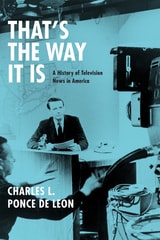
That's the Way It Is
A History of Television News in AmericaCharles L. Ponce de Leon
University of Chicago Press, 2015
The critics may be right. But, as Charles L. Ponce de Leon explains in That’s the Way It Is, TV news has always walked a fine line between hard news and fluff. The familiar story of decline fails to acknowledge real changes in the media and Americans’ news-consuming habits, while also harking back to a golden age that, on closer examination, is revealed to be not so golden after all. Ponce de Leon traces the entire history of televised news, from the household names of the late 1940s and early ’50s, like Eric Sevareid, Edward R. Murrow, and Walter Cronkite, through the rise of cable, the political power of Fox News, and the satirical punch of Colbert and Stewart. He shows us an industry forever in transition, where newsmagazines and celebrity profiles vie with political news and serious investigations. The need for ratings success—and the lighter, human interest stories that can help bring it—Ponce de Leon makes clear, has always sat uneasily alongside a real desire to report hard news.
Highlighting the contradictions and paradoxes at the heart of TV news, and telling a story rich in familiar figures and fascinating anecdotes, That’s the Way It Is will be the definitive account of how television has showed us our history as it happens.

The AEF in Print
An Anthology of American Journalism in World War IChris Dubbs
University of North Texas Press, 2018
The Advice King Anthology
Chris Crofton
Vanderbilt University Press, 2022
If you are looking for traditional advice, this might not be the book for you. But if you care to find the incendiary, subversive, and hilarious alongside actual thoughts about addiction, depression, gentrification, politics, poetry, music, economic policy, living in New Nashville, and (inevitably) romance, the Advice King has much to offer.
The Advice King Anthology
Chris Crofton
Vanderbilt University Press, 2022
The American Newsroom
A History, 1920-1960Will Mari
University of Missouri Press, 2023
The American Revolution and the Press
The Promise of IndependenceCarol Sue Humphrey
Northwestern University Press, 2013
Carol Sue Humphrey’s The American Revolution and the Pressargues that newspapers played an important role during America’s struggle for independence by keeping Americans engaged in the war even when the fighting occurred in distant locales. From the moment that the colonials received word of Britain’s new taxes in 1764 until reports of the peace treaty arrived in 1783, the press constituted the major source of information about events and developments in the conflict with the mother country. Both Benjamin Franklin, one of the Revolution’s greatest leaders, and Ambrose Serle, a Loyalist, described the press as an “engine” that should be used to advance the cause. The efforts of Patriot printers to keep readers informed about the war helped ensure ultimate success by boosting morale and rallying Americans to the cause until victory was achieved. As Humphrey illustrates, Revolutionary-era newspapers provided the political and ideological unity that helped Americans secure their independence and create a new nation.
The Arbiters of Reality
Hawthorne, Melville, and the Rise of Mass Information CulturePeter West
The Ohio State University Press, 2008
Locating Hawthorne and Melville in vivid and overlooked contexts—the Salem Murder scandal of 1830, which transformed Hawthorne's quiet city into a media-manufactured spectacle, and Melville's New York City of 1846–47, where the American Telegraph was powerfully articulating a nation at war—West portrays the romance as a reactive, deeply rhetorical literary form and a rich historical artifact.
In the early twenty-first century, it has become a postmodern cliché to place the word “reality” in scare quotes. The Arbiters of Reality suggests that attending to the construction of the real in public life is more than simply a language of critique: it must also be understood as a specific kind of romantic self-invention.
The Best American Newspaper Narratives of 2012
George Getschow
University of North Texas Press, 2014
The Best American Newspaper Narratives, Volume 10
Gayle Reaves
University of North Texas Press, 2023
The Best American Newspaper Narratives, Volume 2
George Getschow
University of North Texas Press, 2015
The Best American Newspaper Narratives, Volume 3
Gayle Reaves
University of North Texas Press, 2016
The Best American Newspaper Narratives, Volume 4
Gayle Reaves
University of North Texas Press, 2017
The Best American Newspaper Narratives, Volume 5
Gayle Reaves
University of North Texas Press, 2018
The Best American Newspaper Narratives, Volume 6
Gayle Reaves
University of North Texas Press, 2019
The Best American Newspaper Narratives, Volume 7
Gayle Reaves
University of North Texas Press, 2020
The Best Science Stories and How They Work
A Collection with CommentaryEdited by Siri Carpenter
University of Chicago Press, 2026
An invitation to engage with some of today’s most respected science journalists as they take readers beneath the surface to reveal the making of eleven of the best science stories.
With eleven deeply reported, artfully crafted stories and annotations by some of the most thoughtful and respected science journalists working today, The Best Science Stories and How They Work is more than the sum of its impressive parts. Experience the pleasure of reading a “Best of” anthology, attending a science writing masterclass, and meeting journalists who become more than their familiar bylines. Each piece benefits from an introduction, annotations, and a conversation between the piece’s author and annotator.
Siri Carpenter—editor of this book and cofounder of The Open Notebook, a leading source of training and educational materials for journalists who cover science—has long considered what’s behind the best writing. The pieces in this guide are drawn from a range of publications such as Scientific American, Nature, The Atlantic, and The New York Times Magazine and offer a unique perspective on how great science journalism happens: the careful structuring of a narrative, the delicate balance of skepticism and wonder, the ethical challenges of working with sources, the artistry of prose that sings. Readers will not only encounter outstanding examples of stellar storytelling, but they will also understand how these successful stories were reported and written, revealing the choices fundamental to good science journalism. Following each annotation, a Q&A with the original author provides an intimate look at the decisions and challenges that shaped their work.
Taken together, these pieces and annotations reveal the detailed, technical narrative work required to tell science stories. The book will delight, inspire, and equip readers with new tools to appreciate the stories that matter most.
Contributors: Jordana Cepelewicz, Shraddha Chakradhar, Nadia Drake, Ben Goldfarb, Sabrina Imbler, Ferris Jabr, Emily Laber-Warren, Stephanie M. Lee, Dana Mackenzie, Amy Maxmen, Emiliano Rodríguez Mega, Kendra Pierre-Louis, Debbie Ponchner, Sandeep Ravindran, Mary Roach, Paola Rosa-Aquino, Ashley Smart, Jessica Seigel, Ramin Skibba, Kamala Thiagarajan, Bijal Trivedi, and Ed Yong
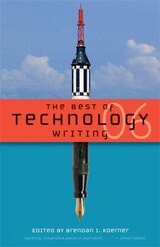
The Best of Technology Writing 2006
Brendan I. Koerner, Editor
University of Michigan Press, 2006
—James Fallows, National Correspondent for Atlantic Monthly
“The human experience is being shaped by our symbiotic relationship to technology. What makes this collection wonderful is that it’s not about the technology, per se, but it’s about this changing human experience. I will look forward to it every year.”
—Po Bronson, author of What Should I Do With My Life?
The Best of Technology Writing 2006 brings together some of the most important, timely, and just plain readable writing in the fast-paced, high-stakes field of technology. The first annual collection to target this vibrant and versatile area, The Best of Technology Writing 2006 features innovative work from an unusually diverse array of writers: best-selling authors, noted academics, and indie journalists and bloggers. The culmination of an open, on-line nominating process, this collection covers topics ranging from jetpacks, to the ethics of genetically cloned pets, to the meaning of life in the information age. By turns epic and intimate, serious and playful, The Best of Technology Writing 2006 captures the vitality, importance, and complexity of technology today. Koerner
Featuring contributions from:
digitalculturebooks is an imprint of the University of Michigan Press and the Scholarly Publishing Office of the University of Michigan Library dedicated to publishing innovative and accessible work exploring new media and their impact on society, culture, and scholarly communication. Visit the website at www.digitalculture.org.
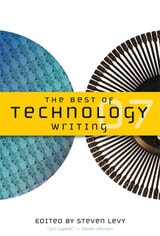
The Best of Technology Writing 2007
Steven Levy, Editor
University of Michigan Press, 2007
The year’s best writing on tech: a collection as imaginative and compelling as its dynamic subject
“This book is not just an illuminating and instructive guide to our high-tech frontier. It’s also a great testimony to the power of that most ancient of technologies, the written word.”
—Steven Johnson, author of Everything Bad is Good for You
Together the essays in The Best of Technology Writing 2007 capture the versatility and verve of technology writing today. Solicited through an open online nominating process, these pieces explore a wide range of intriguing topics—from “crowdsourcing” to the online habits of urban moms to the digital future of movie production. The Best of Technology Writing 2007 will appeal to anyone who enjoys stellar writing.
Steven Levy is a Senior Editor at Newsweek, where he writes the biweekly column “The Technologist.” One of the most acclaimed and versatile technology writers in the country, Levy has written six books, including The Perfect Thing (about Apple’s iPod) and Hackers, which PC Magazine’s readers voted the best sci-tech book written in the last twenty years. He has written for many publications, including the New Yorker, the New York Times Magazine, Rolling Stone, and Wired.
Featuring contributions from
Kevin Berger
Paul Boutin
Kiera Butler
Joshua Davis
Julian Dibbell
Matt Gaffney
Lori Gottlieb
John Gruber
Jeff Howe
Kevin Kelly
Jaron Lanier
Preston Lerner
Farhad Manjoo
Justin McElroy
Ben McGrath
Katharine Mieszkowski
Emily Nussbaum
Jeffrey M. O’Brien
Larry O’Brien
The Onion
Adam L. Penenberg
John Seabrook
Philip Smith
Aaron Swartz
Clive Thompson
Jeffrey R. Young
digitalculturebooks is an imprint of the University of Michigan Press and the Scholarly Publishing Office of the University of Michigan Library dedicated to publishing innovative and accessible work exploring new media and their impact on society, culture, and scholarly communication. Visit the website at www.digitalculture.org.
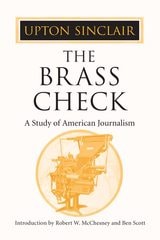
The Brass Check
A STUDY OF AMERICAN JOURNALISMUpton Sinclair
University of Illinois Press, 2002
Fueled by mounting disdain for newspapers run by business tycoons and conservative editors, Sinclair self-published The Brass Check in the years after The Jungle had made him a household name. Despite Sinclair’s claim that this was his most important book, it was dismissed by critics and shunned by reviewers. Yet it sold over 150,000 copies and enjoyed numerous printings.
A substantial introduction to this paperback edition by Robert W. McChesney and Ben Scott asserts the book’s importance as a cornerstone critique of commercial journalism and a priceless resource for understanding the political turbulence of the Progressive Era.
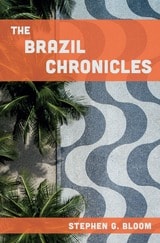
The Brazil Chronicles
Stephen G. Bloom
University of Missouri Press, 2024
As a young journalist at the Brazil Herald from 1979-81, Stephen G. Bloom spent his early professional years working in Rio’s seedy Lapa district, surrounded by fugitives, drug runners, pornographers, and stealth CIA agents. Bloom shares the wild story of this English-language newspaper in The Brazil Chronicles. The expat newspaper was a breeding ground for a different kind of storyteller — audacious risk-takers who told madcap tales of Amazon plantations, Confederate emigres, and lost Indian tribes. Several renown journalists cut their teeth at the Brazil Herald, including acclaimed New York Times correspondent Tad Szulc, Huffington Post CEO Eric Hippeau, and an untamed Gonzo reporter by the name of Hunter S. Thompson.
Drawing from extensive archival research and more than 150 interviews with his former colleagues, Bloom’s eye-opening narrative dive is both entertaining and academically rigorous. With a backdrop of coups, nonstop political instability, censorship, hyper-inflation, and weekends at sultry Ipanema Beach, The Brazil Chronicles doubles as a coming-of-age memoir, following young Bloom as he embarks on his quest to become a foreign correspondent, relocating to a foreign country to pursue under-the-radar stories and tall tales. His firsthand experience provides an insider, eye-witness account of the newspaper’s colorful history, transporting the reader to its sweltering newsroom and delving into the multifarious lives of its eclectic, trailblazing, polyglot staff.
Even as Bloom weaves between personal narrative, history, and accounts from journalism luminaries, it’s clear who the book’s main character is: the one-of-a-kind newspaper itself.
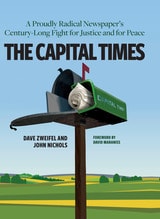
The Capital Times
A Proudly Radical Newspaper’s Century Long Fight for Justice and for PeaceJohn Nichols
Wisconsin Historical Society Press, 2017
As Madison’s Capital Times marks its 100th anniversary in 2017, editors Dave Zweifel and John Nichols recall the remarkable history of a newspaper that served as the tribune of Robert M. La Follette and the progressive movement, earned the praise of Franklin Delano Roosevelt for its stalwart opposition to fascism, battled Joe McCarthy during the "Red Scare," championed civil rights, women’s rights, and LGBTQ rights, opposed the Vietnam War and the invasion of Iraq, and stood with Russ Feingold when he cast the only US Senate vote against the Patriot Act. The Capital Times did not do this from New York or Washington but from the middle of America, with a readership of farmers, factory workers, teachers, and shopkeepers who stood by The Cap Times when the newspaper was boycotted, investigated, and attacked for its determination.
At a point when journalism is under assault, when newspapers struggle to survive, and "old media" struggles to find its way in a digital age, The Capital Times remains unbowed—still living up to the description Lord Francis Williams, the British newspaper editor, wrote 50 years ago: "The vast majority of American papers are as dull as weed-covered ditch-water; vast Saharas of cheap advertising with occasional oases of editorial matter written to bring happiness to the Chamber of Commerce and pain and irritation to none; the bland leading the bland.… Just here and there are a few relics of the old fighting muckraking tradition of American journalism, like The Capital Times of Madison."
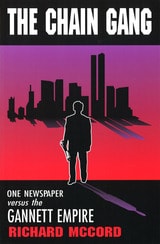
The Chain Gang
One Newspaper versus the Gannett EmpireRichard McCord
University of Missouri Press, 2001
"They're closing in on me, Dick, and I'm afraid they're going to get me," said Frank Wood, publisher of the Green Bay News-Chronicle, in a phone call to his friend and colleague, Richard McCord. Drained of cash and spirit, Wood could not hold out much longer against a devouring giant, the Gannett Company. As editor and publisher of the nationally distinguished weekly Santa Fe Reporter, McCord had successfully fended off Gannett's "Operation Demolition" when it moved into town. Now Wood was seeking the help of a survivor.
Startling case histories of the dubious tactics practiced by Gannett, unsparing insights into the newspaper industry, and harsh conclusions all come together in the dramatic story of these two men's efforts to save the small Green Bay daily from being obliterated at the hands of the nation's largest newspaper chain. Their success is a metaphor for one of the oldest triumphs of the world: that of David over Goliath.
"McCord has done something marvelous with this. He's taken a deeply disturbing nationwide trend and put it on a small midwestern stage with real characters. The Chain Gang's message needs to be heard by as many Americans as read newspapers. Already Gannett's monopoly tactics have impoverished communities across the country. McCord is one man fighting back, coolly, rationally, creatively, and stubbornly. Let's join him."—Michael Shnayerson, Contributing Editor, Vanity Fair
"More graphically than almost any other available record of the era, the Gannett piracy is what has happened to this country, tolled where the price is truly paid, in the lives of communities and people."—Roger Morris, winner of the Investigative Reporters and Editors' National Award for Distinguished Investigative Journalism
"Richard McCord's The Chain Gang takes the losing battle for the soul of American newspapers from the euphoric accounts on financial pages to show what corporate news chains can mean in human terms to the people and the vitality of the victimized cities and towns. His is a unique account of the power and depredations of the Gannett Chain under its glib empire builder, Allen Neuharth. It goes behind the facade of slick public relations and financial killings for investors to show what happens when a ruthless and ambitious wheeler-dealer gets control of our news."—Ben H. Bagdikian, media critic and Pulitzer Prize winner
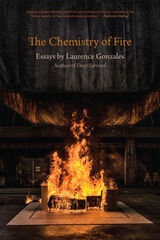
The Chemistry of Fire
EssaysLaurence Gonzales
University of Arkansas Press, 2020
—Publishers Weekly starred review, July 2020
In 1989, Laurence Gonzales was a young writer with his first book of essays, The Still Point, just published by the University of Arkansas Press. Imagine his surprise, one winter day, to receive a letter from none other than Kurt Vonnegut. “The excellence of your writing and the depth of your reporting saddened me, in a way,” Vonnegut wrote, “reminding me yet again what a tiny voice facts and reason have in this era of wrap-around, mega-decibel rock-and-roll.”
Several books, many articles, and a growing list of awards later, Gonzales -- known for taking us to enthralling extremes – is still writing with excellence and depth. In this latest collection, we go from the top of Mount Washington and ”the worst weather in the world,” to 12,000 feet beneath the ocean, where a Naval Intelligence Officer discovers the Titanic using the government’s own spy equipment. We experience night assaults with the 82nd Airborne Division, the dynamiting of the 100-foot snowpack on Going-to-the-Sun Road in Glacier National Park, a trip to the International Space Station, the crash of an airliner to the bottom of the Everglades, and more.
The University of Arkansas Press is proud to bring these stories to a new era, stories that, as with all of Gonzales’s work, “fairly sing with a voice all their own.” (Chicago Sun-Times)
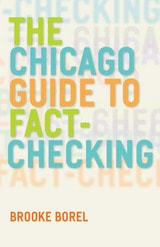
The Chicago Guide to Fact-Checking
Brooke Borel
University of Chicago Press, 2016
Corrections such as this one from the Miami Herald have become a familiar sight for readers, especially as news cycles demand faster and faster publication. While some factual errors can be humorous, they nonetheless erode the credibility of the writer and the organization. And the pressure for accuracy and accountability is increasing at the same time as in-house resources for fact-checking are dwindling. Anyone who needs or wants to learn how to verify names, numbers, quotations, and facts is largely on their own.
Enter The Chicago Guide to Fact-Checking, an accessible, one-stop guide to the why, what, and how of contemporary fact-checking. Brooke Borel, an experienced fact-checker, draws on the expertise of more than 200 writers, editors, and fellow checkers representing the New Yorker, Popular Science, This American Life, Vogue, and many other outlets. She covers best practices for fact-checking in a variety of media—from magazine articles, both print and online, to books and documentaries—and from the perspective of both in-house and freelance checkers. She also offers advice on navigating relationships with writers, editors, and sources; considers the realities of fact-checking on a budget and checking one’s own work; and reflects on the place of fact-checking in today’s media landscape.
“If journalism is a cornerstone of democracy, then fact-checking is its building inspector,” Borel writes. The Chicago Guide to Fact-Checking is the practical—and thoroughly vetted—guide that writers, editors, and publishers need to maintain their credibility and solidify their readers’ trust.
The Chicago Guide to Fact-Checking, Second Edition
Brooke Borel
University of Chicago Press, 2023
- Recognize what information to fact-check
- Identify the quality and ranking of source materials
- Learn to fact-check a variety of media types: newspaper; magazine; social media; public and commercial radio and television, books, films, etc.
- Navigate relationships with editors, writers, and producers
- Recognize plagiarism and fabrication
- Discern conflicting facts, gray areas, and litigious materials
- Learn record keeping best practices for tracking sources
- Test your own fact-checking skills
Over the past few years, fact-checking has been widely touted as a corrective to the spread of misinformation, disinformation, conspiracy theories, and propaganda through the media. “If journalism is a cornerstone of democracy,” says author Brooke Borel, “then fact-checking is its building inspector.”
In The Chicago Guide to Fact-Checking, Borel, an experienced fact-checker, draws on the expertise of more than 200 writers, editors, and fellow checkers representing the New Yorker, Popular Science, This American Life, Vogue, and many other outlets. She covers best practices for editorial fact-checking in a variety of media—from magazine and news articles, both print and online, to books and podcasts—and the perspectives of both in-house and freelance checkers.
In this second edition, Borel covers the evolving media landscape, with new guidance on checking audio and video sources, polling data, and sensitive subjects such as trauma and abuse. The sections on working with writers, editors, and producers have been expanded, and new material includes fresh exercises and advice on getting fact-checking gigs. Borel also addresses the challenges of fact-checking in a world where social media, artificial intelligence, and the metaverse may make it increasingly difficult for everyone—including fact-checkers—to identify false information. The answer, she says, is for everyone to approach information with skepticism—to learn to think like a fact-checker.
The Chicago Guide to Fact-Checking is the practical—and thoroughly vetted—guide that writers, editors, and publishers continue to consult to maintain their credibility and solidify their readers’ trust.
The Chicagoan
A Lost Magazine of the Jazz AgeNeil Harris
University of Chicago Press, 2008
The Coming of the Frontier Press
How the West Was Really WonBarbara Cloud
Northwestern University Press, 2008
From the first story about the discovery of gold in California in 1848 to features on today’s western boomtowns, western expansion and journalism have had a symbiotic relationship. By examining this relationship along its entire timeline, this book argues that newspapers played a crucial role in pushing aside both wildlife and Native Americans to make room for the settlers who would become their readers. The western news sheets not only shaped reader attitudes but also undertook innovations in content and appearance that would affect newspapers nationwide.
The Commercialization of News in the Nineteenth Century
Gerald J. Baldasty
University of Wisconsin Press, 1992
The Commercialization of News in the Nineteenth Century traces the major transformation of newspapers from a politically based press to a commercially based press in the nineteenth century. Gerald J. Baldasty argues that broad changes in American society, the national economy, and the newspaper industry brought about this dramatic shift.
Increasingly in the nineteenth century, news became a commodity valued more for its profitablility than for its role in informing or persuading the public on political issues. Newspapers started out as highly partisan adjuncts of political parties. As advertisers replaced political parties as the chief financial support of the press, they influenced newspapers in directing their content toward consumers, especially women. The results were recipes, fiction, contests, and features on everything from sports to fashion alongside more standard news about politics.
Baldasty makes use of nineteenth-century materials—newspapers from throughout the era, manuscript letters from journalists and politicians, journalism and advertising trade publications, government reports—to document the changing role of the press during the period. He identifies three important phases: the partisan newspapers of the Jacksonian era (1825-1835), the transition of the press in the middle of the century, and the influence of commercialization of the news in the last two decades of the century.
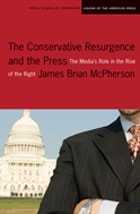
The Conservative Resurgence and the Press
The Media's Role in the Rise of the RightJames Brian McPherson
Northwestern University Press, 2008
Consumers of American media find themselves in a news world that has shifted toward more conservative reporting. This book takes a measured, historical view of the shift, addressing factors that include the greater skill with which conservatives have used the media, the media’s gradual trend toward conservatism, the role of religion, and the effects of media conglomeration. The book makes the case that the media have managed to not only enable today’s conservative resurgence but also ignore, largely, the consequences of that change for the American people.
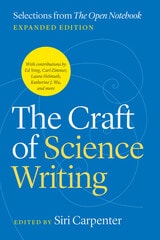
The Craft of Science Writing
Selections from “The Open Notebook,” Expanded EditionEdited by Siri Carpenter
University of Chicago Press, 2024
Science writing has never been so critical to our world, and the demands on writers have never been greater. On any given day, a writer might need to explain the details of AI, analyze developments in climate change research, or serve as a watchdog helping to ensure the integrity of the scientific enterprise. At the same time, writers must spin tales that hook and keep readers, despite the endless other demands on their attention. How does one do it? The Craft of Science Writing is the authoritative guide.
With pieces curated from the archives of science writers’ go-to online resource, The Open Notebook, this book explores strategies for finding and shaping story ideas, pitching editors, and building a specialty in science writing. It delves into fundamental skills that every science writer must learn, including planning their reporting; identifying, interviewing, and quoting sources; organizing interview notes; and crafting stories that engage and inform audiences. This expanded edition includes new introductory material and nine new essays focusing on such topics as how to establish a science beat, how to find and use quotes, how to critically evaluate scientific claims, how to use social media for reporting, and how to do data-driven reporting. In addition, there are essays on inclusivity in science writing, offering strategies for eradicating ableist language from stories, working with sensitivity readers, and breaking into English-language media for speakers of other languages.
Through interviews with leading journalists offering behind-the-scenes inspiration as well as in-depth essays on the craft offering practical advice, readers will learn how the best science stories get made, from conception to completion.
Contributors:
Humberto Basilio, Siri Carpenter, Jeanne Erdmann, Dan Ferber, Tina Casagrand Foss, Geoffrey Giller, Laura Helmuth, Jane C. Hu, Alla Katsnelson, Roxanne Khamsi, Betsy Ladyzhets, Jyoti Madhusoodanan, Amanda Mascarelli, Robin Meadows, Kate Morgan, Tiên Nguyễn, Michelle Nijhuis, Aneri Pattani, Rodrigo Pérez Ortega, Mallory Pickett, Kendall Powell, Tasneem Raja, Sandeep Ravindran, Marion Renault, Julia Rosen, Megha Satyanarayana, Christina Selby, Knvul Sheikh, Abdullahi Tsanni, Alexandra Witze, Katherine J. Wu, Wudan Yan, Ed Yong, Rachel Zamzow, Sarah Zhang, and Carl Zimmer
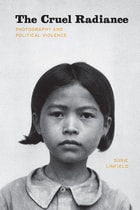
The Cruel Radiance
Photography and Political ViolenceSusie Linfield
University of Chicago Press, 2010
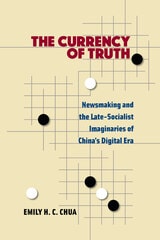
The Currency of Truth
Newsmaking and the Late-Socialist Imaginaries of China's Digital EraEmily H. C. Chua
University of Michigan Press, 2023
In The Currency of Truth, Emily H. C. Chua argues that news in China works less as a medium of mass communication than as a kind of currency as industry players make and use news articles to create agreements, build connections, and protect and advance their positions against one another. Looking at the ethical and professional principles that well-intentioned and civically minded journalists strive to uphold, and the challenges and doubts that they grapple with in the process, Chua brings her findings into conversation around “post-truth” news and the “crisis” of professional journalism in the West. The book encourages readers to rethink contemporary news, arguing that rather than setting out from the assumption that news works either to inform or deceive its publics, we should explore the “post-public” social and political imaginaries emerging among today’s newsmakers and remaking the terms of their practice.
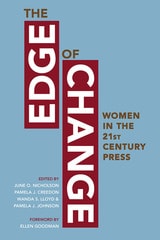
The Edge of Change
Women in the Twenty-First-Century PressEdited by June O. Nicholson, Pamela J. Creedon, Wanda S. Lloyd, and Pamela J. Jo: Foreword by Ellen Goodman
University of Illinois Press, 2008
Prominent female voices in journalism provide critical perspectives on the challenges women face in today's news organizations, such as connecting with diverse audiences, educating readers about international issues and cultures, maintaining credibility, negotiating media consolidation and corporate pressures, and overcoming the persistent barriers to professional advancement. A powerful and complex assessment of how women are transforming the news industry, The Edge of Change explores how the news industry might implement further reforms aimed at creating a more inclusive journalistic community.
Contributors are Catalina Camia, Kathleen Carroll, Pamela J. Creedon, Paula Lynn Ellis, Helen E. Fisher, Dorothy Butler Gilliam, Ellen Goodman, Sharon Grigsby, Carol Guzy, Kirsten Scharnberg Hampton, Cathy Henkel, Pamela J. Johnson, Jane Kirtley, Jan Leach, Caroline Little, Wanda S. Lloyd, Arlene Notoro Morgan, June O. Nicholson, Geneva Overholser, Marty Petty, Deb Price, Donna M. Reed, Sandra Mims Rowe, Peggy Simpson, Margaret Sullivan, Julia Wallace, and Keven Ann Willey.
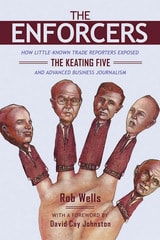
The Enforcers
How Little-Known Trade Reporters Exposed the Keating Five and Advanced Business JournalismRob Wells with a foreword by David Cay Johnston
University of Illinois Press, 2019

The Environmental Beat
Inside the Struggle to Legitimize the Environment as NewsSuzannah Evans Comfort
University of Missouri Press, 2026
Environmental degradation has been part of American life for centuries, and yet environmental journalism as a specialized reporting beat has only existed since the 1960s. In the ensuing decades, the environment has fallen in and out of favor as a priority for news organizations. Moreover, journalists who pursue environmental stories have long been dogged by a reputation that they are activists, a charge that delegitimizes their labor and further undermines the potential for news organizations to commit to reporting on environmental issues.
In The Environmental Beat: Inside the Struggle to Legitimize the Environment as News, Suzannah Evans Comfort examines the circumstances under which news organizations chose to invest in environmental journalism since the early 20th century, demonstrating that a combination of external social factors and internal newsroom dynamics must occur for the environment to appear as a newsworthy topic. Comfort also examines actors on the margins of journalistic legitimacy, such as newspaper outdoor columnists who wrote on the sports pages, and environmental advocacy presses that provided a far more consistent source of environmental news making than their peers in the newsroom. These low-status actors in the journalistic field embraced advocacy and rejected both-siderism in their reporting on issues of the environment. Their consistency and longevity, even as more traditionally produced news attention waxed and waned, may provide an explanation for the perception of environmental news making as fundamentally activist.
The Environmental Beat will be of interest to working journalists as well as scholars of journalism.
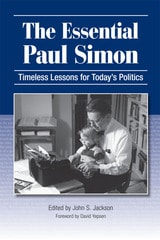
The Essential Paul Simon
Timeless Lessons for Today's PoliticsEdited by John S. Jackson. Foreword by David Yepsen
Southern Illinois University Press, 2012
While Simon covered a broad spectrum of topics in his written works, his mission throughout the years remained the same: to urge his constituents to study and understand issues that affected their daily lives and to make the complexities of politics accessible to the average citizen. An indispensable volume for voters and politicians alike, The Essential Paul Simon compiles some of the most thought-provoking writings from one of the keenest political minds in our nation’s history. Years after their publication, Simon’s eloquent and energetic conversations continue to provide witty, informative guidance through the maze of American politics and inspire the development of spirited public discussion and debate.
Certificate of Excellence from the Illinois State Historical Society, 2013
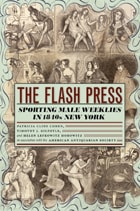
The Flash Press
Sporting Male Weeklies in 1840s New YorkPatricia Cline Cohen, Timothy J. Gilfoyle, Helen Lefkowitz Horowitz, in association with the American Antiquarian Society
University of Chicago Press, 2008

The Great Reporters
David Randall
Pluto Press, 2005
This unique book is the first to try and answer this question. Author David Randall searched nearly two centuries of newspapers and magazines, consulted editors and journalism experts worldwide, and the result is The Great Reporters---13 in-depth profiles of the best journalists who ever lived. They include nine Americans and four Britons, ten men and three women, whose lives were full of adventure, wit, and the considerable ingenuity required to bring the story home. Among chapters are those on the reporter who:
Booked himself onto a ship likely to be sunk by the Germans so he could report its torpedoing Was called out to a multiple shooting, who interviewed 50 witnesses, went back to the office, and wrote a Pulitzer Prize-winning story of 4,000 words in two and a half hours Was deemed useless by her teacher but who went on to become the greatest crime reporter in history Wrote a story that changed the map of Europe Out-bluffed a top Soviet official to get into Russia so he could cover the appalling famine there Feigned madness to get herself locked up in an asylum so she could expose its terrible conditions Was the best ever to apply words to newsprint Became a national hero in America because he stood up for the little guy and his war reporting told it like it really was At the age of 63, and after three major operations, went under-cover in Iran so she could report on the regime's repression Was nearly fired for fouling up his first major assignment, but went on to shock his nation with his courageous war reporting Wrote faster than anyone who could write better and better than anyone who could write faster Single-handedly took on the tobacco industry Said no to William Randolph Hearst
Each profile tells of the reporter's life and his or her major stories, how they were obtained, and their impact. Packed with anecdotes, and inspiring accounts of difficulties overcome, the book quotes extensively from each reporter's work. It also includes an essay on the history of reporting, charting the technologies, economics, and attitudes that made it the way it is---from the invention of the telegraph to the Internet. The Great Reporters is not just the story of 13 remarkable people, it is the story of how society's information hunter-gatherers succeed in bringing us all what we need to know.
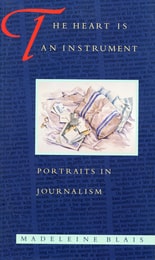
The Heart Is an Instrument
Portraits in JournalismMadeleine Blais
University of Massachusetts Press, 1992
From the Foreword by Geneva Overholser
What is it about really fine writers, how they delight, intrigue, compel us?
Style, you say. But style is not something you begin with. Rather, it's what you end up with, a result of far more fundamental traits. Traits such as an ear and an eye and a heart, traits that Madeleine Blais has honed superbly well.
This is a book well named: The Heart Is an Instrument: Portraits in Journalism. The heart is surely first among Blais's gifts. Whether she is writing about the famous—playwright Tennessee Williams, novelist Mary Gordon—or about the least elevated among us—a teenage prostitute infected with the AIDS virus, a homeless schizophrenic—she brings to her subjects an incomparable empathy.
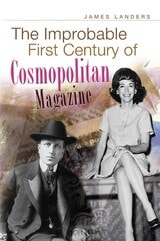
The Improbable First Century of Cosmopolitan Magazine
James Landers
University of Missouri Press, 2010
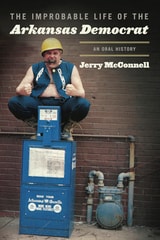
The Improbable Life of the Arkansas Democrat
An Oral HistoryJerry McConnell
University of Arkansas Press, 2016
The Improbable Life of the Arkansas Democrat is based on more than one hundred interviews with employees of the Democrat, including editors, reporters, feature writers, cartoonists, circulation managers, business managers, salespeople, typesetters and others, from the 1930s through the early 1990s, when the Democrat took over the more prominent Arkansas Gazette after an aggressive newspaper war.
This new addition to Arkansas journalism history provides vivid details about what it was like to work at the Democrat. August Engel, who led the paper with focused devotion for forty-two years, was famous for his thrift, creating austere conditions that included no air conditioning in the newsroom and sub-par wages. In spite of these drawbacks, the paper was still home to many dedicated journalism professionals endeavoring to do good work.
Readers who remember the ultimate acrimony between the two papers may be surprised to learn that for many years the Democrat and the Gazette owners operated under a tacit agreement of civility. The papers didn’t raid each other’s staff, for example, and when a fire broke out in the Gazette pressroom, Democrat management offered to loan the use of its press. Staffers recall that when the Gazette struggled with an advertising boycott and reduced circulation during the Little Rock Central High crisis because of its perceived progressive editorial stance, which infuriated many Arkansans, the Democrat did less than it might have to capitalize. The eventual newspaper war that combined the two rivals saw the end of any semblance of civility when the Democrat hired an aggressive and infamous managing editor named John Robert Starr.
Through these firsthand stories of those who lived it, The Improbable Life of the Arkansas Democrat tells the story of how the second-place paper overtook the oldest newspaper west of the Mississippi, forever changing not only Arkansas journalism but also Arkansas history.
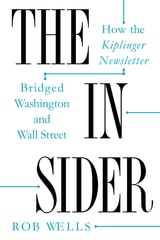
The Insider
How the Kiplinger Newsletter Bridged Washington and Wall StreetRob Wells
University of Massachusetts Press, 2022
When Willard M. Kiplinger launched the groundbreaking Kiplinger Washington Letter in 1923, he left the sidelines of traditional journalism to strike out on his own. With a specialized knowledge of finance and close connections to top Washington officials, Kiplinger was uniquely positioned to tell deeper truths about the intersections between government and business. With careful reporting and insider access, he delivered perceptive analysis and forecasts of business, economic, and political news to busy business executives, and the newsletter’s readership grew exponentially over the coming decades.
More than just a pioneering business journalist, Kiplinger emerged as a quiet but powerful link between the worlds of Presidents Hoover and Roosevelt, and used his Letter to play a little-known but influential role in the New Deal. Part journalism history, part biography, and part democratic chronicle, The Insider offers a well-written and deeply researched portrayal of how Kiplinger not only developed a widely read newsletter that launched a business publishing empire but also how he forged a new role for the journalist as political actor.
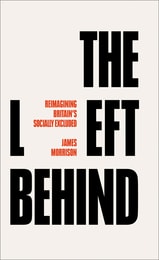
The Left Behind
Reimagining Britain's Socially ExcludedJames
Pluto Press, 2022
Examines the ways in which the 'Left Behind' have been used to symbolize and foment social divisions in contemporary Britain.
'The Left Behind' is a defining motif of contemporary British political discourse. It is the thread that knits together the 2016 Brexit referendum, the crumbling of the fabled 'Red Wall' in the North, and the pernicious culture war being waged today. But who are the Left Behind?
James Morrison goes in search of the reality behind the rhetoric, offering the first comprehensive, historical analysis of the origins, uses and meanings of the term. He interrogates the popular archetype of the Left Behind - as a working-class, Leave-voting white male from a former industrial heartland - and situates the concept in the context of longstanding, demonizing discourses aimed at communities seen as backward and 'undeserving'.
Analyzing national newspaper coverage and parliamentary discussions, and drawing on interviews with MPs, community leaders, charities, and people with direct lived experiences of poverty and precarity, The Left Behind grapples with the real human cost of austerity for neglected post-industrial communities and other marginalized groups across the world, and the stigmatizing discourse that does little to serve them.
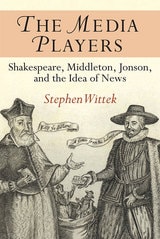
The Media Players
Shakespeare, Middleton, Jonson, and the Idea of NewsStephen Wittek
University of Michigan Press, 2015
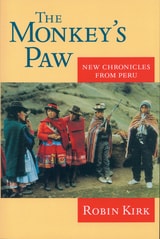
The Monkey's Paw
New Chronicles from PeruRobin Kirk
University of Massachusetts Press, 1997
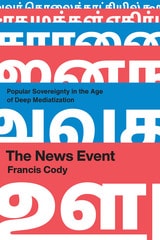
The News Event
Popular Sovereignty in the Age of Deep MediatizationFrancis Cody
University of Chicago Press, 2023
Not merely the act of representing events with words or images, a “news event” is the reciprocal relationship between the events being reported in the news and the event of the news coverage itself. In The News Event, Francis Cody focuses on how imaginaries of popular sovereignty have been remade through the production and experience of such events. Political sovereignty is thoroughly mediated by the production of news, and subjects invested in the idea of democracy are remarkably reflexive about the role of publicly circulating images and texts in the very constitution of their subjectivity. The law comes to stand as both a limit and positive condition in this process of event making, where acts of legal and extralegal repression of publication can also become the stuff of news about news makers. When the subjects of news inhabit multiple participant roles in the unfolding of public events, when the very technologies of recording and circulating events themselves become news, the act of representing a political event becomes difficult to disentangle from that of participating in it. This, Cody argues, is the crisis of contemporary news making: the news can no longer claim exteriority to the world on which it reports.
The News Untold
Community Journalism and the Failure to Confront Poverty in AppalachiaMichael Clay Carey
West Virginia University Press, 2017
Weatherford Award winner, nonfiction
The News Untold offers an important new perspective on media narratives about poverty in Appalachia. It focuses on how small-town reporters and editors in some of the region’s poorest communities decide what aspects of poverty are news, how their audiences interpret those decisions, and how those two related processes help shape broader understandings of economic need and local social responsibility. Focusing on patterns of both media creation and consumption, The News Untold shows how a lack of constructive news coverage of economic need can make it harder for the poor to voice their concerns.
Critical and inclusive news coverage of poverty at the local level, Michael Clay Carey writes, can help communities start to look past old stereotypes and attitudes and encourage solutions that incorporate broader sets of community voices. Such an effort will require journalists and community leaders to reexamine some of the professional traditions and social views that often shape what news looks like in small towns.
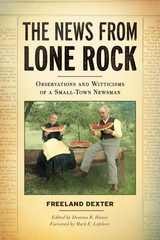
The News from Lone Rock
Observations and Witticisms of a Small-Town NewsmanFreeland Dexter
Wisconsin Historical Society Press, 2016
At the turn of the twentieth century, the bustling railroad town of Lone Rock, Wisconsin, was home to about a thousand residents, and Freeland Dexter seemed to know the business of every single one. Dexter reported all the news from Lone Rock—from the significant to the trivial, the tragic to the comical—for the Weekly Home News of neighboring Spring Green from 1884 to 1912.
This collection of Dexter’s most fascinating, amusing, and poignant stories and observations brings back to life the colorful characters of his time and takes readers on a journey to a world that was both simpler and changing fast. Whether he was reporting who grew the biggest watermelon, teasing the local lovebirds, or taking a side on the ever-controversial question of whether the town should go dry, Dexter wrote with a distinctive wit and an obvious affection for his town and its people. The News from Lone Rock also provides an illuminating window into a time period of rapid technological progress, showing how the introduction of electric light, telephones, and cars changed lives and connected this quaint village more and more to the outside world.