Results by title
128 books match the query 'Language and languages' and 26 start with t
Talking Heads
Language, Metalanguage, and the Semiotics of SubjectivityBenjamin Lee
Duke University Press, 1997
Talking Heads synthesizes the views and works of a breathtaking range of the most influential modern theorists of the humanities and social sciences, including Austin, Searle, Derrida, Jakobson, Bakhtin, Wittgenstein, Peirce, Frege, Kripke, Donnellan, Putnam, Saussure, and Whorf. After illuminating these many strands of thought, Lee moves beyond disciplinary biases and re-embeds within the context of the public sphere the questions of subjectivity and language raised by these theorists. In his examination of how subjectivity relates not just to grammatical patterns but also to the specific social institutions in which these patterns develop and are sustained, Lee discusses such topics as the concept of public opinion and the emergence of Western nation-states.
The Chican@ Hip Hop Nation
Politics of a New Millennial MestizajePancho McFarland
Michigan State University Press, 2013
The Clan of the Flapdragon and Other Adventures in Etymology by B. M. W. Schrapnel, Ph.D.
Richard McKee
University of Alabama Press, 1997
This potpourri of satire on language use in Western culture will trigger chuckles and guffaws from an eclectic readership
In The Clan of the Flapdragon and Other Adventures in Etymology by B. M. W. Schrapnel, Ph.D., the pseudonymous critic satirizes a variety of subjects in and out of academe. These adventurous essays include lampoons on writing, language, and literature, and the collection is a delightful spoof of much in contemporary culture—especially areas of intellectual pretension. Readers will be entertained by anachronistic allusions, improbable parodies, whimsical etymologies, tongue-in-cheek word play, and stunning purple prose—examples of just some of the liberties Schrapnel takes with the language.
Dr. Schrapnel includes a wide array of audience reactions in the form of bogus letters from fictional readers, confirming that language and literature are everyone’s business. He also offers an annual list of words that writers and speakers should use more often—a lexicographer’s equivalent to the endangered species list—and coins terms such as prufrockery and grendelish.
The Company of Words
Hegel, Language, and Systematic PhilosophyJohn McCumber
Northwestern University Press, 1993
The Converting Imagination
Linguistic Theory and Swift's Satiric ProseMarilyn Francus
Southern Illinois University Press, 1994
By illuminating Jonathan Swift’s fascination with language, Marilyn Francus shows how the linguistic questions posed by his work are at the forefront of twentieth-century literary criticism: What constitutes meaning in language? How do people respond to language? Who has (or should have) authority over language? Is linguistic value synonymous with literary value?
Francus starts with a detailed analysis of Swift’s linguistic education, which straddled a radical transition in linguistic thought, and its effect on his prose. This compelling beginning includes sometimes surprising historical information about the teaching and learning of linguistics and language theory in the seventeenth and eighteenth centuries. Swift’s academic studies reflected the traditional universalist view that seeks an Adamic language to reverse the fragmentation of Babel and achieve epistemological unity. But Swift’s tutor also exposed him to the contemporary linguistics of the scientific societies and of John Locke, who argued that the assignment of linguistic meaning is arbitrary and subjective, capturing an individual’s understanding at a particular instant. These competing theories, Francus maintains, help explain the Irish writer’s conflicting inclinations toward both linguistic order and freewheeling creativity.
To develop a complete vision of Swiftian linguistics, Francus focuses on A Tale of a Tub as the archetypal linguistic text in the Swift canon, but she also includes evidence from his other famous works, including Gulliver’s Travels, A Modest Proposal, Journal to Stella, and The Bickerstaff Papers, as well as from his lesser known religious and political tracts and his correspondence. In addition, Francus draws on the relevant work of contemporary linguists (such as Wilkins, Watts, Dyche, and Stackhouse), philosophers (Hobbes and Locke), and authors (including Temple, Sprat, Dryden, Pope, Addison, and Defoe).
Francus concludes that Swift occupies a pivotal place in literary history: his conscious emphasis on textuality and extended linguistic play anticipates not only the future of satiric prose but the modern novel as well.
The Grammar Answer Key
Short Explanations to 100 ESL QuestionsKeith S. Folse
University of Michigan Press, 2018
The 100 questions are organized into 12 chapters on topics that teachers and students can relate to well: adjectives, articles, clauses, connectors, gerunds and infinitives, prepositions, pronouns, pronunciation, subject-verb agreement, suffixes, verbs, and vocabulary-grammar connections. The number of questions in each chapter ranges from 3 to 13 and is based on the questions submitted. Each chapter begins with a short overview of the topic that features key terminology and a chart explaining three common ESL errors.
Each question is presented in a box and is followed by an "answer" that can inform instruction, often in chart format. Examples of questions are:
- How do you know if a word is an adjective?
- Can I say the Monday or the January?
- Do you say on July or in July?
- I received an email from someone that said “Greetings from my wife and I.” Is this right? Why?
- How do I know which way to pronounce the -ed at the end of a word?
- Which verb tenses are the most common in English? Which ones should I study?
- Why do you say turn on the light instead of turn the light?
- In my language, we have one word for make and do. In English, when should I use make and when should I use do?
The book is the ideal teacher resource and professional development tool.
The Great Eskimo Vocabulary Hoax and Other Irreverent Essays on the Study of Language
Geoffrey K. Pullum
University of Chicago Press, 1991
Geoffrey K. Pullum's writings began as columns in Natural Language and Linguistic Theory in 1983. For six years, in almost every issue, under the banner "TOPIC. . .COMMENT," he published a captivating mélange of commentary, criticism, satire, whimsy, and fiction. Those columns are reproduced here—almost exactly as his friends and colleagues originally warned him not to publish them—along with new material including a foreword by James D. McCawley, a prologue, and a new introduction to each of these clever pieces. Whether making a sneak attack on some sacred cow, delivering a tongue-in-cheek protest against current standards, or supplying a caustic review of some recent development, Pullum remains in touch with serious concerns about language and society. At the same time, he reminds the reader not to take linguistics too seriously all of the time.
Pullum will take you on an excursion into the wild and untamed fringes of linguistics. Among the unusual encounters in store are a conversation between Star Trek's Commander Spock and three real earth linguists, the strange tale of the author's imprisonment for embezzling funds from the Campaign for Typographical Freedom, a harrowing account of a day in the research life of four unhappy grammarians, and the true story of how a monograph on syntax was suppressed because the examples were judged to be libelous. You will also find a volley of humorous broadsides aimed at dishonest attributional practices, meddlesome copy editors, mathematical incompetence, and "cracker-barrel philosophy of science." These learned and witty pieces will delight anyone who is fascinated by the quirks of language and linguists.
The Language Parallax
Linguistic Relativism and Poetic IndeterminacyBy Paul Friedrich
University of Texas Press, 1986
Humankind has always been fascinated and troubled by the way languages and dialects differ. Linguistically based differences in point of view have preoccupied many original minds of the past, such as Kant, and remain at the forefront of language study: in philosophy, anthropology, literary criticism, and other fields.
Paul Friedrich's The Language Parallax argues persuasively that the "locus and focus" of differences among languages lies not so much in practical or rational aspects as in the complexity and richness of more poetic dimensions—in the nuances of words, or the style and voice of an author. This poetic reformulation of what has been called "linguistic relativism" is grounded in the author's theory of the imagination as a main source of poetic indeterminacy. The reformulation is also based on the intimate relation of the concentrated language of poetry to the potential or possibilities for poetry in ordinary conversation, dreams, and other experiences. The author presents challenging thoughts on the order and system of language in their dynamic relation to indeterminacy and, ultimately, disorder and chaos.
Drawing on his considerable fieldwork in anthropology and linguistics, Friedrich interweaves distinct and provocative elements: the poetry of language difference, the indeterminacy in dialects and poetic forms, the discovery of underlying orders, the workings of different languages, the strength of his own poetry. The result is an innovative and organic whole.
The Language Parallax, then, is a highly original work with a single bold thesis. It draws on research and writing that has involved, in particular, English, Russian, and the Tarascan language of Mexico, as well as the personal and literary study of the respective cultures. Anthropologist, linguist, and poet, Friedrich synthesizes from his experience in order to interrelate language variation and structure, the creative individual, ideas of system-in-process, and questions of scientific and aesthetic truth. The result is a new view of language held to the light of its potentially creative nature.
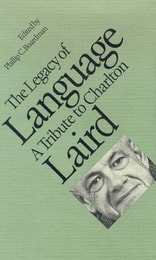
The Legacy Of Language
A Tribute To Charlton LairdPhillip C. Boardman
University of Nevada Press, 1987
In this tribute to Charlton Laird, ten scholars in the fields of language and linguistics provide ordinary readers with new insight into the workings of the English language. Laird, one of Nevada's treasured authors, was a professor of English at the University of Nevada, Reno.
The Linguistic Dimension of Kant's Thought
Historical and Critical EssaysEdited by Frank Schalow and Richard Velkley
Northwestern University Press, 2014
Among modern philosophers, Immanuel Kant (1724–1804) has few rivals for his influence over the development of contemporary philosophy as a whole. While the issue of language has become a key fulcrum of continental philosophy since the twentieth century, Kant has been overlooked as a thinker whose breadth of insight has helped to spearhead this advance.
The Linguistic Dimension of Kant’s Thought remedies this historical gap by gathering new essays by distinguished Kant scholars. The chapters examine the many ways that Kant’s philosophy addresses the nature of language. Although language as a formal structure of thought and expression has always been part of the philosophical tradition, the “linguistic dimension” of these essays speaks to language more broadly as a practice including communication, exchange, and dialogue.
The Linguistic Turn
Essays in Philosophical MethodEdited by Richard M. Rorty
University of Chicago Press, 1992
"All too rarely an anthology is put together that reflects imagination, command, and comprehensiveness. Rorty's collection is just such a book."—Review of Metaphysics
The Natural World as a Philosophical Problem
Jan Patocka, edited by Ivan Chvatík and Lubica Ucnik, translated by Erika Abrams, foreword by Ludwig Landgrebe
Northwestern University Press, 2016
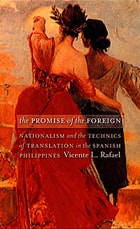
The Promise of the Foreign
Nationalism and the Technics of Translation in the Spanish PhilippinesVicente L. Rafael
Duke University Press, 2005
Through close readings of nationalist newspapers and novels, the vernacular theater, and accounts of the 1896 anticolonial revolution, Rafael traces the deep ambivalence with which elite nationalists and lower-class Filipinos alike regarded Castilian. The widespread belief in the potency of Castilian meant that colonial subjects came in contact with a recurring foreignness within their own language and society. Rafael shows how they sought to tap into this uncanny power, seeing in it both the promise of nationhood and a menace to its realization. Tracing the genesis of this promise and the ramifications of its betrayal, Rafael sheds light on the paradox of nationhood arising from the possibilities and risks of translation. By repeatedly opening borders to the arrival of something other and new, translation compels the nation to host foreign presences to which it invariably finds itself held hostage. While this condition is perhaps common to other nations, Rafael shows how its unfolding in the Philippine colony would come to be claimed by Filipinos, as would the names of the dead and their ghostly emanations.
The Prose of the World
Maurice Merleau-Ponty
Northwestern University Press, 1973
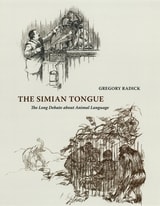
The Simian Tongue
The Long Debate about Animal LanguageGregory Radick
University of Chicago Press, 2007
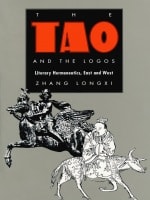
The Tao and the Logos
Literary Hermeneutics, East and WestLongxi Zhang
Duke University Press, 1992
Zhang's book brings together philosophy and literature, theory and practical criticism, the Western and the non-Western in defining common ground on which East and West may come to a mutual understanding. He provides commentary on the rich traditions of poetry and poetics in ancient China; equally illuminating are Zhang's astute analyses of Western poets such as Rilke, Shakespeare, and Mallarmé and his critical engagement with the work of Foucault, Derrida, and de Man, among others.
Wide-ranging and learned, this definitive work in East-West comparative poetics and the hermeneutic tradition will be of interest to specialists in comparative literature, philosophy, literary theory, poetry and poetics, and Chinese literature and history.
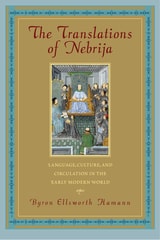
The Translations of Nebrija
Language, Culture, and Circulation in the Early Modern WorldByron Ellsworth Hamann
University of Massachusetts Press, 2015
Tracing the global influence of Nebrija's dictionary, Byron Ellsworth Hamann, in this interdisciplinary, deeply researched book, connects pagan Rome, Muslim Spain, Aztec Tenochtitlan, Elizabethan England, the Spanish Philippines, and beyond, revealing new connections in world history. The Translations of Nebrija re-creates the travels of people, books, and ideas throughout the early modern world and reveals the adaptability of Nebrija's text, tracing the ways heirs and pirate printers altered the dictionary in the decades after its first publication. It reveals how entries in various editions were expanded to accommodate new concepts, such as for indigenous languages in the Americas—a process with profound implications for understanding pre-Hispanic art, architecture, and writing. It shows how words written in the margins of surviving dictionaries from the Americas shed light on the writing and researching of dictionaries across the early modern world.
Exploring words and the dictionaries that made sense of them, this book charts new global connections and challenges many assumptions about the early modern world.
The Truth about Language
What It Is and Where It Came FromMichael C. Corballis
University of Chicago Press, 2017
But as Michael C. Corballis shows in The Truth about Language, it’s time to reconsider those assumptions. Language, he argues, is not the product of some “big bang” 60,000 years ago, but rather the result of a typically slow process of evolution with roots in elements of grammatical language found much farther back in our evolutionary history. Language, Corballis explains, evolved as a way to share thoughts—and, crucially for human development, to connect our own “mental time travel,” our imagining of events and people that are not right in front of us, to that of other people. We share that ability with other animals, but it was the development of language that made it powerful: it led to our ability to imagine other perspectives, to imagine ourselves in the minds of others, a development that, by easing social interaction, proved to be an extraordinary evolutionary advantage.
Even as his thesis challenges such giants as Chomsky and Stephen Jay Gould, Corballis writes accessibly and wittily, filling his account with unforgettable anecdotes and fascinating historical examples. The result is a book that’s perfect both for deep engagement and as brilliant fodder for that lightest of all forms of language, cocktail party chatter.
The Use of Language
Prashant Parikh
CSLI, 2001

The Women and Language Debate
A SourcebookEdited by Camille Roman, Suzanne Juhasz, and Cristanne Miller
Rutgers University Press, 1993
Things, Thoughts, Words, and Actions
The Problem of Language in Late Eighteenth-Century British Rhetorical TheoryH. Lewis Ulman
Southern Illinois University Press, 1994
H. Lewis Ulman here examines the roles of language theory in eighteenth-century British rhetorics, linking those roles to philosophical issues informing twentieth-century rhetorical theory. In doing so, Ulman develops a general model of the "problem of language" for rhetorical theory, a model that transcends the impasse between realism and skepticism that marks both eighteenth- and twentieth-century rhetorical theory.
The nature of language was never more central to rhetorical theory than in the second half of the eighteenth century. Yet, until now, the articulation of theories of language and the arts of rhetoric in eighteenth-century Britain has received little attention. Ulman examines the role of grammar and theories of language in the formation of eighteenth-century rhetorical theory, investigating the significance of language theory for such key concerns of eighteenth-century rhetoric as verbal criticism, style, and elocution. His study highlights what he understands as the central motive of late eighteenth-century British rhetoricians—to construct for their particular cultural context philosophically rigorous accounts of verbal communication based on carefully articulated theories of thought and language.
Toward this end, Ulman examines three eighteenth-century British rhetorical treatises: George Campbell’s Philosophy of Rhetoric, Hugh Blair’s Lectures on Rhetoric and Belles Lettres, and Thomas Sheridan’s Course of Lectures on Elocution. He then identifies the continuities and discontinuities between the problem of language for eighteenth- and twentieth-century rhetorical theory and proposes a pluralistic stance toward the problem of language in rhetoric as an alternative to the theoretical standoff that currently characterizes the debate between realist and antirealist rhetorics.
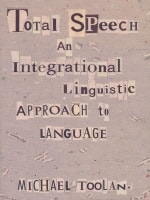
Total Speech
An Integrational Linguistic Approach to LanguageMichael Toolan
Duke University Press, 1996
In every foundational area of linguistics—from literal meaning and metaphor to the nature of repetition to the status of linguistic rules—Toolan advances fascinating and provocative criticisms of received linguistic assumptions. Drawing inspiration from the writings of language theorist Roy Harris, Toolan brings the integrationalist perspective to bear on legal cases, the reception of Salman Rushdie, poetry, and the language of children. Toolan demonstrates that the embeddedness of language and the situation-sensitive mutability of meaning reveal language as a tool for re-fashioning and renewal.
Total Speech breaks free of standard linguistics’ fascinated attraction with “cognitive blueprints” and quasi-algorithmic processing to characterize language anew. Toolan’s reflections on the essence of language, including his important discussion of intention, have strong implications for students and scholars of discourse analysis, literature, the law, anthropology, philosophy of language, communication theory, and cognitive science, as well as linguistics.
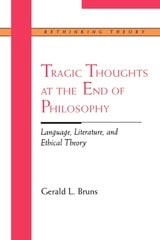
Tragic Thoughts at the End of Philosophy
Language, Literature, and Ethical TheoryGerald L. Bruns
Northwestern University Press, 1999
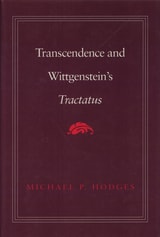
Transcendence and Wittgenstein's Tractatus
Michael P. Hodges
Temple University Press, 1990
Although Wittgenstein claimed that his first book, the Tractatus Logico-Philosophicus, was essentially an ethical work, it has been viewed insistently as a purely logical one. His later work, Philosophical Investigations, is generally seen as presenting totally different ideas from his earlier writings. In this book, Michael Hodges shows how Wittgenstein’s later work emerged from his earlier Tractatus, and he unifies the early philosophy, both its well-known logical aspects and the lesser known ethical dimensions, in terms of the notion of transcendence.
Hodges studies the Tractatus in light of Wittgenstein’s own claim that the Philosophical Investigations can only be understood when read against the background of the Tractatus. At the heart of an understanding of the earlier work is the idea of transcendence which structures both Wittgenstein’s logical and ethical insights. Seen in terms of this notion, the rigorous unity of Wittgenstein’s early thinking becomes apparent and the gestalt shift to the later philosophy comes clearly into focus.

Transcendental Wordplay
America’s Romantic Punsters and the Search for the Language of NatureMichael West
Ohio University Press, 2000
Throughout the first half of the nineteenth century, America was captivated by a muddled notion of “etymology.” New England Transcendentalism was only one outcropping of a nationwide movement in which schoolmasters across small-town America taught students the roots of words in ways that dramatized religious issues and sparked wordplay.
Shaped by this ferment, our major romantic authors shared the sensibility that Friedrich Schlegel linked to punning and christened “romantic irony.” Notable punsters or etymologists all, they gleefully set up as sages, creating jocular masterpieces from their zest for oracular wordplay. Their search for a primal language lurking beneath all natural languages provided them with something like a secret language that encodes their meanings. To fathom their essentially comic masterpieces we must decipher it.
Interpreting Thoreau as an ironic moralist, satirist, and social critic rather than a nature-loving mystic, Transcendental Wordplay suggests that the major American Romantics shared a surprising conservatism. In this award-winning study, Professor West rescues the pun from critical contempt and allows readers to enjoy it as a serious form of American humor.
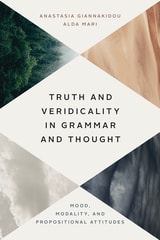
Truth and Veridicality in Grammar and Thought
Mood, Modality, and Propositional AttitudesAnastasia Giannakidou and Alda Mari
University of Chicago Press, 2021
Can language directly access what is true, or is the truth judgment affected by the subjective, perhaps even solipsistic, constructs of reality built by the speakers of that language? The construction of such subjective representations is known as veridicality, and in this book Anastasia Giannakidou and Alda Mari deftly address the interaction between truth and veridicality in the grammatical phenomena of mood choice: the indicative and subjunctive choice in the complements of modal expressions and propositional attitude verbs.
Combining several strands of analysis—formal linguistic semantics, syntactic theory, modal logic, and philosophy of language—Giannakidou and Mari’s theory not only enriches the analysis of linguistic modality, but also offers a unified perspective of modals and propositional attitudes. Their synthesis covers mood, modality, and attitude verbs in Greek and Romance languages, while also offering broader applications for languages lacking systematic mood distinction, such as English. Truth and Veridicality in Grammar and Thought promises to shape longstanding conversations in formal semantics, pragmatics, and philosophy of language, among other areas of linguistics.