Results by title
1993 books match the query 'Latin America' and 392 start with t
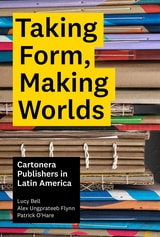
Taking Form, Making Worlds
Cartonera Publishers in Latin AmericaLucy Bell, Alex Ungprateeb Flynn, Patrick O’Hare
University of Texas Press, 2022
2023 LASA Visual Culture Studies Section Book Prize, Latin American Studies Association (LASA)
The first comprehensive study of cartonera, a vibrant publishing phenomenon born in Latin America.
A publishing phenomenon and artistic project, cartonera was born in the wake of Argentina’s 2001 economic crisis. Infused with a rebellious spirit, it has exploded in popularity, with hundreds of publishers across Latin America and Europe making colorful, low-cost books out of cardboard salvaged from the street. Taking Form, Making Worlds is the first comprehensive study of cartonera. Drawing on interdisciplinary research conducted across Mexico, Brazil, and Argentina, the authors show how this hands-on practice has fostered a politically engaged network of writers, artists, and readers. More than a social movement, cartonera uses texts, workshops, encounters, and exhibitions to foster community and engagement through open-ended forms that are at once artistic and social. For various groups including waste-pickers, Indigenous communities, rural children, and imprisoned women, cartonera provides a platform for unique stories and sparks collaborations that bring the walls of the “lettered city” tumbling down. In contexts of stigma and exclusion, cartonera collectives give form to a decolonial aesthetics of resistance, making possible a space of creative experimentation through which plural worlds can be brought to life.
Taking Root
Narratives of Jewish Women in Latin AmericaMarjorie Agosín
Ohio University Press, 2002
In Taking Root, Latin American women of Jewish descent, from Mexico to Uruguay, recall their coming of age with Sabbath candles and Hebrew prayers, Ladino songs and merengue music, Queen Esther and the Virgin of Guadalupe. Rich and poor, Sephardi and Ashkenazi, Jewish immigrant families searched for a new home and identity in predominantly Catholic societies. The essays included here examine the religious, economic, social, and political choices these families have made and continue to make as they forge Jewish identities in the New World.
Marjorie Agosín has gathered narratives and testimonies that reveal the immense diversity of Latin American Jewish experience. These essays, based on first- and second-generation immigrant experience, describe differing points of view and levels of involvement in Jewish tradition. In Taking Root, Agosín presents us with a contemporary and vivid account of the Jewish experience in Latin America.
Taking Root documents the sadness of exile and loss but also a fierce determination to maintain Jewish traditions. This is Jewish history but it is also part of the untold history of Brazil, Argentina, El Salvador, Ecuador, Chile, Peru, and all of Latin America.
Tango Lessons
Movement, Sound, Image, and Text in Contemporary PracticeMarilyn G. Miller, ed.
Duke University Press, 2014
Contributors. Esteban Buch, Oscar Conde, Antonio Gómez, Morgan James Luker, Carolyn Merritt, Marilyn G. Miller, Fernando Rosenberg, Alejandro Susti
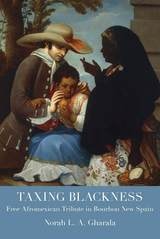
Taxing Blackness
Free Afromexican Tribute in Bourbon New SpainNorah L. A. Gharala
University of Alabama Press, 2019
A definitive analysis of the most successful tribute system in the Americas as applied to Afromexicans
During the eighteenth century, hundreds of thousands of free descendants of Africans in Mexico faced a highly specific obligation to the Spanish crown, a tax based on their genealogy and status. This royal tribute symbolized imperial loyalties and social hierarchies. As the number of free people of color soared, this tax became a reliable source of revenue for the crown as well as a signal that colonial officials and ordinary people referenced to define and debate the nature of blackness.
Taxing Blackness: Free Afromexican Tribute in Bourbon New Spain examines the experiences of Afromexicans and this tribute to explore the meanings of race, political loyalty, and legal privileges within the Spanish colonial regime. Norah L. A. Gharala focuses on both the mechanisms officials used to define the status of free people of African descent and the responses of free Afromexicans to these categories and strategies. This study spans the eighteenth century and focuses on a single institution to offer readers a closer look at the place of Afromexican individuals in Bourbon New Spain, which was the most profitable and populous colony of the Spanish Atlantic.
As taxable subjects, many Afromexicans were deeply connected to the colonial regime and ongoing debates about how taxpayers should be defined, whether in terms of reputation or physical appearance. Gharala shows the profound ambivalence, and often hostility, that free people of African descent faced as they navigated a regime that simultaneously labeled them sources of tax revenue and dangerous vagabonds. Some free Afromexicans paid tribute to affirm their belonging and community ties. Others contested what they saw as a shameful imposition that could harm their families for generations. The microhistory includes numerous anecdotes from specific cases and people, bringing their history alive, resulting in a wealth of rural and urban, gender, and family insight.

Television Drama in Spain and Latin America
Genre and Format TranslationPaul Julian Smith
University of London Press, 2018
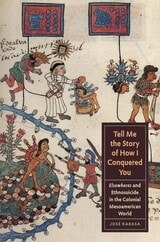
Tell Me the Story of How I Conquered You
Elsewheres and Ethnosuicide in the Colonial Mesoamerican WorldBy José Rabasa
University of Texas Press, 2011
Folio 46r from Codex Telleriano-Remensis was created in the sixteenth century under the supervision of Spanish missionaries in central Mexico. As an artifact of seismic cultural and political shifts, the manuscript painting is a singular document of indigenous response to Spanish conquest. Examining the ways in which the folio's tlacuilo (indigenous painter/writer) creates a pictorial vocabulary, this book embraces the place "outside" history from which this rich document emerged.
Applying contemporary intellectual perspectives, including aspects of gender, modernity, nation, and visual representation itself, José Rabasa reveals new perspectives on colonial order. Folio 46r becomes a metaphor for reading the totality of the codex and for reflecting on the postcolonial theoretical issues now brought to bear on the past. Ambitious and innovative (such as the invention of the concepts of elsewheres and ethnosuicide, and the emphasis on intuition), Tell Me the Story of How I Conquered You embraces the performative force of the native scribe while acknowledging the ineffable traits of 46r—traits that remain untenably foreign to the modern excavator/scholar. Posing provocative questions about the unspoken dialogues between evangelizing friars and their spiritual conquests, this book offers a theoretic-political experiment on the possibility of learning from the tlacuilo ways of seeing the world that dislocate the predominance of the West.

Tell Mother I'm in Paradise
Memoirs of a Political Prisoner in El SalvadorAna Margarita Gasteazoro, edited by Judy Blankenship and Andrew Wilson
University of Alabama Press, 2022
The life and times of Ana Margarita Gasteazoro: political activist, clandestine operative, and prisoner of conscience.
Ana Margarita Gasteazoro (1950–1993) was a Salvadoran opposition activist and renowned Amnesty International prisoner of conscience. Tell Mother I’m in Paradise:Memoirs of a Political Prisoner in El Salvador recounts her extraordinary life story. From a privileged Catholic upbringing, with time spent studying and working abroad, Ana Margarita first became a member of the legal political opposition in the late 1970s and later a clandestine operative at work against the brutal military junta.
Gasteazoro recounts her early rebellion against the strictures of conservative upper-class Salvadoran society. She spoke perfect English and discovered a talent for organizing in administrative jobs abroad and at home. As the civil war progressed, she quickly became a valued figure in the National Revolutionary Movement (MNR), a social democratic party, often representing it at international meetings. Against the backdrop of massive social oppression and the “disappearances” of thousands of opposition members, Gasteazoro began a double life as an operative in a faction of the Farabundo Martí National Liberation Front (FMLN). Multitalented and energetic, she organized safe houses for fellow activists, transported weapons and equipment, wrote scripts for an underground radio station, and produced an award-winning documentary film. But the toll on her family life and personal relationships was heavy.
Ana Margarita was disappeared in May 1981 by the infamous National Guard and endured a nightmare 11 days of interrogations, beatings, and abuse. Through international pressure and the connections of her family, her arrest was finally made public, and she was transferred to the women’s prison at Ilopango. There, she and other activists continued the political struggle through the Committee of Political Prisoners of El Salvador (COPPES). During her two years in prison, tested by hunger strikes, violence, and factional divisions, she became one of Amnesty International’s best-known prisoners of conscience. Tell Mother I’m in Paradise is a gripping story of a self-aware activist and a vital young woman’s struggle to find her own way within a deeply conservative society.
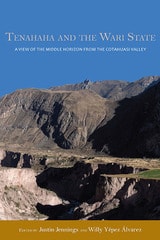
Tenahaha and the Wari State
A View of the Middle Horizon from the Cotahuasi ValleyEdited by Justin Jennings and Willy Yépez Álvarez
University of Alabama Press, 2015
Tenahaha and the Wari State contains a series of essays that challenge current beliefs about the Wari state and suggest a reassessment of this pivotal era in Andean history. In this collection, a picture emerges of Wari power projected across the region’s rugged and formidable topography less as a conquering empire than as a source of ideas, styles, and material culture voluntarily adopted by neighboring peoples.
Much of the previous fieldwork on Wari history took place in the Wari heartland and in Wari strongholds, not areas where Wari power and influence were equivocal. In Tenahaha and the Wari State, editors Justin Jennings and Willy Yépez Álvarez set out to test whether current theories of the Wari state as a cohesive empire were accurate or simply reflective of the bias inherent in studying Wari culture in its most concentrated centers. The essays in this collection examine instead life in the Cotahuasi Valley, an area into which Wari influence expanded during the Middle Horizon period.
Drawing on ten years of exhaustive field work both at the ceremonial site of Tenahaha and in the surrounding valley, Jennings and Yépez Álvarez posit that Cotahuasinos at Tenahaha had little contact with the Wari state. Their excavations and survey in the area tell the story of a region in flux rather than of a people conquered by Wari. In a time of uncertainty, they adopted Wari ideas and culture as ways to cope with change.
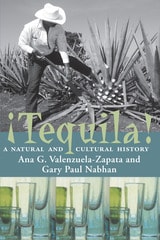
Tequila
A Natural and Cultural HistoryAna G. Valenzuela-Zapata and Gary Paul Nabhan
University of Arizona Press, 2004
The drink is tequila—more properly, mescal de tequila, the first mescal to be codified and recognized by its geographic origin and the only one known internationally by that name. In ¡Tequila! A Natural and Cultural History, Ana G. Valenzuela-Zapata, the leading agronomist in Mexico's tequila industry, and Gary Paul Nabhan, one of America's most respected ethnobotanists, plumb the myth of tequila as they introduce the natural history, economics, and cultural significance of the plants cultivated for its production.
Valenzuela-Zapata and Nabhan take you into the agave fields of Mexico to convey their passion for the century plant and its popular by-product. In the labor-intensive business of producing quality mescal, the cultivation of tequila azul is maintained through traditional techniques passed down over generations. They tell how jimadores seek out the mature agaves, strip the leaves, and remove the heavy heads from the field; then they reveal how the roasting and fermentation process brings out the flavors that cosmopolitan palates crave.
Today in Oaxaca it's not unusual to find small-scale mescal-makers vending their wares in the market plaza, while in Jalisco the scale of distillation facilities found near the town of Tequila would be unrecognizable to old José Cuervo. Valenzuela-Zapata and Nabhan trace tequila's progress from its modest beginnings to one of the world's favored spirits, tell how innovations from cross-cultural exchanges made fortunes for Cuervo and other distillers, and explain how the meteoric rise in tequila prices is due to an epidemic—one they predicted would occur—linked to the industry's cultivation of just one type of agave.
The tequila industry today markets more than four hundred distinct products through a variety of strategies that heighten the liquor's mystique, and this book will educate readers about the grades of tequila, from blanco to añejo, and marks of distinction for connoisseurs who pay up to two thousand dollars for a bottle. ¡Tequila! A Natural and Cultural History will feed anyone's passion for the gift of the blue agave as it heightens their appreciation for its rich heritage.
Terms of Exchange
Brazilian Intellectuals and the French Social SciencesIan Merkel
University of Chicago Press, 2022
Would the most recognizable ideas in the French social sciences have developed without the influence of Brazilian intellectuals? While any study of Brazilian social sciences acknowledges the influence of French scholars, Ian Merkel argues the reverse is also true: the “French” social sciences were profoundly marked by Brazilian intellectual thought, particularly through the University of São Paulo. Through the idea of the “cluster,” Merkel traces the intertwined networks of Claude Lévi-Strauss, Fernand Braudel, Roger Bastide, and Pierre Monbeig as they overlapped at USP and engaged with Brazilian scholars such as Mário de Andrade, Gilberto Freyre, and Caio Prado Jr..
Through this collective intellectual biography of Brazilian and French social sciences, Terms of Exchange reveals connections that shed new light on the Annales school, structuralism, and racial democracy, even as it prompts us to revisit established thinking on the process of knowledge formation through fieldwork and intellectual exchange. At a time when canons are being rewritten, this book reframes the history of modern social scientific thought.
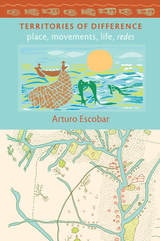
Territories of Difference
Place, Movements, Life, RedesArturo Escobar
Duke University Press, 2008
Escobar illuminates many interrelated dynamics, including the Colombian government’s policies of development and pluralism that created conditions for the emergence of black and indigenous social movements and those movements’ efforts to steer the region in particular directions. He examines attempts by capitalists to appropriate the rainforest and extract resources, by developers to set the region on the path of modernist progress, and by biologists and others to defend this incredibly rich biodiversity “hot-spot” from the most predatory activities of capitalists and developers. He also looks at the attempts of academics, activists, and intellectuals to understand all of these complicated processes. Territories of Difference is Escobar’s effort to think with Afro-Colombian intellectual-activists who aim to move beyond the limits of Eurocentric paradigms as they confront the ravages of neoliberal globalization and seek to defend their place-based cultures and territories.
Territories, Commodities and Knowledges
Latin American Environmental Histories in the Nineteenth and Twentieth CenturiesEdited by Christian Brannstrom
University of London Press, 2004
Contributors include Stephen Bell (UCLA, USA), Reinaldo Funes Monzote (Fundacion Antonio Nunez Jimenez de la Naturaleza y el Hombre, Cuba), Stefania Gallini (Universidad Nacional, Colombia), Nikolas Kozloff (CUNY Brooklyn College, USA), Karl Offen (University of Oklahoma, USA), John Soluri (Carnegie-Mellon University, USA), Alejandro Tortolero Villasenor (Universidad Autonoma Metropolitana-Iztapalapa, Mexico), and Robert W. Wilcox (Northern Kentucky University, USA).
Terror in the Countryside
Campesino Responses to Political Violence in Guatemala, 1954–1985Rachel A. May
Ohio University Press, 2001
The key to democratization lies within the experience of the popular movements. Those who engaged in the popular struggle in Guatemala have a deep understanding of substantive democratic behavior, and the experience of Guatemala’s civil society should be the cornerstone for building a meaningful formal democracy.
In Terror in the Countryside Rachel May offers an in-depth examination of the relationship between political violence and civil society. Focusing on Guatemala, Professor May develops a theoretical scheme that calls into question the more conventional understandings of both violence and civil society.
By elaborating a cyclical model of violence, and suggesting a typology of rural (campesino) popular organizations, Terror in the Countryside provides both a history and an analysis of late-twentieth-century violence and of the role of campesino organizations during the worst years of conflict in Guatemala.
This history details the way ideologies, organizational structures, and mobilization strategies evolved in response to the climate of terror, emphasizing the courage and sacrifice of those who worked for justice and human rights.
This book argues that the peace accords can be considered only as a first step to eliminate a violence that has become deeply rooted in the political life of the country.
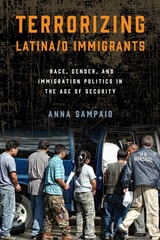
Terrorizing Latina/o Immigrants
Race, Gender, and Immigration Policy Post-9/11Anna Sampaio
Temple University Press, 2015
Immigration politics has been significantly altered by the advent of America’s war on terror and the proliferation of security measures. In her cogent study, Terrorizing Latina/o Immigrants, Anna Sampaio examines how these processes are racialized and gendered and how they impose inequitable burdens on Latina/o immigrants. She interrogates the rise of securitization, restrictive legislation, and the return of large-scale immigration raids and describes how these re-articulate and re-inscribe forms of racial and gender hierarchy.
Terrorizing Latina/o Immigrants demonstrates how the ascendance of America as a security state serves as a template to scrutinize, harass, and encumber immigrants while also reconfiguring citizenship. Sampaio uses intersectional analysis coupled with theoretical and empirical approaches to develop a critical framework for analyzing current immigration politics.
Sampaio provides a sustained and systematic examination of policy and enforcement shifts impacting Latinas/os. Her book concludes with an examination of immigration reform under the Obama administration, contrasting the promise of hope and change with the reality of increased detentions, deportations, and continued marginalization.
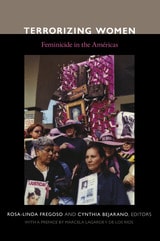
Terrorizing Women
Feminicide in the AmericasRosa-Linda Fregoso and Cynthia L. Bejarano, eds.
Duke University Press, 2010
Terrorizing Women brings together essays by feminist and human rights activists, attorneys, and scholars from Latin America and the United States, as well as testimonios by relatives of women who were disappeared or murdered. In addition to investigating egregious violations of women’s human rights, the contributors consider feminicide in relation to neoliberal economic policies, the violent legacies of military regimes, and the sexual fetishization of women’s bodies. They suggest strategies for confronting feminicide; propose legal, political, and social routes for redressing injustices; and track alternative remedies generated by the communities affected by gender-based violence. In a photo essay portraying the justice movement in Chihuahua, relatives of disappeared and murdered women bear witness to feminicide and demand accountability.
Contributors: Pascha Bueno-Hansen, Adriana Carmona López, Ana Carcedo Cabañas, Jennifer Casey, Lucha Castro Rodríguez , Angélica Cházaro, Rebecca Coplan, Héctor Domínguez-Ruvalcaba, Marta Fontenla, Alma Gomez Caballero, Christina Iturralde, Marcela Lagarde y de los Ríos, Julia Estela Monárrez Fragoso, Hilda Morales Trujillo, Mercedes Olivera, Patricia Ravelo Blancas, Katherine Ruhl, Montserrat Sagot, Rita Laura Segato, Alicia Schmidt Camacho, William Paul Simmons, Deborah M. Weissman, Melissa W. Wright
Testimonio
On The Politics Of TruthJohn Beverley
University of Minnesota Press, 2004
A revealing perspective on the controversial literature of witnessing
These four germinal essays by John Beverley sparked the widespread discussion and debate surrounding testimonio—the socially and politically charged Latin American narrative of witnessing—that culminated with David Stoll’s highly publicized attack on Rigoberta Menchú’s celebrated testimonial text. Challenging Hardt and Negri’s Empire, Beverley’s extensive new introduction examines the broader historical, political, and ethical issues that this literature raises, tracing the development of testimonio from its emergence in the Cold War era to the rise of a globalized economy and U.S. political hegemony.
Informed by postcolonial studies and the current debate over multiculturalism and identity politics, Testimonio reaches across disciplinary boundaries to show how this particular literature at once represents and enacts new forms of agency on the part of previously repressed social subjects, as well as its potential as a new form of “alliance politics” between those subjects and artists, scientists, teachers, and intellectuals in a variety of local, national, and international contexts.
The Abolition of Slavery and the Aftermath of Emancipation in Brazil
Rebecca Scott, Seymour Drescher, Hebe Maria Mattos de Castro, George Reid Andrews, and Robert Levine
Duke University Press, 1988
The articles presented here represent a broad scope of scholarly inquiry that covers developments across a wide canvas of Brazilian history and accentuates the importance of formal abolition as a watershed in that nation’s development.
The Agrarian Dispute
The Expropriation of American-Owned Rural Land in Postrevolutionary MexicoJohn J. Dwyer
Duke University Press, 2008
Dwyer weaves together elite and subaltern history and highlights the intricate relationship between domestic and international affairs. Through detailed studies of land redistribution in Baja California and Sonora, he demonstrates that peasant agency influenced the local application of Cárdenas’s agrarian reform program, his regional state-building projects, and his relations with the United States. Dwyer draws on a broad array of official, popular, and corporate sources to illuminate the motives of those who contributed to the agrarian dispute, including landless fieldworkers, indigenous groups, small landowners, multinational corporations, labor leaders, state-level officials, federal policymakers, and diplomats. Taking all of them into account, Dwyer explores the circumstances that spurred agrarista mobilization, the rationale behind Cárdenas’s rural policies, the Roosevelt administration’s reaction to the loss of American-owned land, and the diplomatic tactics employed by Mexican officials to resolve the international conflict.
The Ailing City
Health, Tuberculosis, and Culture in Buenos Aires, 1870–1950Diego Armus
Duke University Press, 2011
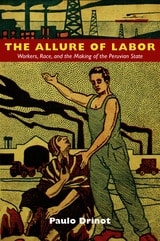
The Allure of Labor
Workers, Race, and the Making of the Peruvian StatePaulo Drinot
Duke University Press, 2011
Although the vast majority of laboring peoples in Peru were indigenous, in the minds of social reformers indigeneity was not commensurable with labor: Indians could not be workers and were therefore excluded from the labor policies enacted in the 1920s and 1930s and, more generally, from elite conceptions of industrial progress. Drinot shows how the incommensurability of indigeneity with labor was expressed in the 1920 constitution, in specific labor policies, and in the activities of state agencies created to oversee collective bargaining and provide workers with affordable housing, inexpensive food, and social insurance. He argues that the racialized assumptions of the modernizing Peruvian state are reflected in the enduring inequalities of present-day Peru.
The Anatomy of Eleven Towns in Michoacán
By Dan Stanislawski
University of Texas Press, 1950
In this book, Dan Stanislawski studies the geography of various small towns in one Mexican state. He discusses the factors—landscape, buildings, culture groups, and so forth—that create a unique personality for each of these towns.
The Anthropological Imagination in Latin American Literature
Amy Fass Emery
University of Missouri Press, 1996
In this examination of the cross between anthropology and literature in contemporary Latin America, Amy Fass Emery studies how Latin American writers' experiences and studies in the field of anthropology have shaped their representations of cultural Others in fiction. She approaches her subject first in broad terms and then in close textual readings of important writers such as Alejo Carpentier, José María Arguedas, and Miguel Barnet.
Emery develops the concept of an "anthropological imagination"--that is, the conjunction of anthropology and literature in twentieth-century Latin American literary texts. While exploring the uses of anthropology in contemporary narrative and fiction, Emery also gives consideration to documentary and testimonial writings.
The major focus of this engaging work is the study of the novel. Analyzing fictions by authors from Cuba, Argentina, Brazil, and Peru, Emery covers a wide geographical region, as well as a diverse group of topics. Subjects such as surrealist primitivism, the testimonio, the transcultural novel, and the relation of the anthropological imagination to the vexed question of postmodernism in the Latin American context are all given insightful deliberation.
As the first extended study of interrelations between anthropology and literature in Latin America, Emery's work will prove invaluable to a wide spectrum of Latin Americanists and to those with comparative interests in anthropology, twentieth-century literature, and postmodernism.
The Archaeology of La Calsada
A Rockshelter in the Sierra Madre Oriental, MexicoBy C. Roger Nance
University of Texas Press, 1992
On a remote mountainside 2,000 meters above sea level in the northern Sierra Madre Oriental, the rockshelter at La Calsada has yielded basic archaeological data for one of the least understood regions of prehistoric North America, the state of Nuevo León in northern Mexico. This comprehensive site report, with detailed information on artifacts and stratigraphy, provides baseline data for further explorations in the region and comparisons with other North American hunter-gatherer groups.
Radiocarbon dating traces the earliest component at the site to 8600-7500 B.C., giving La Calsada arguably the earliest well-dated lithic complex in Mexico. Nance describes some 1,140 recovered stone tools, with comparisons to the archaeology of southern and southwestern Texas, as well as reported sites in Tamaulipas, Coahuila, and Nuevo León, Mexico.
From the lithic and stratigraphic analysis, Nance deduces occupational patterns at the site, beginning with Paleo-Indian cultures that lived in the area until about 7500 B.C. Through changes in tool technology, he follows the rise of the Abasolo tradition around 3000 B.C. and the appearance of a new culture with a radically different lithic industry around 1000 A.D.
The Archive and the Aural City
Sound, Knowledge, and the Politics of ListeningAlejandro L. Madrid
Duke University Press, 2025
The Argentina Reader
History, Culture, PoliticsGabriela Nouzeilles and Graciela Montaldo, eds.
Duke University Press, 2002
This diverse collection brings together songs, articles, comic strips, scholarly essays, poems, and short stories. Most pieces are by Argentines. More than forty of the texts have never before appeared in English. The Argentina Reader contains photographs from Argentina’s National Archives and images of artwork by some of the country’s most talented painters and sculptors. Many selections deal with the history of indigenous Argentines, workers, women, blacks, and other groups often ignored in descriptions of the country. At the same time, the book includes excerpts by or about such major political figures as José de San Martín and Juan Perón. Pieces from literary and social figures virtually unknown in the United States appear alongside those by more well-known writers such as Jorge Luis Borges, Ricardo Piglia, and Julio Cortázar.
The Argentina Reader covers the Spanish colonial regime; the years of nation building following Argentina’s independence from Spain in 1810; and the sweeping progress of economic growth and cultural change that made Argentina, by the turn of the twentieth century, the most modern country in Latin America. The bulk of the collection focuses on the twentieth century: on the popular movements that enabled Peronism and the revolutionary dreams of the 1960s and 1970s; on the dictatorship from 1976 to 1983 and the accompanying culture of terror and resistance; and, finally, on the contradictory and disconcerting tendencies unleashed by the principles of neoliberalism and the new global economy. The book also includes a list of suggestions for further reading.
The Argentina Reader is an invaluable resource for those interested in learning about Argentine history and culture, whether in the classroom or in preparation for travel in Argentina.
The Argentine Folklore Movement
Sugar Elites, Criollo Workers, and the Politics of Cultural Nationalism, 1900–1955Oscar Chamosa
University of Arizona Press, 2010
Oscar Chamosa combines intellectual history with ethnographic and sociocultural analysis to reconstruct the process by which mestizo culture—in Argentina called criollo culture—came to occupy the center of national folklore in a country that portrayed itself as the only white nation in South America. The author finds that the conservative plantation owners—the “sugar elites”—who exploited the criollo peasants sponsored the folklore movement that romanticized them as the archetypes of nationhood. Ironically, many of the composers and folk singers who participated in the landowner-sponsored movement adhered to revolutionary and reformist ideologies and denounced the exploitation to which those criollo peasants were subjected. Chamosa argues that, rather than debilitating the movement, these opposing and contradictory ideologies permitted its triumph and explain, in part, the enduring romanticizing of rural life and criollo culture, essential components of Argentine nationalism.
The book not only reveals the political motivations of culture in Argentina and Latin America but also has implications for understanding the articulation of local culture with national politics and entertainment markets that characterizes contemporary cultural processes worldwide today.
The Argentine Silent Majority
Middle Classes, Politics, Violence, and Memory in the SeventiesSebastián Carassai
Duke University Press, 2014
The Art of Being In-between
Native Intermediaries, Indian Identity, and Local Rule in Colonial OaxacaYanna Yannakakis
Duke University Press, 2008
Through interpretation of a wide array of historical sources—including descriptions of public rituals, accounts of indigenous rebellions, idolatry trials, legal petitions, court cases, land disputes, and indigenous pictorial histories—Yannakakis weaves together an elegant narrative that illuminates political and cultural struggles over the terms of local rule. As cultural brokers, native intermediaries at times reconciled conflicting interests, and at other times positioned themselves in opposing camps over the outcome of municipal elections, the provision of goods and labor, landholding, community ritual, the meaning of indigenous “custom” in relation to Spanish law, and representations of the past. In the process, they shaped an emergent “Indian” identity in tension with other forms of indigenous identity and a political order characterized by a persistent conflict between local autonomy and colonial control. This innovative study provides fresh insight into colonialism’s disparate cultures and the making of race, ethnicity, and the colonial state and legal system in Spanish America.
The Art of Professing in Bourbon Mexico
Crowned-Nun Portraits and Reform in the ConventBy James M. Córdova
University of Texas Press, 2014
In the eighteenth century, New Spaniards (colonial Mexicans) so lauded their nuns that they developed a local tradition of visually opulent portraits, called monjas coronadas or “crowned nuns,” that picture their subjects in regal trappings at the moment of their religious profession and in death. This study identifies these portraits as markers of a vibrant and changing society that fused together indigenous and Euro-Christian traditions and ritual practices to construct a new and complex religious identity that was unique to New Spain.
To discover why crowned-nun portraits, and especially the profession portrait, were in such demand in New Spain, this book offers a pioneering interpretation of these works as significant visual contributions to a local counter-colonial discourse. James M. Córdova demonstrates that the portraits were a response to the Spanish crown’s project to modify and modernize colonial society—a series of reforms instituted by the Bourbon monarchs that threatened many nuns’ religious identities in New Spain. His analysis of the portraits’ rhetorical devices, which visually combined Euro-Christian and Mesoamerican notions of the sacred, shows how they promoted local religious and cultural values as well as client-patron relations, all of which were under scrutiny by the colonial Church. Combining visual evidence from images of the “crowned nun” with a discussion of the nuns’ actual roles in society, Córdova reveals that nuns found their greatest agency as Christ’s brides, a title through which they could, and did, challenge the Church’s authority when they found it intolerable.
The Art of Solidarity
Visual and Performative Politics in Cold War Latin AmericaEdited by Jessica Stites Mor and Maria del Carmen Suescun Pozas
University of Texas Press, 2018
The Cold War claimed many lives and inflicted tremendous psychological pain throughout the Americas. The extreme polarization that resulted from pitting capitalism against communism held most of the creative and productive energy of the twentieth century captive. Many artists responded to Cold War struggles by engaging in activist art practice, using creative expression to mobilize social change. The Art of Solidarity examines how these creative practices in the arts and culture contributed to transnational solidarity campaigns that connected people across the Americas from the early twentieth century through the Cold War and its immediate aftermath.
This collection of original essays is divided into four chronological sections: cultural and artistic production in the pre–Cold War era that set the stage for transnational solidarity organizing; early artistic responses to the rise of Cold War polarization and state repression; the centrality of cultural and artistic production in social movements of solidarity; and solidarity activism beyond movements. Essay topics range widely across regions and social groups, from the work of lesbian activists in Mexico City in the late 1970s and 1980s, to the exchanges and transmissions of folk-music practices from Cuba to the United States, to the uses of Chilean arpilleras to oppose and protest the military dictatorship. While previous studies have focused on politically engaged artists or examined how artist communities have created solidarity movements, this book is one of the first to merge both perspectives.
The Art of Transition
Latin American Culture and Neoliberal CrisisFrancine Masiello
Duke University Press, 2001
Masiello views representation as both a political and artistic device, concerned with the tensions between truth and lies, experience and language, and intellectuals and the marginal subjects they study and claim to defend. These often contentious negotiations, she argues, are most provocatively displayed through the spectacle of difference, which constantly crosses the literary stage, the market, and the North/South divide. While forcefully defending the ability of literature and art to advance ethical positions and to foster a critical view of neoliberalism, Masiello especially shows how issues of gender and sexuality function as integrating threads throughout this cultural project. Through discussions of visual art as well as literary work by prominent novelists and poets, Masiello sketches a broad landscape of vivid intellectual debate in the Southern Cone of Latin America.
The Art of Transition will interest Latin Americanists,literary and political theorists, art critics and historians, and those involved with the study of postmodernism and globalization.
The Assassination of Gaitán
Public Life and Urban Violence in ColombiaHerbert Braun
University of Wisconsin Press, 1985
Drawn in part from personal interviews with participants and witnesses, Herbert Braun’s analysis of the riot’s roots, its patterns and consequences, provides a dramatic account of this historic turning point and an illuminating look at the making of modern Colombia.
Braun’s narrative begins in the year 1930 in Bogotá, Colombia, when a generation of Liberals and Conservatives came to power convinced they could kept he peace by being distant, dispassionate, and rational. One of these politicians, Jorge Eliécer Gaitán, was different. Seeking to bring about a society of merit, mass participation, and individualism, he exposed the private interests of the reigning politicians and engendered a passionate relationship with his followers. His assassination called forth urban crowds that sought to destroy every visible evidence of public authority of a society they felt no longer had the moral right to exist.
This is a book about behavior in public: how the actors—the political elite, Gaitán, and the crowds—explained and conducted themselves in public, what they said and felt, and what they sought to preserve or destroy, is the evidence on which Braun draws to explain the conflicts contained in Colombian history. The author demonstrates that the political culture that was emerging through these tensions offered the hope of a peaceful transition to a more open, participatory, and democratic society.
“Most Colombians regard Jorge Eliécer Gaitán as a pivotal figure in their nation’s history, whose assassination on April 9, 1948 irrevocably changed the course of events in the twentieth century. . . . As biography, social history, and political analysis, Braun’s book is a tour de force.”—Jane M. Rausch, Hispanic American Historical Review
The Aztec Kings
The Construction of Rulership in Mexican HistorySusan D. Gillespie
University of Arizona Press, 1989
The Aztec Kings is the first major study to take into account the Aztec cyclical conception of time—which required that history constantly be reinterpreted to achieve continuity between past and present—and to treat indigenous historical traditions as symbolic statements in narrative form. Susan Gillespie focuses on the dynastic history of the Mexica of Tenochtitlan, whose stories reveal how the Aztecs used "history" to construct, elaborate, and reify ideas about the nature of rulership and the cyclical nature of the cosmos, and how they projected the Spanish conquest deep into the Aztec past in order to make history accommodate that event.
By demonstrating that most of Aztec history is nonliteral, she sheds new light on Aztec culture and on the function of history in society. By relating the cyclical structure of Aztec dynastic history to similar traditions of African and Polynesian peoples, she introduces a broader perspective on the function of history in society and on how and why history must change.
The Aztec Palimpsest
Mexico in the Modern ImaginationDaniel Cooper Alarcón
University of Arizona Press, 1997
He shows how the Chicano myth of Aztlan was constructed upon earlier Mesoamerican myths, discusses representations of Mexico in texts by nineteenth- and twentieth-century writers, and analyzes the content of tourist literature, thereby revealing the economic, social, and political interests that drive the production of Mexicanness today. This original linking of seemingly incongruous discourses corrects the misconception that Mexicanness is produced only by hegemonic groups. Cooper shows how Mexico has been defined and represented, by both Mexicans and non-Mexicans, as more than a political or geographic entity, and he particularly reveals how Mexicanness has been exploited by Mexicans themselves through the promotion of tourism as a form of neocolonialism.
Cooper's work is valuable both for identifying attempts to revise and control Mexican myth, history, and culture and for defining the intricate relationship between history, historiography, and cultural nationalism. The Aztec Palimpsest extends existing analyses of Mexicanness into new theoretical realms and provides a fresh perspective on the relationship between the United States and Mexico at a time when these two nations are becoming more intimately linked.
The Bajío Revolution
Remaking Capitalism, Community, and Patriarchy in Mexico, North America, and the WorldJohn Tutino
Duke University Press, 2025
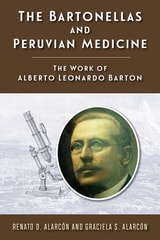
The Bartonellas and Peruvian Medicine
The Work of Alberto Leonardo BartonAlarcón, Graciela S
Rutgers University Press, 2019
The book is the result of intense bibliographic research and of original documents aimed not just at the examination of Barton’s life and work, but also the examination of today’s perspectives and future work in the field of infectious and “neglected” diseases. The authors address current scientific information on the relevant bacteria Bartonella bacilliformis, besides current research and clinical status of the other Bartonellas, making it a useful and practical text for those studying infectious diseases.
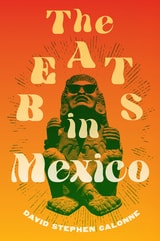
The Beats in Mexico
David Stephen Calonne
Rutgers University Press, 2022
The first book-length study of why the Beats were so fascinated by Mexico and how they represented its culture in their work, this volume examines such canonical figures as Kerouac, Burroughs, Ginsberg, Lamantia, McClure, and Ferlinghetti. It also devotes individual chapters to women such as Margaret Randall, Bonnie Bremser, and Joanne Kyger, who each made Mexico a central setting of their work and interrogated the misogyny they encountered in both American and Mexican culture.
The Beats in Mexico not only considers individual Beat writers, but also places them within a larger history of countercultural figures, from D.H. Lawrence to Antonin Artaud to Jim Morrison, who mythologized Mexico as the land of the Aztecs and Maya, where shamanism and psychotropic drugs could take you on a trip far beyond the limits of the American imagination.
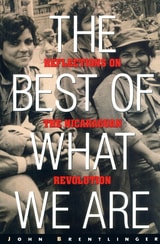
The Best of What We Are
Reflections on the Nicaraguan RevolutionJohn Brentlinger
University of Massachusetts Press, 1995
The Sandinista revolution in Nicaragua inspired many North Americans, including the author of this moving and informative book. John Brentlinger made six trips to Nicaragua, both before and after the defeat of the Sandinista Party. Combining the insights of a philosopher with the experiences of a participant-observer, he interprets the Sandinista period as a people’s struggle for self-realization in work, culture, politics, and community.
The book alternates between journal and essay chapters, weaving descriptions of personal experiences together with interviews and analysis. Whether telling the story of the last day of a young teacher’s life, describing new forms of poetry and art, examining representations of Nicaragua in the U.S. media, or discussing the government’s success and failures, Brentlinger vividly captures the spirit and enduring significance of the Sandinista revolution.

The Bewitchment of Silver
The Social Economy of Mining in Nineteenth-Century PeruJose R. Deustua
Ohio University Press, 1999
José Deustua argues that developing countries must be understood in terms of achieving domestic development as well as in their role in generating foreign exchange and in linking themselves to the world economy. Focusing on various sectors of Peru’s mining production, the mines, owners and mine workers, the transportation networks and the use of muleteers, this study is also concerned with market-building and domestic development in nineteenth-century Latin America.
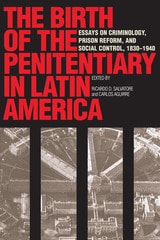
The Birth of the Penitentiary in Latin America
Essays on Criminology, Prison Reform, and Social Control, 1830-1940Edited by Ricardo D. Salvatore and Carlos Aguirre
University of Texas Press, 1996
Opening a new area in Latin American studies, The Birth of the Penitentiary in Latin America showcases the most recent historical outlooks on prison reform and criminology in the Latin American context. The essays in this collection shed new light on the discourse and practice of prison reform, the interpretive shifts induced by the spread of criminological science, and the links between them and competing discourses about class, race, nation, and gender. The book shows how the seemingly clear redemptive purpose of the penitentiary project was eventually contradicted by conflicting views about imprisonment, the pervasiveness of traditional forms of repression and control, and resistance from the lower classes.
The essays are unified by their attempt to view the penitentiary (as well as the variety of representations conveyed by the different reform movements favoring its adoption) as an interpretive moment, revealing of the ideology, class fractures, and contradictory nature of modernity in Latin America. As such, the book should be of interest not only to scholars concerned with criminal justice history, but also to a wide range of readers interested in modernization, social identities, and the discursive articulation of social conflict. The collection also offers an up-to-date sampling of new historical approaches to the study of criminal justice history, illuminates crucial aspects of the Latin American modernization process, and contrasts the Latin American cases with the better known European and North American experiences with prison reform.
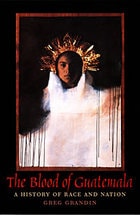
The Blood of Guatemala
A History of Race and NationGreg Grandin
Duke University Press, 2000
Focusing on Mayan elites in the community of Quetzaltenango, Grandin shows how their efforts to maintain authority over the indigenous population and secure political power in relation to non-Indians played a crucial role in the formation of the Guatemalan nation. To explore the close connection between nationalism, state power, ethnic identity, and political violence, Grandin draws on sources as diverse as photographs, public rituals, oral testimony, literature, and a collection of previously untapped documents written during the nineteenth century. He explains how the cultural anxiety brought about by Guatemala’s transition to coffee capitalism during this period led Mayan patriarchs to develop understandings of race and nation that were contrary to Ladino notions of assimilation and progress. This alternative national vision, however, could not take hold in a country plagued by class and ethnic divisions. In the years prior to the 1954 coup, class conflict became impossible to contain as the elites violently opposed land claims made by indigenous peasants.
This “history of power” reconsiders the way scholars understand the history of Guatemala and will be relevant to those studying nation building and indigenous communities across Latin America.
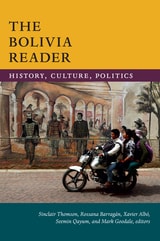
The Bolivia Reader
History, Culture, PoliticsSinclair Thomson, Rossana Barragán, Xavier Albó, Seemin Qayum, and Mark Goodale, editors
Duke University Press, 2018

The Brazil Chronicles
Stephen G. Bloom
University of Missouri Press, 2024
As a young journalist at the Brazil Herald from 1979-81, Stephen G. Bloom spent his early professional years working in Rio’s seedy Lapa district, surrounded by fugitives, drug runners, pornographers, and stealth CIA agents. Bloom shares the wild story of this English-language newspaper in The Brazil Chronicles. The expat newspaper was a breeding ground for a different kind of storyteller — audacious risk-takers who told madcap tales of Amazon plantations, Confederate emigres, and lost Indian tribes. Several renown journalists cut their teeth at the Brazil Herald, including acclaimed New York Times correspondent Tad Szulc, Huffington Post CEO Eric Hippeau, and an untamed Gonzo reporter by the name of Hunter S. Thompson.
Drawing from extensive archival research and more than 150 interviews with his former colleagues, Bloom’s eye-opening narrative dive is both entertaining and academically rigorous. With a backdrop of coups, nonstop political instability, censorship, hyper-inflation, and weekends at sultry Ipanema Beach, The Brazil Chronicles doubles as a coming-of-age memoir, following young Bloom as he embarks on his quest to become a foreign correspondent, relocating to a foreign country to pursue under-the-radar stories and tall tales. His firsthand experience provides an insider, eye-witness account of the newspaper’s colorful history, transporting the reader to its sweltering newsroom and delving into the multifarious lives of its eclectic, trailblazing, polyglot staff.
Even as Bloom weaves between personal narrative, history, and accounts from journalism luminaries, it’s clear who the book’s main character is: the one-of-a-kind newspaper itself.
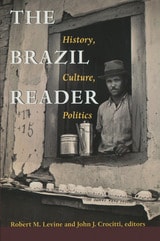
The Brazil Reader
History, Culture, PoliticsRobert M. Levine and John J. Crocitti, eds.
Duke University Press, 1999
Complementing traditional views with fresh ones, The Brazil Reader’s historical selections range from early colonization to the present day, with sections on imperial and republican Brazil, the days of slavery, the Vargas years, and the more recent return to democracy. They include letters, photographs, interviews, legal documents, visual art, music, poetry, fiction, reminiscences, and scholarly analyses. They also include observations by ordinary residents, both urban and rural, as well as foreign visitors and experts on Brazil. Probing beneath the surface of Brazilian reality—past and present—The Reader looks at social behavior, women’s lives, architecture, literature, sexuality, popular culture, and strategies for coping with the travails of life in a country where the affluent live in walled compounds to separate themselves from the millions of Brazilians hard-pressed to find food and shelter. Contributing to a full geographic account—from the Amazon to the Northeast and the Central-South—of this country’s singular multiplicity, many pieces have been written expressly for this volume or were translated for it, having never previously been published in English.
This second book in The Latin America Readers series will interest students, specialists, travelers for both business and leisure, and those desiring an in-depth introduction to Brazilian life and culture.
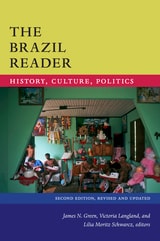
The Brazil Reader
History, Culture, PoliticsJames N. Green, Victoria Langland, and Lilia Moritz Schwarcz, editors
Duke University Press, 2019
The Brazilians
Their Character and AspirationsBy José Honório Rodrigues
University of Texas Press, 1967
Brazil has long been a country in search of its own meaning and mission. Early in their history Brazilians began to puzzle over their surroundings and their relation to them. The eighteenth century produced an entire school of nativistic writers who, with the advent of independence, became fiery nationalists, still pursuing introspective studies of their homeland. Throughout the nineteenth century, the intellectuals of Brazil determined to define their nation, its character, and its aspirations.
In this now well-established tradition, José Honório Rodrigues confronts the questions of who and what the Brazilian is, what Brazil stands for, where it has been, and where it is going. This study, originally published in Portuguese as Aspirações nacionais, was especially timely at a period when strong feelings of nationalism led Brazilians to seek to define their own image, and when the revolution of rising expectations disposed them to determine what goals they were seeking and how far they were on the road to achieving them.
In order to understand and explain his nation, Rodrigues poses two questions: what are the national characteristics, and what are the national aspirations? Both questions are complex, but the reader will find well-reasoned answers, with a wealth of information on growth and development and abundant statistics to substantiate these answers.

The Brink of Freedom
Improvising Life in the Nineteenth-Century Atlantic WorldDavid Kazanjian
Duke University Press, 2016
The Buenos Aires Reader
History, Culture, PoliticsDiego Armus and Lisa Ubelaker Andrade, editors
Duke University Press, 2024
The Burden of the Ancients
Maya Ceremonies of World Renewal from the Pre-columbian Period to the PresentBy Allen J. Christenson
University of Texas Press, 2016
In Maya theology, everything from humans and crops to gods and the world itself passes through endless cycles of birth, maturation, dissolution, death, and rebirth. Traditional Maya believe that human beings perpetuate this cycle through ritual offerings and ceremonies that have the power to rebirth the world at critical points during the calendar year. The most elaborate ceremonies take place during Semana Santa (Holy Week), the days preceding Easter on the Christian calendar, during which traditionalist Maya replicate many of the most important world-renewing rituals that their ancient ancestors practiced at the end of the calendar year in anticipation of the New Year’s rites.
Marshaling a wealth of evidence from Pre-Columbian texts, early colonial Spanish writings, and decades of fieldwork with present-day Maya, The Burden of the Ancients presents a masterfully detailed account of world-renewing ceremonies that spans the Pre-Columbian era through the crisis of the Conquest period and the subsequent colonial occupation all the way to the present. Allen J. Christenson focuses on Santiago Atitlán, a Tz’utujil Maya community in highland Guatemala, and offers the first systematic analysis of how the Maya preserved important elements of their ancient world renewal ceremonies by adopting similar elements of Roman Catholic observances and infusing them with traditional Maya meanings. His extensive description of Holy Week in Santiago Atitlán demonstrates that the community’s contemporary ritual practices and mythic stories bear a remarkable resemblance to similar cultural entities from its Pre-Columbian past.

The Bureaucrats of Buenos Aires, 1769-1810
Amor al Real ServicioSusan Migden Socolow
Duke University Press, 1988
The late eighteenth century was a critical time for the southernmost regions of Latin America, for in this period they became a separate political entity, the Viceroyalty of the Rio de la Plata. Socolow's work, part of a continuing study of the political, economic, and social elites of the emerging city of Buenos Aires, here considers the bureaucracy put into place by the Bourbon reforms. The author examines the professional and personal circumstances of all bureaucrats, from the high-ranking heads of agencies to the more lowly clerks, contrasting their expectations and their actual experiences. She pays particular attention to their recruitment, promotion, salary, and retirement, as well as their marriage and kinship relationships in the local society.