Results by title
101 books match the query 'Liberty' and 25 start with t

Taking the Risk Out of Democracy
Corporate Propaganda versus Freedom and LibertyAlex Carey
University of Illinois Press, 1995
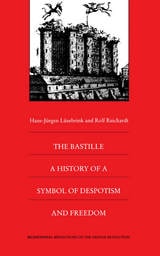
The Bastille
A History of a Symbol of Despotism and FreedomHans-Jürgen Lüsebrink and Rolf Reichardt
Duke University Press, 1997
To facilitate the symbolic nature of the investigation, this analysis of the evolving signification of the Bastille moves from the French Revolution to the nineteenth century to contemporary history. The narrative also shifts from France to other cultural arenas, like the modern European colonial sphere, where the overthrow of the Bastille acquired radical new signification in the decolonization period of the 1940s and 1950s. The Bastille demonstrates the potency of the interdisciplinary historical research that has characterized the end of this century, combining quantitative and qualitative approaches, and taking its methodological tools from history, sociology, linguistics, and cultural and literary studies.
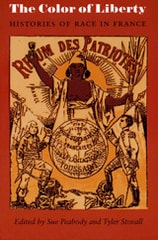
The Color of Liberty
Histories of Race in FranceSue Peabody and Tyler Stovall, eds.
Duke University Press, 2003
The Color of Liberty addresses four major themes: the evolution of race as an idea in France; representations of "the other" in French literature, art, government, and trade; the international dimensions of French racial thinking, particularly in relation to colonialism; and the impact of racial differences on the shaping of the modern French city. The many permutations of race in French history—as assigned identity, consumer product icon, scientific discourse, philosophical problem, by-product of migration, or tool in empire building—here receive nuanced treatments confronting the malleability of ideas about race and the uses to which they have been put.
Contributors. Leora Auslander, Claude Blanckaert, Alice Conklin, Fred Constant, Laurent Dubois, Yaël Simpson Fletcher, Richard Fogarty, John Garrigus, Dana Hale, Thomas C. Holt, Patricia M. E. Lorcin, Dennis McEnnerney, Michael A. Osborne, Lynn Palermo, Sue Peabody, Pierre H. Boulle, Alyssa Goldstein Sepinwall, Tyler Stovall, Michael G. Vann, Gary Wilder
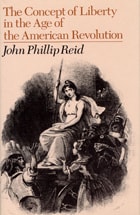
The Concept of Liberty in the Age of the American Revolution
John Phillip Reid
University of Chicago Press, 1988
As John Philip Reid goes on to make clear, "liberty" did not mean to the eighteenth-century mind what it means today. In the twentieth century, we take for granted certain rights—such as freedom of speech and freedom of the press—with which the state is forbidden to interfere. To the revolutionary generation, liberty was preserved by curbing its excesses. The concept of liberty taught not what the individual was free to do but what the rule of law permitted. Ultimately, liberty was law—the rule of law and the legalism of custom. The British constitution was the charter of liberty because it provided for the rule of law.
Drawing on an impressive command of the original materials, Reid traces the eighteenth-century notion of liberty to its source in the English common law. He goes on to show how previously problematic arguments involving the related concepts of licentiousness, slavery, arbitrary power, and property can also be fit into the common-law tradition. Throughout, he focuses on what liberty meant to the people who commented on and attempted to influence public affairs on both sides of the Atlantic. He shows the depth of pride in liberty—English liberty—that pervaded the age, and he also shows the extent—unmatched in any other era or among any other people—to which liberty both guided and motivated political and constitutional action.
The Constitution of Liberty
F. A. Hayek
University of Chicago Press, 1978
"A reflective, often biting, commentary on the nature of our society and its dominant thought by one who is passionately opposed to the coercion of human beings by the arbitrary will of others, who puts liberty above welfare and is sanguine that greater welfare will thereby ensue."—Sidney Hook, New York Times Book Review
In this classic work Hayek restates the ideals of freedom that he believes have guided, and must continue to guide, the growth of Western civilization. Hayek's book, first published in 1960, urges us to clarify our beliefs in today's struggle of political ideologies.
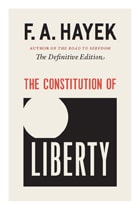
The Constitution of Liberty
The Definitive EditionF. A. Hayek
University of Chicago Press, 2011
From the $700 billion bailout of the banking industry to president Barack Obama’s $787 billion stimulus package to the highly controversial passage of federal health-care reform, conservatives and concerned citizens alike have grown increasingly fearful of big government. Enter Nobel Prize–winning economist and political theorist F. A. Hayek, whose passionate warning against empowering states with greater economic control, The Road to Serfdom, became an overnight sensation last summer when it was endorsed by Glenn Beck. The book has since sold over 150,000 copies.
The latest entry in the University of Chicago Press’s series of newly edited editions of Hayek’s works, The Constitution of Liberty is, like Serfdom, just as relevant to our present moment. The book is considered Hayek’s classic statement on the ideals of freedom and liberty, ideals that he believes have guided—and must continue to guide—the growth of Western civilization. Here Hayek defends the principles of a free society, casting a skeptical eye on the growth of the welfare state and examining the challenges to freedom posed by an ever expanding government—as well as its corrosive effect on the creation, preservation, and utilization of knowledge. In opposition to those who call for the state to play a greater role in society, Hayek puts forward a nuanced argument for prudence. Guided by this quality, he elegantly demonstrates that a free market system in a democratic polity—under the rule of law and with strong constitutional protections of individual rights—represents the best chance for the continuing existence of liberty.
Striking a balance between skepticism and hope, Hayek’s profound insights are timelier and more welcome than ever before. This definitive edition of The Constitution of Liberty will give a new generation the opportunity to learn from his enduring wisdom.
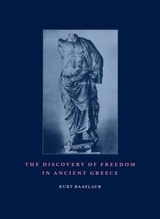
The Discovery of Freedom in Ancient Greece
Revised and Updated EditionKurt Raaflaub
University of Chicago Press, 2003
To find out, Raaflaub analyses ancient Greek texts from Homer to Thucydides in their social and political contexts. Archaic Greece, he concludes, had little use for the idea of political freedom; the concept arose instead during the great confrontation between Greeks and Persians in the early fifth century BCE. Raaflaub then examines the relationship of freedom with other concepts, such as equality, citizenship, and law, and pursues subsequent uses of the idea—often, paradoxically, as a tool of domination, propaganda, and ideology.
Raaflaub's book thus illuminates both the history of ancient Greek society and the evolution of one of humankind's most important values, and will be of great interest to anyone who wants to understand the conceptual fabric that still shapes our world views.
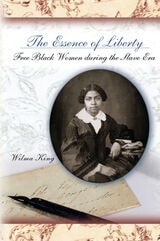
The Essence of Liberty
Free Black Women During the Slave EraWilma King
University of Missouri Press, 2006
The Essence of Liberty blends social, political, and economic history to analyze black women’s experience in both the North and the South, from the colonial period through emancipation. Focusing on class and familial relationships, King examines the myriad sources of freedom for black women to show the many factors that, along with time spent in slavery before emancipation, shaped the meaning of freedom. Her book also raises questions about whether free women were bound to or liberated from gender conventions of their day.
Drawing on a wealth of untapped primary sources—not only legal documents and newspapers but also the diaries, letters, and autobiographical writings of free women—King opens a new window on the world of black women. She examines how they became free, educated themselves, found jobs, maintained self-esteem, and developed social consciousness—even participating in the abolitionist movement. She considers the stance of southern free women toward their enslaved contemporaries and the interactions between previously free and newly freed women after slavery ended. She also looks closely at women’s spirituality, disclosing the dilemma some women faced when they took a stand against men—even black men—in order to follow their spiritual callings.
Throughout this engaging history, King underscores the pernicious constraints that racism placed on the lives of free blacks in spite of the fact that they were not enslaved. The Essence of Liberty shows the importance of studying these women on their own terms, revealing that the essence of freedom is more complex than the mere absence of shackles.
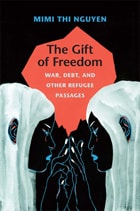
The Gift of Freedom
War, Debt, and Other Refugee PassagesMimi Thi Nguyen
Duke University Press, 2012

The Humane Economy
Populism, Capitalism, and DemocracyPollack, Norman
Rutgers University Press, 1990
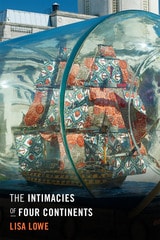
The Intimacies of Four Continents
Lisa Lowe
Duke University Press, 2015

The Limits of Liberty
Between Anarchy and LeviathanJames M. Buchanan
University of Chicago Press, 1977
James Buchanan offers a strikingly innovative approach to a pervasive problem of social philosophy. The problem is one of the classic paradoxes concerning man's freedom in society: in order to protect individual freedom, the state must restrict each person's right to act. Employing the techniques of modern economic analysis, Professor Buchanan reveals the conceptual basis of an individual's social rights by examining the evolution and development of these rights out of presocial conditions.
The Medieval Constitution of Liberty
Political Foundations of Liberalism in the WestAlexander William Salter and Andrew T. Young
University of Michigan Press, 2023
Why did enduring traditions of economic and political liberty emerge in Western Europe and not elsewhere? Representative democracy, constitutionalism, and the rule of law are crucial for establishing a just and prosperous society, which we usually treat as the fruits of the Renaissance and Enlightenment, as Western European societies put the Dark Ages behind them.
In The Medieval Constitution of Liberty, Salter and Young point instead to the constitutional order that characterized the High Middle Ages. They provide a historical account of how this constitutional order evolved following the fall of the Western Roman Empire. This account runs from the settlements of militarized Germanic elites within the imperial frontiers, to the host of successor kingdoms in the sixth and seventh centuries, and through the short-lived Carolingian empire of the late eighth and ninth centuries and the so-called “feudal anarchy” that followed its demise. Given this unique historical backdrop, Salter and Young consider the resulting structures of political property rights. They argue that the historical reality approximated a constitutional ideal type, which they term polycentric sovereignty. Salter and Young provide a theoretical analysis of polycentric sovereignty, arguing that bargains between political property rights holders within that sort of constitutional order will lead to improvements in governance.
The Paradoxes of Unintended Consequences
István Rév
Central European University Press, 2000
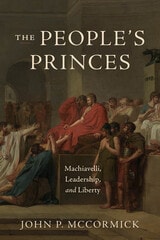
The People's Princes
Machiavelli, Leadership, and LibertyJohn P. McCormick
University of Chicago Press, 2025
A new window into Machiavelli’s idea of virtuous leadership and the appropriate relationship among leaders, common citizens, and elites.
For more than a decade, John P. McCormick has been at the forefront of a new wave of scholarship that reveals the anti-elitist and democratic commitments at the center of Niccolo Machiavelli’s political thought. In The People’s Princes, McCormick turns his attention to Machiavelli’s conception of virtuous leadership and Machiavelli’s views on the appropriate relationships among individual leaders, common citizens, and elites.
While most people think of Machiavelli as a cynical advisor of tyrants—a man who counseled leaders to aggrandize themselves, by any means necessary, at the expense of their subjects and citizens—The People’s Princes fundamentally challenges this understanding. Drawing from Machiavelli’s major political works a normative standard for leadership that emphasizes the mutually reinforcing relationship of civic leadership and popular government, McCormick delineates Machiavelli’s method of “political exemplarity” by analyzing in detail the Florentine’s case studies of leaders and their interactions with populaces throughout ancient and modern history.
McCormick argues that Machiavelli suggests that civic leaders should enhance their reputations by providing for their own eventual obsolescence; specifically, they should establish institutional means through which common citizens rule themselves more directly and substantively. The People’s Princes invites readers to consider Machiavelli anew, and also reflect on insights that remain relevant in the twenty-first century amidst growing concerns that political leaders are not accountable or responsive to popular majorities.
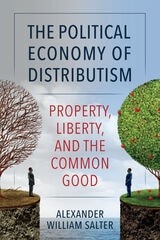
The Political Economy of Distributism
Property, Liberty, and the Common GoodAlexander William Salter
Catholic University of America Press, 2023
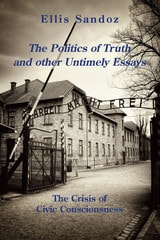
The Politics of Truth and Other Timely Essays
The Crisis of Civic ConsciousnessEllis Sandoz
St. Augustine's Press, 2016

The Politics of Truth and Other Untimely Essays
The Crisis of Civic ConsciousnessEllis Sandoz
University of Missouri Press, 1999
A fascinating collection of studies, The Politics of Truth and Other Untimely Essays explores the historical and theoretical underpinnings of personal liberty and free government and provides a trenchant analysis of the crisis of civic consciousness endangering both of them today. The book addresses a range of issues in contemporary political philosophy and constitutional theory. These are seen to be all the more urgent in importance because of the surging aspirations for liberty in the wake of the collapse of the Soviet empire and the post-Cold War anomaly of crisis, malaise, and disarray in free government itself in America and in other bastions of modern democracy.
While each essay can stand alone, there is an underlying thematic unity to the collection. The fundamental problem considered throughout is whether and to what extent the fall of communism may mark an epoch in world history. These questions are applied to the East Central European nations struggling to achieve free government and personal liberty. The elements required to identify the preconditions of liberty are addressed and specific attention is given to the terms of institutionalization in the American founding.
Several essays focus on American political thought, with emphasis on the Declaration of Independence and the Constitution. Two elements, in particular, are treated: the jurisprudential and common law background to the American political tradition and the centrality of religion within the unfolding of the American political experiment. Sandoz explores the uncommon alliance of philosophers, statesmen, and evangelists during the nation's founding. This alliance, nurturing communities of persons bound together by their faith and a mutual regard for one another, played a vital role in the establishment of the system of freedom under law.
Sandoz sees the tension between religion and natural law as a constant in the human struggle for freedom. That the preservation of liberty under law is no easy task is acknowledged and addressed as it can be seen in the American founding, in the post-communist struggle of East Central Europe, and in the deepening contemporary crisis of American society. Anyone interested in the "politics" of "truth" will appreciate this volume.
The Pox of Liberty
How the Constitution Left Americans Rich, Free, and Prone to InfectionWerner Troesken
University of Chicago Press, 2015
Werner Troesken looks at the history of the United States with a focus on three diseases—smallpox, typhoid fever, and yellow fever—to show how constitutional rules and provisions that promoted individual liberty and economic prosperity also influenced, for good and for bad, the country’s ability to eradicate infectious disease. Ranging from federalism under the Commerce Clause to the Contract Clause and the Fourteenth Amendment, Troesken argues persuasively that many institutions intended to promote desirable political or economic outcomes also hindered the provision of public health. We are unhealthy, in other words, at least in part because our political and legal institutions function well. Offering a compelling new perspective, The Pox of Liberty challenges many traditional claims that infectious diseases are inexorable forces in human history, beyond the control of individual actors or the state, revealing them instead to be the result of public and private choices.
The Spirit of Religion and the Spirit of Liberty
The Tocqueville Thesis RevisitedEdited by Michael P. Zuckert
University of Chicago Press Journals, 2017

The Springs of Liberty
The Satiric Tradition and Freedom of SpeechStewart Justman
Northwestern University Press, 1999
The Time of Liberty
Popular Political Culture in Oaxaca, 1750–1850Peter Guardino
Duke University Press, 2005
Guardino makes extensive use of archival materials, including judicial transcripts and newspaper accounts, to illuminate the dramatic contrasts between the local politics of the city and of the countryside, describing in detail how both sets of citizens spoke and acted politically. He contends that although it was the elites who initiated the national change to republicanism, the transition took root only when engaged by subalterns. He convincingly argues that various aspects of the new political paradigms found adherents among even some of the most isolated segments of society and that any subsequent failure of electoral politics was due to an absence of pluralism rather than a lack of widespread political participation.
The Virtual Point of Freedom
Essays on Politics, Aesthetics, and ReligionLorenzo Chiesa
Northwestern University Press, 2016
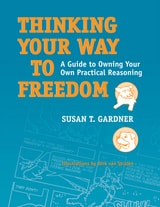
Thinking Your Way to Freedom
A Guide to Owning Your Own Practical ReasoningSusan T. Gardner
Temple University Press, 2009
Thinking Your Way to Freedom is a critical-thinking textbook with a difference. Rather than focusing exclusively on improving college students’ academic achievement, Susan Gardner seeks to dramatically change how students think through issues that are important in their lives beyond school. Gardner created 66 original and entertaining comic strips—featuring her dogs, Diva and Ben—that add a light touch as they encourage intellectual and personal autonomy. Through a clear step-by-step method of practical reasoning, students are taught how to think impartially and how to neutralize invisible biases that limit their freedom of thought and action. With the help of Diva and Ben, readers learn to evaluate the strengths of arguments and to recognize fallacies, all the while avoiding the paralyzing effects of relativism.
Thinking Your Way to Freedom includes the writing of short essays so that students can improve their critical thinking and writing at the same time. A Teacher’s Manual for this book will be available online.
Time and Freedom
Christophe Bouton
Northwestern University Press, 2014