Results by title
102 books match the query 'Limits' and 35 start with t
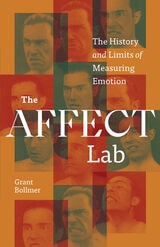
The Affect Lab
The History and Limits of Measuring EmotionGrant Bollmer
University of Minnesota Press, 2023
Examines how our understanding of emotion is shaped by the devices we use to measure it
Since the late nineteenth century, psychologists have used technological forms of media to measure and analyze emotion. In The Affect Lab, Grant Bollmer examines the use of measurement tools such as electrical shocks, photography, video, and the electroencephalograph to argue that research on emotions has confused the physiology of emotion with the tools that define its inscription.
Bollmer shows that the psychological definitions of emotion have long been directly shaped by the physical qualities of the devices used in laboratory research. To investigate these devices, The Affect Lab examines four technologies related to the history of psychology in North America: spiritualist toys at Harvard University, serial photography in early American psychological laboratories, experiments on “psychopaths” performed with an instrument called an Offner Dynograph, and the development of the “electropsychometer,” or “E-Meter,” by Volney Mathison and L. Ron Hubbard.
Challenging the large body of humanities research surrounding affect theory, The Affect Lab identifies an understudied problem in formulations of affect: how affect is a construction inseparable from the techniques and devices used to identify and measure it. Ultimately, Bollmer offers a new critique of affect and affect theory, demonstrating how deferrals to psychology and neuroscience in contemporary theory and philosophy neglect the material of experimental, scientific research.
Retail e-book files for this title are screen-reader friendly with images accompanied by short alt text and/or extended descriptions.
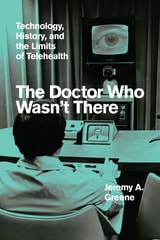
The Doctor Who Wasn't There
Technology, History, and the Limits of TelehealthJeremy A. Greene
University of Chicago Press, 2022
The Doctor Who Wasn’t There traces the long arc of enthusiasm for—and skepticism of—electronic media in health and medicine. Over the past century, a series of new technologies promised to democratize access to healthcare. From the humble telephone to the connected smartphone, from FM radio to wireless wearables, from cable television to the “electronic brains” of networked mainframe computers: each new platform has promised a radical reformation of the healthcare landscape. With equal attention to the history of technology, the history of medicine, and the politics and economies of American healthcare, physician and historian Jeremy A. Greene explores the role that electronic media play, for better and for worse, in the past, present, and future of our health.
Today’s telehealth devices are far more sophisticated than the hook-and-ringer telephones of the 1920s, the radios that broadcasted health data in the 1940s, the closed-circuit televisions that enabled telemedicine in the 1950s, or the online systems that created electronic medical records in the 1960s. But the ethical, economic, and logistical concerns they raise are prefigured in the past, as are the gaps between what was promised and what was delivered. Each of these platforms also produced subtle transformations in health and healthcare that we have learned to forget, displaced by promises of ever newer forms of communication that took their place.
Illuminating the social and technical contexts in which electronic medicine has been conceived and put into practice, Greene’s history shows the urgent stakes, then and now, for those who would seek in new media the means to build a more equitable future for American healthcare.
The Limits of Ancient Christianity
Essays on Late Antique Thought and Culture in Honor of R. A. MarkusWilliam E. Klingshirn and Mark Vessey, Editors
University of Michigan Press, 1999
William Klingshirn and Mark Vessey have assembled some of the most influential scholars in the study of Late Antiquity to test the limits of Christianity. The sixteen essays in this collection investigate the ways in which the concept of "limits" (temporal, spatial, ideological, social, and cultural) can help us to understand the texture of Christianity during this formative period. Taken together, the essays in this volume constitute as yet the most sustained study of cultural transformations evoked by Robert Markus's phrase "the end of ancient Christianity."
This timely volume will interest students of early Christian history and theology, as well as historians of the Roman empire and early middle ages. Because it examines a formative period of western civilization, it will also speak to anyone who wonders why Christianity takes the form it does today.
Contributors include Gerald Bonner, Peter Brown, Virginia Burrus, John Cavadini, Elizabeth Clark, Paula Fredriksen, Sidney Griffith, David Hunter, Conrad Leyser, Paul Meyvaert, Oliver Nicholson, James O'Donnell, Philip Rousseau, Frederick Russell, Carole Straw, and Robert Wilken.
William E. Klingshirn is Associate Professor of Greek and Latin, The Catholic University of America. Mark Vessey is Associate Professor of English, University of British Columbia.

The Limits of Auteurism
Case Studies in the Critically Constructed New HollywoodGodfrey, Nicholas
Rutgers University Press, 2018
The book explores the role that contemporary critics played in determining how the movies of this period were understood and how, in turn, strategies of distribution influenced critical responses and dictated the conditions of entry into the rapidly codifying New Hollywood canon. Focusing on a small number of industrially significant films, this new history advances our understanding of this important moment of transition from Classical to contemporary modes of production.
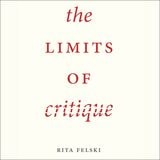
The Limits of Critique
Rita Felski
University of Chicago Press, 2015
Why must critics unmask and demystify literary works? Why do they believe that language is always withholding some truth, that the critic’s task is to reveal the unsaid or repressed? In this book, Rita Felski examines critique, the dominant form of interpretation in literary studies, and situates it as but one method among many, a method with strong allure—but also definite limits.
Felski argues that critique is a sensibility best captured by Paul Ricoeur’s phrase “the hermeneutics of suspicion.” She shows how this suspicion toward texts forecloses many potential readings while providing no guarantee of rigorous or radical thought. Instead, she suggests, literary scholars should try what she calls “postcritical reading”: rather than looking behind a text for hidden causes and motives, literary scholars should place themselves in front of it and reflect on what it suggests and makes possible.
By bringing critique down to earth and exploring new modes of interpretation, The Limits of Critique offers a fresh approach to the relationship between artistic works and the social world.
The Limits of Critique
Rita Felski
University of Chicago Press, 2015
Why must critics unmask and demystify literary works? Why do they believe that language is always withholding some truth, that the critic’s task is to reveal the unsaid or repressed? In this book, Rita Felski examines critique, the dominant form of interpretation in literary studies, and situates it as but one method among many, a method with strong allure—but also definite limits.
Felski argues that critique is a sensibility best captured by Paul Ricoeur’s phrase “the hermeneutics of suspicion.” She shows how this suspicion toward texts forecloses many potential readings while providing no guarantee of rigorous or radical thought. Instead, she suggests, literary scholars should try what she calls “postcritical reading”: rather than looking behind a text for hidden causes and motives, literary scholars should place themselves in front of it and reflect on what it suggests and makes possible.
By bringing critique down to earth and exploring new modes of interpretation, The Limits of Critique offers a fresh approach to the relationship between artistic works and the social world.
The Limits of Familiarity
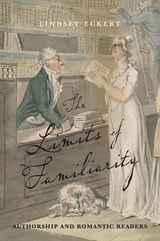
Authorship and Romantic ReadersLindsey Eckert
Bucknell University Press, 2022
What did Wordsworth wear, and where did he walk? Who was Byron’s new mistress, and how did his marriage fare? Answers—sometimes accurate, sometimes not—were tantalizingly at the ready in the Romantic era, when confessional poetry, romans à clef, personal essays, and gossip columns offered readers exceptional access to well-known authors. But at what point did familiarity become overfamiliarity? Widely recognized as a social virtue, familiarity—a feeling of emotional closeness or comforting predictability—could also be dangerous, vulgar, or boring. In The Limits of Familiarity, Eckert persuasively argues that such concerns shaped literary production in the Romantic period. Bringing together reception studies, celebrity studies, and literary history to reveal how anxieties about familiarity shaped both Romanticism and conceptions of authorship, this book encourages us to reflect in our own fraught historical moment on the distinction between telling all and telling all too much.

The Limits of Ferocity
Sexual Aggression and Modern Literary RebellionDaniel Fuchs
Duke University Press, 2011
The Limits of Heroism
Homer and the Ethics of ReadingMark Buchan
University of Michigan Press, 2005
The Limits of History
Constantin Fasolt
University of Chicago Press, 2003
So argues Constantin Fasolt in The Limits of History, an ambitious and pathbreaking study that conquers history's power by carrying the fight into the center of its domain. Fasolt considers the work of Hermann Conring (1606-81) and Bartolus of Sassoferrato (1313/14-57), two antipodes in early modern battles over the principles of European thought and action that ended with the triumph of historical consciousness. Proceeding according to the rules of normal historical analysis—gathering evidence, putting it in context, and analyzing its meaning—Fasolt uncovers limits that no kind of history can cross. He concludes that history is a ritual designed to maintain the modern faith in the autonomy of states and individuals. God wants it, the old crusaders would have said. The truth, Fasolt insists, only begins where that illusion ends.
With its probing look at the ideological underpinnings of historical practice, The Limits of History demonstrates that history presupposes highly political assumptions about free will, responsibility, and the relationship between the past and the present. A work of both intellectual history and historiography, it will prove invaluable to students of historical method, philosophy, political theory, and early modern European culture.
The Limits of Identity
Politics and Poetics in Latin AmericaBy Charles Hatfield
University of Texas Press, 2015
The Limits of Identity is a polemical critique of the repudiation of universalism and the theoretical commitment to identity and difference embedded in Latin American literary and cultural studies. Through original readings of foundational Latin American thinkers (such as José Martí and José Enrique Rodó) and contemporary theorists (such as John Beverley and Doris Sommer), Charles Hatfield reveals and challenges the anti-universalism that informs seemingly disparate theoretical projects.
The Limits of Identity offers a critical reexamination of widely held conceptions of culture, ideology, interpretation, and history. The repudiation of universalism, Hatfield argues, creates a set of problems that are both theoretical and political. Even though the recognition of identity and difference is normally thought to be a form of resistance, The Limits of Identity claims that, in fact, the opposite is true.
The Limits of Legitimacy
Dissenting Opinions, Media Coverage, and Public Responses to Supreme Court DecisionsMichael A. Zilis
University of Michigan Press, 2015
Zilis finds that the media tends not to quote from majority opinions. However, the greater the division over a particular ruling among the justices themselves, the greater the likelihood that the media will criticize that ruling, characterize it as "activist," and employ inflammatory rhetoric. Hethen demonstrates that the media’s portrayal of a decision, as much as the substance of the decision itself, influences citizens’ reactions to and acceptance of it.
This meticulously constructed study and its persuasively argued conclusion advance the understanding of the media, judicial politics, political institutions, and political behavior.

The Limits of Liberty
Between Anarchy and LeviathanJames M. Buchanan
University of Chicago Press, 1977
James Buchanan offers a strikingly innovative approach to a pervasive problem of social philosophy. The problem is one of the classic paradoxes concerning man's freedom in society: in order to protect individual freedom, the state must restrict each person's right to act. Employing the techniques of modern economic analysis, Professor Buchanan reveals the conceptual basis of an individual's social rights by examining the evolution and development of these rights out of presocial conditions.
The Limits of Market Organization
Richard R. Nelson
Russell Sage Foundation, 2005
The Limits of Matter
Chemistry, Mining, and EnlightenmentHjalmar Fors
University of Chicago Press, 2014
Fors reveals how, early in the eighteenth century, chemists began to view metals no longer as the ingredients for “chrysopoeia”—or gold making—but as elemental substances, or the basic building blocks of matter. At the center of this emerging idea, argues Fors, was the Bureau of Mines of the Swedish State, which saw the practical and profitable potential of these materials in the economies of mining and smelting.
By studying the chemists at the Swedish Bureau of Mines and their networks, and integrating their practices into the wider European context, Fors illustrates how they and their successors played a significant role in the development of our modern notion of matter and made a significant contribution to the modern European view of reality.

The Limits of Medicine
How Science Shapes Our Hope for the CureEdward S. Golub
University of Chicago Press, 1997
major advances in medicine are caused by changes in the way scientists describe disease.
Bleeding, sweating, and other treatments we consider barbaric were standard treatments for
centuries because they conformed to a conception of disease shared by patients and doctors.
Scientific breakthroughs in the understanding of disease in the nineteenth century transformed
treatment and the goals of medicine. Golub argues that the ongoing revolution in molecular
genetics has opened the door to the "biology of complexity," again transforming our view of
disease. This thought-provoking, timely book reveals a crucial but overlooked role of science
in medicine, and offers a new vision for the goals of both science and medicine as we enter the
twenty-first century.
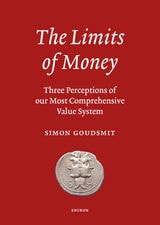
The Limits of Money
Three Perceptions of Our Most Comprehensive Value SystemSimon Goudsmit
Eburon Academic Publishers, 2005
The Limits of Money is an intriguing and much-needed study of the role of money in daily life and human societies.

The Limits of Okinawa
Japanese Capitalism, Living Labor, and Theorizations of CommunityWendy Matsumura
Duke University Press, 2015
The Limits of Orientalism
Seventeenth-Century Representations of IndiaRahul Sapra
University of Delaware Press, 2011
The Limits of Orientalism: Seventeenth-Century Representations of India challenges the recent postcolonial readings of European, predominantly English, representations of India in the seventeenth century. Following Edward Said’s discourse of “Orientalism,” most postcolonial analyses of the seventeenth-century representations of India argue that the natives are represented as barbaric or exotic “others,” imagining these representations as products of colonial ideology. Such approaches tend to offer a homogeneous idea of the “native” and usually equate it with the term “Indian.” Sapra, however, argues that instead of representing all natives as barbaric “others,” the English drew parallels, especially between themselves and the Mughal aristocracy, associating with them as partners in trade and potential allies in war. While the Muslims are from the outset largely portrayed as highly civilized and cultured, early European writers tended to be more conflicted with Hindus, their first highly negative views undergoing a transformation that brings into question any straightforward Orientalist reading of the texts and anticipates the complexity of later representations of the indigenous peoples of the sub-continent.
Sapra’s theoretical and methodological approach is influenced by such writers as Aijaz Ahmad and Denis Porter, who have highlighted powerful alternatives to Said’s discourse of “Orientalism.” Sapra historicizes European representations of the indigenous to draw attention to the contrasting approaches of the Portuguese, the Dutch and the English in relation to seventeenth-century India, effectively undermining comfortable notions of a homogenous “West.” Unlike the Portuguese, for whom the idea of a dynasty and the conversion of heathens went hand in hand with the idea of trade, for the Dutch and the English the primary consideration was commercial. In keeping with the commercial approach of the English East India Company, most English travelers, instead of representing the Muslims as barbaric “others,” highlight the compatibility between the two cultures and consistently praise the Mughal empire for its religious tolerance. In the representations of the Hindus, Sapra demonstrates that most writers, even while denigrating the Hindu religion, appreciate the civilized society of the Hindus. Moreover, in the representations of sati or widow-burning, a distinction needs to be made between the patriarchal and the Orientalist points of views, which are at variance with each other. The tension between the patriarchal and the Orientalist positions challenges Gayatri Chakravorty Spivak’s analysis of sati in “Can the Subaltern Speak?” which has become the standard model for most postcolonial appraisals of European representations of sati. The book highlights the lacuna in postcolonial readings by providing access to selections of commonly unavailable early-modern writings by Thomas Roe, Edward Terry, Henry Lord, Thomas Coryate, Alexander Hamilton and other the records of the East India Company, which makes the book vital for students of theory, European and South-Asian history, and Renaissance literatures.
Published by University of Delaware Press. Distributed worldwide by Rutgers University Press.
The Limits of Party
Congress and Lawmaking in a Polarized EraJames M. Curry and Frances E. Lee
University of Chicago Press, 2020
In The Limits of Party, James M. Curry and Frances E. Lee challenge this conventional wisdom. By constructing legislative histories of congressional majority parties’ attempts to enact their policy agendas in every congress since the 1980s and by drawing on interviews with Washington insiders, the authors analyze the successes and failures of congressional parties to enact their legislative agendas.
Their conclusions will surprise many congressional observers: Even in our time of intense party polarization, bipartisanship remains the key to legislative success on Capitol Hill. Congressional majority parties today are neither more nor less successful at enacting their partisan agendas. They are not more likely to ram though partisan laws or become mired in stalemate. Rather, the parties continue to build bipartisan coalitions for their legislative priorities and typically compromise on their original visions for legislation in order to achieve legislative success.

The Limits of Racial Domination
Plebeian Society in Colonial Mexico City, 1660–1720R. Douglas Cope
University of Wisconsin Press, 1994
In this distinguished contribution to Latin American colonial history, Douglas Cope draws upon a wide variety of sources—including Inquisition and court cases, notarial records and parish registers—to challenge the traditional view of castas (members of the caste system created by Spanish overlords) as rootless, alienated, and dominated by a desire to improve their racial status. On the contrary, the castas, Cope shows, were neither passive nor ruled by feelings of racial inferiority; indeed, they often modified or even rejected elite racial ideology. Castas also sought ways to manipulate their social "superiors" through astute use of the legal system. Cope shows that social control by the Spaniards rested less on institutions than on patron-client networks linking individual patricians and plebeians, which enabled the elite class to co-opt the more successful castas.
The book concludes with the most thorough account yet published of the Mexico City riot of 1692. This account illuminates both the shortcomings and strengths of the patron-client system. Spurred by a corn shortage and subsequent famine, a plebeian mob laid waste much of the central city. Cope demonstrates that the political situation was not substantially altered, however; the patronage system continued to control employment and plebeians were largely left to bargain and adapt, as before.
A revealing look at the economic lives of the urban poor in the colonial era, The Limits of Racial Domination examines a period in which critical social changes were occurring. The book should interest historians and ethnohistorians alike.
The Limits of Rationality
Edited by Karen Schweers Cook and Margaret Levi
University of Chicago Press, 1990
Intended to introduce novices to rational choice theory, this accessible, interdisciplinary book collects writings by leading researchers. The Limits of Rationality illuminates the rational choice paradigm of social and political behavior itself, identifies its limitations, clarifies the nature of current controversies, and offers suggestions for improving current models.
In the first section of the book, contributors consider the theoretical foundations of rational choice. Models of rational choice play an important role in providing a standard of human action and the bases for constitutional design, but do they also succeed as explanatory models of behavior? Do empirical failures of these explanatory models constitute a telling condemnation of rational choice theory or do they open new avenues of investigation and theorizing?
Emphasizing analyses of norms and institutions, the second and third sections of the book investigate areas in which rational choice theory might be extended in order to provide better models. The contributors evaluate the adequacy of analyses based on neoclassical economics, the potential contributions of game theory and cognitive science, and the consequences for the basic framework when unequal bargaining power and hierarchy are introduced.
The Limits of Religious Tolerance
Alan Jay Levinovitz
Amherst College Press, 2016
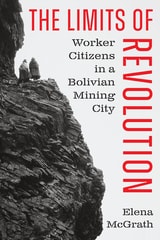
The Limits of Revolution
Worker Citizens in a Bolivian Mining CityElena McGrath
University of Texas Press, 2026
The role of Bolivian mining families in revolution and politics.
In 1952, Bolivia’s Revolutionary Nationalist Movement (MNR) swept into power, promising collective prosperity through class-based nationalism. The heroic symbol of the movement was the worker citizen—the formerly indigenous miner who would fuel economic development in a nationalized mining economy.
The Limits of Revolution explores this history from the worker barrios of the copper mining city of Corocoro. As the state walked back its promises of worker political power at the national level, mining men and women in Corocoro struggled—through protests, court battles, and barfights—to maintain the benefits of worker citizenship locally. After the MNR fell to a military dictatorship in 1964, however, families retreated to defending the nationalized mining company against an increasingly hostile state. In this battle to keep the revolution alive, the expansive potential of worker citizenship disappeared and old racial exclusions resurfaced. Largely forgotten today, Bolivia’s experience of revolution exposes the contradictions of postcolonial nationalism and sheds light on Latin America’s transition from Cold War–era class politics to twenty-first-century Pink Tide politics.

The Limits of Scientific Reasoning
David FaustForeword by Paul E. Meehl
University of Minnesota Press, 1984
The Limits of Scientific Reasoning was first published in 1984. Minnesota Archive Editions uses digital technology to make long-unavailable books once again accessible, and are published unaltered from the original University of Minnesota Press editions.
The study of human judgment and its limitations is essential to an understanding of the processes involved in the acquisition of scientific knowledge. With that end in mind, David Faust has made the first comprehensive attempt to apply recent research on human judgment to the practice of science. Drawing upon the findings of cognitive psychology, Faust maintains that human judgment is far more limited than we have tended to believe and that all individuals - scientists included—have a surprisingly restricted capacity to interpret complex information. Faust's thesis implies that scientists do not perform reasoning tasks, such as theory evaluation, as well as we assume they do, and that there are many judgments the scientist is expected to perform but cannot because of restrictions in cognitive capacity.
"This is a very well-written, timely, and important book. It documents and clarifies, in a very scholarly fashion, what sociologists and psychologists of science have been flirting with for several decades—namely, inherent limitations of scientific judgment," –Michael Mahoney, Pennsylvania State University
David Faust is director of psychology at Rhode Island Hospital and a faculty member of the Brown University Medical School. He is co-author of Teaching Moral Reasoning: Theory and Practice.

The Limits of Sovereignty
Property Confiscation in the Union and the Confederacy during the Civil WarDaniel W. Hamilton
University of Chicago Press, 2006
Americans take for granted that government does not have the right to permanently seize private property without just compensation. Yet for much of American history, such a view constituted the weaker side of an ongoing argument about government sovereignty and individual rights. What brought about this drastic shift in legal and political thought?
Daniel W. Hamilton locates that change in the crucible of the Civil War. In the early days of the war, Congress passed the First and Second Confiscation Acts, authorizing the Union to seize private property in the rebellious states of the Confederacy, and the Confederate Congress responded with the broader Sequestration Act. The competing acts fueled a fierce, sustained debate among legislators and lawyers about the principles underlying alternative ideas of private property and state power, a debate which by 1870 was increasingly dominated by today’s view of more limited government power.
Through its exploration of this little-studied consequence of the debates over confiscation during the Civil War, The Limits of Sovereignty will be essential to an understanding of the place of private property in American law and legal history.

The Limits of Transnationalism
Nancy L. Green
University of Chicago Press, 2019
The Limits of Utilitarianism
Harlan B. Miller and William H. Williams, Editors
University of Minnesota Press, 1982
The Limits of Utilitarianism was first published in 1982. Minnesota Archive Editions uses digital technology to make long-unavailable books once again accessible, and are published unaltered from the original University of Minnesota Press editions.
Many philosophers have argued that utilitarianism is an unacceptable moral theory and that promoting the general welfare is at best only one of the legitimate goals of public policy. Utilitarian principles seem to place no limits on the extent to which society may legitimately interfere with a person's liberties - provided that such actions can be shown to promote the long-term welfare of its members. These issues have played a central role in discussions of utilitarianism since the time of Bentham and Mill. Despite criticisms, utilitarianism remains the most influential and widely accepted moral theory of recent times.
In this volume contemporary philosophers address four aspects of utilitarianism: the principle of utility; utilitarianism vis-à-vis contractarianism; welfare; and voluntary cooperation and helping others. The editors provide an introduction and a comprehensive bibliography that covers all books and articles published in utilitarianism since 1930.
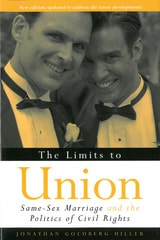
The Limits to Union
Same-Sex Marriage and the Politics of Civil RightsJonathan Goldberg-Hiller
University of Michigan Press, 2004
"The Limits to Union is a superb book about the complexities of recent political struggles over same-sex marriage. Goldberg-Hiller offers a sophisticated account of egalitarian rights advocacy and the reaction it has generated from established majorities animated by a 'new common sense' of exclusionary sovereign authority. The author's analysis is multidimensional and nuanced, but the core argument is bold, important, and well-supported. I recommend it very highly to everyone interested in understanding the character, possibilities, and constraints of civil rights amid our contemporary culture wars."
-Michael McCann, author of Rights at Work: Pay Equity Reform and the Politics of Legal Mobilization
"In this excellent book, Goldberg-Hiller uses Hawaii's experience to examine the interaction between courts and the political system. . . . Relying on briefs, legislative statements, and interviews with activists from both sides of the question, he views this familiar debate . . . through the unfamiliar prism of gay marriage, which allows him to gauge the viability and the pliability of the American civil rights ideal, and how gay and lesbian issues fit (or don't fit) within that ideal."
-Willian Heinzen, New York Law Journal
"Goldberg-Hiller presents the history of the same-sex marriage question since it first sparked debate in Hawaii. He follows the shifting debate through court cases, state propositions, and state and federal legislatures, considering questions about the constitutionality of the Defense of Marriage Act and the concept of equal protection under the law for gays and lesbians. This detailed treatment of the legal issues surrounding same-sex marriages is highly recommended."
-R. L. Abbott, University of Evansville
"[A] valuable contribution to the field, situating the gay marriage debate in broader contexts of theory, law and practice. [S]ame-sex marriage is an important issue...that finds itself caught in the friction points of much larger debates over the nature of rights, the limits of sovereignty and the proper role of courts and law in a democratic society. The Limits to Union should therefore be of interest even to those who do not think of themselves as interested in gay and lesbian rights issues."
-Evan Gerstmann, Loyola Marymount University, Law and Politics Book Review

The Limits to Union
Same-Sex Marriage and the Politics of Civil RightsJonathan Goldberg-Hiller
University of Michigan Press, 2002
"The Limits to Union is a superb book about the complexities of recent political struggles over same-sex marriage. Goldberg-Hiller offers a sophisticated account of egalitarian rights advocacy and the reaction it has generated from established majorities animated by a 'new common sense' of exclusionary sovereign authority. The author's analysis is multidimensional and nuanced, but the core argument is bold, important, and well-supported. I recommend it very highly to everyone interested in understanding the character, possibilities, and constraints of civil rights amid our contemporary culture wars."
-Michael McCann, author of Rights at Work: Pay Equity Reform and the Politics of Legal Mobilization
"In this excellent book, Goldberg-Hiller uses Hawaii's experience to examine the interaction between courts and the political system. . . . Relying on briefs, legislative statements, and interviews with activists from both sides of the question, he views this familiar debate . . . through the unfamiliar prism of gay marriage, which allows him to gauge the viability and the pliability of the American civil rights ideal, and how gay and lesbian issues fit (or don't fit) within that ideal."
-Willian Heinzen, New York Law Journal
"Goldberg-Hiller presents the history of the same-sex marriage question since it first sparked debate in Hawaii. He follows the shifting debate through court cases, state propositions, and state and federal legislatures, considering questions about the constitutionality of the Defense of Marriage Act and the concept of equal protection under the law for gays and lesbians. This detailed treatment of the legal issues surrounding same-sex marriages is highly recommended."
-R. L. Abbott, University of Evansville
"[A] valuable contribution to the field, situating the gay marriage debate in broader contexts of theory, law and practice. [S]ame-sex marriage is an important issue...that finds itself caught in the friction points of much larger debates over the nature of rights, the limits of sovereignty and the proper role of courts and law in a democratic society. The Limits to Union should therefore be of interest even to those who do not think of themselves as interested in gay and lesbian rights issues."
-Evan Gerstmann, Loyola Marymount University, Law and Politics Book Review

The Ocean Is a Wilderness
Atlantic Piracy and the Limits of State Authority, 1688-1856Guy Chet
University of Massachusetts Press, 2014
Chet shows how the traditional focus on the growth of the modern state overlooked the extent to which old attitudes and cultural practices continued to hold sway. Even as the British government extended its naval, legal, and bureaucratic reach, in many parts of the Atlantic world illegal trade was not only tolerated but encouraged. In part this was because Britain's constabulary command of the region remained more tenuous than some have suggested, and in part because maritime insurance and wartime tax policies ensured that piracy and smuggling remained profitable. When Atlantic piracy eventually waned in the early nineteenth century, it had more to do with a reduction in its profitability at port than with forceful confrontation at sea.
Challenging traditional accounts that chronicle forces of civilization taming a wild Atlantic frontier, this book is a valuable addition to a body of borderlands scholarship reevaluating the relationship between the emerging modern state and its imperial frontiers.
The Three and a Half Minute Transaction
Boilerplate and the Limits of Contract DesignMitu Gulati and Robert E. Scott
University of Chicago Press, 2012
Boilerplate language in contracts tends to stick around long after its origins and purpose have been forgotten. Usually there are no serious repercussions, but sometimes it can cause unexpected problems. Such was the case with the obscure pari passu clause in cross-border sovereign debt contracts, until a novel judicial interpretation rattled international finance by forcing a defaulting sovereign—for one of the first times in the market’s centuries-long history—to repay its foreign creditors. Though neither party wanted this outcome, the vast majority of contracts subsequently issued demonstrate virtually no attempt to clarify the imprecise language of the clause.
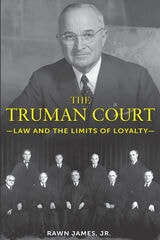
The Truman Court
Law and the Limits of LoyaltyRawn James
University of Missouri Press, 2021
The Truman Court: Law and the Limits of Loyalty argues that the years between FDR’s death in 1945 and Chief Justice Earl Warren’s confirmation in 1953—the dawn of the Cold War—were, contrary to widespread belief, important years in Supreme Court history. Never before or since has a president so quickly and completely changed the ideological and temperamental composition of the Court. With remarkable swiftness and certainty, Truman constructed a Court on which he relied to lend constitutional credence to his political agenda.

Too Far on a Whim
The Limits of High-Steam Propulsion in the US NavyTyler A. Pitrof
University of Alabama Press, 2024
WINNER OF THE LYMAN BOOK AWARD FOR MARITIME AND NAVAL SCIENCE, TECHNOLOGY, AND ENVIRONMENT
Argues that the US Navy’s commitment to high-steam propulsion for its World War II fleet was a tactical, technological, and bureaucratic failure
In Too Far on a Whim, Tyler A. Pitrof presents a high-spirited revision of the US Navy’s commitment to high-steam propulsion systems, the mainstay of its World War II fleets. Pitrof’s research persuasively demonstrates that in its war against the Imperial Japanese Navy, the US Navy succeeded despite its high-steam propulsion systems rather than because of them.
War with an aggressive Japan and a resurgent Germany loomed in the dark days of the late 1930s. Rear Admiral Harold G. Bowen Sr., head of the US Navy’s Bureau of Engineering, advanced a radical vision: a new fleet based on high-steam propulsion, a novel technology that promised high speeds with smaller engines and better fuel efficiency. High-steam engines had drawbacks—smaller operational ranges and maintenance issues. Nevertheless, trusting its engineers to resolve these issues, the US Navy put high-steam propulsion at the heart of its warship design from 1938 to 1945.
The official record of high-steam technology’s subsequent performance has relied heavily on Bowen’s own memoir, in which he painted high-steam innovation in heroic colors. Pitrof’s empirical review of primary sources such as ship’s maintenance records, however, illuminates the opposite—that the heroism lay in the ability of American seamen to improvise solutions to keep these difficult engines running.
Pitrof artfully explains engineering concepts in layman’s terms and provides an account that extends far beyond technology and into matters of naval hierarchies and bureaucracy, strategic theory, and ego. He offers a cautionary tale—as relevant to any endeavor as it is to military undertakings—about how failures arise when technical experts lack managers who understand their work. Admiral Bowen wielded excessive power because no one else in the US Navy knew enough to countermand him.
Compulsively readable, Too Far on a Whim is a landmark for those interested in naval history and technology but also for readers interested in the interplay between innovation, decision-making, and engineering.

Truman and the Steel Seizure Case
The Limits of Presidential PowerMaeva Marcus
Duke University Press, 1994