Results by title
8113 books match the query 'Literary Criticism' and 1818 start with t
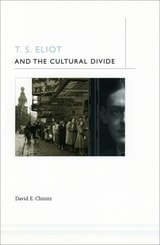
T. S. Eliot and the Cultural Divide
David E. Chinitz
University of Chicago Press, 2003
David Chinitz argues that Eliot was productively engaged with popular culture in some form at every stage of his career, and that his response to it, as expressed in his poetry, plays, and essays, was ambivalent rather than hostile. He shows that American jazz, for example, was a major influence on Eliot's poetry during its maturation. He discusses Eliot's surprisingly persistent interest in popular culture both in such famous works as The Waste Land and in such lesser-known pieces as Sweeney Agonistes. And he traces Eliot's long, quixotic struggle to close the widening gap between high art and popular culture through a new type of public art: contemporary popular verse drama.
What results is a work that will persuade adherents and detractors alike to return to Eliot and find in him a writer who liked a good show, a good thriller, and a good tune, as well as a "great" poem.
TEXT
Transactions of the Society for Textual Scholarship, Volume 7D. C. Greetham and W. Speed Hill, Editors
University of Michigan Press, 1994
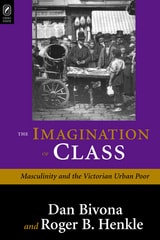
THE IMAGINATION OF CLASS
MASCULINITY AND THE VICTORIAN URBAN POORDan Bivona and Roger B. Henkle
The Ohio State University Press, 2006
Through carefully nuanced discussions of a variety of Victorian novelists, journalists, and sociological investigators (some well known, like Dickens, and others less well known, like Masterman and Greenwood), the book offers new insight into the role played by the imagination of the urban poor in the construction of Victorian middle class masculinity. Whereas many scholars have discussed the feminization of the poor, virtually no one has addressed how the poor have served as a site at which middle class men fashioned their own class and gender identity.
THE NOVEL AND THE MENAGERIE
TOTALITY, ENGLISHNESS, AND EMPIREKURT KOENIGSBERGER
The Ohio State University Press, 2007
Taboo Pushkin
Topics, Texts, InterpretationsEdited by Alyssa Dinega Gillespie
University of Wisconsin Press, 2012
Since his death in 1837, Alexander Pushkin—often called the “father of Russian literature”—has become a timeless embodiment of Russian national identity, adopted for diverse ideological purposes and reinvented anew as a cultural icon in each historical era (tsarist, Soviet, and post-Soviet). His elevation to mythic status, however, has led to the celebration of some of his writings and the shunning of others. Throughout the history of Pushkin studies, certain topics, texts, and interpretations have remained officially off-limits in Russia—taboos as prevalent in today’s Russia as ever before.
The essays in this bold and authoritative volume use new approaches, overlooked archival materials, and fresh interpretations to investigate aspects of Pushkin’s biography and artistic legacy that have previously been suppressed or neglected. Taken together, the contributors strive to create a more fully realized Pushkin and demonstrate how potent a challenge the unofficial, taboo, alternative Pushkin has proven to be across the centuries for the Russian literary and political establishments.
Taboo Subjects
Race, Sex, and PsychoanalysisGwen Bergner
University of Minnesota Press, 2005
Tactics of the Human
Experimental Technics in American FictionLaura Shackelford
University of Michigan Press, 2015
Taking Books to the World
American Publishers and the Cultural Cold WarAmanda Laugesen
University of Massachusetts Press, 2017
In Taking Books to the World, Amanda Laugesen tells the story of this purposeful enterprise, demonstrating the mix of goodwill and political drive behind its efforts to create modern book industries in developing countries. Examining the project through a clarifying lens, she reveals the ways Franklin's work aligned with cultural currents, exposing the imperial beliefs, charitable hopes, and intellectual reasoning behind this global experiment.
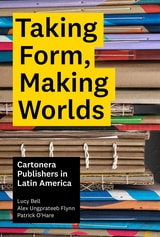
Taking Form, Making Worlds
Cartonera Publishers in Latin AmericaLucy Bell, Alex Ungprateeb Flynn, Patrick O’Hare
University of Texas Press, 2022
2023 LASA Visual Culture Studies Section Book Prize, Latin American Studies Association (LASA)
The first comprehensive study of cartonera, a vibrant publishing phenomenon born in Latin America.
A publishing phenomenon and artistic project, cartonera was born in the wake of Argentina’s 2001 economic crisis. Infused with a rebellious spirit, it has exploded in popularity, with hundreds of publishers across Latin America and Europe making colorful, low-cost books out of cardboard salvaged from the street. Taking Form, Making Worlds is the first comprehensive study of cartonera. Drawing on interdisciplinary research conducted across Mexico, Brazil, and Argentina, the authors show how this hands-on practice has fostered a politically engaged network of writers, artists, and readers. More than a social movement, cartonera uses texts, workshops, encounters, and exhibitions to foster community and engagement through open-ended forms that are at once artistic and social. For various groups including waste-pickers, Indigenous communities, rural children, and imprisoned women, cartonera provides a platform for unique stories and sparks collaborations that bring the walls of the “lettered city” tumbling down. In contexts of stigma and exclusion, cartonera collectives give form to a decolonial aesthetics of resistance, making possible a space of creative experimentation through which plural worlds can be brought to life.
Taking Her Seriously
Penelope and the Plot of Homer's OdysseyRichard Heitman
University of Michigan Press, 2005
---Choice
---Bryn Mawr Classical Review
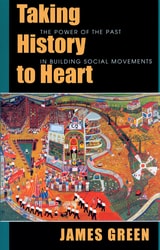
Taking History to Heart
The Power of the Past in Building Social MovementsJames Green
University of Massachusetts Press, 2000
Deftly blending autobiography and history, James Green here reflects on thirty years as an activist, educator, and historian. He recounts how he became deeply immersed in political protest and in recovering and preserving the history of progressive social movements, and how the two are linked. His book, written in an engaging and accessible style, tells powerful stories of people in struggle, framed by the personal account of his own development. As a historian, Green gives voice to generations of Americans who banded together to fight for social justice. His subjects range from the martyrs of the Haymarket tragedy to the Bread and Roses strikers of 1912, from depression-era struggles for democracy to the civil rights crusaders, from recent Rainbow Coalition campaigns to the latest union organizing drives. As an activist, Green describes how his participation in the civil rights and labor movements of our own time has transformed his life, first as a student and radical scholar in the 1960s, then as a public historian and teacher of working-class students. He also describes his efforts to break free from academic confinement and “tell movement stories in public,” in an attempt to offer hope and counsel to those still fighting for equality and fairness. He concludes with a revealing look at how awareness of past social activism has contributed to the revival of the labor movement during the last ten years, an effort in which Green has been vigorously engaged.
Taking Their Word
Literature and the Signs of Central AmericaArturo Arias
University of Minnesota Press, 2007
Central Americans are one of the largest Latino population groups in the United States. Yet, Arturo Arias argues, the cultural production of Central Americans remains little known to North Americans.
In Taking Their Word, Arias complicates notions of the cultural production of Central America, from Mexico in the North to Panama in the South. He charts the literature of Central America’s liberation struggles of the 1970s and 1980s, its transformation after peace treaties were signed, the emergence of a new Maya literature that decenters Latin American literature written in Spanish, and the rise and fall of testimonio. Arias demonstrates that Central America and its literature are marked by an indigenousness that has never before been fully theorized or critically grasped. Never one to avoid controversy, Arias proffers his views of how the immigration of Central Americans to North America has changed the cultural topography of both zones.
With this groundbreaking work, Arias establishes the importance of Central American literature and provides a frame for future studies of the region’s culture.
Arturo Arias is director of Latin American studies at the University of Redlands. He is the author of six novels in Spanish and editor of The Rigoberta Menchú Controversy (Minnesota, 2001).
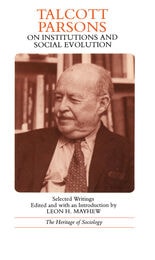
Talcott Parsons on Institutions and Social Evolution
Selected WritingsTalcott Parsons
University of Chicago Press, 1983
In his extensive introduction to this volume, Leon H. Mayhew brings a new focus and clarity to Talcott Parsons's work. Explicating Parsons on his own terms, Mayhew discusses the basic tools of Parsonian analysis and interprets the larger themes of his work. He provides a chronological account of the development of Parsons's thought, his presuppositions, and his position on the ideological spectrum of social thought.
Mayhew then presents twenty of Parsons's essays, touching on each of the major aspects of his work, including "action" theory and the celebrated four-function scheme. Other topics covered include the role of theory in social research, evolutionary universals in society, influence, control, and the mass media.
"Talcott Parsons on Institutions and Social Evolution will become a standard reference for those studying that development of his sociological ideas."—Martin Bulmer, The Times Higher Education Supplement
Tale of a Criminal Mind Gone Good
Nathan Lefler
St. Augustine's Press, 2021
Entrée G. K. Chesterton. If Girard recognizes the talent certain literary figures have for observing what celebrated philosophers fail to see, Chesterton is one of these men of real vision. Lefler in his match-making is interested in “Romance and the romantic,” and placing Girard and Chesterton in a kind of dialogue he draws a clearer concept of Romanticism. Who is the Romatic hero? And why do we so badly need to know? If what Lefler sees in Chesterton and Girard requires “special pleading” on the part of the reader for the author to make himself more clear, Lefler obliges. He takes a sharp turn into the Father Brown stories and points the reader to Chesterton’s famous villain: Flambeau, the “colossus of crime”. The moral transition from sinner to saint in Flambeau is strikingly anti-Romantic and, with Girard in mind, also very much anti-mimetic. Or is it? Lefler argues that even Girard would have “inclined his own regal forehead in delight and awe” at Chesterton’s portrayal of the crowning Romantic quality and unlikely machete in an overgrown jungle of the self-intoxicated modern imagination––namely, humility.
Lefler makes his mark in several places with this new study. As literary critic, both Chesterton and Girard are honored. As philosopher, Lefler speaks as if somehow he managed to find a pocket of unpolluted air to breath. As theologian, he betrays that he also loves what Chesterton and Girard loved. And as special service to the reader, the full text of Chesterton’s The Queer Feet is provided.
Tales Out of School
Gender, Longing, and the Teacher in Fiction and FilmJo Keroes
Southern Illinois University Press, 1999
Jo Keroes's scope is wide: she examines the teacher as represented in fiction and film in works ranging from the twelfth-century letters of Abelard and Heloise to contemporary films such as Dangerous Minds and Educating Rita. And from the twelfth through the twentieth century, Keroes shows, the teaching encounter is essentially erotic.
Tracing the roots of eros from cultural as well as psychological perspectives, Keroes defines erotic in terms broader than the merely sexual. She analyzes ways in which teachers serve as convenient figures on whom to map conflicts about gender, power, and desire. To show how portrayals of men and women differ, she examines pairs of texts, using a film or a novel with a woman protagonist (Up the Down Staircase, for example) as counterpoint to one featuring a male teacher (Blackboard Jungle) or The Prime of Miss Jean Brodie balanced against Dead Poets Society.
The portrayals of teachers, like all images a culture presents of itself, reveal much about our private and social selves. Keroes points out authentic accounts of authoritative women teachers who are admired and respected by colleagues and students alike. Real teachers differ from the stereotypes we see in fiction and film, however. Male teachers are often portrayed as heroes in film and fallibly human in fiction, whereas women in either genre are likely to be monstrous or muddled and are virtually never women of color. Among other things, Keroes demonstrates, the tension between reality and representation reveals society's ambivalence about power in the hands of women.
Tales Out of School
Selected InterviewsRobert Creeley
University of Michigan Press, 1994

Tales and Sketches, vol. 1
1831-1842Edgar Allan Poe
University of Illinois Press, 1978
Poe's stories reflect his professed method of "writing as if the author were firmly impressed with the truth, yet astonished at the immensity of the wonders he related." Marrying grotesque inventiveness with superb plot construction, Poe's strikingly original tales often use only one main character and one main incident. In many of them, horror and suspense, revenge and torture, are laced with hilarious satire. Each volume is enriched with Mabbott's detailed and authoritative notes on sources, the history and collation of all known texts authorized by Poe, and variants of Poe's "final" version.
Volume 1 includes Poe's earliest parodies, beginning in 1831, and gathers his gothic tales written through 1842. The stories collected in this volume include "Ms. Found in a Bottle," the horrific "Berenice," "Ligeia" (which Poe considered his finest tale), "The Murders in the Rue Morgue," and one of his most famous stories, "The Fall of the House of Usher."
Promising spine-tingling delights and sleepless nights, this annotated edition of Tales and Sketches is a treasure trove for scholars and general readers alike, confirming Poe's status as one of literary art's "most brilliant but erratic stars."
Tales and Sketches, vol. 2
1843-1849Edgar Allan Poe
University of Illinois Press, 1978
Poe's stories reflect his professed method of "writing as if the author were firmly impressed with the truth, yet astonished at the immensity of the wonders he related." Marrying grotesque inventiveness with superb plot construction, Poe's strikingly original tales often use only one main character and one main incident. In many of them, horror and suspense, revenge and torture, are laced with hilarious satire. Each volume is enriched with Mabbott's detailed and authoritative notes on sources, the history and collation of all known texts authorized by Poe, and variants of Poe's "final" version.
Volume 2 contains stories written between 1843 and Poe's death, including "The Tell-Tale Heart," "The Purloined Letter," and "The Cask of Amontillado."
Promising spine-tingling delights and sleepless nights, this annotated edition of Tales and Sketches is a treasure trove for scholars and general readers alike, confirming Poe's status as one of literary art's "most brilliant but erratic stars."
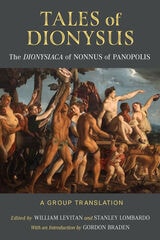
Tales of Dionysus
The Dionysiaca of Nonnus of PanopolisEdited by William Levitan and Stanley Lombardo
University of Michigan Press, 2022
Tales of Dionysus is the first English verse translation of one of the most extraordinary poems of the Greek literary tradition, the Dionysiaca of Nonnus of Panopolis. By any standard, the Dionysiaca is a formidable work. It is by far the longest poem surviving from the classical world, a massive mythological epic stretching to over 20,000 lines, written in the tradition of Homer, using Homer’s verse, Homer’s language, his narrative turns and motifs, and invoking his ancient Muses. But it is also the last ancient epic to follow a Homeric model, composed so late in fact that it stands as close in time to the Renaissance as it does to archaic Greece. Like its titular hero, Dionysus, with his fluidity of forms, names, and divine incarnations, the poem itself is continually shifting shape. Out of its formal epic frame spills a tumult of ancient literary types: tragedy, elegy, didactic, panegyric, pastoral idyll, and the novel are all parts of this gigantic enterprise, each genre coming to the fore one after the other.
Tales of Dionysus brings together forty-two translators from a wide range of backgrounds, with different experiences and different potential relationships to the text of Nonnus’ poem. All work in their own styles and with their own individual approaches to the poem, to translation, and to poetic form. This variety turns Tales of Dionysus into a showcase of the multiple possibilities open to classical translation in the contemporary world.
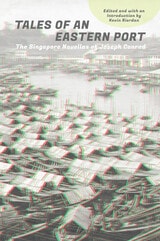
Tales of an Eastern Port
The Singapore Novellas of Joseph ConradJoseph Conrad
National University of Singapore Press, 2023
In the 1880s, Joseph Conrad spent three extended stints in the colonial port city of Singapore, while working on ships around the region. Over the next thirty years, he would return to this place many times in his writing. Singapore is the principal, if sometimes obscured, port of call in Conrad’s fiction; it is the center of overlapping networks, colonial and commercial, religious and literary. His characters travel to upriver Borneo and to Bangkok, to Shanghai and to Sydney, and yet they tend to return to Singapore.
This volume pairs for the first time two Conrad novellas that start in Singapore: The End of the Tether and The Shadow-Line.Together they provide a fleeting portrait of the developing city, through narrators who are uneasy with the trappings and workings of the colonial enterprise. These stories have renewed relevance as part of global modernist and oceanic literatures, and reading them now helps recall one chapter in Singapore’s long history as a vital site of cultural exchange, one that harbors and inspires distinctive storytelling traditions.
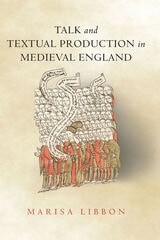
Talk and Textual Production in Medieval England
Marisa Libbon
The Ohio State University Press, 2021
Talking All Morning
Robert Bly
University of Michigan Press, 1980
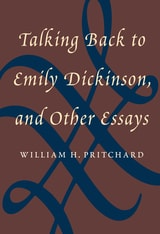
Talking Back to Emily Dickinson, and Other Essays
William H. Pritchard
University of Massachusetts Press, 2009
The essays, all of them about English and American writers, are arranged chronologically, beginning with Shakespeare, an Edmund Burke, and proceeding through the nineteenth and twentieth centuries to end with contemporaries like Kinglsey Amis, V. S. Naipaul, and Doris Lessing. Pritchard writes with equal authority about poetry and fiction; the collection also includes assessments of critics such as Matthew Arnold and Thomas Carlyle, Ford Madox Ford and R. P. Blackmur.
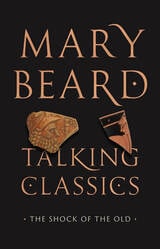
Talking Classics
The Shock of the OldMary Beard
University of Chicago Press, 2026
Why the ongoing fascination with the ancient world? This witty, approachable book asks why—for better or (sometimes) worse—antiquity continues to exert such a powerful hold on the contemporary imagination. Recalling a formative childhood encounter with a four-thousand-year-old piece of bread in a museum, Beard introduces the idea of thauma, or wonder, that kick-started a lifetime engaging with classics. It was not the canonical “greats” of ancient literature and art that initially drew her in, she confesses, but rather the more intimate, messy, and humdrum evidence of daily life in the remote past.
Confronting the uses and abuses of symbols of the ancient world, Beard reminds us that the traditions and “masterpieces” of Greece and Rome have certainly been politicized, but they belong to neither the left nor the right. Happily, no one owns the past. She warns us not to let a sense of reverence or overfamiliarity dampen the “shock of the old,” arguing that one of the most important things that classics teach us is how to grapple with complicated and controversial things. “The Greeks and Romans are long dead, they cannot answer back, and you can say what you like about them,” she reminds readers. “The simple fact that classics belong to none of us can offer a safe space to argue about the most difficult debates we face now.”
Beard welcomes everyone into classics. “It is not compulsory to be excited by the ancient world,” she writes. “But it can be a shame not to be.” This charming, sharp, and readable book from one of the world’s most entertaining classicists offers something for both new and established fans of classics, bringing new wonder and curiosity to even the most ancient of ideas.
Talking Classics
The Shock of the OldMary Beard
University of Chicago Press, 2026
Why the ongoing fascination with the ancient world? This witty, approachable book asks why—for better or (sometimes) worse—antiquity continues to exert such a powerful hold on the contemporary imagination. Recalling a formative childhood encounter with a four-thousand-year-old piece of bread in a museum, Beard introduces the idea of thauma, or wonder, that kick-started a lifetime engaging with classics. It was not the canonical “greats” of ancient literature and art that initially drew her in, she confesses, but rather the more intimate, messy, and humdrum evidence of daily life in the remote past.
Confronting the uses and abuses of symbols of the ancient world, Beard reminds us that the traditions and “masterpieces” of Greece and Rome have certainly been politicized, but they belong to neither the left nor the right. Happily, no one owns the past. She warns us not to let a sense of reverence or overfamiliarity dampen the “shock of the old,” arguing that one of the most important things that classics teach us is how to grapple with complicated and controversial things. “The Greeks and Romans are long dead, they cannot answer back, and you can say what you like about them,” she reminds readers. “The simple fact that classics belong to none of us can offer a safe space to argue about the most difficult debates we face now.”
Beard welcomes everyone into classics. “It is not compulsory to be excited by the ancient world,” she writes. “But it can be a shame not to be.” This charming, sharp, and readable book from one of the world’s most entertaining classicists offers something for both new and established fans of classics, bringing new wonder and curiosity to even the most ancient of ideas.
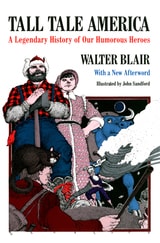
Tall Tale America
A Legendary History of our Humorous HeroesWalter Blair
University of Chicago Press, 1987
Tangential Terrains
Cormac McCarthy's GeoaestheticsStefanie Heine
University of Nevada Press, 2026
Blood Meridian’s emergent geoaesthetics reveals forces operating according to other-than-human principles, as literary desert terrains retain a passive resistance, or weak agency, which presents a radical disturbance of anthropocentrism, mirrored in the novel’s style. Though the mediated unstable deserts in Blood Meridian defy appropriation, they are neither untouched nor untouchable: the borderlands bear the wounds and “blood meridians” of a non-chronological history of violence, tangential to the massacres of Native American and Mexican peoples depicted in the novel.
Stefanie Heine’s reading of Blood Meridian offers a crucial contribution to and intervention in contemporary ecocriticism, Anthropocene criticism, and New Materialist theories, encouraging readers to critically rethink customary notions of entanglement, kinship, and agency.
Tapestries of Life
Women's Work, Women's Consciousness, and the Meaning of Daily ExperienceBettina Aptheker
University of Massachusetts Press, 1989
Tarpeia
Workings of a Roman MythTara S. Welch
The Ohio State University Press, 2015
Welch demonstrates how ancient thinkers used Tarpeia’s myth to highlight matters of ethics, gender, ethnicity, political authority, language, conquest, and tradition. This cluster of themes reveals that Tarpeia’s myth is not primarily about what it means to be human, but rather what it means to be Roman. Thus Tarpeia’s story spans centuries, distances, genres, and modes of communication—Rome itself did. No Greek city-state could admit such continuity, and Greece was never so constant. In this way, though Tarpeia has a dozen Greek cousins whose stories are similar to hers, hers is a powerfully Roman myth, even for the Greeks who told her tale. She is token, totem, and symbol of Rome.
Taste
Giorgio Agamben
Seagull Books, 2017
Taste, Agamben argues, is a category that has much to reveal to the contemporary world. Taking a step into the history of philosophy and reaching to the very origins of aesthetics, Agamben critically recovers the roots of one of Western culture’s cardinal concepts. Agamben is the rare writer whose ideas and works have a broad appeal across many fields, and with Taste he turns his critical eye to the realm of Western art and aesthetic practice. This volume will not only engage the author’s devoted fans in philosophy, sociology, and literary criticism but also his growing audience among art theorists and historians.
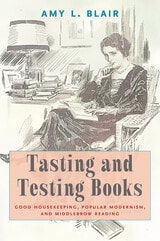
Tasting and Testing Books
Good Housekeeping, Popular Modernism, and Middlebrow ReadingAmy L. Blair
University of Massachusetts Press, 2024
A CHOICE 2025 Outstanding Academic Title
Honorable Mention, 2023-2024 Research Society of American Periodicals Book Prize
In its February 1926 issue, Good Housekeeping magazine introduced a column for its approximately one million subscribers called “Tasting and Testing Books.” The column’s author, Emily Newell Blair, would go on to produce ninety-one reading advice columns for the magazine between 1926 and 1934. During this period, Good Housekeeping became the most widely circulated periodical in the United States, doubling its circulation to over two million copies. Much of its popularity stemmed from its intensive promotion of its Seal of Approval for a variety of products, which brought consumers to it for utilitarian purposes. With her focus on regular books, Blair distinguished herself from highbrow literary critics, many of whom have been objects of study as High Modernists. She offered advice to help middle-class women readers make their own choices about the best books in which to invest time and money, rather than dictating what they should or should not read. She aligns herself with the average subscriber, outside the book publishing and reviewer industries, focusing on books that would now be termed middlebrow reading.
Blair’s time at Good Housekeeping covers the era from the heights of the “Roaring Twenties” to the depths of the Great Depression, and her recommendations offer a window into the uses of middlebrow reading during this period of dramatic economic and social shifts. Tasting and Testing Books argues that the consumer-first message of Good Housekeeping infused Blair’s advice column and validated a new attitude of proudly middlebrow pleasure reading in the mid-twentieth century. These columns shed new light on the reading lives of too-often overlooked women, often living outside of urban centers and away from elite literary circles, and present Emily Newell Blair, who strongly identified with her readers as a truly democratic tastemaker.

Taylored Lives
Narrative Productions in the Age of Taylor, Veblen, and FordMartha Banta
University of Chicago Press, 1993

Teaching Shakespeare into the Twenty-First Century
Ronald E. Salomone
Ohio University Press, 1997
Shakespeare is a central shaping and defining figure in our culture. His plays are being taught, filmed, and performed every day in many places and in most of the world’s languages. At the same time, teachers and students from junior high through the early undergraduate years often struggle with the Bard in discomfort and negativity that can only be counter-productive.
Teaching Shakespeare into the Twenty-First Century is by teachers and for teachers. Specifically, it is a collection of essays in which teachers describe their best ideas and experiences as they confront the challenges of bringing Shakespeare alive for students who often feel intimidated and less than eager to participate.
It is on behalf of these students that this book has been prepared. Written by middle school, high school, and college teachers from around the country, the essays record successful efforts at bringing Shakespeare and the student together in fresh, exciting, and productive ways.
From today’s performance techniques, designed to make students active participants in the learning process, through a host of extra-textual resources such as festivals and films, to a look at applications of the computer and cyberspace, Teaching Shakespeare into the Twenty-First Century is a book of success stories.
Covering the most contemporary issues, critical theory, and classroom approach, it is designed to provide teachers with a useful, friendly, and forward-looking resource as they continue to make Shakespeare available into the future.
Teaching Tainted Lit
Popular American Fiction in Today's ClassroomJanet G. Casey
University of Iowa Press, 2015
The essays in this collection presume that the popular is here to stay and that its instructive implications are not merely noteworthy, but richly nuanced and deeply compelling. They address a broad variety of issues concerning canonicity, literature, genre, and the classroom, as its contributors teach everything from Stephen King and Lady Gaga to nineteenth-century dime novels and the 1852 best-seller Uncle Tom’s Cabin.
It is no secret that teaching popular texts fuels controversies about the value of cultural studies, the alleged relaxation of aesthetic standards, and the possible “dumbing down” of Americans. By implicitly and explicitly addressing such contentious issues, these essays invite a broader conversation about the place of the popular not only in higher education but in the reading lives of all Americans.
Teaching the Eighteenth Century Now
Pedagogy as Ethical EngagementKate Parker
Bucknell University Press, 2024
Published by Bucknell University Press. Distributed worldwide by Rutgers University Press.
Teaching the History of the Book
Edited by Matteo Pangallo and Emily B. Todd
University of Massachusetts Press, 2023
With original contributions from a diverse range of teachers, scholars, and practitioners in literary studies, history, book arts, library science, language studies, and archives, Teaching the History of the Book is the first collection of its kind dedicated to book history pedagogy. Presenting a variety of methods for teaching book history both as its own subject and as an approach to other material, each chapter describes lessons, courses, and programs centered on the latest and best ways of teaching undergraduate and graduate students.
Expansive and instructive, this volume introduces ways of helping students consider how texts were produced, circulated, and received, with chapters that cover effective ways to organize courses devoted to book history, classroom activities that draw on this subject in other courses, and an overview of selected print and digital tools. Contributors, many of whom are leading figures in the field, utilize their own classroom experiences to bring to life some of the rich possibilities for teaching book history in the twenty-first century.
In addition to the volume editors, contributors include Ryan Cordell, Brigitte Fielder, Barbara Hochman, Leslie Howsam, Matthew Kirschenbaum, Clare Mullaney, Kate Ozment, Leah Price, Jonathan Rose, Jonathan Senchyne, Sarah Wadsworth, and others.
Teaching with Digital Humanities
Tools and Methods for Nineteenth-Century American LiteratureJennifer Travis, Jessica DeSpain
University of Illinois Press, 2018
Travis and DeSpain curate conversations on the value of project-based, collaborative learning; examples of real-world assignments where students combine close, collaborative, and computational reading; how digital humanities aids in the consideration of marginal texts; the ways in which an ethics of care can help students organize artifacts; and how an activist approach affects debates central to the study of difference in the nineteenth century.
A supplemental companion website with substantial appendixes of syllabi and assignments is now available for readers of Teaching with Digital Humanities.
Techniques for Living
Fiction and Theory in the Work of Christine Brooke-RoseKaren R. Lawrence
The Ohio State University Press, 2010
Techno-Orientalism
Imagining Asia in Speculative Fiction, History, and MediaRoh, David S.
Rutgers University Press, 2015
Technologies of Empire
Writing, Imagination, and the Making of Imperial Networks, 1750–1820Dermot Ryan
University of Delaware Press, 2013
Published by University of Delaware Press. Distributed worldwide by Rutgers University Press.
Technologies of the Self
A Seminar with Michel FoucaultLuther H. Martin
University of Massachusetts Press, 1988
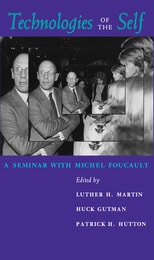
Shortly before his death in 1984, Michel Foucault spoke of an idea for a new book on “technologies of the self.” He described it as “composed of different papers about the self. . . . about the role of reading and writing in constituting the self. . . . and so on.” The book Foucault envisioned was based on a faculty seminar on “Technologies of the Self,” originally presented at the University of Vermont in the fall of 1982. This volume is a partial record of that seminar.
In many ways, Foucault's project on the self was the logical conclusion to his historical inquiry over twenty-five years into insanity, deviancy, criminality, and sexuality. Because Foucault died before he completed the revisions of his seminar presentations, this volume includes a careful transcription instead...as a prolegomenon to that unfinished task.
Foucault was a French philosopher, historian of ideas, social theorist, philologist and literary critic.
This volume was edited by Luther H. Martin, Huck Gutman, and Patrick H. Hutton.

Technology's Pulse
Essays on Rhythm in German ModernismMichael Cowan
University of London Press, 2011
Technology, Pessimism, and Postmodernism
Yaron Ezrahi
University of Massachusetts Press, 1995
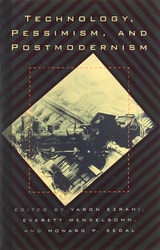
This collection of essays from international scholars across various disciplines addresses the compelling theme of technological pessimism—the conviction that technology has simultaneously given humanity the means to achieve unlimited progress while simultaneously providing the tools for self-destruction and the degradation of our most cherished values.
Edited by Yaron Ezrahi, Everett Mendelsohn, and Howard P. Segal, this intellectually rigorous anthology examines the paradoxes and contradictions inherent in contemporary technological society through a postmodern lens. The contributors explore how technology shapes human experience, culture, and social structures in the late twentieth century, questioning the foundational narratives of technological progress and enlightenment that have dominated Western thought.
Technomodern Poetics
The American Literary Avant-Garde at the Start of the Information AgeTodd F. Tietchen
University of Iowa Press, 2018
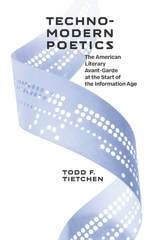
After the second World War, the term “technology” came to signify both the anxieties of possible annihilation in a rapidly changing world and the exhilaration of accelerating cultural change. Technomodern Poetics examines how some of the most well-known writers of the era described the tensions between technical, literary, and media cultures at the dawn of the Digital Age. Poets and writers such as Allen Ginsberg, Charles Olson, Jack Kerouac, and Frank O’Hara, among others, anthologized in Donald Allen’s iconic The New American Poetry, 1945–1960, provided a canon of work that has proven increasingly relevant to our technological present. Elaborating on the theories of contemporaneous technologists such as Norbert Wiener, Claude Shannon, J. C. R. Licklider, and a host of noteworthy others, these artists express the anxieties and avant-garde impulses they wrestled with as they came to terms with a complex array of issues raised by the dawning of the nuclear age, computer-based automation, and the expansive reach of electronic media. As author Todd Tietchen reveals, even as these writers were generating novel forms and concerns, they often continued to question whether such technological changes were inherently progressive or destructive.
With an undeniable timeliness, Tietchen’s book is sure to appeal to courses in modern English literature and American studies, as well as among fans of Beat writers and early Cold War culture.
Technophobia!
Science Fiction Visions of Posthuman TechnologyBy Daniel Dinello
University of Texas Press, 2006
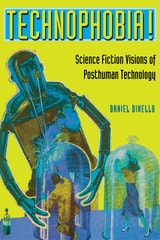
Techno-heaven or techno-hell? If you believe many scientists working in the emerging fields of twenty-first-century technology, the future is blissfully bright. Initially, human bodies will be perfected through genetic manipulation and the fusion of human and machine; later, human beings will completely shed the shackles of pain, disease, and even death, as human minds are downloaded into death-free robots whereby they can live forever in a heavenly "posthuman" existence. In this techno-utopian future, humanity will be saved by the godlike power of technology.
If you believe the authors of science fiction, however, posthuman evolution marks the beginning of the end of human freedom, values, and identity. Our dark future will be dominated by mad scientists, rampaging robots, killer clones, and uncontrollable viruses. In this timely new book, Daniel Dinello examines "the dramatic conflict between the techno-utopia promised by real-world scientists and the techno-dystopia predicted by science fiction."
Organized into chapters devoted to robotics, bionics, artificial intelligence, virtual reality, biotechnology, nanotechnology, and other significant scientific advancements, this book summarizes the current state of each technology, while presenting corresponding reactions in science fiction. Dinello draws on a rich range of material, including films, television, books, and computer games, and argues that science fiction functions as a valuable corrective to technological domination, countering techno-hype and reflecting the "weaponized, religiously rationalized, profit-fueled" motives of such science. By imaging a disastrous future of posthuman techno-totalitarianism, science fiction encourages us to construct ways to contain new technology, and asks its audience perhaps the most important question of the twenty-first century: is technology out of control?
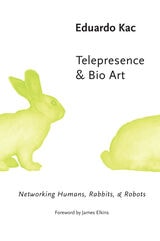
Telepresence and Bio Art
Networking Humans, Rabbits and RobotsEduardo Kac
University of Michigan Press, 2005
-Edward Lucie-Smith, author of Visual Arts in the 20th Century
"His works introduce a vital new meaning into what had been known as the creative process while at the same time investing the notion of the artist-inventor with an original social and ethical responsibility."
-Frank Popper, author of Origins and Development of Kinetic Art
"Kac's radical approach to the creation and presentation of the body as a wet host for artificial memory and 'site-specific' work raises a variety of important questions that range from the status of memory in digital culture to the ethical dilemmas we are facing in the age of bioengineering and tracking technology."
-Christiane Paul, Whitney Museum of Art
For nearly two decades Eduardo Kac has been at the cutting edge of media art, first inventing early online artworks for the web and continuously developing new art forms that involve telecommunications and robotics as a new platform for art. Interest in telepresence, also known as telerobotics, exploded in the 1990s, and remains an important development in media art. Since that time, Kac has increasingly moved into the fields of biology and biotechnology.
Telepresence and Bio Art is the first book to document the evolution of bio art and the aesthetic development of Kac, the creator of the "artist's gene" as well as the controversial glow-in-the-dark, genetically engineered rabbit Alba. Kac covers a broad range of topics within media art, including telecommunications media, interactive systems and the Internet, telematics and robotics, and the contact between electronic art and biotechnology. Addressing emerging and complex topics, this book will be essential reading for anyone interested in contemporary art.
Tell Me a Story
Narrative and IntelligenceRoger C. Schank
Northwestern University Press, 1995
Tell This Silence
Asian American Women Writers And The Politics Of SpeechPatti Duncan
University of Iowa Press, 2004
However, as the writers discussed in Tell This Silence suggest, silence too has multiple meanings especially in contexts like the U.S., where speech has never been a guaranteed right for all citizens. Duncan argues that writers such as Maxine Hong Kingston, Mitsuye Yamada, Joy Kogawa, Theresa Hak Kyung Cha, Nora Okja Keller, and Anchee Min deploy silence as a means of resistance. Juxtaposing their “unofficial narratives” against other histories—official U.S. histories that have excluded them and American feminist narratives that have stereotyped them or distorted their participation—they argue for recognition of their cultural participation and offer analyses of the intersections among gender, race, nation, and sexuality.
Tell This Silence offers innovative ways to consider Asian American gender politics, feminism, and issues of immigration and language. This exciting new study will be of interest to literary theorists and scholars in women's, American, and Asian American studies.
Telling Complexions
The Nineteenth-Century English Novel and the BlushMary Ann O Farrell
Duke University Press, 1997
Although the blush was used to tell the truth of character and body, O’Farrell shows how it is actually undermined as a stable indicator of character in novels such as Pride and Prejudice, Persuasion, North and South, and David Copperfield. She reveals how these writers then moved on in search of other bodily indicators of mortification and desire, among them the swoon, the scar, and the blunder. Providing unique and creative insights into the constructedness of the body and its semiotic play in literature and in culture, Telling Complexions includes parallel examples of the blush in contemporary culture and describes ways that textualized bodies are sometimes imagined to resist the constraints imposed by such construction.
Telling Incest
Narratives of Dangerous Remembering from Stein to SapphireJanice Doane and Devon Hodges
University of Michigan Press, 2001
Examining the work of writers from Gertrude Stein to Toni Morrison and Dorothy Allison, Telling Incest argues that an incest story's plausibility depends upon a shifting set of narrative conventions and cultural expectations. As contexts for telling incest stories have changed, so too have the tasks of those who tell and those who listen. The authors analyze both fictional and nonfiction narratives about father-daughter incest, beginning by scrutinizing the shadowy accounts found in nineteenth-century case records, letters, and narratives.
Telling Incest next explores African American stories that shift the blame for incest from the black family to the predations of a paternalistic white culture. Janice Doane and Devon Hodges demonstrate that writers drew upon this reworked incest narrative in the 1970s and early 1980s in order to relate a feminist story about incest, a story that criticizes patriarchal power. This feminist form of the story, increasingly emphasizing trauma and recovery, can be found in such popular books as Alice Walker's The Color Purple and Jane Smiley's A Thousand Acres. Doane and Hodges then examine recent memoirs and novels such as Dorothy Allison's Bastard Out of Carolina and Sapphire's Push, narratives that again rework the incest story in an effort to "tell" about women's complex experiences of subjugation and hope.
Telling Incest will be of particular interest to readers who have enjoyed the popular and culturally significant work of writers such as Alice Walker, Toni Morrison, Jane Smiley, and Dorothy Allison and to students of women's studies, feminist theory, and cultural studies.
Janice Doane is Professor of English, St. Mary's College of California. Devon Hodges is Professor of English, George Mason University. They have also coauthored From Klein to Kristeva: Psychoanalytic Feminism and the Search for the "Good Enough" Mother and Nostalgia and Sexual Difference: The Resistance to Contemporary Feminism.