268 books match the query 'Mass media' and 43 start with t

cover of Tactical Media

Tactical Media

Rita Raley

University of Minnesota Press, 2009

Tactical media describes interventionist media art practices that engage and critique the dominant political and economic order. Rather than taking to the streets and staging spectacular protests, the practitioners of tactical media engage in an aesthetic politics of disruption, intervention, and education. From They Rule, an interactive map of the myriad connections between the world’s corporate and political elite created by Josh On and Futurefarmers, toBlack Shoals, a financial market visualization that is intended to be both aesthetically and politically disruptive, they embrace a broad range of oppositional practices.

In Tactical Media, Rita Raley provides a critical exploration of the new media art activism that has emerged out of, and in direct response to, postindustrialism and neoliberal globalization. Through close readings of projects by the DoEAT group, the Critical Art Ensemble, Electronic Civil Disobedience, and other tactical media groups, she articulates their divergent methods and goals and locates a virtuosity that is also boldly political. Contemporary models of resistance and dissent, she finds, mimic the decentralized and virtual operations of global capital and the post-9/11 security state to exploit and undermine the system from within. 

Emphasizing the profound shift from strategy to tactics that informs new media art-activism, Raley assesses the efficacy of its symbolic performances, gamings, visualizations, and hacks. With its cogent analyses of new media art and their social impact, Tactical Media makes a timely and much needed contribution to wider debates about political activism, contemporary art, and digital technology.
[more]
cover of Talking Back to the West: How Turkey Uses Counter-Hegemony to Reshape the Global Communication Order

Talking Back to the West

How Turkey Uses Counter-Hegemony to Reshape the Global Communication Order

Bilge Yesil

University of Illinois Press, 2024

In the 2010s, Turkey’s ruling Justice and Development Party (AKP) began to mobilize an international media system to project Turkey as a rising player and counter foreign criticism of its authoritarian practices. Bilge Yesil examines the AKP’s English-language communication apparatus, focusing on its objectives and outcomes, the idea-generating framework that undergirds it, and the implications of its activities. She also analyzes the decolonial and pan-Islamist messages AKP-sponsored outlets deploy to position Turkey as a burgeoning great power opposed to imperialism and claiming to be the voice of oppressed Muslims around the world. As the AKP wields this rhetoric to further its geopolitical and economic goals, media outlets pursue their own objectives by obfuscating facts with identity politics, demonizing the West to aggrandize the East and rallying Muslims under Turkey’s purportedly benevolent leadership.

Insightfully exploring the crossroads of communications and authoritarianism, Talking Back to the West illuminates how the Erdogan government and its media allies use history, religion, and identity to pursue complementary agendas and tighten the AKP’s grip on power.
[more]
cover of That Could Be Us: News Media, Politics, and the Necessary Conditions for Disaster Risk Reduction

That Could Be Us

News Media, Politics, and the Necessary Conditions for Disaster Risk Reduction

Thomas Jamieson and Douglas A. Van Belle

University of Michigan Press, 2022

The evidence presented in this book suggests that when the necessary conditions for disaster risk reduction (DRR) are in place, it is possible for elected officials to pursue DRR policies in their rational self-interest. As such, when the media makes it possible through lesson-drawing coverage of distant disasters, DRR policies become much more likely in observing communities because elected officials can seize the opportunity to both make political gains and protect their constituents. Authors Thomas Jamieson and Douglas A. Van Belle provide reasons for optimism about the prospect of DRR in at-risk communities around the world—observing communities are able to learn from the experiences of stricken areas and pursue policies that ultimately save lives and reduce economic damage from disasters.
In That Could Be Us, Jamieson and Van Belle find that the news media delivers information to observing communities in a form that enables learning from other disasters. Experimental evidence shows that people react to this information in a way that would punish leaders who do not back DRR efforts. Case studies, interviews, experiments, and illustrative examples suggest that leaders and political entrepreneurs heed this public demand, react to news media coverage, and act accordingly. Taken as a whole, this suggests that the policy and research implications derived from this book’s theoretical model are worthy of further exploration, particularly in terms of how they might resolve the puzzle presented by the variations in DRR policy uptake around the world that do not seem to be driven by developmental differences across communities.
[more]
cover of The Conservative Resurgence and the Press: The Media's Role in the Rise of the Right

The Conservative Resurgence and the Press

The Media's Role in the Rise of the Right

James Brian McPherson

Northwestern University Press, 2008

Consumers of American media find themselves in a news world that has shifted toward more conservative reporting. This book takes a measured, historical view of the shift, addressing factors that include the greater skill with which conservatives have used the media, the media’s gradual trend toward conservatism, the role of religion, and the effects of media conglomeration. The book makes the case that the media have managed to not only enable today’s conservative resurgence but also ignore, largely, the consequences of that change for the American people.
[more]
cover of The Currency of Truth: Newsmaking and the Late-Socialist Imaginaries of China's Digital Era

The Currency of Truth

Newsmaking and the Late-Socialist Imaginaries of China's Digital Era

Emily H. C. Chua

University of Michigan Press, 2023

China’s news sector is a place where newsmakers, advertising executives, company bosses, and Party officials engage one another in contingent and evolving arrangements that run from cooperation and collaboration to manipulation and betrayal. Drawing on long-term ethnographic fieldwork with journalists, editors, and executives at a newspaper in Guangzhou, The Currency of Truth brings its readers into the lives of the people who write, publish, and profit from news in this milieu. The book shows that far from working as mere cogs in a Party propaganda machine, these individuals are immersed in fluidly shifting networks of formal and informal relationships, which they carefully navigate to pursue diverse goals.

In The Currency of Truth, Emily H. C. Chua argues that news in China works less as a medium of mass communication than as a kind of currency as industry players make and use news articles to create agreements, build connections, and protect and advance their positions against one another. Looking at the ethical and professional principles that well-intentioned and civically minded journalists strive to uphold, and the challenges and doubts that they grapple with in the process, Chua brings her findings into conversation around “post-truth” news and the “crisis” of professional journalism in the West.  The book encourages readers to rethink contemporary news, arguing that rather than setting out from the assumption that news works either to inform or deceive its publics, we should explore the “post-public” social and political imaginaries emerging among today’s newsmakers and remaking the terms of their practice.
[more]
cover of The Democratic Surround: Multimedia and American Liberalism from World War II to the Psychedelic Sixties

The Democratic Surround

Multimedia and American Liberalism from World War II to the Psychedelic Sixties

Fred Turner

University of Chicago Press, 2013

We commonly think of the psychedelic sixties as an explosion of creative energy and freedom that arose in direct revolt against the social restraint and authoritarian hierarchy of the early Cold War years. Yet, as Fred Turner reveals in The Democratic Surround, the decades that brought us the Korean War and communist witch hunts also witnessed an extraordinary turn toward explicitly democratic, open, and inclusive ideas of communication and with them new, flexible models of social order. Surprisingly, he shows that it was this turn that brought us the revolutionary multimedia and wild-eyed individualism of the 1960s counterculture.

In this prequel to his celebrated book From Counterculture to Cyberculture, Turner rewrites the history of postwar America, showing how in the 1940s and ’50s American liberalism offered a far more radical social vision than we now remember. Turner tracks the influential mid-century entwining of Bauhaus aesthetics with American social science and psychology. From the Museum of Modern Art in New York to the New Bauhaus in Chicago and Black Mountain College in North Carolina, Turner shows how some of the most well-known artists and intellectuals of the forties developed new models of media, new theories of interpersonal and international collaboration, and new visions of an open, tolerant, and democratic self in direct contrast to the repression and conformity associated with the fascist and communist movements. He then shows how their work shaped some of the most significant media events of the Cold War, including Edward Steichen’s Family of Man exhibition, the multimedia performances of John Cage, and, ultimately, the psychedelic Be-Ins of the sixties. Turner demonstrates that by the end of the 1950s this vision of the democratic self and the media built to promote it would actually become part of the mainstream, even shaping American propaganda efforts in Europe.

Overturning common misconceptions of these transformational years, The Democratic Surround shows just how much the artistic and social radicalism of the sixties owed to the liberal ideals of Cold War America, a democratic vision that still underlies our hopes for digital media today.

[more]
cover of The End of Japanese Cinema: Industrial Genres, National Times, and Media Ecologies

The End of Japanese Cinema

Industrial Genres, National Times, and Media Ecologies

Alexander Zahlten

Duke University Press, 2017

In The End of Japanese Cinema Alexander Zahlten moves film theory beyond the confines of film itself, attending to the emergence of new kinds of aesthetics, politics, temporalities, and understandings of film and media. He traces the evolution of a new media ecology through deep historical analyses of the Japanese film industry from the 1960s to the 2000s. Zahlten focuses on three popular industrial genres: Pink Film (independently distributed softcore pornographic films), Kadokawa (big-budget productions as part of a transmedia strategy), and V-Cinema (direct-to-video films). He examines the conditions of these films' production to demonstrate how the media industry itself becomes part of the politics of the media text and to highlight the complex negotiation between media and politics, culture, and identity in Japan. Zahlten points to a different history of film, one in which a once-powerful film industry transformed into becoming only one component within a complex media-mix ecology. In so doing, Zahlten opens new paths for uncovering similar broad processes in other large media societies.

A Study of the Weatherhead East Asian Institute, Columbia University
[more]
cover of The Family Firm: monarchy, mass media and the British public, 1932-53

The Family Firm

monarchy, mass media and the British public, 1932-53

Edward Owens

University of London Press, 2019
The Family Firm presents the first major historical analysis of the transformation of the royal household’s public relations strategy in the period 1932-1953. Beginning with King George V’s first Christmas broadcast, Buckingham Palace worked with the Church of England and the media to initiate a new phase in the House of Windsor’s approach to publicity. This book also focuses on audience reception by exploring how British readers, listeners, and viewers made sense of royalty’s new media image. It argues that the monarchy’s deliberate elevation of a more informal and vulnerable family-centred image strengthened the emotional connections that members of the public forged with the royals, and that the tightening of these bonds had a unifying effect on national life in the unstable years during and either side of the Second World War. Crucially, The Family Firm also contends that the royal household’s media strategy after 1936 helped to restore public confidence in a Crown that was severely shaken by the abdication of King Edward VIII.
[more]
cover of The Iowa Precinct Caucuses: The Making of a Media Event, Third Edition

The Iowa Precinct Caucuses

The Making of a Media Event, Third Edition

Hugh Winebrenner

University of Iowa Press, 2010

 Although some people
[more]
cover of The Lab Book: Situated Practices in Media Studies

The Lab Book

Situated Practices in Media Studies

Darren Wershler

University of Minnesota Press, 2021

An important new approach to the study of laboratories, presenting a practical method for understanding labs in all walks of life

From the “Big Science” of Bell Laboratories to the esoteric world of séance chambers to university media labs to neighborhood makerspaces, places we call “labs” are everywhere—but how exactly do we account for the wide variety of ways that they produce knowledge? More than imitations of science and engineering labs, many contemporary labs are hybrid forms that require a new methodological and theoretical toolkit to describe. The Lab Book investigates these vital, creative spaces, presenting readers with the concept of the “hybrid lab” and offering an extended—and rare—critical investigation of how labs have proliferated throughout culture.

Organized by interpretive categories such as space, infrastructure, and imaginaries, The Lab Book uses both historical and contemporary examples to show how laboratories have become fundamentally connected to changes in the contemporary university. Its wide reach includes institutions like the MIT Media Lab, the Tuskegee Institute’s Jesup Wagon, ACTLab, and the Media Archaeological Fundus. The authors cover topics such as the evolution and delineation of lab-based communities, how labs’ tools and technologies contribute to defining their space, and a glossary of key hybrid lab techniques.

Providing rich historical breadth and depth, The Lab Book brings into focus a critical, but often misunderstood, aspect of the contemporary arts and humanities. 

[more]
cover of The Look of the 1960s: Barbarella and Pulp Pop Comics

The Look of the 1960s

Barbarella and Pulp Pop Comics

Jan Baetens and Hugo Frey

University of Texas Press, 2026

How the classic aesthetic of 1960s pulp comics influenced art, culture, and politics.

As a form of visual art, comic books rely on a distinct and eye-catching aesthetic. This is especially true of the iconic comics, graphic novels, and illustrations of the 1960s and 1970s. The Look of the 1960s explores the sources of inspiration that influenced the world of comics, beginning with the well-known French comics series Barbarella.

Noted comics scholars Jan Baetens and Hugo Frey analyze the impacts of the often-provocative images featured in the comics of the 1960s, which pushed back against French censorship in a politically tense time, and detail how women resisted their objectification in the comic book industry. Barbarella left its mark on the world and gained international attention, inspiring a movie adaptation and changing the look and content of other popular comics. The “Pulp Pop” movement remains relevant today, continuing to influence the art and political world. With new information about artists and an astute analysis of sociopolitical influence, The Look of the 1960s offers deep insights, making it a must read for comics fans all over the world.
[more]
cover of The Media Swirl: Politics, Audiovisuality, and Aesthetics

The Media Swirl

Politics, Audiovisuality, and Aesthetics

Carol Vernallis

Duke University Press, 2023
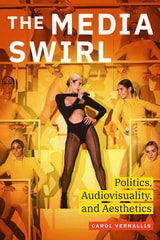
From fan-generated content on TikTok to music videos, the contemporary media landscape is becoming ever more vast, spectacular, and intense. In The Media Swirl Carol Vernallis examines short-form audiovisual media—Beyoncé’s Lemonade, brief sequences from Baz Luhrmann’s The Great Gatsby, TikTok challenges, YouTube mashups, commercials, and many other examples—to offer ways of understanding digital media. She analyzes music videos by Beyoncé, Lady Gaga, Janelle Monáe, Kendrick Lamar, Anderson .Paak, and others to outline how sound and image enhance each other and shape a viewer’s mood. Responding to today’s political-media landscape through discussions of Fox News and Presidential inaugurations, Vernallis shows how a media literacy that exceeds newscasts and campaign advertising is central to engaging with the democratic commons. Forays into industry studies, neuroscience, and ethics also inform her readings. By creating our own content and knowing what corporations, the wealthy, and the government do through media, Vernallis contends, we can create a more just world.
[more]
cover of The Media Welfare State: Nordic Media in the Digital Era

The Media Welfare State

Nordic Media in the Digital Era

Trine Syvertsen, Gunn Enli, Ole J. Mjøs, and Hallvard Moe

University of Michigan Press, 2014

The Media Welfare State: Nordic Media in the Digital Era comprehensively addresses the central dynamics of the digitalization of the media industry in the Nordic countries—Sweden, Norway, Denmark, Finland, and Iceland—and the ways media organizations there are transforming to address the new digital environment. Taking a comparative approach, the authors provide an overview of media institutions, content, use, and policy throughout the region, focusing on the impact of information and communication technology/internet and digitalization on the Nordic media sector. Illustrating the shifting media landscape the authors draw on a wide range of cases, including developments in the press, television, the public service media institutions, and telecommunication.

[more]
cover of The Metaphysics of Media: Toward an End of Postmodern Cynicism and the Construction of a Virtuous Reality

The Metaphysics of Media

Toward an End of Postmodern Cynicism and the Construction of a Virtuous Reality

Peter K. Fallon

University of Scranton Press, 2009

In The Metaphysics of Media, award-winning media critic Peter K. Fallon tackles the complicated question of how a succession of dominant forms of media have supported—and even to some extent created—different conceptions of reality. To do so, he starts with the basics: a critical discussion of the very idea of objective reality and the various postmodern responses that have tended to dominate recent philosophical approaches to the subject. From there, he embarks on a survey of the evolution of communication through four major eras: orality; literacy; print; and electricity. 

Within each era, Fallon argues, the dominant form of media supported particular ways of understanding the world, from the ascendance of reason that followed the development of alphabets to the obliteration of space and time that we associate with electronic communications. Fallon concludes with a hard look at the mass ignorance that prevails today despite (or perhaps because of) the sea of information with which contemporary life is surrounded. 

A stirring, philosophically rich investigation, The Metaphysics of Media offers not only a clear picture of where our society has been but also a road map to a more engaged, informed, and fully human future.

[more]
cover of The Moro Morality Play: Terrorism as Social Drama

The Moro Morality Play

Terrorism as Social Drama

Robin Wagner-Pacifici

University of Chicago Press, 1986
On March 16, 1978, the former prime minister of Italy, Aldo Moro, was kidnapped by the Red Brigades, and what followed—the fifty-five days of captivity that resulted in Moro's murder—constitutes one of the most striking social dramas of the twentieth century. In this compelling study of terrorism, Robin Wagner-Pacifici employs methods from sociology, symbolic anthropology, and literary criticism to decode the many social "texts" that shaped the event: political speeches, newspaper reports, television and radio news, editorials, photographs, Moro's letters, Red Brigade communiques, and appeals by various international figures. The analysis of these "texts" calls into question the function of politics, social drama, spectacle, and theater. Wagner-Pacifici provides a dramaturgic analysis of the Moro affair as a method for discussing the culture of politics in Italy.
[more]
cover of The Neopopular Bubble: Speculating on "the People" in Late Modern Democracy

The Neopopular Bubble

Speculating on "the People" in Late Modern Democracy

Péter Csigó

Central European University Press, 2017
The common critique of media- and ratings-driven politics envisions democracy falling hostage to a popularity contest. By contrast, the following book reconceives politics as a speculative Keynesian beauty contest that alienates itself from the popular audience it ceaselessly targets. Political actors unknowingly lean on collective beliefs about the popular expectations they seek to gratify, and thus do not follow popular public opinion as it is, but popular public opinion about popular public opinion. This book unravels how collective discourses on “the popular” have taken the role of intermediary between political elites and electorates. The shift has been driven by the idea of “liquid control:” that postindustrial electorates should be reached through flexibly designed media campaigns based on a complete understanding of their media-immersed lives. Such a complex representation of popular electorates, actors have believed, cannot be secured by rigid bureaucratic parties, but has to be distilled from the collective wisdom of the crowd of consultants, pollsters, journalists and pundits commenting on the political process. The mediatization of political representation has run a strikingly similar trajectory to the marketization of capital allocation in finance: starting from a rejection of bureaucratic control, promising a more “liquid” alternative, attempting to detect a collective wisdom (of/about “the markets” and “the people”), and ending up in self-driven spirals of collective speculation.
[more]
cover of The News Event: Popular Sovereignty in the Age of Deep Mediatization

The News Event

Popular Sovereignty in the Age of Deep Mediatization

Francis Cody

University of Chicago Press, 2023

In the hypermediated world of Tamil Nadu, Francis Cody studies how “news events” are made.
 
Not merely the act of representing events with words or images, a “news event” is the reciprocal relationship between the events being reported in the news and the event of the news coverage itself. In The News Event, Francis Cody focuses on how imaginaries of popular sovereignty have been remade through the production and experience of such events. Political sovereignty is thoroughly mediated by the production of news, and subjects invested in the idea of democracy are remarkably reflexive about the role of publicly circulating images and texts in the very constitution of their subjectivity. The law comes to stand as both a limit and positive condition in this process of event making, where acts of legal and extralegal repression of publication can also become the stuff of news about news makers. When the subjects of news inhabit multiple participant roles in the unfolding of public events, when the very technologies of recording and circulating events themselves become news, the act of representing a political event becomes difficult to disentangle from that of participating in it. This, Cody argues, is the crisis of contemporary news making: the news can no longer claim exteriority to the world on which it reports.

[more]
cover of The Other Air Force: U.S. Efforts to Reshape Middle Eastern Media Since 9/11

The Other Air Force

U.S. Efforts to Reshape Middle Eastern Media Since 9/11

Sienkiewicz, Matt

Rutgers University Press, 2016

Winner of the 2019 Alpha Sigma Nu Book Award

As it seeks to win the hearts and minds of citizens in the Muslim world, the United States has poured millions of dollars into local television and radio programming, hoping to generate pro-American currents on Middle Eastern airwaves. However, as this fascinating new book shows, the Middle Eastern media producers who rely on these funds are hardly puppets on an American string, but instead contribute their own political and creative agendas while working within U.S. restrictions.  

 
The Other Air Force gives readers a unique inside look at television and radio production in Afghanistan and the Palestinian territories, from the isolated villages of the Afghan Panjshir Valley to the congested streets of Ramallah. Communications scholar Matt Sienkiewicz explores how the U.S. takes a “soft-psy” approach to its media efforts combining “soft” methods of encouraging entertainment programming, such as adaptations of The Voice and The Apprentice with more militaristic “psy-ops” approaches to information control. Drawing from years of field research and interviews with everyone from millionaire executives to underpaid but ever resourceful cameramen, Sienkiewicz considers the perspectives of the Afghan and Palestinian media workers trying to forge viable broadcasting businesses without straying outside American-set boundaries for acceptable content.   
 
As it carefully examines the interplay of U.S. military and economic might with the capacity for local ingenuity and resistance, the book also analyzes the intriguingly complex programming that emerges from this tension. Combining eyewitness reportage with cutting-edge scholarship, The Other Air Force reveals the remarkable creative output that can emerge even from the world’s tensest conflict zones.
 
[more]
cover of The Other Side of the Digital: The Sacrificial Economy of New Media

The Other Side of the Digital

The Sacrificial Economy of New Media

Andrea Righi

University of Minnesota Press, 2021

A necessary, rich new examination of how the wired world affects our humanity

Our tech-fueled economy is often touted as a boon for the development of our fullest human potential. But as our interactions are increasingly turned into mountains of data sifted by algorithms, what impact does this infinite accumulation and circulation of information really have on us? What are the hidden mechanisms that drive our continuous engagement with the digital?

In The Other Side of the Digital, Andrea Righi argues that the Other of the digital acts as a new secular God, exerting its power through endless accountability that forces us to sacrifice ourselves for the digital. Righi deconstructs the contradictions inherent in our digital world, examining how ideas of knowledge, desire, writing, temporality, and the woman are being reconfigured by our sacrificial economy. His analyses include how both our self-image and our perception of reality are skewed by technologies like fitness bands, matchmaking apps, and search engines, among others.

The Other Side of the Digital provides a necessary, in-depth cultural analysis of how the political theology of the new media functions under neoliberalism. Drawing on the work of well-known thinkers like Jacques Derrida, Jacques Lacan, and Ludwig Wittgenstein, as well as Carla Lonzi, Luisa Muraro, and Luciano Parinetto, Righi creates novel appraisals of popular digital tools that we now use routinely to process life experiences. Asking why we must sign up for this sort of regime, The Other Side of the Digital is an important wake-up call to a world deeply entangled with the digital.

[more]
cover of The Political Economy of Global Communication: An Introduction

The Political Economy of Global Communication

An Introduction

Peter Wilkin

Pluto Press, 2001

Recent debates surrounding human security have focused on the satisfaction of human needs as the vital goal for global development. Peter Wilkin highlights the limitations of this view and argues that unless we incorporate an account of human autonomy into human security then the concept is flawed. He reveals how human security is a concern with social relations that connect people in local, national and global networks of power, structured through capitalism and hierarchical inter-state systems. Autonomy, as an aspect of human security, depends upon the ability of citizens to gain information about the processes that shape their lives. In this respect autonomy and communication are inherently linked and are prerequisites for the establishment of meaningful democratic systems.

To what extent do developments in global communication enhance or undermine autonomy? As the world's media companies continue to merge, we are moving towards an ever more commercially driven system of global information. Wilkin argues that private ownership provides an increasingly powerful obstacle to human autonomy, and that the neo-liberal institutional and policy framework – now a global tendency – raises major problems for the attainment of human security. At the same time it has provided the ideological justification for the extension of private power into ever wider areas of public life. Changes in global communication reflect wider tendencies to enhance the power of global elites at the expense of working people and the author illustrates how and why these changes have taken place and the forms of opposition that have arisen in response to them.

[more]
cover of The Politics of Herding Cats: When Congressional Leaders Fail

The Politics of Herding Cats

When Congressional Leaders Fail

John Lovett

University of Michigan Press, 2021
In The Politics of Herding Cats, John Lovett looks at the relationship between media, Congress, and public policy, showing that leaders in Congress under normal circumstances control public policy on issue areas due to their status both within Congress and in the media by and large. When issue coverage on topics increases in media, however, other members seize on the opportunities to engage in the issue and shift public policy away from leader desires. As more members engage and more groups become involved, leaders lose the ability to control the process and are more likely to have problems actually getting public policy enacted. Lovett look at this phenomenon using newspaper coverage in the Washington Post over a 40-year period, both in terms of general analysis as well as individual case studies exploring agricultural subsidies (a low coverage topic), immigration (a changing coverage topic), and health care (a high coverage topic). As coverage increases, the amount leaders can control in the process decreases. Only under extreme circumstances, as seen in the Affordable Care Act, can leaders get anything done at all. The Politics of Herding Cats would be useful for those who wish to better understand the relationship between the media and Congress. It will also be useful to those who want to understand the relationship between actors in government and how the media has influenced American politics, as well as how individual members of Congress can go against party leaders on major issues.
[more]
cover of The Popular Arts

The Popular Arts

Stuart Hall and Paddy Whannel

Duke University Press, 2018
When it first appeared in 1964, Stuart Hall and Paddy Whannel's The Popular Arts opened up an almost unprecedented field of analysis and inquiry into contemporary popular culture. Counter to the prevailing views of the time, Hall and Whannel recognized popular culture's social importance and considered it worthy of serious study. In their analysis of everything from Westerns and the novels of Mickey Spillane, Ian Fleming, and Raymond Chandler to jazz, advertising, and the television industry, they were guided by the belief that studying popular culture demanded an ethical evaluation of the text and full attention to its properties. In so doing, they raised questions about the relation of culture to society and the politics of taste and judgment in ways that continue to shape cultural studies. Long out of print, this landmark text highlights the development of Hall's theoretical and methodological approach while adding a greater understanding of his work. This edition also includes a new introduction by Richard Dyer, who contextualizes The Popular Arts within the history of cultural studies and outlines its impact and enduring legacy.
[more]
cover of The Positive Case for Negative Campaigning

The Positive Case for Negative Campaigning

Kyle Mattes and David P. Redlawsk

University of Chicago Press, 2015

Turn on the television or sign in to social media during election season and chances are you’ll see plenty of negative campaigning. For decades, conventional wisdom has held that Americans hate negativity in political advertising, and some have even argued that its pervasiveness in recent seasons has helped to drive down voter turnout. Arguing against this commonly held view, Kyle Mattes and David P. Redlawsk show not only that some negativity is accepted by voters as part of the political process, but that negative advertising is necessary to convey valuable information that would not otherwise be revealed.

The most comprehensive treatment of negative campaigning to date, The Positive Case for Negative Campaigning uses models, surveys, and experiments to show that much of the seeming dislike of negative campaigning can be explained by the way survey questions have been worded. By failing to distinguish between baseless and credible attacks, surveys fail to capture differences in voters’ receptivity. Voters’ responses, the authors argue, vary greatly and can be better explained by the content and believability of the ads than by whether the ads are negative. Mattes and Redlawsk continue on to establish how voters make use of negative information and why it is necessary. Many voters are politically naïve and unlikely to make inferences about candidates’ positions or traits, so the ability of candidates to go on the attack and focus explicitly on information that would not otherwise be available is crucial to voter education.
[more]
cover of The Production of Modernization: Daniel Lerner, Mass Media, and The Passing of Traditional Society

The Production of Modernization

Daniel Lerner, Mass Media, and The Passing of Traditional Society

Authored by Hemant Shah

Temple University Press, 2011

Daniel Lerner's 1958 book The Passing of Traditional Society was central in shaping Cold War–era ideas about the use of mass media and culture to promote social and economic progress in postcolonial nations. Based on a study of the effectiveness of propaganda in the Middle East, Lerner’s book claimed that exposure to American media messages could motivate “traditional” people in the postcolonial nations to become “modern” by cultivating empathy for American ideas, goods, and ways of life.

The Production of Modernization examines Lerner’s writings to construct the intellectual trajectory of his thinking about mass media and modernization up to and beyond the publication of his famous book. Shah has written not just an intellectual biography of Lerner but also a history of the discipline he shaped.
[more]
cover of The Right to Look: A Counterhistory of Visuality

The Right to Look

A Counterhistory of Visuality

Nicholas Mirzoeff

Duke University Press, 2011
In The Right to Look, Nicholas Mirzoeff develops a comparative decolonial framework for visual culture studies, the field that he helped to create and shape. Casting modernity as an ongoing contest between visuality and countervisuality, or “the right to look,” he explains how visuality sutures authority to power and renders the association natural. An early-nineteenth-century concept, meaning the visualization of history, visuality has been central to the legitimization of Western hegemony. Mirzoeff identifies three “complexes of visuality”—plantation slavery, imperialism, and the present-day military-industrial complex—and explains how, within each, power is made to seem self-evident through techniques of classification, separation, and aestheticization. At the same time, he shows how each complex of visuality has been countered—by the enslaved, the colonized, and opponents of war, all of whom assert autonomy from authority by claiming the right to look. Encompassing the Caribbean plantation and the Haitian revolution, anticolonialism in the South Pacific, antifascism in Italy and Algeria, and the contemporary global counterinsurgency, The Right to Look is a work of astonishing geographic, temporal, and conceptual reach.
[more]
cover of The Society of the Selfie: Social Media and the Crisis of Liberal Democracy

The Society of the Selfie

Social Media and the Crisis of Liberal Democracy

Jeremiah Morelock and Felipe Ziotti Narita

University of Westminster Press, 2021
This book explores how the Internet is connected to the global crisis of liberal democracy. Today, self-promotion is at the heart of many human relationships. The selfie is not just a social media gesture people love to hate. It is also a symbol of social reality in the age of the Internet. Through social media people have new ways of rating and judging themselves and one another, via metrics such as likes, shares, followers and friends. There are new thirsts for authenticity, outlets for verbal aggression, and social problems. Social media culture and neoliberalism dovetail and amplify one another, feeding social estrangement. With neoliberalism, psychosocial wounds are agitated and authoritarianism is provoked. Yet this new sociality also inspires resistance and political mobilisation. Illustrating ideas and trends with examples from news and popular culture, the book outlines and applies theories from Debord, Foucault, Fromm, Goffman, and Giddens, among others. Topics covered include the global history of communication technologies, personal branding, echo chamber effects, alienation and fear of abnormality. Information technologies provide channels for public engagement where extreme ideas reach farther and faster than ever before, and political differences are widened and inflamed. They also provide new opportunities for protest and resistance.
[more]
cover of The Stone and the Wireless: Mediating China, 1861–1906

The Stone and the Wireless

Mediating China, 1861–1906

Shaoling Ma

Duke University Press, 2021

In the final decades of the Manchu Qing dynasty in China, technologies such as the phonograph, telephone, telegraph, and photography were both new and foreign. In The Stone and the Wireless Shaoling Ma analyzes diplomatic diaries, early science fiction, feminist poetry, photography, telegrams, and other archival texts, and shows how writers, intellectuals, reformers, and revolutionaries theorized what media does despite lacking a vocabulary to do so. Media defines the dynamics between technologies and their social or cultural forms, between devices or communicative processes and their representations in texts and images. More than simply reexamining late Qing China's political upheavals and modernizing energies through the lens of media, Ma shows that a new culture of mediation was helping to shape the very distinctions between politics, gender dynamics, economics, and science and technology. Ma contends that mediation lies not only at the heart of Chinese media history but of media history writ large.
[more]
cover of The Suppression of Guilt: The Israeli Media and the Reoccupation of the West Bank

The Suppression of Guilt

The Israeli Media and the Reoccupation of the West Bank

Daniel Dor

Pluto Press, 2005

In the three years that have passed since Operation Defensive Shield – three years marked by denial, deceit, rage and resentment – one fact remains uncontroversial: never, until the operation, had there been such a wide breach between the Israeli collective consciousness and international public opinion. Israeli scholar Daniel Dor measures this gap and concludes that Israeli society has withdrawn into an unprecedented sense of isolation and victimization – largely because of the role played by the Israeli media.

Different media outlets provided their readers and viewers with significantly different perspectives on the operation, but they all shared a certain emotional attitude, not vis-à-vis the operation itself, but in relations to the global discourse of blame against Israel: they all projected an urgent, desperate, almost obsessive urge to suppress, to dismiss, to fend off guilt.

Dor shows how analysing this type of reporting as an attempt to manufacture consent with the government and the military fails to capture its essential nature. He argues that, at its core, the coverage proposed alternatives for the construction of an Israeli identity. During the operation, all the different media converged around one assertion: being Israeli at this point in time feels like being accused by the entire world of something we are not guilty of. Basing his arguments on detailed analyses of media reports, Dor explores how the Israeli media work within the context of the global media and world opinion, rather than within the classic context of the nation-state -- and what it means for the future of the country.
[more]
cover of The Supreme Court and the Press: The Indispensable Conflict

The Supreme Court and the Press

The Indispensable Conflict

Joe Mathewson

Northwestern University Press, 2011
Although theirs has been a contentious relationship, Joe Mathewson shows that, since the framing of the Constitution, the Supreme Court has needed the press to educate the public about its actions, just as the press has depended on the Supreme Court to ensure the freedoms that give it life. The Court ignored the First Amendment for more than a century and then trampled it, but since the 1960s it has tended to uphold the rights of the press in the face of opposition, that coming from the Executive Branch. Still, the Court has repeatedly failed to fully inform the public of its decisions. Even today the Court permits only limited access to its audio tapes of oral arguments, and it famously refuses to allow television cameras into the courtroom. Mathewson argues that if the Supreme Court wants to maintain its legitimacy and authority in the internet age it must allow broader access for the press.
[more]
cover of The Technical Delusion: Electronics, Power, Insanity

The Technical Delusion

Electronics, Power, Insanity

Jeffrey Sconce

Duke University Press, 2019

Delusions of electronic persecution have been a preeminent symptom of psychosis for over two hundred years. In The Technical Delusion Jeffrey Sconce traces the history and continuing proliferation of this phenomenon from its origins in Enlightenment anatomy to our era of global interconnectivity. While psychiatrists have typically dismissed such delusions of electronic control as arbitrary or as mere reflections of modern life, Sconce demonstrates a more complex and interdependent history of electronics, power, and insanity. Drawing on a wide array of psychological case studies, literature, court cases, and popular media, Sconce analyzes the material and social processes that have shaped historical delusions of electronic contamination, implantation, telepathy, surveillance, and immersion. From the age of telegraphy to contemporary digitality, the media emerged within such delusions to become the privileged site for imagining the merger of electronic and political power, serving as a paranoid conduit between the body and the body politic. Looking to the future, Sconce argues that this symptom will become increasingly difficult to isolate, especially as remote and often secretive powers work to further integrate bodies, electronics, and information.  
[more]
cover of The Time of Laughter: Comedy and the Media Cultures of Japan

The Time of Laughter

Comedy and the Media Cultures of Japan

David Humphrey

University of Michigan Press, 2023

From broadcast to social media, comedy plays a prominent role in Japan’s cultural landscape and political landscape. The Time of Laughter explores how comedy grew out of the early days of television to become a central force in shaping Japanese media over the past half-century. Comedy and its impact, David Humphrey argues, established a “time of laughter” in the media of the late twentieth and early twenty-first centuries in Japan. Through masterful interrogation of Japanese televisual archives and media discourse, Humphrey demonstrates that the unique temporality of laughter has had a profound role in the cultural atmosphere of Japan’s recent past. Laughter both complemented and absorbed the profound tensions and contradictions that emerged in Japanese television. Joyous and cacophonous, reaffirming and subverting, laughter simultaneously alienated and unified viewers. Through its exploration of the influence of comedy and the culture of laughter, The Time of Laughter presents a vibrant new take on Japan’s recent media history.
[more]
cover of The World Computer: Derivative Conditions of Racial Capitalism

The World Computer

Derivative Conditions of Racial Capitalism

Jonathan Beller

Duke University Press, 2021
In The World Computer Jonathan Beller forcefully demonstrates that the history of commodification generates information itself. Out of the omnipresent calculus imposed by commodification, information emerges historically as a new money form. Investigating its subsequent financialization of daily life and colonization of semiotics, Beller situates the development of myriad systems for quantifying the value of people, objects, and affects as endemic to racial capitalism and computation. Built on oppression and genocide, capital and its technical result as computation manifest as racial formations, as do the machines and software of social mediation that feed racial capitalism and run on social difference. Algorithms, derived from for-profit management strategies, conscript all forms of expression—language, image, music, communication—into the calculus of capital such that even protest may turn a profit. Computational media function for the purpose of extraction rather than ameliorating global crises, and financialize every expressive act, converting each utterance into a wager. Repairing this ecology of exploitation, Beller contends, requires decolonizing information and money, and the scripting of futures wagered by the cultural legacies and claims of those in struggle.
[more]
cover of This Is Enlightenment

This Is Enlightenment

Edited by Clifford Siskin and William Warner

University of Chicago Press, 2010

Debates about the nature of the Enlightenment date to the eighteenth century, when Imanual Kant himself addressed the question, “What is Enlightenment?” The contributors to this ambitious book offer a paradigm-shifting answer to that now-famous query: Enlightenment is an event in the history of mediation. Enlightenment, they argue, needs to be engaged within the newly broad sense of mediation introduced here—not only oral, visual, written, and printed media, but everything that intervenes, enables, supplements, or is simply in between. 

With essays addressing infrastructure and genres, associational practices and protocols, this volume establishes mediation as the condition of possibility for enlightenment. In so doing, it not only answers Kant’s query; it also poses its own broader question: how would foregrounding mediation change the kinds and areas of inquiry in our own epoch? This Is Enlightenment is a landmark volumewith the polemical force and archival depth to start a conversation that extends across the disciplines that the Enlightenment itself first configured.

[more]
cover of Threatened Children: Rhetoric and Concern about Child-Victims

Threatened Children

Rhetoric and Concern about Child-Victims

Joel Best

University of Chicago Press, 1990
Child abuse, incest, child molestation, Halloween sadism, child pornography: although clearly not new problems, they have attracted more attention than ever before. Threatened Children asks why. Joel Best analyzes the rhetorical tools used by child advocates when making claims aimed at raising public anxiety and examines the media's role in transmitting reformers' claims and the public's response to the frightening statistics, compelling examples, and expanding definitions it confronts. Drawing on a wide range of sources, from criminal justice records to news stories, from urban legends to public opinion surveys, Best reveals how the cultural construction of social problems evolves.
[more]
cover of Time Passages: Collective Memory and American Popular Culture

Time Passages

Collective Memory and American Popular Culture

George Lipsitz

University of Minnesota Press, 2001

The classic work on collective memory and popular culture in the United States.

Probes the complicated relationship between postwar America between historical memory and commercial culture—popular television, music, and film.
[more]
cover of Tomboys, Pretty Boys, and Outspoken Women: The Media Revolution of 1973

Tomboys, Pretty Boys, and Outspoken Women

The Media Revolution of 1973

Edward D. Miller

University of Michigan Press, 2011

“Edward Miller has written a sharply observant, often revelatory, and stimulating book that explores the 1970s with gusto, showing all the intimacy and pleasure and startling richness of observation with which a scholar may sometimes approach a period in which he lived.”
—Martin Harries, New York University

Contemporary American media is awash with reality programs, faux documentaries, and user generated content. When did this fixation on real or feigned nonfictionality begin? Tomboys, Pretty Boys, and Outspoken Women argues that its origins can be found in the early 1970s, when American media discovered the entertainment value of documentaries, news programming, and other nonfiction forms. Edward D. Miller challenges preconceptions of the ’60s and ’70s through close readings of key events and important figures in the early 1970s: John Dean’s performance in front of the Senate during the Watergate Hearings; Billie Jean King popularizing tennis by taking on Bobby Riggs in a prime-time match; David Bowie experiencing “outer space” in his tours across America; An American Family and their gay son facing the public’s consternation; and Alison Steele, a female DJ who invited listeners to fly with her at night. Miller explores the early 1970s as a turning point in American culture, with nonfiction media of the time creating new possibilities for expressions of gender and sexuality, and argues that we are living in its aftermath.

In addition to readers attracted to media studies, this book will be of great interest to those involved in LGBT studies, feminism, and queer studies as well as students of contemporary media culture. The aim of the book is to demystify current media trends by providing an analysis of the recent past. Tomboys, Pretty Boys, and Outspoken Women is written for a large audience that extends beyond academia and embraces readers who have an interest in American pop culture and, in particular, the '70s.

[more]
cover of Towards a Praxis-based Media and Journalism Research

Towards a Praxis-based Media and Journalism Research

Edited by Leon Barkho

Intellect Books, 2017
This volume brings together current scholarly debates about how to bridge the gap between theory and practice in media and journalism research. Drawing on work from media scholars and media practitioners that focuses on how both sides can work together for the good of society, Towards a Praxis-based Media and Journalism Research is the first collection to examine how theory and practice can be combined for positive effect. The result will lay important groundwork for scholarship on this new and increasingly important idea in media and communication studies.
[more]
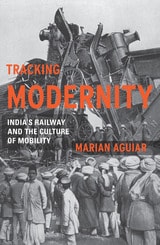
cover of Tracking Modernity: India’s Railway and the Culture of Mobility

Tracking Modernity

India’s Railway and the Culture of Mobility

Marian Aguiar

University of Minnesota Press, 2010

From Mohandas Gandhi’s nineteenth-century tour in a third-class compartment to the recent cinematic shenanigans of Wes Anderson’s The Darjeeling Limited, the railway has been one of India’s most potent emblems of modern life. In the first in-depth analysis of representations of the Indian railway, Marian Aguiar interprets modernity through the legacy of this transformative technology.

Since the colonial period in India, the railway has been idealized as a rational utopia—a moving box in which racial and class differences might be amalgamated under a civic, secular, and public order. Aguiar charts this powerful image into the postcolonial period, showing how the culture of mobility exposes this symbol of reason as surprisingly dynamic and productive. Looking in turn at the partition of India, labor relations, rituals of travel, works of literature and film, visual culture, and the Mumbai train bombings of 2006, Aguiar finds incongruities she terms “counternarratives of modernity” to signify how they work both with and against the dominant rhetoric.  Revealing railways as a microcosm of tensions within Indian culture, Aguiar demonstrates how their representations have challenged prevailing ideas of modernity.

[more]
cover of Transatlantic Central Europe: Contesting Geography and Redifining Culture beyond the Nation

Transatlantic Central Europe

Contesting Geography and Redifining Culture beyond the Nation

Jessie Labov

Central European University Press, 2019
While there are still occasional uses of it today, the term "Central Europe" carries little of the charge that it did in the 1980s and early 1990s, and as a political and intellectual project it has receded from the horizon. Proponents of a distinct cultural profile of these countries—all involved now in the process of Transatlantic integration—used "Central European", as a contestation with the geo-political label of Eastern Europe. This book discusses the transnational set of practices connecting journals with other media in the mid-1980s, disseminating the idea of Central Europe simultaneously in East and West. A range of new methodologies, including GIS-mapping visualization, is used, repositing the political-cultural journal as one central node of a much larger cultural system. What has happened to the liberal humanist philosophy that "Central Europe" once evoked? In the early years of the transition era, the liberal humanist perspective shared by Havel, Konrád, Kundera, and Michnik was quickly replaced by an economic liberalism that evolved into neoliberal policies and practices. The author follows the trajectories of the concept into the present day, reading its material and intellectual traces in the postcommunist landscape. She explores how the current use of transnational, web-based media follows the logic and practice of an earlier, 'dissident' generation of writers.
[more]
cover of Transgenerational Media Industries: Adults, Children, and the Reproduction of Culture

Transgenerational Media Industries

Adults, Children, and the Reproduction of Culture

Derek Johnson

University of Michigan Press, 2019

Within corporate media industries, adults produce children’s entertainment. Yet children, presumed to exist outside the professional adult world, make their own contributions to it—creating and posting unboxing videos, for example, that provide content for toy marketers. Many adults, meanwhile, avidly consume entertainment products nominally meant for children. Media industries reincorporate this market-disrupting participation into their strategies, even turning to adult consumers to pass fandom to the next generation.

Derek Johnson presents an innovative perspective that looks beyond the simple category of “kids’ media” to consider how entertainment industry strategies invite producers and consumers alike to cross boundaries between adulthood and childhood, professional and amateur, new media and old. Revealing the social norms, reproductive ideals, and labor hierarchies on which such transformations depend, he identifies the lines of authority and power around which legacy media institutions like television, comics, and toys imagine their futures in a digital age. Johnson proposes that it is not strategies of media production, but of media reproduction, that are most essential in this context. To understand these critical intersections, he investigates transgenerational industry practice in television co-viewing, recruitment of adult comic readers as youth outreach ambassadors, media professionals’ identification with childhood, the branded management of adult fans of LEGO, and the labor of child YouTube video creators. These dynamic relationships may appear to disrupt generational and industry boundaries alike. However, by considering who media industries empower when generating the future in these reproductive terms and who they leave out, Johnson ultimately demonstrates how their strategies reinforce existing power structures.

This book makes vital contributions to media studies in its fresh approach to the intersections of adulthood and childhood, its attention to the relationship between legacy and digital media industries, and its advancement of dialogue between media production and consumption researchers. It will interest scholars in media industry studies and across media studies more broadly, with particular appeal to those concerned about the current and future reach of media industries into our lives.
 
[more]
cover of Transmedia Geographies: Decoloniality, Democratization, Cultural Citizenship, and Media Convergence

Transmedia Geographies

Decoloniality, Democratization, Cultural Citizenship, and Media Convergence

Kevin Glynn

Rutgers University Press, 2025

Looking at the US, New Zealand, and Central America, this book considers how cultural politics has been deeply reworked in our contemporary media environment. The authors analyze how rampant technological convergence has allowed stories to spill across media platforms as well as geographical borders and how those stories reemerge as transmediated events.    

The authors explore the cultural politics that have developed within this new media environment by moving across the mediated landscapes of the first, third, and fourth (Indigenous people’s) worlds, which are deeply intertwined and interconnected under contemporary conditions of neoliberal globalization and emergent regimes of authoritarian postdemocracy. The book attends both to the platforms and digital networks of the new media environment and to the cultural forms and practices that have constituted television as the dominant medium of communication throughout the second half of the twentieth century. In the new media environment, transmediation works on behalf not only of those corporate megaconglomerates that have become all too familiar to media consumers around the world but also of many communities that have previously been excluded from access to the means of electronic textual production and circulation. For the latter, grassroots transmediation has become an important technique for the production of cultural citizenship.
 
[more]
cover of Truth and Tales: Cultural Mobility and Medieval Media

Truth and Tales

Cultural Mobility and Medieval Media

Edited by Fiona Somerset and Nicholas Watson

The Ohio State University Press, 2015

In the medieval period, as in the media culture of the present, learned and popular forms of talk were intermingled everywhere. They were also highly mobile, circulating in speech, writing, and symbol, as performances as well as in material objects. The communication through and between different media we all negotiate in daily life did not develop from a previous separation of orality and writing, but from a communications network not unlike our own, if slower, and similarly shaped by disparities of access. Truth and Tales: Cultural Mobility and Medieval Media, edited by Fiona Somerset and Nicholas Watson, develops a variety of approaches to the labor of imaginatively reconstructing this network from its extant artifacts.
 
Truth and Tales includes fourteen essays by medieval literary scholars and historians. Some essays focus on written artifacts that convey high or popular learning in unexpected ways. Others address a social problem of concern to all, demonstrating the genres and media through which it was negotiated. Still others are centered on one or more texts, detailing their investments in popular as well as learned knowledge, in performance as well as writing. This collective archaeology of medieval media provides fresh insight for medieval scholars and media theorists alike.

[more]
cover of Turntables and Tropes: A Rhetoric of Remix

Turntables and Tropes

A Rhetoric of Remix

Scott Haden Church

Michigan State University Press, 2022

The creative practice of remix is essential to contemporary culture, as the proliferation of song mashups, political remix videos, memes, and even streaming television shows like Stranger Things demonstrates. Yet remix is not an exclusively digital practice, nor is it even a new one, as there is evidence of remix in the speeches of classical Greek and Roman orators. Turntables and Tropes is the first book to address remix from a communicative perspective, examining its persuasive dimensions by locating its parallels with classical rhetoric. Through identifying, recontextualizing, mashing up, and applying rhetorical tropes to contemporary digital texts and practices, this groundbreaking book presents a new critical vocabulary that scholars and students can use to analyze remix. Building upon scholarship from classical thinkers such as Isocrates, Quintilian, Nāgārjuna, and Cicero and contemporary luminaries like Kenneth Burke, Richard Lanham, and Eduardo Navas, Scott Haden Church shows that an understanding of rhetoric offers innovative ways to make sense of remix culture.
[more]