Results by title
209 books match the query 'Mathematics' and 38 start with t

Tarski's World
Revised and ExpandedDavid Barker-Plummer, Jon Barwise, and John Etchemendy
CSLI, 2004
A brand new feature in this revised and expanded edition is student access to Grade Grinder, an innovative Internet-based grading service that provides accurate and timely feedback to students whenever they need it. Students can submit solutions for the program’s more than 100 exercises to the Grade Grinder for assessment, and the results are returned quickly to the students and optionally to the teacher as well. A web-based interface also allows instructors to manage assignments and grades for their classes.
Intended as a supplement to a standard logic text, Tarski’s World is an essential tool for helping students learn the language of logic.
Teaching the Quadrivium
A Guide for InstructorsPeter Ulrickson
Catholic University of America Press, 2023

The American and Japanese Auto Industries in Transition
Report of the Joint U.S.–Japan Automotive StudyRobert E. Cole and Taizo Yakushiji, Editors
University of Michigan Press, 1984

The Best of All Possible Worlds
Mathematics and DestinyIvar Ekeland
University of Chicago Press, 2006
Optimists believe this is the best of all possible worlds. And pessimists fear that might really be the case. But what is the best of all possible worlds? How do we define it? Is it the world that operates the most efficiently? Or the one in which most people are comfortable and content? Questions such as these have preoccupied philosophers and theologians for ages, but there was a time, during the seventeenth and eighteenth centuries, when scientists and mathematicians felt they could provide the answer.
This book is their story. Ivar Ekeland here takes the reader on a journey through scientific attempts to envision the best of all possible worlds. He begins with the French physicist Maupertuis, whose least action principle asserted that everything in nature occurs in the way that requires the least possible action. This idea, Ekeland shows, was a pivotal breakthrough in mathematics, because it was the first expression of the concept of optimization, or the creation of systems that are the most efficient or functional. Although the least action principle was later elaborated on and overshadowed by the theories of Leonhard Euler and Gottfried Leibniz, the concept of optimization that emerged from it is an important one that touches virtually every scientific discipline today.
Tracing the profound impact of optimization and the unexpected ways in which it has influenced the study of mathematics, biology, economics, and even politics, Ekeland reveals throughout how the idea of optimization has driven some of our greatest intellectual breakthroughs. The result is a dazzling display of erudition—one that will be essential reading for popular-science buffs and historians of science alike.
The Broken Dice, and Other Mathematical Tales of Chance
Ivar Ekeland
University of Chicago Press, 1993
"Ivar Ekeland gained a large and enthusiastic following with Mathematics and the Unexpected, a brilliant and charming exposition of fundamental new discoveries in the theory of dynamical systems. The Broken Dice continues the same theme, and in the same elegant, seemingly effortless style, but focuses more closely on the implications of those discoveries for the rest of human culture. What are chance and probability? How has our thinking about them been changed by the discovery of chaos? What are all of these concepts good for? . . . Ah, but, I mustn't give the game away, any more than I should if I were reviewing a detective novel. And this is just as gripping a tale. . . . Beg, borrow, or preferably buy a copy. . . . I guarantee you won't be disappointed."—Ian Stewart, Science

The Calculus
A Genetic ApproachOtto Toeplitz
University of Chicago Press, 2007
When first published posthumously in 1963, this bookpresented a radically different approach to the teaching of calculus. In sharp contrast to the methods of his time, Otto Toeplitz did not teach calculus as a static system of techniques and facts to be memorized. Instead, he drew on his knowledge of the history of mathematics and presented calculus as an organic evolution of ideas beginning with the discoveries of Greek scholars, such as Archimedes, Pythagoras, and Euclid, and developing through the centuries in the work of Kepler, Galileo, Fermat, Newton, and Leibniz. Through this unique approach, Toeplitz summarized and elucidated the major mathematical advances that contributed to modern calculus.
Reissued for the first time since 1981 and updated with a new foreword, this classic text in the field of mathematics is experiencing a resurgence of interest among students and educators of calculus today.
The Chicago Guide to Writing about Multivariate Analysis, Second Edition
Jane E. Miller
University of Chicago Press, 2013
The Chicago Guide to Writing about Multivariate Analysis is the book researchers turn to when looking for guidance on how to clearly present statistical results and break through the jargon that often clouds writing about applications of statistical analysis. This new edition features even more topics and real-world examples, making it the must-have resource for anyone who needs to communicate complex research results.
For this second edition, Jane E. Miller includes four new chapters that cover writing about interactions, writing about event history analysis, writing about multilevel models, and the “Goldilocks principle” for choosing the right size contrast for interpreting results for different variables. In addition, she has updated or added numerous examples, while retaining her clear voice and focus on writers thinking critically about their intended audience and objective. Online podcasts, templates, and an updated study guide will help readers apply skills from the book to their own projects and courses.
This continues to be the only book that brings together all of the steps involved in communicating findings based on multivariate analysis—finding data, creating variables, estimating statistical models, calculating overall effects, organizing ideas, designing tables and charts, and writing prose—in a single volume. When aligned with Miller’s twelve fundamental principles for quantitative writing, this approach will empower readers—whether students or experienced researchers—to communicate their findings clearly and effectively.
The Chicago Guide to Writing about Numbers, Second Edition
Jane E. Miller
University of Chicago Press, 2015
Miller, an experienced teacher of research methods, statistics, and research writing, opens by introducing a set of basic principles for writing about numbers, then presents a toolkit of techniques that can be applied to prose, tables, charts, and presentations. Throughout the book, she emphasizes flexibility, showing writers that different approaches work for different kinds of data and different types of audiences.
The second edition adds a chapter on writing about numbers for lay audiences, explaining how to avoid overwhelming readers with jargon and technical issues. Also new is an appendix comparing the contents and formats of speeches, research posters, and papers, to teach writers how to create all three types of communication without starting each from scratch. An expanded companion website includes new multimedia resources such as slide shows and podcasts that illustrate the concepts and techniques, along with an updated study guide of problem sets and suggested course extensions.
This continues to be the only book that brings together all the tasks that go into writing about numbers, integrating advice on finding data, calculating statistics, organizing ideas, designing tables and charts, and writing prose all in one volume. Field-tested with students and professionals alike, this holistic book is the go-to guide for everyone who writes or speaks about numbers.
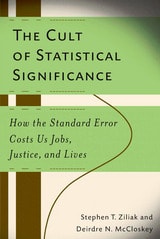
The Cult of Statistical Significance
How the Standard Error Costs Us Jobs, Justice, and LivesStephen T. Ziliak and Deirdre N. McCloskey
University of Michigan Press, 2010
“McCloskey and Ziliak have been pushing this very elementary, very correct, very important argument through several articles over several years and for reasons I cannot fathom it is still resisted. If it takes a book to get it across, I hope this book will do it. It ought to.”
—Thomas Schelling, Distinguished University Professor, School of Public Policy, University of Maryland, and 2005 Nobel Prize Laureate in Economics
“With humor, insight, piercing logic and a nod to history, Ziliak and McCloskey show how economists—and other scientists—suffer from a mass delusion about statistical analysis. The quest for statistical significance that pervades science today is a deeply flawed substitute for thoughtful analysis. . . . Yet few participants in the scientific bureaucracy have been willing to admit what Ziliak and McCloskey make clear: the emperor has no clothes.”
—Kenneth Rothman, Professor of Epidemiology, Boston University School of Health
The Cult of Statistical Significance shows, field by field, how “statistical significance,” a technique that dominates many sciences, has been a huge mistake. The authors find that researchers in a broad spectrum of fields, from agronomy to zoology, employ “testing” that doesn’t test and “estimating” that doesn’t estimate. The facts will startle the outside reader: how could a group of brilliant scientists wander so far from scientific magnitudes? This study will encourage scientists who want to know how to get the statistical sciences back on track and fulfill their quantitative promise. The book shows for the first time how wide the disaster is, and how bad for science, and it traces the problem to its historical, sociological, and philosophical roots.
Stephen T. Ziliak is the author or editor of many articles and two books. He currently lives in Chicago, where he is Professor of Economics at Roosevelt University. Deirdre N. McCloskey, Distinguished Professor of Economics, History, English, and Communication at the University of Illinois at Chicago, is the author of twenty books and three hundred scholarly articles. She has held Guggenheim and National Humanities Fellowships. She is best known for How to Be Human* Though an Economist (University of Michigan Press, 2000) and her most recent book, The Bourgeois Virtues: Ethics for an Age of Commerce (2006).

The Decomposition of Figures Into Smaller Parts
Vladimir Grigor'evich Boltyanskii and Izrail' Tsudikovich Gokhberg
University of Chicago Press, 1980
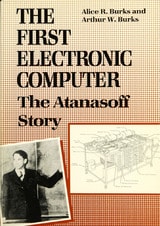
The First Electronic Computer
The Atanasoff StoryAlice R. Burks and Arthur W. Burks
University of Michigan Press, 1989
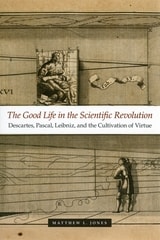
The Good Life in the Scientific Revolution
Descartes, Pascal, Leibniz, and the Cultivation of VirtueMatthew L. Jones
University of Chicago Press, 2006
Amid the unrest, dislocation, and uncertainty of seventeenth-century Europe, readers seeking consolation and assurance turned to philosophical and scientific books that offered ways of conquering fears and training the mind—guidance for living a good life.
The Good Life in the Scientific Revolution presents a triptych showing how three key early modern scientists, René Descartes, Blaise Pascal, and Gottfried Leibniz, envisioned their new work as useful for cultivating virtue and for pursuing a good life. Their scientific and philosophical innovations stemmed in part from their understanding of mathematics and science as cognitive and spiritual exercises that could create a truer mental and spiritual nobility. In portraying the rich contexts surrounding Descartes’ geometry, Pascal’s arithmetical triangle, and Leibniz’s calculus, Matthew L. Jones argues that this drive for moral therapeutics guided important developments of early modern philosophy and the Scientific Revolution.
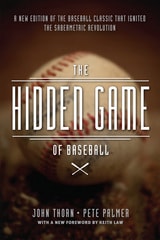
The Hidden Game of Baseball
A Revolutionary Approach to Baseball and Its StatisticsJohn Thorn, Pete Palmer, with David Reuther
University of Chicago Press, 2015
The new gospel promulgated by Thorn and Palmer opened the door for a flood of new questions, such as how a ballpark’s layout helps or hinders offense or whether a strikeout really is worse than another kind of out. Taking questions like these seriously—and backing up the answers with data—launched a new era, showing fans, journalists, scouts, executives, and even players themselves a new, better way to look at the game.
This brand-new edition retains the body of the original, with its rich, accessible analysis rooted in a deep love of baseball, while adding a new introduction by the authors tracing the book’s influence over the years. A foreword by ESPN’s lead baseball analyst, Keith Law, details The Hidden Game’s central role in the transformation of baseball coverage and team management and shows how teams continue to reap the benefits of Thorn and Palmer’s insights today. Thirty years after its original publication, The Hidden Game is still bringing the high heat—a true classic of baseball literature.
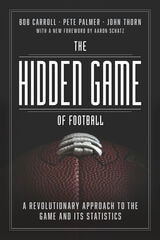
The Hidden Game of Football
A Revolutionary Approach to the Game and Its StatisticsBob Carroll, Pete Palmer, and John Thorn
University of Chicago Press, 2023
Data analytics have revolutionized football. With play sheets informed by advanced statistical analysis, today’s coaches pass more, kick less, and go for more two-point or fourth-down conversions than ever before. In 1988, sportswriters Bob Carroll, Pete Palmer, and John Thorn proposed just this style of play in The Hidden Game of Football, but at the time baffled readers scoffed at such a heartless approach to the game. Football was the ultimate team sport and unlike baseball could not be reduced to pure probabilities. Nevertheless, the book developed a cult following among analysts who, inspired by its unorthodox methods, went on to develop the core metrics of football analytics used today: win probability, expected points, QBR, and more. With a new preface by Thorn and Palmer and a new foreword by Football Outsiders’s Aaron Schatz, The Hidden Game of Football remains an essential resource for armchair coaches, fantasy managers, and fans of all stripes.
The Logic of Decision
Richard C. Jeffrey
University of Chicago Press, 1990
The Martin Gardner Bibliography
Edited by Dana Richards
CSLI, 2023
Martin Gardner (1914–2010) was a polymath whose international reputation extended from mathematics to literature, philosophy to science, and magic to fiction. This comprehensive bibliography covers every aspect of Gardner’s lengthy publishing career, from 1930 to 2010, and features detailed descriptions and indices of his writings on mathematics and many other topics. Editor Dana Richards worked directly with Gardner on this project from 1978 until Gardner’s death; it draws on the two hundred boxes of Gardner’s mathematical papers held in the Stanford archives
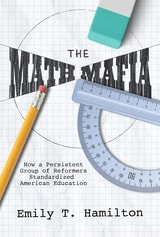
The Math Mafia
How a Persistent Group of Reformers Standardized American EducationEmily T. Hamilton
University of Alabama Press, 2026
How Cold War urgency, academic ambition, and federal power converged to make math the cornerstone of American education policy.
The Math Mafia by Emily T. Hamilton is a historical account of mathematics education reform in twentieth-century America and how that movement played a role in shaping the broader contours of national education policy. Hamilton contends that a cohesive and well-organized community of advocates was instrumental in the rise of standardized testing and curriculum reforms, as well as federal involvement in classrooms, especially during the Cold War. By positioning mathematics as central to national strength and security, these reformers established math education as a key area of federal focus.
The “mafia” at the center of Hamilton’s story includes mathematicians, educators, and researchers from universities, as well as members of government-funded organizations such as the National Science Foundation and various educational psychology circles. Prominent figures such as Edward Begle, who led the School Mathematics Study Group during the “new math” movement, played key roles. Other influential participants include federal education officials, advocates from professional organizations such as the National Council of Teachers of Mathematics, and cognitive scientists, who contributed both research and theoretical frameworks that informed curriculum design and assessment methods.
The Math Mafia offers historians, educators, policymakers, and other interested readers a compelling perspective on the legacy of the math education reforms on federal education policy in the United States and is a welcome contribution to ongoing discourse around “teaching toward the test,” educational equity, school performance, and other hot-button issues in US education today.
The Nature of Scientific Evidence
Statistical, Philosophical, and Empirical ConsiderationsEdited by Mark L. Taper and Subhash R. Lele
University of Chicago Press, 2004
Though the book uses ecology as an exemplary science, the interdisciplinary evaluation of the use of statistics in empirical research will be of interest to any reader engaged in the quantification and evaluation of data.
The New Math
A Political HistoryChristopher J. Phillips
University of Chicago Press, 2014
In this history, Christopher J. Phillips examines the rise and fall of the new math as a marker of the period’s political and social ferment. Neither the new math curriculum designers nor its diverse legions of supporters concentrated on whether the new math would improve students’ calculation ability. Rather, they felt the new math would train children to think in the right way, instilling in students a set of mental habits that might better prepare them to be citizens of modern society—a world of complex challenges, rapid technological change, and unforeseeable futures. While Phillips grounds his argument in shifting perceptions of intellectual discipline and the underlying nature of mathematical knowledge, he also touches on long-standing debates over the place and relevance of mathematics in liberal education. And in so doing, he explores the essence of what it means to be an intelligent American—by the numbers.

The Optics of Ibn al-Haytham Books IV–V
On Reflection and Images Seen by ReflectionAbdelhamid I. Sabra
University of London Press, 2023
Ibn al-Haytham was perhaps the greatest mathematician and physicist of the medieval Arabic/Islamic world. The most famous book in which he applied his scientific method is his Optics, through which he dealt with both the mathematics of rays of light and the physical aspects of the eye in seven comprehensive books. His rethinking of the entire science of optics set the scene for the whole of the subsequent development of the subject, influencing figures such as William of Ockham, Kepler, Descartes, and Christaan Huygens. The immense work of editing, translating into English, and commenting on this work was undertaken by Abdelhamid I. Sabra. This English translation of Books IV–V was completed by Sabra just before his death in 2013 with an introduction and critical analysis. It has been extensively revised by Jan Hogendijk.
The Organism Is a Theory
Giuseppe Longo on Biology, Mathematics, and AIGiuseppe Longo
University of Minnesota Press, 2026
A bold reimagining of life that bridges science, philosophy, cybernetics, and the complexities of biological existence
The Organism Is a Theory is an intriguing synthesis of decades of interdisciplinary research by eminent mathematician and biological scientist Giuseppe Longo. A unique collaboration between Longo and philosopher of technology Adam Nocek, the volume confronts foundational issues in the history of mathematics, computer science, physics, and theoretical biology.
Challenging conventional approaches that apply computational and formalist models to the biological world, Longo reveals how the limitations of these models hinder the understanding of organismic complexity, development, and evolution. Through a critique of dominant scientific paradigms, he emphasizes the need for a new biological theory that accounts for the temporal and spatial intricacies of life. Enhanced by Nocek’s comprehensive introduction and a fascinating three-part interview with Longo, The Organism Is a Theory offers a bold rethinking of the biosciences, integrating the work of Alan Turing, Bernhard Riemann, Henri Poincaré, Kurt Gödel, and others into Longo’s vision of critical biology.
Bridging scientific and philosophical discourses, this book creatively applies insights from mathematics, physics, and computing into the study of the organism to present a new theoretical approach to understanding biological complexity that resists reductive mechanistic and informatic explanations.
Retail e-book files for this title are screen-reader friendly with image accompanied by short alt text and/or extended description.
The Shaping of American Liberalism
The Debates over Ratification, Nullification, and SlaveryDavid F. Ericson
University of Chicago Press, 1993
Focusing on three critical debates in American history—the debate between Anti-Federalists and Federalists over the ratification of the Constitution; the debate between the national republicans and the states-rights republicans over the nullification of the tariff; and the Lincoln-Douglas debates over slavery and pluralist democracy—Ericson shows that republicanism, rather than being opposed to liberalism, is in fact an offshoot of it. His descriptions of republicanism and pluralism represent the poles of an evolving tradition of liberal ideas in America: the former championing the claims of the public sphere, general welfare, and civic virtue; the latter protecting the rights of the individual to liberty, property, and privacy.
Republicanism and pluralism are therefore more properly understood as two sets of competing ideas that evolved from common roots. Ericson concludes that although republican themes persist in American politics, the profound transformations brought about by the Civil War made the ascendancy of pluralism virtually inevitable.
This highly original discussion of the relation between liberalism and republicanism—the central concern of much of the recent scholarship in American political thought—will be important reading for those interested in American politics, history, and culture.
The Situation in Logic
Jon Barwise
CSLI, 1989

The Subject Matters
Classroom Activity in Math and Social StudiesSusan S. Stodolsky
University of Chicago Press, 1988
Stodolsky presents a challenge to educational research. She shows that classroom activities are coherent actions shaped by the instructional context—especially what is taught. Stodolsky contradicts the received view of both teaching and learning as uniform and consistent. Individual teachers arrange instruction very differently, depending on what they are teaching, and students respond to instruction very differently, depending on the structure and demands of the lesson.
The instructional forms used in math classes, a "basic" subject, and social studies classes, an "enrichment" subject, differ even when the same teacher conducts both classes. Social studies classes show more diversity in activities, while math classes are very similar to one another. Greater variety is found in social studies within a given teacher's class and when different teachers' classes are compared. Nevertheless, in the classrooms Stodolsky studied, the range of instructional arrangements is very constricted.
Challenging the "back to basics" movement, Stodolsky's study indicates that, regardless of subject matter, students are more responsive to instruction that requires a higher degree of intellectual complexity and performance, to learning situations that involve them in interaction with their peers, and to active modes of learning. Stodolsky also argues that students develop ideas about how to learn a school subject, such as math, by participating in particular activities tied to instruction in the subject. These conceptions about learning are unplanned but enduring and significant consequences of schooling.
The Subject Matters has important implications for instructional practice and the training, education, and supervision of teachers. Here is a new way of understanding the dynamics of teaching and learning that will transform how we think about schools and how we study them.
The Tbilisi Symposium on Logic, Language and Computation
Selected PapersEdited by Jonathan Ginzburg, Zurab Khasidashvili, Carl Vogel, Jean-Jacques Lévy,
CSLI, 1998
The Topological Classification of Stratified Spaces
Shmuel Weinberger
University of Chicago Press, 1994
Divided into three parts, the book begins with an overview of modern high-dimensional manifold theory. Rather than including complete proofs of all theorems, Weinberger demonstrates key constructions, gives convenient formulations, and shows the usefulness of the technology. Part II offers the parallel theory for stratified spaces. Here, the topological category is most completely developed using the methods of "controlled topology." Many examples illustrating the topological invariance and noninvariance of obstructions and characteristic classes are provided. Applications for embeddings and immersions of manifolds, for the geometry of group actions, for algebraic varieties, and for rigidity theorems are found in Part III.
This volume will be of interest to topologists, as well as mathematicians in other fields such as differential geometry, operator theory, and algebraic geometry.
The Total Survey Error Approach
A Guide to the New Science of Survey ResearchHerbert F. Weisberg
University of Chicago Press, 2005
Herbert F. Weisberg's handbook presents a unified method for conducting good survey research centered on the various types of errors that can occur in surveys—from measurement and nonresponse error to coverage and sampling error. Each chapter is built on theoretical elements drawn from specific disciplines, such as social psychology and statistics, and follows through with detailed treatments of the specific types of error and their potential solutions. Throughout, Weisberg is attentive to survey constraints, including time and ethical considerations, as well as controversies within the field and the effects of new technology on the survey process—from Internet surveys to those completed by phone, by mail, and in person. Practitioners and students will find this comprehensive guide particularly useful now that survey research has assumed a primary place in both public and academic circles.
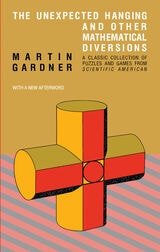
The Unexpected Hanging and Other Mathematical Diversions
Martin Gardner
University of Chicago Press, 1991
"Gardner conjures problems that are both profound and silly; exquisite truths and outrageous absurdities; paradoxes, anagrams, palindromes and party tricks. . . . He knows, better than most, how many amazing true things there are in the world."—Newsweek
The Universe in Thirteen Graphs
Charting Cosmic Discoveries Across Space and TimeChris Lintott, Jeffrey Grube, and Daina Bouquin
University of Chicago Press, 2027
See the Universe as astronomers do: These thirteen graphs distill the cutting-edge discoveries of the cosmos—from planets and stars to galaxies, to ripples in spacetime itself.
From the front page of newspapers to your favorite t-shirt, the visual language of the cosmos is pervasive. Yet while you may have seen stunning images of planets, nebulae, and even the shadow of a black hole, pretty pictures alone cannot reveal the universe. Whether you’re looking for planets outside our solar system, searching for dark matter, listening for ripples in spacetime, or looking back to very early times, to truly understand the cosmos you need graphs.
In this fully illustrated and engaging book, astronomers Chris Lintott and Jeffrey Grube and data scientist Daina Bouquin focus on thirteen graphs to offer a tour of the major astronomical discoveries of the last century. Meet the HR diagram, which tells us about stellar lives; marvel at the Hubble diagram’s evidence for the expansion of the Universe; understand special relativity through Minkowski spacetime; and turn back time to the earliest visible light of the cosmic microwave background. With fascinating stories of discovery and accessible science for understanding ongoing debates, this book proves that while a picture may be worth a thousand words, a graph can show you the universe.
The Wiener-Hopf Method in Electromagnetics
Vito G. Daniele
The Institution of Engineering and Technology, 2014

Thinking Through Statistics
John Levi Martin
University of Chicago Press, 2018
Martin argues that the task of social statistics isn't to estimate parameters, but to reject false theory. He illustrates common pitfalls that can keep researchers from doing just that using a combination of visualizations, re-analyses, and simulations. Thinking Through Statistics gives social science practitioners accessible insight into troves of wisdom that would normally have to be earned through arduous trial and error, and it does so with a lighthearted approach that ensures this field guide is anything but stodgy.
Time Warps, String Edits, and Macromolecules
The Theory and Practice of Sequence ComparisionDavid Sankoff and Joseph Kruskal
CSLI, 1983
Topics in Analytic Number Theory
Edited by Sidney W. Graham and Jeffrey D. Vaaler
University of Texas Press, 1985
Topics in Geometric Group Theory
Pierre de la Harpe
University of Chicago Press, 2000
The first five chapters present basic combinatorial and geometric group theory in a unique and refreshing way, with an emphasis on finitely generated versus finitely presented groups. In the final three chapters, de la Harpe discusses new material on the growth of groups, including a detailed treatment of the "Grigorchuk group." Most sections are followed by exercises and a list of problems and complements, enhancing the book's value for students; problems range from slightly more difficult exercises to open research problems in the field. An extensive list of references directs readers to more advanced results as well as connections with other fields.
Topics in the Foundations of General Relativity and Newtonian Gravitation Theory
David B. Malament
University of Chicago Press, 2012
Torsion-Free Modules
Eben Matlis
University of Chicago Press, 1973
The first eight chapters of the book are a general introduction to the theory of torsion-free modules. This part of the book is suitable for a self-contained basic course on the subject. More specialized problems of finding all integrally closed D-rings are examined in the last seven chapters, where material covered in the first eight chapters is applied.
An integral domain is said to be a D-ring if every torsion-free module of finite rank decomposes into a direct sum of modules of rank 1. After much investigation, Professor Matlis found that an integrally closed domain is a D-ring if, and only if, it is the intersection of at most two maximal valuation rings.

Toward a History of Game Theory, Volume 24
E. Roy Weintraub, ed.
Duke University Press, 0
Drawing on interviews with original members of the game theory community and on the Morgenstern diaries, the first section of the book examines early work in game theory. It focuses on the groundbreaking role of the von Neumann-Morgenstern collaborative work, The Theory of Games and Economic Behavior (1944). The second section recounts the reception of this new theory, revealing just how game theory made its way into the literatures of the time and thus became known among relevant communities of scholars. The contributors explore how game theory became a wedge in opening up the social sciences to mathematical tools and use the personal recollections of scholars who taught at Michigan and Princeton in the late 1940s to show why the theory captivated those practitioners now considered to be "giants" in the field. The final section traces the flow of the ideas of game theory into political science, operations research, and experimental economics.
Contributors. Mary Ann Dimand, Robert W. Dimand, Robert J. Leonard, Philip Mirowski, Angela M. O'Rand, Howard Raiffa, Urs Rellstab, Robin E. Rider, William H. Riker, Andrew Schotter, Martin Shubik, Vernon L. Smith
Truth, Reference and Realism
Zsolt Novak
Central European University Press, 2011