Results by title
65 books match the query 'Melville, Herman' and 11 start with t
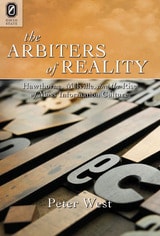
The Arbiters of Reality
Hawthorne, Melville, and the Rise of Mass Information CulturePeter West
The Ohio State University Press, 2008
The Arbiters of Reality: Hawthorne, Melville, and the Rise of Mass Information Culture disrupts our critical sense of nineteenth-century American literature by examining the storytelling strategies of both Nathaniel Hawthorne and Herman Melville in light of an emerging information industry. Peter West reveals how these writers invoked telegraphic and penny press journalism, daguerreotypy, and moving panoramas in their fiction to claim for themselves a privileged access to a reality beyond the reach of a burgeoning mass audience.
Locating Hawthorne and Melville in vivid and overlooked contexts—the Salem Murder scandal of 1830, which transformed Hawthorne's quiet city into a media-manufactured spectacle, and Melville's New York City of 1846–47, where the American Telegraph was powerfully articulating a nation at war—West portrays the romance as a reactive, deeply rhetorical literary form and a rich historical artifact.
In the early twenty-first century, it has become a postmodern cliché to place the word “reality” in scare quotes. The Arbiters of Reality suggests that attending to the construction of the real in public life is more than simply a language of critique: it must also be understood as a specific kind of romantic self-invention.
[more]

The Composition of Herman Melville
Rick Mitchell
Intellect Books, 2002
How do writers compose, and how are they in turn composed?
This play, which contains biographical information relating to Herman Melville, is fundamentally an exploration of the ways in which these two things take place.
The play admits the truth of Walter Benjamin's view of history as, "time filled by the presence of the now." Parallels between past and present (e.g., racism, domestic abuse, and the plight of the visionary American artist) are clearly implied, but the play also utilizes new technologies, in particular video, in order to represent the kind of dialectical history and representation promoted by Benjamin.
During Melville's lifetime, and in his own creative imagination, the archaic was undergoing its transformation into modernity. Thus Melville is an especially apt subject for an exploration of modernity and representation that utilizes both the modern &endash; i.e., video, montage &endash; and elements of the archaic &endash; i.e., the performing body, allusions to whaling, 'discovery' in the South Seas.
The Composition of Herman Melville utilizes performance strategies in an effort to embody the complex textuality of a writer who haunts the landscape of America, from the mid-nineteenth century to the present. This book is believed to represent the only work of historical fiction &endash; albeit in dramatic form &endash; that focuses primarily on Herman Melville, considered by many to be America's greatest writer.
[more]
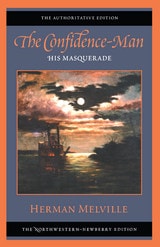
The Confidence-Man
His MasqueradeHerman Melville
Northwestern University Press, 2002
Long considered Melville's strangest novel, The Confidence-Man is a comic allegory aimed at the optimism and materialism of mid-nineteenth century America. A shape-shifting Confidence-Man approaches passengers on a Mississippi River steamboat and, winning over his not-quite-innocent victims with his charms, urges each to trust in the cosmos, in nature, and even in human nature--with predictable results. In Melville's time the book was such a failure he abandoned fiction writing for twenty years; only in the twentieth century did critics celebrate its technical virtuosity, wit, comprehensive social vision, and wry skepticism.
This scholarly edition includes a Historical Note offering a detailed account of the novel's composition, publication, reception, and subsequent critical history. In addition the editors present the twenty-six surviving manuscript leaves and scraps with full transcriptions and analytical commentary.
This scholarly edition aims to present a text as close to the author's intention as surviving evidence permits. Based on collations of both editions publishing during Melville's lifetime, it incorporates 138 emendations made by the present editors. It is an Approved Text of the Center for Editions of American Authors (Modern Language Association of America).
[more]
The Confidence-Man
Volume Ten, Scholarly EditionHerman Melville
Northwestern University Press, 1984
Long considered Melville's strangest novel, The Confidence-Man is a comic allegory aimed at the optimism and materialism of mid-nineteenth century America. A shape-shifting Confidence-Man approaches passengers on a Mississippi River steamboat and, winning over his not-quite-innocent victims with his charms, urges each to trust in the cosmos, in nature, and even in human nature--with predictable results. In Melville's time the book was such a failure he abandoned fiction writing for twenty years; only in the twentieth century did critics celebrate its technical virtuosity, wit, comprehensive social vision, and wry skepticism.
This scholarly edition includes a Historical Note offering a detailed account of the novel's composition, publication, reception, and subsequent critical history. In addition the editors present the twenty-six surviving manuscript leaves and scraps with full transcriptions and analytical commentary.
This scholarly edition aims to present a text as close to the author's intention as surviving evidence permits. Based on collations of both editions publishing during Melville's lifetime, it incorporates 138 emendations made by the present editors. It is an Approved Text of the Center for Editions of American Authors (Modern Language Association of America).
This scholarly edition includes a Historical Note offering a detailed account of the novel's composition, publication, reception, and subsequent critical history. In addition the editors present the twenty-six surviving manuscript leaves and scraps with full transcriptions and analytical commentary.
This scholarly edition aims to present a text as close to the author's intention as surviving evidence permits. Based on collations of both editions publishing during Melville's lifetime, it incorporates 138 emendations made by the present editors. It is an Approved Text of the Center for Editions of American Authors (Modern Language Association of America).
[more]
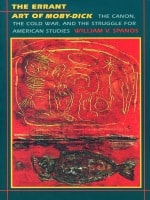
The Errant Art of Moby-Dick
The Canon, the Cold War, and the Struggle for American StudiesWilliam V. Spanos
Duke University Press, 1995
In The Errant Art of Moby-Dick, one of America’s most distinguished critics reexamines Melville’s monumental novel and turns the occasion into a meditation on the history and implications of canon formation. In Moby-Dick—a work virtually ignored and discredited at the time of its publication—William V. Spanos uncovers a text remarkably suited as a foundation for a "New Americanist" critique of the ideology based on Puritan origins that was codified in the canon established by "Old Americanist" critics from F. O. Matthiessen to Lionel Trilling. But Spanos also shows, with the novel still as his focus, the limitations of this "New Americanist" discourse and its failure to escape the totalizing imperial perspective it finds in its predecessor.
Combining Heideggerian ontology with a sociopolitical perspective derived primarily from Foucault, the reading of Moby-Dick that forms the center of this book demonstrates that the traditional identification of Melville’s novel as a "romance" renders it complicitous in the discourse of the Cold War. At the same time, Spanos shows how New Americanist criticism overlooks the degree to which Moby-Dick anticipates not only America’s self-representation as the savior of the world against communism, but also the emergent postmodern and anti-imperial discourse deployed against such an image. Spanos’s critique reveals the extraordinary relevance of Melville’s novel as a post-Cold War text, foreshadowing not only the self-destructive end of the historical formation of the American cultural identity in the genocidal assault on Vietnam, but also the reactionary labeling of the current era as "the end of history."
This provocative and challenging study presents not only a new view of the development of literary history in the United States, but a devastating critique of the genealogy of ideology in the American cultural establishment.
[more]
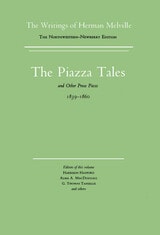
The Piazza Tales and Other Prose Pieces, 1839-1860
Volume Nine, Scholarly EditionHerman Melville
Northwestern University Press, 1987
In this new edition of The Piazza Tales, the editors of the acclaimed Northwestern-Newberry Edition of the Writings of Herman Melville have used the original magazine versions for five of the six stories in order to present the most accurate tests of these works. Here, in such famous stories as "Bartleby, the Scrivener" and "The Encantadas, or Enchanted Isles," we find Melville's imagination and style at its best. Of the less well known tales, the humor in "The Piazza" and "The Lightning-Rod Man," and the gothic horror of "The Bell Tower," command attention as well. Whether in the exotic Galapagos or the more familiar climes of Wall Street or a Massachusetts farmhouse, Melville's power and imagination transport the reader into his unique worlds.
This scholarly edition presents texts as close to the author's intentions as surviving evidence permits. Based on surviving manuscripts, on original newspaper and magazine printings, and on collations of magazine printings with the book of editions of The Piazza Tales, the text incorporates over 800 emendations by the editors and over 200 from later printings during Melville's lifetime.
This edition is an Approved Text of the Center for Editions of American Authors (Modern Language Association of America).
[more]
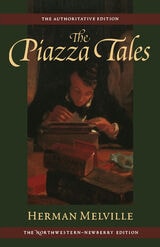
The Piazza Tales
Volume NineHerman Melville
Northwestern University Press, 1996
In this new edition of The Piazza Tales, the editors of the acclaimed Northwestern-Newberry Edition of the Writings of Herman Melville have used the original magazine versions for five of the six stories in order to present the most accurate tests of these works. Here, in such famous stories as "Bartleby, the Scrivener" and "The Encantadas, or Enchanted Isles," we find Melville's imagination and style at its best. Of the less well known tales, the humor in "The Piazza" and "The Lightning-Rod Man," and the gothic horror of "The Bell Tower," command attention as well. Whether in the exotic Galapagos or the more familiar climes of Wall Street or a Massachusetts farmhouse, Melville's power and imagination transport the reader into his unique worlds.
This scholarly edition presents texts as close to the author's intentions as surviving evidence permits. Based on surviving manuscripts, on original newspaper and magazine printings, and on collations of magazine printings with the book of editions of The Piazza Tales, the text incorporates over 800 emendations by the editors and over 200 from later printings during Melville's lifetime.
This edition is an Approved Text of the Center for Editions of American Authors (Modern Language Association of America).
This scholarly edition presents texts as close to the author's intentions as surviving evidence permits. Based on surviving manuscripts, on original newspaper and magazine printings, and on collations of magazine printings with the book of editions of The Piazza Tales, the text incorporates over 800 emendations by the editors and over 200 from later printings during Melville's lifetime.
This edition is an Approved Text of the Center for Editions of American Authors (Modern Language Association of America).
[more]
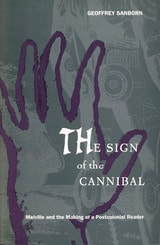
The Sign of the Cannibal
Melville and the Making of a Postcolonial ReaderGeoffrey Sanborn
Duke University Press, 1998
In The Sign of the Cannibal Geoffrey Sanborn offers a major reassessment of the work of Herman Melville, a definitive history of the post-Enlightenment discourse on cannibalism, and a provocative contribution to postcolonial theory. These investigations not only explore mid–nineteenth century resistance to the colonial enterprise but argue that Melville, using the discourse on cannibalism to critique colonialism, contributed to the production of resistance.
Sanborn focuses on the representations of cannibalism in three of Melville’s key texts—Typee, Moby-Dick, and “Benito Cereno.” Drawing on accounts of Pacific voyages from two centuries and virtually the entire corpus of the post-Enlightenment discourse on cannibalism, he shows how Melville used his narratives to work through the ways in which cannibalism had been understood. In so doing, argues Sanborn, Melville sought to move his readers through stages of possible responses to the phenomenon in order to lead them to consider alternatives to established assumptions and conventions—to understand that in the savage they see primarily their own fear and fascination. Melville thus becomes a narrator of the postcolonial encounter as he uncovers the dynamic of dread and menace that marks the Western construction of the “non-savage” human.
Extending the work of Slavoj Zizek and Homi Bhabha while providing significant new insights into the work of Melville, The Sign of the Cannibal represents a breakthrough for students and scholars of postcolonial theory, American literary history, critical anthropology, race, and masculinity.
[more]
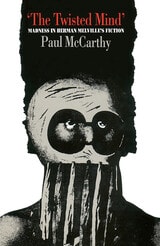
The Twisted Mind
Madness In Melville'S FictionPaul Mccarthy
University of Iowa Press, 1990
Madness in Herman Melville's Fiction
Paul McCarthy
"Though madness has been a consistent topic in considerations of Melville's work, this is the first full-scale treatment of the subject. It is in a sense, then, a pioneering work that will no doubt receive widespread attention."
—William B. Dillingham
Paul McCarthy
"Though madness has been a consistent topic in considerations of Melville's work, this is the first full-scale treatment of the subject. It is in a sense, then, a pioneering work that will no doubt receive widespread attention."
—William B. Dillingham
[more]
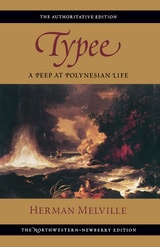
Typee
A Peep at Polynesian LifeHerman Melville
Northwestern University Press, 2003
Almost from the time of its publication early in 1846, Melville's first book, based on his own travels in the South Seas, has been recognized as a classic in the literature of travel and adventure. From the beginning, however, there have been problems with the text. Due to disparities between the American and English editions, and revisions Melville had to make at his publisher's request concerning its racy style and attitude toward missionaries, the book has circulated in two versions.
This scholarly edition is based on collations of all editions published during his lifetime, incorporating many authorial readings that have often been omitted and some that have been misprinted in all previous editions. This edition is an Approved Text of the Center for Editions of American Authors (Modern Language Association of America).
This scholarly edition is based on collations of all editions published during his lifetime, incorporating many authorial readings that have often been omitted and some that have been misprinted in all previous editions. This edition is an Approved Text of the Center for Editions of American Authors (Modern Language Association of America).
[more]
Typee
Volume One, Scholarly EditionHerman Melville
Northwestern University Press, 1968
Almost from the time of its publication early in 1846, Melville's first book, based on his own travels in the South Seas, has been recognized as a classic in the literature of travel and adventure. From the beginning, however, there have been problems with the text. Due to disparities between the American and English editions, and revisions Melville had to make at his publisher's request concerning its racy style and attitude toward missionaries, the book has circulated in two versions.
This scholarly edition is based on collations of all editions published during his lifetime, incorporating many authorial readings that have often been omitted and some that have been misprinted in all previous editions. This edition is an Approved Text of the Center for Editions of American Authors (Modern Language Association of America).
This scholarly edition is based on collations of all editions published during his lifetime, incorporating many authorial readings that have often been omitted and some that have been misprinted in all previous editions. This edition is an Approved Text of the Center for Editions of American Authors (Modern Language Association of America).
[more]