Results by title
1107 books match the query 'Memoirs' and 198 start with t
Tail of the Storm
Flying Missions in the First Gulf WarAlan Cockrell
University of Alabama Press, 1995
A Gulf War memoir that captures the poetry and peril of flight.
Within days of Saddam Hussein’s invasion of Kuwait, the far reaching arm of American airpower sprang into action. The skyscapes of the North Atlantic, Europe, and the Mediterranean became laced with the contrails of great jets flowing day and night toward the Persian Gulf. From the skies, manpower and material poured onto the bleak sands under the ominous clouds of the gathering storm, and in only a few weeks the size of the effort eclipsed that of the Berlin Airlift.
The thousands of crewmembers flying the jets, as well as those servicing and managing them, became the backbone of history’s largest air logistical operation. Many of these men and women were Air Force reservists, and the author participated as a pilot of a C-141B Starlifter with the Mississippi Air National Guard.
Cockrell writes lyrically about flying and about the emotional and intellectual satisfaction enjoyed by those who fly. His focus is on the people recalled to active duty, who flew thousands of hours, coping with fatigue, cracked wings, missile attacks, and, in some cases, deteriorating businesses and families at home. Tail of the Storm gives expression to their love of flight, as well as their dedication to the endangered values of duty, honor, country. This story is good reading—not only for those who share the author’s enthusiasm for flying but also for those who read for pleasure and have a curiosity about a pilot’s world.
Taken from the Paradise Isle
The Hoshida Family StoryHeidi Kim
University Press of Colorado, 2015
Crafted from George Hoshida’s diary and memoir, as well as letters faithfully exchanged with his wife Tamae, Taken from the Paradise Isle is an intimate account of the anger, resignation, philosophy, optimism, and love with which the Hoshida family endured their separation and incarceration during World War II.
George and Tamae Hoshida and their children were a Japanese American family who lived in Hawai‘i. In 1942, George was arrested as a “potentially dangerous alien” and interned in a series of camps over the next two years. Meanwhile, forced to leave her handicapped eldest daughter behind in a nursing home in Hawai‘i, Tamae and three daughters, including a newborn, were incarcerated at the Jerome Relocation Center in Arkansas. George and Tamae regularly exchanged letters during this time, and George maintained a diary including personal thoughts, watercolors, and sketches. In Taken from the Paradise Isle these sources are bolstered by extensive archival documents and editor Heidi Kim’s historical contextualization, providing a new and important perspective on the tragedy of the incarceration as it affected Japanese American families in Hawai‘i.
This personal narrative of the Japanese American experience adds to the growing testimony of memoirs and oral histories that illuminate the emotional, psychological, physical, and economic toll suffered by Nikkei as the result of the violation of their civil rights during World War II.
Taking History to Heart
The Power of the Past in Building Social MovementsJames Green
University of Massachusetts Press, 2000
Deftly blending autobiography and history, James Green here reflects on thirty years as an activist, educator, and historian. He recounts how he became deeply immersed in political protest and in recovering and preserving the history of progressive social movements, and how the two are linked. His book, written in an engaging and accessible style, tells powerful stories of people in struggle, framed by the personal account of his own development. As a historian, Green gives voice to generations of Americans who banded together to fight for social justice. His subjects range from the martyrs of the Haymarket tragedy to the Bread and Roses strikers of 1912, from depression-era struggles for democracy to the civil rights crusaders, from recent Rainbow Coalition campaigns to the latest union organizing drives. As an activist, Green describes how his participation in the civil rights and labor movements of our own time has transformed his life, first as a student and radical scholar in the 1960s, then as a public historian and teacher of working-class students. He also describes his efforts to break free from academic confinement and “tell movement stories in public,” in an attempt to offer hope and counsel to those still fighting for equality and fairness. He concludes with a revealing look at how awareness of past social activism has contributed to the revival of the labor movement during the last ten years, an effort in which Green has been vigorously engaged.
Taking Leave
Deborah Kapchan
Duke University Press, 2025
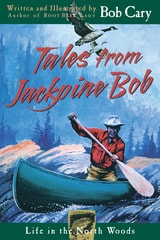
Tales From Jackpine Bob
Bob Cary
University of Minnesota Press, 2003
Bob Cary’s entertaining stories of life in the outdoors will touch your heart and make you laugh. Despite Bob’s many years as an expert woodsman, when he relates an adventure or a misadventure, the joke is always on him. Whether you read Tales from Jackpine Bob by firelight or lamplight, you’ll enjoy Bob’s warm humor and buoyant spirit.
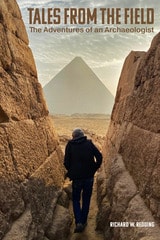
Tales From the Field
The Adventures of an ArchaeologistDr. Richard W. Redding, edited by Alexis Redding
Michigan Publishing Services, 2026
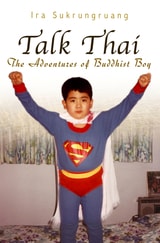
Talk Thai
The Adventures of Buddhist BoyIra Sukrungruang
University of Missouri Press, 2011
When Ira Sukrungruang was born to Thai parents newly arrived in the U.S., they picked his Jewish moniker out of a book of “American” names. In this lively, entertaining, and often hilarious memoir, he relates the early life of a first-generation Thai-American and his constant, often bumbling attempts to reconcile cultural and familial expectations with the trials of growing up in 1980s America.
Young Ira may have lived in Oak Lawn, Illinois, but inside the family’s bi-level home was “Thailand with American conveniences.” They ate Thai food, spoke the Thai language, and observed Thai customs. His bedtime stories were tales of Buddha and monkey-faced demons. On the first day of school his mother reminded him that he had a Siamese warrior’s eyes—despite his thick glasses—as Aunty Sue packed his Muppets lunch box with fried rice. But when his schoolmates played tag he was always It, and as he grew, he faced the constant challenge of reconciling American life with a cardinal family rule: “Remember, you are Thai.”
Inside the Thai Buddhist temple of Chicago, another “simulated Thailand,” are more rules, rules different from those of the Southside streets, and we see mainstream Western religion—“god people”—through the Sukrungruang family’s eyes. Within the family circle, we meet a mother who started packing for her return to Thailand the moment she arrived; her best friend, Aunty Sue, Ira’s second mother, who lives with and cooks for the family; and a wayward father whose dreams never quite pan out.
Talk Thai is a richly told account that takes us into an immigrant’s world. Here is a story imbued with Thai spices and the sensibilities of an American upbringing, a story in which Ira practices English by reciting lines from TV sitcoms and struggles with the feeling of not belonging in either of his two worlds. For readers who delight in the writings of Amy Tan, Gish Jen, and other Asian-Americans, Talk Thai provides generous portions of a still-mysterious culture while telling the story of an American boyhood with humor, playfulness, and uncompromising honesty.
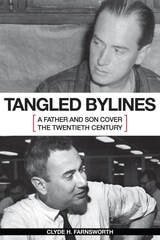
Tangled Bylines
A Father and Son Cover the Twentieth CenturyClyde H. Farnsworth
University of Missouri Press, 2017
Tazmamart
18 Years in Morocco's Secret PrisonAziz BineBine
Haus Publishing, 2021
On July 10, 1971, during birthday celebrations for King Hassan II of Morocco, attendant officers and cadets opened fire on visiting dignitaries. A young officer, Aziz BineBine, arrived late and witnessed the ensuing massacre without firing a single shot, yet he would spend the next two decades in a political prison hidden in the Atlas Mountains—Tazmamart. Conditions in this now-infamous prison were nightmarish. The dark, underground cells, too small for standing up in, exposed prisoners to extreme weather, overflowing sewage, and disease-ridden rats. Forgetting life outside his cell—his past, his family, his friends—and clinging to God, BineBine resolved to survive. Tazmamart: 18 Years in Morocco’s Secret Prison is a memorial to BineBine and his fellow inmates’ sacrifice. This searing tale of endurance offers an unfiltered depiction of the agonizing life of a political prisoner.
Technoscientific Imaginaries
Conversations, Profiles, and MemoirsEdited by George E. Marcus
University of Chicago Press, 1995
In these penetrating essays, twenty-four distinguished contributors from a broad range of fields present the voices of the scientists themselves—through interviews, conversations, and memoirs. We hear from Lithuanian physicists who discuss science after Communism and their own fantasies about what Western science is; a Japanese-American woman struggling with her ambivalence over designing nuclear weapons; political activists in India who examine relations among science, environmental politics, and government ideology in the aftermath of the Bhopal disaster; and many others, including biologists, physicians, corporate researchers, and scientists working with virtual reality and other cutting-edge technologies.
The contributors to this volume are Mario Biagioli, Maria E. Carson, Gary Lee Downey, Joseph Dumit, Michael M. J. Fischer, Mary-Jo DelVecchio Good, Hugh Gusterson, Diana L. L. Hill, James Holston, Herbert C. Hoover, Jr., Gudrun Klein, Leszek Koczanowicz, Irene Kuter, Kim Laughlin, Rita Linggood, George E. Marcus, Kathryn Milun, Livia Polanyi, Christopher Pound, Simon Powell, Paul Rabinow, Kathleen Stewart, Allucquere Rosanne Stone, and Sharon Traweek.
Television, a memoir
Karen Brennan
Four Way Books, 2022
Television, a memoir is a hybrid collection of autobiographical pieces, tragi-comic in spirit, that depict a woman’s life evolving through time and culture in fragmentary glimpses. Indeterminate in genre, Television is a fluid text that sometimes reads as poetry, sometimes as prose, while exploring classism, ableism, and feminism in a world defined by the advent of new media and, for the author, a privilege that often felt suffocating. Working structurally and thematically, television creates conceptual mileposts in the memoir, with certain programs and cultural references corresponding to specific eras in the author’s past, but it also gestures at an existential modality — the experience of a televisual life, the performative arrangements of nuclear families and neighborhoods, the periodic events and dramas of an adolescence watched from outside oneself.
Tell Me, Grandmother
Traditions, Stories, and Cultures of Arapaho PeopleVirginia Sutter
University Press of Colorado, 2004
- Watonga Republican
"Virginia Sutter uses an interesting technique to write the history of her people, the Northern Arapaho Indian Nation. She constructs her work as a series of conversations between herself and her paternal great-grandmother. . . . [T]hrough this device, the history of the Arapaho people is traced from the early nineteenth-century years, when the buffalo ran aplenty and the prairies were boundless, through present-day living conditions in American Indian tribal reservations."
- Moira Richards, www.WomenWriters.net
"Emblematic of the struggle of so many Native Americans of the twentieth century, who seek to reconcile modernity with tradition, and who struggle to recast, reframe, and restore what is Native, even as the majority culture has done its best to uproot, separate, and tell Natives that they can be either modern or Native, but certainly not both."
- Brian Hosmer, Studies in American Indian Literatures (SAIL)
Tell Me, Grandmother is at once the biography of Goes-in-Lodge, a traditional Arapaho woman of the nineteenth century, and the autobiography of her descendant, Virginia Sutter, a modern Arapaho woman with a Ph.D. in public administration. Sutter adeptly weaves her own story with that of Goes-in-Lodge - who, in addition to being Sutter's great-grandmother, was first wife of Sharpnose, the last chief of the Northern Arapaho nation.
Writing in a question-and-answer format between twentieth-century granddaughter and matriarchal ancestor, Sutter discusses four generations of home life, including details about child rearing, education, courtship, marriage, birthing, and burial. Sutter's portrait of Goes-in-Lodge is based on tribal history and interviews with tribal members. Goes-in-Lodge speaks of social and ceremonial gatherings, the Sun Dance, the sweat lodges, and the changes that took place on the Great Plains throughout her lifetime. Sutter details her own life as a child born in a teepee to a white mother and Indian father and the discrimination and injustice she faced struggling to make her way in an increasingly Euro-American world.
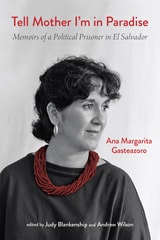
Tell Mother I'm in Paradise
Memoirs of a Political Prisoner in El SalvadorAna Margarita Gasteazoro, edited by Judy Blankenship and Andrew Wilson
University of Alabama Press, 2022
The life and times of Ana Margarita Gasteazoro: political activist, clandestine operative, and prisoner of conscience.
Ana Margarita Gasteazoro (1950–1993) was a Salvadoran opposition activist and renowned Amnesty International prisoner of conscience. Tell Mother I’m in Paradise:Memoirs of a Political Prisoner in El Salvador recounts her extraordinary life story. From a privileged Catholic upbringing, with time spent studying and working abroad, Ana Margarita first became a member of the legal political opposition in the late 1970s and later a clandestine operative at work against the brutal military junta.
Gasteazoro recounts her early rebellion against the strictures of conservative upper-class Salvadoran society. She spoke perfect English and discovered a talent for organizing in administrative jobs abroad and at home. As the civil war progressed, she quickly became a valued figure in the National Revolutionary Movement (MNR), a social democratic party, often representing it at international meetings. Against the backdrop of massive social oppression and the “disappearances” of thousands of opposition members, Gasteazoro began a double life as an operative in a faction of the Farabundo Martí National Liberation Front (FMLN). Multitalented and energetic, she organized safe houses for fellow activists, transported weapons and equipment, wrote scripts for an underground radio station, and produced an award-winning documentary film. But the toll on her family life and personal relationships was heavy.
Ana Margarita was disappeared in May 1981 by the infamous National Guard and endured a nightmare 11 days of interrogations, beatings, and abuse. Through international pressure and the connections of her family, her arrest was finally made public, and she was transferred to the women’s prison at Ilopango. There, she and other activists continued the political struggle through the Committee of Political Prisoners of El Salvador (COPPES). During her two years in prison, tested by hunger strikes, violence, and factional divisions, she became one of Amnesty International’s best-known prisoners of conscience. Tell Mother I’m in Paradise is a gripping story of a self-aware activist and a vital young woman’s struggle to find her own way within a deeply conservative society.
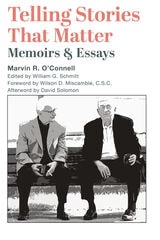
Telling Stories That Matter
Memoirs and EssaysMarvin R. O'Connell
St. Augustine's Press, 2020
In Miscamble’s thorough introduction of O’Connell, he writes that the latter “utilized his striking talents as a historian as an integral part of his fundamental vocation as a priest. [O’Connell] once described the historian as a veritable ‘midwife to our faith,’ who must capture, as best as evidence will allow, the truth of the past.” This position lends itself to the structure of this work. The first part is the sadly incomplete memoirs of Fr. O’Connell, wherein the reader meets the historian and moves with eagerness and confidence into the essays that follow. Highlights of these collected essays include thoughts on Cardinal Newman, Belloc, the Spanish Inquisition, and the historical perspective of evangelization in the United States and modernism at large. What one reads are stories that might have been lost but are here preserved in what can with all moral certainty be called truthfulness. As his friend Ralph McInerny once qualified him, O’Connell combined compassion and judgment such that his histories were always indeed primarily stories and, as the reader well knows, stories have layers and threads and are not told simply for their conclusions.
O’Connell succeeds in showing one how human history is written. Above all, he reveals that history is made by humans, but must also be remembered and deciphered by humans who cannot forego leaving their own marks and prints on everything they encounter (in memory or otherwise). The objectivity we seek can be found in one historical account alone, asserts the priest-storyteller, yet a sharp eye to the past is always consonant with a compassionate desire to understand. Bill Schmitt, Fr. Bill Miscamble and David Solomon do posterity a service by giving us this man and his masterful engagement of history. These friends of O’Connell deem the historian’s passion for truth-in-context to be foundational for shaping stories that matter, including his own.
"This artful combination of memoir and selected essays reawakens our memory of Father O'Connell in all his immense personal charm, intellectual energy, rich erudition, keen wit, and steadfast dedication to his interlocking callings as priest and historian." —J. Philip Gleason, Emeritus Professor, History Department, University of Notre Dame
"The work of a master historian, these memoirs and essays are reliable in recounting what happened, insightful in judging how and why, and eloquent in presenting it all with a flair and wit rarely equaled in historical writing. Moreover, they come forth from a Catholic faith so deep and secure that it need not be imposed on the reader. Rather, they do what good historical writing does, placing the reader into a past that can be seen and felt, recognized and understood. Whether it be his colorful accounts of the tumultuous life and times of Thomas More, or the valiant struggles of Newman and the Oxford Movement, or his own seminary training and teaching in St. Paul, or his fortunes as a graduate student at Notre Dame under the tutelage of the eminent Monsignor Phillip Hughes—whatever the topic, reading O’Connell’s history gives one the gift of being able to say, I remember that happening and I wasn’t even there!"—Michael J. Baxter, Director of Catholic Studies, Regis University in Denver
"O'Connell was a master story teller. He was not, however, just a story teller. He was painstakingly rigorous in what and how he taught. His stories always perfectly illustrated a point, but they were never a substitution for the truth--rather an illustration of it." —Bradley Birzer, Russell Amos Kirk Chair in American Studies, Hillsdale College
Ten Thousand Nights
Highlights from 50 Years of Theatre-GoingMarvin Carlson
University of Michigan Press, 2017
Tenderfoot in Colorado
Richard Baxter Townshend
University Press of Colorado, 1968
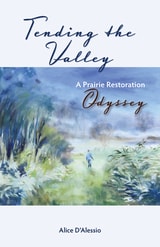
Tending the Valley
A Prairie Restoration OdysseyAlice D'Alessio
Wisconsin Historical Society Press, 2020
In Tending the Valley, Alice chronicles their efforts to return the land to its natural prairie state and to manage their oak and pine woods. Along the way they joined the land restoration movement, became involved in a number of stewardship groups, and discovered the depths of dedication and toil required to bring their dream to fruition. With hard-earned experience and the evocative language of a poet, D’Alessio shares her personal triumphs and setbacks as a prairie steward, along with a profound love for the land and respect for the natural history of the Driftless.
The Algerian Memoirs
Days of Hope and CombatHenri Alleg
Seagull Books, 2011
The personal history of journalist Henri Alleg is tied inextricably to the history of the French-Algerian Conflict. Best known for his book The Question, a first-hand account of his torture by French troops during the Algerian war for independence, Alleg is famous both for having brought the issue of French torture to the public eye and for his passionate work as a writer, a newspaperman, and a communist activist.
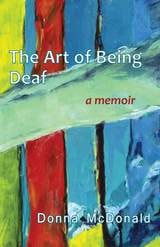
The Art of Being Deaf
A MemoirDonna McDonald
Gallaudet University Press, 2014
Born in 1950s Australia, McDonald was placed in an oral deaf school when she was five. There, she was trained to communicate only in spoken English. Afterwards, she attended mainstream schools where she excelled with speechreading and hard work. Her determination led to achievements that proved her to be “the deaf girl that had made good.” Yet, despite her constant focus on fitting in the hearing world, McDonald soon realized that she missed her deaf schoolmates and desired to explore her closed-off feelings about being deaf.
When she reconnected with her friends, one urged her to write about her experiences to tell all about “the Forgotten Generation, the orally-raised deaf kids that no one wants to talk about.” In writing her memoir, McDonald did learn to reconcile her deaf-self with her “hearing-deaf” persona, and she realized that the art of being deaf is the art of life, the art of love.
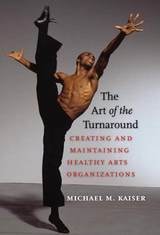
The Art of the Turnaround
Creating and Maintaining Healthy Arts OrganizationsMichael M. Kaiser
Brandeis University Press, 2008
The Attic
A MemoirHarnack, Curtis
University of Iowa Press, 2011
In The Attic, his sequel to the classic We Have All Gone Away, Curtis Harnack returns to his rural Iowa homeplace to sift through an attic full of the trash and treasures left behind by the thirteen children in two generations who grew up in the big farmhouse.
The Backwards Hand
A MemoirMatt Lee
Northwestern University Press, 2024
Told in lyric fragments, The Backwards Hand traces Matt Lee’s experience living in the United States for more than thirty years with a rare congenital defect. Weaving in historical research and pop culture references, Lee dissects how the disabled body has been conflated with impurity, worthlessness, and evil. His voice swirls amid those of artists, criminals, activists, and philosophers. With a particular focus on horror films, Lee juxtaposes portrayals of fictitious monsters with the real-life atrocities of the Nazi regime and the American eugenics movement. Through examining his struggles with physical and mental health, Lee confronts his own beliefs about monstrosity and searches for atonement as he awaits the birth of his son.
The Backwards Hand interrogates what it means to be a cripple in a predominantly ableist society, deconstructing how perceptions of disability are—and are not—reflected in art and media.
The Battle to Stay in America
Immigration's Hidden Front LineMichael Kagan
University of Nevada Press, 2025
The Battle to Stay in America is the story of a community coming to grips with the federal government’s crackdown on immigrants, and learning how to defend itself. Informative and personal, this is a story about mothers and fathers, lawyers and activists, local police and federal agencies, and a struggle for the identity of a nation. This is the quintessential story of the war on immigrants, as fought and felt on the front lines in the heart of America.

The Beautiful Agonies
Adrie Kusserow
Duke University Press, 2027
The Black Penguin
Andrew Evans
University of Wisconsin Press, 2018
Ejected from church and shunned by his family as a young man, Evans embarks on an ambitious overland journey halfway across the world. Riding public transportation, he crosses swamps, deserts, mountains, and jungles, slowly approaching his lifelong dream and ultimate goal: Antarctica. With each new mile comes laughter, pain, unexpected friendship, true weirdness, unsettling realities, and some hair-raising moments that eventually lead to a singular discovery on a remote beach at the bottom of the world.
Evans's 12,000-mile voyage becomes a soulful quest to balance faith, family, and self, reminding us that, in the end, our lives are defined by the roads we take, the places we touch, and those we hold nearest.
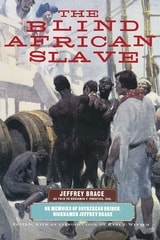
The Blind African Slave
Memoirs of Boyrereau Brinch, Nicknamed Jeffrey BraceJeffrey Brace, as told to Benjamin F. Prentiss, Esq.
University of Wisconsin Press, 2005
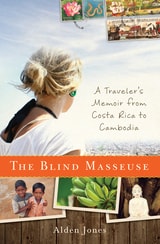
The Blind Masseuse
A Traveler's Memoir from Costa Rica to CambodiaAlden Jones
University of Wisconsin Press, 2013
Gold Winner for Travel Essays, Foreword Books of the Year
Gold Medal for Travel Essays, Independent Publisher Book Awards
Winner, Bisexual Book Awards, Bisexual Biography/Memoir Category
Finalist, Housatonic Book Awards
Longlist of eight, PEN/Diamonstein Spielvogel Award for the Art of the Essay
Finalist, Travel Book or Guide Award, North American Travel Journalists Association
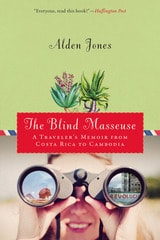
The Blind Masseuse
A Traveler's Memoir from Costa Rica to CambodiaAlden Jones
University of Wisconsin Press, 2017
By way of explorations to Costa Rica, Bolivia, Nicaragua, Cuba, Burma, Cambodia, Egypt, and around the world on a ship, Jones chronicles her experience as a young American traveler while pondering her role as an outsider in the cultures she temporarily inhabits. Her wanderlust fuels a strong, high-adventure story and, much in the vein of classic travel literature, Jones's picaresque tale of personal evolution informs her own transitions, rites of passage, and understandings of her place as a citizen of the world. With sharp insight and stylish prose, Jones asks: Is there a right or wrong way to travel? The Blind Masseuse concludes that there is, but that it's not always black and white.
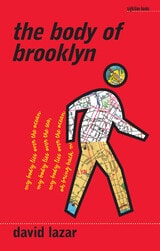
The Body of Brooklyn
David Lazar
University of Iowa Press, 2003
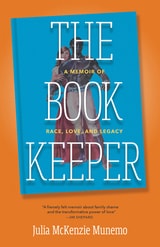
The Book Keeper
A Memoir of Race, Love, and LegacyJulia McKenzie Munemo
Ohio University Press, 2020
“A fiercely felt memoir about family shame and the transformative power of love even as it’s also an ongoing meditation on privilege and race in twenty-first-century America. This is a debut striking in its empathetic imagination, observational acuity, and emotional intelligence.” — Jim Shepard, author of Like You’d Understand, Anyway.
In a memoir that’s equal parts love story, investigation, and racial reckoning, Munemo unravels and interrogates her whiteness, a shocking secret, and her family’s history.
When interracial romance novels written by her long-dead father landed on Julia McKenzie Munemo’s kitchen table, she—a white woman—had been married to a black man for six years and their first son was a toddler. Out of shame about her father’s secret career as a writer of “slavery porn,” she hid the books from herself, and from her growing mixed-race family, for more than a decade. But then, with police shootings of African American men more and more in the public eye, she realized that understanding her own legacy was the only way to begin to understand her country.
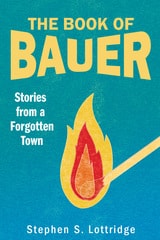
The Book of Bauer
Stories from a Forgotten TownStephen S. Lottridge
University of Utah Press, 2023
Graffiti-covered industrial concrete ruins are all that remain today to remind us of the lives, adventures, and human relationships that once animated Bauer, Utah. Located just south of Tooele, across the Oquirrh Mountains west of the Salt Lake Valley, Bauer was abandoned in 1979 and declared a toxic waste site. The Book of Bauer: Stories from a Forgotten Town brings it back to life, evoking mid-twentieth century family and community in that company town as seen through the eyes of an observant adolescent boy.
Presenting a dramatic snapshot of life in Bauer in narrative autobiographical form, the book recalls the fate of hundreds of derelict mining towns throughout the mountain and sagebrush West. With vivid prose and intimate observation, The Book of Bauer offers an unparalleled memoir of small-town life in Utah and the Great Basin.
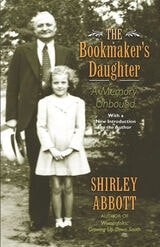
The Bookmaker's Daughter
A Memory UnboundShirley Abbott
University of Arkansas Press, 2006
This deeply felt memoir is a journey through family history, feminist insight, and southern mythology. In it a daughter reflects on the complicated and volatile love she and her father shared. Shirley Jean Abbott grew up in Hot Springs, Arkansas, in the 1940s and 50s and was the beloved daughter of Alfred Bemont Abbott, affectionately known as “Hat.” Hat wasn’t a bookmaker in the literary sense, even though he allowed Shirley’s mother to believe as much while they were dating. Rather, his craft was gambling, and his business was horse racing.
Despite the corruption, which put food on the table and rabbit coats in the closet, Abbott remembers the kind and attentive father who spent nights reading to her. He alone is responsible for opening the door to a world of language and literature for her. And she ran with it. Against her father’s wishes, after graduation she headed for New York City. In the end, the girl he had nurtured into an independent and intelligent young woman had outgrown the small town where she grew up. The Bookmaker’s Daughter was originally published by Ticknor and Fields in 1992 and was a Book of the Month Club selection.
The Boy of Battle Ford and the Man
W. S. Blackman
Southern Illinois University Press, 2012
A classic story of a young man’s journey to adulthood, The Boy of Battle Ford covers Blackman’s years growing up in early post-settlement Illinois, where he gave in to temptations such as drinking, gambling, and the lure of prostitutes before joining the army, finding God and becoming a preacher. Blackman, who notes that he is determined to “write facts” in this book, peppers his story with the sordid details of the sinful times of his life as well as with discussions of faith and of struggling to understand his God and his beliefs.
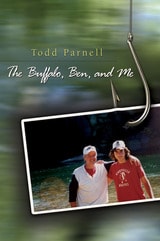
The Buffalo, Ben, and Me
Todd Parnell & Foreword by Jim Baker
University of Missouri Press, 2007
The Buffalo River in northwest Arkansas is one of the longest free-flowing, undammed rivers west of the Mississippi—and one of the most beautiful waterways on earth. Almost lost to development, it proved to be the perfect testing ground for a young boy almost lost to mediocrity.
Middle-schooler Ben is struggling with learning challenges that have left him resentful and underachieving. His father, middle-ager Todd, wants to help his son gain self-confidence but is searching for his own identity. For twelve adventure-filled days on the river—all 125 miles of her navigable course, from Ponca to the White River—father and son discover the formative, curative, and redemptive powers of nature.
Leaving video games and cell phones behind isn’t easy for kids these days, but in the great outdoors parents and youngsters can connect in unimaginable ways. The Buffalo, Ben, and Me shares such a connection in an adventure story set on a wild river. It is a captivating tale featuring a host of colorful characters and enlivened by photos that reflect the essence of the wilderness.
But deeper than that, it is the story of crossing a threshold from dream to possibility—of one man’s search for meaning in his life and his efforts to motivate his son, blending love of family with love of nature in a tale of transformation. It tells how a rebellious teen and a bored banker conspired to buck a system keyed to predictability, and how a wild river inspired both to a better use of their lives. “This trip hit me as hard as it did Ben,” writes Parnell, “as a wake-up call to life, to what is important, to what is not.”
The trip down the Buffalo was one that even Ben admits changed his life in more ways than one, as he later went on to earn a master of science degree specializing in stream ecology. For any reader who loves the outdoors—and especially those seeking to connect with their children—The Buffalo, Ben, and Me is essential reading that reminds us of possibilities to be had in facing life head-on as it raises awareness of the need to protect the Ozarks’ water resources and heritage.
The Canals of Mars
A MemoirGary Fincke
Michigan State University Press, 2010
The Canals of Mars is a memoir that explores and ponders "weakness," which in Gary Fincke's family was the catch-all term for every possible human flaw-physical, psychological, or spiritual. Fincke grew up near Pittsburgh during the 1950s and 1960s, raised by blue-collar parents for whom the problems that beset people-from alcoholism to nearsightedness to asthma to fear of heights-were nothing but weaknesses.
In a highly engaging style, Fincke meditates on the disappointments he suffered-in his body, his mind, his work-because he was convinced that he had to be "perfect." Anything less than perfection was weakness and no one, he understood from an early age, wants to be weak.
Six of the chapters in the book have been cited in Best American Essays. The chapter that provides the book's title, The Canals of Mars, won a Pushcart Prize and was included in The Pushcart Book of Essays: The Best Essays from a Quarter Century of the Pushcart Prize.

The Career of a Tsarist Officer
Memoirs, 1872-1916Anton I. DenikinMargaret Patoski, Editor
University of Minnesota Press, 1975
The Career of a Tsarist Officer was first published in 1975. Minnesota Archive Editions uses digital technology to make long-unavailable books once again accessible, and are published unaltered from the original University of Minnesota Press editions.
General Anton I. Denikin served as an officer in the Russian army throughout a notable career until 1920 when, as commander in chief of the White Russian armies, he was forced to flee from Bolshevik forces at Novorossiisk. In these memoirs, which cover his childhood, youth, and military service up to 1916, we have an unusually candid autobiography and one which illuminates some little-known aspects of Russian social as well as military history.
General Denikin was born in 1872 in the Warsaw province of Russian Poland. He was a graduate of the prestigious General Staff Academy in St. Petersburg, and during his years at the academy he launched a literary career which continued for the rest of his life, enabling him to support his family in their later exile.
Distinguished service in the Russo-Japanese War earned his promotion to colonel in the army, and from that time in 1905 to his tragic fate in 1920 when he left Russia never to return, he served his country with a deep and abiding loyalty, matched only by his devotion to the Orthodox religion. After living in exile in several European countries, principally in France, he moved in 1945 to the United States, where he died in 1947.
The present volume is a translation from the Russian-language edition which was published in 1953 by the Chekhov Publishing house in New York. In this, General Denikin's last work, he provides the social and intellectual background for an understanding of the traits of the Russian officer corps which enabled them to continue the fight for a unified, non-Bolshevik Russia even after the tsar was dead and the cause obviously lost. Through Denikin's eyes one sees also a revealing picture of the efforts of Russo-Japanese War participants to renovate the Russian army in the interwar period, their recognition of the growing threat from Germany as well as from the revolutionaries, and the futility they felt as they entered prematurely into World War I.
The Change
My Great American, Postindustrial, Midlife Crisis TourLori Soderlind
University of Wisconsin Press, 2020
With humanity and humor, Soderlind's journey introduces quirky folks along the way, including Swannie Jim of Silo City and his fawn pit bull, Champ. She attempts to channel muckraking journalist Ida M. Tarbell and celebrates complicated characters, including Robert De Niro's heartbroken veteran in The Deer Hunter. Ultimately a romance—of Soderlind's love for America, her dog, the long-term partner she left behind, and the childhood crush she remembers with a big, aching pang—The Change offers daring and often hilarious insights into loss and acceptance, especially when it takes a while to get there.
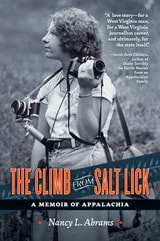
The Climb from Salt Lick
A Memoir of AppalachiaNancy L. Abrams
West Virginia University Press, 2018
The Climb from Salt Lick is the remarkable memoir of an outsider coming into adulthood. It is the story of a unique place and its people from the perspective of a woman who documents its burdens and its beauty, using words and pictures to tell the rich stories of those around her.
The Collected Works of Benjamin Hawkins, 1796–1810
Benjamin Hawkins, edited and with an introduction by H. Thomas Foster, II
University of Alabama Press, 2003
In 1795 Benjamin Hawkins, a former US senator and advisor to George Washington, was appointed US Indian agent and superintendent of all the tribes south of the Ohio River. Unlike most other agents, he lived among the Creek Indians for his entire tenure, from 1796 to 1816. Journeying forth from his home on the Flint River in Georgia, he served southeastern Indians as government intermediary during one of the longest eras of peace in the historic period.
Hawkins’s journals provide detailed information about European-Indian relations in the 18th-century frontier of the South. His descriptions of the natural and cultural environment are considered among the best sources for the ethnohistory of the Choctaw, Cherokee, Chickasaw, and, especially, the Creek Indians and the natural history of their territory.
Two previously published bodies of work by Benjamin Hawkins are included here—A Sketch of the Creek Country in the Years 1798 and 1799 and The Letters of Benjamin Hawkins 1796-1806. A third body of work that has never been published, “A Viatory or Journal of Distances” (describing routes and distances of a 3,578-mile journey through parts of Georgia, Alabama, and Mississippi), has been added. Together, these documents make up the known body of Hawkins’ work—his talks, treaties, correspondence, aboriginal vocabularies, travel journals, and records of the manners, customs, rites, and civil polity of the tribes. Hawkins' work provides an invaluable record of the time period.
The Communist and the Communist's Daughter
A MemoirJane Lazarre
Duke University Press, 2017
Soon after immigrating to the United States as a young man, Lazarre began a long career as a radical activist, being convicted of sedition, holding leadership positions in the American Communist Party, fighting in the Spanish Civil War, organizing labor unions, testifying in front of the House Un-American Activities Committee, and resisting the FBI’s efforts to recruit him as an informant. Through periods of heroism and deep despair Lazarre never abandoned his ideals or his sustained faith in the fundamental goodness of people.
This is also the story of Jane as she grew up, married an African American civil rights activist, and became a mother and a writer while coming to terms with her father’s legacy. She recounts her arguments with her father over ideology, but also his profound influence on her life. Throughout this poignant and beautifully written work, Jane examines memory, grief, love, and conscience while detailing the sacrifices, humanity, and unwavering convictions of a man who worked tirelessly to create a brighter future for us all.
The Compensations of War
The Diary of an Ambulance Driver during the Great WarBy Guy Emerson Bowerman
University of Texas Press, 1983
In 1917, shortly after the United States’ declaration of war on Germany, Guy Emerson Bowerman, Jr., enlisted in the American army’s ambulance service. Like other young ambulance drivers—Hemingway, Dos Passos, Cummings, Cowley—Bowerman longed to “see the show.” He was glad to learn that the ambulance units were leaving for France right away.
For seventeen months, until the armistice of November 1918, Bowerman kept an almost daily diary of the war. To read his words today is to live the war with an immediacy and vividness of detail that is astonishing.
Only twenty when he enlisted, Bowerman was an idealistic, if snobbish, young man who exulted that his section was made up mostly of young “Yalies” like himself. But he expected the war to change him, and it did. In the end he writes that he and his compatriots scarcely remember a world at peace. "The old life was gone forever. . ."
Guy Bowerman’s unit was attached to a French infantry division stationed near Verdun. Sent to halt the German drive to Paris in 1918, the division participated in the decisive counterattack of July and tracked the routed Germans through Belgium. Then, “unwarned,” Bowerman and his comrades were “plunged into … a life of peace.” Into this life, he writes, they walked “bewildered,” like “men fearing ambush.”
This remarkable chronicle of one young man’s rite of passage is destined to become a classic in the literature of the Great War.
The Confessions and Correspondence, Including the Letters to Malesherbes
Jean-Jacques Rousseau
Dartmouth College Press, 1998
The Dark Eclipse
Reflections on Suicide and AbsenceA.W. Barnes
Bucknell University Press, 2019
Published by Bucknell University Press. Distributed worldwide by Rutgers University Press.
The Desert Year
Joseph Wood Krutch
University of Iowa Press, 1952
Now back in print, Joseph Wood Krutch’s Burroughs Award–winning The Desert Year is as beautiful as it is philosophically profound. Although Krutch—often called the Cactus Walden—came to the desert relatively late in his life, his curiosity and delight in his surroundings abound throughout The Desert Year, whether he is marveling at the majesty of the endless dry sea, at flowers carpeting the desert floor, or at the unexpected appearance of an army of frogs after a heavy rain.
Krutch’s trenchant observations about life prospering in the hostile environment of Arizona’s Sonoran Desert turn to weighty questions about humanity and the precariousness of our existence, putting lie to Western denials of mind in the “lower” forms of life: “Let us not say that this animal or even this plant has ‘become adapted’ to desert conditions. Let us say rather that they have all shown courage and ingenuity in making the best of the world as they found it. And let us remember that if to use such terms in connection with them is a fallacy then it can only be somewhat less a fallacy to use the same terms in connection with ourselves.”
This edition contains 33 exacting drawings by noted illustrator Rudolf Freund. Closely tied to Krutch’s uncluttered text, the drawings tell a story of ineffable beauty.
The Desperate Diplomat
Saburo Kurusu's Memoir of the Weeks before Pearl HarborEdited by J. Garry Clifford and Masako R. Okura
University of Missouri Press, 2014
The Diary of Olga Romanov
Royal Witness to the Russian RevolutionHelen Azar
Westholme Publishing, 2014
The Disabled Child
Memoirs of a Normal FutureAmanda Apgar
University of Michigan Press, 2023
The Donigers of Great Neck
A Mythologized MemoirWendy Doniger
Brandeis University Press, 2019
The Door of Last Resort
Memoirs of a Nurse PractitionerWard, Frances
Rutgers University Press, 2013
Ward views nurse practitioners as important providers of primary health care (including the prevention of and attention to the root causes of ill health) in independent practice and as equal members of professional teams of physicians, registered nurses, and other health care personnel. She describes the education of nurse practitioners, their scope of practice, their abilities to prescribe medications and diagnostic tests, and their overall management of patients’ acute and chronic illnesses. Also explored are the battles that nurse practitioners have waged to win the right to practice—battles with physicians, health insurance companies, and even other nurses.
The Door of Last Resort, though informed by Ward’s experiences, is not a traditional memoir. Rather, it explores issues in primary health care delivery to poor, urban populations from the perspective of nurse practitioners and is intended to be their voice. In doing so, it investigates the factors affecting health care delivery in the United States that have remained obscure throughout the current national debate
The Eclipse I Call Father
Essays on AbsenceDavid Axelrod
Oregon State University Press, 2019
The essays in this collection grew from a ten-year period when the author found himself periodically living and working abroad, wondering why foreign landscapes haunted him more than the familiar landscapes of the inland Pacific Northwest he called home. Each place had a long history of habitation, but at home he was blind, unable to see past the surfaces of things. Axelrod examines many aspects of that phenomenon in these pages, framing surface realities and imagining the scale and scope of that surface, but also trying to sense what is absent or changed, and how, despite its absence, the unseen accretes to ever-greater densities and persists as something uncanny.
Curious, alert, and keenly observant, these essays probe the boundaries between what is here and what is gone, what is present and what is past, in elegant prose. Readers familiar with Axelrod’s poetry will find a new facet of his lyrical gifts, while those encountering his work for the first time will be richly rewarded by the discovery of this Northwest literary talent.