Results by title
364 books match the query 'Michigan' and 82 start with t

TV Land--Detroit
Gordon Castelnero
University of Michigan Press, 2006
Long before cable, prepackaged syndication, infomercials, do-it-yourselfers, and reality shows cluttered the television dial, there was a brand of entertainment that has today nearly vanished from the airwaves: local TV. And with its colorful and quirky cast of characters, Detroit TV arguably offered some of the best of the best of local programming anywhere in the nation-a smorgasbord of exuberant, one-of-a-kind television shows.
Based on actual interviews with the people who made Detroit TV, Gordon Castelnero's TV Land-Detroit awakens the emotional attachment and nostalgia our community has for these shows, bringing the beloved characters and memorable programs back to life.
From the glamorous Rita Bell to the insanity of the Ghoul, the zany Jingles in Boofland to the opinionated and often confrontational Lou Gordon and the gruff-voiced and somnolent George Pierrot, Castelnero reacquaints us with the talent and behind-the-scenes people, of the creative spirit in Detroit, and the intimacy they shared with the community both on and off the air.
Gordon Castelnero was a producer at WNIC radio for four years. He produced the acclaimed documentaries for WDIV and WTVS, Michigan, It Started Here! Michigan and the American Dream, and Titanic: The Final Chapter. He currently lives in Livonia, Michigan, and works at Technicolor in DVD and game media distribution. He can be contacted by e-mail at tvlanddetroit@yahoo.com

Talking Union
Judith Stepan-Norris and Maurice Zeitlin
University of Illinois Press, 1996
and cultural oral history of the struggle to unionize the River Rouge
Plant near Detroit during the 1930s and 40s, this book affords us a rare
insight into the difficulties of organizing a union in the face of the
then anti-union Ford Motor Company. Against a backdrop of the depression
and entrenched racism, history was made by courageous individuals whose
rich, eloquent stories illuminate the character and views of others like
them across the nation, from all backgrounds: left, right, and center;
black and white; native and foreign born, Jew and gentile.

The 16th Michigan Infantry in the Civil War, Revised and Updated
Kim Crawford
Michigan State University Press, 2019

The 4th Michigan Infantry in the Civil War
Martin N. Bertera
Michigan State University Press, 2010
This fascinating narrative tells the story of a remarkable regiment at the center of Civil War history. The real-life adventure emerges from accounts of scores of soldiers who served in the 4th Michigan Infantry, gleaned from their diaries, letters, and memoirs; the reports of their officers and commanders; the stories by journalists who covered them; and the recollections of the Confederates who fought against them. The book includes tales of life in camp, portraying the Michigan soldiers as everyday people—recounting their practical jokes, illnesses, political views, personality conflicts, comradeship, and courage.
The book also tells the true story of what happened to Colonel Harrison Jeffords and the 4th Michigan when the regiment marched into John Rose's wheat field on a sweltering early July evening at Gettysburg. Beyond the myths and romanticized newspaper stories, this account presents the historical evidence of Jeffords's heroic, yet tragic, hand-to-hand struggle for his regiment's U.S. flag.
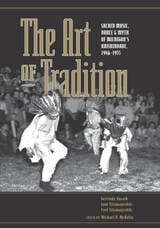
The Art of Tradition
Sacred Music, Dance & Myth of Michigan's Anishinaabe, 1946-1955Michael D. McNally
Michigan State University Press, 2009
The Art of Tradition documents the complexity of Native life and culture at a critical juncture in Native American history, where the rekindling of pride in Native cultures characteristic of the later twentieth century met the generation of elders who spent their early years speaking Native tongues but who came of age in boarding schools and amid strong pressures of assimilation. Because this period was deemed by most ethnographers of the time to be one of "acculturation," marking the end of traditional Native cultures, the authors' appreciation for the integrity of mid-century Native culture stands out markedly from other scholarship of the day. The songs, dance steps, and stories collected here are evidence of the artful work of maintaining and breathing new life into traditions, often in contexts that seem anything but traditional, by indigenous elders and artists. As the editor notes, there are no "Native informants" in this study, only collaborators whose lives are shown to be as resilient as the repertories they performed.

The Best of Bacon
Select CutsJohn U. Bacon
University of Michigan Press, 2018
From the Preface:
“I wrote these stories between 1992 and 2018. They cover a dozen different sports for a dozen different media outlets, from the Ann Arbor News to National Public Radio, and they stretch from a couple pages to a dozen. But they have one thing in common: they all meant a lot to me when I wrote them, and they still do today.”
The Best of Bacon presents both new and familiar stories by best-selling author John U. Bacon, all centered on sports in his home state of Michigan. Best known for his acclaimed books on college football, Bacon’s writing has been praised for going beyond traditional Xs and Os sports reporting. True to that reputation, this collection showcases personal, behind-the-scenes stories of players, coaches, and even fans. Many of these stories are connected to specific moments in time—a great season, the passing of a legendary broadcaster, or a star player’s daily grind before a big game—and will immediately transport readers to some of the highs (and lows) of their own sports memories. More often, Bacon’s writing explores timeless themes—why we love sports, how we pass that passion down to the next generation, and how it will be threatened or preserved in the future.
Michigan is one of the nation’s best sports states, home to countless amateur squads, two Big Ten schools, and professional teams in all four major sports whose histories reach back to the start of their leagues—something only New York, Massachusetts, and Illinois can also claim. This book covers the spectrum, from insider profiles of big names like Magic Johnson, Bo Schembechler, and Joe Louis, to cautionary tales of the debilitating greed threatening our favorite pastimes, to uplifting stories of the unsung heroes whose passion drives them to coach Little League baseball teams or run summer camps for peanuts. These stories speak to the value of sports, but also to our values. Whether a Spartan or a Wolverine, a long-suffering Lions’ backer or a diehard Wing-Nut, a lifetime sports fan or just someone who loves a good story, there is something here for everyone.
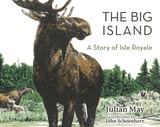
The Big Island
A Story of Isle RoyaleJulian May
University of Minnesota Press, 2021
First published in 1968, this engrossing and beautiful picture book about wildlife on Isle Royale is available again
Isle Royale, “the big island” of this book, is a wilderness national park in Lake Superior and home to a unique and fascinating ecosystem of animals, most notably the iconic wolf and majestic moose. Here is author Julian May’s story about the island’s beginning, the kinds of animals that came to populate it, and their effects on the pristine landscape. Among them were the moose, who swam to the island from the distant shore to fend off starvation. The moose found conditions on Isle Royale so favorable that they reproduced quickly—but then faced another food shortage. The wolves arrived by floating to the island on an ice floe in winter and soon became important to the island’s ecology as successful predators of the moose.
Complementing this fascinating text, John Schoenherr’s magnificent illustrations convey the strength of these animals and the beauty of the island that is their home.
First published in 1968, and reprinted here with a new note by renowned wolf expert L. David Mech, The Big Island is an enchanting introduction to the wilderness and wildlife of Isle Royale.

The Birds of Michigan
Norman A. Wood
University of Michigan Press, 1951
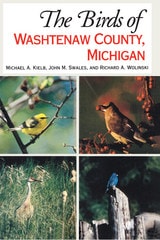
The Birds of Washtenaw County, Michigan
Michael A. Kielb, John M. Swales, and Richard A. Wolinski
University of Michigan Press, 1993
The Birds of Washtenaw County, Michigan provides a comprehensive account of the birdlife in Washtenaw County. Situated to the west of Detroit in southeast Michigan, the county has an exceptionally rich history of ornithological study, fueled by the activists of numerous amateur birdwatchers and by the interests of two major universities.
Frequency accounts of the 267 species recorded in the county during the last 15 years are framed by a discussion of the topographical history of the county. In addition, the authors present notes on another 30 species not seen in the county since 1976. A comprehensive site guide offers suggestions of the optimal locals and times to try to find the birds.
Michael A. Kielb has studied birds in Michigan for over 15 years and teaches classes on birds at the Matthaei Botanical Gardens in Ann Arbor and the College of Du Page in Illinois. He also leads bird-watching tours throughout the Americas and is currently a Research Associate in the Reproductive Sciences Program at the University of Michigan.
John M. Swales first became interested in birds while teaching in the Sudan and has been exploring the birdlife of Washtenaw County since arriving at the University of Michigan in 1985. He is Professor of Linguistics and Director of the English Language Institute, University of Michigan.
Richard A. Wolinski has been studying birds of Washtenaw County for nearly two decades. He is a staff biologist with an engineering firm in southeast Michigan.

The Boletes of Michigan
Alexander H. Smith and Harry D. Thiers
University of Michigan Press, 1971

The Boundaries of Pluralism
The World of the University of Michigan’s Jewish Students from 1897 to 1945Andrei S. Markovits & Kenneth Garner
Michigan Publishing Services, 2020
Raoul Wallenberg Distinguished University Professor of History,
University of Michigan
Arthur F. Thurnau Professor, University of Michigan,
and Director, Bentley Historical Library

The Boy Governor
Stevens T. Mason and the Birth of Michigan PoliticsDon Faber
University of Michigan Press, 2012
In 1831, Stevens T. Mason was named Secretary of the Michigan Territory at the tender age of 19, two years before he could even vote. The youngest presidential appointee in American history, Mason quickly stamped his persona on Michigan life in large letters. After championing the territory's successful push for statehood without congressional authorization, he would defend his new state's border in open defiance of the country's political elite and then orchestrate its expansion through the annexation of the Upper Peninsula---all before his official election as Michigan's first governor at age 24, the youngest chief executive in any state's history.
The Boy Governor tells the complete story of this dominant political figure in Michigan's early development. Capturing Mason's youthful idealism and visionary accomplishments, including his advocacy for a strong state university and legislating for the creation of the Soo Locks, this biography renders a vivid portrait of Michigan's first governor---his conflicts, his desires, and his sense of patriotism. This book will appeal to anyone with a love of American history and interest in the many, larger-than-life personalities that battled on the political stage during the Jacksonian era.
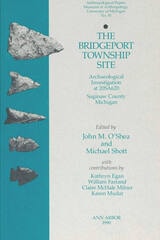
The Bridgeport Township Site
Archaeological Investigation at 20SA620, Saginaw County, MichiganEdited by John M. O'Shea and Michael Shott with contributions by Kathryn Egan, William Farrand, Claire McHale Milner, and Karen Mudar
University of Michigan Press, 1990

The Broken Table
The Detroit Newspaper Strike and the State of American LaborChris Rhomberg
Russell Sage Foundation, 2012

The Cedarville Conspiracy
Indicting U.S. SteelL. Stephen Cox
University of Michigan Press, 2005
The Cedarville Conspiracy is the story of that doomed ship and its crew. It is also the first Great Lakes history to expose the heroism, villainy, courage, and confusion surrounding the Cedarville disaster.
In atmospheric, cinematic style, L. Stephen Cox's gripping page-turner dramatizes the events surrounding the collision between the Norwegian and American freighters. As the mortally wounded Cedarville began to list and sink, U.S. Steel refused to allow the crew to escape to safety, while the captain secretly donned his life jacket and abandoned the sinking ship. Ten seamen died in the frigid waters that morning as the captain and survivors swam to safety.
Researching the story, author L. Stephen Cox interviewed the surviving crew and their rescuers and attorneys, examined more than 20,000 pages of Coast Guard reports, and discovered deposition transcripts and other documentary evidence that detailed the deterioration of the ship, the captain's disregard of Great Lakes navigational rules, the company's participation in the decision to confine the men aboard the sinking vessel, and the subsequent efforts by U.S. Steel to manipulate the evidence.

The Changing Environment of Northern Michigan
A Century of Science and Nature at the University of Michigan Biological StationKnute J. Nadelhoffer, Alan J. Hogg, Jr., Brian A. Hazlett, editors
University of Michigan Press, 2009
Northern Michigan is undergoing unprecedented changes in land use, climate, resource extraction, and species distributions. For the last hundred years, the University of Michigan Biological Station has monitored these environmental transformations. Stretching 10,000 acres along Burt and Douglas Lakes in the northern Lower Peninsula and 3,200 acres on Sugar Island near Sault Ste. Marie, Michigan, the station has played host to nearly 10,000 students and a steady stream of top scientists in the fields of biology, ecology, geology, archeology, and climatology.
The Changing Environment of Northern Michigan collects essays by some of these scientists, who lead readers on virtual field trips exploring the history of people and science at the station itself, the relations of indigenous people to the land, the geophysical history of the region, characteristics of terrestrial and aquatic ecosystems, key groups of organisms and their relations to local habitats, and perspectives on critical environmental challenges of today and their effects on the region. Accompanying the chapters are color illustrations and photographs that bring the station's pristine setting to life.
Like the station itself, the book provides a solid background for better appreciating the relationships among living and nonliving parts of northern Michigan, for anyone interested in exploring the region's forests, fields, and wetlands; wading or paddling down its rivers; or swimming or floating across its lakes.
Knute J. Nadelhoffer is Director of the University of Michigan Biological Station and Professor of Ecology and Evolutionary Biology at the University of Michigan.
Alan J. Hogg, Jr., teaches science writing at the University of Michigan as a faculty member of the Sweetland Writing Center. His Ph.D. research explored the effects of ozone and nitrogen oxides on University of Michigan Biological Station forests.
Brian A. Hazlett is Professor Emeritus of Zoology at the University of Michigan.
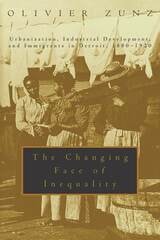
The Changing Face of Inequality
Urbanization, Industrial Development, and Immigrants in Detroit, 1880-1920Olivier Zunz
University of Chicago Press, 1983

The City after Property
Abandonment and Repair in Postindustrial DetroitSara Safransky
Duke University Press, 2023

The Collected Short Stories of Harriette Simpson Arnow
Harriette Simpson Arnow
Michigan State University Press, 2005
Harriette Simpson Arnow is an American treasure. Of the twenty-five stories in this collection, fifteen were previously unpublished. Until now, the short fiction of Arnow has remained relatively obscure despite the literary acclaim given to her novels The Dollmaker and Hunter’s Horn. These stories, written early in her career for the most part, reveal an artistic vision and narrative skill and serve as harbingers for her later work. They echo her interest in both agrarian and urban communities, the sharpening of her social conscience, and her commitment to creating credible and complex characters. This collection is organized against the backdrop of her life, from Kentucky in the 1920s to Ohio and Kentucky in the 1930s and to Michigan in the 1940s. As Arnow fans read these early gems, they will be led from gravel roads to city pavement and open layers of Arnow’s development as a novelist to expose the full range of her contributions to American literature.
In 1938, Esquire purchased "The Hunters," which was eventually published as "The Two Hunters," a chilling story of a seventeen-year- old boy’s confrontation with a deputy sheriff. At the time, Esquire did not accept submissions from women, and its editors had no idea that writer H. L. Simpson was not a man. Years later, she admitted in an interview, "it worried me a little, that big lie, but I thought if they wanted a story, let them have it." Esquire paid her $125 for this story. The contributor’s notes at the back of the magazine include a photo of "H.L.Simpson," actually a photo of one of her brothers-in-law. It was her little joke on a publisher that discriminated against women....
—from the Introduction
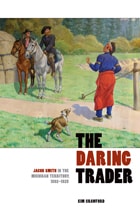
The Daring Trader
Jacob Smith in the Michigan Territory, 1802-1825Kim Crawford
Michigan State University Press, 2012
A fur trader in the Michigan Territory and confidant of both the U.S. government and local Indian tribes, Jacob Smith could have stepped out of a James Fenimore Cooper novel. Controversial, mysterious, and bold during his lifetime, in death Smith has not, until now, received the attention he deserves as a pivotal figure in Michigan’s American period and the War of 1812. This is the exciting and unlikely story of a man at the frontier’s edge, whose missions during both war and peace laid the groundwork for Michigan to accommodate settlers and farmers moving west. The book investigates Smith’s many pursuits, including his role as an advisor to the Indians, from whom the federal government would gradually gain millions of acres of land, due in large part to Smith’s work as an agent of influence. Crawford paints a colorful portrait of a complicated man during a dynamic period of change in Michigan’s history.

The Detroit Genre
Race, Dispossession, and Resilience in American Literature and Film, 1967-2023Vincent Haddad
Lever Press, 2024
The book first establishes the concept of the “Detroit genre” that emerged in late 1960s and traces the tropes of this white-centric narrative genre in popular culture, touching on key texts including Blue Collar, Robocop, The Crow, It Follows, and Barbarian. The second part shows how Black writers, including Alice Randall, adrienne maree brown, Stephen Mack Jones, and Angela Flournoy, reclaimed and revised the Detroit genre by un-fixing Detroit narratives of dispossession, criminality, and industrial and social failure through formal experimentations on genre itself.
Where Detroit has typically been painted in the news as one of three things—the center of the automotive industry; crime-ridden and in ruins; or as a “blank canvas” with limitless potential of entrepreneurship—Vincent Haddad shows that the Detroit genre in literature and film can be far more powerful than news media in narrating Black dispossession as a pragmatic, even liberal consensus. The texts studied here condition forgetfulness about Detroit’s history or expose it to a full reckoning, direct attention toward or away from the city’s agents of injustice, fetishize resilience or model resistance, and foreclose or imagine a future of Black liberation. Appealing to scholars of popular literature, media, race, and American studies, The Detroit Genre is an accessible and engaging study of the city’s influence on a wide array of genres in pop culture.
The Eagle Returns
The Legal History of the Grand Traverse Band of Ottawa and Chippewa IndiansMatthew L.M. Fletcher
Michigan State University Press, 2012
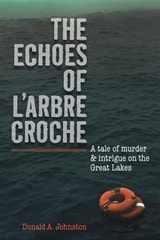
The Echoes of L'Arbre Croche
Donald A. Johnston
University of Michigan Press, 2009
The year is 1915, and Benjamin Corvet, founder of the ship-owning firm Corvet, Sherrill and Spearman, suddenly disappears, sparking events and questions that baffle even those who are close to him.
Constance Sherrill, an attractive, sheltered young woman, feels strangely responsible for what may have happened to him---her father's best friend and coworker. Alan Conrad arrives in Chicago searching for his identity and an unknown benefactor and is swept into a maelstrom of mystery and intrigue that tests his intelligence and athleticism to the fullest. Henry Spearman, the firm's junior partner, is the most eligible bachelor along Chicago's Lake Shore Drive as a result of his catapult from ships' ranks to successful owner.
When a ship sinks off the coast of Beaver Island in Michigan, the intertwining lives of these characters unlock the mystery of the disappearance of another ship twenty years earlier, in a riveting whodunit set on the stormy waters of the Great Lakes.
Donald A. Johnston was born and raised in Detroit, served in World War II as a U.S. Navy Reserve officer, and was decorated for service in the Philippines and in the invasions of Iwo Jima and Okinawa. His career includes forty years in the insurance business. An ardent sailing enthusiast, he has cruised the Great Lakes extensively and has sailed winners in class boats and in offshore competition.
Jacket photograph © Yuriz / iStockphoto.com
The Ethnobotanical Laboratory at the University of Michigan
Melvin R. Gilmore
University of Michigan Press, 1932
The Evolution of Investing at the University of Michigan
1817–2016Rafael E. Castilla and William P. Hodgeson
Michigan Publishing Services, 2017
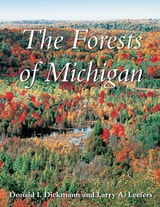
The Forests of Michigan
Donald I. Dickmann and Larry A. Leefers
University of Michigan Press, 2003
No book currently on bookstore shelves explores, as The Forests of Michigan does, the natural history, ecology, management, economic importance, and use of the rich and varied forests that cover about half of the state's 36.3 million acres. The authors look at the forests, where they are, how they got to be, and their present-day usage, using the story of Michigan forests as a backdrop for the state's history, including its archaeology.
The Forests of Michigan explores how the forests came back after the great Wisconsin glacier began to recede over 12,000 years ago, and how they recovered from the onslaught of unrestrained logging and wildfire that, beginning in the mid-1800s, virtually wiped them out. The emphasis of the book is on sustaining for the long term the forests of the state, with a view of sustainability that builds not only upon the lessons learned from native peoples' attitude and use of trees but also on the latest scientific principles of forest ecology and management.
Generously illustrated and written in an engaging style, The Forests of Michigan sees the forest and the trees, offering both education and delight. "As forest scientists," the authors note, "we opted for a hearty serving of meat and potatoes; anyone who reads this book with the intention of learning something will not be disappointed. Nonetheless, we do include some anecdotal desserts, too."
Donald I. Dickmann is Professor of Forestry at Michigan State University and holds a doctorate from the University of Wisconsin. He is the author of The Culture of Poplars. Larry A. Leefers is Associate Professor in the Department of Forestry at Michigan State University. He holds a doctorate from Michigan State University.
The Forests of Michigan, Revised Ed.
Donald I. Dickmann and Larry A. Leefers
University of Michigan Press, 2016

The Founding Mothers of Mackinac Island
The Agatha Biddle Band of 1870Theresa L. Weller
Michigan State University Press, 2021
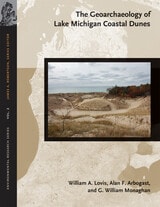
The Geoarchaeology of Lake Michigan Coastal Dunes
William A. Lovis, Alan F. Arbogast, and G. William Monaghan
Michigan State University Press, 2012
Complex sets of environmental factors have interacted over the past 5,000 years to affect how changes in climate, temperature, relative precipitation, and the levels of Lake Michigan influence the preservation of archaeological sites in coastal sand dunes along Lake Michigan. As a collaboration between earth scientists, archaeologists, and geoarchaeologists, this study draws on a wealth of research and multidisciplinary insights to explore the conditions necessary to safeguard ancient human settlements in these landscapes. A variety of contemporary and innovative techniques, including numerous dating methods and approaches, were employed to determine when and for how long sand dunes were active and when and for how long archaeological sites were occupied. Knowledge of dune processes and settlement patterns not only affects archaeological interpretations, but it is also consummately important to land planners responsible for managing heritage archaeological sites in the Lake Michigan coastal zone.
The George Reserve Deer Herd
Population Ecology of a K-Selected SpeciesDale R. McCullough
University of Michigan Press, 1979

The Grasinski Girls
The Choices They Had and the Choices They MadeMary Patrice Erdmans
Ohio University Press, 2004
The Grasinski Girls were working-class Americans of Polish descent, born in the 1920s and 1930s, who created lives typical of women in their day. They went to high school, married, and had children. For the most part, they stayed home to raise their children. And they were happy doing that. They took care of their appearance and their husbands, who took care of them. Like most women of their generation, they did not join the women’s movement, and today they either reject or shy away from feminism.
Basing her account on interviews with her mother and aunts, Mary Erdmans explores the private lives of these white, Christian women in the post-World War II generation. She compares them, at times, to her own postfeminist generation. Situating these women within the religious routines that shaped their lives, Professor Erdmans explores how gender, class, ethnicity, and religion shaped the choices the Grasinski sisters were given as well as the choices they made. These women are both acted upon and actors; they are privileged and disadvantaged; they resist and surrender; they petition the Lord and accept His will.
The Grasinski Girls examines the complexity of ordinary lives, exposing privileges taken for granted as well as nuances of oppression often overlooked. Erdmans brings rigorous scholarship and familial insight to bear on the realities of twentieth-century working-class white women in America.

The Great Water
A Documentary History of MichiganMatthew R Thick
Michigan State University Press, 2018

The Heart of the Lakes
Freshwater in the Past, Present and Future of Southeast MichiganDave Dempsey
Michigan State University Press, 2019

The History of Michigan Law
Paul Finkelman
Ohio University Press, 2006
The History of Michigan Law offers the first serious survey of Michigan’s rich legal past. Michigan legislators have played a leading role in developing modern civil rights law, protecting the environment, and assuring the right to counsel for those accused of crimes. Michigan was the first jurisdiction in the English-speaking world to abolish the death penalty. As the state industrialized, its legal system responded to the competing demands and interests of farmers, railroads, entrepreneurs, and workers.
Michigan was a beacon of liberty for fugitive slaves and free blacks before the Civil War and an early leader in the adoption of laws to protect civil rights and prohibit discrimination after that conflict. The state was the site of the Ossian Sweet murder trial, which illustrated the tensions in Michigan between law and popular ideology. The History of Michigan Law documents and analyzes these legal developments and others, including the history of labor law, women’s rights, and legal education.
This landmark volume will serve as the entry point for all future studies that involve law and society in Michigan and will be invaluable in the comparative study of state law. As the Michigan Supreme Court enters its third century, The History of Michigan Law has relevance beyond the legal community, for scholars and students of American history.
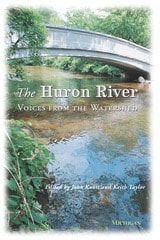
The Huron River
Voices from the WatershedJohn Knott and Keith Taylor, Editors
University of Michigan Press, 2000
"The Huron River . . . was called 'Cos-scut-e-nong Sebee'. . . . [It] is a beautiful, transparent stream, passing alternatively through rich bottoms, openings, plains, and sloping woodlands, covered with heavy timber."
---History of Washtenaw County, Michigan, 1881
The Huron River---stretching 130 miles through three counties---has inspired numerous writers throughout the nineteenth and twentieth centuries. Contained here is a collection of new poems, essays, and stories, accompanied by maps, photographs, and illustrations that celebrate the Huron River. Over twenty locally and nationally known literary figures, including Alice Fulton and Charles Baxter, have contributed to this volume. In addition, the work of biologists, naturalists, and even an arche-ologist have been included to give a richer sense of the physical and cultural environment.
Each of these writers reminds us that our lives are more intertwined with the river and its watershed than we might think. The Huron River opens with these words: "Watersheds are the oldest and most durable markers of place. . . . These boundaries affect our lives by defining our natural environment, not only its topography but its soils, its plant and animal life, and to some extent its weather. The water that sustains most of us is the water that flows through our local watershed."
And the river's strength is wondrous unto itself. "The water will always be there, and it will always find its way down," writer Gary Snyder tells us. The river is sometimes visible, sometimes not; yet it "is alive and well under the city streets, running in giant culverts."
John Knott is Professor of English, University of Michigan. After working as a bookseller for twenty years, Keith Taylor now teaches writing part-time for the University of Michigan and works as a freelance writer.
The Indians of Hungry Hollow
Bill Dunlop and Marcia Fountain-Blacklidge
University of Michigan Press, 2004

The Invasion
Janet Lewis
Michigan State University Press, 2000
The Invasion, a novel originally published in 1932, marked the debut of historical novelist Janet Lewis, who went on to write numerous poems and short stories as well as the novels The Wife of Martin Guerre and The Trial of Soren Quist. Lewis grew up in the Lake country of the Old Northwest and The Invasion is based on family stories she heard as a child.The Invasion displays well-researched historical accuracy, an innate understanding of and feeling for Native American culture enhanced by the author's fluency in the Ojibway language, and an economy of style that is remarkable for a first novel.
In 1790, John Johnston, a cultivated young Irishman, came to the far corner of the Northwest Territory to make his fortune intending to spend only a year. Instead he married Ozhah-guscoday- wayquay (The Woman of the Glade), daughter of the Ojibway chief Waub- ojeeg, and settled on the St. Mary's River. Together they founded a family that was loved, respected, and famous throughout the region for honesty, fairness, and hospitality. Their home was the center of culture for the area and for every visiting traveler, Native American or white. The Invasion chronicles a time when one culture violently supplanted another even as it depicts a family that blends two cultures together.
Henry Rowe Schoolcraft considered the Johnston family his most valued connection to the Native American population. He eventually married Jane Johnston, daughter of John and The Woman of the Glade, and remain close to her entire family. In his diary, Schoolcraft wrote of the Johnstons, "I have in fact stumbled, as it were, on the only family in Northwest America who could in Indian lore have acted as my guide, philosopher, and friend."

The Last House on the Block
Black Homeowners, White Homesteaders, and Failed Gentrification in DetroitSharon Cornelissen
University of Chicago Press, 2025
In the minds of many, Detroit is undergoing a renaissance thanks to gentrifying urbanites who’ve been drawn to the city with the promise of cheap housing and thriving culture. But what happens when gentrification attempts to come to one of the most depopulated neighborhoods in the country—a place where every other property in the neighborhood was a vacant lot and every third house stood empty? To find out, Sharon Cornelissen moved to the Brightmoor neighborhood of Detroit for three years and became the owner of a $7,000 house.
The Last House on the Block takes us to Brightmoor to meet Cornelissen’s fellow residents. She introduces us to the long-time residents of the neighborhood who reveal their struggles to keep a home while keeping violence, tall grass, and yes—gentrification—at bay. We also meet the eclectic white newcomers of Brightmoor and learn about their real estate bargains, urban farms, and how they became the unlikely defenders of urban desolation. Where oldtimers take pride in neatly mowed lawns and hope for a return to residential density, newcomers love the open space and aim to buy more empty lots to raise chickens and goats. It is a story of gentrification, but not at all in the usual sense: it is a case of failed gentrification. We often think about gentrification as an unstoppable force—once the first white newcomers with yoga mats enter an often brown or Black community, the coffee shops and restaurants follow. But in Brightmoor, the dreams of white newcomers met the harsh reality of decade-long decline. Nearly a decade after Cornelissen’s fieldwork began, Brightmoor is even emptier than it was when she started.
Today, depopulation remains more common than gentrification in poor communities. Cornelissen’s story offers deep insights into what it is like to live in a declining neighborhood, and through the example of Brightmoor, Cornelissen reveals why depopulation continues and helps us imagine a more inclusive and equitable city turnaround.
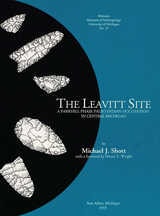
The Leavitt Site
A Parkhill Phase Paleo-Indian Occupation in Central MichiganMichael J. Shott, with a foreword by Henry T. Wright
University of Michigan Press, 1993
The Life and Work of Francis Willey Kelsey
Archaeology, Antiquity, and the ArtsJohn Griffiths Pedley
University of Michigan Press, 2011
President of the Archaeological Institute of America, professor at the University of Michigan from 1889 to 1927, and president of the American Philological Association, Francis Kelsey was crucially involved in the founding or growth of major educational institutions. He came to maturity in a period of great technological change in communications, transportation, and manufacturing. Kelsey took full advantage of such innovations in his ceaseless drive to promote education for all, to further the expansion of knowledge, and to champion the benefits of the study of antiquity.
A vigorous traveler around the United States, Europe, and the Mediterranean, Kelsey strongly believed in the value of personally viewing sites ancient and modern and collecting artifacts that could be used by the new museums and universities that were springing up in the United States. This collecting habit put him in touch with major financiers of the day, including Charles Freer, Andrew Carnegie, and J. P. Morgan, as he sought their help for important projects.
Drawing heavily on Kelsey's daily diaries now held at the University of Michigan's Bentley Historical Library, John Griffiths Pedley gives us a biography that records the wide-ranging activities of a gifted and energetic scholar whose achievements mirrored the creative and contributive innovations of his contemporary Americans.

The Lone Wolverine
Tracking Michigan's Most Elusive AnimalElizabeth Philips Shaw and Jeff Ford
University of Michigan Press, 2012
It began in late winter of 2004. Almost 100 years had passed since the last spotting of a wild wolverine in Michigan when coyote hunters caught a glimpse of one of the animals in a frozen farm field in the northern thumb region. For the next six years, Jeff Ford, a local science teacher and amateur naturalist, devoted himself to locating and filming the wolverine that had unexpectedly and inexplicably appeared in the Wolverine State. By the time hikers found the animal dead in early 2010, Ford had taken hundreds of rare live action photos and shot numerous hours of video, with the story of the "Wolverine Guy" attracting national attention through countless newspaper and magazine articles and appearances on Animal Planet and PBS Nature.
This is the tale of Ford's quest as he uncovered answers to mysteries surrounding the animal's territory and movement patterns, while sparking a flurry of controversy surrounding the elusive predator's origin, much of which remains unresolved today. It's an intimate look at research in the raw, from DNA samples stuck on barbed wire to a sophisticated, motion-sensing infrared camera unit strategically placed to observe nocturnal behavior.
The Lone Wolverine brings to vivid life this unforgettable piece of American wildlife lore, using candid interviews, public records, and Ford's own vast storehouse of notes, personal writings, correspondence, and images, offering an extraordinary chronicle of a wild wolverine in its natural habitat, at play and in fierce competition for food and survival. This is a wildlife detective story, recounting years of study and fierce debate as researchers pondered the riddles of Michigan's last wolverine---her origins, habits, and ultimately the cause of her untimely death.

The Making of Working-Class Religion
Matthew Pehl
University of Illinois Press, 2016
Pehl embarks on an integrative view of working-class faith that ranges across boundaries of class, race, denomination, and time. As he shows, workers in the 1910s and 1920s practiced beliefs characterized by emotional expressiveness, alliance with supernatural forces, and incorporation of mass culture's secular diversions into the sacred. That gave way to the more pragmatic class-conscious religion cultures of the New Deal era and, from the late Thirties on, a quilt of secular working-class cultures that coexisted in competitive, though creative, tension. Finally, Pehl shows how the ideology of race eclipsed class in the 1950s and 1960s, and in so doing replaced the class-conscious with the race-conscious in religious cultures throughout the city.
An ambitiously inclusive contribution to a burgeoning field, The Making of Working-Class Religion breaks new ground in the study of solidarity and the sacred in the American heartland.
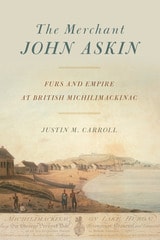
The Merchant John Askin
Furs and Empire at British MichilimackinacJustin M. Carroll
Michigan State University Press, 2017

The Michigan Eco-Traveler
A Guide to Sustainable Adventures in the Great Lakes StateSally Barber
University of Michigan Press, 2014
Whether you’re a weekend traveler, extreme adventurer, or family on vacation, The Michigan Eco-Travelerlights the way to a greener getaway. Naturalists, conservationists, and hospitality experts will find the book equally helpful in responding to the ever rising demand for sustainable recreation.

The Michigan Gardening Guide
Jerry Minnich
University of Michigan Press, 1998
It's all here---step-by-step guidance for gardening success in Michigan's varying soil types and often difficult climate. Veteran garden writer Jerry Minnich presents detailed directions and practical tips for growing vegetables, herbs, flowers, landscaping plants, and house plants, as well as dependable advice on hundreds of garden operations.
Minnich begins where gardening begins---in the soil---as he tells how to build a healthy and productive soil, and how to solve soil problems. In subsequent chapters he reveals composting and mulching techniques, and what to do when the weather is less than congenial for gardens. Minnich describes more than sixty Michigan vegetables, tells how to grow them, and lists recommended varieties for each. There are also chapters on growing fruits, berries, and nuts, and on food storage. Minnich devotes a chapter to growing annuals and perennials, another on lawns, trees, and ornamental woody plants. He tells how to deal with insect and animal pests without using harmful chemicals, and he includes a major section on houseplants.
Throughout, Minnich approaches the subject with experience, wit, and style. Readers will learn how to deal with weeds in the lawn, how to surf the landscape for com-posting materials, and how to grow mulch at home. He explains intercropping, companion planting, seed saving, cover cropping, strip composting and other techniques. He tells how to raise unusual crops such as tomatillos and radicchio, as well as the standard favorites. He explains how the science of phenology can help the gardener, how to take a soil test, how to use earthworms to turn household wastes in to compost, and how to attract birds and toads to the garden. And he lists more than a thousand varieties of vegetables, herbs, fruits, and ornamentals that can be trusted to grow in the Michigan climate.
The Michigan Gardening Guide is the one backyard guide that Michigan gardeners can trust. It is a tool as indispensable as the hoe and the shovel.
Jerry Minnich has written about gardening for more than twenty years and has been commended with a Certificate of Merit by the Garden Writers Association of America. His interest in gardening began when he joined the staff of Organic Gardening in the 1950s.

The Michigan Murders
Edward Keyes
University of Michigan Press, 2010
"True crime devotees won't want to miss this one!"
---Publishers Weekly
"Very engrossing . . . in the finest you can't put it down tradition."
---Hartford Courant
"This factual account of each murder, through the conviction of the killer, has all the excitement of a first-rate work of fiction, and is told straight, without the usual sociological jargon. Keyes collaborated with Robin Moore on The French Connection; The Michigan Murders is his first solo effort, and it is a good one."
---Miami Herald
"The Michigan Murders is the ultimate True Crime classic, unfolding like great mystery fiction while still delivering the powerful charge of real life."
---Jamie Agnew, Aunt Agatha's Mystery Bookshop
With a new prologue by Mardi Link and a new epilogue by Laura James
The true story of the savage coed killings---by the boy who could have lived next door!
Southeastern Michigan was rocked in the late 1960s by the terrifying serial murders of young women, whose bodies were dumped in Ann Arbor and Ypsilanti. In each case, few clues were left at the scene, and six separate police agencies were unable to end the horror. Then, almost by accident, a break came. The suspect: John Norman Collins, a young, quiet, all-American boy.
Collins was caught, went to trial, and, on August 19, 1970, was found guilty and sentenced to life imprisonment with no possibility of parole. He is now in his sixties and is serving his sentence in Marquette, Michigan.
Collins was one of the first serial killers exposed in the region, and his crimes had many in the area locking their doors for the first time. Edward Keyes's harrowing The Michigan Murders covers every step of the case. It fell out of print for more than a decade before being revived for this special edition.
Mardi Link, author of the new prologue, is the author of two regionally best-selling true crime books based in northern Michigan, When Evil Came to Good Hart and Isadore's Secret.
Laura James, author of the new epilogue, is a trial lawyer, crime historian, and true crime author who blogs about the true crime genre at her Web site CLEWS (www.laurajames.com).
Edward Keyes, now deceased, spent several years in the early 1970s investigating the Michigan murders. He also authored the works Double Dare and Cocoanut Grove. The Michigan Murders was a finalist for the Edgar Allan Poe Award for Best Fact Crime in 1977.

The Michigan Roadside Naturalist
J. Alan Holman and Margaret B. Holman
University of Michigan Press, 2003
Did you know . . . ?
- Michigan is seventeenth in oil production in the United States.
- The Great Lakes are said to be the only glacially produced structures that can be seen from the moon.
- Michigan was once part of a coral reef.
- The wood frog is one of the commonest true frogs of moist woodland floors in Michigan today and is able to freeze solid during the winter without harmful effects.
These and many more amazing facts await the curious traveler in The Michigan Roadside Naturalist, J. Alan and Margaret B. Holman's captivating guide to the natural treasures of Michigan. A perfect accompaniment to the classic Michigan Trees and The Forests of Michigan, this user-friendly guide offers a Who's Who of the geology, biology, and archaeology of the Great Lakes State, as well as highway adventures along the state's major routes.
The book begins with an educational yet accessible tour of important points in Michigan's natural and archaeological history, followed by seven road trips based on commonly traveled state routes, moving from south to north in the Lower Peninsula and east to west in the Upper Peninsula. Readers can proceed directly to the road trips or familiarize themselves with the state's treasure trove of fascinating features before embarking. Either way, an informative and fun odyssey awaits the passionate naturalist, amateur or otherwise.
J. Alan Holman is Curator Emeritus of Vertebrate Paleontology at the Michigan State University Museum and Emeritus Professor of Geology and Zoology at Michigan State University. Margaret B. Holman is Research Associate at Michigan State University Museum and Department of Anthropology, Michigan State University.
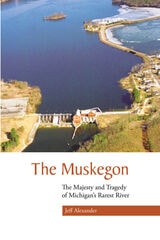
The Muskegon
The Majesty and Tragedy of Michigan's Rarest RiverJeff Alexander
Michigan State University Press, 2006
Muskegon is a derivation of a Native American word meaning "river with marshes." Jeff Alexander examines the creation, uses of, devastation, and restoration of Michigan's historic and beautiful Muskegon River.
Four of the five Great Lakes touch Michigan's shores; the state's shoreline spans more than 4,500 miles, not to mention more than 11,000 inland lakes and a multitude of rivers. The Muskegon River, the state's second longest river, runs 227 miles and has the most diverse features of any of Michigan’s many rivers. The Muskegon rises from the center of the state, widens, and moves westward, passing through the Pere Marquette and AuSable State Forests. The river ultimately flows toward Lake Michigan, where it opens into Muskegon Lake, a 12 square-mile, broad harbor located between the Muskegon River and Lake Michigan.
Formed several thousand years ago, when the glaciers that created the Great Lakes receded, and later inhabited by Ottawa and Potawatomi Indians, the Muskegon River was used by French fur trappers in the 1600s. Rich in white pine, the area was developed during the turn-of-the-century lumber boom, and at one time Muskegon Lake boasted more than 47 sawmills. The Muskegon was ravaged following settlement by Europeans, when rivers and streams were used to transport logs to the newly developing cities. Dams on rivers and larger streams provided power for sawmills and grain milling, and later provided energy for generating electricity as technology advanced.
There is now an ambitious effort to restore and protect this mighty river's natural features in the face of encroaching urbanization and land development that threatens to turn this majestic waterway into a mirror image of the Grand River, Michigan's longest river and one of its most polluted.
The Offbeat
Collecting GlancesKristen DeMay
Michigan State University Press, 2005
The Offbeat is an independent literary series devoted to publishing a diverse collection of voices,and to promoting contactand discussion among Michigan writers. The Offbeat is run entirely by Michigan State University undergraduates, and is centered in East Lansing. Student editors encourage contributions by all individuals with a Michigan connection, past and present, visitor and resident, urban and rural, student and non-student alike. The Offbeat’s goal is to provide an alternative literary outlet for all Michigan writers.
The Offbeat
Eschew ObfuscationTheresa Mlinarcik
Michigan State University Press, 2003
The Offbeat literary collection series is devoted to publishing a diverse selection of voices and to promoting contact and discussion among writers. The Offbeat is run entirely by Michigan State University students, with the goal of providing an alternative literary outlet for Michigan writers.
This edition features an interview with noted author, W. S. Penn, plus a selection of original fiction, prose, and poetry from a variety of authors, including Daniel Klass, Timothy Carmody, Joshua Moon, Robert Brady, Mark Geralds, Andrew Hungerford, Jeremy Campbell, Gavin Craig, Ashley Honeysett, Andy McGashen, Colleen Farrow, Crystal Passmore, Jogn Garcia, De'Juan McDuell, Gregory Wright, Bailey Follette, and Brandon Connell.