Results by title
225 books match the query 'Modernism' and 50 start with t

Tactile Sensibilities
Seeing Through Print in American ArtJuliet Sperling
University of Chicago Press, 0
A print-driven history of American art in the long nineteenth century.
Juliet Sperling’s Tactile Sensibilities uses interactive printed objects to uncover culturally instilled ideas about touch’s role in perception and shows how these frameworks were integral to ways of making and appreciating even seemingly untouchable works of painting and sculpture. Crucial to Sperling’s argument is a genre of paper constructions designed to engage the hand and eye in tandem: multilayered and lift-the-flap book plates, pull-tab engravings, foldable playbills, and spinning paper wheels that built expectations of touch as a trained, focused process into their structure and material. Intimately scaled and portable, tactile prints cut across multiple spheres of experience, including spaces in which people learned to view, understand, and create art.
Sperling reverses standard procedures for integrating prints into art history. Rather than working her way outward from canonical artworks toward ephemeral sources within the artist’s orbit, she uses previously unstudied printed materials to open period discourses of tactile sensibility that ultimately lead to art objects, unlocking new meanings behind works of painting and sculpture by artists including Raphaelle Peale, Hiram Powers, William Sidney Mount, and Winslow Homer. In treating sidelined materials as dedicated objects of study in their own right, Tactile Sensibilities reveals that in the long nineteenth century, print was an intellectually dense and powerfully connective medium, vital in mediating the tactile sensibilities that shaped ways of making and appreciating art.
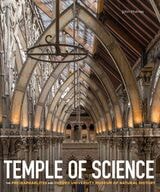
Temple of Science
The Pre-Raphaelites and Oxford University Museum of Natural HistoryJohn Holmes
Bodleian Library Publishing, 2020
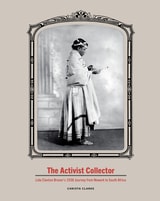
The Activist Collector
Lida Clanton Broner’s 1938 Journey from Newark to South AfricaChrista Clarke
Rutgers University Press, 2023
Published by the Newark Museum. Distributed worldwide by Rutgers University Press.
“After twenty-eight years of desire and determination, I have visited Africa, the land of my forefathers.” So wrote Lida Clanton Broner (1895–1982), an African American housekeeper and hairstylist from Newark, New Jersey, upon her return from an extraordinary nine-month journey to South Africa in 1938. This epic trip was motivated not only by Broner’s sense of ancestral heritage, but also a grassroots resolve to connect the socio-political concerns of African Americans with those of black South Africans under the segregationist policies of the time. During her travels, this woman of modest means circulated among South Africa’s Black intellectual elite, including many leaders of South Africa’s freedom struggle. Her lectures at Black schools on “race consciousness and race pride” had a decidedly political bent, even as she was presented as an “American beauty specialist.”
How did Broner—a working class mother—come to be a globally connected activist? What were her experiences as an African American woman in segregated South Africa and how did she further her work after her return? Broner’s remarkable story is the subject of this book, which draws upon a deep visual and documentary record now held in the collection of the Newark Museum of Art. This extraordinary archive includes more than one hundred and fifty objects, ranging from beadwork and pottery to mission school crafts, acquired by Broner in South Africa, along with her diary, correspondence, scrapbooks, and hundreds of photographs with handwritten notations.
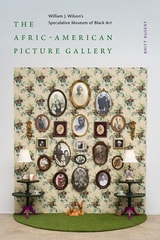
The Afric-American Picture Gallery
William J. Wilson's Speculative Museum of Black ArtBritt Rusert
Duke University Press, 2026
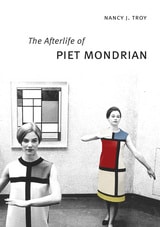
The Afterlife of Piet Mondrian
Nancy J. Troy
University of Chicago Press, 2014
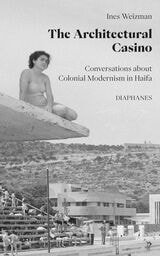
The Architectural Casino
Conversations about Modernism in HaifaInes Weizman
Diaphanes, 2026
After the First World War and under the British Mandate, Haifa grew from a small Ottoman port town into a regional metropolis and industrial center around a deep seaport. The city was part of an open space that extended from Cairo to Damascus through Beirut, in a region where Syria, Palestine, and Lebanon were part of the same fluid, interconnected space. During the Second World War, Haifa became a border town. Under French Vichy, the border between Lebanon and Syria ran sixty kilometers to the north and hardened only after the creation of Israel in 1948 and the wars with Lebanon. Haifa’s architectural modernism developed in relation to the city’s geopolitical environment. No building better manifests Haifa’s predicament than the modernist casino building, built in the city’s Bat Galim seafront district.
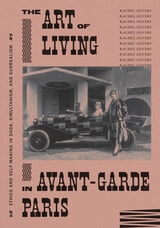
The Art of Living in Avant-Garde Paris
Ethics and Self-Making in Dada, Simultanism, and SurrealismRachel Silveri
University of Chicago Press, 2026
With The Art of Living in Avant-Garde Paris, Rachel Silveri takes a fresh look at the desire to unify art and life, an ambition long regarded as foundational to the European historical avant-gardes. She reveals how many early twentieth-century artists saw their own everyday lives—their bodies, identities, and relationships—as a type of creative material and a central component to their avant-garde practice. These artists abandoned traditional forms of artmaking and venues of art viewing, instead aspiring to integrate art with everyday life, creating an “art of living.”
Considering Tristan Tzara’s performances of Dadaist identity, Sonia Delaunay’s simultaneous fashions and self-branding, and the collective endeavor to open and operate the Surrealist Research Bureau, Silveri offers a new narrative about how the artists of interwar Paris developed experiential life practices that resisted dominant forms of “lifestyle” and normative discourses surrounding gender, ethnicity, and office work. This book argues that ethical questions of “How should I live?” and “How should I relate to others?” were as important to the avant-garde as politics, and that aspirations to change the world played out in daily practices of self-making.
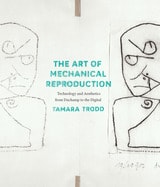
The Art of Mechanical Reproduction
Technology and Aesthetics from Duchamp to the DigitalTamara Trodd
University of Chicago Press, 2015
The Art of Mechanical Reproduction weaves a rich history of the experimental networks in which artists as diverse as Paul Klee, Hans Bellmer, Ellsworth Kelly, Robert Smithson, Gerhard Richter, Chris Marker, and Tacita Dean have worked, and it shows for the first time how extensively technological innovations of the moment have affected their work. Original and broad-ranging, The Art of Mechanical Reproduction challenges some of the most respected and entrenched criticism of the past several decades—and allows us to think about these artists anew.
The Bauhaus Idea and Bauhaus Politics
Éva Forgács
Central European University Press, 1995
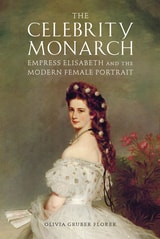
The Celebrity Monarch
Empress Elisabeth and the Modern Female PortraitOlivia Gruber Florek
University of Delaware Press, 2023
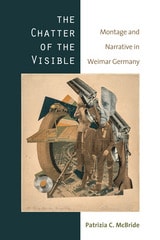
The Chatter of the Visible
Montage and Narrative in Weimar GermanyPatrizia C. McBride
University of Michigan Press, 2016
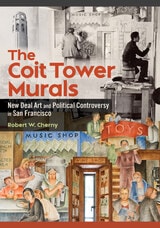
The Coit Tower Murals
New Deal Art and Political Controversy in San FranciscoRobert W. Cherny
University of Illinois Press, 2024
Created in 1934, the Coit Tower murals were sponsored by the Public Works of Art Project (PWAP), the first of the New Deal art programs. Twenty-five master artists and their assistants worked there, most of them in buon fresco, Nearly all of them drew upon the palette and style of Diego Rivera. The project boosted the careers of Victor Arnautoff, Lucien Labaudt, Bernard Zakheim, and others, but Communist symbols in a few murals sparked the first of many national controversies over New Deal art.
Sixty full-color photographs illustrate Robert Cherny’s history of the murals from their conception and completion through their evolution into a beloved San Francisco landmark. Cherny traces and critiques the treatment of the murals by art critics and historians. He also probes the legacies of Coit Tower and the PWAP before surveying San Francisco’s recent controversies over New Deal murals.
An engaging account of an artistic landmark, The Coit Tower Murals tells the full story behind a public art masterpiece.
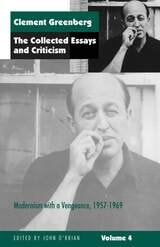
The Collected Essays and Criticism, Volume 4
Modernism with a Vengeance, 1957-1969Clement Greenberg
University of Chicago Press, 1995
With the inclusion of critical exchanges between Greenberg and F. R. Leavis, Fairfield Porter, Thomas B. Hess, Herbert Read, Max Kozloff, and Robert Goldwater, these volumes are essential sources in the ongoing debate over modern art. For each volume, John O'Brian has furnished an introduction, a selected bibliography, and a brief summary of events that places the criticism in its artistic and historical context.

The Cube and the Face
Around a Sculpture by Alberto GiacomettiGeorges Didi-Huberman. Edited by Mira Fliescher and Elena Vogman
Diaphanes, 2015
With The Cube and the Face, renowned French art historian and philosopher Georges Didi-Huberman has conducted a careful analysis of Cube, consulting the artist’s sketches, etchings, texts, and other sculptural works in the years just before and after Cube was created. Cube, he finds, is indeed exceptional—a work without clear stylistic kinship to the works that came before or after it. At the same time, Didi-Huberman shows, Cube marks the transition between the artist’s surrealist and realist phases and contains many elements of Giacometti’s aesthetic consciousness, including his interest in dimensionality, the relation of the body to geometry, and the portrait—or what Didi-Huberman terms “abstract anthropomorphism.” Drawing on Freud, Bataille, Leiris, and others Giacometti counted as influence, Didi-Huberman presents fans and collectors of Giacometti’s art with a new approach to transitional work.

The Dada Cyborg
Visions of the New Human in Weimar BerlinMatthew Biro
University of Minnesota Press, 2009
Finding the cyborg in early twentieth-century German art
In an era when technology, biology, and culture are becoming ever more closely connected, The Dada Cyborg explains how the cyborg as we know it today actually developed between 1918 and 1933 when German artists gave visual form to their utopian hopes and fantasies in a fearful response to World War I.
In what could be termed a prehistory of the posthuman, Matthew Biro shows the ways in which new forms of human existence were imagined in Germany between the two world wars through depictions of cyborgs. Examining the work of Hannah Höch, Raoul Hausmann, George Grosz, John Heartfield, Otto Dix, and Rudolf Schlichter, he reveals an innovative interpretation of the cyborg as a representative of hybrid identity, as well as a locus of new modes of awareness created by the impact of technology on human perception. Tracing the prevalence of cyborgs in German avant-garde art, Biro demonstrates how vision, hearing, touch, and embodiment were beginning to be reconceived during the Weimar Republic. Biro’s unique and interdisciplinary analysis offers a substantially new account of the Berlin Dada movement, one that integrates the group’s poetic, theoretical, and performative practices with its famous visual strategies of photomontage, assemblage, and mixed-media painting to reveal radical images of a “new human.”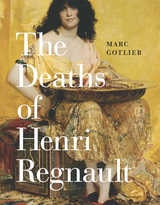
The Deaths of Henri Regnault
Marc Gotlieb
University of Chicago Press, 2016
Gotlieb traces Regnault’s trajectory after he won the prestigious Grand Prix de Rome, a fellowship that provided four years of study in Italy. Arriving in Rome, however, Regnault suffered a profound crisis of originality that led him to flee the city in favor of Spain and Morocco. But the crisis also proved productive: from Rome, Madrid, Tangier, and Paris, Regnault enthralled audiences with a bold suite of strange, seductive, and violent Orientalist paintings inspired by his exotic journey—images that, Gotlieb argues, arose precisely from the crisis that had overtaken Regnault and that in key respects was shared by his more avant-garde counterparts.
Both an in-depth look at Regnault’s violent art and a vibrant essay on historical memory, The Deaths of Henri Regnault lays bare a creative legend who helped shape the collective experience of a generation.
The Demon and the Damozel
Dynamics of Desire in the Works of Christina Rossetti and Dante Gabriel RossettiSuzanne M. Waldman
Ohio University Press, 2008
The Ecology of Modernism
American Environments and Avant-Garde PoeticsJoshua Schuster
University of Alabama Press, 2015
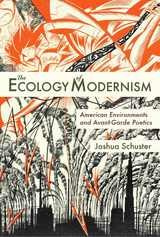
In his opening passage, Schuster boldly invokes lines from Walt Whitman’s “Crossing Brooklyn Ferry,” which echo as a paean to pollution: “Burn high your fires, foundry chimneys! cast black shadows at nightfall!” Schuster labels this theme “regeneration through pollution” and demonstrates how this motif recurs in modernist compositions. This tolerance for, if not actual exultation of, the by-products of industrialization hindered modernist American artists, writers, and musicians from embracing environmentalist agendas.
Schuster provides specific case studies focusing on Marianne Moore and her connection of fables with animal rights; Gertrude Stein and concepts of nature in her avant-garde poetics; early blues music and poetry and the issue of how environmental disasters (floods, droughts, pestilence) affected black farmers and artists in the American South; and John Cage, who extends the modernist avant-garde project formally but critiques it at the same time for failing to engage with ecology. A fascinating afterword about the role of oil in modernist literary production rounds out this work.
Schuster masterfully shines a light on the modernist interval between the writings of bucolic and nature-extolling Romantics and the emergence of a self-conscious green movement in the 1960s. This rewarding work shows that the reticence of modernist poets in the face of resource depletion, pollution, animal rights, and other ecological traumas is highly significant.
The Experimenters
Chance and Design at Black Mountain CollegeEva Díaz
University of Chicago Press, 2014
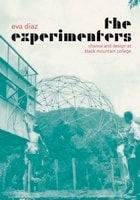
Díaz’s focus is on experimentation. Albers, Cage, and Fuller, she shows, taught new models of art making that favored testing procedures rather than personal expression. These methodologies represented incipient directions for postwar art practice, elements of which would be sampled, and often wholly adopted, by Black Mountain students and subsequent practitioners. The resulting works, which interrelate art and life in a way that imbues these projects with crucial relevance, not only reconfigured the relationships among chance, order, and design—they helped redefine what artistic practice was, and could be, for future generations.
Offering a bold, compelling new angle on some of the most widely studied creative figures of modern times, The Experimenters does nothing less than rewrite the story of art in the mid-twentieth century.
The Forces of Form in German Modernism
Malika Maskarinec
Northwestern University Press, 2018
Considering canonical artists such as Rodin and Klee, seminal authors such as Kafka and Döblin, and largely neglected thinkers in aesthetics and art history such as those associated with Empathy Aesthetics, Maskarinec unpacks the manifold anthropological and aesthetic concerns and historical lineage embedded in the idea of form as the precarious achievement of uprightness.
The Forces of Form in German Modernism makes a decisive contribution to our understanding of modernism and to contemporary discussions about form, empathy, materiality, and human embodiment.
The Geometry of Modernism
The Vorticist Idiom in Lewis, Pound, H.D., and YeatsBy Miranda B. Hickman
University of Texas Press, 2006
Addressing both the literature and the visual arts of Anglo-American modernism, The Geometry of Modernism recovers a crucial development of modernism's early years that until now has received little sustained critical attention: the distinctive idiom composed of geometric forms and metaphors generated within the early modernist movement of Vorticism, formed in London in 1914. Focusing on the work of Wyndham Lewis, leader of the Vorticist movement, as well as Ezra Pound, H.D., and William Butler Yeats, Hickman examines the complex of motives out of which Lewis initially forged the geometric lexicon of Vorticism—and then how Pound, H.D., and Yeats later responded to it and the values that it encoded, enlisting both the geometric vocabulary and its attendant assumptions and ideals, in transmuted form, in their later modernist work.
Placing the genesis and appropriation of the geometric idiom in historical context, Hickman explores how despite its brevity as a movement, Vorticism in fact exerted considerable impact on modernist work of the years between the wars, in that its geometric idiom enabled modernist writers to articulate their responses to both personal and political crises of the 1930s and 1940s. Informed by extensive archival research as well as treatment of several of the least-known texts of the modernist milieu, The Geometry of Modernism clarifies and enriches the legacy of this vital period.
The Ghosts of the Avant-Garde(s)
Exorcising Experimental Theater and PerformanceJames M. Harding
University of Michigan Press, 2015
James M. Harding revisits iconic sites of early 20th-century performance to examine how European avant-gardists attempted—unsuccessfully—to employ that discourse as a strategy for enforcing uniformity among a politically and culturally diverse group of artists. He then takes aim at historical and aesthetic categories that have promoted a restrictive history and theory of the avant-garde and narrow readings of avant-garde performance. Harding reveals the Eurocentric undercurrents that underlie these categories and urges a consideration of the global political dimensions of avant-garde gestures. His book will interest scholars of theater and performance, art history, and literary studies, as well as those interested in the relation of art to politics in various historical periods and cultures.
The Global Work of Art
World's Fairs, Biennials, and the Aesthetics of ExperienceCaroline A. Jones
University of Chicago Press, 2017
As world’s fairs brought millions of attendees into contact with foreign cultures, products, and processes, artworks became juxtaposed in a “theater of nations,” which challenged artists and critics to think outside their local academies. From Gustave Courbet’s rebel pavilion near the official art exhibit at the 1855 French World’s Fair to curator Beryl Madra’s choice of London-based Cypriot Hussein Chalayan for the off-site Turkish pavilion at the 2006 Venice Biennale, artists have used these exhibitions to reflect on contemporary art, speak to their own governments back home, and challenge the wider geopolitical realm—changing art and art history along the way. Ultimately, Caroline A. Jones argues, the modern appetite for experience and event structures, which were cultivated around the art at these earlier expositions, have now come to constitute contemporary art itself, producing encounters that transform the public and force us to reflect critically on the global condition.

The Harlequin Eaters
From Food Scraps to Modernism in Nineteenth-Century FranceJanet Beizer
University of Minnesota Press, 2024
How representations of the preparation, sale, and consumption of leftovers in nineteenth-century urban France link socioeconomic and aesthetic history
The concept of the “harlequin” refers to the practice of reassembling dinner scraps cleared from the plates of the wealthy to sell, replated, to the poor in nineteenth-century Paris. In The Harlequin Eaters, Janet Beizer investigates how the alimentary harlequin evolved in the nineteenth and early twentieth centuries from the earlier, similarly patchworked Commedia dell’arte Harlequin character and can be used to rethink the entangled place of class, race, and food in the longer history of modernism.
By superimposing figurations of the edible harlequin taken from a broad array of popular and canonical novels, newspaper articles, postcard photographs, and lithographs, Beizer shows that what is at stake in nineteenth-century discourses surrounding this mixed meal are representations not only of food but also of the marginalized people—the “harlequin eaters”—who consume it at this time when a global society is emerging. She reveals the imbrication of kitchen narratives and intellectual–aesthetic practices of thought and art, presenting a way to integrate socioeconomic history with the history of literature and the visual arts. The Harlequin Eaters also offers fascinating background to today’s problems of food inequity as it unpacks stories of the for-profit recycling of excess food across class and race divisions.
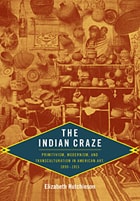
The Indian Craze
Primitivism, Modernism, and Transculturation in American Art, 1890–1915Elizabeth Hutchinson
Duke University Press, 2009
Illustrating her argument with images culled from late-nineteenth- and early-twentieth-century publications, Hutchinson revises the standard history of the mainstream interest in Native American material culture as “art.” While many locate the development of this cross-cultural interest in the Southwest after the First World War, Hutchinson reveals that it began earlier and spread across the nation from west to east and from reservation to metropolis. She demonstrates that artists, teachers, and critics associated with the development of American modernism, including Arthur Wesley Dow and Gertrude Käsebier, were inspired by Native art. Native artists were also able to achieve some recognition as modern artists, as Hutchinson shows through her discussion of the Winnebago painter and educator Angel DeCora. By taking a transcultural approach, Hutchinson transforms our understanding of the role of Native Americans in modernist culture.
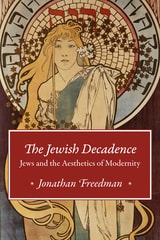
The Jewish Decadence
Jews and the Aesthetics of ModernityJonathan Freedman
University of Chicago Press, 2021
The first to tell this sweeping story, Freedman demonstrates the centrality of decadence to the aesthetics of modernity and its inextricability from Jewishness. Freedman recounts a series of diverse and surprising episodes that he insists do not belong solely to the past, but instead reveal that the identification of Jewishness with decadence persists today.
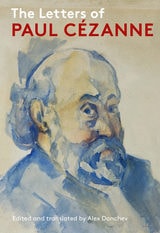
The Letters of Paul Cézanne
Alex Danchev
J. Paul Getty Trust, The, 2013
Revered and misunderstood by his peers and lauded by later generations as the father of modern art, Paul Cézanne (1839-1906) has long been a subject of fascination for artists and art lovers, writers, poets, and philosophers. His life was a ceaseless artistic quest, and he channeled much of his wide-ranging intellect and ferocious wit into his letters. Punctuated by exasperated theorizing and philosophical reflection, outbursts of creative ecstasy and melancholic confession, the artist’s correspondence reveals both the heroic and all-toohuman qualities of a man who is indisputably among the pantheon of all-time greats.
This new translation of Cézanne’s letters includes more than twenty that were previously unpublished and reproduces the sketches and caricatures with which Cézanne occasionally illustrated his words. The letters shed light on some of the key artistic relationships of the modern period—about one third of Cézanne’s more than 250 letters are to his boyhood companion Émile Zola, and he communicated extensively with Camille Pissarro and the dealer Ambroise Vollard. The translation is richly annotated with explanatory notes, and, for the first time, the letters are cross-referenced to the current catalogue raisonné. Numerous inaccuracies and archaisms in the previous English edition of the letters are corrected, and many intriguing passages that were unaccountably omitted have been restored. The result is a publishing landmark that ably conveys Cézanne’s intricacy of expression.
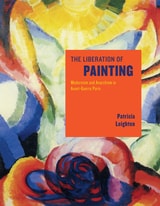
The Liberation of Painting
Modernism and Anarchism in Avant-Guerre ParisPatricia Leighten
University of Chicago Press, 2013
Leighten examines the circle of artists—Pablo Picasso, Juan Gris, František Kupka, Maurice de Vlaminck, Kees Van Dongen, and others—for whom anarchist politics drove the idea of avant-garde art, exploring how their aesthetic choices negotiated the myriad artistic languages operating in the decade before World War I. Whether they worked on large-scale salon paintings, political cartoons, or avant-garde abstractions, these artists, she shows, were preoccupied with social criticism. Each sought an appropriate subject, medium, style, and audience based on different conceptions of how art influences society—and their choices constantly shifted as they responded to the dilemmas posed by contradictory anarchist ideas. According to anarchist theorists, art should expose the follies and iniquities of the present to the masses, but it should also be the untrammeled expression of the emancipated individual and open a path to a new social order. Revealing how these ideas generated some of modernism’s most telling contradictions among the prewar Parisian avant-garde, The Liberation of Painting restores revolutionary activism to the broader history of modern art.
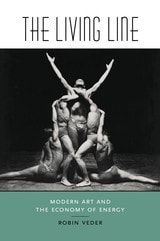
The Living Line
Modern Art and the Economy of EnergyRobin Veder
Dartmouth College Press, 2015
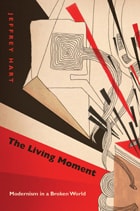
The Living Moment
Modernism in a Broken WorldJeffrey Hart
Northwestern University Press, 2012
In the spirit of Lionel Trilling, Edmund Wilson, and Susan Sontag, the renowned literary critic Jeffrey Hart writes The Living Moment, a close reading of literature as it intersects with the political. Hart’s book is an even-handed guide for anyone toddling into the mists of the modernist moment, effortlessly moving between such modernist monuments as Eliot’s “The Waste Land,” Hemingway’s A Farewell to Arms, Mann’s Doctor Faustus, and Fitzgerald’s The Great Gatsby. Hart’s most stunning achievement is his brilliant inclusion of Marilynne Robinson’s Gilead as a modernist text, for the way the novel teaches us to see more, to hear more, to feel more. Hart’s dazzling study is an examination of important works of literature as they explore the experience of living in a broken world with thought and sometimes with examples of resolve that possess permanent validity. The Living Moment is for anyone who is wearied by so much of today’s trendy, narrow, and ideologically driven criticism.
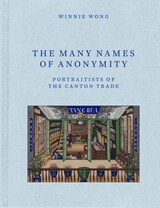
The Many Names of Anonymity
Portraitists of the Canton TradeWinnie Wong
University of Chicago Press, 2025
Challenging contemporary procedures for establishing attribution, chronology, and authenticity in Chinese art, Winnie Wong explores the means, methods, and stakes of recovering the names of an anonymous community of artists. To examine how Western art history has misconstrued and miscategorized names and identities in Chinese art, she looks to conflicting features of modernity: the European attachment of singular names to individuals and their works, and the Chinese use of socially contingent names that often are not attached to material labor and sometimes operate against it. Wong charts the genealogy of this naming problem by bringing to life the artists of the Qing Empire’s trade with Europeans at the port of Guangzhou, centering on a group of portraitists known by names that were recorded in a pidgin language: Chin Qua, Chit Qua, Spoilum, Lam Qua, and Ting Qua.
Many of these paintings survive today, yet scholars have identified only a handful of the painters’ identities. Pushing against Western norms that have shaped our understanding of authorship, Wong reveals that these artists shared names, created works in multiples, and signed their pieces with different names or none at all. This lavishly illustrated volume explores portraiture across media, including unfired clay, reverse painting on glass, watercolor on paper, oil on canvas, and the daguerreotype, to propose new ways of studying anonymity, copying, and the emergence of author names in the Sino-European visual culture of the long eighteenth century.
The Measurement of Modernism
A Study of Values in Brazil and MexicoBy Joseph A. Kahl
University of Texas Press, 1968
One of the most interesting questions that can be raised about the twentieth century world concerns the degree to which industrialization created a common culture for all peoples. Reported here are the results of an empirical investigation designed to produce instruments to measure those personal values that have been central variables in the theory of modernization of societies.
The purpose of Joseph Kahl’s research is primarily methodological: to advance the description and measurement of those value orientations used by men to organize their occupational careers. It seeks to delineate and measure a set of values that represents a “modern” view of work and life.
The working laboratory was Brazil and Mexico, two countries undergoing rapid industrialization. More than six hundred men in Brazil and more than seven hundred in Mexico responded to questionnaires. In addition, over twenty-five men in each country were asked to sit beside a tape recorder and talk freely of their worldviews. The respondents were divided between inhabitants of the cities of Rio de Janeiro and Mexico City and those who lived in provincial towns of fewer than ten thousand inhabitants. The samples included manual and nonmanual employees.
The results showed that the main variable predicting whether or not a man would tend toward modernism was his social-class position. Middle-class men were much more modern in outlook than working-class men. Residence in a metropolis rather than in a small town also increased modernism, though to a lesser extent. Differences between Brazil and Mexico (and, indeed, the United States) were found to be surprisingly small, of considerably less weight than position in the social structure in predicting value orientations.
The author addresses himself primarily to sociologists and their students who are themselves studying aspects of socio-economic development. His findings, however, cannot fail to be of interest and benefit to social scientists of various disciplines and to all who are concerned with the process of development—planners at the national and local levels, demographers, and businesspeople.
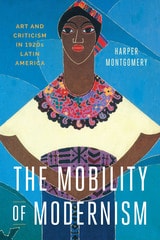
The Mobility of Modernism
Art and Criticism in 1920s Latin AmericaBy Harper Montgomery
University of Texas Press, 2017
Arvey Foundation Book Award, Association for Latin American Art, 2018
Many Latin American artists and critics in the 1920s drew on the values of modernism to question the cultural authority of Europe. Modernism gave them a tool for coping with the mobility of their circumstances, as well as the inspiration for works that questioned the very concepts of the artist and the artwork and opened the realm of art to untrained and self-taught artists, artisans, and women. Writing about the modernist works in newspapers and magazines, critics provided a new vocabulary with which to interpret and assign value to the expanding sets of abstracted forms produced by these artists, whose lives were shaped by mobility.
The Mobility of Modernism examines modernist artworks and criticism that circulated among a network of cities, including Buenos Aires, Mexico City, Havana, and Lima. Harper Montgomery maps the dialogues and relationships among critics who published in avant-gardist magazines such as Amauta and Revista de Avance and artists such as Carlos Mérida, Xul Solar, and Emilio Pettoruti, among others, who championed esoteric forms of abstraction. She makes a convincing case that, for these artists and critics, modernism became an anticolonial stance which raised issues that are still vital today—the tensions between the local and the global, the ability of artists to speak for blighted or unincorporated people, and, above all, how advanced art and its champions can enact a politics of opposition.
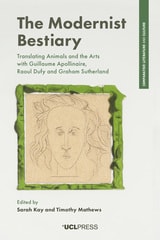
The Modernist Bestiary
Translating Animals and the Arts with Guillaume Apollinaire, Raoul Dufy and Graham SutherlandEdited by Sarah Kay and Timothy Mathews
University College London, 2020
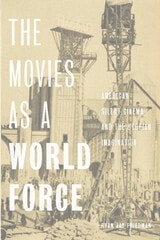
The Movies as a World Force
American Silent Cinema and the Utopian ImaginationFriedman, Ryan J
Rutgers University Press, 2019
The Old Guard and the Avant-Garde
Modernism in Chicago, 1910-1940Edited by Sue Ann Prince
University of Chicago Press, 1990
"This is fresh and fascinating research about the ups and downs of modernism in Chicago, a city where art students reportedly once hung Matisse in effigy. Regional studies like this one broaden our understanding of how the art world has worked outside of New York and gives depth to a story we know too narrowly. Applause all the way around."—Wanda M. Corn, Stanford University
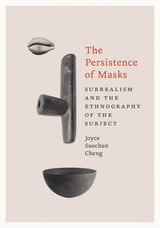
The Persistence of Masks
Surrealism and the Ethnography of the SubjectJoyce Suechun Cheng
University of Minnesota Press, 2025
An examination of surrealism’s unofficial ethnography of marginalized subjectivities
In interwar Paris, the encounter between surrealism and the nascent discipline of ethnology led to an intellectual project now known as “ethnographic surrealism.” In The Persistence of Masks, Joyce Suechun Cheng considers the ethnographic dimension of the surrealist movement in its formative years through a close look at the reviews Documents (1929–30) and Minotaure (1933–39) as well as the surrealist writer-turned-ethnographer Michel Leiris’s ethnography of possession. Analyzing surrealist aesthetic criticism, art, poetry, and field research in terms of a common interest in marginalized modes of subjectivity, Cheng argues that the surrealists used the figures of the mask, the veil, the hand, and the hat to radically reconceive the subject as nonhegemonic, nonanthropocentric, and feminine-identified.
Though ethnographic surrealism usually refers to the collaboration between professional ethnologists at the Institut de l’Ethnologie in Paris and Georges Bataille’s so-called dissident circle of surrealists, Cheng demonstrates that surrealism’s unofficial ethnography began long before the founding of the movement. Starting with André Breton’s wartime text “Subject” (1916), written when he was still a young psychiatric intern treating traumatized soldiers, she shows how the future surrealist poet shifted from a clinical to a para-ethnographic approach to subjectivity when adopting his patient’s first-person voice as a textual mask.
Revealing surrealism to be always implicitly ethnographic, Cheng uncovers deep affinities between archrivals Breton and Bataille, highlights psychiatry’s underacknowledged role in surrealism’s lay ethnography, and theorizes the surrealists’ feminine identification as a means of critiquing power. By broadening the scope of ethnographic surrealism, The Persistence of Masks offers new insights that challenge longstanding beliefs about this multifaceted movement in poetry, the arts, and culture.
The Phantom of the Ego
Modernism and the Mimetic UnconsciousNidesh Lawtoo
Michigan State University Press, 2013
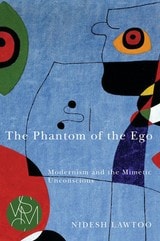
The Phantom of the Ego is the first comparative study that shows how the modernist account of the unconscious anticipates contemporary discoveries about the importance of mimesis in the formation of subjectivity. Rather than beginning with Sigmund Freud as the father of modernism, Nidesh Lawtoo starts with Friedrich Nietzsche’s antimetaphysical diagnostic of the ego, his realization that mimetic reflexes—from sympathy to hypnosis, to contagion, to crowd behavior—move the soul, and his insistence that psychology informs philosophical reflection. Through a transdisciplinary, comparative reading of landmark modernist authors like Nietzsche, Joseph Conrad, D. H. Lawrence, and Georges Bataille, Lawtoo shows that, before being a timely empirical discovery, the “mimetic unconscious” emerged from an untimely current in literary and philosophical modernism. This book traces the psychological, ethical, political, and cultural implications of the realization that the modern ego is born out of the spirit of imitation; it is thus, strictly speaking, not an ego, but what Nietzsche calls, “a phantom of the ego.” The Phantom of the Ego opens up a Nietzschean back door to the unconscious that has mimesis rather than dreams as its via regia, and argues that the modernist account of the “mimetic unconscious” makes our understanding of the psyche new.
The Poster
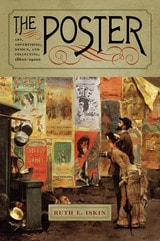
Art, Advertising, Design, and Collecting, 1860s–1900sRuth E. Iskin
Dartmouth College Press, 2014
The Promise of Pragmatism
Modernism and the Crisis of Knowledge and AuthorityJohn Patrick Diggins
University of Chicago Press, 1994
"Diggins, an eminent historian of American intellectual life, has written a timely and impressive book charting the rich history of American pragmatism and placing William James, Charles Peirce, John Dewey, George Herbert Mead, Sidney Hook, and Richard Rorty in their times and in the light of contemporary concerns. The book also draws on an alternative set of American thinkers to explore the blind spots in the pragmatic temper."—William Connolly, New York Times Book Review
"An extraordinarily ambitious work of both analysis and synthesis. . . . Diggins's book is rewarding in its thoughtfulness and its nuanced presentation of ideas."—Daniel J. Silver, Commentary
"Diggins's superbly informed book comprises a comprehensive history of American pragmatic thought. . . . It contains expert descriptions of James, John Dewey and Charles Sanders Peirce, the first generation of American pragmatists. . . . Diggins is just as good on the revival of pragmatism that's taken place over the last 20 years in America. . . . [A] richly intelligent book."—Mark Edmundson, Washington Post Book World
The Subject in Art
Portraiture and the Birth of the ModernCatherine M. Soussloff
Duke University Press, 2006
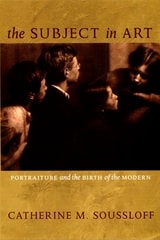
Soussloff combines a historically grounded examination of art and art historical thinking in Vienna with subsequent theories of portraiture and a careful historiography of philosophical and psychoanalytic approaches to human consciousness from Hegel to Sartre and from Freud to Lacan. She chronicles the emergence of a social theory of art among the art historians of the Vienna School, demonstrates how the Expressionist painter Oskar Kokoschka depicted the Jewish subject, and explores the development of pictorialist photography. Reflecting on the implications of the visualized, modern subject for textual and linguistic analyses of subjectivity, Soussloff concludes that the Viennese art historians, photographers, and painters will henceforth have to be recognized as precursors to such better-known theorists of the subject as Sartre, Foucault, and Lacan.
The Subject in Question
Early Contemporary Spanish Literature and ModernismC. Christopher Soufas
Catholic University of America Press, 2007
The Subject of Modernism
Narrative Alterations in the Fiction of Eliot, Conrad, Woolf, and JoyceTony E. Jackson
University of Michigan Press, 1994
The Surrealism Reader
An Anthology of IdeasEdited by Dawn Ades, Michael Richardson, and Krzysztof Fijalkowski
University of Chicago Press, 2016
Including essays by leading surrealists and other major writers on the movement, the volume addresses the key themes of identity, otherness, freedom and morality, and poetry. The texts uncover, among other things, the significance of surrealism for the antifascist and anticolonialist movements and the various manifestations of surrealism in the years after World War II. Giving space to the many different voices that made up the movement, and placing them for the first time within a clear and coherent historical framework, The Surrealism Reader radically revises the popular understanding of what, and when, surrealism was—making this book an essential reference for students, scholars, and all those interested in the central place of surrealism within twentieth-century thought and culture.
The Transformation of the Avant-Garde
The New York Art World, 1940-1985Diana Crane
University of Chicago Press, 1989
Crane's account is built around discussions of seven styles: Abstract Expressionism in the forties; Pop art and Minimalism in the sixties; Figurative painting, Photorealism, and Pattern painting in the early seventies; and Neo-Expressionism in the early eighties. Demonstrating that the New York art world moved toward increasing acceptance of dominant American cultural trends, Crane offers a fascinating look not only at the intricacies of New York's artistic inner circle but also at the sociology of work and professions, the economics of culture markets such as "dealing art," and the sociology of culture.
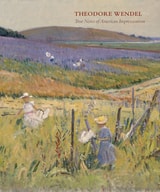
Theodore Wendel
True Notes of American ImpressionismTheodore Wendel
The Artist Book Foundation, 2019
One of the original "Duveneck boys" who studied in Munich at the Royal Academy, Theodore Wendel followed his mentor to Florence and Venice; he later went on to Paris and ultimately joined a colony of young artists at Giverny. The scenes and subject matter in the works he completed there are among the earliest by an American artist to adopt and evolve Impressionist strategies. Upon his return to America, he spent the next decades rendering scenes of the farmland and coast north of Boston that contemporary critics acclaimed as some of the best they had seen. Yet despite his talent and the significant accolades earned during his career, in the near-century following his death the recognition of his achievements has faded. The Artist Book Foundation is delighted to have the opportunity to remedy this siutation with its forthcoming monograph on the artist, Theodore Wendel: True Notes of American Impressionism.
Laurene Buckley's years of exhaustive research inform an engaging and detailed narrative of Wendel's time in Europe and his many years capturing the essence of the farms and fishing villages along the rural coast of Massachusetts. Thanks to her efforts, the book will feature many of his best works, a number of which are in private collections. An informative introduction by William H. Gerdts provides significant artistic context for Wendel and explains the artist's deft ability to draw the viewer into a scene. Concluding the monograph, an extensive chronology, exhibition history, and bibliography complete the scholarship on this long overdue tribute to a master of American Impressionism.

Thinking through Art
Aesthetic Agency and Global Modernity, Volume 25Daniel T. O’Hara and Alan Singer, eds.
Duke University Press, 0
Included in this volume are considerations of the relation between theories of art and the avant-garde; art’s relation to cognition; the aesthetic as history; the aesthetic as a unique access to modernity; and its impact on problems of identity formation, ideology, and resistances to the institutional powers inherent in dominant social formations.
Contributors. Charles Altieri, Peter Burger, David Carroll, Anthony J. Cascardi, Howard Caygill, Allen Dunn, Eric Gans, Agnes Heller, Ronald A. T. Judy, Marie-Rose Logan, Daniel T. O’Hara, Donald E. Pease, Alan Singer

Travels with Mina Loy
Navigating the Avant-GardeSuzanne W. Churchill, Linda A. Kinnahan, and Susan Rosenbaum
Lever Press, 2026
Artist and writer Mina Loy (1882-1966) traversed continents, participated in Futurism, Dada, and Surrealism, and depicted poetic and painterly vistas ranging from lunar landscapes to the gritty streets of the Bowery. Travels with Mina Loy: Navigating the Avant-Garde, a companion text to the award-winning, multi-authored web resource Mina Loy: Navigating the Avant-Garde, offers an illustrated tour of Mina Loy’s long and varied career, contextualized with in-depth explorations of key places that shaped her life and work. Shedding new light on Loy's poetic responses to Italy, her theatrical explorations in New York City, and her forays into the museums of Paris and New York, the book brings in newly discovered and critically overlooked Loy works, as well as fresh timelines and surveys of the critical corpus on her creative output. This essential guidebook to Mina Loy charts her migrations across geography, movements among artistic circles and people, and transit across arts to illuminate her evolving aesthetics, politics, and artistic commitments.
Treasuring the Gaze
Intimate Vision in Late Eighteenth-Century Eye MiniaturesHanneke Grootenboer
University of Chicago Press, 2013
True Grit
American Prints from 1900 to 1950Stephanie Schrader
J. Paul Getty Trust, The, 2019
In the first half of the twentieth century, a group of American artists influenced by the painter and teacher Robert Henri aimed to reject the pretenses of academic fine art and polite society. Embracing the democratic inclusiveness of the Progressive movement, these artists turned to making prints, which were relatively inexpensive to produce and easy to distribute. For their subject matter, the artists mined the bustling activity and stark realities of the urban centers in which they lived and worked. Their prints feature sublime towering skyscrapers and stifling city streets, jazzy dance halls and bleak tenement interiors—intimate and anonymous everyday scenes that addressed modern life in America.
True Grit examines a rich selection of prints by well-known figures like George Bellows, Edward Hopper, Joseph Pennell, and John Sloan as well as lesser-known artists such as Ida Abelman, Peggy Bacon, Miguel Covarrubias, and Mabel Dwight. Written by three scholars of printmaking and American art, the essays present nuanced discussions of gender, class, literature, and politics, contextualizing the prints in the rapidly changing milieu of the first decades of twentieth-century America.
This volume is published to accompany an exhibition on view at the J. Paul Getty Museum at the Getty Center October 15, 2019, to January 19, 2020.