Results by title
52 books match the query 'Morality' and 20 start with t
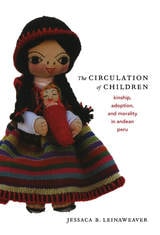
The Circulation of Children
Kinship, Adoption, and Morality in Andean PeruJessaca B. Leinaweaver
Duke University Press, 2008
Leinaweaver provides insight into the emotional and material factors that bring together and separate indigenous Andean families in the highland city of Ayacucho. She describes how child circulation is intimately linked to survival in the city, which has had to withstand colonialism, economic isolation, and the devastating civil war unleashed by the Shining Path. Leinaweaver examines the practice from the perspective of parents who send their children to live in other households, the adults who receive them, and the children themselves. She relates child circulation to international laws and norms regarding children’s rights, adoptions, and orphans, and to Peru’s history of racial conflict and violence. Given that history, Leinaweaver maintains that it is not surprising that child circulation, a practice associated with Peru’s impoverished indigenous community, is alternately ignored, tolerated, or condemned by the state.
The Dialectical Necessity of Morality
An Analysis and Defense of Alan Gewirth's Argument to the Principle of Generic ConsistencyDeryck Beyleveld
University of Chicago Press, 1991
Beyleveld then classifies all the criticisms that Gewirth's argument has received and measures them against his reconstruction of the argument. The overall result is an immensely rich picture of the argument, in which all of its complex issues and key moves are clearly displayed and its validity can finally be discerned.
The comprehensiveness of Beyleveld's treatment provides ready access to the entire debate surrounding the foundational argument of Reason and Morality. It will be required reading for all who are interested in Gewirth's theory and deontological ethics and will be of central importance to moral and legal theorists.
The Emergence of Morality in Young Children
Edited by Jerome Kagan and Sharon Lamb
University of Chicago Press, 1987
"This is a welcome and immensely provocative book. For those of us who favor ethical theorizing done in close proximity to psychology and anthropology, it provides new and illuminating theory and research relevant to perennial debates about the origins of moral sense, its psychological organization, and the objectivity and unity of the moral."—Owen Flanagan, Ethics
The contributors are Augusto Blasi, Lawrence Blum, Judy Dunn, M. Ann Easterbrooks, Carolyn Pope Edwards, Robert Emde, Carol Gilligan, Charles C. Helwig, William F. Johnson, Jerome Kagan, Melanie Killen, Sharon Lamb, Manamohan Mahapatra, Joan G. Miller, Edward Mueller, Richard A. Shweder, Catherine Snow, Elliot Turiel, and Grant Wiggins.

The Forest of Taboos
Morality, Hunting, and Identity among the Huaulu of the MoluccasValerio Valeri
University of Wisconsin Press, 2000
“The Forest of Taboos may be considered among the most important books ever written by an anthropologist. Valeri writes superbly, and this book makes a fundamental contribution to one of the most central lines of thought in twentieth-century anthropology. He shows that taboo is finally comprehensible.”—John Stephen Lansing, University of Michigan
“The Forest of Taboos is no conventional ethnography, more an extended meditative essay on its subject, erudite, rich in ideas and data, wide-ranging in its theoretical inspiration, and self-consciously literary in form. It is a fitting memorial to an author whose life was so tragically cut short.”—Roy Ellen, University of Kent at Canterbury
This eloquent and profound book, completed by Valerio Valeri shortly before his death in 1998, contends that the ambivalence felt by all humans about sex, death, and eating other animals can be explained by a set of coordinated principles that are expressed in taboos. In elegant prose, Valeri evokes the world of the Huaulu, forest hunters of Indonesia. The hidden attractions of the animal world, which invades the human world in perilous ways, he shows, also delineate that which the Huaulu regard as most human about themselves.

The Historian and Believer
The Morality of Historical Knowledge and Christian BeliefVan A. Harvey
University of Illinois Press, 1952
theology--available again!
"As a critic of the contemporary
theological scene, Van Harvey has few, if any, competitors. This is nowhere
clearer than in The Historian and the Believer . . . the classic
discussion of its topic. Rich in insight and penetrating in argument,
it is one book that belongs in the library of every theologian and seminarian."
-- Schubert M. Ogden, author of Doing Theology Today
Is it possible to be both
a historian and a Christian? Van Harvey's classic The Historian and
the Believer posed that question when it was first published.
In this printing, the author
has provided a new introduction in which he reflects on how he would reframe
his original argument in order to bring out more fully the basic theological
intention underlying his view that Christian faith cannot rest on dubious
historical claims.
From reviews of the first
edition:
"Probably the most interesting
piece of American theological writing to appear this year." -- John
Reumann, Union Seminary Quarterly Review
The Life Worth Living
Disability, Pain, and MoralityJoel Michael Reynolds
University of Minnesota Press, 2022
A philosophical challenge to the ableist conflation of disability and pain
More than 2,000 years ago, Aristotle said: “let there be a law that no deformed child shall live.” This idea is alive and well today. During the past century, Supreme Court Justice Oliver Wendell Holmes Jr. argued that the United States can forcibly sterilize intellectually disabled women and philosopher Peter Singer argued for the right of parents to euthanize certain cognitively disabled infants. The Life Worth Living explores how and why such arguments persist by investigating the exclusion of and discrimination against disabled people across the history of Western moral philosophy.
Joel Michael Reynolds argues that this history demonstrates a fundamental mischaracterization of the meaning of disability, thanks to the conflation of lived experiences of disability with those of pain and suffering. Building on decades of activism and scholarship in the field, Reynolds shows how longstanding views of disability are misguided and unjust, and he lays out a vision of what an anti-ableist moral future requires.
The Life Worth Living is the first sustained examination of disability through the lens of the history of moral philosophy and phenomenology, and it demonstrates how lived experiences of disability demand a far richer account of human flourishing, embodiment, community, and politics in philosophical inquiry and beyond.
Accessibility features: Retail e-book files for this title are screen-reader friendly with images accompanied by short alt text and/or extended descriptions.
The Morality of Everyday Life
Rediscovering an Ancient Alternative to the Liberal TraditionThomas Fleming
University of Missouri Press, 2007
In TheMorality of Everyday Life, Thomas Fleming offers an alternative to the enlightened liberalism espoused by thinkers as different as Kant, Mill, Rand, and Rawls. Philosophers in the liberal tradition, although they disagree on many important questions, agree that moral and political problems should be looked at from an objective point of view and a decision made from a rational perspective that is universally applied to all comparable cases.
Fleming instead places importance on the particular, the local, and moral complexity. He advocates a return to premodern traditions, such as those exemplified in the texts of Aristotle, the Talmud, and the folk wisdom in ancient Greek literature, for a solution to ethical predicaments. In his view, liberalism and postmodernism ignore the fact that human beings by their very nature refuse to live in a world of universal abstractions.
While such modern philosophers as Kant and Kohlberg have regarded a mother’s self-sacrificing love for her children as beneath their level of morality, folk wisdom tells us it is nearly the highest morality, taking precedence over the duties of citizenship or the claims of humanity. Fleming believes that a modern type of “casuistry” should be applied to these moral conflicts in which the line between right and wrong is rarely clear.
This volume will appeal to students of ethics and classics, as well as the general educated reader, who will appreciate Fleming’s jargon-free prose. Teachers will find this text useful because each chapter is a self-contained essay that could be used as the basis for classroom discussion.
The Morality of Laughter
F. H. Buckley
University of Michigan Press, 2005
superior piece of work.”
—P. J. O’Rourke
“F. H. Buckley’s The Morality of Laughter is at once
a humorous look at serious matters and a serious
book about humor.”
—Crisis Magazine
“Buckley has written a . ne and funny book that will
be read with pleasure and instruction.”
—First Things
“. . . written elegantly and often wittily. . . .”
—National Post
“. . . a fascinating philosophical exposition of
laughter. . . .”
—National Review
“. . . at once a wise and highly amusing book.”
—Wall Street Journal Online
“. . . a useful reminder that a cheery society is a
healthy one.”
—Weekly Standard

The Morality of Mrs. Dulska
A Play by Gabriela ZapolskaGabriela Zapolska
Intellect Books, 2007
The Morality of Revolution
Reeducation Camps and the Politics of Punishment in Socialist Mozambique, 1968–1990Benedito Luís Machava
Ohio University Press, 2024
The Perspective of Morality
Philosophical Foundations of Thomistic Virtue EthicsMartin Rhonheimer
Catholic University of America Press, 2011
The Politics of Morality
The Church, the State, and Reproductive Rights in Postsocialist PolandJoanna Mishtal
Ohio University Press, 2015
After the fall of the state socialist regime and the end of martial law in 1989, Polish society experienced both a sense of relief from the tyranny of Soviet control and an expectation that democracy would bring freedom. After this initial wave of enthusiasm, however, political forces that had lain concealed during the state socialist era began to emerge and establish a new religious-nationalist orthodoxy. While Solidarity garnered most of the credit for democratization in Poland, it had worked quietly with the Catholic Church, to which a large majority of Poles at least nominally adhered. As the church emerged as a political force in the Polish Sejm and Senate, it precipitated a rapid erosion of women’s reproductive rights, especially the right to abortion, which had been relatively well established under the former regime.
The Politics of Morality is an anthropological study of this expansion of power by the religious right and its effects on individual rights and social mores. It explores the contradictions of postsocialist democratization in Poland: an emerging democracy on one hand, and a declining tolerance for reproductive rights, women’s rights, and political and religious pluralism on the other. Yet, as this thoroughly researched study shows, women resist these strictures by pursuing abortion illegally, defying religious prohibitions on contraception, and organizing into advocacy groups. As struggles around reproductive rights continue in Poland, these resistances and unofficial practices reveal the sharp limits of religious form of governance.
The Rhetoric of Morality and Philosophy
Plato's Gorgias and PhaedrusSeth Benardete
University of Chicago Press, 1991
The Rhetoric of Morality and Philosophy, one of the most groundbreaking works of twentieth-century Platonic studies, is now back in print for a new generation of students and scholars to discover. In this volume, distinguished classicist Seth Benardete interprets and pairs two important Platonic dialogues, the Gorgias and the Phaedrus, illuminating Socrates’ notion of rhetoric and Plato’s conception of morality and eros in the human soul.
Following his discussion of the Gorgias as a dialogue about the rhetoric of morality, Benardete turns to the Phaedrus as a discourse about genuine rhetoric, namely the science of eros, or true philosophy. This novel interpretation addresses numerous issues in Plato studies: the relation between the structure of the Gorgias and the image of soul/city in the Republic, the relation between the structure of Phaedrus and the concept of eros, and Socrates’ notion of ignorance, among others.
The Rule of Rules
Morality, Rules, and the Dilemmas of LawLarry Alexander and Emily Sherwin
Duke University Press, 2001
Once the importance of this moral and practical conflict is acknowledged, the authors argue, authoritative rules become the central problems of jurisprudence. The inevitable gap between rules and background morality cannot be bridged, they claim, although many contemporary jurisprudential schools of thought are misguided attempts to do so. Alexander and Sherwin work through this dilemma, which lies at the heart of such ongoing jurisprudential controversies as how judges should reason in deciding cases, what effect should be given to legal precedent, and what status, if any, should be accorded to “legal principles.” In the end, their rigorous discussion sheds light on such topics as the nature of interpretation, the ancient dispute among legal theorists over natural law versus positivism, the obligation to obey law, constitutionalism, and the relation between law and coercion.
Those interested in jurisprudence, legal theory, and political philosophy will benefit from the edifying discussion in The Rule of Rules.
The Science of Sympathy
Morality, Evolution, and Victorian CivilizationRob Boddice
University of Illinois Press, 2016

The Scope of Morality
Peter A. French
University of Minnesota Press, 1980
The Scope of Morality was first published in 1980. Minnesota Archive Editions uses digital technology to make long-unavailable books once again accessible, and are published unaltered from the original University of Minnesota Press editions.
The scope of morality, Peter A. French contends, is much narrower than many traditional and contemporary works in ethical theory suggest. We trivialize morality if we think it has something to say about everything we do; it touches us all, but not at all times.
This essay in philosophical ethics focuses upon the origin, purpose, and function of the various concepts to be found in a more or less mature morality. The author draws a distinction between moral concepts that arise from an individual's wish to live a worthwhile life and those directed towards the development of virtue in the moral community. Moral concepts, in his view, are subjective creations of human beings rather than laws with an objective basis in nature. The ethics of sociobiology, of the lifeboat and spaceship models, and of game theory all come under his critical eye in this useful and progressive work. The Scope of Morality, says Hector-Neri Castaneda, "represents a serious effort at discussing the nature of morality, taking into account the most important contributions of recent writers."

The Search for Society
Quest for a Biosocial Science and MoralityFox, Robin
Rutgers University Press, 1989
The Theory of Morality
Alan Donagan
University of Chicago Press, 1977
"The man value of this book seems to me to be that it shows the force of the Hebrew-Christian moral tradition in the hands of a creative philosopher. Throughout the book, one cannot but feel that a serious philosopher is trying to come to terms with his religious-moral background and to defend it against the prevailing secular utilitarian position which seems to dominate academic philosophy."—Bernard Gert, Journal of Medicine and Philosophy
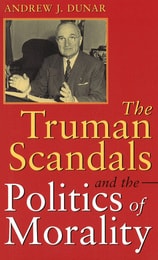
The Truman Scandals and the Politics of Morality
Andrew J. Dunar
University of Missouri Press, 1997
The Truman Scandals and the Politics of Morality is a thoroughly researched effort offering an excellent historical narrative of the scandals and accusations of scandal that bedeviled Harry Truman throughout his political career. The book is particularly significant in light of the connections the author establishes between Truman's early political experiences and his subsequent difficulties as president.
Trialectic
The Confluence of Law, Neuroscience, and MoralityPeter A. Alces
University of Chicago Press, 2023
A thought-provoking examination of how insights from neuroscience challenge deeply held assumptions about morality and law.
As emerging neuroscientific insights change our understanding of what it means to be human, the law must grapple with monumental questions, both metaphysical and practical. Recent advances pose significant philosophical challenges: how do neuroscientific revelations redefine our conception of morality, and how should the law adjust accordingly?
Trialectic takes account of those advances, arguing that they will challenge normative theory most profoundly. If all sentient beings are the coincidence of mechanical forces, as science suggests, then it follows that the time has come to reevaluate laws grounded in theories dependent on the immaterial that distinguish the mental and emotional from the physical. Legal expert Peter A. Alces contends that such theories are misguided—so misguided that they undermine law and, ultimately, human thriving.
Building on the foundation outlined in his previous work, The Moral Conflict of Law and Neuroscience, Alces further investigates the implications for legal doctrine and practice.