Results by title
51 books match the query 'Nicaragua' and 12 start with t
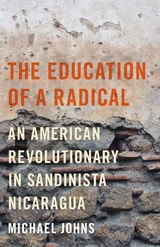
The Education of a Radical
An American Revolutionary in Sandinista NicaraguaBy Michael Johns
University of Texas Press, 2012
“I went to Nicaragua with nothing but a tourist visa, $1,500 in cash, the name of someone at the Agrarian Reform Ministry, and the idea of being a revolutionary intellectual. . . . The idea took hold in a simple character flaw: wanting to believe that I knew better than everyone else.” —From the preface
When Michael Johns joined a Sandinista militia in 1983, a fellow revolutionary dubbed him a rábano, a radish: red on the outside but white on the inside. Now, more than twenty-five years later, Johns appreciates the wisdom of that label as he revisits the questions of identity he tried to resolve by working with the Sandinistas at that point in his life. In The Education of a Radical, Johns recounts his immersion in Marxism and the Nicaraguan sojourn it led to, with a painful maturation process along the way.
His conversion began in college, where he joined a student group called the Latin American Solidarity Association and traveled to Chiapas, Mexico, for research on his senior thesis. Overwhelmed by the poverty he witnessed (and fascinated by a new friend named Maricela who was trying to turn peasants into revolutionaries and who carried a heavily highlighted copy of Late Capitalism), he experienced an ideological transformation. When a Marxist professor later encouraged him to travel to Nicaragua, the real internal battle began for him, a battle that was intensified by the U.S. invasion of Grenada and its effect on the Sandinistas, who believed they were the next target for an imminent American invasion. Before he knew it, Johns was digging trenches and learning how to use an AK-47. His intellectual ideals came face-to-face with revolutionary facts, and the results would perplex him for years to come.
Bringing to life a vivid portrait of the sometimes painful process of reconciling reality with romanticized principles, The Education of a Radical encapsulates a trove of truths about humanity, economics, and politics in one man’s memorable journey.
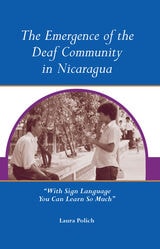
The Emergence of the Deaf Community in Nicaragua
“With Sign Language You Can Learn So Much”Laura Polich
Gallaudet University Press, 2005
The sudden discovery of Nicaraguan Sign Language (NSL) enthralled scholars worldwide who hoped to witness the evolution of a new language. But controversy erupted regarding the validity of NSL as a genuinely spontaneous language created by young children. Laura Polich’s fascinating book recounts her nine-year study of the Deaf community in Nicaragua and her findings about its formation and that of NSL in its wake.
Polich crafted The Emergence of the Deaf Community in Nicaragua from her copious research in Nicaragua’s National Archives, field observations of deaf pupils in 20 special education schools, polls of the teachers for deaf children about their education and knowledge of deafness, a survey of 225 deaf individuals about their backgrounds and living conditions, and interviews with the oldest members of the National Nicaraguan Association of the Deaf.
Polich found that the use of a “standardized” sign language in Nicaragua did not emerge until there was a community of users meeting on a regular basis, especially beyond childhood. The adoption of NSL did not happen suddenly, but took many years and was fed by multiple influences. She also discovered the process that deaf adolescents used to attain their social agency, which gained them recognition by the larger Nicaraguan hearing society. Her book illustrates tremendous changes during the past 60 years, and the truth in one deaf Nicaraguan’s declaration, “With sign language you can learn so much.”
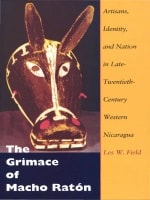
The Grimace of Macho Ratón
Artisans, Identity, and Nation in Late-Twentieth-Century Western NicaraguaLes W. Field
Duke University Press, 1999
Elite appropriations of El Güegüence construe it as an allegory of mestizo national identity in which mestizaje is defined as the production of a national majority of ethnically bounded non-Indians in active collaboration with the state. By contrast, Field interprets the play as a parable of cultural history and not a declaration of cultural identity, a scatological reflection on power and the state, and an evocation of collective loss and humor broadly associated with the national experience of disempowered social groups. By engaging with those most intimately involved in the performance of the play—and by including essays by some of these artisans—Field shows how El Güegüence tells a story about the passing of time, the absurdity of authority, and the contradictions of coping with inheritances of the past. Refusing essentialist notions of what it means to be Indian or artisan, Field explains the reemergence of politicized indigenous identity in western Nicaragua and relates this to the longer history of artisan political organization. Parting ways with many scholars who associate the notion of mestizaje with identity loss and hegemony, Field emphasizes its creative,
productive, and insightful meanings. With an emphasis on the particular struggles of women artisans, he explores the reasons why forms of collective identity have posed various kinds of predicaments for this marginalized class of western Nicaraguans.
This book will appeal to readers beyond the field of Latin American anthropology, including students and scholars of literature, intellectual history, women’s studies, and the politics of ethnicity.

The Kidney and the Cane
Planetary Health and Plantation Labor in NicaraguaAlex M. Nading
Duke University Press, 2025

The Many Faces of Sandinista Democracy
Katherine Hoyt
Ohio University Press, 1997
Taking power in Nicaragua in 1979 as a revolutionary party, the Sandinista National Liberation Front (FSLN) was willing to put its fate in the hands of the Nicaraguan people twice, in 1984 and 1990. The party wrote a democratic constitution and then, remarkably, accepted the decision of the majority by relinquishing power upon its defeat in the 1990 election.
The Many Faces of Sandinista Democracy explores the conflicts involving different visions of political and economic democracy, as well as new radical thought on participatory democracy. The latter addresses the problems popular organizations encountered as they moved from subservience to the FSLN in the 1980s to the liberating but disorientating electoral defeat of 1990. Up until the moment of defeat, the Sandinistas saw themselves as the true vanguard of the Nicaraguan people, able to submit themselves to free elections, because they felt they truly represented the general will of the people.
Dr. Hoyt brings to an international audience for the first time a study of the ideas of several Nicaraguan thinkers. She examines the conflicts surrounding the development of ideas within the FSLN, as well as the strengths and weaknesses of its rare combination of democratic and vanguard principles.

The Miskitu People of Awastara
By Philip A. Dennis
University of Texas Press, 2004
"Most anthropologists who have lived among other people . . . feel a periodic need to go back," writes Philip A. Dennis in the introduction to this book. "Fieldwork gives you a stake in the people themselves, a set of relationships that last the rest of your life . . . and when the time is right, it is important to go back."
Dennis first journeyed to Awastara, a village on the northeastern coast of Nicaragua, during 1978-1979 as a postdoctoral student. He had come to study a culture-bound syndrome in which young women are possessed by devils. In the process, he became fascinated by other aspects of Miskitu culture—turtle fishing, Miskitu Christianity, community development efforts—the whole pattern of Miskitu community life. He also formed deep friendships to carry into the future.
Twenty years later he was able to return and continue his ethnographic work. Utilizing ideas from recent interpretive anthropology and a vivid writing style, Dennis describes food habits, language, health practices, religious beliefs, and storytelling, inviting the reader to experience life in Awastara along with him. Building upon earlier work by Mary Helms, Bernard Nietschmann, Edmund Gordon, and Charles Hale, The Miskitu People of Awastara makes its own original contribution. It is the first full-length study of a coastal Miskitu community north of Puerto Cabezas, contrasting life before and after the war years of the 1980s. It will be a valuable addition to the literature on this indigenous group and should appeal to anthropologists and other social scientists, as well as all readers interested in peoples of the Caribbean coast.

The Naturalist in Nicaragua
Thomas Belt
University of Chicago Press, 1985
The Nicaraguan Constitution of 1987
English Translation and CommentaryKenneth J. Mijeski
Ohio University Press, 1991
This volume of seven essays on the 1987 Nicaraguan constitution does not accept a priori the judgment that Latin American constitutions are as fragile as egg shells, easily broken and discarded if found to be inconvenient to the interests of the rulers. Rather, they are viewed as being central to understanding political life in contemporary Nicaragua.
The perspectives of the analysts and their conclusions are not consensual. They prohibit glib and facile general conclusions. Some find the constitution to be nothing more than a façade for arbitrary and capricious rule; others that the document reflects clear commitments to the democratic rule of law. Thus far the implementation of the constitution has resulted in the peaceful transition of power from the Sandinistas to the National Opposition Union.
Theory in the Practice of the Nicaraguan Revolution
Bruce E. Wright
Ohio University Press, 1995
Even in the period following the electoral defeat of the Sandinista National Liberation Front (FSLN) in 1990, the revolution of 1979 continues to have a profound effect on the political economy of Nicaragua. Wright’s study, which is based on interviews with people from all walks of life—from government and party officials to academics and campesinos—as well as on the large volume of literature in both English and Spanish, focuses on the FSLN understanding of the relationships between the state, the party, and mass actors, and the nature of social classes. Wright considers the topics of agrarian reform, the development of mass organizations, the role of labor, and other aspects of the Nicaraguan political economy in order to assess their significance in theoretical as well as practical terms.

To Defend This Sunrise
Black Women’s Activism and the Authoritarian Turn in NicaraguaCourtney Desiree Morris
Rutgers University Press, 2023
To Die in this Way
Nicaraguan Indians and the Myth of Mestizaje, 1880-1965Jeffrey L. Gould
Duke University Press, 1998
Through interviews with indigenous peoples and records of the elite discourse that suppressed the expression of cultural differences and rationalized the destruction of Indian communities, Gould tells a story of cultural loss. Land expropriation and coerced labor led to cultural alienation that shamed the indigenous population into shedding their language, religion, and dress. Beginning with the 1870s, Gould historicizes the forces that prompted a collective movement away from a strong identification with indigenous cultural heritage to an “acceptance” of a national mixed-race identity.
By recovering a significant part of Nicaraguan history that has been excised from the national memory, To Die in This Way critiques the enterprise of third world nation-building and thus marks an important step in the study of Latin American culture and history that will also interest anthropologists and students of social and cultural historians.
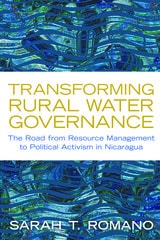
Transforming Rural Water Governance
The Road from Resource Management to Political Activism in NicaraguaSarah T. Romano
University of Arizona Press, 2019
In Transforming Rural Water Governance Sarah T. Romano explains the bottom-up development and political impact of community-based water and sanitation committees (CAPS) in Nicaragua. Romano traces the evolution of CAPS from rural resource management associations into a national political force through grassroots organizing and strategic alliances.
Resource management and service provision is inherently political: charging residents fees for service, determining rules for household water shutoffs and reconnections, and negotiating access to water sources with local property owners constitute just a few of the highly political endeavors resource management associations like CAPS undertake as part of their day-to-day work in their communities. Yet, for decades in Nicaragua, this local work did not reflect political activism. In the mid-2000s CAPS’ collective push for social change propelled them onto a national stage and into new roles as they demanded recognition from the government.
Romano argues that the transformation of Nicaragua’s CAPS into political actors is a promising example of the pursuit of sustainable and equitable water governance, particularly in Latin America. Transforming Rural Water Governance demonstrates that when activism informs public policy processes, the outcome is more inclusive governance and the potential for greater social and environmental justice.