Results by title
59 books match the query 'Philosophy and aesthetics' and 10 start with t
The Aesthetic Character of Blackness
Sounds Like UsJemma DeCristo
Duke University Press, 2025
The Emperor’s New Epistemology
Music, Empire, and Empiricism in Early Modern ChinaLester Hu
University of Chicago Press, 2027
An innovative account of listening and empire-building in 17th- and 18th-century China.
The Emperor’s New Epistemology explores how listening shaped knowledge and empire-building in seventeenth- and eighteenth-century China. As the Manchu dynasty expanded deep into Inner Asian territories deemed foreign by the majority-Han population, the Qing Empire’s musical culture encompassed the sounds of Mongols, Uyghurs, and Tibetans, as well as Western music brought by Jesuit and other Christian missionaries. Lester Hu reveals that this diversity transformed not only Qing court culture but the very grounds on which knowledge and power could be established.
In one revealing episode from 1692, the Kangxi Emperor (1654–1722) misinterpreted a key term of Classical Chinese music after studying European music with the Jesuits. Hu situates this anecdote within the political, social, and epistemic shifts that transformed late-imperial China. As Hu shows, listening was an instrument of Qing imperial authority: Knowledge about music, language, and even the universe could only be verified through the emperor’s ears. Furthermore, listening facilitated new theories of empirical knowledge, which both lent themselves to Qing-imperial ideology and generated new epistemic tensions. By exploring their echoes in similar shifts in early modern Europe, Hu’s book brings a global perspective to the study of music in the early modern world and reconsiders the transcendental ground on which such comparative and intercultural knowledge is possible.
The Idea of Absolute Music
Carl Dahlhaus
University of Chicago Press, 1989
"Essential reading for anyone interested in the larger intellectual framework in which Romantic music found its place, a framework that to a remarkable degree has continued to shape our image of music."—Robert P. Morgan, Yale University
Carl Dahlhaus (1928-1989) is the author of a highly influential body of works on the foundations of music history and aesthetics.
The Music between Us
Is Music a Universal Language?Kathleen Marie Higgins
University of Chicago Press, 2012
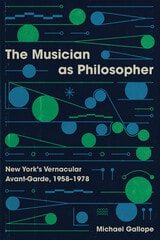
The Musician as Philosopher
New York’s Vernacular Avant-Garde, 1958–1978Michael Gallope
University of Chicago Press, 2024
The Musician as Philosopher explores the philosophical thought of avant-garde musicians in postwar New York: David Tudor, Ornette Coleman, the Velvet Underground, Alice Coltrane, Patti Smith, and Richard Hell. It contends that these musicians—all of whom are understudied and none of whom are traditionally taken to be composers—not only challenged the rules by which music is written and practiced but also confounded and reconfigured gendered and racialized expectations for what critics took to be legitimate forms of musical sound. From a broad historical perspective, their arresting music electrified a widely recognized social tendency of the 1960s: a simultaneous affirmation and crisis of the modern self.
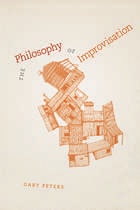
The Philosophy of Improvisation
Gary Peters
University of Chicago Press, 2009
Improvisation is usually either lionized as an ecstatic experience of being in the moment or disparaged as the thoughtless recycling of clichés. Eschewing both of these orthodoxies, The Philosophy of Improvisation ranges across the arts—from music to theater, dance to comedy—and considers the improvised dimension of philosophy itself in order to elaborate an innovative concept of improvisation.
Gary Peters turns to many of the major thinkers within continental philosophy—including Heidegger, Nietzsche, Adorno, Kant, Benjamin, and Deleuze—offering readings of their reflections on improvisation and exploring improvisational elements within their thinking. Peters’s wry, humorous style offers an antidote to the frequently overheated celebration of freedom and community that characterizes most writing on the subject. Expanding the field of what counts as improvisation, The Philosophy of Improvisation will be welcomed by anyone striving to comprehend the creative process.
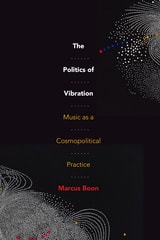
The Politics of Vibration
Music as a Cosmopolitical PracticeMarcus Boon
Duke University Press, 2022
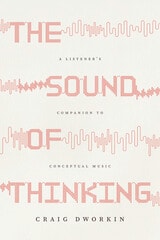
The Sound of Thinking
A Listener's Companion to Conceptual MusicCraig Dworkin
University of Chicago Press, 2026
An artist draws two octaves of pitches randomly from a hat, just enough to set each syllable of the dictionary definition of imprimer (to score, to print). Trawling the internet for cute videos of cats “playing” piano, an artist splices together a complete, note-perfect performance of Arnold Schoenberg’s Opus 11. Half a century after the release of Miles Davis’s album Kind of Blue, a jazz quintet spends months of focused practice to reproduce the original exactly. These performances share a common denominator: absolute fidelity to the outcome of a system. From Marcel Duchamp to Yoko Ono, Steve Reich to Sun Ra, The Sound of Thinking brings together a diverse array of musical or sonic works that are algorithmic, automatic, permutational, procedural, or otherwise structured in contrast to the creative expressivity typically associated with artistic production.
In twenty-six short essays, each keyed to a term that begins with a different letter of the alphabet, Dworkin discusses work composed or performed according to a predetermined rule, transforming artistic creation into a system running its course. The pieces detailed here, drawn from more than a century of musical experimentation, offer a fresh perspective on the history of innovative music by decoupling music from expression and by shunting creativity from the level of organizing sounds to the level of devising a system that can do the organizing. Not only does this book spotlight the critical role of music in twentieth-century conceptual art, but it also identifies previously overlooked links among diverse artists and movements.
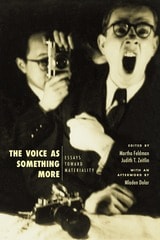
The Voice as Something More
Essays toward MaterialityEdited by Martha Feldman and Judith T. Zeitlin
University of Chicago Press, 2019
Using Mladen Dolar’s influential A Voice and Nothing More as a reference point, The Voice as Something More reorients Dolar’s psychoanalytic analysis around the material dimensions of voices—their physicality and timbre, the fleshiness of their mechanisms, the veils that hide them, and the devices that enhance and distort them. Throughout, the essays put the body back in voice. Ending with a new essay by Dolar that offers reflections on these vocal aesthetics and paradoxes, this authoritative, multidisciplinary collection, ranging from Europe and the Americas to East Asia, from classics and music to film and literature, will serve as an essential entry point for scholars and students who are thinking toward materiality.
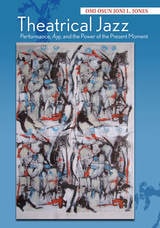
Theatrical Jazz
Performance, À??, and the Power of the Present MomentOmi Osun Joni L. Jones
The Ohio State University Press, 2015
Theatrical Jazz examines how artists are made and how artists make art. In charting their overlapping artistic genealogies, the book also discusses the work of veteran artists Aishah Rahman, Robbie McCauley, Sekou Sundiata, Ntozake Shange, and Erik Ehn, as well as the next generation of theatrical jazz innovators, Grisha Coleman, Walter Kitundu, Florinda Bryant, and Zell Miller III. Using autocritography as a primary methodology, the author draws on her role as performer, collaborator, audience/witness, and dramaturg in theatrical jazz, and her experiences with Yoruba spiritual traditions, to excavate the layers and nuances of this performance form. Jones’s use of performative writing, a blend of intellectual, artistic, and sensory experiences, allows scholars and students not only to read but also to “hear” the principles of theatrical jazz on the page.