Results by title
355 books match the query 'Political and social views' and 82 start with t
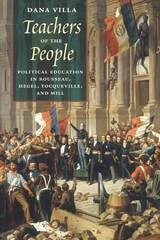
Teachers of the People
Political Education in Rousseau, Hegel, Tocqueville, and MillDana Villa
University of Chicago Press, 2017
In Teachers of the People, Dana Villa takes us back to the moment in history when “the people” first appeared on the stage of modern European politics. That moment—the era just before and after the French Revolution—led many major thinkers to celebrate the dawning of a new epoch. Yet these same thinkers also worried intensely about the people’s seemingly evident lack of political knowledge, experience, and judgment. Focusing on Rousseau, Hegel, Tocqueville, and Mill, Villa shows how reformist and progressive sentiments were often undercut by skepticism concerning the political capacity of ordinary people. They therefore felt that “the people” needed to be restrained, educated, and guided—by laws and institutions and a skilled political elite. The result, Villa argues, was less the taming of democracy’s wilder impulses than a pervasive paternalism culminating in new forms of the tutorial state.
Ironically, it is the reliance upon the distinction between “teachers” and “taught” in the work of these theorists which generates civic passivity and ignorance. And this, in turn, creates conditions favorable to the emergence of an undemocratic and illiberal populism.
Technomodern Poetics
The American Literary Avant-Garde at the Start of the Information AgeTodd F. Tietchen
University of Iowa Press, 2018
After the second World War, the term “technology” came to signify both the anxieties of possible annihilation in a rapidly changing world and the exhilaration of accelerating cultural change. Technomodern Poetics examines how some of the most well-known writers of the era described the tensions between technical, literary, and media cultures at the dawn of the Digital Age. Poets and writers such as Allen Ginsberg, Charles Olson, Jack Kerouac, and Frank O’Hara, among others, anthologized in Donald Allen’s iconic The New American Poetry, 1945–1960, provided a canon of work that has proven increasingly relevant to our technological present. Elaborating on the theories of contemporaneous technologists such as Norbert Wiener, Claude Shannon, J. C. R. Licklider, and a host of noteworthy others, these artists express the anxieties and avant-garde impulses they wrestled with as they came to terms with a complex array of issues raised by the dawning of the nuclear age, computer-based automation, and the expansive reach of electronic media. As author Todd Tietchen reveals, even as these writers were generating novel forms and concerns, they often continued to question whether such technological changes were inherently progressive or destructive.
With an undeniable timeliness, Tietchen’s book is sure to appeal to courses in modern English literature and American studies, as well as among fans of Beat writers and early Cold War culture.
Telling Wonders
Ethnographic and Political Discourse in the Work of HerodotusRosaria Munson
University of Michigan Press, 2001
As he explores the causes of the East-West conflict from its most remote antecedents, Herodotus includes conflicting traditions about different historical periods as well as apparently tangential descriptions of the customs of faraway peoples. What was his aim in combining such diverse material? Rosaria Vignolo Munson argues that Herodotus' aim was two-fold: to use historical narrative to illuminate the present and to describe barbarian customs so that the Greeks might understand themselves.
Herodotus assumes the role of advisor to his audience, acting as a master of metaphor and oracular speech and as an intellectual fully aware of new philosophical and political trends. By comparing, interpreting, and evaluating facts through time and space or simply by pointing them out as objects of "wonder," he teaches that correct political action is linked to an appropriate approach to foreigners and additional "others." Munson relies on traditional scholarship and modern studies in narratology and related critical fields to distinguish between narrative and metanarrative, providing a framework for analyzing the construction of Herodotus' discourse and his presentation of himself through it.
Munson's work will be useful to classicists and ancient historians and will also engage anthropologists interested in cultural interaction and notions of ethnicity and literary critics interested in narrative constructions.
Textual Conspiracies
Walter Benjamin, Idolatry, and Political TheoryJames R. Martel
University of Michigan Press, 2012
“This is a sophisticated and fascinating argument written in a very enjoyably entertaining style. It is hard for me to see how readers initially interested in these texts will not be ‘swept off their feet’ by the core assertions of this author, and the devastatingly comprehensive way in which he demonstrates those arguments.”
—Brent Steele, University of Kansas
In Textual Conspiracies, James R. Martel applies the literary, theological, and philosophical insights of Walter Benjamin to the question of politics and the predicament of the contemporary left. Through the lens of Benjamin’s theories, as influenced by Kafka, of the fetishization of political symbols and signs, Martel looks at the ways in which various political and literary texts “speak” to each other across the gulf of time and space, thereby creating a “textual conspiracy” that destabilizes grand narratives of power and authority and makes the narratives of alternative political communities more apparent.
However, in keeping with Benjamin’s insistence that even he is complicit with the fetishism that he battles, Martel decentralizes Benjamin’s position as the key theorist for this conspiracy and contextualizes Benjamin in what he calls a “constellation” of pairs of thinkers and writers throughout history, including Alexis de Tocqueville and Edgar Allen Poe, Hannah Arendt and Federico García Lorca, and Frantz Fanon and Assia Djebar.
The Anatomy of National Fantasy
Hawthorne, Utopia, and Everyday LifeLauren Berlant
University of Chicago Press, 1991
At the core of Berlant's work is a three-part study of The Scarlet Letter, analyzing the modes and effects of national identity that characterize the narrator's representation of Puritan culture and his construction of the novel's political present tense. This analysis emerges from an introductory chapter on American citizenship in the 1850s and a following chapter on national fantasy, ranging from Hawthorne's early work "Alice Doane's Appeal" to the Statue of Liberty. In her conclusion, Berlant suggests that Hawthorne views everyday life and local political identities as alternate routes to the revitalization of the political and utopian promises of modern national life.
The Anatomy of National Fantasy
Hawthorne, Utopia, and Everyday LifeLauren Berlant
University of Chicago Press, 2026
A classic work that launched the career of one of the most influential scholars of their generation.
Lauren Berlant influenced generations of scholars in gender studies, affect theory, literary criticism, anthropology, sociology, and beyond. Her first book, The Anatomy of National Fantasy, was published in 1991, and it marked the start of an extraordinary career of groundbreaking essays, editorial collaborations, and monographs. This new edition reintroduces Berlant’s earliest work with a new foreword by Caleb Smith, who connects Berlant’s initial investigations as a scholar of nineteenth-century American literature to her more widely known interventions in how we understand the entanglements of national ideology, citizenship, affect, and everyday life.
The Anti-Journalist
Karl Kraus and Jewish Self-Fashioning in Fin-de-Siècle EuropePaul Reitter
University of Chicago Press, 2008

The Attack of the Blob
Hannah Arendt's Concept of the SocialHanna Fenichel Pitkin
University of Chicago Press, 1998
"[O]ne leaves this book feeling enriched and challenged. Pitkin prompts us to rethink our understanding of Arendt and to demythologize the pervasive sense of political helplessness Arendt herself sought so hard to articulate. . . . [A] cause for celebration."—Peter Baehr, Times Literary Supplement
"[Arendt] is certainly among the most original and outstanding political theorists of the twentieth century. . . . It is difficult to imagine a hostile critic examining more effectively than Pitkin . . . Arendt's concept of the social, for hostility would inhibit the acquisition of the mastery of Arendt's texts that Pitkin displays at every turn."—Peter Berkowitz, New Republic

The Betrayal of Dissent
Beyond Orwell, Hitchens and the New American CenturyScott Lucas
Pluto Press, 2004
political writer, and the standard-bearer of honesty and decency for the honourable 'Left'. In this controversial polemic, Scott Lucas argues that the exaltation of Orwell, far from upholding dissent against the State, has sought to quash such opposition. Indeed, Orwell has become the icon of those who, in the pose of the contrarian, try to silence public opposition to US and U K foreign policy in the 'War on Terror'.
Lucas's lively and readable critique of public intellectuals including Christopher Hitchens, Michael Walzer, David Aaronovitch, and Johann Hari – who have all invoked Orwellian honesty and decency to shut down dissent – will appeal to anyone disillusioned with the wars in Afghanistan and Iraq.
Lucas contends that these leading journalists and commentators have used Orwell to justify their own political transition from radicals to upholders of the establishment. All of them play influential roles in supporting the UK and US governments' charge that opponents of war -- and those who question the motives behind American foreign policy and its implementation -- should be condemned as 'appeasers of mass murder'.
This controversial book shows how Orwell has been used since 9/11 to justify, in the guise of independent thought, the suppression of dissent. We must rescue ourselves from Orwell and from those who take on his guise so, as Lucas puts it, our ‘silencing is… vital to a "manufacture of consent" for the wars which are supposedly being fought in our name and for our good’.
The Big No
Kennan Ferguson
University of Minnesota Press, 2021
What it means to celebrate the potential and the power of no
What does it mean to refuse? To not participate, to not build a better world, to not come up with a plan? To just say “no”? Against the ubiquitous demands for positive solutions, action-oriented policies, and optimistic compromises, The Big No refuses to play. Here leading scholars traverse the wide range of political action when “no” is in the picture, analyzing topics such as collective action, antisocialism, empirical science, the negative and the affirmative in Deleuze and Derrida, the “real” and the “clone,” Native sovereignty, and Afropessimism.
In his introduction, Kennan Ferguson sums up the concept of the “Big No,” arguing for its political importance. Whatever its form—he identifies various strains—the Big No offers power against systems of oppression. Joshua Clover argues for the importance of Marx and Fanon in understanding how people are alienated and subjugated. Theodore Martin explores the attractions of antisociality in literature and life, citing such novelists as Patricia Highsmith and Richard Wright. François Laruelle differentiates nonphilosophy from other forms of French critical theory. Katerina Kolozova applies this insight to the nature of reality itself, arguing that the confusion of thought and reality leads to manipulation, automation, and alienation. Using poetry and autobiography, Frank Wilderson shows how Black people—their bodies and being—are displaced in politics, replaced and erased by the subjectivities of violence, suffering, and absence. Andrew Culp connects these themes of negativity, comparing and contrasting the refusals of antiphilosophy and Afropessimism.
Thinking critically usually demands alternatives: how would you fix things? But, as The Big No shows, being absolutely critical—declining the demands of world-building—is one necessary response to wrong, to evil. It serves as a powerful reminder that the presumption of political action is always positive.
Contributors: Joshua Clover, U of California Davis and U of Copenhagen; Andrew Culp, California Institute of the Arts; Katerina Kolozova, Institute of Social Sciences and Humanities Skopje; Theodore Martin, U of California, Irvine; Anthony Paul Smith, La Salle U; Frank B. Wilderson III, U of California, Irvine.
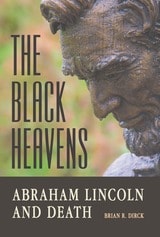
The Black Heavens
Abraham Lincoln and DeathBrian R. Dirck
Southern Illinois University Press, 2019
From multiple personal tragedies to the terrible carnage of the Civil War, death might be alongside emancipation of the slaves and restoration of the Union as one of the great central truths of Abraham Lincoln’s life. Yet what little has been written specifically about Lincoln and death is insufficient, sentimentalized, or devoid of the rich historical literature about death and mourning during the nineteenth century. The Black Heavens: Abraham Lincoln and Death is the first in-depth account of how the sixteenth president responded to the riddles of mortality, undertook personal mourning, and coped with the extraordinary burden of sending hundreds of thousands of soldiers to be killed on battlefields.
Going beyond the characterization of Lincoln as a melancholy, tragic figure, Brian R. Dirck investigates Lincoln’s frequent encounters with bereavement and sets his response to death and mourning within the social, cultural, and political context of his times. At a young age Lincoln saw the grim reality of lives cut short when he lost his mother and sister. Later, he was deeply affected by the deaths of two of his sons, three-year-old Eddy in 1850 and eleven-year-old Willie in 1862, as well as the combat deaths of close friends early in the war. Despite his own losses, Lincoln learned how to approach death in an emotionally detached manner, a survival skill he needed to cope with the reality of his presidency.
Dirck shows how Lincoln gradually turned to his particular understanding of God’s will in his attempts to articulate the meaning of the atrocities of war to the American public, as showcased in his allusions to religious ideas in the Gettysburg Address and the Second Inaugural. Lincoln formed a unique approach to death: both intellectual and emotional, typical and yet atypical of his times. In showing how Lincoln understood and responded to death, both privately and publicly, Dirck paints a compelling portrait of a commander in chief who buried two sons and gave the orders that sent an unprecedented number of Americans to their deaths.
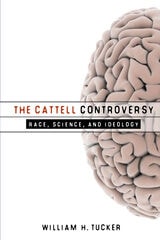
The Cattell Controversy
Race, Science, and IdeologyWilliam H. Tucker
University of Illinois Press, 2008
In addition to his mainstream research, Cattell had also authored a series of publications that posited evolutionary progress as the ultimate goal of human existence and argued that scientifically measurable criteria should be used to distinguish "successful" from "failing" racial groups so that the latter might be gradually "phased out" by non-violent methods such as regulation of birth control. Derived from science, Cattell's evolutionary philosophy was intended to be the basis of a full-blown religion. Although the earliest of these works had been published in the 1930s, near the end of an era in which eugenically based policies for human improvement were much more acceptable, Cattell promoted similar ideas well into the 1980s and '90s.
The Cattell Controversy describes Cattell's socio-religious beliefs in detail and analyzes their relationship to his scientific contributions. William H. Tucker discusses the controversy that arose within the field in response to the award's postponement, after which Cattell withdrew his name from consideration for the award but insisted that his position had been distorted by taking statements out of context. Reflecting on these events, Tucker concludes with a discussion of the complex question of whether and how a scientist's ideological views should ever be a relevant factor in determining the value of his or her contributions to the field.
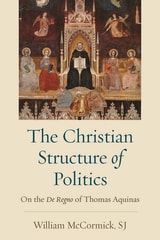
The Christian Structure of Politics
The De Regno of Thomas AquinasWilliam McCormick, SJ
Catholic University of America Press, 2022
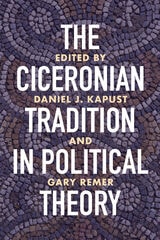
The Ciceronian Tradition in Political Theory
Edited by Daniel J. Kapust and Gary Remer
University of Wisconsin Press, 2021
Individual chapters examine the ways thinkers throughout history, specifically Augustine, John of Salisbury, Thomas More, Machiavelli, Montaigne, Hobbes, Locke, Adam Smith, and Edmund Burke, have engaged with and been influenced by Cicero. A final chapter surveys the impact of Cicero’s ideas on political thought in the second half of the twentieth century. By tracing the long reception of these ideas, the collection demonstrates not only Cicero’s importance to both medieval and modern political theorists but also the comprehensive breadth and applicability of his philosophy.
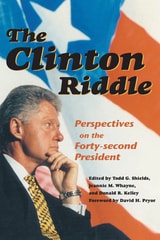
The Clinton Riddle
Perspectives on the Forty-second PresidentTodd G. Shields
University of Arkansas Press, 2004
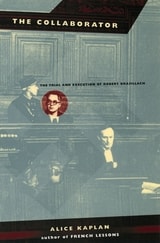
The Collaborator
The Trial and Execution of Robert BrasillachAlice Kaplan
University of Chicago Press, 2000
Was Brasillach in fact guilty of treason? Was he condemned for his denunciations of the resistance, or singled out as a suspected homosexual? Was it right that he was executed when others, who were directly responsible for the murder of thousands, were set free? Kaplan's meticulous reconstruction of Brasillach's life and trial skirts none of these ethical subtleties: a detective story, a cautionary tale, and a meditation on the disturbing workings of justice and memory, The Collaborator will stand as the definitive account of Brasillach's crime and punishment.
A National Book Award Finalist
A National Book Critics Circle Award Finalist
"A well-researched and vivid account."—John Weightman, New York Review of Books
"A gripping reconstruction of [Brasillach's] trial."—The New Yorker
"Readers of this disturbing book will want to find moral touchstones of their own. They're going to need them. This is one of the few works on Nazism that forces us to experience how complex the situation really was, and answers won't come easily."—Daniel Blue, San Francisco Chronicle Book Review
"The Collaborator is one of the best-written, most absorbing pieces of literary history in years."—David A. Bell, New York Times Book Review
"Alice Kaplan's clear-headed study of the case of Robert Brasillach in France has a good deal of current-day relevance. . . . Kaplan's fine book . . . shows that the passage of time illuminates different understandings, and she leaves it to us to reflect on which understanding is better."—Richard Bernstein, The New York Times

The Collected Works of William Howard Taft, Volume I
Four Aspects of Civic Duty and Present Day ProblemsDavid H. Burton
Ohio University Press, 2001
The inaugural volume of The Collected Works of William Howard Taft is composed of two of his earliest books, Four Aspects of Civic Duty and Present Day Problems. Based on a series of lectures delivered at Yale in 1906, Four Aspects of Civic Duty is an attempt by then Secretary of War Taft to bring to the attention of his audience the importance of civic duty from the perspective of the university graduate, the judge on the bench, the colonial administrator, and the national executive branch of government. His remarks were drawn from his own experience, while at the same time he laid down the principles of citizenship with which all people could identify. In Present Day Problems, William Howard Taft demonstrates the depth of his knowledge and the seriousness of his reflections on a wide range of topics including Sino-American relations and the ongoing contest between capital and labor in America’s increasingly industrial socioeconomy. The problems he takes up are met head-on and discussed in a fashion likely to persuade his audience that he is well prepared to tackle the burdens of the presidency.
The Collected Works of William Howard Taft, in eight volumes, will include Taft’s complete published works as well as his presidential and state addresses and selected court opinions from his days as chief justice of the Supreme Court.
The Collected Works of William Howard Taft, Volume II
Political Issues and Outlooks: Speeches Delivered Between August 1908 and February 1909David H. Burton
Ohio University Press, 2001
The second volume of The Collected Works of William Howard Taft is dedicated to the speeches and writings that displayed his thinking in the autumn of 1908 and the following winter.
At this time he was campaigning for the presidency against the well-known William Jennings Bryan, and in Taft’s writings is evidence of the contrast in style between Taft and Bryan and between Taft and his predecessor, Teddy Roosevelt. as well. Although uncomfortable with campaigning, he thoughtfully addresses the concerns of the day that framed the election, including race, the Philippines, and socialism.
Political Issues and Outlooks also contains speeches made after the election and leading up to his inauguration as the twenty-seventh president of the United States. Introduced by a commentary from the general series editor Professor David H. Burton, the second volume of The Collected Works of William Howard Taft is a revealing look at the machinations of United States politics at the beginning of the twentieth century and a glimpse into the mind of one of the century’s most influential political architects.
The Collected Works of William Howard Taft, Volume III
Presidential Addresses and State PapersDavid H. Burton
Ohio University Press, 2001
The third volume of The Collected Works of William Howard Taft imparts an appreciation of the range of the twenty-seventh president’s interests. Beginning with his inaugural address and concluding with a detailed exposition of governmental expenses and needed economies, President William Howard Taft showed himself willing to tackle the routine as well as the rarified responsibilities of executive rule.
Whether he was addressing the issue of strikes and labor unions or conservation, President Taft consistently demonstrated that, in word and action, he was prepared to be a modern president. What impresses the reader of these remarks is Taft’s willingness to administer to virtually every part of the nation, thereby proving that he was not a mere figurehead but a chief executive truly concerned about problems across the country. Perhaps, as his words here indicate, Taft was not a good politician after all but a kind man who saw himself as president of all the people. As the first of two volumes directly related to Taft’s tenure as president, Presidential Addresses and State Papers documents a pivotal time in the public life of this man from Ohio. Introduced by a commentary from the general series editor Professor David H. Burton, the third volume of The Collected Works of William Howard Taft underscores the presidential stature of William Howard Taft.
The Collected Works of William Howard Taft, Volume IV
Presidential Messages to CongressDavid H. Burton
Ohio University Press, 2002
“A time when panics seem far removed is the best time to prepare our financial system to withstand a storm. The most crying need this country has is a proper banking and currency system. The existing one is inadequate, and everyone who has studied the question admits it.”—William Howard Taft
The interaction between President William Howard Taft and the Congress provides a window on his leadership. Volume IV of The Collected Works of William Howard Taft is devoted to his messages to the legislative branch and concerns some of the pressing issues of the day, issues that have relevance still.
Oftentimes President Taft was at odds with a somewhat reactionary Congress, causing him to veto legislation that he thought unwise. For example, his commitment to the independence of elected judges led him to reject statehood for Arizona until its constitution was altered to address his objection.
His messages also touched on subjects for which he led the way over the objections of Congress, such as his recommendation of a federal law to protect resident aliens against denial of their civil rights and his advocacy of free trade with Canada.
In his commentary to the volume, Professor Burton points out: “There is exhibited time after time concern for the American people, for men and women from different walks of life. Taft comes across less as a judge, which he had been, or the chief justice he was to become, and more as a sitting president of all the people.”
Taft’s Presidential Messages to Congress provides the documentary evidence to support that claim.
The Collected Works of William Howard Taft, Volume V
Popular Government and The Anti-trust Act and the Supreme CourtDavid H. Burton
Ohio University Press, 2003
The fifth volume of The Complete Works of William Howard Taft presents two publications Taft wrote as Kent Professor of Constitutional Law at Yale University, the position he assumed in 1913 after he was defeated in his bid for re-election as U.S. president. The first, Popular Government, was prepared for a series of lectures, but was motivated by Taft’s passion over the issue of constitutional interpretation, which had been hotly contested during the campaign. Organized around the preamble of the Constitution, the lectures and later the book were opportunities for Taft to restate his opposition to the direct democracy movement and to reveal the workings of a conservative mind.
In the second, The Anti-trust Act and the Supreme Court, Taft articulates his position in the ongoing debate over the conventional nineteenth-century notion of “laissez faire” and the provisions of the Sherman Antitrust Act. Taft had pursued a policy of vigorous antitrust enforcement during his presidency. In this book he intended to demonstrate that restraint of trade was part of the common law, thereby arguing to good effect in favor of reasonable restraint of trade in his own time.
Taft's careful distinction between predatory monopolistic practices and the reasonable business practices of well-behaved corporations continues to inform today's chambers of government.
The Collected Works of William Howard Taft, Volume VI
The President and His Powers and The United States and PeaceDavid H. Burton
Ohio University Press, 2003
Volume VI of The Collected Works of William Howard Taft follows the career of William Howard Taft upon his leaving the White House. It consists of two short publications from 1914 and 1915.
The first, The President and His Powers, is based on a series of lectures delivered at Columbia University and draws on Taft’s experience in the presidency and the executive branch. It speaks particularly to the nature of executive power and its place in the American system and is rooted in his disagreement with Theodore Roosevelt regarding presidential power. Taft believed all presidential power must be traced to some specific grant of power or be necessary to its exercise, while Roosevelt saw the presidency as a position of “steward of the people” limited only by some express provision of the Constitution.
The second, The United States and Peace, reflects Taft’s interest in foreign policy, which was intensified by his years as governor of the Philippines and as secretary of war, as well as by his presidency. Originally four lectures delivered in 1914, The United States and Peace discusses the Monroe Doctrine, the threat to peace presented by incidents of violence to foreigners in the United States, the maintenance of peace through international arbitration, and the trend toward federation in international affairs. Taft hoped to see the latter result in the establishment of an independent judiciary to resolve international disputes.
Taft’s reasoned arguments, supplemented by the commentaries of Professors McWilliams and Gerrity, will stimulate interest among historians, lawmakers, political activists, and the general public.
The Collected Works of William Howard Taft, Volume VII
Taft Papers on League of NationsFrank X. Gerrity
Ohio University Press, 2003
Eager to turn the congressional election of 1918 into a confirmation of his foreign policy, President Woodrow Wilson was criticized for abandoning the spirit of the popular slogan “Politics adjourned!”
His predecessor, William Howard Taft, found Wilson difficult to deal with and took issue with his version of the League of Nations, which Taft felt was inferior to the model proposed by the League to Enforce Peace. Rather than join the massive Republican opposition to the Treaty of Versailles, however, Taft instead supported Wilson’s controversial decision to travel to Paris as the head of the American peace delegation, and he defended the critical tenth article in the covenant, which detractors saw as a surrender of American sovereignty. He also counseled Wilson to insert a clause concerning the Monroe Doctrine that would pacify the Senate’s group of “reservationists,” whose votes were essential to approval of the treaty.
Volume VII in The Collected Works of William Howard Taft consists of the Taft Papers on League of Nations originally published in 1920. This is a collection ofTaft’s speeches, newspaper articles, and complementary documents that reflect his consistent support for a league of nations and, eventually, for the Covenant of the League of Nations emanating from the Paris Peace Conference.
Although the failure of the treaty and its League of Nations can probably be laid at the feet of an obstinate Wilson and a wily Henry Cabot Lodge, William Howard Taft can be credited with rising above partisanship to emerge as the League’s most consistent supporter.
As in the rest of the Collected Works, Taft Papers on League of Nations provides a window on the machinations surrounding some of the most significant decisions of the era.
The Collected Works of William Howard Taft, Volume VIII
“Liberty under Law” and Selected Supreme Court OpinionsFrancis Graham Lee
Ohio University Press, 2004
William Howard Taft’s presidency (1909-1913), succeeding Theodore Roosevelt’s, was mired in bitter partisan fighting, and Taft sometimes blundered politically. However, this son of Cincinnati assumed his true calling when President Warren G. Harding appointed him to the U.S. Supreme Court in 1921. Taft remains the only person to have served both as president of the United States and as chief justice of the Supreme Court.
The Collected Works of William Howard Taft, Volume VIII, consists of “Liberty under Law” and selected Supreme Court opinions, among the most instructive accomplishments of Taft’s ten years at the helm of the court. The writings reveal the sober judgments of a federalist who viewed state regulation with suspicion, championed national government, and saw an independent and powerful judiciary as the bulwark protecting the “vested rights” that the framers of the U.S. Constitution sought to guarantee.
Whatever his failings as a politician, Taft was an intellectual powerhouse who knew how to use the law as a lever to encourage society to move toward more stable and productive ends. Although Taft is considered an average president at best, historians and political scientists rank him among fifteen “near greats” who have served on the high court. His ability and his love for the law shine through in Volume VIII, the concluding volume of The Collected Works of William Howard Taft. As Taft reportedly said to President Harding upon his appointment as chief justice, “I love judges and I love courts. They are my ideals on earth of what we shall meet afterward in heaven under a just God.”
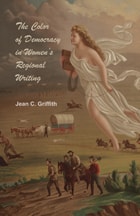
The Color of Democracy in Women's Regional Writing
Jean Carol Griffith
University of Alabama Press, 2009
Exploring how women writers used regional fiction to reimagine democracy, identity, and belonging in America.
American regionalism has become a contested subject in literary studies alongside the ubiquitous triad of race, class, and gender. The Color of Democracy in Women's Regional Writing enters into the heart of an ongoing debate in the field about the significance of regional fiction at the end of the 19th century. Jean Griffith presents the innovative view that regional writing provided Edith Wharton, Ellen Glasgow, and Willa Cather with the means to explore social transformation in a form of fiction already closely associated with women readers and writers.
Griffith provides new readings of texts by these authors; she places them alongside the works of their contemporaries, including William Faulkner and Langston Hughes, to show regionalism's responses to the debate over who was capable of democratic participation and reading regionalism's changing mediations between natives and strangers as reflections of the changing face of democracy.
This insightful work enriches the current debate about whether regionalism critiques hierarchies or participates in nationalist and racist agendas and will be of great interest to those invested in regional writing or the works of these significant authors.
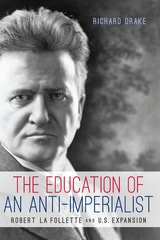
The Education of an Anti-Imperialist
Robert La Follette and U.S. ExpansionRichard Drake
University of Wisconsin Press, 2013
“An excellent book. . . . As Drake fully documents, La Follette's warnings about [World War I] profiteers and the lust for power were fully justified. Then as now, the American people were lied to by the government and media and manipulated into the stink and blood of war."—Mark Taylor, The Daily Call
“Scholars will . . . value the insights into La Follette's foreign policy education.”—The Historian

The Emergence of Social Space
Rimbaud and the Paris CommuneKristin RossForeword by Terry Eagleton
University of Minnesota Press, 1989
Central to her analysis of the Commune as social space and oppositional culture is a close textual reading of Arthur Rimbaud’s poetry. His poems - a common thread running through the book - are one set of documents among many in Ross’s recreation of the Communard experience. Rimbaud, Paul Lafargue, and the social geographer Elisee Reclus serve as emblematic figures moving within and on the periphery of the Commune; in their resistance to the logic and economy of a capitalist conception of work, in their challenge to work itself as a term of identity, all three posed a threat to the existing order. Ross looks at these and other emancipator notions as aspects of Communard life, each with an analogous strategy in Rimbaud’s poetry. Applying contemporary theory to a wealth of little-known archival material, she has written a fresh, persuasive, and original book.
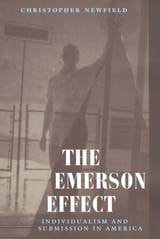
The Emerson Effect
Individualism and Submission in AmericaChristopher Newfield
University of Chicago Press, 1995
Christopher Newfield analyzes the interplay of liberal and authoritarian impulses in Emerson's work in various domains: domestic life, the changing New England economy, theories of poetic language, homoerotic friendship, and racial hierarchy. Focusing on neglected later writings, Newfield shows how Emerson explored the tensions between autonomy and community—and consistently resolved these tensions by "abandoning crucial elements of both" and redefining autonomy as a kind of liberating subjection. He argues that in Emersonian individualism, self-determination is accompanied by submission to authority, and examines the influence of this submissive individualism on the history of American liberalism. In a provocative reading of Emerson's early and neglected later works, Newfield analyzes Emerson's emphasis on collective, or "corporate", world-building, rather than private possession. Tracing the development of this corporate individualism, he illuminates contradictions in Emerson's political outlook, and the conjunctions of liberal and authoritarian ideology they produced.
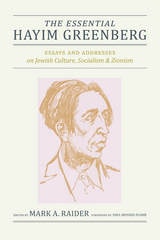
The Essential Hayim Greenberg
Essays and Addresses on Jewish Culture, Socialism, and ZionismHayim Greenberg, Edited and introduced by Mark Raider, Foreword by Paul Mendes-Flohr
University of Alabama Press, 2016
This collection of thoroughly annotated essays, spanning the 1920s to the early 1950s, includes Greenberg’s meditations on socialism and ethics, profiles of polarizing twentieth-century figures (among them Trotsky, Lenin, and Gandhi), and several essays investigating the compatibility of socialism and communism. Greenberg always circles back, however, to the recurring question of how Jews might situate themselves in modernity, both before and after the Holocaust, and how Labor Zionist ideology might reshape the imbalances of Jewish economic life.
Alongside his role as an American Zionist leader, Greenberg maintained a lifelong commitment to the vitality of the Jewish diaspora. Rather than promoting Jewish autonomy and statehood, he argued for fidelity to the Jewish spirit. This volume not only seeks to restore Greenberg to his previous stature in the field of Judaic studies but also to return a vital and authentic voice, long quieted, to the continuing debate over what it means to be Jewish.
The Essential Hayim Greenberg provides an accessible text for scholars, historians, and students of Jewish studies, religion, and theology.
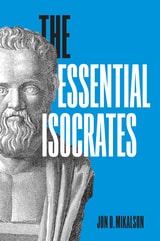
The Essential Isocrates
Jon D. Mikalson
University of Texas Press, 2022
The Essential Isocrates is a comprehensive introduction to Isocrates, one of ancient Greece’s foremost orators. Jon D. Mikalson presents Isocrates largely in his own words, with original English translations of selections of his writings on his life and times and on morality, religion, philosophy, rhetoric, education, political theory, and Greek and Athenian history. In Mikalson’s treatment, Isocrates receives his due not only as a major thinker but as one whose work has resonated across time, influencing even modern education practices and theory.
Isocrates wrote extensively about Athens in the fourth century BCE and before, and his speeches, letters, and essays provide a trove of insights concerning the intellectual, political, and social currents of his time. Mikalson details what we know about Isocrates’s long, eventful, and complicated life, and much can be gleaned on the personal level from his own writings, as Isocrates was one of the most introspective authors of the Classical Period. By collecting the most representative and important passages of Isocrates’s writings, arranging them topically, and placing them in historical context, The Essential Isocrates invites general and expert readers alike to engage with one of antiquity’s most compelling men of ideas.
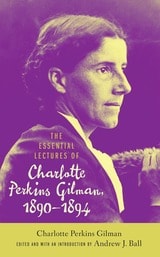
The Essential Lectures of Charlotte Perkins Gilman, 1890–1894
Charlotte Perkins Gilman Edited and with an introduction by Andrew J. Ball
University of Alabama Press, 2024
A foundational archive of Gilman’s early feminist, sociological, and philosophical thought, revealing the origins of a major American intellectual tradition.
The last decades have seen a resurgence of interest in Charlotte Perkins Gilman, now considered among the most important thinkers in US history. She is best known for fiction—such as the classic short story “The Yellow Wall-Paper” (1892)—and nonfiction, including her manifesto Women and Economics (1898), a work of intersectional sociology avant la lettre. Nevertheless, as a young writer, Gilman made her living delivering lectures. One cannot know Gilman without some knowledge of this body of lectures; this book fills that critical gap in Gilman scholarship.
Since the recovery of Charlotte Perkins Gilman began in the late 1960s and continued with the republication of “The Yellow Wall-Paper” in the 1970s, her image in cultural memory has been increasingly celebrated. Andrew J. Ball presents here fifty previously unpublished texts. They trace the development of Gilman’s thoughts on diverse subjects like gender, education, labor, science, theology, and politics—forming an intellectual diary of her growth.
These lectures are not just a testament to Gilman’s personal evolution, but also a crucial contribution to the foundations of American sociology and philosophy. The Essential Lectures of Charlotte Perkins Gilman, 1890–1894 marks a historic moment, unveiling the hidden genius of Gilman's oratory legacy.
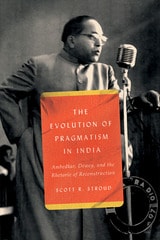
The Evolution of Pragmatism in India
Ambedkar, Dewey, and the Rhetoric of ReconstructionScott R. Stroud
University of Chicago Press, 2023
In The Evolution of Pragmatism in India, Scott R. Stroud delivers a comprehensive exploration of the influence of John Dewey’s pragmatism on Bhimrao Ambedkar, architect of the Republic of India’s constitution. Stroud traces Ambedkar’s development in Dewey’s Columbia University classes in 1913–1916 through his final years in 1950s India when he rewrote the story of Buddhism. Stroud examines pragmatism’s influence not only on the philosophical ideas underpinning Ambedkar’s fight against caste oppression but also how his persuasive techniques drew on pragmatism’s commitment to reconstruction and meliorism. At the same time, Stroud is careful to point out the ways that Ambedkar pushed back against Dewey’s paradigm and developed his own approach to challenges in India. The result is a nuanced study of one of the most important figures in Indian history.
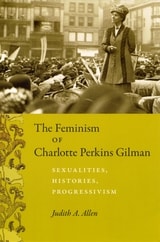
The Feminism of Charlotte Perkins Gilman
Sexualities, Histories, ProgressivismJudith A. Allen
University of Chicago Press, 2009
Famous for her short fiction—most notably “The Yellow Wallpaper”—Charlotte Perkins Gilman also produced a vast body of nonfiction in tandem with her work as a Progressive-era feminist reformer. Rooted in groundbreaking research on Gilman’s extensive correspondence, publications, and speeches, this keenly argued intellectual biography reconstructs her controversial output and the heady context in which she produced it.
Judith Allen provides the first comprehensive assessment of Gilman’s complicated feminism by exploring the renowned writer’s theories of sexuality and evolutionary analyses of androcentric—or male-dominated—culture. These ideas, Allen shows, informed Gilman’s many contributions to the suffrage movement, the fight to abolish regulated prostitution, and efforts to legalize birth control. Restoring a previously overlooked public intellectual to her preeminent place in Progressive-era politics and the history of feminism at home and abroad, Allen’s landmark study provides the fullest account available of Gilman’s consequential life and profoundly influential work.
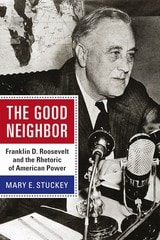
The Good Neighbor
Franklin D. Roosevelt and the Rhetoric of American PowerMary E. Stuckey
Michigan State University Press, 2013
No modern president has had as much influence on American national politics as Franklin D. Roosevelt. During FDR’s administration, power shifted from states and localities to the federal government; within the federal government it shifted from Congress to the president; and internationally, it moved from Europe to the United States. All of these changes required significant effort on the part of the president, who triumphed over fierce opposition and succeeded in remaking the American political system in ways that continue to shape our politics today. Using the metaphor of the good neighbor, Mary E. Stuckey examines the persuasive work that took place to authorize these changes. Through the metaphor, FDR’s administration can be better understood: his emphasis on communal values; the importance of national mobilization in domestic as well as foreign affairs in defense of those values; his use of what he considered a particularly democratic approach to public communication; his treatment of friends and his delineation of enemies; and finally, the ways in which he used this rhetoric to broaden his neighborhood from the limits of the United States to encompass the entire world, laying the groundwork for American ideological dominance in the post–World War II era.

The Heresies of Jan Patocka
Phenomenology, History, and PoliticsJames Dodd
Northwestern University Press, 2023
Foregrounding the turbulent political and intellectual scene in Czechoslovakia following the Prague Spring in 1968, James Dodd explores the unity of philosophy, history, and politics in Jan Patočka’s life and legacy. Dodd presents Patočka as an essential philosopher of modern concepts—such as freedom, subjectivity, and history—and also as an interpreter of prominent thinkers such as Husserl and Heidegger.
Dodd outlines the phenomenology that Patočka, as a late pupil of Husserl and Heidegger, crafted in response to the classical model before turning to his philosophy of history, which was oriented around the problem of Europe and the care for the soul. Finally, Dodd examines Patočka’s role as a dissident intellectual and one of the principal voices of the Charter 77 human rights movement until his death in March 1977. By situating Patočka’s thought in relation to classical phenomenology and to the political and historical conditions of Central Europe, Dodd illuminates the enduring impact of this key thinker of the twentieth century.
The Illusion of History
Andrew R. Russ
Catholic University of America Press, 2012
The Imaginative Vision of Abdilatif Abdalla’s Voice of Agony
Abdilatif Abdalla, edited by Annmarie Drury
University of Michigan Press, 2024
Yet, Imaginative Vision is also something more. Even as it centers on a literary translation of a singularly beautiful and influential book of poetry, it tells English-language readers the story of that book. Supporting materials illuminate the circumstances of its inception when Abdilatif, aged 22, was arrested and tried. They explore what the volume meant to its first readers and its affiliations with subsequent extraordinary works of prison literature by Alamin Mazrui and Ngũgĩ wa Thiong’o. They trace its links to literary art of the past, including the nineteenth-century poet Muyaka bin Haji, and to writing that followed. And they explain social and historical aspects of the Swahili coastal world that nurtured Abdilatif’s political engagement and stunning verbal art. Under the editorship of scholar, translator, and poet Annmarie Drury, contributors bring insights from their diverse backgrounds to present contextualizing material that illuminates the poems at the heart of this book.

The Information Master
Jean-Baptiste Colbert's Secret State Intelligence SystemJacob Soll
University of Michigan Press, 2011
"Colbert has long been celebrated as Louis XIV's minister of finance, trade, and industry. More recently, he has been viewed as his minister of culture and propaganda. In this lively and persuasive book, Jake Soll has given us a third Colbert, the information manager."
---Peter Burke, University of Cambridge
"Jacob Soll gives us a road map drawn from the French state under Colbert. With a stunning attention to detail Colbert used knowledge in the service of enhancing
royal power. Jacob Soll's scholarship is impeccable and his story long
overdue and compelling."
---Margaret Jacob, University of California, Los Angeles
"Nowadays we all know that information is the key to power, and that the masters of information rule the world. Jacob Soll teaches us that Jean-Baptiste Colbert had grasped this principle three and a half centuries ago, and used it to construct a new kind of state. This imaginative, erudite, and powerfully written book re-creates the history of libraries and archives in early modern Europe, and ties them in a novel and convincing way to the new statecraft of Europe's absolute monarchs."
---Anthony Grafton, Princeton University
"Brilliantly researched, superbly told, and timely, Soll's story is crucial for the history of the modern state."
---Keith Baker, Stanford University
When Louis XIV asked his minister Jean-Baptiste Colbert---the man who was to oversee the building of Versailles and the Royal Academy of Sciences, as well as the navy, the Paris police force, and French industry---to build a large-scale administrative government, Colbert created an unprecedented information system for political power. In The Information Master, Jacob Soll shows how the legacy of Colbert's encyclopedic tradition lies at the very center of the rise of the modern state and was a precursor to industrial intelligence and Internet search engines.
Soll's innovative look at Colbert's rise to power argues that his practice of collecting knowledge originated from techniques of church scholarship and from Renaissance Italy, where merchants recognized the power to be gained from merging scholarship, finance, and library science. With his connection of interdisciplinary approaches---regarding accounting, state administration, archives, libraries, merchant techniques, ecclesiastical culture, policing, and humanist pedagogy---Soll has written an innovative book that will redefine not only the history of the reign of Louis XIV and information science but also the study of political and economic history.
Jacob Soll is Associate Professor of History at Rutgers University and the author of Publishing The Prince: History, Reading, and the Birth of Political Criticism (University of Michigan Press, 2005), and winner of the 2005 Jacques Barzun Prize from the American Philosophical Society and a 2009 Guggenheim Fellowship. Soll edited a special issue of Journal of the History of Ideas titled "The Uses of Historical Evidence in Early Modern Europe"; has cofounded the online journal Republics of Letters; and is editor, along with Anthony Grafton and Ann Blair, of the series Cultures of Knowledge in the Early Modern World.
The Jester and the Sages
Mark Twain in Conversation with Nietzsche, Freud, and MarxForrest G. Robinson, Gabriel Noah Brahm, Jr., and Catherine Carlstroem
University of Missouri Press, 2011
During their lifetimes, Twain, Nietzsche, Freud, and Marx witnessed massive upheavals in Western constructions of religion, morality, history, political economy, and human nature. The foundations of reality had been shaken, and one did not need to be a philosopher—nor did one even need to read philosophy—to weigh in on what this all might mean. Drawing on a wide range of primary and secondary materials, the authors show that Twain was well attuned to debates of the time. Unlike his Continental contemporaries, however, he was not as systematic in developing his views.
Brahm and Robinson’s chapter on Nietzsche and Twain reveals their subjects’ common defiance of the moral and religious truisms of their time. Both desired freedom, resented the constraints of Christian civilization, and saw punishing guilt as the disease of modern man. Pervasive moral evasion and bland conformity were the principal end result, they believed.
In addition to a continuing focus on guilt, Robinson discovers in his chapter on Freud and Twain that the two men shared a lifelong fascination with the mysteries of the human mind. From the formative influence of childhood and repression, to dreams and the unconscious, the mind could free people or keep them in perpetual chains. The realm of the unconscious was of special interest to both men as it pertained to the creation of art.
In the final chapter, Carlstroem and Robinson explain that, despite significant differences in their views of human nature, history, and progress, Twain and Marx were both profoundly disturbed by economic and social injustice in the world. Of particular concern was the gulf that industrial capitalism opened between the privileged elite property owners and the vast class of property-less workers. Moralists impatient with conventional morality, Twain and Marx wanted to free ordinary people from the illusions that enslaved them.
Twain did not know the work's of Nietzsche, Freud, and Marx well, yet many of his thoughts cross those of his philosophical contemporaries. By focusing on the deeper aspects of Twain’s intellectual makeup, Robinson, Brahm, and Carlstroem supplement the traditional appreciation of the forces that drove Twain’s creativity and the dynamics of his humor.
The Legacy of Edward W. Said
William V. Spanos
University of Illinois Press, 2008
With the untimely death of Edward W. Said in 2003, various academic and public intellectuals worldwide have begun to reassess the writings of this powerful oppositional intellectual. Figures on the neoconservative right have already begun to discredit Said’s work as that of a subversive intent on slandering America’s benign global image and undermining its global authority. On the left, a significant number of oppositional intellectuals are eager to counter this neoconservative vilification, proffering a Said who, in marked opposition to the “anti-humanism” of the great poststructuralist thinkers who were his contemporaries--Jacques Derrida, Jean-Francois Lyotard, Jacques Lacan, Louis Althusser, and Michel Foucault--reaffirms humanism and thus rejects poststructuralist theory.
In this provocative assessment of Edward Said’s lifework, William V. Spanos argues that Said’s lifelong anti-imperialist project is actually a fulfillment of the revolutionary possibilities of poststructuralist theory. Spanos examines Said, his legacy, and the various texts he wrote--including Orientalism,Culture and Imperialism, and Humanism and Democratic Criticism--that are now being considered for their lasting political impact.
The Making of a Southerner
William Barclay Napton's Private Civil WarChristopher Phillips
University of Missouri Press, 2008
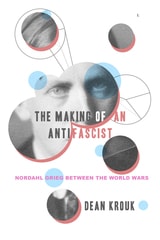
The Making of an Antifascist
Nordahl Grieg between the World WarsDean Krouk
University of Wisconsin Press, 2022
In this comprehensive and accessible book, Dean Krouk examines a significant public figure in Scandinavian literature and a critical period in modern European history through original readings of the political, ethical, and gender issues in Grieg’s works. This volume offers a first-rate analysis of the interwar period’s political and cultural agendas in Scandinavia and Europe leading to the Second World War by examining the rise of fascism, communism, and antifascism. Grieg’s poetry found renewed resonance in Norway following the 2011 far-right domestic terrorist attacks, making insight into his contradictory ideas more crucial than ever. Krouk’s presentation of Grieg’s unexpected ideological tensions will be thought-provoking for many readers in the United States and elsewhere.
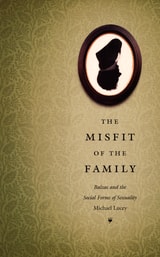
The Misfit of the Family
Balzac and the Social Forms of SexualityMichael Lucey
Duke University Press, 2003
The Misfit of the Family is a compelling argument that Balzac must be taken seriously as a major inventor and purveyor of new tools for analyzing connections between the sexual and the social. Lucey’s account of the novelist’s deployment of "sexual misfits" to impel a wide range of his most canonical works—Cousin Pons, Cousin Bette, Eugenie Grandet, Lost Illusions, The Girl with the Golden Eyes—demonstrates how even the flexible umbrella term "queer" barely covers the enormous diversity of erotic and social behaviors of his characters. Lucey draws on the thinking of Michel Foucault and Pierre Bourdieu and engages the work of critics of nineteenth-century French fiction, including Naomi Schor, D. A. Miller, Franco Moretti, and others. His reflections on Proust as Balzac’s most cannily attentive reader suggest how the lines of social and erotic force he locates in Balzac’s work continued to manifest themselves in twentieth-century writing and society.
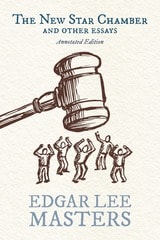
The New Star Chamber and Other Essays
Annotated EditionEdgar Lee Masters; edited by Jason Stacy
Southern Illinois University Press, 2023
Coedited by noted Masters scholar, Jason Stacy, and his class, “Editing History,” this annotated edition of Edgar Lee Masters’s The New Star Chamber and Other Essays reappears at a perilous time in US history, when large corporations and overseas conflicts once again threaten the integrity of American rights and liberties, and the United States still finds itself beholden to corporate power and the legacy of imperial hubris. In speaking to his times, Masters also speaks to ours.
These thirteen essays lay bare the political ideology that informed Spoon River Anthology. Masters argues that the dangerous imperialism championed by then-President Theodore Roosevelt was rooted in the Constitution itself. By debating the ethics of the Philippine-American War, criticizing Hamiltonian centralization of government, and extolling the virtues of Jeffersonian individualism, Masters elucidates the ways in which America had strayed from its constitutional morals and from democracy itself. The result is a compelling critique of corporate capitalism and burgeoning American imperialism, as well as an exemplary source for understanding its complicated author in the midst of his transformation from urban lawyer to poet of rural America.
In print again for the first time since 1904, this edition includes an introduction and historical annotations throughout. Edited and annotated by students at Southern Illinois University Edwardsville, and designed and illustrated by students at Southern Illinois University Carbondale, this volume traces economic and political pathologies to the origins of the American republic. The New Star Chamber and Other Essays is as vital now as it was over 100 years ago.

The One Thomas More
Travis Curtright
Catholic University of America Press, 2012
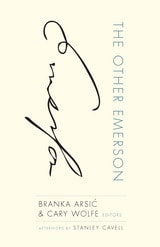
The Other Emerson
Branka Arsic
University of Minnesota Press, 2010
Considering Emerson first and foremost as a daring and original thinker, The Other Emerson focuses on three Emersonian subjects-subjectivity, the political, and the nature of philosophy-and range in topic from Emerson's relationships to slavery and mourning to his place in the development of Romanticism as reread by contemporary systems theory. It is Emerson's appreciation of truth's instability that link him to the European philosophical tradition.
Contributors: Eduardo Cadava, Princeton U; Sharon Cameron, Johns Hopkins U; Russell B. Goodman, U of New Mexico; Paul Grimstad, Yale U; Eric Keenaghan, U at Albany, SUNY; Gregg Lambert, Syracuse U; Sandra Laugier, Université de Picardie Jules Verne; Donald Pease, Dartmouth College.
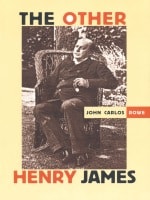
The Other Henry James
John Carlos Rowe
Duke University Press, 1998
Rowe traces a particular development in James’s work, showing how in his early writings James criticized women’s rights, same-sex relations, and other social and political trends now identified with modern culture; how he ambivalently explored these aspects of modernity in his writings of the 1880s; and, later, how he increasingly identified with such modernity in his heretofore largely ignored or marginally treated fiction of the 1890s. Building on recent scholarship that has shown James to be more anxious about gender roles, more conflicted, and more marginal a figure than previously thought, Rowe argues that James—through his treatment of women, children, and gays—indicts the values and conventions of the bourgeoisie. He shows how James confronts social changes in gender roles, sexual preferences, national affiliations, and racial and ethnic identifications in such important novels as The American, The Tragic Muse, What Maisie Knew, and In the Cage, and in such neglected short fiction as “The Last of the Valerii,” “The Death of the Lion,” and “The Middle Years.”
Positioning James’s work within an interpretive context that pits the social and political anxieties of his day against the imperatives of an aesthetic ideology, The Other Henry James will engage scholars, students, and teachers of American literature and culture, gay literature, and queer theory.
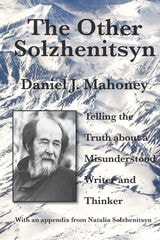
The Other Solzhenitsyn
Telling the Truth about a Misunderstood Writer and ThinkerDaniel J. Mahoney
St. Augustine's Press, 2014
This book above all explores philosophical, political, and moral themes in Solzhenitsyn’s two masterworks, The Gulag Archipelago and The Red Wheel, as well as in his great European novel In the First Circle. We see Solzhenitsyn as analyst of revolution, defender of the moral law, phenomenologist of ideological despotism, and advocate of “resisting evil with force.” Other chapters carefully explore Solzhenitsyn’s conception of patriotism, his dissection of ideological mendacity, and his controversial, but thoughtful and humane discussion of the “Jewish Question” in the Russian – and Soviet twentieth century. Some of Solzhenitsyn’s later writings, such as the “binary tales” that he wrote in the 1990s, are subject to critically appreciative analysis. And a long final chapter comments on Solzhenitsyn’s July 2007 Der Spiegel interview, his last word to Russia and the West. He is revealed to be a man of faith and freedom, a patriot but not a nationalist, and a principled advocate of self-government for Russia and the West.
A final Appendix reproduces the beautiful Introduction (“The Gift of Incarnation”) that the author’s widow, Natalia Solzhenitsyn, wrote to the 2009 Russian abridgment of The Gulag Archipelago, a work that is now taught in Russian high schools.
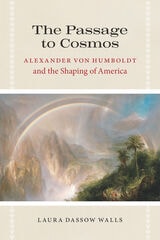
The Passage to Cosmos
Alexander von Humboldt and the Shaping of AmericaLaura Dassow Walls
University of Chicago Press, 2009
Explorer, scientist, writer, and humanist, Alexander von Humboldt was the most famous intellectual of the age that began with Napoleon and ended with Darwin. With Cosmos, the book that crowned his career, Humboldt offered to the world his vision of humans and nature as integrated halves of a single whole. In it, Humboldt espoused the idea that, while the universe of nature exists apart from human purpose, its beauty and order, the very idea of the whole it composes, are human achievements: cosmos comes into being in the dance of world and mind, subject and object, science and poetry.
Humboldt’s science laid the foundations for ecology and inspired the theories of his most important scientific disciple, Charles Darwin. In the United States, his ideas shaped the work of Emerson, Thoreau, Poe, and Whitman. They helped spark the American environmental movement through followers like John Muir and George Perkins Marsh. And they even bolstered efforts to free the slaves and honor the rights of Indians.
Laura Dassow Walls here traces Humboldt’s ideas for Cosmos to his 1799 journey to the Americas, where he first experienced the diversity of nature and of the world’s peoples—and envisioned a new cosmopolitanism that would link ideas, disciplines, and nations into a global web of knowledge and cultures. In reclaiming Humboldt’s transcultural and transdisciplinary project, Walls situates America in a lively and contested field of ideas, actions, and interests, and reaches beyond to a new worldview that integrates the natural and social sciences, the arts, and the humanities.
To the end of his life, Humboldt called himself “half an American,” but ironically his legacy has largely faded in the United States. The Passage to Cosmos will reintroduce this seminal thinker to a new audience and return America to its rightful place in the story of his life, work, and enduring legacy.
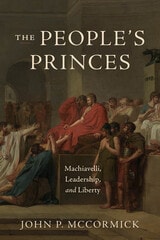
The People's Princes
Machiavelli, Leadership, and LibertyJohn P. McCormick
University of Chicago Press, 2025
A new window into Machiavelli’s idea of virtuous leadership and the appropriate relationship among leaders, common citizens, and elites.
For more than a decade, John P. McCormick has been at the forefront of a new wave of scholarship that reveals the anti-elitist and democratic commitments at the center of Niccolo Machiavelli’s political thought. In The People’s Princes, McCormick turns his attention to Machiavelli’s conception of virtuous leadership and Machiavelli’s views on the appropriate relationships among individual leaders, common citizens, and elites.
While most people think of Machiavelli as a cynical advisor of tyrants—a man who counseled leaders to aggrandize themselves, by any means necessary, at the expense of their subjects and citizens—The People’s Princes fundamentally challenges this understanding. Drawing from Machiavelli’s major political works a normative standard for leadership that emphasizes the mutually reinforcing relationship of civic leadership and popular government, McCormick delineates Machiavelli’s method of “political exemplarity” by analyzing in detail the Florentine’s case studies of leaders and their interactions with populaces throughout ancient and modern history.
McCormick argues that Machiavelli suggests that civic leaders should enhance their reputations by providing for their own eventual obsolescence; specifically, they should establish institutional means through which common citizens rule themselves more directly and substantively. The People’s Princes invites readers to consider Machiavelli anew, and also reflect on insights that remain relevant in the twenty-first century amidst growing concerns that political leaders are not accountable or responsive to popular majorities.