Results by title
50 books match the query 'Political campaigns' and 10 start with t
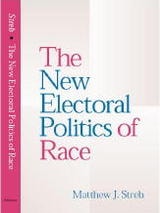
The New Electoral Politics of Race
Matthew Justin Streb
University of Alabama Press, 2002
Historically, race has always been at the heart of American politics, and southern politics more specifically. Southern elections revolved almost entirely around racial issues during the 1950s and 1960s as debates raged over integration of schools, voting rights, and busing patterns. The election of George Wallace as governor of Alabama in 1962 underscored the electoral power of ruthless racial rhetoric, not only in Alabama, but throughout the South and the entire country. Almost 40 years later, segregation is no longer legal, tensions between blacks and whites have lessened, and the influx of large numbers of African Americans into the electorate has forced politicians to court black voters.
Matthew Streb finds, however, that although extreme racial rhetoric has disappeared from the modern campaign trail, voters are still polarized along racial lines. By comparing gubernatorial campaigns in four southern and three northern states-Alabama, Georgia, Arkansas, Virginia, Ohio, Iowa, and Massachusetts-the author examines how candidates use, or fail to use, race in their campaign strategies. He demonstrates that race indeed remains a significant factor in American elections, couched in alternative issues, such as affirmative action, profiling, and social welfare.
Streb's analysis of the appeal by politicians for the elite vote and the public vote reveals that class has replaced race as a definitive issue in American politics. This book will, therefore, be important not only to academic libraries and students and scholars of political science, southern history, and civil rights, but also to pollsters, campaign strategists, and state political party officials.
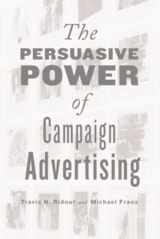
The Persuasive Power of Campaign Advertising
Authored by Travis N. Ridout and Michael M. Franz
Temple University Press, 2011
The Persuasive Power of Campaign Advertising offers a comprehensive overview of political advertisements and their changing role in the Internet age. Travis Ridout and Michael Franz examine how these ads function in various kinds of campaigns and how voters are influenced by them.
The authors particularly study where ads are placed, asserting that television advertising will still be relevant despite the growth of advertising on the Internet. The authors also explore the recent phenomenon of outrageous ads that "go viral" on the web-which often leads to their replaying as television news stories, generating additional attention.
It also features the first analysis of the impact on voters of media coverage of political advertising and shows that televised political advertising continues to have widespread influence on the choices that voters make at the ballot box.
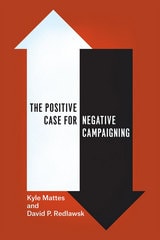
The Positive Case for Negative Campaigning
Kyle Mattes and David P. Redlawsk
University of Chicago Press, 2015
The most comprehensive treatment of negative campaigning to date, The Positive Case for Negative Campaigning uses models, surveys, and experiments to show that much of the seeming dislike of negative campaigning can be explained by the way survey questions have been worded. By failing to distinguish between baseless and credible attacks, surveys fail to capture differences in voters’ receptivity. Voters’ responses, the authors argue, vary greatly and can be better explained by the content and believability of the ads than by whether the ads are negative. Mattes and Redlawsk continue on to establish how voters make use of negative information and why it is necessary. Many voters are politically naïve and unlikely to make inferences about candidates’ positions or traits, so the ability of candidates to go on the attack and focus explicitly on information that would not otherwise be available is crucial to voter education.
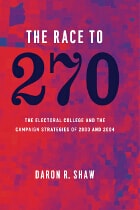
The Race to 270
The Electoral College and the Campaign Strategies of 2000 and 2004Daron R. Shaw
University of Chicago Press, 2006
The Electoral College has played an important role in presidential politics since our nation’s founding, but surprisingly little information exists about precisely how it affects campaign strategy. Daron R. Shaw, a scholar who also worked as a strategist in both Bush-Cheney campaigns, has written the first book to go inside the past two presidential elections and reveal how the race to 270 was won—and lost.
Shaw’s nonpartisan study lays out how both the Democrats and the Republicans developed strategies to win decisive electoral votes by targeting specific states and media markets. Drawing on his own experience with Republican battle plans, candidate schedules, and advertising purchases—plus key contacts in the Gore and Kerry camps—Shaw goes on to show that both sides used information on weekly shifts in candidate support to reallocate media buys and schedule appearances. Most importantly, he uses strikingly original research to prove that these carefully constructed plans significantly affected voters’ preferences and opinions—not in huge numbers, but enough to shift critical votes in key battlegrounds.
Bridging the gap between those who study campaigns and those who conduct them, The Race to 270 will provide political scientists and practitioners alike with fresh insights about the new strategies that stem from one of our oldest institutions.
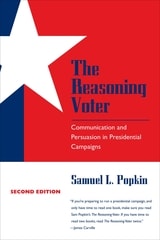
The Reasoning Voter
Communication and Persuasion in Presidential CampaignsSamuel L. Popkin
University of Chicago Press, 1991
"Professor Popkin has brought V.O. Key's contention that voters are rational into the media age. This book is a useful rebuttal to the cynical view that politics is a wholly contrived business, in which unscrupulous operatives manipulate the emotions of distrustful but gullible citizens. The reality, he shows, is both more complex and more hopeful than that."—David S. Broder, The Washington Post
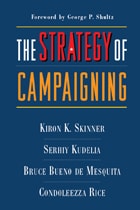
The Strategy of Campaigning
Lessons from Ronald Reagan and Boris YeltsinKiron K. Skinner, Serhiy Kudelia, Bruce Bueno de Mesquita, and Condoleezza Rice
University of Michigan Press, 2010
The Strategy of Campaigning explores the political careers of Ronald Reagan and Boris Yeltsin, two of the most galvanizing and often controversial political figures of our time. Both men overcame defeat early in their political careers and rose to the highest elected offices in their respective countries.
The authors demonstrate how and why Reagan and Yeltsin succeeded in their political aspirations, despite—or perhaps because of—their apparent “policy extremism”: that is, their advocacy of policy positions far from the mainstream. The book analyzes the viability of policy extremism as a political strategy that enables candidates to forge new coalitions and outflank conventional political allegiances.
Bruce Bueno de Mesquita is Julius Silver Professor and Director of the Alexander Hamilton Center for Political Economy at New York University and a Senior Fellow at the Hoover Institution.
Condoleezza Rice is on a leave of absence from Stanford University, where she was a Professor of Political Science and a Senior Fellow at the Hoover Institution. She is currently serving as U.S. Secretary of State.
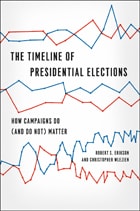
The Timeline of Presidential Elections
How Campaigns Do (and Do Not) MatterRobert S. Erikson and Christopher Wlezien
University of Chicago Press, 2012
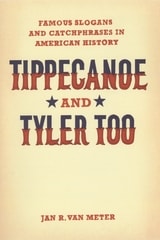
Tippecanoe and Tyler Too
Famous Slogans and Catchphrases in American HistoryJan R. Van Meter
University of Chicago Press, 2008
“By necessity, by proclivity, by delight,” Ralph Waldo Emerson said in 1876, “we all quote.” But often the phrases that fall most readily from our collective lips—like “fire when ready,” “speak softly and carry a big stick,” or “nice guys finish last”—are those whose origins and true meanings we have ceased to consider. Restoring three-dimensionality to more than fifty of these American sayings, Tippecanoe and Tyler Too turns clichés back into history by telling the life stories of the words that have served as our most powerful battle cries, rallying points, laments, and inspirations.
In individual entries on slogans and catchphrases from the early seventeenth to the late twentieth century, Jan Van Meter reveals that each one is a living, malleable entity that has profoundly shaped and continues to influence our public culture. From John Winthrop’s “We shall be as a city upon a hill” and the 1840 Log Cabin Campaign’s “Tippecanoe and Tyler Too” to Martin Luther King Jr.’s “I have a dream” and Ronald Reagan’s “Mr. Gorbachev, tear down this wall,” each of Van Meter’s selections emerges as a memory device for a larger political or cultural story. Taken together in Van Meter’s able hands, these famous slogans and catchphrases give voice to our common history even as we argue about where it should lead us.
“As Van Meter argues, these are important ‘memory devices for a larger story.’ . . . The author has thoroughly researched all the catchphrases . . . . This book would make delightful in-flight reading or a nice gift for a trivia buff. Recommended.”—Choice
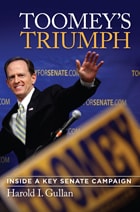
Toomey's Triumph
Inside a Key Senate CampaignHarold Gullan
Temple University Press, 2012
The 2010 Pennsylvania Senate election provided high drama from the earliest days of its primary campaigns right through Election Day. After long-time incumbent Arlen Specter was eliminated, the race boiled down to two fresh faces—Pat Toomey and Joe Sestak. Their battle constitutes a microcosm of the political divide that characterizes contemporary American politics.
Veteran writer Hal Gullan obtained special access to the Toomey campaign early on. Toomey's Triumph offers both that inside look and a Philadelphian's reflections of a riveting election. Gullan's astute month-by-month narrative distills the events of the year-long battles through the high drama and the day-to-day of grassroots organizing and campaigning. He describes how the candidates appear, what they say, and how the media pundits respond to their various gambits. He provides wry observations on the efficacy of each candidate's campaign ads and strategies, and he analyzes the up-and-down polls.
Toomey's Triumph provides an engaging chronicle of a critical campaign.
Tracks on the Trail
Popular Music, Race, and the US PresidencyDana Gorzelany-Mostak
University of Michigan Press, 2023
From Bill Clinton playing his saxophone on The Arsenio Hall Show to Barack Obama referencing Jay-Z’s song “Dirt Off Your Shoulder,” politicians have used music not only to construct their personal presidential identities but to create the broader identity of the American presidency. Through music, candidates can appear relatable, show cultural competency, communicate values and ideas, or connect with a specific constituency. On a less explicit level, episodes such as Clinton’s sax-playing and Obama’s shoulder brush operate as aural and visual articulations of race and racial identity. But why do candidates choose to engage with race in this manner? And why do supporters and detractors on YouTube and the Twittersphere similarly engage with race when they create music videos or remixes in homage to their favorite candidates?
With Barack Obama, Ben Carson, Kamala Harris, and Donald Trump as case studies, Tracks on the Trail: Popular Music, Race, and the US Presidency sheds light on the factors that motivate candidates and constituents alike to articulate race through music on the campaign trail and shows how the racialization of sound intersects with other markers of difference and ultimately shapes the public discourse surrounding candidates, popular music, and the meanings attached to race in the 21st century. Gorzelany-Mostak explores musical engagement broadly, including official music in the form of candidate playlists and launch event setlists, as well as unofficial music in the form of newly composed campaign songs, mashups, parodies, and remixes.