Results by title
471 books match the query 'Power' and 110 start with t
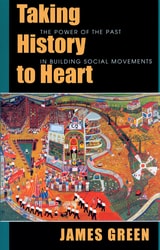
Taking History to Heart
The Power of the Past in Building Social MovementsJames Green
University of Massachusetts Press, 2000
Deftly blending autobiography and history, James Green here reflects on thirty years as an activist, educator, and historian. He recounts how he became deeply immersed in political protest and in recovering and preserving the history of progressive social movements, and how the two are linked. His book, written in an engaging and accessible style, tells powerful stories of people in struggle, framed by the personal account of his own development. As a historian, Green gives voice to generations of Americans who banded together to fight for social justice. His subjects range from the martyrs of the Haymarket tragedy to the Bread and Roses strikers of 1912, from depression-era struggles for democracy to the civil rights crusaders, from recent Rainbow Coalition campaigns to the latest union organizing drives. As an activist, Green describes how his participation in the civil rights and labor movements of our own time has transformed his life, first as a student and radical scholar in the 1960s, then as a public historian and teacher of working-class students. He also describes his efforts to break free from academic confinement and “tell movement stories in public,” in an attempt to offer hope and counsel to those still fighting for equality and fairness. He concludes with a revealing look at how awareness of past social activism has contributed to the revival of the labor movement during the last ten years, an effort in which Green has been vigorously engaged.

Talking Therapy
Knowledge and Power in American Psychiatric NursingKylie Smith
Rutgers University Press, 2020
Winner of the 2020 Lavinia L. Dock Award from the American Association for the History of Nursing
Talking Therapy traces the rise of modern psychiatric nursing in the United States from the 1930s to the 1970s. Through an analysis of the relationship between nurses and other mental health professions, with an emphasis on nursing scholarship, this book demonstrates the inherently social construction of ‘mental health’, and highlights the role of nurses in challenging, and complying with, modern approaches to psychiatry. After WWII, heightened cultural and political emphasis on mental health for social stability enabled the development of psychiatric nursing as a distinct knowledge project through which nurses aimed to transform institutional approaches to patient care, and to contribute to health and social science beyond the bedside. Nurses now take for granted the ideas that underpin their relationships with patients, but this book demonstrates that these were ideas not easily won, and that nurses in the past fought hard to make mental health nursing what it is today.
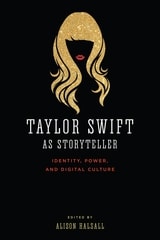
Taylor Swift as Storyteller
Identity, Power, and Digital CultureEdited by Alison Halsall
The Ohio State University Press, 2027
Taylor Swift as Storyteller examines one of the most influential cultural figures of the twenty-first century as both artist and “star text,” arguing that Swift’s global impact is shaped through the dynamic interplay of music, media, fandom, and branding. Bringing together literary scholars, ethnographers, and musicologists, this collection positions Swift as not just a pop figure but a transmedial construct.
Contributors explore how Swift’s carefully curated personae—from girl-next-door to feminist icon to “tortured poet”—generate powerful affective connections with audiences while also functioning as strategic marketing tools. At the same time, contributors retheorize authorship and control in the digital age. By foregrounding the roles of management, branding, and platform circulation, and by interrogating the participatory roles of Swifties as cocreators of meaning, Taylor Swift as Storyteller complicates the idea of singular authorship. Attending to questions of feminism, authorship, nostalgia, and literary adaptation, this collection ultimately reveals how Swift’s enterprise both reflects and reshapes contemporary media culture, illuminating the complex relationship between narrative, identity, and power in the digital age.
Contributors:
Natalie Abbott, Alexander Carpenter, Zixiao Chen, Katie E. Cline, Jennifer Duggan, Rachel M. Friars, Andrea LeMahieu Glaws, Wendy J. Glenn, Alison Halsall, Roxanne Harde, Juliette Holder, Erika Kvistad, Zhimou Li, Sarah E. Maier, Catherine McCarthy, Elly McCausland, Laura Carman McClintock, Adrianna Mirabal, Linh S. Nguy?n, Hazel O’Brien, Anah-Jayne Samuelson, L. M. Schmidt, Katlin Marisol Sweeney-Romero
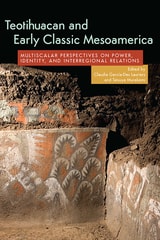
Teotihuacan and Early Classic Mesoamerica
Multiscalar Perspectives on Power, Identity, and Interregional RelationsClaudia García-Des Lauriers
University Press of Colorado, 2021
The volume offers a multiscalar view of power and identity, showing that the spread of Teotihuacan-related material culture may have resulted from direct and indirect state administration, colonization, emulation by local groups, economic transactions, single-event elite interactions, and various kinds of social and political alliances. The contributors explore questions concerning who interacted with whom; what kinds of materials and ideas were exchanged; what role interregional interactions played in the creation, transformation, and contestation of power and identity within the city and among local polities; and how interactions on different scales were articulated. The answers to these questions reveal an Early Classic Mesoamerican world engaged in complex economic exchanges, multidirectional movements of goods and ideas, and a range of material patterns that require local, regional, and macroregional contextualization.
Focusing on the intersecting themes of identity and power, Teotihuacan and Early Classic Mesoamerica makes a strong contribution to the understanding of the role of this important metropolis in the Early Classic history of the region. The volume will be of interest to scholars and graduate students of Mesoamerican archaeology, the archaeology of interaction, and the archaeology of identity.
Contributors: Sarah C. Clayton, Fiorella Fenoglio Limón, Agapi Filini, Julie Gazzola, Sergio Gómez-Chávez, Haley Holt Mehta, Carmen Pérez, Patricia Plunket, Juan Carlos Saint Charles Zetina, Yoko Sugiura, Gabriela Uruñuela, Gustavo Jaimes Vences
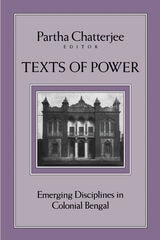
Texts Of Power
Emerging Disciplines in Colonial BengalPartha Chatterjee
University of Minnesota Press, 1995
The case of Bengal illustrates the interaction of colonialism and modernity.
Bengal was the first “modern” province in India-the first, that is, to undergo a forced encounter with Western modernity. Beginning with this premise, the writers in Texts of Power consider what the case of Bengal says about the workings of Western modernity in a colonial setting.
A truly interdisciplinary effort, this collection probes questions of pedagogy, nationalism, and gender. Among the subjects explored are colonialist and nationalist surveillance of Bengali literature; the disposition of the nation’s art; the politics of child-rearing; the mapping of Calcutta; and the disciplining of historical memory. By applying the theoretical insights of recent historical and cultural studies to the specific circumstances of Bengal, the authors develop a new approach to Indian intellectual and cultural history. Their work makes a significant contribution to our understanding of contemporary intellectual modernity.Contributors: Pradip Kumar Bose, Keya Dasgupta, Tapati Guha-Thakurta, all at the Centre for Studies in Social Sciences, Calcutta; Tapti Roy, Maharani Kashiswari College, Calcutta; Ranabir Samaddar, Maulana Azad Institute of Asian Studies.
Thailand’s Political Peasants
Power in the Modern Rural EconomyAndrew Walker
University of Wisconsin Press, 2012
When a populist movement elected Thaksin Shinawatra as prime minister of Thailand in 2001, many of the country’s urban elite dismissed the outcome as just another symptom of rural corruption, a traditional patronage system dominated by local strongmen pressuring their neighbors through political bullying and vote-buying. In Thailand’s Political Peasants, however, Andrew Walker argues that the emergence of an entirely new socioeconomic dynamic has dramatically changed the relations of Thai peasants with the state, making them a political force to be reckoned with. Whereas their ancestors focused on subsistence, this generation of middle-income peasants seeks productive relationships with sources of state power, produces cash crops, and derives additional income through non-agricultural work. In the increasingly decentralized, disaggregated country, rural villagers and farmers have themselves become entrepreneurs and agents of the state at the local level, while the state has changed from an extractor of taxes to a supplier of subsidies and a patron of development projects.
Thailand’s Political Peasants provides an original, provocative analysis that encourages an ethnographic rethinking of rural politics in rapidly developing countries. Drawing on six years of fieldwork in Ban Tiam, a rural village in northern Thailand, Walker shows how analyses of peasant politics that focus primarily on rebellion, resistance, and evasion are becoming less useful for understanding emergent forms of political society.

The Ambivalence of Power in the Twenty-First Century Economy
Cases from Russia and BeyondEdited by Vadim Radaev and Zoya Kotelnikova
University College London, 2022
This book explores the ambivalent nature of power as wielded in economic practices from an empirical perspective. It offers a collection of country-based cases and critically assesses the existing conceptions of power from a cross-disciplinary perspective. Analyzing power at the macro, meso, and micro levels allows the volume to highlight the complexity of political economy in the twenty-first century. Each chapter addresses key elements of a given political economy (from the ambivalence of the cases of former communist countries that do not conform with the grand narratives about democracy and markets to the dual utility of new technologies such as face-recognition), thus providing mounting evidence for the centrality of understanding ambivalence in the analysis of power.

The Best-Kept Secret
Women Corporate Lobbyists, Policy, and Power in the United StatesBenoit, Denise
Rutgers University Press, 2007
From lobbyists such as Jack Abramoff, to corporate executives, like Enron's Kenneth Lay and Jeffrey Skilling, recent scandals dealing with politics and government have focused only on men at the top. But do these high-profile men accurately represent the gendered make up of corporate-government in the United States?
In this first in-depth look at the changing face of corporate lobbying, Denise Benoit shows how women who have historically worked mostly in policy areas relating to "women's issues" such as welfare, family, and health have become increasingly influential as corporate lobbyists, specializing in what used to be considered "masculine" policy, such as taxes and defense. Benoit finds that this new crop of female lobbyists mobilize both masculinity and femininity in ways that create and maintain trusting, open, and strong relations with those in government, and at the same time help corporations to save and earn billions of dollars.
While the media focuses on the dubious behaviors of men at the top of business and government, this book shows that female corporate lobbyists are indeed one of the best kept secrets in Washington.
The Cloaking of Power
Montesquieu, Blackstone, and the Rise of Judicial ActivismPaul O. Carrese
University of Chicago Press, 2003

The Common Camp
Architecture of Power and Resistance in Israel–PalestineIrit Katz
University of Minnesota Press, 2022
Seeing the camp as a persistent political instrument in Israel–Palestine and beyond
The Common Camp underscores the role of the camp as a spatial instrument employed for reshaping, controlling, and struggling over specific territories and populations. Focusing on the geopolitical complexity of Israel–Palestine and the dramatic changes it has experienced during the past century, this book explores the region’s extensive networks of camps and their existence as both a tool of colonial power and a makeshift space of resistance.
Examining various forms of camps devised by and for Zionist settlers, Palestinian refugees, asylum seekers, and other groups, Irit Katz demonstrates how the camp serves as a common thread in shaping lands and lives of subjects from across the political spectrum. Analyzing the architectural and political evolution of the camp as a modern instrument engaged by colonial and national powers (as well as those opposing them), Katz offers a unique perspective on the dynamics of Israel–Palestine, highlighting how spatial transience has become permanent in the ongoing story of this contested territory.
The Common Camp presents a novel approach to the concept of the camp, detailing its varied history as an apparatus used for population containment and territorial expansion as well as a space of everyday life and subversive political action. Bringing together a broad range of historical and ethnographic materials within the context of this singular yet versatile entity, the book locates the camp at the core of modern societies and how they change and transform.

The Darkened Room
Women, Power, and Spiritualism in Late Victorian EnglandAlex Owen
University of Chicago Press, 2004
The hugely popular spiritualist movement, which maintained that women were uniquely qualified to commune with spirits of the dead, offered female mediums a new independence, authority, and potential to undermine conventional class and gender relations in the home and in society.
Using previously unexamined sources and an innovative approach, Alex Owen invokes the Victorian world of darkened séance rooms, theatrical apparitions, and moving episodes of happiness lost and regained. She charts the struggles between spiritualists and the medical and legal establishments over the issue of female mediumship, and provides new insights into the gendered dynamics of Victorian society.
The Development of Political Institutions
Power, Legitimacy, DemocracyFederico Ferrara
University of Michigan Press, 2022
While the literature on “new institutionalism” explains the stability of institutional arrangements within countries and the divergence of paths of institutional development between countries, Federico Ferrara takes a “historical institutionalist” approach to theorize dynamic processes of institutional reproduction, institutional decay, and institutional change in explaining the development of political institutions. Ferrara synthesizes “power-based” or “power-distributional” explanations and “ideas-based” “legitimation explanations.” He specifies the psychological “microfoundations” of processes of institutional development, drawing heavily from the findings of experimental psychology to ensure that the explanation is grounded in clear and realistic assumptions regarding human motivation, cognition, and behavior. Aside from being of interest to scholars and graduate students in political science and other social-scientific disciplines whose research concentrates on the genesis of political institutions, their evolution over time, and their impact on the stability of political order and the quality of governance, the book will be required reading in graduate courses and seminars in comparative politics where the study of institutions and their development ranks among the subfield’s most important subjects.
The Duty to Act
Tort Law, Power, and Public PolicyBy Marshall S. Shapo
University of Texas Press, 1977
A woman terrified by the threats of a jilted suitor is denied police protection. A workman collapses on the job and the employer is slow to help him. A bully in a bar begins to carry out threats of serious injury to a customer, after the bartender’s lackadaisical response. Springing from varied areas of human activity, such cases occupy an important area of the legal battleground called modern tort law. They also provide the basis for a fascinating legal analysis by Marshall S. Shapo.
Tort law is an important social mediator of events surrounding personal injuries. It impinges on many other areas of the law—those dealing with crime, constitutional protections against government officials and agencies, and property rights. Since litigated tort cases often involve brutal treatment or accidents inflicting severe physical harm, this area of the law generates much emotion and complex legal doctrine.
Shapo cuts through the emotion and the complexity to present a view of these problems that is both legally sound and intuitively appealing. His emphasis is on power relationships between private citizens and other individuals, as well as between private persons and governments and officials. He undertakes to define power in a meaningful way as it relates to many tort issues faced by ordinary citizens, and to make this definition precise by constant reference to concrete cases. His particular focus is on an age-old problem in tort law: the question of when a person has a duty to aid another in peril.
In analyzing a large number of cases in this category, Shapo develops an analysis that blends considerations of economic efficiency and humanitarian concern. Recognizing that economic considerations are significant in judicial analysis of these cases, he emphasizes elements that go beyond a simple concern with efficiency, especially the ability of one person to control another’s actions or exposure to risk.
These considerations of power and corresponding dependence provide the basis for Shapo’s study of the duties of both private citizens and governments to prevent injury to others. Calling on a broad range of legal precedents, he also refers to social science research dealing with the behavior of bystanders when fellow citizens are under attack.
Beyond his application of a power-based analysis to litigation traditionally based in tort doctrine, Shapo offers some speculative suggestions on the possible applicability of his views to several controversial areas of welfare law: medical care, municipal services, and educational standards.
This book was written with a view to readership by interested citizens as well as legal scholars, judges, and practicing attorneys.

The Edge of Islam
Power, Personhood, and Ethnoreligious Boundaries on the Kenya CoastJanet McIntosh
Duke University Press, 2009
The Edge of Islam explores themes as wide-ranging as spirit possession, divination, healing rituals, madness, symbolic pollution, ideologies of money, linguistic code-switching, and syncretism and its alternatives. McIntosh shows how the differing versions of Islam practiced by Swahili and Giriama, and their differing understandings of personhood, have figured in the growing divisions between the two groups. Her ethnographic analysis helps to explain why Giriama view Islam, a supposedly universal religion, as belonging more deeply to certain ethnic groups than to others; why Giriama use Islam in their rituals despite the fact that so many do not consider the religion their own; and how Giriama appropriations of Islam subtly reinforce a distance between the religion and themselves. The Edge of Islam advances understanding of ethnic essentialism, religious plurality, spirit possession, local conceptions of personhood, and the many meanings of “Islam” across cultures.

The Failure of Our Fathers
Family, Gender, and Power in Confederate AlabamaVictoria E. Ott
University of Alabama Press, 2023
An in-depth study of non-elite white families in Alabama—from the state’s creation through the end of the Civil War
The Failure of Our Fathers: Family, Gender, and Power in Confederate Alabama examines the evolving position of non-elite white families in Alabama during one of the most pivotal epochs in the state’s history. Drawing on a wide range of personal and public documents reflecting the state’s varied regions and economies, Victoria E. Ott uses gender and family as a lens to examine the yeomanry and poor whites, a constituency that she collectively defines as “common whites,” who identified with the Confederate cause.
Ott provides a nuanced examination of how these Alabamians fit within the antebellum era’s paternalistic social order, eventually identifying with and supporting the Confederate mission to leave the Union and create an independent, slaveholding state. But as the reality of the war slowly set in and the Confederacy began to fray, the increasing dangers families faced led Alabama’s common white men and women to find new avenues to power as a distinct socioeconomic class.
Ott argues that family provided the conceptual framework necessary to understand why common whites supported a war to protect slavery despite having little or no investment in the institution. Going to war meant protecting their families from outsiders who threatened to turn their worlds upside down. Despite class differences, common whites envisioned the Confederacy as a larger family and the state as paternal figures who promised to protect its loyal dependents throughout the conflict. Yet, as the war ravaged many Alabama communities, devotion to the Confederacy seemed less a priority as families faced continued separations, threats of death, and the potential for starvation. The construct of a familial structure that once created a sense of loyalty to the Confederacy now gave them cause to question its leadership. Ott shows how these domestic values rooted in highly gendered concepts ultimately redefined Alabama’s social structure and increased class distinctions after the war.

The Feast of the Sorcerer
Practices of Consciousness and PowerBruce Kapferer
University of Chicago Press, 1997
Kapferer focuses on sorcery among Sinhalese Buddhists in Sri Lanka to explore how the art of sorcery is in fact deeply connected to social practices and lived experiences such as birth, death, sickness, and war. He describes in great detail the central ritual of exorcism, a study which opens up new avenues of thought that challenge anthropological approaches to such topics as the psychological forces of emotion and the dynamics of power. Overcoming both "orientalist" bias and postmodern permissiveness, Kapferer compellingly reframes sorcery as a pragmatic, conscious practice which, through its dynamic of destruction and creation, makes it possible for humans to reconstruct repeatedly their relation to the world.

The Fractured Voice
Silence and Power in Imperial Roman LiteratureAmy A. Koenig
University of Wisconsin Press, 2023
In this volume, Amy Koenig deftly confronts the trope of muteness in Imperial Roman literature, arguing that this understanding of silence is incomplete. By unpacking the motif of voicelessness across a wide range of written sources, she shows that the Roman perception of silence was more complicated than a simple binary and that elite male authors used muted or voiceless characters to interrogate the concept of voicelessness in ways that would be taboo in other contexts. Paradoxically, Koenig illustrates that silence could in fact be freeing—that the loss of voice permits an untethering from other social norms and expectations, thus allowing a freedom of expression denied to many of the voiced.

The Great Texas Wind Rush
How George Bush, Ann Richards, and a Bunch of Tinkerers Helped the Oil and Gas State Win the Race to Wind PowerBy Kate Galbraith and Asher Price
University of Texas Press, 2013
In the late 1990s, West Texas was full of rundown towns and pumpjacks, aging reminders of the oil rush of an earlier era. Today, the towns are thriving as 300-foot-tall wind turbines tower above those pumpjacks. Wind energy has become Texas’s latest boom, with the Lone Star State now leading the nation. How did this dramatic transformation happen in a place that fights federal environmental policies at every turn? In The Great Texas Wind Rush, environmental reporters Kate Galbraith and Asher Price tell the compelling story of a group of unlikely dreamers and innovators, politicos and profiteers.
The tale spans a generation and more, and it begins with the early wind pioneers, precocious idealists who saw opportunity after the 1970s oil crisis. Operating in an economy accustomed to exploiting natural resources and always looking for the next big thing, their ideas eventually led to surprising partnerships between entrepreneurs and environmentalists, as everyone from Enron executives to T. Boone Pickens, as well as Ann Richards, George W. Bush and Rick Perry, ended up backing the new technology. In this down-to-earth account, the authors explain the policies and science that propelled the “windcatters” to reap the great harvest of Texas wind. They also explore what the future holds for this relentless resource that is changing the face of Texas energy.

The Hatchet's Blood
Separation, Power, and Gender in Ehing Social LifeMarc R. Schloss
University of Arizona Press, 1988
The ritual complexes of the Ehing, a farming people of southern Senegal, embody an elaborate set of prohibitions on social behavior and prescribe the general rules of Ehing social organization. Power is distributed and maintained in Ehing culture by the concept of Odieng (“hatchet”), which as a spirit acts upon human beings much as an ax does upon a tree, falling from above to punish its victims for transgression. Marc R. Schloss’s ethnography of the Ehing is a study of the meaning of Odieng’s power, explaining why its rules are so essential to the Ehing way of life.
The Hinge
Civil Society, Group Cultures, and the Power of Local CommitmentsGary Alan Fine
University of Chicago Press, 2021
The History and Power of Writing
Henri-Jean Martin
University of Chicago Press, 1994
Traversing four millennia, Martin offers a chronicle of writing as a cultural system, a means of communication, and a history of technologies. He shows how the written word originated, how it spread, and how it figured in the evolution of civilization. Using as his center the role of printing in making the written way of thinking dominant, Martin examines the interactions of individuals and cultures to produce new forms of "writing" in the many senses of authorship, language rendition, and script.
Martin looks at how much the development of writing owed to practical necessity, and how much to religious and social systems of symbols. He describes the precursors to writing and reveals their place in early civilization as mnemonic devices in service of the spoken word. The tenacity of the oral tradition plays a surprisingly important part in this story, Martin notes, and even as late as the eighteenth century educated individuals were trained in classical rhetoric and preferred to rely on the arts of memory. Finally, Martin discusses the changes to writing wrought by the electronic revolution, offering invaluable insights into the influence these new technologies have had on children born into the computer age.

The House Will Come To Order
How the Texas Speaker Became a Power in State and National PoliticsBy Patrick L. Cox and Michael Phillips
University of Texas Press, 2010
In a state assumed to have a constitutionally weak governor, the Speaker of the Texas House wields enormous power, with the ability to almost single-handedly dictate the legislative agenda. The House Will Come to Order charts the evolution of the Speaker's role from a relatively obscure office to one of the most powerful in the state. This fascinating account, drawn from the Briscoe Center's oral history project on the former Speakers, is the story of transition, modernization, and power struggles.
Weaving a compelling story of scandal, service, and opportunity, Patrick Cox and Michael Phillips describe the divisions within the traditional Democratic Party, the ascendance of Republicans, and how Texas business, agriculture, and media shaped perceptions of officeholders. While the governor and lieutenant governor wielded their power, the authors show how the modern Texas House Speaker built an office of equal power as the state became more complex and diverse. The authors also explore how race, class, and gender affected this transition as they explain the importance of the office in Texas and the impact the state's Speakers have had on national politics.
At the apex of its power, the Texas House Speaker's role at last receives the critical consideration it deserves.

The Infinite Resource
The Power of Ideas on a Finite PlanetRamez Naam
University Press of New England, 2013
The Insecure City
Space, Power, and Mobility in BeirutMonroe, Kristin V
Rutgers University Press, 2016
Download open access ebook here.

The Italian Fascist Party in Power
A Study in Totalitarian RuleDante L. Germino
University of Minnesota Press, 1959
The Italian Fascist Party in Power was first published in 1959. Minnesota Archive Editions uses digital technology to make long-unavailable books once again accessible, and are published unaltered from the original University of Minnesota Press editions.
Although much significant material on the Italian Fascist party became available when the regime collapsed, scholars have not made extensive use of it until now. In this study, which is based on all the available sources, Professor Germino describes the functions of the party, ,explains how it was organized to perform tasks, and discusses conflicts between the party and other power elements in the dictatorship. He reaches a conclusion contrary to that of most other scholars -- that Fascist Italy was a full-fledged totalitarian state resembling Nazi Germany and Soviet Russia in political structure and ideological content.
Professor Carl J. Riedrich of Harvard University writes: "I consider this a major contribution to our knowledge of totalitarian dictatorship. There is nothing in the existing literature that can be compared to it either in terms of depth or analysis, range of documentation or breadth of treatment."
Professor Taylor Cole of Duke University comments: "Professor Germino has presented an excellent case study of the Italian Fascist Party. He has made use of more materials on the Party than any previous writer in English, and has marshalled them effectively to support his contention that the Fascist Party did not differ 'in kind' from [the Nazi and Soviet Communist parties] on the eve of World War II. His conclusion that on most (though not all) basic counts the Italian Fascist system was to be classified as 'totalitarian' is controversial, but it merits the careful attention of all students who are interested in the Italian Fascist period and in totalitarianism."
The Khmer Rouge Tribunal
Power, Politics, and Resistance in Transitional JusticeJulie Bernath
University of Wisconsin Press, 2023
Here, Julie Bernath takes a different tack, deliberately decentering the trials in an effort to understand the ECCC in its particular context—and, by extension, the degree to which notions of transitional justice generally must be understood in particular social, cultural, and political contexts. She focuses on “sites of resistance” to the ECCC, including not only members of the elite political class but also citizens who do not, for a variety of tangled reasons, participate in the tribunal—and even resistance from victims of the regime and participants in the trials. Bernath demonstrates that the ECCC both shapes and is shaped by long-term contestation over Cambodia’s social, economic, and political transformations, and thereby argues that transitional justice must be understood locally rather than as a homogenous good that can be implanted by international actors.
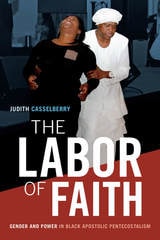
The Labor of Faith
Gender and Power in Black Apostolic PentecostalismJudith Casselberry
Duke University Press, 2017
The Modern Invention of Information
Discourse, History, and PowerRonald E. Day
Southern Illinois University Press, 2008
In The Modern Invention of Information: Discourse, History, and Power, Ronald E. Day provides a historically informed critical analysis of the concept and politics of information. Analyzing texts in Europe and the United States, his critical reading method goes beyond traditional historiographical readings of communication and information by engaging specific historical texts in terms of their attempts to construct and reshape history.
After laying the groundwork and justifying his method of close reading for this study, Day examines the texts of two pre–World War II documentalists, Paul Otlet and Suzanne Briet. Through the work of Otlet and Briet, Day shows how documentation and information were associated with concepts of cultural progress. Day also discusses the social expansion of the conduit metaphor in the works of Warren Weaver and Norbert Wiener. He then shows how the work of contemporary French multimedia theorist Pierre Lévy refracts the earlier philosophical writings of Gilles Deleuze and Félix Guattari through the prism of the capitalist understanding of the “virtual society.”
Turning back to the pre–World War II period, Day examines two critics of the information society: Martin Heidegger and Walter Benjamin. He explains Heidegger’s philosophical critique of the information culture’s model of language and truth as well as Benjamin’s aesthetic and historical critique of mass information and communication. Day concludes by contemplating the relation of critical theory and information, particularly in regard to the information culture’s transformation of history, historiography, and historicity into positive categories of assumed and represented knowledge.
The Mormon Hierarchy
Extensions of PowerD. Michael Quinn
Signature Books, 1997
But by interviewing former church aides, examining hundreds of diaries, and drawing from his own past experience as an insider within the Latter-day Saint historical department, D. Michael Quinn presents a fuller view. His extensive research documents how the governing apostles, seventies, and presiding bishops are likely to be at loggerheads, as much as united. These strong-willed, independent men–like directors of a large corporation or supreme court justices–lobby among their colleagues, forge alliances, out-maneuver opponents, and broker compromises.
There is more: clandestine political activities, investigative and punitive actions by church security forces, personal “loans” from church coffers (later written off as bad debts), and other privileged power-vested activities. Quinn considers the changing role and attitude of the leadership toward visionary experiences, the momentous events which have shaped quorum protocol and doctrine, and day-to-day bureaucratic intrigue from the time of Brigham Young to the dawn of the twenty-first century.
The hierarchy seems at root well-intentioned and even at times aggressive in fulfilling its stated responsibility, which is to expedite the Second Coming. Where they have become convinced that God has spoken, they have set aside personal differences, offered unqualified support, and spoken with a unified voice. This potential for change, when coupled with the tempering effect of competing viewpoints, is something Quinn finds encouraging about Mormonism. But one should not assume that these men are infallible or work in anything approaching uninterrupted unanimity.
The Mormon Hierarchy
Origins of PowerD. Michael Quinn
Signature Books, 1994
Not until seven years later did Mormons first learn that authority had been restored by angels or of the need for a hierarchy mirroring the Pauline model. That same year (1835) a Quorum of Twelve Apostles was organized, but their jurisdiction was limited to areas outside established stakes (dioceses). Stakes were led by a president, who oversaw spiritual development, and by a bishop, who supervised temporal needs.
At Smith’s martyrdom in 1844, the church had five leading quorums of authority. The most obvious successor to Smith, Illinois stake president William Marks, opposed the secret rites of polygamy, anointing, endowments, and the clandestine political activity that had characterized the church in Illinois. The secret Council of Fifty had recently ordained Smith as King on Earth and sent ambassadors abroad to form alliances against the United States.
The majority of church members knew nothing of these developments, but they followed Brigham Young, head of the Quorum of the Twelve, who spoke forcefully and moved decisively to eliminate contenders for the presidency. He continued to build on Smith’s political and doctrinal innovations and social stratification. Young’s twentieth-century legacy is a well-defined structure without the charismatic spontaneity or egalitarian chaos of the early church.
Historian D. Michael Quinn examines the contradictions and confusion of the first two tumultuous decades of LDS history. He demonstrates how events and doctrines were silently, retroactively inserted into the published form of scriptures and records to smooth out the stormy, haphazard development. The bureaucratization of Mormonism was inevitable, but the manner in which it occurred was unpredictable and will be, for readers, fascinating.
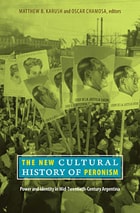
The New Cultural History of Peronism
Power and Identity in Mid-Twentieth-Century ArgentinaMatthew B. Karush and Oscar Chamosa, eds.
Duke University Press, 2010
Situating Peronism within the broad arc of twentieth-century Argentine cultural change, the contributors focus on the interplay of cultural traditions, official policies, commercial imperatives, and popular perceptions. They describe how the Perón regime’s rhetoric and representations helped to produce new ideas of national and collective identity. At the same time, they show how Argentines pursued their interests through their engagement with the Peronist project, and, in so doing, pushed the regime in new directions. While the volume’s emphasis is on the first Perón presidency, one contributor explores the origins of the regime and two others consider Peronism’s transformations in subsequent years. The essays address topics including mass culture and melodrama, folk music, pageants, social respectability, architecture, and the intense emotional investment inspired by Peronism. They examine the experiences of women, indigenous groups, middle-class anti-Peronists, internal migrants, academics, and workers. By illuminating the connections between the state and popular consciousness, The New Cultural History of Peronism exposes the contradictions and ambivalences that have characterized Argentine populism.
Contributors: Anahi Ballent, Oscar Chamosa, María Damilakou, Eduardo Elena, Matthew B. Karush, Diana Lenton, Mirta Zaida Lobato, Natalia Milanesio, Mariano Ben Plotkin, César Seveso, Lizel Tornay
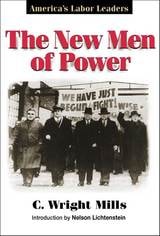
The New Men of Power
America's Labor LeadersC. Wright Mills
University of Illinois Press, 1948
thought labor leaders a new strategic elite and the unions a set of vanguard organizations that were crucial to "stopping the main drift towards war and slump." Today, as the unions once again seek to play a decisive role in American life, Mills' remarkable probe into the structure and ideology of mid-twentieth-century trade unionism remains essential reading. A new introduction by historian Nelson Lichtenstein offers insight into the Millsian political world at the time he wrote The New Men of Power.
The New Metropolis
Power, Place, and Inequality in Twenty-First-Century AmericaMargaret Weir
University of Chicago Press, 2027
A path-breaking investigation of changing patterns of inequality and contestation in America’s metropolises.
Since 1990, a new political geography of winners and losers has emerged in metros across America. This new metropolis looks nothing like the old. In many exurbs, suburban mansions abut declining towns and distressed communities. In historic central cities, African American communities reel from institutional stripping, even as gentrification and immigration revitalize once forgotten neighborhoods. The New Metropolis considers why, despite all the changes over the past four decades, we have recreated a metropolis that makes it harder for low-income Americans—especially low-income Americans of color—to thrive and why some efforts to promote equitable opportunity succeed against the odds.
With a focus on Chicago, Atlanta, and Houston, The New Metropolis shows how multi-level political actors and translocal networks build power across political boundaries to determine the pool of local public resources and the scope of local powers. Weir demonstrates how the timing of urbanization set up distinct conflicts over the public sector in Frostbelt versus Sunbelt metropolises, explaining how partisan divisions now supercharge these conflicts.
The New Metropolis shows why the battle over the metropolis sits at the center of American politics. It determines the shape of the public arenas where we make decisions and, ultimately, the kinds of connections Americans have with one another.
The New Political Sociology of Science
Institutions, Networks, and PowerEdited by Scott Frickel and Kelly Moore
University of Wisconsin Press, 2015
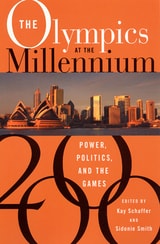
The Olympics at the Millennium
Power, Politics, and the GamesEdited by Kay Schaffer
Rutgers University Press, 2000
The Olympics thrill the world with spectacle and drama. They also carry a cultural and social significance that goes beyond the stadium, athletes, and fans. The Games are arenas in which individual and team athletic achievement intersect with the politics of national identity in a global context.
The Olympics at the Millennium offers groundbreaking essays that explore the cultural politics of the Games. The contributors investigate such topics as the emergence of women athletes as cultural commodities, the orchestrated spectacles of the opening and closing ceremonies, and the alternative sport culture offered via the Gay Games. Unforgettable events and decisions are discussed: Native American athlete Jim Thorpe winning—and losing—his two gold medals in 1912. Why America was one of the few countries to actually send Jewish athletes to the “Nazi Olympics.” The disqualification of champion Ewa Klobukowska from competing as a woman, due to chromosomal testing in 1967.
With the 2000 Sydney Games imminent, several essays address concerns with which every host country must contend, such as the threat of terrorism. Highlighting the difficult issues of racism and nationalism, another article explores the efforts of this country’s aboriginal people to define a role for themselves in the 2000 Games, as they struggle with ongoing discrimination. And with the world watching, Sydney faces profound pressure to implement a successful Olympics, as a matter of national pride.
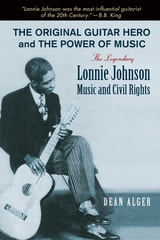
The Original Guitar Hero and the Power of Music
The Legendary Lonnie Johnson, Music, and Civil RightsDean Alger
University of North Texas Press, 2014
The Performance of Power
Theatrical Discourse and PoliticsSue-Ellen Case
University of Iowa Press, 1991
Recently in the field of theatre studies there has been an increasing amount of debate and dissonance regarding the borders of its territory, its methodologies, subject matter, and scholarly perspectives. The nature of this debate could be termed "political" and, in fact, concerns "the performance of power"—the struggle over power relations embedded in texts, methodologies, and the academy itself.
This striking new collection of nineteen divergent essays represents this performance of power and the way in which the recent convergence of new critical theories with historical studies has politicized the study of the theatre. Neither play text, performance, nor scholarship and teaching can safely reside any longer in the "free," politically neutral, self-signifying realm of the aesthetic. Politicizing theatrical discourse means that both the hermeneutics and the histories of theatre reveal the role of ideology and power dynamics.
New strategies and concepts—and a vital new phase of awareness—appear in these illuminating essays. A variety of historical periods, from the Renaissance through the Victorian and up to the most contemporary work of the Wooster group, illustrate the ways in which contemporary strategies do not require contemporary texts and performances but can combine with historical methods and subjects to produce new theatrical discourse.
The Personality of Power
A Theory of Fascism for Anti-fascist LifeBrian Massumi
Duke University Press, 2025

The Petro-state Masquerade
Oil, Sovereignty, and Power in Trinidad and TobagoRyan Cecil Jobson
University of Chicago Press, 2024
Examining the past, present, and future of Trinidad and Tobago’s oil and gas industries, anthropologist Ryan Cecil Jobson traces how a model of governance fashioned during prior oil booms is imperiled by declining fossil fuel production and a loss of state control. Despite the twin-island nation’s increasingly volatile and vulnerable financial condition, however, government officials continue to promote it as a land of inexhaustible resources and potentially limitless profits.
The result is what Jobson calls a “masquerade of permanence” whereby Trinbagonian state actors represent the nation as an interminable reserve of hydrocarbons primed for multinational investment. In The Petro-state Masquerade, Jobson examines the gulf between this narrative crafted by the postcolonial state and the vexed realities of its dwindling petroleum-fueled aspirations. After more than a century of commercial oil production, Trinidad and Tobago instructs us to regard the petro-state as less a permanent form than a fragile relation between fossil fuels and sovereign authority. Foregrounding the concurrent masquerades of oil workers, activists, and Carnival revelers, Jobson argues that the promise of decolonization lies in the disarticulation of natural resources, capital, and political power by ordinary people in the Caribbean.
The Place of the Stage
License, Play, and Power in Renaissance EnglandSteven Mullaney
University of Michigan Press, 1995
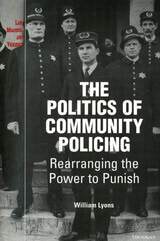
The Politics of Community Policing
Rearranging the Power to PunishWilliam Lyons
University of Michigan Press, 2002
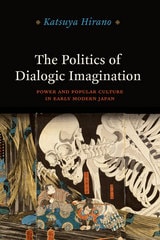
The Politics of Dialogic Imagination
Power and Popular Culture in Early Modern JapanKatsuya Hirano
University of Chicago Press, 2013

The Politics of Islamophobia
Race, Power and FantasyDavid Tyrer
Pluto Press, 2013
Despite its emblematic place within contemporary racism and its increasingly important position in defining relations between states and ethnicised minorities, Islamophobia remains a contested, frequently unrecognised and largely under-theorised form of racism.
The Politics of Islamophobia provides a definitive contribution to these debates, offering a theoretically sophisticated account which draws upon a series of substantive case studies to position Islamophobia as an expression of racialised governmentality.
By taking into account connections across different national contexts, and by moving beyond the limiting framing of the war on terror which has dominated recent debates, this book offers a new perspective on the study of Islamophobia.
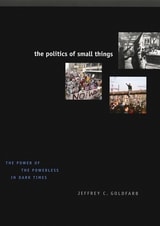
The Politics of Small Things
The Power of the Powerless in Dark TimesJeffrey C. Goldfarb
University of Chicago Press, 2006
In The Politics of Small Things, Jeffrey Goldfarb provides an innovative way for understanding politics, a way of appreciating the significance of politics at the micro level by comparatively analyzing key turning points and institutions in recent history. He presents a sociology of human interactions that lead from small to large: dissent around the old Soviet bloc; life on the streets in Warsaw, Prague, and Bucharest in 1989; the network of terror that spawned 9/11; and the religious and Internet mobilizations that transformed the 2004 presidential election, to name a few. In such pivotal moments, he masterfully shows, political autonomy can be generated, presenting alternatives to the big politics of the global stage and the dominant narratives of terrorism, antiterrorism, and globalization.
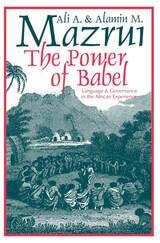
The Power of Babel
Language and Governance in the African ExperienceAli A. Mazrui and Alamin M. Mazrui
University of Chicago Press, 1998
The Power of Babel is one of the first comprehensive studies of the complex linguistic constellations of Africa. It draws on Ali Mazrui's earlier work in its examination of the "triple heritage" of African culture, in which indigenous, Islamic, and Western traditions compete for influence. In bringing the idea of the triple heritage to language, the Mazruis unravel issues of power, culture, and modernity as they are embedded in African linguistic life.
The first section of the book takes a global perspective, exploring such issues as the Eurocentrism of much linguistic scholarship on Africa; part two takes an African perspective on a variety of issues from the linguistically disadvantaged position of women in Africa to the relation of language policy and democratic development; the third section presents a set of regional studies, centering on the Swahili language's exemplification of the triple heritage.The Power of Babel unites empirical information with theories of nationalism and pluralism—among others—to offer the richest contextual account of African languages to date.
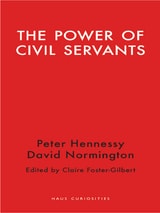
The Power of Civil Servants
David Normington and Peter Hennessy
Haus Publishing, 2018
Throughout Britain, Civil Servants are exposed to public scrutiny today in unprecedented ways. What does it mean that the political neutrality of the Civil Service has only been enshrined in law since 2010, nearly 150 years after it was first proposed? Why is it so important for politicians to trust Civil Servants (and what difficulties arise when they do not)?
Coauthored by former First Civil Service Commissioner David Normington and historian Peter Hennessy, The Power of Whitehall provides answers through rich observations about the nature of the British Civil Service, its values and effectiveness, and how it should continue to adapt to a changing world.
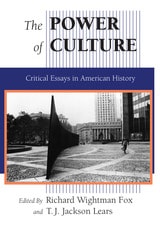
The Power of Culture
Critical Essays in American HistoryEdited by Richard Wightman Fox and T. J. Jackson Lears
University of Chicago Press, 1993
More and more scholars are turning to cultural history in order to make sense of the American past. This volume brings together nine original essays by some leading practitioners in the field. The essays aim to exhibit the promise of a cultural approach to understanding the range of American experiences from the seventeenth century to the present.
Expanding on the editors' pathbreaking The Culture of Consumption, the contributors to this volume argue for a cultural history that attends closely to language and textuality without losing sight of broad configurations of power that social and political history at its best has always stressed. The authors here freshly examine crucial topics in both private and public life. Taken together, the essays shed new light on the power of culture in the lives of Americans past and present.

The Power of Data
An Introduction to Using Local, State, and National Data to Support School Library ProgramsSandra D. Andrews
American Library Association, 2012

The Power of Dialogue between Israelis and Palestinians
Stories of Change from the School for PeaceSonnenschein, Nava
Rutgers University Press, 2019

The Power of Forgiving
Everett L. Worthington Jr.
Templeton Press, 2005
Forgiveness is a virtue that author Everett L.Worthington Jr. has advocated throughout his career as a counselor and psychologist. In this book, he explains the paradoxical power of forgiveness through his personal and professional experiences andthrough the wisdom of others. The paradox is that in forgiving for the well-being of others, we actually receive tremendous benefits for ourselves in terms of physical and mental health.
This book treats forgiveness as a quest to find the treasure of restored relationships, personal peace, and even health, which has often become buried in relational harms, betrayals, and injustices. Worthington shows how one begins the quest, prepares the self for the rigors of the search, and makes the journey.
In the process, he describes the resources and supports needed. He also discusses how enemies can continue to betray and how unruly angry emotions can arise but can be tamed by forgiving. Worthington shows readers the map to forgiveness using methods such as his time-tested and research-supported method of REACH, a five-step process of forgiving.
The Power of Forgiving will inspire people to use forgiveness. It will show how forgiving is a transforming process that will enrich relationships and empower people to improve their own lives.