Results by title
57 books match the query 'Readings' and 6 start with t
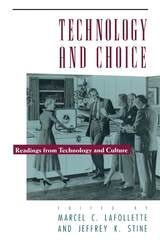
Technology and Choice
Readings from Technology and CultureEdited by Marcel C. LaFollette and Jeffrey K. Stine
University of Chicago Press, 1991
Through historical accounts that span centuries and national boundaries, exploring the complexity of a nuclear power plant and the apparent simplicity of an electrical plug, the contributors to this volume dramatically illustrate the push and pull between technology and society. General topics addressed include:
- Regulation of private industry
- Social acceptance of commercial innovation
- Negative perceptions of the "Technological Age"
- Cultural and artistic features of technology
These essays were originally published in the journal Technology and Culture
The People Shall Judge, Volume I, Part 1
Readings in the Formation of American PolicyEdited by Staff of Social Sciences 1 at The College of the University of Chicago
University of Chicago Press, 1976
These selections have been drawn from systematic philosophies; from opinions expressed in law and judicial decisions; from speeches or pamphlets struck off in the heat of controversy; from political and diplomatic correspondence. They are grouped to focus attention on the perennial issues of liberty, equality, and security in about a dozen significant periods of American history. Volume I, Part 1, begins with a consideration of truth and liberty in the seventeenth century, continues with a study of the issues of the American Revolution, and concludes with a study of the Confederation and the Constitution.
The organization of the readings puts the issues in the context of four fundamental relationships: the citizen and the economy (and, within the economy, the interrelations of major interest groups); the federal union and the states; the United States and the world. The best available texts have been used. Introductions and explanatory notes relate the readings to one another, suggest the circumstances in which they were written, and provide biographical information about the authors.

The Scientific Enterprise in America
Readings from IsisEdited by Ronald L. Numbers and Charles E. Rosenberg
University of Chicago Press, 1996
Contributions include Sally Gregory Kohlstedt, "Parlors, Primers, and Public Schooling: Education for Science in Nineteenth-Century America;" Margaret Rossiter, "'Women's Work' in Science, 1880-1910;" Philip J. Pauly, "The Development of High School Biology: New York City, 1900-1925;" Susan E. Lederer, "Political Animals: The Shaping of Biomedical Research Literature in Twentieth-Century America;" Stanley Goldberg, "Inventing a Climate of Opinion: Vannevar Bush and the Decision to Build the Bomb;" Daniel J. Kevles, "The National Science Foundation and the Debate over Postwar Research Policy, 1942-1945: A Political Interpretation of Science: The Endless Frontier;" David A. Hollinger, "Science as a Weapon in Kulturkämpfe in the United States During and After World War II;" and others.
These essays originally were published in Isis, a publication of the History of Science Society.
The Scientific Enterprise in Antiquity and Middle Ages
Readings from IsisEdited by Michael H. Shank
University of Chicago Press, 2001
Contributors include Francesca Rochberg, David Pingree, G. E. R. Lloyd, Heinrich von Staden, Martin Bernal, Alexander Jones, Bernard Goldstein, Alan Bowen, Owsei Temkin, David Lindberg, Steven McCluskey, Linda Voigts, Edward Grant, Bernard Goldstein, Victor Roberts, Lynn Thorndike, Helen Lemay, William Newman, A. Mark Smith, Nancy Siraisi, Michael McVaugh, and Brian P. Copenhaver.
The Scientific Enterprise in Early Modern Europe
Readings from IsisEdited by Peter Dear
University of Chicago Press, 1997
The anthology features classic and prize-winning articles by renowned scholars, including "Totius in verba: Rhetoric and Authority in the Early Royal Society," by Peter Dear; "The Melanchthon Circle, Rheticus, and the Wittenberg Interpretation of the Copernican Theory," by Robert S. Westman; "Laboratory Design and the Aim of Science," by Owen Hannaway; "Geography as Self-Definition in Early Modern England," by Lesley B. Cormack; "What Happened to Occult Qualities in the Scientific Revolution?" by Keith Hutchison; and "Galileo, Motion, and Essences," by Margaret J. Osler.
Also, "Scientific Patronage: Galileo and the Telescope," by Richard S. Westfall; "The Telescope in the Seventeenth Century," by Albert Van Helden; "Descartes on Refraction," by Bruce S. Eastwood; "Early Seventeenth-Century Atomism," by Christoph Meinel; "Robert Boyle and Structural Chemistry in the Seventeenth Century," by Thomas S. Kuhn; "Newton's Alchemy and His Theory of Matter," by B. J. T. Dobbs; "The House of Experiment in Seventeenth-Century England," by Steven Shapin; and "Maria Winkelmann at the Berlin Academy," by Londa Scheibinger.
This carefully structured collection will help readers approach complex questions—involving argument and experiment, audience and agency, authority and institutions.
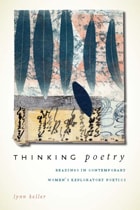
Thinking Poetry
Readings in Contemporary Women’s Exploratory PoeticsLynn Keller
University of Iowa Press, 2010
As the twentieth century drew to a close, experimentalism in American poetry was most commonly identified with Language writing. At the same time, however, a number of poets, many of them women, were developing their own alternative forms of experimentalism, creating “uncommon languages” often indebted to Language writing but distinct from it.
With impressive intellectual engagement and nuanced presentation, Thinking Poetry provides a meticulous and provocative analysis of the ways in which Alice Fulton, Myung Mi Kim, Joan Retallack, Cole Swensen, Rosmarie Waldrop, Susan Wheeler, and C. D. Wright explored varied compositional strategies and created their own innovative works. In doing so, Lynn Keller resourcefully models a range of reading strategies that will assist others in analyzing the complex epistemology and craft of recent “exploratory” writing.
The seven women whose work is discussed here demonstrate widely differing ways of using poetry to, as Swensen puts it, “stretch the boundaries of the sayable.” Thinking Poetry examines approaches to women’s poetic exploration, ranging from radically open, thoroughly disjunctive writing to feminist experimentation within relatively conventional free verse forms; from texts testing the resources of visual elements and page space to those in which multilingualism or digital technology provide arenas for innovation; from revitalized forms of ekphrasis to fresh approaches to pop culture.
Keller illuminates as well a transitional era in U.S. poetry that presaged current developments that are often seen as combining the poetics of personal lyric and Language writing. Thinking Poetry challenges reductive notions of such a synthesis as it makes clear that the groundwork for current poetic trends was laid by poets who, in a far more polarized climate, pursued their own, often distinctly feminist, visions of necessary innovation.