Results by title
4743 books match the query 'Religion' and 1168 start with t

THE AMERICAN QUEST FOR THE PRIMITIVE CHURCH
Richard T. Hughes
University of Illinois Press, 1988
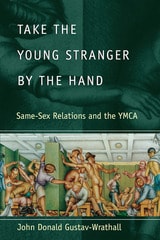
Take the Young Stranger by the Hand
Same-Sex Relations and the YMCAJohn Donald Gustav-Wrathall
University of Chicago Press, 1998
"Gustav-Wrathall's book offers an in-depth history of the origins and purposes of the Young Men's Christian Association and how it evolved into—and out of—a gay playland."—Arnie Kantrowitz, Lambda Book Report
"The book's absorbing exploration of the sometimes schismatic, sometimes synergistic relationship between spirituality and sexuality is a fascinating addition to the growing body of social history."—Jim Van Buskirk, San Francisco Bay Guardian
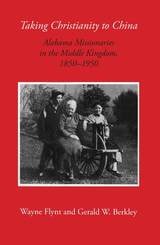
Taking Christianity to China
Alabama Missionaries in the Middle Kingdom, 1850–1950Wayne Flynt and Gerald W. Berkley
University of Alabama Press, 2017
A study of faith, cultural exchange, and the Alabama missionaries who helped shape the story of Christianity in modern China.
Beginning early in the 19th century, the American missionary movement made slow headway in China. Alabamians became part of that small beachhead. After 1900 both the money and personnel rapidly expanded, peaking in the early 1920s. By the 1930s many American denominations became confused and divided over the appropriateness of the missionary endeavor. Secular American intellectuals began to criticize missionaries as meddling do-gooders trying to impose American Evangelicalism on a proud, ancient culture.
By examining the lives of 47 Alabama missionaries who served in China between 1850 and 1950, Flynt and Berkley reach a different conclusion. Although Alabama missionaries initially fit the negative description of Americans trying to superimpose their own values and beliefs on "heathen," they quickly learned to respect Chinese civilization. The result was a new synthesis, neither entirely southern nor entirely Chinese. Although previous works focus on the failure of Christianity to change China, this book focuses on the degree to which their service in China changed Alabama missionaries. And the change was profound.
In their consideration of 47 missionaries from a single state--their call to missions, preparation for service in China, living, working, contacts back home, cultural clashes, political views, internal conflicts, and gender relations--the authors suggest that the efforts by Baptist, Methodist, and Presbyterian missionaries from Alabama were not the failure judged by many historians. In fact, the seeds sown in the hundred years before the Communist revolution in 1950 seem to be reaping a rich harvest in the declining years of the 20th century, when the number of Chinese Christians is estimated by some to be as high as one hundred million.
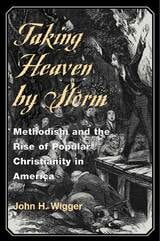
Taking Heaven by Storm
Methodism and the Rise of Popular Christianity in AmericaJohn H. Wigger
University of Illinois Press, 1998
Taking Heaven by Storm shows how Methodism fed into popular religious enthusiasm as well as the social and economic ambitions of the "middling people on the make"--skilled artisans, shopkeepers, small planters, petty merchants--who constituted its core. Wigger describes how the movement expanded its reach and fostered communal intimacy and "intemperate zeal" by means of an efficient system of itinerant and local preachers, class meetings, love feasts, quarterly meetings, and camp meetings. He also examines the important role of African Americans and women in early American Methodism and explains how the movement's willingness to accept impressions, dreams, and visions as evidence of the work and call of God circumvented conventional assumptions about education, social standing, gender, and race.
A pivotal text on the role of religion in American life, Taking Heaven by Storm shows how the enthusiastic, egalitarian, entrepreneurial, lay-oriented spirit of early American Methodism continues to shape popular religion today.
Taking Leave
Deborah Kapchan
Duke University Press, 2025
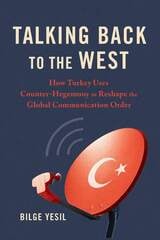
Talking Back to the West
How Turkey Uses Counter-Hegemony to Reshape the Global Communication OrderBilge Yesil
University of Illinois Press, 2024
Insightfully exploring the crossroads of communications and authoritarianism, Talking Back to the West illuminates how the Erdogan government and its media allies use history, religion, and identity to pursue complementary agendas and tighten the AKP’s grip on power.
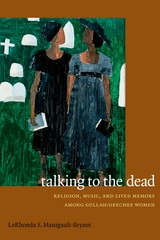
Talking to the Dead
Religion, Music, and Lived Memory among Gullah/Geechee WomenLeRhonda S. Manigault-Bryant
Duke University Press, 2014
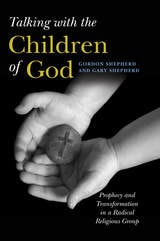
Talking with the Children of God
Prophecy and Transformation in a Radical Religious GroupGordon Shepherd and Gary Shepherd
University of Illinois Press, 2010
Grounded in direct, systematic observation by neutral observers, Talking with the Children of God is a unique study of the radical religious movement now known as The Family International. The book draws on extraordinarily candid interviews with the group's leaders and administrative staff. In revealing new information about the organization's history, beliefs, and use of prophecy, Gordon Shepherd and Gary Shepherd offer a highly detailed case study that is both an antidote to sensationalized coverage of the group and a means for understanding the transformational practices of new religious movements in general.
One of the most controversial groups emerging from the Jesus People movement of the 1960s, the Family originally was known as The Children of God. Under leader David Berg, members proclaimed an apocalyptic "Endtime," shunned secular occupations, lived communally, and adopted unusual sexual practices that led to abuse scandals in the 1970s and 1980s. Following Berg's death in 1994, the organization began to dramatically alter its evangelization efforts and decision-making processes.
Talking with the Children of God builds a picture of a complex organization with ten thousand core members worldwide, including details on the lives, careers, and responsibilities of the second generation and their efforts to defend their faith. The authors summarize the Family's history and beliefs as well as its controversial past. In particular, they analyze the organization's use of prophecy--or channeled revelations from Jesus and other spiritual beings--for making decisions and setting policy, revealing how this essentially democratic process works and how it shapes Family life and culture.
These remarkable insights are the result of sixteen years of surveys and field observations conducted in Family member homes in sixteen countries, plus four days of face-to-face interviews with Family leaders and organizational staff. The volume also includes condensed transcripts of the interviews with analysis by Shepherd and Shepherd.
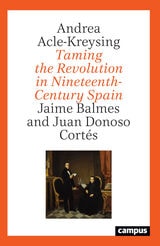
Taming the Revolution
Andrea Acle-Kreysing
Campus Verlag, 2022
Jaime Balmes and Juan Donoso Cortés–the two most important conservative thinkers in nineteenth-century Spain–actively sought to preserve the centrality of church and monarchy in the wake of the rise of liberalism, while at the same time discrediting the stereotypical view of Spain as a backward and isolated country. Although they pursued a similar goal, their positions differed: while Balmes’ works anticipated a socially oriented Catholicism, Donoso presented Christianity as the supreme social good, incompatible with modern liberalism. In Taming the Revolution, Andrea Acle-Kreysing highlights the unresolved tensions in their works, escaping the dualistic interpretations of this period that defines tradition from modernity. This work endeavors to show how Spanish political thought was a compelling variation–rather than an aberration–of contemporary European debates.
Tanu Rabbanan - Our Rabbis Taught
Joseph B. Glaser
Central Conference of American Rabbis, 1990
Taoist Meditation and Longevity Techniques
Edited by Livia Kohn, in cooperation with Yoshinobu Sakade
University of Michigan Press, 1989
Teacher of the Logos
Essays on Origen's Rediscovered Last WorkJoseph W. Trigg
Catholic University of America Press, 2025
Teaching Other Voices
Women and Religion in Early Modern EuropeEdited by Margaret L. King and Albert Rabil Jr.
University of Chicago Press, 2007
Teaching about Religions
A Democratic Approach for Public SchoolsEmile Lester
University of Michigan Press, 2013
"This provocative and timely book challenges Americans to rethink what it means to take democracy and religious freedom seriously in public education. Emile Lester takes the reader beyond culture war conflicts rooted in religious divisions and offers bold, new solutions for addressing our differences with fairness and robust toleration. Instead of battlegrounds, he argues, public schools can and should be places that include all voices in ways that prepare citizens to engage one another with civility and respect. Teaching about Religions is essential reading for all who care about the future of public schools---and the health of American democracy."
--- Charles C. Haynes, Senior Scholar, Freedom Forum First Amendment Center
"More than simply a synthesis of existing scholarship, [this book is] an original contribution to the field. [The] major themes are timely, and this book might well contribute to public discussion of important issues in our culture wars."
---Warren Nord, University of North Carolina–Chapel Hill
"Arriving in the wake of a bitter battle over the place of Islam in America and in the midst of calls for greater understanding and civility, Emile Lester's new book is a timely contribution to the debate about the best ways to teach about religion in our nation's public schools. A pioneering researcher in this field, Lester offers thoughtful critiques of existing proposals as well as fresh ideas. His recommendations reflect painstaking efforts to understand the concerns of groups (most notably, conservative Christians) to which he does not belong, and a firm grasp of the difference between fostering understanding of other faiths and pressing for acceptance of them. Lester's prescriptions, always informed and fair-minded and sometimes provocative, should drive the debate forward in productive ways."
---Melissa Rogers, Director, Center for Religion and Public Affairs at Wake Forest University School of Divinity and Nonresident Senior Fellow, The Brookings Institution
Frequent news stories about the debates waged between secularists and religious conservatives have convinced most Americans that public schools must choose between promoting respect for religious minorities and respecting the interests of conservative Christians. As a result, public schools fail to teach students about the meaning and value of protecting religious liberty and consequently perpetuate mistrust across the cultural divide, further empower extremists, and obscure the fact that most Americans of all religious backgrounds share a commitment to basic democratic principles.
In response, the public schools in the religiously diverse and divided community of Modesto, California, have introduced a widely acclaimed required world religions course. Drawing on groundbreaking research on the creation of and response to the Modesto course as well as on political philosophy, Emile Lester advocates a civic approach to teaching about religion in public schools that at once emphasizes respect for all views about religion and provides a special recognition of conservative Christian beliefs.
Teaching in Black and White
The Sisters of St. Joseph in the American SouthBarbara E. Mattick
Catholic University of America Press, 2022
Teaching the Bible through Popular Culture and the Arts
Mark Roncace
SBL Press, 2007
Teaching the Bible with Undergraduates
Jocelyn McWhirter
SBL Press, 2022
Teaching the Bible with Undergraduates offers concrete strategies for Bible instruction in college classrooms. Each essay pays special attention to the needs of tech-savvy students whose sensibilities, aspirations, expectations, and preferred ways of learning may differ significantly from those of their instructors. The volume’s contributors, all biblical scholars and undergraduate instructors, focus on best pedagogical practices using concrete examples while sharing effective strategies. Essays and quick tips treat topics, including general education, reading skills, student identities, experiential learning, and instructional technology. Contributors include Kimberly Bauser McBrien, George Branch-Trevathan, Callie Callon, Lesley DiFransico, Nicholas A. Elder, Timothy A. Gabrielson, Kathleen Gallagher Elkins, Susan E. Haddox, Seth Heringer, John Hilton III, Melanie A. Howard, Christopher M. Jones, Steve Jung, Katherine Low, Timothy Luckritz Marquis, Kara J. Lyons-Pardue, Jocelyn McWhirter, Sylvie T. Raquel, Eric A. Seibert, Hanna Tervanotko, Carl N. Toney, John Van Maaren, and Robby Waddell. This book provides an essential resource not only for instructors at the undergraduate level but also for anyone who teaches biblical studies in the classroom.
Teaching the Bible
Practical Strategies for Classroom InstructionMark Roncace
SBL Press, 2005
Tears and Saints
E. M. Cioran
University of Chicago Press, 1995
"Who can tell?" he wrote in the first paragraph of this book, first published in Romania in 1937. "To be sure, tears are their trace. Tears did not enter the world through the saints; but without them we would never have known that we cry because we long for a lost paradise." By following in their traces, "wetting the soles of one's feet in their tears," Cioran hoped to understand how a human being can renounce being human. Written in Cioran's characteristic aphoristic style, this flamboyant, bold, and provocative book is one of his most important—and revelatory—works.
Cioran focuses not on martyrs or heroes but on the mystics—primarily female—famous for their keening spirituality and intimate knowledge of God. Their Christianity was anti-theological, anti-institutional, and based solely on intuition and sentiment. Many, such as Catherine of Siena, Teresa of Avila, and Saint John of the Cross, have produced classic works of mystical literature; but Cioran celebrates many more minor and unusual figures as well.
Following Nietzsche, he focuses explicitly on the political element hidden in saints' lives. In his hands, however, their charitable deeds are much less interesting than their thirst for pain and their equally powerful capacity to endure it. Behind their suffering and their uncanny ability to renounce everything through ascetic practices, Cioran detects a fanatical will to power.
"Like Nietzsche, Cioran is an important religious thinker. His book intertwines God and music with passion and tears. . . . [Tears and Saints] has a chillingly contemporary ring that makes this translation important here and now."—Booklist
Technology and Religion
Remaining Human Co-created WorldNoreen Herzfeld
Templeton Press, 2009
Technology is changing all the time, but does it also have the ability to change us and the way we approach religion and spirituality? In Technology and Religion: Remaining Human in a Co-created World, Noreen Herzfeld examines this and other provocative questions as she provides an accessible and fascinating overview of the relationship between religion and the ever-broadening world of technology.
The result is a multifaceted look at the ongoing dialogue between these two subjects that are not commonly associated with one another. This volume is the third title published in the new Templeton Science and Religion Series.
Teenage Witches
Magical Youth and the Search for the SelfBerger, Helen
Rutgers University Press, 2007
Yet, as Helen A. Berger and Douglas Ezzy show in this in-depth look into the lives of teenage Witches, the reality of their practices, beliefs, values, and motivations is very different from the sensational depictions we see in popular culture. Drawing on extensive research across three countries--the United States, England, and Australia--and interviews with young people from diverse backgrounds, what they find are highly spiritual and self-reflective young men and women attempting to make sense of a postmodern world via a religion that celebrates the earth and emphasizes self-development.
The authors trace the development of Neo-Paganism (an umbrella term used to distinguish earth-based religions from the pagan religions of ancient cultures) from its start in England during the 1940s, through its growing popularity in the decades that followed, up through its contemporary presence on the Internet. Though dispersed and disorganized, Neo-Pagan communities, virtual and real, are shown to be an important part of religious identity particularly for those seeking affirmation during the difficult years between childhood and adulthood.
Teeth and Talons Whetted for Slaughter
Divine Attributes and Suffering Animals in Historical Perspective (1600–1961)Piet Slootweg
Central European University Press, 2026
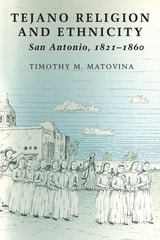
Tejano Religion and Ethnicity
San Antonio, 1821-1860By Timothy M. Matovina
University of Texas Press, 1995
While the flags of Spain, Mexico, the Republic of Texas, and the United States successively flew over San Antonio, its Tejano community (Texans of Spanish or Mexican descent) formed a distinct ethnic identity that persisted despite rapid social and cultural changes. In this pioneering study, Timothy Matovina explores the central role of Tejano Catholicism in forging this unique identity and in binding the community together.
The first book-length treatment of the historical role of religion in a Mexican-origin community in the United States, this study covers three distinct periods in the emergence of Tejano religious and ethnic identity: the Mexican period (1821-1836), the Texas Republic (1836-1845), and the first decade and a half after annexation into the United States (1845-1860). Matovina's research demonstrates how theories of unilateral assimilation are inadequate for understanding the Tejano community, especially in comparison with the experiences of European immigrants to the United States.
As residents of the southwestern United States continue to sort out the legacy of U.S. territorial expansion in the nineteenth century, studies like this one offer crucial understanding of the survival and resilience of Latino cultures in the United States. Tejano Religion and Ethnicity will be of interest to a broad popular and scholarly audience.
Tel Dan in Its Northern Cultic Context
Andrew R. Davis
SBL Press, 2013
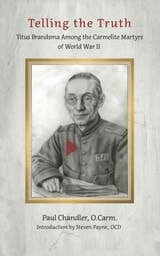
Telling the Truth
Titus Brandsma Among the Carmelite Martyrs of World War IIPaul Chandler
Catholic University of America Press, 2026
Templeton Plan
21 Steps to Personal Success and Real HappinessSir John Templeton
Templeton Press, 2013
Templeton Science and Religion Book Series Bundle
J. Wetzel van Huysssteen
Templeton Press, 2013
The books found in the bundle are:
•Neuroscience, Psychology and Religion by Malcolm Jeeves and Warren Brown
•Technology and Religion by Noreen Herzfeld
•Horizons of Cosmology by Joseph Silk
•Paleontology by Ian Tttersall
•Cognitive Science, Religion, and Theology by Justin L. Barrett
•Ecology and the Environment by R. J. Berry
•The Language of Genetics by Denis Alexander
•Mathematics and Religion by Javier Leach
•The Templeton Science and Religion Reader
•The Templeton Science and Religion Study Guide
This bundle is only sold in e-book format!
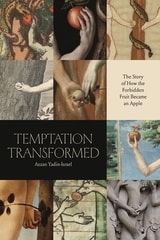
Temptation Transformed
The Story of How the Forbidden Fruit Became an AppleAzzan Yadin-Israel
University of Chicago Press, 2022
How did the apple, unmentioned by the Bible, become the dominant symbol of temptation, sin, and the Fall? Temptation Transformed pursues this mystery across art and religious history, uncovering where, when, and why the forbidden fruit became an apple.
Azzan Yadin-Israel reveals that Eden’s fruit, once thought to be a fig or a grape, first appears as an apple in twelfth-century French art. He then traces this image back to its source in medieval storytelling. Though scholars often blame theologians for the apple, accounts of the Fall written in commonly spoken languages—French, German, and English—influenced a broader audience than cloistered Latin commentators. Azzan Yadin-Israel shows that, over time, the words for “fruit” in these languages narrowed until an apple in the Garden became self-evident. A wide-ranging study of early Christian thought, Renaissance art, and medieval languages, Temptation Transformed offers an eye-opening revisionist history of a central religious icon.
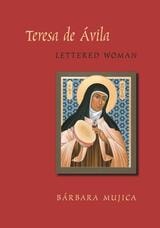
Teresa de Avila, Lettered Woman
Barbara Mujica
Vanderbilt University Press, 2009
Teresa's epistolary writing reveals how she used her political acumen to dodge inquisitors and negotiate the thorny issues of the reform, facing off the authorities--albeit with considerable tact--and reprimanding priests and nuns who failed to follow her orders. Her letters bring to light the different strategies she used--code names, secret routing--in order to communicate with nuns and male allies. They show how she manipulated language, varying her tone and rhetoric according to the recipient or slipping into deliberate vagueness in order to avoid divulging secrets. What emerges from her correspondence is a portrait of extraordinary courage, ability, and shrewdness.
In the sixteenth century, the word letrado (lettered) referred to the learned men of the Church. Teresa treated letrados with great respect and always insisted on her own lack of learning. The irony is that although women could not be letradas, Teresa was, as her correspondence shows, "lettered" in more ways than one.
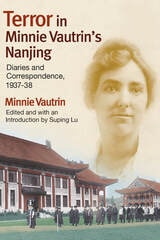
Terror in Minnie Vautrin's Nanjing
Diaries and Correspondence, 1937-38Minnie Vautrin. Edited and with an Introduction by Suping Lu
University of Illinois Press, 2007
In December of 1937, the Japanese Imperial Army marched into China's capital city of Nanjing and launched six weeks of carnage that would become known as the Rape of Nanjing. In addition to the deaths of Chinese POWs and civilians, tens of thousands of women were raped, tortured, and killed by Japanese soldiers. In this traumatic environment, both native and foreign-born inhabitants of Nanjing struggled to carry on with their lives.
This volume collects the diaries and correspondence of Minnie Vautrin, a farmgirl from Illinois who had dedicated herself to the education of Chinese women at Ginling College in Nanjing. Faced with the impending Japanese attack, she turned the school into a sanctuary for ten thousand women and girls. Vautrin's firsthand accounts of daily life in Nanjing and the intensifying threat of Japanese invasion reveal the courage of the occupants under siege--Chinese nationals as well as Western missionaries, teachers, surgeons and business people--and the personal costs of violence in wartime.
Thanks to Vautrin's painstaking effort in keeping a day-to-day account, present-day readers are able to examine this episode of history at close range through her eyes. With detailed maps, photographs, and carefully researched in-depth annotations, Terror in Minnie Vautrin's Nanjing: Diaries and Correspondence, 1937-38 presents a comprehensive and detailed daily account of the events and of life during the horror-stricken days within the city walls and in particular on the Ginling campus. Through chronologically arranged diaries, letters, reports, documents, and telegrams, Vautrin bears witness to those terrible events and to the magnitude of trauma that the Nanjing Massacre exacted on the populace.
Tertullian's Aduersus Iudaeos
A Rhetorical Analysis (NAPS Patristic Monograph Series, Volume 19)Geoffrey D. Dunn
Catholic University of America Press, 2008
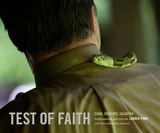
Test of Faith
Signs, Serpents, SalvationLauren Pond
Duke University Press, 2017
Who are the serpent handlers? What motivates them to continue their potentially lethal practices through the generations? Documentary photographer Lauren Pond traveled to West Virginia in search of answers to these questions. There she met Pastor Randy “Mack” Wolford, one of the best-known Signs Following preachers in the region, and spent the following year documenting Mack and his family. The course of her work changed dramatically in May 2012, when Mack, then forty-four years old, suffered a fatal rattlesnake bite during a worship service she attended. Pond photographed the events that followed and has continued her relationship with Mack’s family.
Test of Faith provides a deeply nuanced, personal look at serpent handling that not only invites greater understanding of a religious practice that has long faced derision and criticism; it also serves as a meditation on the photographic process, its ethics, and its capacity to generate empathy.
Published by Duke University Press and the Center for Documentary Studies at Duke University
Text, Image, and Otherness in Children's Bibles
What is in the Picture.Caroline Vander Stichele
SBL Press, 2012
Texts and Contexts of the Book of Sirach / Texte und Kontexte des Sirachbuches
Gerhard Karner
SBL Press, 2017
Now available from SBL Press
Thirteen essays, some in German and others in English, tackle the complicated history of textual transmission of Sirach. This book presents the proceedings of an international conference held in 2014 in Eichstaett, Germany on the text of Ben Sira within its historical contexts.Contributors include James K. Aitken, Pierre-Maurice Bogaert, Franz Böhmisch, Anthony J. Forte SJ, Jan Joosten, Otto Kaiser, Siegfried Kreuzer, Jean-Sébastien Rey, Werner Urbanz, Knut Usener, Oda Wischmeyer, Markus Witte, Benjamin G. Wright, and Burkard M. Zapff.
Features:
- A sociocultural and theological history of Sirach
- Philological and textual problems of the Hebrew, Greek, Syriac, and Latin versions
- Translation strategies based on Greek, Syriac, and Latin text traditions and related hermeneutical questions
Texts from the Pyramid Age
Nigel C. Strudwick
SBL Press, 2005
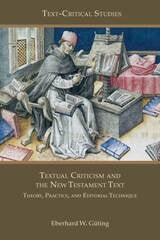
Textual Criticism and the New Testament Text
Theory, Practice, and Editorial TechniqueEberhard W. Güting
SBL Press, 2020
The fruit of more than three decades of research
This collection of fourteen essays by Eberhard W. Güting covers important aspects of editorial science with a particular focus on New Testament textual criticism. Essays cover textual emendation, text-critical procedures, literary criticism, history of scholarship, advantages and disadvantages of online manuscripts, and text-critical studies of words and phrases. The addition of a substantial introduction to text criticism makes this a valuable resource for students and teachers.
Features
- Essays concerned with establishing the original text of New Testament writings
- Nine essays published in English for the first tim
- Two previously unpublished essays
Textual History and the Reception of Scripture in Early Christianity
Johannes de Vries
SBL Press, 2013
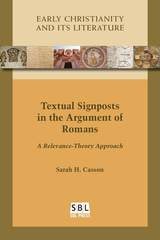
Textual Signposts in the Argument of Romans
A Relevance-Theory ApproachSarah H. Casson
SBL Press, 2019
A fresh look at the development of Paul’s argument in Romans
The Greek word gar occurs 144 times in Romans and 1,041 times in the entire New Testament. However, many instances of this connective defy easy definition, and the English translation for is often inadequate, obscuring the clue that gar gives to the direction of the communicator’s thought. In this ground-breaking work, Sarah H. Casson argues that gar offers vital guidance to the coherence of Romans. The book applies the cognitive approach of relevance theory to show how garfunctions as an indispensable guide for tracing the significant points of Paul’s argument, helping resolve questions about the coherence of sections, as well as smaller-scale exegetical problems. The work engages with key debates regarding the purpose of Romans and challenges some recent influential interpretations.
Features:
- An exegetically useful understanding of the connective gar
- A new method for determining Paul’s audience and reason for writing
- A challenge to recent key debates and influential interpretations of the purpose of Romans
Textual Sources for the Study of Hinduism
Edited by Wendy Doniger O'Flaherty
University of Chicago Press, 1990
Textual Sources for the Study of Islam
Edited by Andrew Rippin and Jan Knappert
University of Chicago Press, 1990
Textual Sources for the Study of Judaism
Edited and Translated by Philip S. Alexander
University of Chicago Press, 1990
"The texts . . . which are drawn from over two thousand years of history, are usefully divided, annotated and glossed. They enable students to explore the tradition in a new way [and] give a marvellous insight into the richness and liveliness of the Jewish religion and culture: we are given wit and pathos in addition to popular story and religious law."—Janet Trotter, Resource
Textual Sources for the Study of Sikhism
Edited by W.H. McLeod
University of Chicago Press, 1990
Textual Sources for the Study of Zoroastrianism
Edited by Mary Boyce
University of Chicago Press, 1990
"Wide-ranging. . . . An indispensable one-volume collection of primary materials."—William R. Darrow, Religious Studies Review
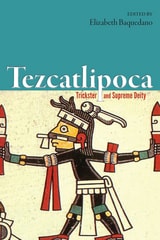
Tezcatlipoca
Trickster and Supreme DeityElizabeth Baquedano
University Press of Colorado, 2020
The interlocking complexities of Tezcatlipoca’s nature, multiple roles, and metaphorical attributes illustrate the extent to which his influence penetrated Aztec belief and social action across all levels of late Postclassic central Mexican culture. Tezcatlipoca examines the results of archaeological investigations—objects like obsidian mirrors, gold, bells, public stone monuments, and even a mosaic skull—and reveals new insights into the supreme deity of the Aztec pantheon and his role in Aztec culture.
That Which Is Just in the Church
An Introduction to Canon Law: Volume 1Carlos José Errázuriz
St. Augustine's Press, 2021
Errázuriz presents more than the current Code of Canon Law. He instills a realistic perspective of right and law in the Church, and in so doing fills a massive gap in English scholarship. No introduction to canon law available in English rivals Errázuriz's description of justice in the Church and its relationship with communion and sacramentality.
Volume I is comprised of the first three chapters of the original, Corso fondamentale sul diritto nella Chiesa (in two volumes, Giuffrè: Milan, 2009 and 2017): "Rights, Justice and Law in the Church," "Canon Law in History," and "The Configuration of Rights and Law in the Church."
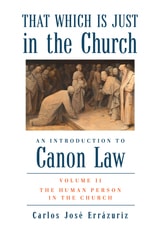
That Which Is Just in the Church
Volume 2: The Human Person in the ChurchCarlos José Errázuriz
St. Augustine's Press, 2023
Being subject to law, Errázuriz observes, does not undermine the freedom and dignity of the person. Rather, ecclesial law intends to confront the human person with his true supernatural inheritance, while preserving him in the mystery of communion within which the Church herself exists. Indeed, the human person has both natural and supernatural dignity, and likewise responsibilities that bear upon the seen and unseen realms of communion.
Prof. Errázuriz examines the practical applications of personhood and law, as well as the perspectives of the human subject that derive from his ontological status. This is further drawn across various states of life that occur within the Church and the differing juridical relations encountered. Also considered is the nature of association in the Church, and Errázuriz breaks down the concepts and particular realities pertaining to this natural tendency and the legal discipline.
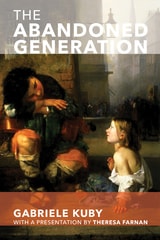
The Abandoned Generation
Gabriele Kuby
St. Augustine's Press, 2021
Reading Kuby’s analysis of cultural, sociological and biological data, the danger is clear and present. Yet Kuby asserts that, generally, our plight goes unnoticed and is veiled from our eyes. We need to see children for who and what they really are to us, to the family, and society at large. In the words of Fulton Sheen, “Children play a redeemer role in the family. The represent the victory of love over the insatiable ego. They symbolize the defeat of selfishness and the triumph of giving love.” Tragically, children are increasingly less a part of Western culture. This leaves the family, in the best case scenario, an artifact, and in the worst case, a casualty.
The topics addressed by Kuby cover towering influences in postmodern family life: Gender politics, the abortion mentality, daycare (“Socialism 2.0”), premature stress, rights of children, digital distractions, pornography, and divorce. A native German, Kuby’s work is, heartbreakingly, as relevant to American society as her own. This European perspective drives home the urgent need to recognize our situation as global and embedded, and one that requires more than political mobilization of mainstream efforts and responses. What really is good and normal, and how to we realize it? Listen to the heartstrings that yearn for true knowledge of oneself, Kuby implores, of God, and how in the surprise of God’s mercy we are guided through life. Kuby backs up this invitation to personal conversion and betterment with hard data.
The Abyss or Life Is Simple
Reading Knausgaard Writing ReligionCourtney Bender, Jeremy Biles, Liane Carlson, Joshua Dubler, Hannah C. Garvey, M. Cooper Harriss, Winnifred Fallers Sullivan, and Erik Thorstensen
University of Chicago Press, 2022
Min kamp, or My Struggle, is a six-volume novel by Karl Ove Knausgaard and one of the most significant literary works of the young twenty-first century. Published in Norwegian between 2009 and 2011, the novel presents an absorbing first-person narrative of the life of a writer with the same name as the author, in a world at once fully disillusioned and thoroughly enchanted.
In 2015, a group of scholars began meeting to discuss the peculiarly religious qualities of My Struggle. Some were interested in Knausgaard’s attention to explicitly religious subjects and artworks, others to what they saw as more diffuse attention to the religiousness of contemporary life. The group wondered what reading these textures of religion in these volumes might say about our times, about writing, and about themselves. The Abyss or Life Is Simple is the culmination of this collective endeavor—a collection of interlocking essays on ritual, beauty, and the end of the world.
The Academic Sermons (The Fathers of the Church, Mediaeval Continuation, Volume 11)
Thomas Aquinas
Catholic University of America Press, 2010
The Achievement of Hans Urs von Balthasar
Matthew Levering
Catholic University of America Press, 2019