Results by title
1095 books match the query 'Rhetoric' and 192 start with t
Talk, Tools, and Texts
A Logic-in-Use for Studying Lifespan Literate Action DevelopmentRyan J. Dippre
University Press of Colorado, 2020
Talk, Tools, and Texts tackles a perplexing issue: how can we envision writing as developing throughout a lifetime, from the first purposeful marks made on paper to the last? How can we make accounts of writing development that keep the complexity of our lives in mind while also providing useful insight to researchers, teachers, and writers?
Drawing on eleven accounts of writers at different points in the lifespan (ages 12 to 80) and in different social circumstances (from a middle-school classroom to a bird-sanctuary newsletter), Talk, Tools, and Texts constructs a “logic-in-use” for following writers and their writing development at a variety of points in the lifespan. It also offers several strategies scholars can use in pursuit of their own research into lifespan writing.

Talking Back
Senior Scholars and Their Colleagues Deliberate the Past, Present, and Future of Writing StudiesNorbert Elliot
Utah State University Press, 2020
In Talking Back, a veritable Who’s Who of writing studies scholars deliberate on intellectual traditions, current practices, and important directions for the future. In response, junior and mid-career scholars reflect on each chapter with thoughtful and measured moves forward into the contemporary environment of research, teaching, and service. Each of the prestigious chapter authors in the volume has three common traits: a sense of responsibility for advancing the profession, a passion for programs of research dedicated to advancing opportunities for others, and a reflective sense of their work accompanied by humility for their contributions. As a documentary, Talking Back is the first history of writing studies in autobiography.
Contributors: Jo Allen, Ann N. Amicucci, Akua Duku Anokye, Paige Davis Arrington, Doug Baldwin, John C. Brereton, Judy Buchanan, Hugh Burns, Leasa Burton, Ellen C. Carillo, William Condon, Dylan B. Dryer, Michelle F. Eble, Jennifer Enoch, Joan Feinberg, Patricia Friedrich, Cinthia Gannett, Eli Goldblatt, Shenika Hankerson, Janis Haswell, Richard Haswell, Eric Heltzel, Douglas Hesse, Bruce Horner, Alice S. Horning, Asao B. Inoue, Ruth Ray Karpen, Suzanne Lane, Min-Zhan Lu, Donald McQuade, Elisabeth L. Miller, Rebecca Williams Mlynarczyk, Sean Molloy, Les Perelman, Louise Wetherbee Phelps, Stacey Pigg, Sherry Rankins-Robertson, Jessica Restaino, J. Michael Rifenburg, Eliana Schonberg, Geneva Smitherman, Richard Sterling, Katherine E. Tirabassi, Devon Tomasulo, Martha A. Townsend, Mike Truong, Victor Villanueva, Edward M. White, Anne Elrod Whitney, Kathleen Blake Yancey
Teaching About Place
Learning From The LandLaird Christensen
University of Nevada Press, 2008
Teaching Accelerated and Corequisite Composition
David Starkey
Utah State University Press, 2023
The book primarily explores accelerated composition through the lens of two-year colleges to answer a central question in the field: to what extent do educators need to alter two-year college curricular design? The contributors also delve into assessment, a crucial process for instructors and their students transitioning to accelerated learning; the key role that reading plays in the writing process; and noncognitive learning, an area of study that has been associated with accelerated learning since its inception. Together these thirteen chapters provide instructors with a strategic approach to teaching accelerated and corequisite composition.
Teaching Accelerated and Corequisite Composition points toward a new way of approaching first-year composition: a method of instruction that fosters the growth and success of writers who were once considered underprepared for college writing and are now achieving unprecedented success.
Teaching College Writing to Diverse Student Populations
Dana R. Ferris
University of Michigan Press, 2013
Statistical and anecdotal evidence documents that even states with relatively little ethnic or cultural diversity are beginning to notice and ask questions about long-term resident immigrants in their classes. As shifts in student population become more widespread, there is an even greater need for second language specialists, composition specialists, program administrators, and developers in colleges and universities to understand and adapt to the needs of the changing student audience(s).
Teaching Composition As A Social Process
Bruce McComiskey
Utah State University Press, 2000
Bruce McComiskey is a strong advocate of social approaches to teaching writing. However, he opposes composition teaching that relies on cultural theory for content, because it too often prejudges the ethical character of institutions and reverts unnecessarily to product-centered practices in the classroom. He opposes what he calls the "read-this-essay-and-do-what-the-author-did method of writing instruction: read Roland Barthes's essay 'Toys' and write a similar essay; read John Fiske's essay on TV and critique a show."
McComiskey argues for teaching writing as situated in discourse itself, in the constant flow of texts produced within social relationships and institutions. He urges writing teachers not to neglect the linguistic and rhetorical levels of composing, but rather to strengthen them with attention to the social contexts and ideological investments that pervade both the processes and products of writing.
A work with a sophisticated theory base, and full of examples from McComiskey's own classrooms, Teaching Composition as a Social Process will be valued by experienced and beginning composition teachers alike.
Teaching Lives
Essays & StoriesWendy Bishop
Utah State University Press, 1997
Teaching Mindful Writers
Brian Jackson
Utah State University Press, 2020
Teaching Mindful Writers introduces new writing teachers to a learning cycle that will help students become self-directed writers through planning, practicing, revising, and reflecting. Focusing on the art and science of instructing self-directed writers through major writing tasks, Brian Jackson helps teachers prepare students to engage purposefully in any writing task by developing the habits of mind and cognitive strategies of the mindful writer.
Relying on the most recent research in writing studies and learning theory, Jackson gives new teachers practical advice about setting up writing tasks, using daily writing, leading class discussions, providing feedback, joining teaching communities, and other essential tools that should be in every writing teacher’s toolbox. Teaching Mindful Writers is a timely, fresh perspective on teaching students to be self-directed writers.
Teaching Multiwriting
Researching and Composing with Multiple Genres, Media, Disciplines, and CulturesRobert L. Davis and Mark F. Shadle
Southern Illinois University Press, 2007
Teaching Readers in Post-Truth America
Ellen C. Carillo
Utah State University Press, 2018
Readers in this post-truth culture are under unprecedented pressure to interpret an overwhelming quantity of texts in many forms, including speeches, news articles, position papers, and social media posts. In response, Carillo describes pedagogical interventions designed to help students become more metacognitive about their own reading and, in turn, better equipped to respond to texts in a post-truth culture.
Teaching Readers in Post-Truth America is an invaluable source of support for writing instructors striving to prepare their students to resist post-truth rhetoric and participate in an information-rich, divisive democratic society.
Teaching With Student Texts
Essays Toward an Informed PracticeJoseph Harris
Utah State University Press, 2010
Harris, Miles and Paine ask: What happens when the texts that students write become the focus of a writing course? In response, a distinguished group of scholar/teachers suggests that teaching with students texts is not simply a classroom technique, but a way of working with writing that defines composition as a field.
In Teaching with Student Texts, authors discuss ways of revaluing student writing as intellectual work, of circulating student texts in the classroom and beyond, and of changing our classroom practices by bringing student writings to the table. Together, these essays articulate a variety of ways that student texts can take a central place in classroom work and can, in the process, redefine the ways our field talks about writing.
Teaching Writing That Works
A Group Approach to Practical EnglishEric S. Rabkin and Macklin Smith
University of Michigan Press, 1990
Teaching Writing as a Second Language
Alice S. Horning. Foreword by W. Ross Winterowd
Southern Illinois University Press, 1986
Classrooms filled with glassy-eyed students provide an experiential base for Alice S. Horning’s new comprehensive theory about basic writers.
Horning explores the theory of writing acquisition in detail. Her examination of spoken and written language and redundancy give a theoretical base to her argument that academic discourse is a separate linguistic system characterized by particular psycholinguistic features. She proposes that basic writers learn to write as other learners master a second language because for them, academic written English is a whole new language.
She explores the many connections to be found in second language acquisition research to the teaching and learning of writing and gives special attention to the interlanguage hypothesis, pidginization theory, and the Monitor theory. She also addresses the role of affective factors (feelings, attitudes, emotions, and motivation) in the success or failure of writing students.
Teaching Writing through the Immigrant Story
Heather Ostman
Utah State University Press, 2021
Each of the chapters recognizes the prevalence of immigrant students in writing classrooms across the United States—including foreign-born, first- and second-generation Americans, and more—and the myriad opportunities and challenges those students present to their instructors. These contributors have seen the validity in the stories and experiences these students bring to the classroom—evidence of their lifetimes of complex learning in both academic and nonacademic settings. Like thousands of college-level instructors in the United States, they have immigrant stories of their own. The immigrant “narrative” offers a unique framework for knowledge production in which students and teachers may learn from each other, in which the ordinary power dynamic of teacher and students begins to shift, to enable empathy to emerge and to provide space for an authentic kind of pedagogy.
By engaging writing and literature teachers within and outside the classroom, Teaching Writing through the Immigrant Story speaks to the immigrant narrative as a viable frame for teaching writing—an opportunity for building and articulating knowledge through academic discourse. The book creates a platform for immigration as a writing and literary theme, a framework for critical thinking, and a foundation for significant social change and advocacy.
Contributors: Tuli Chatterji, Katie Daily-Bruckner, Libby Garland, Silvia Giagnoni, Sibylle Gruber, John Havard, Timothy Henderson, Brennan Herring, Lilian Mina, Rachel Pate, Emily Schnee, Elizabeth Stone
Teaching Writing
Landmarks and HorizonsEdited by Christina Russell McDonald and Robert L. McDonald. Foreword by Gary Tate. Postscript by Steve North
Southern Illinois University Press, 2002
Teaching Writing: Landmarks and Horizons, edited by Christina Russell McDonald and Robert L. McDonald, is designed to present an overview of some of the major developments in the establishment of composition studies as a field during the past thirty-five years. The essays are theoretically grounded but are focused on pedagogy as well. Divided into two parts, the first presents nine landmark essays, selected and introduced by distinguished composition scholars, and the second brings together eight new essays by emerging scholars.
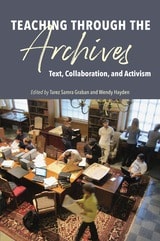
Teaching through the Archives
Text, Collaboration, and ActivismEdited by Tarez Samra Graban and Wendy Hayden
Southern Illinois University Press, 2022
Disruptive pedagogies for archival research
In a cultural moment when institutional repositories carry valuable secrets to the present and past, this collection argues for the critical, intellectual, and social value of archival instruction. Graban and Hayden and 37 other contributors examine how undergraduate and graduate courses in rhetoric, history, community literacy, and professional writing can successfully engage students in archival research in its many forms, and successfully model mutually beneficial relationships between archivists, instructors, and community organizations.
Combining new and established voices from related fields, each of the book’s three sections includes a range of form-disrupting pedagogies. Section I focuses on how approaching the archive primarily as text fosters habits of mind essential for creating and using archives, for critiquing or inventing knowledge-making practices, and for being good stewards of private and public collections. Section II argues for conducting archival projects as collaboration through experiential learning and for developing a preservationist consciousness through disciplined research. Section III details praxis for revealing, critiquing, and intervening in historic racial omissions and gaps in the archives in which we all work.
Ultimately, contributors explore archives as sites of activism while also raising important questions that persist in rhetoric and composition scholarship, such as how to decolonize research methodologies, how to conduct teaching and research that promote social justice, and how to shift archival consciousness toward more engaged notions of democracy. This collection highlights innovative classroom and curricular course models for teaching with and through the archives in rhetoric and composition and beyond.
Teaching/Writing in Thirdspaces
The Studio ApproachRhonda C. Grego and Nancy S. Thompson
Southern Illinois University Press, 2007
Teaching/Writing in Thirdspaces: The Studio Approach examines a dynamic approach to teaching composition that reimagines not only the physical space in which writing and learning occurs but also the place occupied by composition in the power structure of universities and colleges.
In response to financial and programmatic cutbacks at the University of South Carolina in the 1990s, authors Rhonda C. Grego and Nancy S. Thompson used their academic backgrounds in composition and English education, along with their personal histories in working-class families, to look at compositional spaces and places with an eye to challenging the embedded issues of race, class, and gender within the university hierarchies. The result was a supplemental writing program that they called the writing studio.
The studio model emphasizes individual participation in a small group that allows students to present work they are preparing for outside classes, discuss their challenges, and refine their ideas with other students and staff facilitators. This “interactional inquiry” is replicated and reinforced by the facilitators, who meet in their own small groups to analyze larger patterns, possibilities, and needs as they arise in their studios.
Grego and Thompson argue that because the studio is physically and institutionally “outside but alongside” both students’ other coursework and the hierarchy of the institution, it represents a “thirdspace,” a unique position in which to effect institutional change. The focus on interactional inquiry challenges traditional power hierarchies within classrooms and shifts the nature of discourse. As a bottom-up approach to the development of educational programs within institutions that have different needs, demographies, and histories, the studio model can address a multitude of different institutional needs with little disruption to the curriculum.
The studio model allows university administrators, teachers, student aides, and students to continually adapt to changing institutional environments with new teaching and learning strategies. Teaching/Writing in Thirdspaces provides an alternative approach to traditional basic writing courses that can be adopted in educational institutions of all types and at all levels.
Tell Me How It Reads
Tutoring Deaf and Hearing Students in the Writing CenterRebecca Day Babcock
Gallaudet University Press, 2012
Deaf students are attending mainstream postsecondary institutions in increasing numbers, raising the stakes for the complicated and multifaceted task of tutoring deaf students at these schools. Common tutoring practices used with hearing students do not necessarily work for deaf people. Rebecca Day Babcock researched and wrote Tell Me How It Reads: Tutoring Deaf and Hearing Students in the Writing Center to supply writing instructors an effective set of methods for teaching Deaf and other students how to be better writers.
Babcock’s book is based on the resulting study of tutoring writing in the college context with both deaf and hearing students and their tutors. She describes in detail sessions between deaf students, hearing tutors, and the interpreters that help them communicate, using a variety of English or contact signing rather than ASL in the tutorials. These experiences illustrate the key differences between deaf-hearing and hearing-hearing tutorials and suggest ways to modify tutoring and tutor-training practices accordingly. Although this study describes methods for tutoring deaf students, its focus on students who learn differently can apply to teaching writing to Learning Disabled students, ESL students, and other students with different learning styles. Ultimately, the well-grounded theory analysis within Tell Me How It Reads provides a complete paradigm for tutoring in all writing centers.
Telling Stories
Perspectives on Longitudinal Writing ResearchJenn Fishman
Utah State University Press, 2023
In Telling Stories, more than a dozen longitudinal writing researchers look beyond conventional project findings to story their work and, in doing so, offer otherwise unavailable glimpses into the logics and logistics of long-range studies of writing. The result is a volume that centers interrelations among people, places, and politics across two decades of praxis and an array of educational sites: two-year colleges, a senior military college, an adult literacy center, a small liberal arts college, and both public and private four-year universities.
Contributors share direct knowledge of longitudinal writing research, citing project data (e.g., interview transcripts, research notes, and journals), descriptions drawn from memory, and extended personal reflections. The resulting stories, tempered by the research and scholarship of others, convey a sense of longitudinal research as a lived activity as well as a prominent and consequential approach to inquiry. Yet Telling Stories is not a how-to guide, nor is it written for longitudinal researchers alone. Instead, this volume addresses issues about writing research that are germane to all who conduct or count on it. Such topics include building and sustaining good interpersonal research relations, ethically negotiating the institutional power dynamics that undergird writing research, effectively using knowledge from longitudinal studies to advocate for writers and writing educators, and improving both conceptual and concrete resources for long-range research in writing studies.
Telling a Research Story
Writing a Literature ReviewChristine B. Feak and John M. Swales
University of Michigan Press, 2009
Telling a Research Story: Writing a Literature Review is concerned with the writing of a literature review and is not designed to address any of the preliminary processes leading up to the actual writing of the literature review.
This volume represents a revision and expansion of the material on writing literature reviews that appeared in English in Today's Research World.
This volume progresses from general to specific issues in the writing of literature reviews. It opens with some orientations that raise awareness of the issues that surround the telling of a research story. Issues of structure and matters of language, style, and rhetoric are then discussed. Sections on metadiscourse, citation, and paraphrasing and summarizing are included.
Tense Times
Rhetoric, Syntax, and Politics in US Crisis CultureLee M. Pierce
University of Alabama Press, 2023
American public culture is obsessed with crisis. Political polarization, economic collapse, moral decline—the worst seems always yet to come and already here. Tense Times argues that the ways we discuss these crises, especially through verb tenses, not only contribute to our perception and description of such crises but create them.
Past. Present. Future. These are the three principal verb tenses—the category of syntax that allows us to discuss time—that account for much of what is written about our crisis culture. Lee M. Pierce invites readers to expand their syntactic inventory beyond tense to include aspect (duration) and mood (attitude). Doing so opens new possibilities for understanding crisis discourse, as Pierce demonstrates with close readings of three syntaxes: the historical present, the past imperfective, and the retroactive subjunctive. Each mode produces a different experience of crisis and can help us understand our current political reality.
The book investigates a dozen widely circulated discourses from the past decade of US political culture, from Beyoncé’s controversial hit single “Formation” to the presidential campaign slogans of Hillary Clinton and Donald Trump, from the dueling rallies of Glenn Beck and Jon Stewart at the National Mall to the Ground Zero Mosque controversy and the 2007–2008 bailout. Taking a comparative approach that integrates theories of syntax from rhetorical, literary, affect, and cultural studies as well as linguistics, computer science, and Black studies, Tense Times suggests that the public’s conjuring of crisis is not inherently problematic. Rather, it is the openness of that crisis to contingency—the possibility that things could have been otherwise—that ought to concern anyone interested in language, politics, American culture, current events, or the direction this country is headed.
Tensions in the American Dream
Rhetoric, Reverie, or RealityRoderick Bush
Temple University Press, 2015
Tensions in the American Dream also addresses the relevancy of nation to empire in the context of the historical world capitalist system. The authors ask, is the American Dream a reality only questioned by those unwilling or unable to achieve it? What is the "good life" and how is it particularly "American"?
Tenured Bosses and Disposable Teachers
Writing Instruction in the Managed UniversityEdited by Marc Bousquet, Tony Scott, and Leo Parascondola. Foreword by Randy Martin
Southern Illinois University Press, 2003
Tenured Bosses and Disposable Teachers: Writing Instruction in the Managed University exposes the poor working conditions of contingent composition faculty and explores practical alternatives to the unfair labor practices that are all too common on campuses today.
Editors Marc Bousquet, Tony Scott, and Leo Parascondola bring together diverse perspectives from pragmatism to historical materialism to provide a perceptive and engaging examination of the nature, extent, and economics of the managed labor problem in composition instruction—a field in which as much as ninety-three percent of all classes are taught by graduate students, adjuncts, and other “disposable” teachers. These instructors enjoy few benefits, meager wages, little or no participation in departmental governance, and none of the rewards and protections that encourage innovation and research. And it is from this disenfranchised position that literacy workers are expected to provide some of the core instruction in nearly everyone's higher education experience.
Twenty-six contributors explore a range of real-world solutions to managerial domination of the composition workplace, from traditional academic unionism to ensemble movement activism and the pragmatic rhetoric, accommodations, and resistances practiced by teachers in their daily lives.
Contributors are Leann Bertoncini, Marc Bousquet, Christopher Carter, Christopher Ferry, David Downing, Amanda Godley, Robin Truth Goodman, Bill Hendricks, Walter Jacobsohn, Ruth Kiefson, Paul Lauter, Donald Lazere, Eric Marshall, Randy Martin, Richard Ohmann, Leo Parascondola, Steve Parks, Gary Rhoades, Eileen Schell, Tony Scott, William Thelin, Jennifer Seibel Trainor, Donna Strickland, William Vaughn, Ray Watkins, and Katherine Wills.
Textual Carnivals
The Politics of CompositionSusan Miller
Southern Illinois University Press, 1993
This is the first book-length study of the status of composition in English studies and the uneasy relationship between composition and literature. Composition studies and institutional histories of English studies have long needed this kind of clarification of the historical and political contexts of composition teaching, research, and administration.
Susan Miller argues that composition constitutes a major national industry, citing the four million freshman-level students enrolled in such courses each year, the $40 million annual expenditure for textbooks, and the more than $50 million in teacher salaries. But this concrete magnitude is not expressed in political power within departments. Miller calls on her associates in composition to engage in a persistent critique of the social practices and political agenda of the discipline that have been responsible for its institutional marginalization. Drawing on her own long experience as a composition administrator, teacher, and scholar, as well as on a national survey of composition professionals, Miller argues that composition teachers inadvertently continue to foster the negative myth about composition’s place in the English studies hierarchy by assuming an assigned, self-sacrificial cultural identity. Composition has been regarded as subcollegiate, practical, a "how-to," and has been denied intellectual rigor in order to preserve literature’s presentations of quasi-religious textual ideals.
Winner of three major book awards:
The Modern Language Association’s Mina P. Shaughnessy Prize
The Conference on College Composition and Communication’s Outstanding Book Award
The Teachers of Advanced Composition’s W. Ross Winterowd Award
Textual Dynamics
Historical & Contemporary Studies OfCharles Bazerman
University of Wisconsin Press, 1991
Invaluable to the new pedagogical field of “writing across the curriculum,” Textual Dynamics of the Professions is also a significant intervention into the studies of rhetoric, writing theory, and the sociology of knowledge.
The Activist WPA
Changing Stories About Writing and WritersLinda Adler-Kassner
Utah State University Press, 2008
Drawing on recent developments in framing theory and the resurgent traditions of progressive organizers, Linda Adler-Kassner calls upon composition teachers and administrators to develop strategic programs of collective action that do justice to composition’s best principles. Adler-Kassner argues that the “story” of college composition can be changed only when writing scholars bring the wonders down, to articulate a theory framework that is pragmatic and intelligible to those outside the field--and then create messages that reference that framework. In The Activist WPA, she makes a case for developing a more integrated vision of outreach, English education, and writing program administration.
The Age of Subtlety
Nature and Rhetorical Conceits in Early Modern EuropeJavier Patiño Loira
University of Delaware Press, 2024
The Argumentative Turn in Policy Analysis and Planning
Frank Fischer and John Forester, eds.
Duke University Press, 1993
The contributors, scholars of international renown who range across the theoretical spectrum, emphasize the political nature of the policy planner's work and stress the role of persuasive arguments in practical decision making. Recognizing the rhetorical, communicative character of policy and planning deliberations, they show that policy arguments are necessarily selective, both shaping and being shaped by relations of power. These essays reveal the practices of policy analysts and planners in powerful new ways--as matters of practical argumentation in complex, highly political environments. They also make an important contribution to contemporary debates over postempiricism in the social and policy sciences.
Contributors. John S. Dryzek, William N. Dunn, Frank Fischer, John Forester, Maarten Hajer, Patsy Healey, Robert Hoppe, Bruce Jennings, Thomas J. Kaplan, Duncan MacRae, Jr., Martin Rein, Donald Schon, J. A. Throgmorton
The Art of Growing Older
Writers on Living and AgingEdited by Wayne C. Booth
University of Chicago Press, 1996
"Funny . . . profound. . . . It is hard to resist the closing chapters, which celebrate the freedom from constraint and ambition, the permission to be crotchety, the joy of memory and perspective that come with age."—William March, Tampa Tribune
The Art of Visual Exegesis
Rhetoric, Texts, ImagesVernon K. Robbins
SBL Press, 2017
A critical study for those interested in the intersection of art and biblical interpretation
With a special focus on biblical texts and images, this book nurtures new developments in biblical studies and art history during the last two or three decades. Analysis and interpretation of specific works of art introduce guidelines for students and teachers who are interested in the relation of verbal presentation to visual production. The essays provide models for research in the humanities that move beyond traditional disciplinary boundaries erected in previous centuries. In particular, the volume merges recent developments in rhetorical interpretation and cognitive studies with art historical visual exegesis. Readers will master the tools necessary for integrating multiple approaches both to biblical and artistic interpretation.
Features
The Benevolent Gaslight
A Technology of Race-MakingLouis M. Maraj
Utah State University Press, 2026
At the intersection of rhetorical studies and critical race/ethnic studies, The Benevolent Gaslight analyzes cultural and political discourses that recharacterize acts of racial violence as teaching moments and learning opportunities. Naming this phenomenon “benevolent gaslighting,” Louis M. Maraj and Pritha Prasad explore its application across academic disciplines/epistemologies, educational history, and university race management, while also diving into how popular culture and political figures use benevolent gaslighting to reinscribe normative operations of race, gender, and sexuality.
Although this rhetoric usually presents as progressive, when used for the purposes of advancing “antiracism,” the benevolent gaslight re-centers the very whiteness it supposedly critiques. It prompts peoples of color to question their histories, memories, and realities by suggesting their pain has been necessary for positive social change and by situating racial trauma as opportunities for public learning. Specific examples include antiracist teaching initiatives and the sudden proliferation of apologies for past acts of racism by public figures. Both trends saw an uptick from 2020 onward as a result of publicity crises and public “reckonings” necessitated by Black Lives Matter protests in response to widely reported, hypervisible anti-Black violences like the murders of George Floyd, Breonna Taylor, and Ahmaud Arbery.
These discourses deflect blame for past or present racial violence by narrating it as an opportunity for “antiracist” growth and intervention. Utilizing conventional academic and creative/narrative methods to examine examples of the benevolent gaslight across US histories of education during the First Reconstruction, the post–Civil Rights management of student activists in the university, and the progressivist discourses of humanities disciplines and popular culture, this book reveals the insidious ways in which peoples of color are routinely (re)traumatized through mechanisms of “pedagogy.”
The Call
Eloquence in the Service of TruthCraig R. Smith
Michigan State University Press, 2022
The Case for Single Motherhood
Contemporary Maternal Identities and Family FormationsKatherine E. Mack
University of Alabama Press, 2024
Scholars of rhetoric have largely overlooked the inherent rhetoricity of family. In The Case for Single Motherhood, Katherine Mack posits family as a central concern of rhetorical studies by reflecting on how language is used by single mothers who seek to reenvision the personal, social, and political meanings of family.
Drawing on intersectional and rhetorical theories, Mack demonstrates how the category of elective single motherhood emerged in response to the historically differential treatment of “unwed mothers” along racial and class lines. Through her readings of a range of self-sponsored ESM texts—guidebooks, memoirs, and interactive digital media written by and primarily for other ESMs—and from her perspective as an elective single mother herself, Mack evaluates the rhetorical power, as well as the exclusions and hierarchies, that the ESM label effects. She analyzes how ESMs envision motherhood, visions that entail their musings about who can and should mother. Ultimately, Mack offers women who are considering nonnormative paths to motherhood a way to affirm their maternal identities and paths without disparaging others’.
Scholars in the fields of rhetoric and feminist rhetorical studies will find in this volume an illuminating perspective on the rhetorical power of self-sponsored texts in particular. Crafting a methodology to identify and evaluate the goals and effects of legitimacy work and selecting sources that bring academic attention to varied genres of self-sponsored writings, Mack paves the way for future rhetorical studies of motherhood and family.
The Chattering Mind
A Conceptual History of Everyday TalkSamuel McCormick
University of Chicago Press, 2020
From Plato’s contempt for “the madness of the multitude” to Kant’s lament for “the great unthinking mass,” the history of Western thought is riddled with disdain for ordinary collective life. But it was not until Kierkegaard developed the term chatter that this disdain began to focus on the ordinary communicative practices that sustain this form of human togetherness.
The Chattering Mind explores the intellectual tradition inaugurated by Kierkegaard’s work, tracing the conceptual history of everyday talk from his formative account of chatter to Heidegger’s recuperative discussion of “idle talk” to Lacan’s culminating treatment of “empty speech”—and ultimately into our digital present, where small talk on various social media platforms now yields big data for tech-savvy entrepreneurs.
In this sense, The Chattering Mind is less a history of ideas than a book in search of a usable past. It is a study of how the modern world became anxious about everyday talk, figured in terms of the intellectual elites who piqued this anxiety, and written with an eye toward recent dilemmas of digital communication and culture. By explaining how a quintessentially unproblematic form of human communication became a communication problem in itself, McCormick shows how its conceptual history is essential to our understanding of media and communication today.
The Child before the Court
Judgment, Citizenship, and the ConstitutionTimothy Barouch
University of Alabama Press, 2021
A study that challenges our notions about citizenship and judgment by considering the place of children in historical and contemporary legal discourse.
Many of the most controversial political issues of our time focus on the actions and well-being of children such as Greta Thunberg’s climate movement; youth activists standing up for racial justice, safe schools, and an equitable economy; and the furor over separating migrant children from their families. When do we treat children as competent citizens, when do we treat them as dependents in need of protection, and why?
The Child before the Court: Judgment, Citizenship, and the Constitution provides answers to these foundational questions. It analyzes landmark US Supreme Court cases involving children’s free speech and due process rights and argues that our ideas about civic and legal judgment are deeply contested concepts instead of simple character traits. These cases serve as analytic touchstones for these problems, and the Court’s opinions seemingly articulate clear rules through a pragmatic balancing of interests.
Timothy Barouch shows how these cases continually reshape constitutional thought, breaking from a vocabulary of wardship and recasting the child as a liberal individual. He analyzes these legal opinions as judicial novelizations and focuses on their rhetorical markers: the range of tropes, idioms, figures, and arguments that emerge across nearly two centuries of jurisprudence in this important but oft-neglected area. The careful and subtle readings of these cases demonstrate how judicial representations of the child provide key resources for thinking about the child as citizen and, more broadly, citizenship itself. It serves as a bold call to think through the relationship between the liberal individual and the problem of civic judgment as it manifests in public culture in a wide array of contexts at a time when liberal democracy is under siege.
The Community College Writer
Exceeding ExpectationsHoward Tinberg and Jean-Paul Nadeau
Southern Illinois University Press, 2010
While there have been several studies of writing programs at larger, baccalaureate institutions, the community college classroom has often been overlooked. Authors Howard Tinberg and Jean-Paul Nadeau fill this gap with The Community College Writer, a systematic and unique case study of first semester writing students at a community college. Drawing on surveys, interviews, and samples of classroom assignments, Tinberg and Nadeau use their research at one community college to reach out to instructors throughout the nation, fostering communication between community college faculty members in the effort to establish full-fledged writing programs geared toward student success.
At the heart of the book are the voices of the students themselves, as they discuss both their teachers’ expectations and their own. Through a series of case studies, the authors reveal the challenges students face as budding writers, and their firsthand experiences with writing programs at the community college level.
With this informative study, Tinberg and Nadeau seek not only to encourage dialogue between student and teacher or community college instructors, but to expand the conversation about program improvement to include both two- and four-year colleges, bringing composition faculty together in an effort to improve writing programs in all schools. Included in the volume are seven appendices, including surveys and interviews with faculty and students, making The Community College Writer a comprehensive and practical guide to tackling the issues facing writing programs and instructors.
The Condensed ESL Writer's Handbook
Janine Carlock, Maeve Eberhardt, Jaime Horst, Lionel Menasche
University of Michigan Press, 2013
The CondensedESL Writer’s Handbook is a reference work for ESL students who are taking college-level courses. Because its purpose is to provide help with the broad variety of writing questions students may have when working on school assignments, the text focuses on English for Academic Purposes. Unlike other handbooks on the market, this book’s sole purpose is to address the issues of primary importance to language learners.
The Condensed Handbook complements a student writer’s dictionary, thesaurus, and grammar reference book. It would be suitable as a text for an advanced ESL writing course.
The Condensed Handbook is concise and easily navigated; is accessible, with clear and direct explanatory language; and limits its focus to the grammatical and style aspects of writing and reference material.
Included as special features in the Condensed Handbook are:
• The explanatory language is appropriate for ESL students, in contrast to the more complex and idiomatic language of other English handbooks.
• The level of detail is more manageable for ESL students, compared to what is in other English handbooks.
• Many of the examples of paragraphs and exercise sentences were written by ESL students; this encourages users of this Handbook to realize that they too can also become effective writers.
• Additional samples of MLA and APA reference entries.
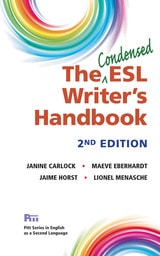
The Condensed ESL Writer's Handbook, 2nd Ed.
Janine Carlock, Maeve Eberhardt, Jaime Horst, and Lionel Menasche
University of Michigan Press, 2018
The Condensed version is concise and easily navigated; is accessible with clear and direct explanatory language; and limits its focus to the grammatical and style aspects of writing and reference material.
The 2nd Edition of The Condensed ESL Writer’s Handbook has been revised to better align with the exercises in Workbook for The ESL Writer’s Handbook, 2nd Ed.(978-0-472-03726-1). It also features an expanded Section 1 (to include more on pre-writing, drafting, revising, and editing), updated exercise items, and completely revised APA and MLA style guides (featuring MLA, 8th Edition). Overall, this handbook has these special features:
- The topic selection is based on ESL writers’ needs as observed by the authors over many years.
- The coverage of topics is more complete than the limited amount usually provided for ESL writers in first language or L1 handbooks.
- The explanatory language is appropriate for ESL students, in contrast to the more complex and idiomatic language of other English handbooks.
- Many of the text examples and exercise sentences were written by ESL students to help users realize that they too can become effective writers.
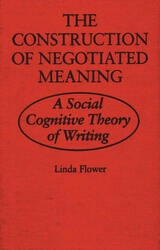
The Construction of Negotiated Meaning
A Social Cognitive Theory of WritingLinda Flower
Southern Illinois University Press, 1994
Based on five years of close observation of students, writing and collaborative planning—the practice in which student writers take the roles of planner and supporter to help each other develop a more rhetorically sophisticated writing plan—foremost cognitive composition researcher Linda Flower redefines writing in terms of an interactive social and cognitive process and proposes a convincing and compelling theory of the construction of negotiated meaning.
Flower seeks to describe how writers construct meaning. Supported by the emerging body of social and cognitive research in rhetoric, education, and psychology, she portrays meaning making as a literate act and a constructive process. She challenges traditional definitions of literacy, adding to that concept the elements of social literate practices and personal literate acts. In Flower’s view, this social cognitive process is a source of tension and conflict among the multiple forces that shape meaning: the social and cultural context, the demands of discourse, and the writer’s own goals and knowledge.
Flower outlines a generative theory of conflict. With this conflict central to her theory of the construction of negotiated meaning, she examines negotiation as an alternative to the metaphors of reproduction and conversation. It is through negotiation, Flower argues, that social expectations, discourse conventions, and the writer’s personal goals and knowledge become inner voices. The tension among these forces often creates the hidden logic behind student writing. In response to these conflicting voices, writers sometimes rise to the active negotiation of meaning, creating meaning in the interplay of alternatives, opportunities, and constraints.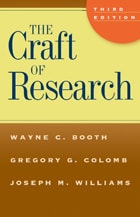
The Craft of Research, Third Edition
Wayne C. Booth, Gregory G. Colomb, and Joseph M. Williams
University of Chicago Press, 2008

The Critical Turn
Rhetoric and Philosophy in Postmodern DiscourseEdited by Ian Angus and Lenore Langsdorf
Southern Illinois University Press, 1992
Concerned with criticizing representational theories of knowledge by developing alternative concepts of knowing and communicating, Ian Angus and Lenore Langsdorf bring together eight essays that are united by a common theme: the convergence of philosophy and rhetoric.
In the first chapter, Angus and Langsdorf illustrate the centrality of critical reasoning to the nature of questioning itself, arguing that human inquiry has entered a "new situation" where "the convictions and orientations that have traditionally marked the separation of rhetoric and philosophy—the concern for truth and the focus on persuasion—have begun to converge on a new space that can be defined through the central term discourse."In these essays, this convergence of rhetoric and philosophy is addressed as it presents itself to a variety of interests that transcend the traditional boundaries of these fields.
The two editors, Raymie E. McKerrow, Michael J. Hyde and Craig R. Smith, James W. Hikins and Kenneth S. Zagacki, Calvin O. Schrag and David James Miller, and Richard L. Lanigan map this new space, recognizing that such mapping "simultaneously constitutes the territory mapped."
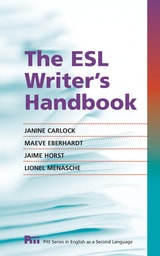
The ESL Writer's Handbook
Janine Carlock, Maeve Eberhardt, Jaime Horst, Lionel Menasche
University of Michigan Press, 2010
The ESL Writer’s Handbook is a reference work for ESL students who are taking college-level courses. Because its purpose is to provide help with the broad variety of writing questions students may have when working on school assignments, the text focuses on
English for Academic Purposes. Unlike other handbooks on the market, this book’s sole purpose is to address the issues of second language learners.
This spiral-bound Handbook complements a student writer’s dictionary, thesaurus, and grammar reference book. It would be suitable as a text for an advanced ESL writing course when used together with the companion Workbook (978-0-472-03404-8). The Handbook is concise and easily navigated; is accessible, with clear and direct explanatory language; features information on both APA and MLA styles (including a sample paper for each); and includes many examples from ESL student writers to provide realistic models.
Included as special features in the Handbook are:
• The topic selection is based on ESL writers’ needs as observed by the authors over many years.
• The coverage of topics is more complete than the limited amount usually provided for ESL writers in first language or L1 handbooks.
• The explanatory language is appropriate for ESL students, in contrast to the more complex and idiomatic language of other English handbooks.
• The level of detail is more manageable for ESL students, compared to what is in other English handbooks.
- Many of the examples of paragraphs, essays, research papers, and exercise sentences were written by ESL students; this encourages users of this Handbook to realize that they can also become effective writers.
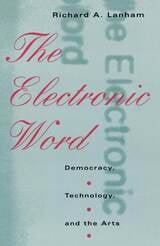
The Electronic Word
Democracy, Technology, and the ArtsRichard A. Lanham
University of Chicago Press, 1993
This highly acclaimed collection of Richard Lanham's witty, provocative, and engaging essays surveys the effects of electronic text on the arts and letters. Lanham explores how electronic text fulfills the expressive agenda of twentieth-century visual art and music, revolutionizes the curriculum, democratizes the instruments of art, and poses anew the cultural accountability of humanism itself.
Persuading us with uncommon grace and power that the move from book to screen gives cause for optimism, not despair, Lanham proclaims that "electronic expression has come not to destroy the Western arts but to fulfill them."
The Electronic Word is also available as a Chicago Expanded Book for your Macintosh®. This hypertext edition allows readers to move freely through the text, marking "pages," annotating passages, searching words and phrases, and immediately accessing annotations, which have been enhanced for this edition. In a special prefatory essay, Lanham introduces the features of this electronic edition and gives a vividly applied critique of this dynamic new edition.
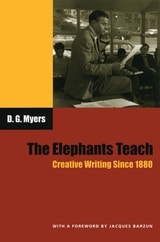
The Elephants Teach
Creative Writing Since 1880David Gershom Myers
University of Chicago Press, 2006
Myers explores more than a century of debate over how writing should be taught and whether it can or should be taught in a classroom at all. Along the way, he incorporates insights from a host of poets and teachers, including Henry Wadsworth Longfellow, Ralph Waldo Emerson, Robert Frost, John Berryman, John Dewey, Lionel Trilling, Robert Lowell, Ezra Pound, and Saul Bellow. And from his exhaustive research, Myers extracts relevant background information on nineteenth-century educational theory; shifts in technology, publishing, and marketing; the growth of critical theory in this country; and the politics of higher education. While he shows how creative writing has become a machine for creating more creative writing programs, Myers also suggests that its history supplies a precedent for something different—a way for creativity and criticism, poetry and scholarship, to join together to produce not just writing programs but good writers.
Updated with fresh commentary on what’s happened to creative writing in the academy since the first edition was published ten years ago, The Elephants Teach will be indispensable for students and teachers of writing, literature, and literary history.
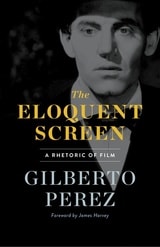
The Eloquent Screen
A Rhetoric of FilmGilberto Perez
University of Minnesota Press, 2019
A lifetime of cinematic writing culminates in this breathtaking statement on film’s unique ability to move us
Cinema is commonly hailed as “the universal language,” but how does it communicate so effortlessly across cultural and linguistic borders? In The Eloquent Screen, influential film critic Gilberto Perez makes a capstone statement on the powerful ways in which film acts on our minds and senses.
Drawing on a lifetime’s worth of viewing and re-viewing, Perez invokes a dizzying array of masters past and present—including Chaplin, Ford, Kiarostami, Eisenstein, Malick, Mizoguchi, Haneke, Hitchcock, and Godard—to explore the transaction between filmmaker and audience. He begins by explaining how film fits into the rhetorical tradition of persuasion and argumentation. Next, Perez explores how film embodies the central tropes of rhetoric––metaphor, metonymy, allegory, and synecdoche––and concludes with a thrilling account of cinema’s spectacular capacity to create relationships of identification with its audiences.
Although there have been several attempts to develop a poetics of film, there has been no sustained attempt to set forth a rhetoric of film—one that bridges aesthetics and audience. Grasping that challenge, The Eloquent Screen shows how cinema, as the consummate contemporary art form, establishes a thoroughly modern rhetoric in which different points of view are brought into clear focus.
The End of Composition Studies
David W. Smit
Southern Illinois University Press, 2007
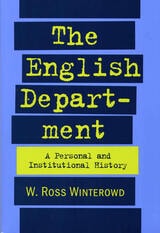
The English Department
A Personal and Institutional HistoryW. Ross Winterowd
Southern Illinois University Press, 1998
Tounderstand the history of "English," Ross Winterowd insists, one must understand how literary studies, composition-rhetoric studies, and influential textbooks interrelate. Stressing the interrelationship among these three forces, Winterowd presents a history of English studies in the university since the Enlightenment.
Winterowd’s history is unique in three ways. First, it tells the whole story of English studies: it does not separate the history of literary studies from that of composition-rhetoric studies, nor can it if it is going to be an authentic history. Second, it traces the massive influence on English studies exerted by textbooks such as Adventures in Literature, Understanding Poetry, English in Action, and the Harbrace College Handbook. Finally, Winterowd himself is very much a part of the story, a partisan with more than forty years of service to the discipline, not simply a disinterested scholar searching for the truth.
After demonstrating that literary studies and literary scholars are products of Romantic epistemology and values, Winterowd further invites controversy by reinterpreting the Romantic legacy inherited by English departments. His reinterpretation of major literary figures and theory, too, invites discussion, possibly argument. And by directly contradicting current histories of composition-rhetoric that allow for no points of contact with literature, Winterowd intensifies the argument by explaining the development of composition-rhetoric from the standpoint of literature and literary theory.
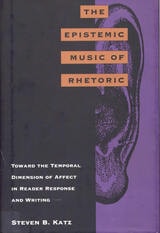
The Epistemic Music of Rhetoric
Toward the Temporal Dimension of Affect in Reader Response and WritingSteven B. Katz
Southern Illinois University Press, 1996
Arguing for an oral theory of Reader Response Criticism, Steven B. Katz conducts a philosophical investigation into the possibility and desirability of teaching reading and writing as rhetorical music.
In the course of this investigation, Katz deals with New Physics, the sophists, Cicero, orality, epistemology, voice, writing, temporality, and sound. He demonstrates that Reader Response Criticism—as part of a new sophistic that has entered the mainstream of pedagogy and practice in our culture—parallels the philosophy of science engendered by the Copenhagen school of New Physics, which theoretically holds that knowledge of subatomic phenomena is probable, relative, contingent, and uncertain, thus requiring more nonformalistic, nonrationalistic methods in understanding and reconstructing it; Katz shows how the same methods are required in the study of affect in reading and writing. Katz also demonstrates that, like New Physics, Reader Response Criticism, in its commitment to interpretation as the primary function and goal of writing about literature, must remain somewhat committed to the formalistic, rationalistic epistemology it seeks to redress.
Basing his oral theory of Reader Response Criticism on notions of language as physical, sensuous, and musical and understanding reception as participatory performance rather that interpretation, Katz suggests a way to reconceptualize Reader Response Criticism. He accounts for "voice," "felt sense," "dissonance," and aesthetic response generally as it is created by the temporal, musical patterns of language, noting that the physical, musical dimension of language has been relatively neglected in contemporary movements in rhetoric, composition, and literature.
Thus, set against the relationship between literature and science, especially between Reader Response Criticism and the philosophy of science engendered by New Physics, Katz examines the sophistic and Ciceronian conceptions of rhetoric. He reinterprets Cicero’s rhetorical theory in light of recent revisionist scholarship on the sophists and reevaluates his assigned position in rhetorical history as neo-Aristotelian by focusing on his oral notions of style as epistemic music. In so doing, Katz offers a new interpretation of Cicero within the sophistic tradition.
Discussing the relationship between sophistic and Ciceronian conceptions of style as an oral, physical, nonrational, indirect form of knowledge and viewing philosophical conceptions of language as sensuous, temporal gestalten or "shapes" in consciousness, Katz suggests that response to and performance of the epistemic music of language can supplement analysis and interpretation in the teaching of reading and writing and can provide less formalistic, less rationalistic foundation for a reader response criticism as a new sophistic.
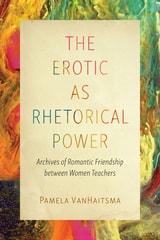
The Erotic as Rhetorical Power
Archives of Romantic Friendship between Women TeachersPamela VanHaitsma
The Ohio State University Press, 2024
Winner, 2025 Marie Hochmuth Nichols Award from the National Communication Association’s Public Address Division
The Erotic as Rhetorical Power offers a queer feminist history of rhetoric that recovers the civic contributions of women teachers in same-sex romantic friendships. Extending perspectives from ancient rhetoric to nineteenth-century progressivism, from Audre Lorde’s Black lesbian feminist theory to its present-day uptakes, Pamela VanHaitsma conceives of the erotic as an interanimation of desires that, in being passionately shared, becomes imbued with the power to forge connection and foment change.
VanHaitsma’s theory of the erotic as rhetorical power emerges from both historiographic and imaginative engagements with more than twenty archives of romantic friendships between women: Sallie Holley and Caroline Putnam, Irene Leache and Anna Wood, Gertrude Buck and Laura Wylie, and Rebecca Primus and Addie Brown. VanHaitsma considers how even as the erotic in these romantic friendships fueled the women’s rhetorical activities toward transformational ends—whether working toward the abolition of slavery, greater educational access, or voting rights—it also energized rhetorical activities that sometimes challenged but also reinforced troubling power dynamics. The Erotic as Rhetorical Power uncovers the erotic’s significance as a conflicted site of power that is central to rhetorical theory and history as well as feminist and LGBTQ+ studies.
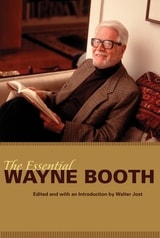
The Essential Wayne Booth
Wayne C. Booth
University of Chicago Press, 2006
While Booth’s work was formative to the study of literature, his essential writings have never been collected in a single volume—until now. Selected by Walter Jost in collaboration with Booth himself, the texts anthologized here present a picture of this indispensable critic’s contributions to literary and rhetorical studies. The selections range from memorable readings of Macbeth, Jane Austen, George Eliot, and Henry James to engagements with Booth’s intellectual heroes, such as Richard McKeon and Mikhail Bakhtin. But rhetoric, Booth’s abiding concern as a critic and thinker, provides the organizing principle of the anthology. The Essential Wayne Booth illuminates the scope of Booth’s rhetorical inquiry: the entire range of resources that human beings share for producing effects on one another. Whether about metaphors for our friendship with books or the two cultures of science and religion, the texts collected here always return to the techniques and ethics of our ways of communicating with each other—that is, to rhetoric.
The Essential Wayne Booth is a capstone to Booth's long career and an eloquent reminder of the ways in which criticism can make us alive to the arts of writing, talking, and listening.