90 books match the query 'Rituals & Practice' and 17 start with t
cover of The Art of Reciting the Qur'an

The Art of Reciting the Qur'an

By Kristina Nelson

University of Texas Press, 1985

For the Muslim faithful, the familiar sound of the Qurʾanic recitation is the predominant and most immediate means of contact with the Word of God. Heard day and night, on the street, in taxis, in shops, in mosques, and in homes, the sound of recitation is far more than the pervasive background music of daily life in the Arab world. It is the core of religious devotion, the sanctioning spirit of much cultural and social life, and a valued art form in its own right. Participation in recitation, as reciter or listener, is itself an act of worship, for the sound is basic to a Muslim’s sense of religion and invokes a set of meanings transcending the particular occasion.

For the most part, Westerners have approached the Qurʾan much as scriptural scholars have studied the Bible, as a collection of written texts. The Art of Reciting the Qurʾan aims at redirecting that focus toward a deeper understanding of the Qurʾan as a fundamentally oral phenomenon. By examining Muslim attitudes toward the Qurʾan, the institutions that regulate its recitation, and performer-audience expectations and interaction, Kristina Nelson, a trained Arabist and musicologist, casts new light on the significance of Qurʾanic recitation within the world of Islam. Her landmark work is of importance to all scholars and students of the modern Middle East, as well as ethnomusicologists, anthropologists, linguists, folklorists, and religious scholars.
[more]
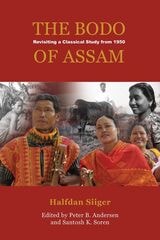
cover of The Bodo of Assam: Revisiting a Classical Study from 1951

The Bodo of Assam

Revisiting a Classical Study from 1951

Halfdan Siiger

National University of Singapore Press, 2015
The Bodo (or Boros) are one of the indigenous tribal peoples of Assam. During colonial times they resisted Christianization and in recent decades they have been involved both in interethnic violence and separatist insurgencies. Much research has gone into understanding the Boros and their aspirations but an issue has been that earlier accounts of this once-animist people are meagre and date from the colonial period. The rediscovery and publication of the ethnographic material based on fieldwork carried out by Halfdan Siiger among the Boros in 1949–50 is thus hugely important. Siiger’s manuscript is unique, offering detailed descriptions of the social and ritual life of the Boros and new insights into the traditions and myths as they were told in the village he studied before the transformation of religious life in recent decades. Thanks to Siiger’s diligent translation and interpretation, the manuscript also preserves a number of ritual formulas and songs in the Boro language. Siiger’s manuscript is given even greater relevance by the inclusion of more recent material contributed by the editors and other contemporary scholars. In addition, his original photos are augmented by new photos from the village and by rare images from the collections of the National Museum of Denmark.
[more]
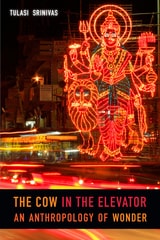
cover of The Cow in the Elevator: An Anthropology of Wonder

The Cow in the Elevator

An Anthropology of Wonder

Tulasi Srinivas

Duke University Press, 2018
In The Cow in the Elevator Tulasi Srinivas explores a wonderful world where deities jump fences and priests ride in helicopters to present a joyful, imaginative, yet critical reading of modern religious life. Drawing on nearly two decades of fieldwork with priests, residents, and devotees, and her own experience of living in the high-tech city of Bangalore, Srinivas finds moments where ritual enmeshes with global modernity to create wonder—a feeling of amazement at being overcome by the unexpected and sublime. Offering a nuanced account of how the ruptures of modernity can be made normal, enrapturing, and even comical in a city swept up in globalization's tumult, Srinivas brings the visceral richness of wonder—apparent in creative ritual in and around Hindu temples—into the anthropological gaze. Broaching provocative philosophical themes like desire, complicity, loss, time, money, technology, and the imagination, Srinivas pursues an interrogation of wonder and the adventure of writing true to its experience. The Cow in the Elevator rethinks the study of ritual while reshaping our appreciation of wonder's transformative potential for scholarship and for life.
[more]
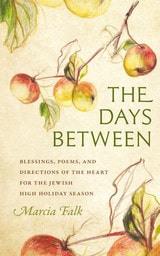
cover of The Days Between: Blessings, Poems, and Directions of the Heart for the Jewish High Holiday Season

The Days Between

Blessings, Poems, and Directions of the Heart for the Jewish High Holiday Season

Marcia Falk

Brandeis University Press, 2014
The Jewish High Holidays—the ten days beginning with the New Year Festival of Rosh Hashanah and culminating with Yom Kippur, the Day of Atonement—constitute the most sacred period of the Jewish year. During this season, religious as well as nonaffiliated Jews attend synagogue services in unparalleled numbers. Yet much of what they find there can be unwelcoming in its patriarchal imagery, leaving many worshipers unsatisfied. For those seeking to connect more deeply with their Judaism, and for all readers in search of a contemplative approach to the themes of the fall season, poet and scholar Marcia Falk re-creates the holidays’ key prayers and rituals from an inclusive perspective. Among the offerings in The Days Between are Hebrew and English blessings for festive meals, prayers for synagogue services, and poems and meditations for quiet reflection. Emphasizing introspection as well as relationship to others, Falk evokes her vision of the High Holidays as “ten days of striving to keep the heart open to change.” Accessible and welcoming to modern readers, The Days Between is steeped in traditional sources and grounded in liturgical and biblical scholarship. It will serve as a meaningful alternative or supplement to the traditional liturgy for individuals, families, synagogues, and communities small and large—that is, for all who seek fresh meaning in the High Holidays.
[more]
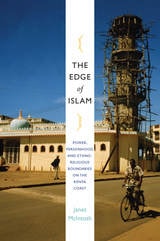
cover of The Edge of Islam: Power, Personhood, and Ethnoreligious Boundaries on the Kenya Coast

The Edge of Islam

Power, Personhood, and Ethnoreligious Boundaries on the Kenya Coast

Janet McIntosh

Duke University Press, 2009

In this theoretically rich exploration of ethnic and religious tensions, Janet McIntosh demonstrates how the relationship between two ethnic groups in the bustling Kenyan town of Malindi is reflected in and shaped by the different ways the two groups relate to Islam. While Swahili and Giriama peoples are historically interdependent, today Giriama find themselves literally and metaphorically on the margins, peering in at a Swahili life of greater social and economic privilege. Giriama are frustrated to find their ethnic identity disparaged and their versions of Islam sometimes rejected by Swahili.

The Edge of Islam explores themes as wide-ranging as spirit possession, divination, healing rituals, madness, symbolic pollution, ideologies of money, linguistic code-switching, and syncretism and its alternatives. McIntosh shows how the differing versions of Islam practiced by Swahili and Giriama, and their differing understandings of personhood, have figured in the growing divisions between the two groups. Her ethnographic analysis helps to explain why Giriama view Islam, a supposedly universal religion, as belonging more deeply to certain ethnic groups than to others; why Giriama use Islam in their rituals despite the fact that so many do not consider the religion their own; and how Giriama appropriations of Islam subtly reinforce a distance between the religion and themselves. The Edge of Islam advances understanding of ethnic essentialism, religious plurality, spirit possession, local conceptions of personhood, and the many meanings of “Islam” across cultures.
[more]
cover of The Enlightened Gene: Biology, Buddhism, and the Convergence that Explains the World

The Enlightened Gene

Biology, Buddhism, and the Convergence that Explains the World

Arri Eisen and Yungdrung Konchok

University Press of New England, 2017

Eight years ago, in an unprecedented intellectual endeavor, the Dalai Lama invited Emory University to integrate modern science into the education of the thousands of Tibetan Buddhist monks and nuns in exile in India. This project, the Emory Tibet Science Initiative, became the first major change in the monastic curriculum in six centuries. Eight years in, the results are transformative. The singular backdrop of teaching science to Tibetan Buddhist monks and nuns offered provocative insights into how science and religion can work together to enrich each other, as well as to shed light on life and what it means to be a thinking, biological human. In The Enlightened Gene, Emory University Professor Dr. Arri Eisen, together with monk Geshe Yungdrung Konchok explore the striking ways in which the integration of Buddhism with cutting-edge discoveries in the biological sciences can change our understanding of life and how we live it. What this book discovers along the way will fundamentally change the way you think. Are humans inherently good? Where does compassion come from? Is death essential for life? Is experience inherited? These questions have occupied philosophers, religious thinkers and scientists since the dawn of civilization, but in today’s political discourse, much of the dialogue surrounding them and larger issues—such as climate change, abortion, genetically modified organisms, and evolution—are often framed as a dichotomy of science versus spirituality. Strikingly, many of new biological discoveries—such as the millions of microbes that we now know live together as part of each of us, the connections between those microbes and our immune systems, the nature of our genomes and how they respond to the environment, and how this response might be passed to future generations—can actually be read as moving science closer to spiritual concepts, rather than further away. The Enlightened Gene opens up and lays a foundation for serious conversations, integrating science and spirit in tackling life’s big questions. Each chapter integrates Buddhism and biology and uses striking examples of how doing so changes our understanding of life and how we lead it.
[more]
cover of The Fatal Embrace: Jews and the State

The Fatal Embrace

Jews and the State

Benjamin Ginsberg

University of Chicago Press, 1993

In this provocative book, Benjamin Ginsberg examines the cycle of Jewish success and anti-Semitic attack throughout the history of the Diaspora, with a concentrated focus on the "special case" of America. For Ginsberg, the essential issue is not anti-Jewish feeling, but the conditions under which such sentiment is likely to be used in the political arena. The Fatal Embrace identifies the political dynamics that, historically, have set the stage for the persecution of Jews.
[more]
cover of The Hajj and the Arts of Pilgrimage: Essays in Honour of Nasser David Khalili

The Hajj and the Arts of Pilgrimage

Essays in Honour of Nasser David Khalili

Edited by Qaisra M. Khan and Nahla Nassar

Gingko, 2023

A comprehensive overview of Hajj, one of the central pillars of Islam.

Hajj and the Arts of Pilgrimage consists of twenty-seven essays addressing objects in the remarkable collection of Nasser David Khalili. The collection features more than five thousand objects relating to the arts of pilgrimage, from the eighth century to today, and includes Qur’ans, illustrated manuscripts, rare books, scientific instruments, textiles, coins, paintings, prints, and photo-postcards, as well as archival material, unique historical documents, and examples of the work of some of the earliest Muslim photographers of Hajj. Together the essays collected in Hajj and the Arts of Pilgrimage provide a comprehensive overview of Hajj, illustrating the religious, spiritual, cultural, and artistic aspects of pilgrimage to the Holy Sanctuaries of Islam and the cosmopolitan nature of Hajj itself. Each essay is written by a prominent specialist in the field and beautifully illustrated with full-color images of objects from the collection, some of which have never been seen in print before. Taking readers from the early history of Islam to the fascinating story of the Western view of Muslim pilgrimage, these essays will transform our perception of Hajj.
 
[more]
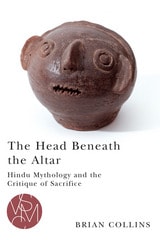
cover of The Head Beneath the Altar: Hindu Mythology and the Critique of Sacrifice

The Head Beneath the Altar

Hindu Mythology and the Critique of Sacrifice

Brian Collins

Michigan State University Press, 2014
In the beginning, says the ancient Hindu text the Rg Veda, was man. And from man’s sacrifice and dismemberment came the entire world, including the hierarchical ordering of human society. The Head Beneath the Altar is the first book to present a wide-ranging study of Hindu texts read through the lens of René Girard’s mimetic theory of the sacrificial origin of religion and culture. For those interested in Girard and comparative religion, the book also performs a careful reading of Girard’s work, drawing connections between his thought and the work of theorists like Georges Dumézil and Giorgio Agamben. Brian Collins examines the idea of sacrifice from the earliest recorded rituals through the flowering of classical mythology and the ancient Indian institutions of the duel, the oath, and the secret warrior society. He also uncovers implicit and explicit critiques in the tradition, confirming Girard’s intuition that Hinduism offers an alternative anti-sacrificial worldview to the one contained in the gospels.
[more]
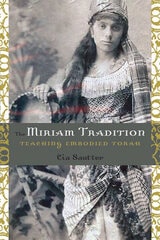
cover of The Miriam Tradition: Teaching Embodied Torah

The Miriam Tradition

Teaching Embodied Torah

Cia Sautter

University of Illinois Press, 2010
The Miriam Tradition works from the premise that religious values form in and through movement, with ritual and dance developing patterns for enacting those values. Cia Sautter considers the case of Sephardic Jewish women who, following in the tradition of Miriam the prophet, performed dance and music for Jewish celebrations and special occasions. She uses rabbinic and feminist understandings of the Torah to argue that these women, called tanyaderas, "taught" Jewish values by leading appropriate behavior for major life events.
 
Sautter considers the religious values that are in music and dance performed by tanyaderas and examines them in conjunction with written and visual records and evidence from dance and music traditions. Explaining the symbolic gestures and motions encoded in dances, Sautter shows how rituals display deeply held values that are best expressed through the body. The book argues that the activities of women in other religions might also be examined for their embodiment and display of important values, bringing forgotten groups of women back into the historical record as important community leaders
[more]
cover of The Mussar Torah Commentary: A Spiritual Path to Living a Meaningful and Ethical Life

The Mussar Torah Commentary

A Spiritual Path to Living a Meaningful and Ethical Life

Rabbi Barry H. Block

Central Conference of American Rabbis, 2020

This Mussar-based commentary is a vital resource for Torah study, offering a thoughtful analysis of each of the 54 weekly parashot. Each essay in this anthology brings a parashah into juxtaposition with one of the Mussar middot (character traits as described within the Jewish school of ethics called Mussar), thereby providing an applied lens of Mussar teachings that helps us to delve deeper into our tradition with increased mindfulness and intention.
 

[more]
cover of The Open Door: A Passover Haggadah

The Open Door

A Passover Haggadah

Rabbi Sue Levi Elwell

Central Conference of American Rabbis, 2002
The Open Door includes traditional and innovative blessings, extensive commentaries and supplemental readings, contemporary additions like Miriam's Cup, women's and men's voices in gender inclusive language, more than 40 pages of traditional and newly commissioned music, and magnificent full color art.
[more]
cover of The Path of Desire: Living Tantra in Northeast India

The Path of Desire

Living Tantra in Northeast India

Hugh B. Urban

University of Chicago Press, 2024

A provocative study of contemporary Tantra as a dynamic living tradition.
 
Tantra, one of the most important religious currents in South Asia, is often misrepresented as little more than ritualized sex. Through a mixture of ethnography and history, Hugh B. Urban reveals a dynamic living tradition behind the sensationalist stories. Urban shows that Tantric desire goes beyond the erotic, encompassing such quotidian experiences as childbearing and healing. He traces these holistic desires through a series of unique practices: institutional Tantra centered on gurus and esoteric rituals; public Tantra marked by performance and festival; folk Tantra focused on magic and personal well-being; and popular Tantra imagined in fiction, film, and digital media. The result is a provocative new description of Hindu Tantra that challenges us to approach religion as something always entwined with politics and culture, thoroughly entangled with ordinary needs and desires.
[more]
cover of The Stranger within Your Gates: Converts and Conversion in Rabbinic Literature

The Stranger within Your Gates

Converts and Conversion in Rabbinic Literature

Gary G. Porton

University of Chicago Press, 1994

If the People of Israel understood themselves to share a common ancestry as well as a common religion, how could a convert to their faith who did not share their ethnicity fit into the ancient Israelite community? While it is comparatively simple to declare religious beliefs, it is much more difficult to enter a group whose membership is defined in ethnic terms. In showing how the rabbis struggled continually with the dual nature of the Israelite community and the dilemma posed by converts, Gary G. Porton explains aspects of their debates which previous scholars have either ignored or minimized.

The Stranger within Your Gates analyzes virtually every reference to converts in the full corpus of rabbinic literature. The intellectual dilemma that converts posed for classical Judaism played itself out in discussions of marriage, religious practice, inheritance of property, and much else. Reviewing the rabbinic literature text by text, Porton exposes the rabbis' frequently ambivalent and ambiguous views.

The Stranger within Your Gates is the only examination of conversion in rabbinic literature to draw upon the full scope of contemporary anthropological and sociological studies of conversion. It is also unique in its focus on the opinions of the community into which the convert enters, rather than on the testimony of the convert. By approaching data with new methods, Porton heightens our understanding of conversion and the nature of the People of Israel in rabbinic literature.

[more]
cover of The Talmud of the Land of Israel, Volume 16: Rosh Hashanah

The Talmud of the Land of Israel, Volume 16

Rosh Hashanah

Jacob Neusner, General Editor

University of Chicago Press, 1988

Edited by the acclaimed scholar Jacob Neusner, this thirty-five volume English translation of the Talmud Yerushalmi has been hailed by the Jewish Spectator as a "project...of immense benefit to students of rabbinic Judaism."
[more]
cover of The Victim and its Masks: An Essay on Sacrifice and Masquerade in the Maghreb

The Victim and its Masks

An Essay on Sacrifice and Masquerade in the Maghreb

Abdellah Hammoudi

University of Chicago Press, 1993
Each year, in a solemn Sunni Muslim feast, the Ait Mizane of southern Morocco reenact the story of Abraham as a ritual sacrifice, a symbolic observance of their submission to the divine. After this sober ceremony comes a bacchanalian masquerade which seems to violate every principle the sacrifice affirmed. Because of the apparent contradiction between sacrifice and masquerade, observers have described the two as entirely separate events. This book reunites them as a single ritual process within Islamic tradition.
[more]
cover of The Year of Mourning: A Jewish Journey

The Year of Mourning

A Jewish Journey

Rabbi Lisa D. Grant, PhD and Cantor Lisa B. Segal

Central Conference of American Rabbis, 2023

The Jewish mourning process is a voyage through pain, brokenness, comfort, resilience, acceptance, and even gratitude. The Year of Mourning: A Jewish Journey offers an expansive array of resources—stories, songs, study texts, poetry, and prayers—to lovingly and patiently guide the bereaved through the first year after their loss. Each week the mourner is encouraged to focus on a particular theme to deepen their Kaddish practice. The book also includes new rituals for shivah, sh’loshim, unveiling, and yahrzeit. The Year of Mourning helps support individuals to regain their grounding after loss and, through the richness of Jewish tradition, deepen their connections to memories of loved ones and to others in the community who are walking a similar path.
[more]