Results by title
67 books match the query 'Romance' and 23 start with t

The Adventures of Lindamira
A Lady of QualityBenjamin Boyce, Editor
University of Minnesota Press, 1949
The Adventures of Lindamira was first published in 1949. Minnesota Archive Editions uses digital technology to make long-unavailable books once again accessible, and are published unaltered from the original University of Minnesota Press editions.
The Adventures of Lindamira, A Lady of Quality. Written by her own hand, to her Friend in the Country. In IV Parts. Revised and Corrected by Mr. Tho. Brown (London, 1702) is a very rare but important and interesting early English novel. This work was reissued in 1713 as The Lover's Secretary: or the Adventures of Lindamira, and again, with the same title, in 1734, 1745, and 1751.
Lindamira is remarkable historically as one of the earliest epistolary novels in English and also as one of the first pieces of extended prose fiction to enter the gap between the risque, realistic romance on one hand and the artificial French romance of court life on the other. The book is entertaining and compares favorably in naturalness, humor, and plausibility with the work of the contemporary Mrs. Behn, Congreve, and even Defoe.
Most historians have been unfamiliar with the work for the good reason that few copies have survived. The British Museum, Yale, University of Pennsylvania, Newberry, and Brown University have copies of the second or later edition. The only known copy of the first edition is in the Library of the University of Minnesota, and it is from this copy of the first edition that the University of Minnesota Press has reprinted this edition.
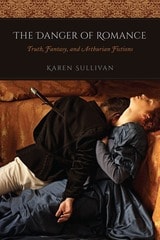
The Danger of Romance
Truth, Fantasy, and Arthurian FictionsKaren Sullivan
University of Chicago Press, 2018
Yet is it possible that romance is expressing a truth—and a truth unrecognized by realist genres? The Arthurian literature of the Middle Ages, Karen Sullivan argues, consistently ventriloquizes in its pages the criticisms that were being made of romance at the time, and implicitly defends itself against those criticisms. The Danger of Romance shows that the conviction that ordinary reality is the only reality is itself an assumption, and one that can blind those who hold it to the extraordinary phenomena that exist around them. It demonstrates that that which is rare, ephemeral, and inexplicable is no less real than that which is commonplace, long-lasting, and easily accounted for. If romance continues to appeal to audiences today, whether in its Arthurian prototype or in its more recent incarnations, it is because it confirms the perception—or even the hope—of a beauty and truth in the world that realist genres deny.
The Dangerous Lover
Gothic Villains, Byronism, and the Nineteenth-Century Seduction NarrativeDeborah Lutz
The Ohio State University Press, 2006
The dangerous lover has haunted our culture for over two hundred years; English, American, and European literature is permeated with his erotic presence. The Dangerous Lover takes seriously the ubiquity of the brooding romantic hero—his dark past, his remorseful and rebellious exile from comfortable everyday living. Deborah Lutz traces the recent history of this figure, through the melancholy iconoclasm of the Romantics, the lost soul redeemed by love of the Brontës, and the tormented individualism of twentieth-century love narratives. Arguing for this character’s central influence not only in literature but also in the history of ideas, this book places the dangerous lover firmly within the philosophy of Martin Heidegger, the Modernism of Georg Lukács, and Roland Barthes’s theories on love and longing. Working with canonical authors such as Ann Radcliffe, Charles Maturin, Lord Byron, Charles Dickens, George Eliot, and Oscar Wilde, and also with non-canonical texts such as contemporary romance, The Dangerous Lover combines a lyrical, essayistic style with a depth of inquiry that raises questions about the mysteries of desire, death, and eroticism.
The Dangerous Lover is the first book-length study of this pervasive literary hero; it also challenges the tendency of sophisticated philosophical readings of popular narratives and culture to focus on male-coded genres. In its conjunction of high and low literary forms, this volume explores new historical and cultural framings for female-coded popular narratives.
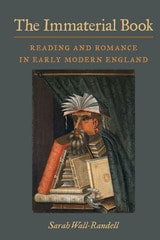
The Immaterial Book
Reading and Romance in Early Modern EnglandSarah Wall-Randell
University of Michigan Press, 2013
In romances—Renaissance England’s version of the fantasy novel—characters often discover books that turn out to be magical or prophetic, and to offer insights into their readers’ selves. The Immaterial Book examines scenes of reading in important romance texts across genres: Spenser’s Faerie Queene, Shakespeare’s Cymbeline and The Tempest, Wroth’s Urania, and Cervantes’ Don Quixote. It offers a response to “material book studies” by calling for a new focus on imaginary or “immaterial” books and argues that early modern romance authors, rather than replicating contemporary reading practices within their texts, are reviving ancient and medieval ideas of the book as a conceptual framework, which they use to investigate urgent, new ideas about the self and the self-conscious mind.
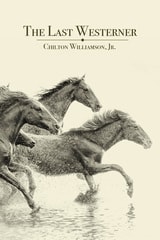
The Last Westerner
Chilton Williamson, Jr.
St. Augustine's Press, 2025
A Finalist for the 2026 Spur Award for Best Western Contemporary Novel, this is a tale of one man's road toward fulfillment that plays out in stages of encounters and abandonment instead of one glorious "last stand" expected in a Western romance. Williamson's story weaves the best elements of several genres and with masterful dialogue he illustrates the landscape of a heart cultivated and ravaged by the challenges that emerge in his path. The majestic setting of the rugged west and its horses is not the main aesthetical context, however. "For [us] women were the whole world and the promise of it, men being hardly more than rivals in love to be challenged and defeated." The Last Westerner is an ode to human happiness embodied in women, and "the kind that comes from a sense of the wholeness, the absolute rightness, of it all." Williamson seems to mean that without women (and horses) no such answers will ever be found. "People without hope don't write books, they say. Neither do men who love women––one woman in particular––lack hope."
Jeb Stuart Ryder, at 51 a retired range detective from Wyoming, meets Jody James, a handsome widowed cowgirl at a horse show in Moab, Utah, where she is exhibiting her prize horse. They begin an idyllic life together until this horse is stolen, and he pledges to pursue the thieves and bring him back to her. Along the way he meets a 16-year-old Navajo boy, John-Wayne Bilagody, who joins the search but with the intention of offering this horse to his own woman. Jeb takes it upon himself to instruct John-Wayne in the proper chivalric attitude a man owes a woman. When they come to the camp of brigada who now possesses the horse, Jeb's world strains to accommodate the existence of Carmen, the beautiful and aristocratic woman who is preparing to lead those men back into Mexico. She has his horse, but his pledge to return it to Jody holds fast. His promise had been a sign of hope, but Jeb at long last arrives at a pass that he knows is the real path to his sunset.
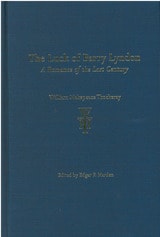
The Luck of Barry Lyndon
A Romance of the Last Century. By Fitz-Boodle.William Makepeace Thackeray
University of Michigan Press, 1999
The Thackeray Edition proudly announces two additions to its collection: Catherine and The Luck of Barry Lyndon. The Thackeray Edition is the first full-scale scholarly edition of William Makepeace Thackeray's works to appear in over seventy years, and the only one ever to be based on an examination of manuscripts and relevant printed texts. It is also a concrete attempt to put into practice a theory of scholarly editing that gives new insight into Thackeray's own compositional process.
The Luck of Barry Lyndon, serialized in Fraser's Magazine in 1844, is a wonderfully hard-edged advance upon Thackeray's previous writing: a tour de force dramatization at novelistic length of the moral vacuity of its first person narrator. The inner workings of this narrator are far more complicated than in earlier Thackeray writings, and are presented in a far more subtle, yet not humorless, manner. The mock-Bildungsroman aspect of the novel is brought about by the non-enlightenment of the title-figure, his failure to find a meaningful love-relationship, and his inability to discover a calling that identifies both a significant direction for his individual existence and, at the same time, an appropriate accommodation to his duties to society. Achieved in brilliant, accomplished style, Barry Lyndon is a significant and progressive experiment in narration for Thackeray.
The Medieval Castle
Romance and RealityKathryn L. Reyerson and Faye Powe, Editors
University of Minnesota Press, 1991
The Medieval Castle was first published in 1991. Minnesota Archive Editions uses digital technology to make long-unavailable books once again accessible, and are published unaltered from the original University of Minnesota Press editions.
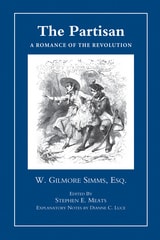
The Partisan
A Romance of RevolutionWilliam Gilmore Simms
University of Arkansas Press, 2011
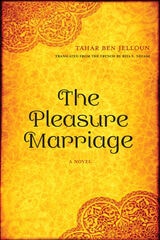
The Pleasure Marriage
A NovelTahar Ben Jelloun; Translated from the French by Rita S. Nezami
Northwestern University Press, 2021
Nabou returns to Fez as Amir’s second wife, weathering the jealous cruelty of Lalla Fatma, his first partner. Isolated within her new home, Nabou gives birth to twin sons, one black and one white, who come of age on the opposite sides of racial, social, and political chasms and who chart vastly different courses. The Pleasure Marriage showcases Ben Jelloun’s mastery of metaphor and lyrical narrative as he continues to take us into the worlds of Moroccan culture through his exquisite language and literary genius.
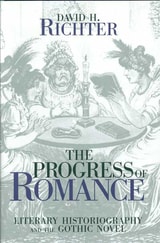
The Progress of Romance
Literary Historiography and the Gothic NovelDavid H. Richter
The Ohio State University Press, 1900

The Romance of Individualism in Emerson and Nietzsche
David Mikics
Ohio University Press, 2027
The great American thinker Ralph Waldo Emerson and the influential German philosopher Friedrich Nietzsche, though writing in different eras and ultimately developing significantly different philosophies, both praised the individual’s wish to be transformed, to be fully created for the first time. Emerson and Nietzsche challenge us to undertake the task of identity on our own, in order to see (in Nietzsche’s phrase) “how one becomes what one is.”
David Mikics’s The Romance of Individualism in Emerson and Nietzsche examines the argument, as well as the affinity, between these two philosophers. Nietzsche was an enthusiastic reader of Emerson and inherited from him an interest in provocation as a means of instruction, an understanding of the permanent importance of moods and transitory moments in our lives, and a sense of the revolutionary character of impulse. Both were deliberately outrageous thinkers, striving to shake us out of our complacency.
Rather than choosing between Emerson and Nietzsche, Mikics attends to Nietzsche’s struggle with Emerson’s example and influence. Elegant in its delivery, The Romance of Individualism in Emerson and Nietzsche offers a significant commentary on the visions of several contemporary theorists whose interests intersect with those of Emerson and Nietzsche, especially Stanley Cavell, Jacques Lacan, Slavoj Zizek, and Harold Bloom.
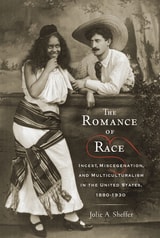
The Romance of Race
Incest, Miscegenation, and Multiculturalism in the United States, 1880-1930Sheffer, Jolie A.
Rutgers University Press, 2013
In the United States miscegenation is not merely a subject of literature and popular culture. It is in many ways the foundation of contemporary imaginary community. The Romance of Race examines the role of minority women writers and reformers in the creation of our modern American multiculturalism.
The national identity of the United States was transformed between 1880 and 1930 due to mass immigration, imperial expansion, the rise of Jim Crow, and the beginning of the suffrage movement. A generation of women writers and reformers—particularly women of color—contributed to these debates by imagining new national narratives that put minorities at the center of American identity. Jane Addams, Pauline Hopkins, Onoto Watanna (Winnifred Eaton), María Cristina Mena, and Mourning Dove (Christine Quintasket) embraced the images of the United States—and increasingly the world—as an interracial nuclear family. They also reframed public debates through narratives depicting interracial encounters as longstanding, unacknowledged liaisons between white men and racialized women that produced an incestuous, mixed-race nation.
By mobilizing the sexual taboos of incest and miscegenation, these women writers created political allegories of kinship and community. Through their criticisms of the nation’s history of exploitation and colonization, they also imagined a more inclusive future. As Jolie A. Sheffer identifies the contemporary template for American multiculturalism in the works of turn-of-the century minority writers, she uncovers a much more radical history than has previously been considered.
The Romance of Tristan and Isolt
Norman B. Spector
Northwestern University Press, 1992
The Romance of Wisconsin Place Names
Robert E. Gard
Wisconsin Historical Society Press, 2015
Fifty years ago, educator and writer Robert E. Gard traveled across Wisconsin, learning the trivial, controversial, and landmark stories behind how cities, counties, and local places got their names. This volume records the fruits of Gard’s labors in an alphabetical listing of places from every corner of Wisconsin, and the stories behind their often-unusual names. Gard’s work provides an important snapshot of how Wisconsin residents of a bygone era came to understand the names of their towns and home places, many of which can no
longer be found on any map.
Celebrated rural historian Jerry Apps introduces this reprint of Gard’s work,
saying that in “some ways The Romance of Wisconsin Place Names is a reference book, a place where you can go to learn a little more about your home town. But in many ways it is much more than that, for it includes the stories of places throughout the state, submitted by the people who knew them. It is a book where story, people, and place all come together.”
The Romance of the Middle Ages
Nicholas Perkins and Alison Wiggins
Bodleian Library Publishing, 2012
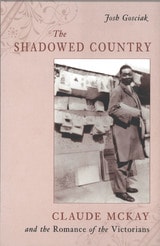
The Shadowed Country
Claude McKay and the Romance of the VictoriansGosciak, Josh
Rutgers University Press, 2006
One of the most important voices of the Harlem Renaissance, Claude McKay is largely recognized for his work during the 1920s, which includes a major collection of poems, Harlem Shadows, as well as a critically acclaimed novel, Home to Harlem. But McKay was never completely comfortable with his literary reputation during this period. Throughout his world travels, he saw himself as an English lyricist.
In this compelling examination of the life and works of this complex poet, novelist, journalist, and short story writer, Josh Gosciak sheds light on McKay’s literary contributions beyond his interactions with Harlem Renaissance artists and writers. Working within English literary traditions, McKay crafted a verse out of hybridity and diaspora. Gosciak shows how he reinvigorated a modern pastoral through his encounters with some of the major aesthetic and political movements of the late Victorian and early modern periods.
Exploring new archival material as well as many of McKay’s lesser known poetic works, TheShadowed Country provides a unique interpretation of the writings of this major author.

The Sorrowful Eyes Of Hannah Karajich
Ivan Olbracht
Central European University Press, 1999
The Sorrowful Eyes of Hannah Karajich is a lyrical, deeply moving story of love and the pain of emancipation, set in the now vanished world of rural East European Jewish village life. Hanna is the most beautiful girl in all Polona, a Hasidic community in the remote province of Sub-Carpathian Ruthenia. Involvement in the exciting new movement of Zionism takes her away to a commune in a nearby town. But there she meets and falls in love with the strangely named Ivo Karajich: a Jew, yet not a Jew. The agonizing drama that follows, plants into her beautiful almond-shaped eyes the hard grain of sorrow that her children, too, will inherit.
Olbracht's novella is both a great love story and a marvellous portrait of a world that modernity threatened and Hitler destroyed.
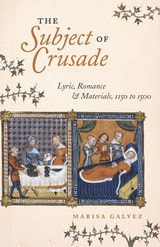
The Subject of Crusade
Lyric, Romance, and Materials, 1150 to 1500Marisa Galvez
University of Chicago Press, 2020
In The Subject of Crusade, Marisa Galvez offers a nuanced view of holy war and crusade poetry, reading these lyric works within a wider conversation with religion and culture. Arguing for an interdisciplinary treatment of crusade lyric, she shows how such poems are crucial for understanding the crusades as a complex cultural and historical phenomenon. Placing them in conversation with chronicles, knightly handbooks, artworks, and confessional and pastoral texts, she identifies a particular “crusade idiom” that emerged out of the conflict between pious and earthly duties. Galvez fashions an expanded understanding of the creative works made by crusaders to reveal their experiences, desires, ideologies, and reasons for taking up the cross.

The Subversion of Romance in the Novels of Barbara Pym
University of Wisconsin Press, 1998
This book seeks to explore how Barbara Pym subverts the discourse of the romance novel through her use of food, clothes, heroine and hero characterizations, and marriage customs.

The Yemassee
A Romance of CarolinaWilliam Gilmore Simms
University of Arkansas Press, 1994
To Zenzi
Robert L. Shuster
New Issues Poetry and Prose, 2021
Shuttling between the insanity of the Führer’s bunker and the chaotic streets, Tobias must contend with a scheming Martin Bormann, a deceitful deserter, the Russian onslaught, and his own compounding despair—all while falling for Zenzi, a girl of Jewish descent (a mischling) who relays secret news of death camps and convinces Tobias to make a treacherous escape to the Americans.
With thrilling risks in plotting and prose, with moments of pathos and absurdity, Shuster richly conjures a mad, tragic world.
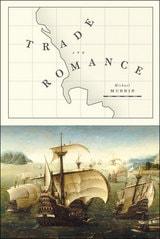
Trade and Romance
Michael Murrin
University of Chicago Press, 2013
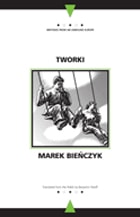
Tworki
Marek Bienczyk
Northwestern University Press, 2008
In Tworki, a village just southwest of Warsaw, there is a psychiatric hospital and in that hospital, the patients and their caretakers are hidden from the war just outside their iron gates. Our hero, Jurek, answers an ad in the paper for a job there and finds himself keeping the books alongside a knockout strawberry blonde named Sonia. They and their group of friends—vital young people like Marcel, an initial rival for Jurek; Olek, Sonia’s chosen love; and Janka, with whom Jurek becomes involved—do their jobs, picnic on the weekends, and dance in the gardens on the grounds of the hospital. Jurek speaks often of, and even in, verse, whether he is talking to his friends or in letters to a distant and admiring cousin. He and his friends live lives that defy the discord and destruction of the war in Europe, striving to rediscover or save whatever beauty they can. Much of this beauty is embodied by Sonia, who is beloved of all the friends and patients at the asylum. But the revitalizing spring they all hope will come for Poland is not to arrive this year. Despite the relative safety of their odd surroundings, the world and the war soon come for the friends. Olek’s absences are longer and unexplained. Marcel is not what he seems, and he and his wife mysteriously disappear, she says, to the gas. And the perfection that Sonia embodies cannot ultimately be kept, by the friends, by the nation, or even by Sonia herself.