Results by title
424 books match the query 'Russian & Soviet' and 105 start with t
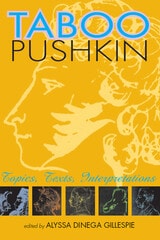
Taboo Pushkin
Topics, Texts, InterpretationsEdited by Alyssa Dinega Gillespie
University of Wisconsin Press, 2012
Since his death in 1837, Alexander Pushkin—often called the “father of Russian literature”—has become a timeless embodiment of Russian national identity, adopted for diverse ideological purposes and reinvented anew as a cultural icon in each historical era (tsarist, Soviet, and post-Soviet). His elevation to mythic status, however, has led to the celebration of some of his writings and the shunning of others. Throughout the history of Pushkin studies, certain topics, texts, and interpretations have remained officially off-limits in Russia—taboos as prevalent in today’s Russia as ever before.
The essays in this bold and authoritative volume use new approaches, overlooked archival materials, and fresh interpretations to investigate aspects of Pushkin’s biography and artistic legacy that have previously been suppressed or neglected. Taken together, the contributors strive to create a more fully realized Pushkin and demonstrate how potent a challenge the unofficial, taboo, alternative Pushkin has proven to be across the centuries for the Russian literary and political establishments.
Testaments
Two Novellas of Emigration and ExileDanuta Mostwin
Ohio University Press, 2005
Translated from Polish by Marta Erdman and Nina Dyke.
Polish émigrés have written poignantly about the pain of exile in letters, diaries, and essays; others, more recently, have recreated Polish-American communities in works of fiction. But it is Danuta Mostwin’s fiction, until now unavailable in English translation, that bridges the divide between Poland and America, exile and emigration.
Mostwin and her husband survived the ravages of World War II, traveled to Britain, and then emigrated to the United States. Mostwin devoted her scholarly career to the study of immigrants trapped between cultural worlds. Winner of international awards for her fiction, Danuta Mostwin here offers two novellas, translated by the late Marta Erdman, which are the first of her works published in English in the United States.
Deeply melancholic and moving in its unsentimental depiction of ordinary people trying to make sense of their uprooted lives, Testaments presents two powerful vignettes of life in immigrant America, The Last Will of Blaise Twardowski and Jocasta. This timely publication provides an introduction to Mostwin’s work that will ensure that she is recognized as the creator of one of the most nuanced and deeply moving pictures of emigration and exile in Polish-American literature.
Testimony after Catastrophe
Narrating the Traumas of Political ViolenceStevan Weine
Northwestern University Press, 2006
A deeply involving, compassionate, occasionally confrontational blend of practical hands-on experience and dialogic theory, emerging from the author's decade-long work in Europe and Chicago with survivors of the Balkan wars, this book is committed to the proposition that efforts to use testimony to address the consequences of political violence can be strengthened--though by no means guaranteed--if they are based on a fuller acknowledgment of the personal and ethical elements embodied in the narrative essence of testimony. These elements are what Testimony after Catastrophe seeks to reveal.
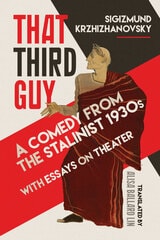
That Third Guy
A Comedy from the Stalinist 1930s with Essays on TheaterSigizmund Krzhizhanovsky, Translated and edited by Alisa Ballard Lin, Foreword by Caryl Emerson
University of Wisconsin Press, 2018
The volume also features selections from Krzhizhanovsky's compelling and idiosyncratic essays on Shakespeare, Pushkin, Shaw, and the philosophy of theater. Professionally, he worked with director Alexander Tairov at the Moscow Kamerny Theater, and his original philosophy of the stage bears comparison with the great theater theorists of the twentieth century. In these writings, he reflects on the space and time of the theater, the resonance of language onstage, the experience of the actor, and the relationship between the theater and the everyday. Commentary by Alisa Ballard Lin and Caryl Emerson contextualizes Krzhizhanovsky's writings.
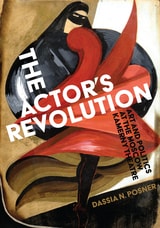
The Actor’s Revolution
Art and Politics at the Moscow Kamerny TheatreDassia N. Posner
Northwestern University Press, 2027
Reclaims the lost history of one of the twentieth century’s most innovative theaters
The Moscow Kamerny Theatre created stage worlds of movement, color, and light. Cofounded in 1914 by Alexander Tairov, a Jewish director from Ukraine, and Alisa Koonen, a Moscow-born actress from an immigrant family, the company celebrated the actor’s virtuosic inventiveness during an era when most theaters imitated daily life or prioritized the autocratic director’s vision. By the 1920s, it had become the most famous Soviet theater in the world, renowned for its actors’ acrobatic grace, its bold collaborations with avant-garde artists, and its revolutionary redefinition of what theater can be. But the accusations of Soviet disloyalty that were used to destroy the Kamerny during Stalin’s post–World War II antisemitic purge have rendered it little known outside Russia today and frequently misunderstood even there.
The Actor’s Revolution vividly reclaims this lost history by reconstructing the theater’s most illustrious premieres, analyzing them within the turbulent artistic and political context of the early Soviet era. Drawing on a decade of archival research, Dassia N. Posner restores Tairov’s legacy as one of history’s most significant directors and celebrates Koonen’s liberatory creative expressiveness as a vital alternative to Konstantin Stanislavsky’s better-known acting system. Building on rich archival sources, from unpublished memoirs to vibrant scenic and costume designs, this timely volume grapples with the entangled histories of art, politics, and erasure and celebrates the radical power of human creativity under—and in spite of—totalitarianism.
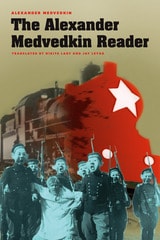
The Alexander Medvedkin Reader
Alexander Medvedkin
University of Chicago Press, 2016
Although he was a dedicated Communist, Medvedkin’s satirical approach and social critiques ultimately led to his suppression by the Soviet regime. State institutions held back or marginalized his work, and for many years, his films were assumed to have been lost or destroyed. These texts, many assembled for this volume by Medvedkin himself, document for the first time his considerable achievements, experiments in film and theater, and attempts to develop satire as a major Soviet film genre. Through scripts, letters, autobiographical writings, and more, we see a Medvedkin supported and admired by figures like Eisenstein, Dovzhenko, and Maxim Gorky.

The Annihilation of Inertia
Dostoevsky and MetaphysicsLiza Knapp
Northwestern University Press, 1996
The Art of Witnessing
Documentary Literature, Film and Theater in Eastern Europe and the BalticsJohanna Lindbladh
Central European University Press, 2026
The Art of Writing Badly
Valentin Kataev's Mauvism and the Rebirth of Russian ModernismRichard C. Borden
Northwestern University Press, 1999
Beginning with a close examination of the work of Kataev, the best-known progenitor of "bad writing," Borden then broadens his study to include the "mauvist creations" of post-Stalinist writers Aksenov, Bitov, Sokolov, Limonov, Evgeny Popov, and Venedikt Erofeev. Borden shows how these writers' shared mauvistic characteristics reveal major philosophical and aesthetic tendencies in contemporary Russian culture, bring to light facets of their writing that have never been discussed, and enrich the readings of the particular texts under discussion.
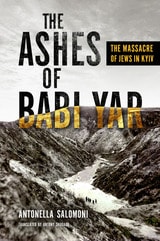
The Ashes of Babi Yar
The Massacre of Jews in KyivAntonella Salomoni, Translated by Antony Shugaar
University of Wisconsin Press, 2025
Beginning with an explication of the mass murders and their aftermath, Antonella Salomoni examines the afterlife of a massacre whose physical remains were intentionally hidden. She focuses especially on how the arts—prose, poetry, music, architecture, and painting—shaped a collective narrative that, despite repression, played a crucial role in preserving the history and memory of the genocide.
The Author as Hero
Self and Tradition in Bulgakov, Pasternak, and NabokovJustin Weir
Northwestern University Press, 2011
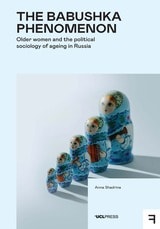
The Babushka Phenomenon
Older Women and the Political Sociology of Ageing in RussiaAnna Shadrina
University College London, 2025
The word “babushka” literally means “grandmother,” but it has come to represent much more since the Soviet era, not least the family caregiver. In her new study, Anna Shadrina explores the marginalization of older women in post-Soviet Russia, shedding light on the complex image of the babushka as both the cornerstone of the family unit and a passive recipient of social benefits. The author argues that this image has been shaped in no small part by welfare cutbacks that shifted the responsibility of family care from the state to individual women, as well as the increasing frustration of working-age people with the post-socialist economic system. Ultimately, she shows that despite being ostracized from society for defying age- and gender-specific social expectations, older women occupy a crucial position as active contributors to the economy.
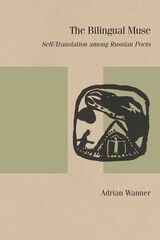
The Bilingual Muse
Self-Translation among Russian PoetsAdrian Wanner
Northwestern University Press, 2020
The Bilingual Muse analyzes the work of seven Russian poets who translated their own poems into English, French, German, or Italian. Investigating the parallel versions of self-translated poetic texts by Vladimir Nabokov, Joseph Brodsky, Andrey Gritsman, Katia Kapovich, Marina Tsvetaeva, Wassily Kandinsky, and Elizaveta Kul’man, Adrian Wanner considers how verbal creativity functions in different languages, the conundrum of translation, and the vagaries of bilingual identities.
Wanner argues that the perceived marginality of self-translation stems from a romantic privileging of the mother tongue and the original text. The unprecedented recent dispersion of Russian speakers over three continents has led to the emergence of a new generation of diasporic Russians who provide a more receptive milieu for multilingual creativity.
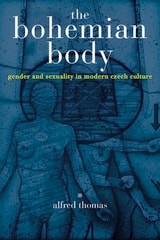
The Bohemian Body
Gender and Sexuality in Modern Czech CultureAlfred Thomas
University of Wisconsin Press, 2007
By re-examining the work of key Czech male and female writers and poets from the National Revival to the Velvet Revolution, Alfred Thomas exposes the tendency of Czech literary criticism to separate the political and the personal in modern Czech culture. He points instead to the complex interplay of the political and the personal across ethnic, cultural, and intellectual lines and within the works of such individual writers as Karel Hynek Mácha, Bozena Nemcová, and Rainer Maria Rilke, resulting in the emergence and evolution of a protean modern identity. The product is a seemingly paradoxical yet nuanced understanding of Czech culture (including literature, opera, and film), long overlooked or misunderstood by Western scholars.

The Bond of the Furthest Apart
Essays on Tolstoy, Dostoevsky, Bresson, and KafkaSharon Cameron
University of Chicago Press, 2017
Whether exploring Bresson’s efforts to reassess the limits of human reason and will, Dostoevsky’s subversions of Christian conventions, Tolstoy’s incompatible beliefs about death, or Kafka’s focus on creatures neither human nor animal, Cameron illuminates how the repeated juxtaposition of disparate, even antithetical, phenomena carves out new approaches to defining the essence of being, one where the very nature of fixed categories is brought into question. An innovative look at a classic French auteur and three giants of European literature, The Bond of the Furthest Apart will interest scholars of literature, film, ethics, aesthetics, and anyone drawn to an experimental venture in critical thought.
The Chekhovian Intertext
Dialogue with a ClassicLyudmila Parts
The Ohio State University Press, 2008
In The Chekhovian Intertext Lyudmila Parts explores contemporary Russian writers’ intertextual engagement with Chekhov and his myth. She offers a new interpretative framework to explain the role Chekhov and other classics play in constructing and maintaining Russian national identity and the reasons for the surge in the number of intertextual engagements with the classical authors during the cultural crisis in post-perestroika Russia.
The book highlights the intersection of three distinct concepts: cultural memory, cultural myth, and intertextuality. It is precisely their interrelation that explains how intertextuality came to function as a defense mechanism of culture, a reaction of cultural memory to the threat of its disintegration.
In addition to offering close readings of some of the most significant short stories by contemporary Russian authors and by Chekhov, as a theoretical case study the book sheds light on important processes in contemporary literature: it explores the function of intertextuality in the development of Russian literature, especially post-Soviet literature; it singles out the main themes in contemporary literature, and explains their ties to national cultural myths and to cultural memory. The Chekhovian Intertext may serve as a theoretical model and impetus for examinations of other national literatures from the point of view of the relationship between intertextuality and cultural memory.

The Conundrum of Russian Capitalism
The Post-Soviet Economy in the World SystemRuslan Dzarasov
Pluto Press, 2013
The Conundrum of Russian Capitalism looks at the nature of Russian capitalism following the fall of the Soviet Union, showing how the system originated in the degenerated Soviet bureaucracy and the pressures of global capital. Ruslan Dzarasov provides a detailed analysis of Russian corporate governance, labour practices and investment strategies.
By comparing the practices of Russian companies to the typical models of corporate governance and investment behaviour of big firms in the West, Dzarasov sheds light on the relationship between the core and periphery of the capitalist world-system.
This groundbreaking study shows that Russia's new capitalism is not a break with the country's Stalinist past, but in fact the continuation of that tradition.
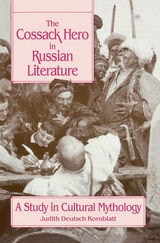
The Cossack Hero in Russian Literature
A Study in Cultural MythologyJudith Deutsch Kornblatt
University of Wisconsin Press, 1992
This is the first book to study the development of the Cossack hero and to identify him as part of Russian cultural mythology. Kornblatt explores the power of the myth as a literary image, providing new and challenging readings of Pushkin, Gogol, Tolstoi, and a host of other writers.
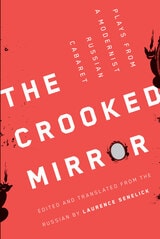
The Crooked Mirror
Plays from a Modernist Russian CabaretEdited and translated from the Russian by Laurence Senelick
Northwestern University Press, 2023
“Don’t blame the mirror if your mug is crooked!”
Parody dominated early twentieth-century Russian cabaret, but the Crooked Mirror extended its lampooning to theatrical practice itself. Eclectic in its targets, the Saint Petersburg theater mocked not only naturalism but also symbolism, futurism, and “Meyerholditis.” Its shows parodied both the stale conventions of melodrama and opera and the stylized trends in staging, wielding satire to provoke artistic and social reform. Though the theater was liquidated in 1931, many of its innovations would become standard techniques in cabaret repertoires and improv revues.
As a cultural phenomenon of the Silver Age, the Crooked Mirror deserves critical attention, yet it has received only fleeting mention in histories of Russian theater and biographies of its major figures. This anthology fills a critical gap in our understanding of that heady era by bringing together key plays—most appearing in English here for the first time—together with short biographies of their authors and robust commentary and annotations. Laurence Senelick guides readers through the artistic and ideological evolution of the Crooked Mirror and provides performers with the material to bring its innovations back to the stage.
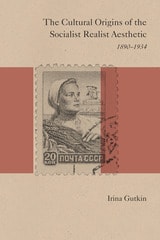
The Cultural Origins of the Socialist Realist Aesthetic
1890-1934Irina Gutkin
Northwestern University Press, 1999
In The Cultural Origins of the Socialist Realist Aesthetic, Irina Gutkin brings together the best work written on the subject to argue that socialist realism encompassed a philosophical worldview that marked thinking in the USSR on all levels: political, social, and linguistic. Using a wealth of diverse cultural material, Gutkin traces the emergence of the central tenants of socialist realist theory from Symbolism and Futurism through the 1920s and 1930s.
The Culture of Neural Networks
Synthetic Literature and Art in (Not Only) the Czech and Slovak ContextZuzana Husárová and Karel Piorecký
Karolinum Press, 2024
The possibilities of generated cultural production have undergone fundamental changes in recent years, leading to a rethinking of existing approaches to the text and the artwork as such. To grasp this process, Zuzana Husárová and Karel Piorecký propose the term “neural network culture,” which captures a wide range of generative practices and reception mechanisms. The Culture of Neural Networks contextualizes the phenomenon of literary texts and other artifacts generated using the latest technological techniques. The generation of literary texts using neural networks is part of a broader cultural process, to which this publication formulates a position through the lens of literary science, media theory, and art theory.
The scholarly debate over this topic has been inconsistent—on the one hand, it underestimates the diachronic connections between generated texts and the tradition of experimental and conceptual literature; on the other hand, it does not sufficiently clarify the new-generation procedures and the contribution of human and technological actors in them. Therefore, Husárová and Piorecký propose the notion of synthetic textual art, which reflects the specific roles of the different actors involved in generative practice and its intermedial nature. In doing so, they approach the topic from both historical and theoretical perspectives, analyzing the current state of generative practice in all three basic literary types and in the intermedial space using selected foreign and Czech-Slovak projects. This state of affairs is often distorted in media discourse and even mythicized in terms of the capabilities of “artificial intelligence”; therefore, a critical analysis of this media discourse is essential. Finally, the authors summarize the implications of this stage in the development of generative practice on creativity theory and literary theory.
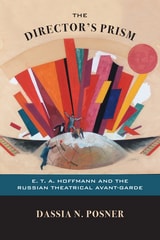
The Director's Prism
E. T. A. Hoffmann and the Russian Theatrical Avant-GardeDassia N. Posner
Northwestern University Press, 2016
Shortlist, 2019 Prague Quadrennial Best Scenography and Design Publication Award
The Director's Prism investigates how and why three of Russia's most innovative directors— Vsevolod Meyerhold, Alexander Tairov, and Sergei Eisenstein—used the fantastical tales of German Romantic writer E. T. A. Hoffmann to reinvent the rules of theatrical practice. Because the rise of the director and the Russian cult of Hoffmann closely coincided, Posner argues, many characteristics we associate with avant-garde theater—subjective perspective, breaking through the fourth wall, activating the spectator as a co-creator—become uniquely legible in the context of this engagement. Posner examines the artistic poetics of Meyerhold's grotesque, Tairov's mime-drama, and Eisenstein's theatrical attraction through production analyses, based on extensive archival research, that challenge the notion of theater as a mirror to life, instead viewing the director as a prism through whom life is refracted. A resource for scholars and practitioners alike, this groundbreaking study provides a fresh, provocative perspective on experimental theater, intercultural borrowings, and the nature of the creative process.
The Elsewhere
On Belonging at a Near DistanceAdam Zachary Newton
University of Wisconsin Press, 2005
The Essential Poetry of Bohdan Ihor Antonych
Ecstasies and ElegiesBohdan Ihor Antonych (1909-1937)
Bucknell University Press, 2024
The Ethics of Witnessing
The Holocaust in Polish Writers' Diaries from Warsaw, 1939-1945Rachel Feldhay Brenner
Northwestern University Press, 2014
Winner, 2015 USC Book Award in Literary and Cultural Studies, for outstanding monograph published on Russia, Eastern Europe or Eurasia in the fields of literary and cultural studies
The Ethics of Witnessing investigates the reactions of five important Polish diaristswriters—Jaroslaw Iwaszkiewicz, Maria Dabrowska, Aurelia Wylezynska, Zofia Nalkowska, and Stanislaw Rembek—during the period when the Nazis persecuted and murdered Warsaw’s Jewish population. The responses to the Holocaust of these prominent prewar authors extended from insistence on empathic interaction with victims to resentful detachment from Jewish suffering. Whereas some defied the dehumanization of the Jews and endeavored to maintain intersubjective relationships with the victims they attempted to rescue, others selfdeceptively evaded the Jewish plight. The Ethics of Witnessing examines the extent to which ideologies of humanism and nationalism informed the diarists’ perceptions, proposing that the reality of the Final Solution exposed the limits of both orientations and ultimately destroyed the ethical landscape shaped by the Enlightenment tradition, which promised the equality and fellowship of all human beings.
The Familiar Letter as a Literary Genre in the Age of Pushkin
William Mills Todd III
Northwestern University Press, 1999
The Fearful Steelpen
Russian Translations of "Ulysses," 1920–1930sNatalia Kamovnikova
University of Massachusetts Press, 2026
Examining how a single book inspired devotion, dread, and lasting superstition in Russian letters
When James Joyce first published Ulysses in 1922, the book enjoyed a hearty welcome in the Soviet Union. In fact, Russian was the second language into which excerpts were translated. However, the early enthusiasm soon gave way to apprehension, and then to public condemnation. The Russian literary community found itself at the epicenter of the political repression of the 1930s, suffering enormous losses among writers and translators, who died en masse through executions and exile. In the context of Ulysses, the numerous violent deaths of its Soviet translators and editors gave rise to rumors, which then developed into superstitious beliefs that managed to outlive their own time. Russian translation scholar Natalia Kamovnikova examines the struggles faced by those who attempted early translations, including death and imprisonment, and how both this translation work and the text itself became sources of fear.
Alongside important background on these early translation attempts, including information on the translators themselves, The Fearful Steelpen unpacks the literary approaches to rendering Joyce’s aesthetics in Russian and traces the socio-political beliefs behind translation and publishing decisions. Kamovnikova goes further, to examine why Ulysses in particular aroused fears in both in its contemporaries and in subsequent generations of Russian writers, as if the text held a dangerous power that could harm those working on it. This fascinating publishing case study reveals the complicated cultural and political dynamics at work behind a seemingly simple translation from one language to another that still resonates in the contemporary moment.
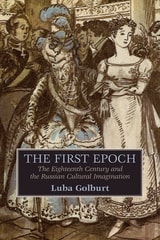
The First Epoch
The Eighteenth Century and the Russian Cultural ImaginationLuba Golburt
University of Wisconsin Press, 2014
Why did nineteenth-century Russians put the eighteenth century so quickly behind them? How does a meaningful present become a seemingly meaningless past? Interpreting texts by Lomonosov, Derzhavin, Pushkin, Viazemsky, Turgenev, Tolstoy, and others, Golburt finds surprising answers, in the process innovatively analyzing the rise of periodization and epochal consciousness, the formation of canon, and the writing of literary history.
Winner, Marc Raeff Book Prize, Eighteenth-Century Russian Studies Association
Winner, Heldt Prize for the Best Book by a Woman in Slavic/Eastern European/Eurasian Studies, Association for Women in Slavic Studies
Winner, Best Book in Literary and Cultural Studies, American Association of Teachers of Slavic and Eastern European Languages
The Gift of Active Empathy
Scheler, Bakhtin, and DostoevskyAlina Wyman
Northwestern University Press, 2016
The Glance of Countess Hahn-Hahn (down the Danube)
Peter Esterhazy
Northwestern University Press, 1999
In The Glance of Countess Hahn-Hahn (down the Danube), Péter Esterházy tells the story of a professional traveler, commissioned--like Marco Polo by Kublai Khan--to undertake a voyage of discovery and prepare a travelogue. Communicating the details of his journey through terse and surreal telegrams, the Traveller weaves a rich tapestry of narratives, evoking the ethereal past and the precarious present of a disappearing world.
The Graphomaniac
A Literary-Historical Discussion of Dmitry KhvostovIlya Vinitsky and James H. McGavran III
Northwestern University Press, 2025
The only Russian Count of Sardinia, Dmitry Ivanovich Khvostov (1757–1835) didn’t achieve fame in his lifetime—he achieved infamy. Pathologically prolific and delusionally dedicated to a craft for which he had no talent, the count was renowned for his compulsive output, driven by a passion for poetry that was as strong as his abilities were weak. Only the country that gave the world Pushkin, however, could produce Khvostov, in whom we find a distorted yet illuminating reflection of his poetic epoch, with all its numerous cultural manifestations and hidden impulses, its desires and prejudices.
As he leads us on a playful journey across Russia’s Golden Age and beyond, from neoclassical salon to faculty lounge, Ilya Vinitsky reflects on the challenges and necessities of literary critique and on the unexpected rewards of bad art as a subject of study, not just ridicule. Mischievous but erudite, sensitive but never self-serious, The Graphomaniac is an intellectual biography of the anti-hero, a cultural figure whose paradoxes yield new insights into his era.
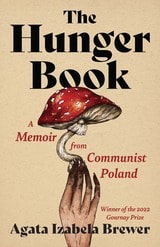
The Hunger Book
A Memoir from Communist PolandAgata Izabela Brewer
The Ohio State University Press, 2023
“A searing memoir about growing up behind the Iron Curtain, motherhood, addiction, and finding sustenance in the natural world.” —Kirkus
In The Hunger Book, Agata Izabela Brewer evokes her Polish childhood under Communism, where the warmth of her grandparents’ love and the scent of mushrooms drying in a tiny apartment are as potent as the deprivations and traumas of life with a terrifyingly unstable, alcoholic single mother. Brewer indelibly renders stories of foraging for food, homemade potato vodka (one of the Eastern Bloc’s more viable currencies), blood sausage, sparrows plucked and fried with linseed oil, and the respite of a country garden plot, all amid Stalinist-era apartment buildings, food shortages, martial law, and nuclear disaster in nearby Ukraine.
Brewer reflects on all of this from her immigrant’s vantage point, as she wryly tries to convince her children to enjoy the mushrooms she gathers from a roadside and grieves when they choose to go by Americanized versions of their Polish names. Hunting mushrooms, like her childhood, carried both reward and mortal peril. The Hunger Book, which includes recipes, is an unforgettable meditation on motherhood and addiction, resilience and love.
The Imperative of Reliability
Russian Prose on the Eve of the Novel, 1820s-1850sVictoria Somoff
Northwestern University Press, 2015
The Imperative of Reliability examines the development of nineteenth-century Russian prose and the remarkably swift emergence of the Russian novel. Victoria Somoff identifies an unprecedented situation in the production and perception of the utterance that came to define nascent novelistic fictionality both in European and Russian prose, where the utterance itself—whether an oral story or a “found” manuscript—became the object of representation within the compositional format of the frame narrative. This circumstance generated a narrative perspective from which both the events and their representation appeared as concomitant in time and space: the events did not precede their narration but rather occurred and developed along with and within the narration itself. Somoff establishes this story-discourse convergence as a major factor in enabling the transition from shorter forms of Russian prose to the full-fledged realist novel.
The Imperial Sublime
A Russian Poetics of EmpireHarsha Ram
University of Wisconsin Press, 2003
The Institutions of Russian Modernism
Conceptualizing, Publishing, and Reading SymbolismJonathan Stone
Northwestern University Press, 2017
The Institutions of Russian Modernism illuminates the key role of Symbolism as the earliest form of modernism in Russia, emerging seemingly ex nihilo at the end of the nineteenth century. Combining book history, periodical studies, and reception theory, Jonathan Stone examines the poetry and theory of Russian Symbolism within the framework of the institutions that organized, published, and disseminated the works to Russian readers. Surveying a wealth of examples of books, journals, and almanacs, Stone traces how publishers of Symbolist works marketed the movement and fashioned a Symbolist reader. His persuasive argument that after its eclipse Symbolism's legacy remained embedded in the heart of Russian modernism will be of interest to scholars and general readers.
The Kingdom of Insignificance
Miron Bialoszewski and the Quotidian, the Queer, and the TraumaticJoanna Nizynska
Northwestern University Press, 2012
In one of the first scholarly book in English on Miron Białoszewski (1922–1983), Joanna Niżyńska illuminates the elusive prose of one of the most compelling and challenging postwar Polish writers. Niżyńska’s study, exemplary in its use of theoretical concepts, introduces English-language readers to a preeminent voice of Polish literature. Niżyńska explores how a fusion of seemingly irreconcilable qualities, such as the traumatic and the everyday, imbues Białoszewski’s writing with its idiosyncratic appeal.
Białoszewski’s A Memoir of the Warsaw Uprising (1977, revised 1991) describes the Poles’ heroic struggle to liberate Warsaw from Nazi occupation in 1944 as harrowing yet ordinary. His later prose represents everyday life permeated by traces of the traumatic. Niżyńska closely examines the topic of autobiography and homosexuality, showing how Białoszewski discloses his homosexuality but, paradoxically, renders it inconspicuous by hiding it in plain sight.
The Letters and the Law
Legal and Literary Culture in Late Imperial RussiaAnna Schur
Northwestern University Press, 2022
Anna Schur combines historical research and literary analysis to argue that the first generations of Russian trial lawyers shaped their professional identity with an eye to the celebrated figure of the writer and that they considered their own activities to be a form of verbal art. A fuller understanding of writers’ antipathy to the law, Schur contends, must take into account this overlooked cultural backdrop. Laced with the better‑known critique of the lawyer’s legalistic proclivities and lack of moral principle are the writer’s reactions to a whole network of explicit and implicit claims of similarity between the two professions’ goals, methods, and missions that were central to the lawyer’s professional ideal. Viewed in this light, writers’ critiques of the law and lawyers emerge as a concerted effort at protecting literature’s exclusive cultural status in the context of modernization and the rapidly expanding public sphere.
The study draws upon a mix of well-known and rarely studied nineteenth-century authors and texts—with particular attention paid to Fyodor Dostoevsky and Mikhail Saltykov-Shchedrin—and on a wide range of nonliterary sources, including courtroom speeches, guides to forensic oratory, legal treatises, and specialized press.
The Life and Work of Fedor Abramov
David Gillespie
Northwestern University Press, 1997
The Life of Arseniev
YouthIvan Bunin
Northwestern University Press, 1994
In ways similar to Nabokov's Speak, Memory, Bunin's novel powerfully evokes the atmosphere of Russia in the decades before the Revolution and illuminates those Russian literary and cultural traditions eradicated in the Soviet era. This first full English-language edition updates earlier translations, taking as its source the version Bunin revised in 1952, and including an introduction and annotations by Andrew Baruch Wachtel.
The Literature of Roguery in Seventeenth and Eighteenth Century Russia
Marcia A. Morris
Northwestern University Press, 2000
The Making of a Man
Aleksandr Aleksandrov, Transsexuality, and Imperial RussiaRuth Averbach
University of Wisconsin Press, 2026
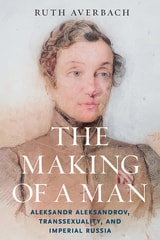
Aleksandr Aleksandrov was an author and soldier in service of the Russian tsar, active in the Prussian theater of the War of the Fourth Coalition (1806–7) and in the Napoleonic Wars. In scholarship, he is better known by his birth name, Nadezhda Andreevna Durova, and often referred to with the female pronouns bestowed upon him at birth. In this first book-length study of Aleksandrov, Ruth Averbach argues that we should understand this celebrated figure of Imperial Russia, whose sex was legally changed by Tsar Aleksandr I, simply as a man, one whose masculinity was intimately connected to the imperialist cause and Russian nationalism.
For the majority of his life, Aleksandrov lived, wrote, and fought as a man and was recognized as such by most of his contemporaries. This contradicts the dominant position in especially Western feminist scholarship, which understands “Durova” either as a woman so patriotic that she dressed as a man to fight Russia’s wars or as a woman so frustrated by gender restrictions that she dramatically sought to cast them aside. Averbach instead asserts that we should take Aleksandrov at his word and accept his transition as genuine. Doing so allows for fresh interpretations of both his autobiographical writings and his works of fiction, interpretations that Averbach deftly shows have salience not just for a single man’s life but also for how we understand masculinity, imperialism, and nationalism in nineteenth-century Russia more broadly.
The Mitki and the Art of Postmodern Protest in Russia
Alexandar Mihailovic
University of Wisconsin Press, 2019
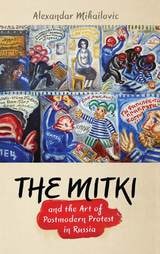
More broadly, Alexandar Mihailovic shows, the Mitki pioneered a form of political protest art that has since become a centerpiece of activism in post-Soviet Russia, most visibly today in groups such as Pussy Riot. He draws on extensive interviews with members of the collective and illuminates their critique of the authoritarian state, militarism, and social strictures from the Brezhnev years to the present.
The Modernist Masquerade
Stylizing Life, Literature, and Costumes in RussiaColleen McQuillen
University of Wisconsin Press, 2013
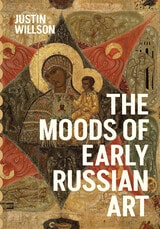
The Moods of Early Russian Art
Justin Willson
University of Chicago Press, 2026
The Moods of Early Russian Art describes an alternative early modernity at the easternmost border of the European cultural sphere, where the Renaissance marked a return not to secular humanism but to the religiosity and art of the Middle Ages. Charting a kind of “Renaissance in reverse,” art historian Justin Willson explores how the value placed on style and virtuosity faded in importance as the Church cultivated miracle-working images during the reigns of Ivan the Great and Ivan the Terrible. Arguing for a broader unity of interests among artistic workshops across the Muscovite landscape—a system of interconnected values that he explains using the language of “moods”—Willson examines icons, illuminated manuscripts, enamelwork, and murals, tracing how the interpretive framework of the age shifted from the “aesthetic” and “literal” moods to the “intoxicated” and “romantic” over the fifteenth and sixteenth centuries.
The Novel in the Age of Disintegration
Dostoevsky and the Problem of Genre in the 1870sKate Holland
Northwestern University Press, 2013
Scholars have long been fascinated by the creative struggles with genre manifested throughout Dostoevsky’s career. In The Novel in the Age of Disintegration, Kate Holland brings historical context to bear, showing that Dostoevsky wanted to use the form of the novel as a means of depicting disintegration brought on by various crises in Russian society in the 1860s. This required him to reinvent the genre. At the same time he sought to infuse his novels with the capacity to inspire belief in social and spiritual reintegration, so he returned to some older conventions of a society that was already becoming outmoded.
In thoughtful readings of Demons, The Adolescent, A Writer’s Diary, and The Brothers Karamazov, Holland delineates Dostoevsky’s struggle to adapt a genre to the reality of the present, with all its upheavals, while maintaining a utopian vision of Russia’s future mission.
The Origins of Russian Literary Theory
Folklore, Philology, FormJessica Merrill
Northwestern University Press, 2022
The Origins of Russian Literary Theory reconstructs lost Formalist theories of authorship, of the psychology of narrative structure, and of the social spread of poetic innovations. According to these theories, literary form is always a product of human psychology and cultural history. By recontextualizing Russian Formalism within this philological paradigm, the book highlights the aspects of Formalism’s legacy that speak to the priorities of twenty-first-century literary studies.
The Philosophy of Parochialism
Radomir Konstantinovic, Edited and with an Introduction by Branislav Jakovljevic, Translation by Ljiljana Nikolic and Branislav Jakovljevic
University of Michigan Press, 2021
The Philosophy of Parochialism is Radomir Konstantinović’s (1928–2011) most celebrated and reviled book. First published in Belgrade as Filosofija palanke in 1969, it attracted keen attention and controversy through its unsparing critique of Serbian and any other nationalism in Yugoslavia and beyond. The book was prophetic, seeming to anticipate not only the bloody disintegration of Yugoslavia in the 1990s, but also the totalitarian turn in politics across the globe in the first decades of the new century. With this translation, English-speaking audiences can at last discover one of the most original writers of eastern European late modernism, and gain an important and original perspective into contemporary politics and culture in the West and beyond. This is a book that seems to age in reverse, as its meanings become deeper and more universal with the passage of time.
Konstantinović’sbookresists easy classification, mixing classical, Montaigne-like essay, prose poetry, novel, and literary history. The word “philosophy” in the book’s title refers to the solitary activity of reflection and critical thinking, and is also paradoxical: according to the author, a defining characteristic of parochialism is precisely its intolerance toward this kind of self-reflexivity. In Konstantinović’s analysis, parochialism is not a simply a characteristic of a geographical region or a cultural, political, and historical formation—these are all just manifestations of the parochial spirit as the spirit of insularity. His book illuminates the current moment, in which insularity undergirds not only ethnic and national divisions, but also dictates the very structure of everyday life, and where individuals can easily find themselves locked in an echo chamber of social media. The Philosophy of Parochialism can help us understand better not only the dead ends of ethnic nationalism and other atavistic ideologies, but also of those cultural forces such as digital technologies that have been built on the promise of overcoming those ideologies.
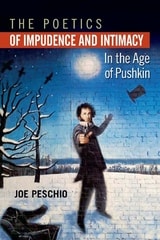
The Poetics of Impudence and Intimacy in the Age of Pushkin
Joe Peschio
University of Wisconsin Press, 2012
Joe Peschio offers the first comprehensive history of a set of associated behaviors known in Russian as “shalosti,” a word which at the time could refer to provocative behaviors like practical joking, insubordination, ritual humiliation, or vandalism, among other things, but also to literary manifestations of these behaviors such as the use of obscenities in poems, impenetrably obscure allusions, and all manner of literary inside jokes. One of the period’s most fashionable literary and social poses became this complex of behaviors taken together. Peschio explains the importance of literary shalosti as a form of challenge to the legitimacy of existing literary institutions and sometimes the Russian regime itself. Working with a wide variety of primary texts—from verse epistles to denunciations, etiquette manuals, and previously unknown archival materials—Peschio argues that the formal innovations fueled by such “prankish” types of literary behavior posed a greater threat to the watchful Russian government and the literary institutions it fostered than did ordinary civic verse or overtly polemical prose.
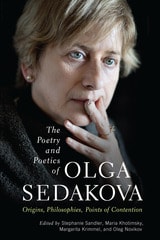
The Poetry and Poetics of Olga Sedakova
Origins, Philosophies, Points of ContentionEdited by Stephanie Sandler, Maria Khotimsky, Margarita Krimmel, and Oleg Novikov
University of Wisconsin Press, 2019
Essayists from Russia, Ukraine, Germany, Italy, and the United States show how Sedakova has contributed to ongoing aesthetic and cultural debates. Like Sedakova's own work, the volume affirms the capacity of words to convey meaning and to change our understanding of life itself. The volume also includes dozens of elegant new translations of Sedakova's poems.
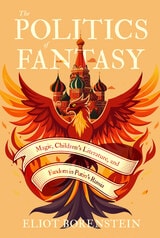
The Politics of Fantasy
Magic, Children's Literature, and Fandom in Putin's RussiaEliot Borenstein
University of Wisconsin Press, 2025
With crisp, engaging prose, Eliot Borenstein leaps from Harry Potter into an exploration of the culture wars and moral panics sparked in Russia by Western-inspired children’s literature, extending back into the Soviet period and through the invasion of Ukraine. As cultural products pitched ostensibly to children, the Harry Potter books and films became the perfect objects for criticism, translation, adaptation, parody, attack, mimicry, and meme-making, allowing Russians to carve out their own space in the worldwide market of magical multiverses.