Results by title
74 books match the query 'Russian literature' and 18 start with t
The Chekhovian Intertext
Dialogue with a ClassicLyudmila Parts
The Ohio State University Press, 2008
In The Chekhovian Intertext Lyudmila Parts explores contemporary Russian writers’ intertextual engagement with Chekhov and his myth. She offers a new interpretative framework to explain the role Chekhov and other classics play in constructing and maintaining Russian national identity and the reasons for the surge in the number of intertextual engagements with the classical authors during the cultural crisis in post-perestroika Russia.
The book highlights the intersection of three distinct concepts: cultural memory, cultural myth, and intertextuality. It is precisely their interrelation that explains how intertextuality came to function as a defense mechanism of culture, a reaction of cultural memory to the threat of its disintegration.
In addition to offering close readings of some of the most significant short stories by contemporary Russian authors and by Chekhov, as a theoretical case study the book sheds light on important processes in contemporary literature: it explores the function of intertextuality in the development of Russian literature, especially post-Soviet literature; it singles out the main themes in contemporary literature, and explains their ties to national cultural myths and to cultural memory. The Chekhovian Intertext may serve as a theoretical model and impetus for examinations of other national literatures from the point of view of the relationship between intertextuality and cultural memory.
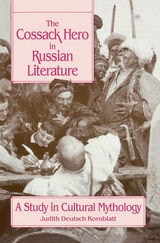
The Cossack Hero in Russian Literature
A Study in Cultural MythologyJudith Deutsch Kornblatt
University of Wisconsin Press, 1992
This is the first book to study the development of the Cossack hero and to identify him as part of Russian cultural mythology. Kornblatt explores the power of the myth as a literary image, providing new and challenging readings of Pushkin, Gogol, Tolstoi, and a host of other writers.
The First Epoch
The Eighteenth Century and the Russian Cultural ImaginationLuba Golburt
University of Wisconsin Press, 2014
Why did nineteenth-century Russians put the eighteenth century so quickly behind them? How does a meaningful present become a seemingly meaningless past? Interpreting texts by Lomonosov, Derzhavin, Pushkin, Viazemsky, Turgenev, Tolstoy, and others, Golburt finds surprising answers, in the process innovatively analyzing the rise of periodization and epochal consciousness, the formation of canon, and the writing of literary history.
Winner, Marc Raeff Book Prize, Eighteenth-Century Russian Studies Association
Winner, Heldt Prize for the Best Book by a Woman in Slavic/Eastern European/Eurasian Studies, Association for Women in Slavic Studies
Winner, Best Book in Literary and Cultural Studies, American Association of Teachers of Slavic and Eastern European Languages
The Imperial Sublime
A Russian Poetics of EmpireHarsha Ram
University of Wisconsin Press, 2003
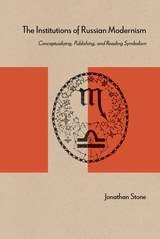
The Institutions of Russian Modernism
Conceptualizing, Publishing, and Reading SymbolismJonathan Stone
Northwestern University Press, 2017
The Institutions of Russian Modernism illuminates the key role of Symbolism as the earliest form of modernism in Russia, emerging seemingly ex nihilo at the end of the nineteenth century. Combining book history, periodical studies, and reception theory, Jonathan Stone examines the poetry and theory of Russian Symbolism within the framework of the institutions that organized, published, and disseminated the works to Russian readers. Surveying a wealth of examples of books, journals, and almanacs, Stone traces how publishers of Symbolist works marketed the movement and fashioned a Symbolist reader. His persuasive argument that after its eclipse Symbolism's legacy remained embedded in the heart of Russian modernism will be of interest to scholars and general readers.
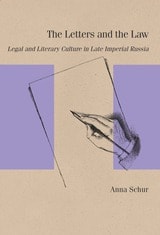
The Letters and the Law
Legal and Literary Culture in Late Imperial RussiaAnna Schur
Northwestern University Press, 2022
Anna Schur combines historical research and literary analysis to argue that the first generations of Russian trial lawyers shaped their professional identity with an eye to the celebrated figure of the writer and that they considered their own activities to be a form of verbal art. A fuller understanding of writers’ antipathy to the law, Schur contends, must take into account this overlooked cultural backdrop. Laced with the better‑known critique of the lawyer’s legalistic proclivities and lack of moral principle are the writer’s reactions to a whole network of explicit and implicit claims of similarity between the two professions’ goals, methods, and missions that were central to the lawyer’s professional ideal. Viewed in this light, writers’ critiques of the law and lawyers emerge as a concerted effort at protecting literature’s exclusive cultural status in the context of modernization and the rapidly expanding public sphere.
The study draws upon a mix of well-known and rarely studied nineteenth-century authors and texts—with particular attention paid to Fyodor Dostoevsky and Mikhail Saltykov-Shchedrin—and on a wide range of nonliterary sources, including courtroom speeches, guides to forensic oratory, legal treatises, and specialized press.
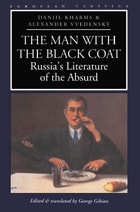
The Man with the Black Coat
Russia's Literature of the AbsurdDaniil Kharms and Alexander Vvedensky
Northwestern University Press, 1997
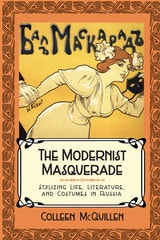
The Modernist Masquerade
Stylizing Life, Literature, and Costumes in RussiaColleen McQuillen
University of Wisconsin Press, 2013
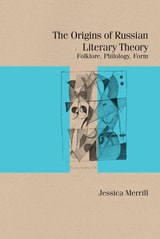
The Origins of Russian Literary Theory
Folklore, Philology, FormJessica Merrill
Northwestern University Press, 2022
The Origins of Russian Literary Theory reconstructs lost Formalist theories of authorship, of the psychology of narrative structure, and of the social spread of poetic innovations. According to these theories, literary form is always a product of human psychology and cultural history. By recontextualizing Russian Formalism within this philological paradigm, the book highlights the aspects of Formalism’s legacy that speak to the priorities of twenty-first-century literary studies.
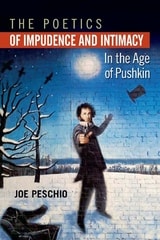
The Poetics of Impudence and Intimacy in the Age of Pushkin
Joe Peschio
University of Wisconsin Press, 2012
Joe Peschio offers the first comprehensive history of a set of associated behaviors known in Russian as “shalosti,” a word which at the time could refer to provocative behaviors like practical joking, insubordination, ritual humiliation, or vandalism, among other things, but also to literary manifestations of these behaviors such as the use of obscenities in poems, impenetrably obscure allusions, and all manner of literary inside jokes. One of the period’s most fashionable literary and social poses became this complex of behaviors taken together. Peschio explains the importance of literary shalosti as a form of challenge to the legitimacy of existing literary institutions and sometimes the Russian regime itself. Working with a wide variety of primary texts—from verse epistles to denunciations, etiquette manuals, and previously unknown archival materials—Peschio argues that the formal innovations fueled by such “prankish” types of literary behavior posed a greater threat to the watchful Russian government and the literary institutions it fostered than did ordinary civic verse or overtly polemical prose.
The Trace of Judaism
Dostoevsky, Babel, Mandelstam, LevinasVal Vinokur
Northwestern University Press, 2009
The defining quality of Russian literature, for most critics, is its ethical seriousness expressed through formal originality. The Trace of Judaism addresses this characteristic through the thought of the Lithuanian-born Franco-Jewish philosopher Emmanuel Levinas. Steeped in the Russian classics from an early age, Levinas drew significantly from Dostoevsky in his ethical thought. One can profitably read Russian literature through Levinas, and vice versa.
The Translator in the Text
On Reading Russian Literature in EnglishRachel May
Northwestern University Press, 1994

The Unlikely Futurist
Pushkin and the Invention of Originality in Russian ModernismJames Rann
University of Wisconsin Press, 2020
Through systematic and detailed readings of Futurist texts, James Rann offers the first book-length study of the tensions between the outspoken literary group and the great national poet. He observes how those in the movement engaged with and invented a new Pushkin, who by turns became a founding father to rebel against, a source of inspiration to draw from, a prophet foreseeing the future, and a monument to revive.
Rann's analysis contributes to the understanding of both the Futurists and Pushkin's complex legacy. The Unlikely Futurist will appeal broadly to scholars of Slavic studies, especially those interested in literature and modernism.
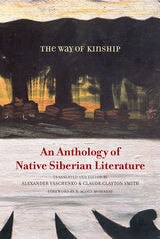
The Way of Kinship
An Anthology of Native Siberian LiteratureAlexander Vaschenko
University of Minnesota Press, 2010
The first anthology of Native Siberian literature in English, The Way of Kinship represents writers from regions extending from the Ob River in the west to the Chukotka peninsula, the easternmost point of the Siberian Russian Arctic. Drawn from seven distinct ethnic groups, this diverse body of work-prose fiction, poetry, drama, and creative nonfiction-chronicles ancient Siberian cultures and traditions threatened with extinction in the contemporary world.
Translated and edited by Alexander Vaschenko and Claude Clayton Smith, leading scholars in Native Siberian literature, The Way of Kinship is an essential collection that will introduce readers to new writers and new worlds.
The Writer in Petrograd and the House of Arts
Martha Weitzel Hickey
Northwestern University Press, 2009
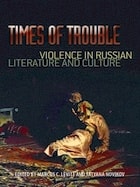
Times of Trouble
Violence in Russian Literature and CultureEdited by Marcus C. Levitt and Tatyana Novikov
University of Wisconsin Press, 2007
From the country that has added to our vocabulary such colorful terms as "purges," "pogroms," and "gulag," this collection investigates the conspicuous marks of violence in Russian history and culture.
Russians and non-Russians alike have long debated the reasons for this endemic violence. Some have cited Russia's huge size, unforgiving climate, and exposed geographical position as formative in its national character, making invasion easy and order difficult. Others have fixed the blame on cultural and religious traditions that spurred internecine violence or on despotic rulers or unfortunate episodes in the nation's history, such as the Mongol invasion, the rule of Ivan the Terrible, or the "Red Terror" of the revolution. Even in contemporary Russia, the specter of violence continues, from widespread mistreatment of women to racial antagonism, the product of a frustrated nationalism that manifests itself in such phenomena as the wars in Chechnya.
Times of Trouble is the first in English to explore the problem of violence in Russia. From a variety of perspectives, essays investigate Russian history as well as depictions of violence in the visual arts and in literature, including the works of Fyodor Dostoevsky, Isaac Babel, Mikhail Lermontov, and Nina Sadur. From the Mongol invasion to the present day, topics include the gulag, genocide, violence against women, anti-Semitism, and terrorism as a tool of revolution.
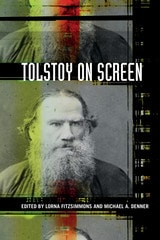
Tolstoy on Screen
Edited by Lorna Fitzsimmons and Michael A. Denner
Northwestern University Press, 2015
Scholarship on screen adaptation has proliferated in recent years, but it has remained largely focused on English- and Romance-language authors. Tolstoy on Screen aims to correct this imbalance with a comprehensive examination of film and television adaptations of Tolstoy’s fiction. Spanning the silent era to the present day, these essays consider well-known as well as neglected works in light of contemporary adaptation and media theory. The book is organized to facilitate a comparative, cross-cultural understanding of the various practices employed in different eras and different countries to bring Tolstoy’s writing to the screen. International in scope and rigorous in analysis, the essays cast new light on Tolstoy’s work and media studies alike.
Toxic Voices
The Villain from Early Soviet Literature to Socialist RealismEric Laursen
Northwestern University Press, 2013