Results by title
64 books match the query 'Sacred Writings' and 35 start with t
The Bhagavadgita in the Mahabharata
Edited by J. A. B. van Buitenen
University of Chicago Press, 1981
The Bhagavadgita ("Song of the Lord") tells of the young and virtuous Prince Arjuna who is driven to lead his forces into battle against an opposing army composed of close relatives and others whom he loves. The Lord Krsna, appearing in the poem as Arjuna's friend and charioteer, persuades him that he must do battle, and we see Arjuna changing from revulsion at the thought of killing members of his family to resignation and awareness of duty, to manly acceptance of his role as warrior and defender of his kingdom.
The Bhagavadgita is a self-contained episode in the Mahabharata, a vast collection of epics, legends, romances, theology, and metaphysical doctrine that reflects the history and culture of the whole of Hindu civilization. The present edition forms a part of J. A. B. van Buitenen's widely acclaimed translation of this great work. Here English and Sanskrit are printed on facing pages, enabling those with some knowledge of Sanskrit to appreciate van Buitenen's accurate rendering of the intimate, familial tone and directness of the original poem.
The Birth of Doubt
Confronting Uncertainty in Early Rabbinic LiteratureMoshe Halbertal
SBL Press, 2020
A systematic attempt to understand the rabbinic world through its approach to confronting uncertainty
In the history of halakhah, the treatment of uncertainty became one of the most complex fields of intense study. In his latest book, Moshe Halbertal focuses on examining the point of origin of the study of uncertainty in early rabbinic literature, including the Mishnah, Tosefta, and halakhic midrashim. Halbertal explores instructions concerning how to behave in situations of uncertainty ranging from matters of ritual purity, to lineage and marriage, to monetary law, and to the laws of forbidden foods. This examination of the rules of uncertainty introduced in early rabbinic literature reveals that these rules were not aimed at avoiding but rather at dwelling in the midst of uncertainty, thus rejecting the sectarian isolationism that sought to minimize a community’s experience of and friction with uncertainty.
Features:
- A thorough investigation of the principles concerning how to behave in cases of uncertainty
- An examination of two distinct modes for coping with uncertainty
The Community Rule
A Critical Edition with TranslationSarianna Metso
SBL Press, 2019
An authoritative critical edition
The discovery and translation of the Dead Sea Scrolls transformed our understanding of the life and history of ancient Jewish communities when both rabbinic Judaism and early Christianity were emerging. As part of this rich discovery, the Community Rule serves to illuminate the religious beliefs and practices as well as the organizational rules of the group behind the Dead Sea Scrolls. However, there is no single, unified text of the Community Rule; rather, multiple manuscripts of the Community Rule show considerable variation and highlight the work of ancient Jewish scribes and their intentional literary development of the text. In this volume, Sarianna Metso brings together the surviving evidence in a new edition that presents a critically established Hebrew text with an introduction and an English translation.
Features:
- A critical apparatus and textual notes
- All the surviving evidence of the Community Rule
- A new method for presenting complex developments and transmission history of ancient texts

The Dead Sea Scrolls in Scholarly Perspective
A History of ResearchDevorah Dimant
SBL Press, 2016
Now in paperback!
The volume covers Qumran scholarship in separate countries: the USA, Canada, Israel, France, Germany, Spain, the Netherlands, Scandinavia, Italy, and Eastern Europe. Each essay carries a detailed bibliography for the respective country. Biographies of all the major scholars active in the field are briefly given as well. This book thereby exhaustively surveys past and present Qumran research, outlining its particular development in various circumstances and national contexts. For the first time, perspectives and information not recorded in any other publication are highlighted.
Features:
The Economics of the Mishnah
Jacob Neusner
University of Chicago Press, 1990
The Economics of the Mishnah is the first book to examine the place of economic theory generally in the Judaic system of the Mishnah. Jacob Neusner begins by surveying previous work on economics and Judaism, the best known being Werner Sombart's The Jews and Modern Capitalism. The mistaken notion that Jews have had a common economic history has outlived the demise of Sombart's argument, and it is a notion that Neusner overturns before discussing the Mishnaic economics.
Only in Aristotle, Neusner argues, do we find an equal to the Mishnah's accomplishment in engaging economics in the service of a larger systemic statement. Neusner shows that the framers of the Mishnah imagined a distributive economy functioning through the Temple and priesthood, while also legislating for the action of markets. The economics of the Mishnah, then, is to some extent a mixed economy. The dominant, distributive element in this mixed economy, Neusner contends, derives from the belief that the Temple and its designated castes on earth exercise God's claim to the ownership of the holy land. He concludes by considering the implications of the derivation of the Mishnah's economics from the interests of the undercapitalized and overextended farmer.
The Exegetical Value of the Masoretic Pointing
Jan Joosten
SBL Press, 2020
The Guide of the Perplexed
Complete in One VolumeMoses Maimonides
University of Chicago Press, 1963
The twelfth-century Judeo-Arabic text The Guide of the Perplexed is a monument of rabbinical exegesis and one of the most important works in the history of Jewish thought. Written by Moses ben Maimon,commonly known as Maimonides, the Guide aims to liberate people from the perplexities that arise from an understanding of the Bible based only on its literal meaning.
Shlomo Pines’s translation has served students and scholars for decades, and it is presented here, with Leo Strauss’s influential introduction, in one volume for the first time.
The Heart Sutra
Revisiting Its Texts, History, and MeaningHenry C.H. Shiu
Hong Kong University Press, 2025
A nuanced reconsideration of the Heart Sutra, one of the most celebrated and widely chanted texts in Mahayana Buddhism.
In The Heart Sutra: Revisiting Its Texts, History, and Meaning, Henry C. H. Shiu investigates the historical origins of the Heart Sutra, a significant Buddhist scripture. He compares the Sanskrit texts with their Chinese and Tibetan translations to analyse whether the Heart Sutra might be a Chinese apocryphon, through detailed linguistic examination. To achieve this goal, Shiu thoroughly examines the primary sources from which the scripture was extracted. He emphasises the necessity of reading the Heart Sutra in the larger context of the Perfection of Wisdom literature, which contains the essence of Mahayana Buddhist teaching. In this monograph, Shiu successfully transcends the boundaries between the Chinese, Indian, and Tibetan Buddhist traditions and provides a revisionist interpretation of the Heart Sutra.
The Hodayot (Thanksgiving Psalms)
A Study Edition of 1QHaEileen M. Schuller
SBL Press, 2012
The Jewish Middle Ages
Carol Bakhos
SBL Press, 2023
For many, the Middle Ages in general evokes a sense of the sinister and brings to mind a world of fear, superstition, and religious fanaticism. For Jews it was a period marked by persecutions, pogroms, and expulsions. Yet at the same time, the Middle Ages was also a time of lively cultural exchange and heightened creativity for Jews. In The Jewish Middle Ages, contributors explore the ways in which the stories of biblical women, including, Eve, Sarah, Hagar, Rebekah, Zipporah, Ruth, Esther, and Judith, make their way into the rich tapestry of medieval Jewish literature, mystical texts, and art, particularly in works emanating from Ashkenazic circles. Contributors include Carol Bakhos, Judith R. Baskin, Elisheva Baumgarten, Dagmar Börner-Klein, Constanza Cordoni, Rachel Elior, Meret Gutmann-Grün, Robert A. Harris, Yuval Katz-Wilfing, Sheila Tuller Keiter, Katrin Kogman-Appel, Gerhard Langer, Aurora Salvatierra Ossorio, and Felicia Waldman. These essays give us a glimpse into the role women played and the authority they assumed in medieval Jewish culture beyond the rabbinic centers of Palestine and Babylonia.

The Madman's Middle Way
Reflections on Reality of the Tibetan Monk Gendun ChopelDonald S. Lopez Jr.
University of Chicago Press, 2005
The Madman’s Middle Way presents the first English translation of this major Tibetan Buddhist work, accompanied by an essay on Gendun Chopel’s life liberally interspersed with passages from his writings. Donald S. Lopez Jr. also provides a commentary that sheds light on the doctrinal context of the Adornment and summarizes its key arguments. Ultimately, Lopez examines the long-standing debate over whether Gendun Chopel in fact is the author of the Adornment; the heated critical response to the work by Tibetan monks of the Dalai Lama’s sect; and what the Adornment tells us about Tibetan Buddhism’s encounter with modernity. The result is an insightful glimpse into a provocative and enigmatic workthatwill be of great interest to anyone seriously interested in Buddhism or Asian religions.
The Mahabharata, Volume 1
Book 1: The Book of the BeginningEdited by J. A. B. van Buitenen
University of Chicago Press, 1974
The Mahabharata, Volume 2
Book 2: The Book of Assembly; Book 3: The Book of the ForestEdited by J. A. B. van Buitenen
University of Chicago Press, 1975
The Mahabharata, Volume 3
Book 4: The Book of the Virata; Book 5: The Book of the EffortEdited by J. A. B. van Buitenen
University of Chicago Press, 1978
The Mahabharata, Volume 7
Book 11: The Book of the Women Book 12: The Book of Peace, Part 1Edited by James L. Fitzgerald
University of Chicago Press, 2004
What is not in this epic is nowhere else.
—from The Mahabharata
The second longest poem in world literature, The Mahabharata is an epic tale, replete with legends, romances, theology, and metaphysical doctrine written in Sanskrit. One of the foundational elements in Hindu culture, this great work consists of nearly 75,000 stanzas in eighteen books, and this volume marks the much anticipated resumption of its first complete modern English translation. With the first three volumes, the late J. A. B. van Buitenen had taken his translation up to the threshold of the great war that is central to the epic. Now James Fitzgerald resumes this work with translations of the books that chronicle the wars aftermath: The Book of Women and part one of The Book of Peace. These books constitute volume 7 of the projected ten-volume edition. Volumes 4, 5, 6, 8, 9, and 10 of the series will be published over the next several years.
In his introductions to these books, Fitzgerald examines the rhetoric of The Mahabharatas representations of the wars aftermath. Indeed, the theme of The Book of Women is the grief of the women left by warriors slain in battle. The book details the keening of palace ladies as they see their dead husbands and sons, and it culminates in a mass cremation where the womens tears turn into soothing libations that help wash the deaths away. Fitzgerald shows that the portrayal of the womens grief is much more than a sympathetic portrait of the sufferings of war. The scenes of mourning in The Book of Women lead into a crisis of conscience that is central to The Book of Peace and, Fitzgerald argues, the entire Mahabharata. In this book, the man who has won power in the great war is torn between his own sense of guilt and remorse and the obligation to rule which ultimately he is persuaded to embrace.
The Mahabharata is a powerful work that has inspired awe and wonder for centuries. With a penetrating glimpse into the trauma of war, this volume offers two of its most timely and unforgettable chapters.
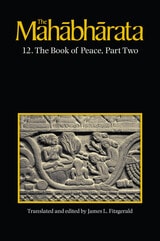
The Mahabharata, Volume 8
Book 12, The Book of Peace, Part 2Translated and Edited by James L. Fitzgerald
University of Chicago Press, 2026
A remarkable composition of 100,000 couplets, The Mahābhārata is the second-longest poem in world literature. In this volume, James L. Fitzgerald completes his translation of the twelfth of The Mahābhārata’s eighteen books, the vast Shanti Parvan, or The Book of Peace. Covering a wide range of ancient Indian intellectual history, The Book of Peace was intended to serve as a comprehensive, brahmin-inspired basis for living a Good Life in a Good Society in a Good Polity and is one of the most important and complex books of the poem.
Fitzgerald’s previous contribution to the Chicago edition of The Mahābhārata, volume 7, opened with Book 11, The Book of the Women, which movingly portrayed the grief of the wives, mothers, and sisters of the many warriors slain in the epic’s central war narrative. The crises of grief presented in The Book of the Women give particular poignancy and depth to the shanti, or pacification, that is the theme of Book 12, The Book of Peace. Volume 7 included the first half of The Book of Peace, and volume 8 now completes it with the second half, which is focused particularly on the ways people can escape the cycle of rebirth and realize sublime beatitude by way of saving knowledge or yoga meditation or devotion to God Viṣṇu-Nārāyaṇa. Supported by an extensive introduction and notes, this publication will be greeted as a major event in Sanskrit studies.
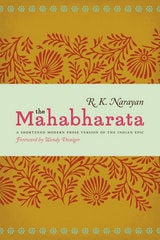
The Mahabharata
A Shortened Modern Prose Version of the Indian EpicR. K. Narayan
University of Chicago Press, 2013
Centuries of listeners and readers have been drawn to The Mahabharata, which began as disparate oral ballads and grew into a sprawling epic. The modern version is famously long, and at more than 1.8 million words—seven times the combined lengths of the Iliad and Odyssey—it can be incredibly daunting.
Contemporary readers have a much more accessible entry point to this important work, thanks to R. K. Narayan’s masterful translation and abridgement of the poem. Now with a new foreword by Wendy Doniger, as well as a concise character and place guide and a family tree, The Mahabharata is ready for a new generation of readers. As Wendy Doniger explains in the foreword, “Narayan tells the stories so well because they’re all his stories.” He grew up hearing them, internalizing their mythology, which gave him an innate ability to choose the right passages and their best translations.
In this elegant translation, Narayan ably distills a tale that is both traditional and constantly changing. He draws from both scholarly analysis and creative interpretation and vividly fuses the spiritual with the secular. Through this balance he has produced a translation that is not only clear, but graceful, one that stands as its own story as much as an adaptation of a larger work.
The Mishnah in Contemporary Perspective, Volume 1
Alan J. Avery-Peck
SBL Press, 2016
Now in Paperback!
In the past thirty years, the Mishnah has taken its place as a principal focus in the academic study of religion and of Judaism. Many university scholars have participated in the contemporary revolution in the description, analysis, and interpretation of the Mishnah. Nearly all the publishing scholars of the academy who are now at work are represented in this project. Both essential volumes present a broad selection of approaches to the study of the Mishnah. What they prove in diverse ways is that the Mishnah defines the critical focus of the study of Judaism. It is a document that rewards study in the academic humanities.
Features:
- The best of contemporary scholarship on the Mishnah
- The most representative selection of contemporary Mishnah-study contributions available in any collection in a Western language
- Paperback format of an essential Brill reference work
The Mishnah in Contemporary Perspective, Volume 2
Alan J. Avery-Peck
SBL Press, 2016
Now in Paperback!
This second volume of a two-part project on the Mishnah displays a broad selection of approaches to the study of the Mishnah in the contemporary academy. The work derives from Israel, North America, and Europe and shows the intellectual vitality of scholarship in all three centers of learning. What these articles show in diverse ways is that the Mishnah forms a critical focus of the study of Judaism.
Features:
- The best of contemporary scholarship on the Mishnah
- The most representative selection of contemporary Mishnah-study contributions available in any collection in a Western language
- Paperback format of an essential Brill reference work
The Nakedness of the Fathers
Biblical Visions and RevisionsOstriker, Alicia Suskin
Rutgers University Press, 1997
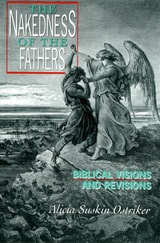
In her introduction, "Entering the Tents, " Ostriker defines the need to struggle against a tradition in which women have been silenced and disempowered - and to recover the female power buried beneath the surface of the biblical texts. In "The Garden, " she reinterprets the mythically complex stories of Creation. Then she considers the stories of "The Fathers, " from Abraham and Isaac to Moses, David, and Solomon - and their wives, mothers, and sisters. In "The Return of the Mothers, " she begins with a radical new interpretation of the book of Esther, includes a meditation on the silenced wife of Job and the idea of justice, and concludes with a fable on the death of God and a prayer to the Shekhinah, the feminine aspect of God. Ostriker refuses to dismiss the Bible as meaningless to women. Instead, in this angry, eloquent, visionary book, she attempts to recover what is genuinely sacred in these sacred texts.
The Psalms of Solomon
Language, History, TheologyEberhard Bons
SBL Press, 2015
A fresh analysis of that sheds new light on the Psalms of Solomon
Researchers whose work focuses on the Psalms of Solomon, experts on the Septuagint, and scholars of Jewish Hellenistic literature take a fresh look at debates surrounding the text. Authors engage linguistic, historical, and theological issues including the original language of the psalms, their historical setting, and their theological intentions with the goal of expanding our understanding of first-century BCE Jewish theology.
Features:
- New methods applied to open questions of authorship and historical context
- Focusd scholarly attention on a work of theological and literary importance
- Revised essays originally presented at the First International Meeting on the Psalms of Solomon
The Song of Songs and the Ancient Egyptian Love Songs
Michael V. Fox
University of Wisconsin Press, 1985
The Soul of the Stranger
Reading God and Torah from a Transgender PerspectiveJoy Ladin
Brandeis University Press, 2018
The Studia Philonica Annual XXIX, 2017
Studies in Hellenistic JudaismDavid T. Runia
SBL Press, 2017
The best current research on Philo and Hellenistic Judaism
The Studia Philonica Annual is a scholarly journal devoted to the study of Hellenistic Judaism, particularly the writings and thought of the Hellenistic-Jewish writer Philo of Alexandria (circa 15 BCE to circa 50 CE). This volume includes a soecial section on Philo's De plantatione.
Features:
- Articles on aspects of Hellenistic Judaism written by experts in the field
- Bibliography
- Book reviews
The Studia Philonica Annual XXVII, 2015
Studies in Hellenistic JudaismDavid T. Runia
SBL Press, 2015
The best current research on Philo and Hellenistic Judaism
The Studia Philonica Annual is a scholarly journal devoted to the study of Hellenistic Judaism, particularly the writings and thought of the Hellenistic-Jewish writer Philo of Alexandria (circa 15 BCE to circa 50 CE).
Features:
- Articles on aspects of Hellenistic Judaism written by experts in the field
- Bibliography
- Book reviews
The Studia Philonica Annual XXVIII, 2016
Studies in Hellenistic JudaismDavid T. Runia
SBL Press, 2016
Celebrate the contributions of David T. Runia
The Studia Philonica Annual is a scholarly journal devoted to the study of Hellenistic Judaism, particularly the writings and thought of the Hellenistic-Jewish writer Philo of Alexandria. More than fifteen scholars from around the world offer contributions to this special edition of the Annual in honor of Professor David T. Runia on the occasion of his 65th birthday and retirement from his post as Master of Queens College, University of Melbourne. Professor Runia is internationally recognized as one of the world's foremost experts on Philo of Alexandria. As founder of The Studia Philonica Annual, he has been editor or coeditor for twenty-seven years. He initiated a Philo Bibliography project prior to the Annual and incorporated the bibliography into the Annual from the outset. It serves as the primary bibliography for Philonic studies worldwide.
The Studia Philonica Annual XXX, 2018
Studies in Hellenistic JudaismDavid T. Runia
SBL Press, 2018
Studies on Philo and Hellenistic Judaism from experts in the field
The Studia Philonica Annual is a scholarly journal devoted to the study of Hellenistic Judaism, particularly the writings and thought of the Hellenistic-Jewish writer Philo of Alexandria. This volume includes five articles on topics ranging from preserved fragments of Philo to travel in Philo’s works. Nine book reviews cover recent books on Philo, Josephus, and ancient pedagogy.
Features:
- Articles on aspects of Hellenistic Judaism written by scholars from around the world
- Comprehensive bibliography and book reviews
The Studia Philonica Annual XXXI, 2019
Studies in Hellenistic JudaismDavid T. Runia
SBL Press, 2019
Studies on Philo and Hellenistic Judaism from experts in the field
The Studia Philonica Annual is a scholarly journal devoted to the study of Hellenistic Judaism, particularly the writings and thought of the Hellenistic-Jewish writer Philo of Alexandria. This volume includes articles on allegory, Platonic interpretations of the law, rhetoric, and Philo’s thoughts on reincarnation.
Features:
- Articles on aspects of Hellenistic Judaism written by scholars from around the world
- Comprehensive bibliography and book reviews
The Studia Philonica Annual XXXII, 2020
Studies in Hellenistic JudaismDavid T. Runia
SBL Press, 2021
Celebrate the contributions of Gregory E. Sterling
Harold W. Attridge, Ellen Birnbaum, Adela Yarbro Collins, John J. Collins, Michael B. Cover, Jan Willem van Henten, Carl R. Holladay, Andrew McGowan, Karl-Wilhelm Niebuhr, Maren R. Niehoff, James R. Royse, and David T. Runia offer essays honoring Professor Gregory E. Sterling in this special edition of the The Studia Philonica Annual. This volume includes a biography of Sterling’s life by David T. Runia and a bibliography of Sterling’s scholarship by Michael B. Cover. Essays cover a range of topics on Philo, the Bible, and Josephus.
Features:
- Articles on aspects of Hellenistic Judaism written by scholars from around the world
- Comprehensive bibliography of scholarship on Philo
The Studia Philonica Annual XXXIII, 2021
Studies in Hellenistic JudaismDavid T. Runia
SBL Press, 2021
Studies on Philo and Hellenistic Judaism from experts in the field
The Studia Philonica Annual is a scholarly journal devoted to the study of Hellenistic Judaism, particularly the writings and thought of the Hellenistic-Jewish writer Philo of Alexandria (circa 15 BCE to circa 50 CE). Volume 33 includes a special section on the history of editions of Philo, five general articles on Philo’s work, an annotated bibliography, and thirteen book reviews.
The Subversion of the Apocalypses in the Book of Jubilees
Todd R. Hanneken
SBL Press, 2012
The Vision of the Priestly Narrative
Its Genre and Hermeneutics of TimeSuzanne Boorer
SBL Press, 2016
A fresh look at the Priestly narrative that places less weight on linguistic criteria alone in favor of narrative coherence
Boorer explores the theology of an originally independent Priestly narrative (Pg), extending through Genesis–Numbers, as a whole. In this book she describes the structure of the Priestly narrative, in particular its coherent sequential and parallel patterns. Boorer argues that at every point in the narrative’s sequential and parallel structure, it reshapes past traditions, synthesizing these with contemporary and unique elements into future visions, in a way that is akin to the timelessness of liturgical texts. The book sheds new light on what this material might have sought to accomplish as a whole, and how it might have functioned for, its original audience.
- Solid arguments based on genre and themes, with regard to a once separate Priestly narrative (Pg) that concludes in Numbers 27*
- Thorough discussion of the overall interpretation of the Priestly narrative (Pg), by bringing together consideration of its structure and genre
- Clear illustration of how understanding the genre of the material and its hermeneutics of time is vital for interpreting Pg as a whole
Theology of the Hebrew Bible, Volume 2
Texts, Readers, and Their WorldsSoo Kim Sweeney
SBL Press, 2024
This follow-up to Theology of the Hebrew Bible, Volume 1: Methodological Studies, focuses on readers’ engagement with the text and their communities. Part 1 offers fresh interpretations of divine images and theological concepts drawn from various theophanies in the text. Part 2 focuses on how these insights can form new overarching structures, serving as reading strategies or foundations for alternative theologies. Part 3 emphasizes the bond between readers and their communities, highlighting the active participation of both ancient and modern readers through an analysis of past literature. Contributors, each an expert in their field, include Rachel Adelman, Samuel E. Balentine, Shelly L. Birdsong, Ginny Brewer-Boydston, Johanna Etzberger, Frances Flannery, David Frankel, Barry R. Huff, Hyun Chul Paul Kim, Barbara Leung Lai, J. Richard Middleton, Hye Kyung Park, Kris Sonek, Brent A. Strawn, David E. S. Stein, Marvin A. Sweeney, Soo Kim Sweeney, Joseph Sykora, Daniel C. Timmer, and Beat Weber. This collection of essays guides readers, including those well-versed in theology, to explore innovative and unexpected depictions of divine beings and how human characters respond to them.
To You I Call
Psalms Throughout Our LivesRabbi Jade Sank Ross
Central Conference of American Rabbis, 2024
Torah Today
A Renewed Encounter with ScriptureBy Pinchas H. Peli
University of Texas Press, 2005
The central element of Jewish worship is the yearly cycle of reading the first five books of the Bible, the Five Books of Moses, called the Torah in Hebrew. Torah Today, a compilation of fifty-four essays that grew out of Pinchas Peli's Torah column in the Jerusalem Post, comments upon the weekly readings from the Torah. Written in a wonderfully clear style, each essay brings the reader closer to the rich spiritual world of Torah as it confronts the challenges of modern society. This reissue of Torah Today, with a new preface by Rabbi Harold M. Schulweis, makes this classic work available to a new generation of Bible students.