Results by title
200 books match the query 'Second Edition' and 54 start with t
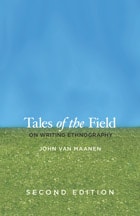
Tales of the Field
On Writing Ethnography, Second EditionJohn Van Maanen
University of Chicago Press, 2011
For more than twenty years, John Van Maanen’s Tales of the Field has been a definitive reference and guide for students, scholars, and practitioners of ethnography and beyond. Originally published in 1988, it was the one of the first works to detail and critically analyze the various styles and narrative conventions associated with written representations of culture. This is a book about the deskwork of fieldwork and the various ways culture is put forth in print. The core of the work is an extended discussion and illustration of three forms or genres of cultural representation—realist tales, confessional tales, and impressionist tales. The novel issues raised in Tales concern authorial voice, style, truth, objectivity, and point-of-view. Over the years, the work has both reflected and shaped changes in the field of ethnography.
In this second edition, Van Maanen’s substantial new Epilogue charts and illuminates changes in the field since the book’s first publication. Refreshingly humorous and accessible, Tales of the Field remains an invaluable introduction to novices learning the trade of fieldwork and a cornerstone of reference for veteran ethnographers.
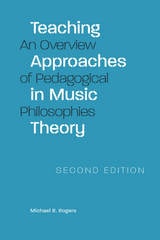
Teaching Approaches in Music Theory, Second Edition
An Overview of Pedagogical PhilosophiesMichael R. Rogers
Southern Illinois University Press, 2004
Drawing on decades of teaching experience and the collective wisdom of dozens of the most creative theorists in the country, Michael R. Rogers’s diverse survey of music theory—one of the first to comprehensively survey and evaluate the teaching styles, techniques, and materials used in theory courses—is a unique reference and research tool for teachers, theorists, secondary and postsecondary students, and for private study. This revised edition of Teaching Approaches in Music Theory: An Overview of Pedagogical Philosophies features an extensive updated bibliography encompassing the years since the volume was first published in 1984.
In a new preface to this edition, Rogers references advancements in the field over the past two decades, from the appearance of the first scholarly journal devoted entirely to aspects of music theory education to the emergence of electronic advances and devices that will provide a supporting, if not central, role in the teaching of music theory in the foreseeable future. With the updated information, the text continues to provide an excellent starting point for the study of music theory pedagogy.
Rogers has organized the book very much like a sonata. Part one, “Background,” delineates principal ideas and themes, acquaints readers with the author’s views of contemporary musical theory, and includes an orientation to an eclectic range of philosophical thinking on the subject; part two, “Thinking and Listening,” develops these ideas in the specific areas of mindtraining and analysis, including a chapter on ear training; and part three, “Achieving Teaching Success,” recapitulates main points in alternate contexts and surroundings and discusses how they can be applied to teaching and the evaluation of design and curriculum.
Teaching Approaches in Music Theory emphasizes thoughtful examination and critique of the underlying and often tacit assumptions behind textbooks, materials, and technologies. Consistently combining general methods with specific examples and both philosophical and practical reasoning, Rogers compares and contrasts pairs of concepts and teaching approaches, some mutually exclusive and some overlapping. The volume is enhanced by extensive suggested reading lists for each chapter.
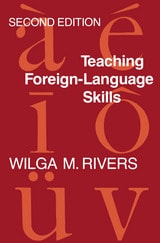
Teaching Foreign Language Skills
Second EditionWilga M. Rivers
University of Chicago Press, 1981
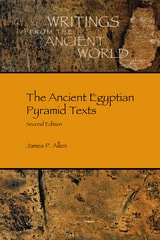
The Ancient Egyptian Pyramid Texts, Second Edition
James P. Allen
SBL Press, 2015
Completely revised and updated
James P. Allen provides a translation of the oldest corpus of ancient Egyptian religious texts from the six royal pyramids of the Fifth and Sixth Dynasties (ca. 2350–2150 BCE). Allen’s revisions take into account recent advances in the understanding of Egyptian grammar.
Features:
- Sequential translations based on all available sources, including texts newly discovered in the last decade
- Texts numbered according to the most widely used numbering system with new numbers from the latest 2013 concordance
- Translations reflect the primarily atemporal verbal system of Old Egyptian, which conveys the timeless quality that the text’s authors understood the texts to have

The Art and Science of Screenwriting
Second EditionPhilip Parker
Intellect Books, 2006
This second edition contains:
• the different layouts for film, television, documentary and corporate screenplays
• a detailed analysis of what is required from a premise, an outline, a step outline, a treatment and a first draft
• a simple stage by stage guide to the inevitable re-write
• tips on finding an agent.
This new approach to writing for film and television covers everything from finding an idea to writing a finished screenplay. The author's framework, 'A Creative Matrix', brings together all the elements of screenplay writing - from story, character, theme, and dramatic structure to plot, genre, tone and style in an understandable way that is easy to follow. His analysis includes illustrating what comprises a good thriller, identifying the different types of sit-com, and showing the qualities of a screen romance that both works and convinces.
The author uses examples from across European, American and World Cinema, as well as television, and this revised edition now contains a comprehensive index.
The Bilingual Courtroom
Court Interpreters in the Judicial Process, Second EditionSusan Berk-Seligson
University of Chicago Press, 2017
Susan Berk-Seligson’s groundbreaking book draws on more than one hundred hours of audio recordings of Spanish/English court proceedings in federal, state, and municipal courts—along with a number of psycholinguistic experiments involving mock juror reactions to interpreted testimony—to present a systematic study of court interpreters that raises some alarming, vitally important concerns. Contrary to the assumption that interpreters do not affect the dynamics of court proceedings, Berk-Seligson shows that interpreters could potentially make the difference between a defendant being found guilty or not guilty of a crime.
This second edition of the The Bilingual Courtroom includes a fully updated review of both theoretical and policy-oriented research relevant to the use of interpreters in legal settings, particularly from the standpoint of linguistic pragmatics. It provides new insights into interpreting in quasi-judicial, informal, and specialized judicial settings, such as small claims court, jails, and prisons; updates trends in interpreter certification and credentialing, both in the United States and abroad; explores remote interpreting (for example, by telephone) and interpreter training programs; looks at political trials and tribunals to add to our awareness of international perspectives on court interpreting; and expands upon cross-cultural issues. Also featuring a new preface by Berk-Seligson, this second edition not only highlights the impact of the previous versions of The Bilingual Courtroom, but also draws attention to the continued need for critical study of interpreting in our ever diversifying society.

The Book of Beetles, Second Edition
A Life-Size Guide to Six Hundred of Nature’s GemsEdited by Patrice Bouchard and Arthur V. Evans
University of Chicago Press, 2026
An up-to-date, exquisitely illustrated guide to six hundred of the world’s beguiling beetles.
When renowned British geneticist J. B. S. Haldane was asked what could be inferred about God from a study of his works, Haldane replied, “An inordinate fondness for beetles.” With more than 440,000 known species, and scientific estimates that millions more have yet to be identified, their abundance is indisputable, as is their variety. They range from the delightful summer firefly to the one-hundred-gram Goliath beetle. Beetles offer a dazzling array of shapes, sizes, and colors that entice scientists and collectors across the globe.
In a new updated edition, The Book of Beetles celebrates the beauty and diversity of this marvelous group of insects. The book includes six hundred significant beetle species, and each entry features a distribution map, basic biology, feeding habits, and information on cultural and economic significance. The beetles appear both at their actual size and enlarged to show details, such as the sextet of spots that distinguish the six-spotted tiger beetle or the jagged ridges of the mandibles on the giant jawed sawyer beetle. With updates to the common names, distribution, classification, or photographs for nearly five hundred entries, this edition offers the latest science and accessibly written, descriptive text that will appeal to researchers and armchair coleopterists alike.
The humble beetle continues to grow in popularity, taking center stage in biodiversity studies, sustainable agriculture programs, and even the dining rooms of adventurous and eco-conscious chefs. The Book of Beetles is the authoritative reference on these remarkably adaptable and beautiful creatures.
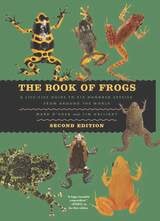
The Book of Frogs
A Life-Size Guide to Six Hundred Species from around the World, Second EditionMark O'Shea and Tim Halliday
University of Chicago Press, 2025
With almost nine thousand known species, frogs display a stunning array of forms and behaviors. A single gram of the toxin produced by the skin of the Golden Poison Frog can kill one hundred thousand people. Male Darwin’s Frogs carry their tadpoles in their vocal sacs for sixty days before coughing them out into the world. And the Wood Frogs of North America freeze every winter, reanimating in the spring.
The Book of Frogs documents the diversity and magnificence of all these anurans and many more. Readers meet six hundred of nature’s most fascinating frogs, with each entry including a distribution map, illustrations, species identification, natural history, and conservation status. Color photos show the frogs at their actual size—from Papua New Guinea’s diminutive Paedophryne amauensis, smaller than a coin, to Cameroon’s colossal Goliath Frog, heavier than some dogs. Written by experts Mark O’Shea and Tim Halliday and containing updated information on one hundred species and nearly twenty new entries, this revised edition will enthrall both veteran researchers and amateur herpetologists.
As frogs increasingly make headlines for their troubling worldwide decline, The Book of Frogs brings readers face to face with six hundred astonishingly unique and irreplaceable species that display a diverse array of adaptations to habitats that are ever changing.
The Business of Being a Writer, Second Edition
Jane Friedman
University of Chicago Press, 2025
Writers talk about their work in many ways: as an art, as a calling, as a lifestyle. Too often missing from these conversations is the fact that writing is also a business, and those who want to make a living from their writing must understand the basic business principles underlying the industry. The Business of Being a Writer offers the business education writers need but so rarely receive.
Jane Friedman is one of today’s leading experts on the publishing industry. Through her website, social media presence, online courses, email newsletters, and other media, she helps writers understand how to navigate the industry with confidence and intentionality. This book advises writers on how to build a platform in a way that aligns with their values, how to spot critical mindset issues that might sabotage their efforts before they even begin, how to publish strategically, and what it means to diversify income streams beyond book sales. For this second edition, Friedman has updated every topic to reflect how the industry has evolved over the past half decade. New features include a section on business and legal issues commonly faced by writers, exercises at the end of each chapter, and a wealth of sample materials posted on a companion website.
Reaching beyond the mechanical aspects of publishing, The Business of Being a Writer will help both new and experienced writers approach their careers with the same creative spirit as their writing. Friedman is encouraging without sugarcoating reality, blending years of research with practical advice that will help writers market themselves and maximize their writing-related income. Her book will leave them empowered, confident, and ready to turn their craft into a sustainable career.
The Chicago Guide to Communicating Science
Second EditionScott L. Montgomery
University of Chicago Press, 2017
For more than a decade, The Chicago Guide to Communicating Science has been the go-to reference for anyone who needs to write or speak about their research. Whether a student writing a thesis, a faculty member composing a grant proposal, or a public information officer crafting a press release, Scott Montgomery’s advice is perfectly adaptable to any scientific writer’s needs.
This new edition has been thoroughly revised to address crucial issues in the changing landscape of scientific communication, with an increased focus on those writers working in corporate settings, government, and nonprofit organizations as well as academia. Half a dozen new chapters tackle the evolving needs and paths of scientific writers. These sections address plagiarism and fraud, writing graduate theses, translating scientific material, communicating science to the public, and the increasing globalization of research.
The Chicago Guide to Communicating Science recognizes that writers come to the table with different needs and audiences. Through solid examples and concrete advice, Montgomery sets out to help scientists develop their own voice and become stronger communicators. He also teaches readers to think about their work in the larger context of communication about science, addressing the roles of media and the public in scientific attitudes as well as offering advice for those whose research concerns controversial issues such as climate change or emerging viruses.
More than ever, communicators need to be able to move seamlessly among platforms and styles. The Chicago Guide to Communicating Science’s comprehensive coverage means that scientists and researchers will be able to expertly connect with their audiences, no matter the medium.
The Chicago Guide to Fact-Checking, Second Edition
Brooke Borel
University of Chicago Press, 2023
- Recognize what information to fact-check
- Identify the quality and ranking of source materials
- Learn to fact-check a variety of media types: newspaper; magazine; social media; public and commercial radio and television, books, films, etc.
- Navigate relationships with editors, writers, and producers
- Recognize plagiarism and fabrication
- Discern conflicting facts, gray areas, and litigious materials
- Learn record keeping best practices for tracking sources
- Test your own fact-checking skills
Over the past few years, fact-checking has been widely touted as a corrective to the spread of misinformation, disinformation, conspiracy theories, and propaganda through the media. “If journalism is a cornerstone of democracy,” says author Brooke Borel, “then fact-checking is its building inspector.”
In The Chicago Guide to Fact-Checking, Borel, an experienced fact-checker, draws on the expertise of more than 200 writers, editors, and fellow checkers representing the New Yorker, Popular Science, This American Life, Vogue, and many other outlets. She covers best practices for editorial fact-checking in a variety of media—from magazine and news articles, both print and online, to books and podcasts—and the perspectives of both in-house and freelance checkers.
In this second edition, Borel covers the evolving media landscape, with new guidance on checking audio and video sources, polling data, and sensitive subjects such as trauma and abuse. The sections on working with writers, editors, and producers have been expanded, and new material includes fresh exercises and advice on getting fact-checking gigs. Borel also addresses the challenges of fact-checking in a world where social media, artificial intelligence, and the metaverse may make it increasingly difficult for everyone—including fact-checkers—to identify false information. The answer, she says, is for everyone to approach information with skepticism—to learn to think like a fact-checker.
The Chicago Guide to Fact-Checking is the practical—and thoroughly vetted—guide that writers, editors, and publishers continue to consult to maintain their credibility and solidify their readers’ trust.
The Chicago Guide to Writing about Multivariate Analysis, Second Edition
Jane E. Miller
University of Chicago Press, 2013
The Chicago Guide to Writing about Multivariate Analysis is the book researchers turn to when looking for guidance on how to clearly present statistical results and break through the jargon that often clouds writing about applications of statistical analysis. This new edition features even more topics and real-world examples, making it the must-have resource for anyone who needs to communicate complex research results.
For this second edition, Jane E. Miller includes four new chapters that cover writing about interactions, writing about event history analysis, writing about multilevel models, and the “Goldilocks principle” for choosing the right size contrast for interpreting results for different variables. In addition, she has updated or added numerous examples, while retaining her clear voice and focus on writers thinking critically about their intended audience and objective. Online podcasts, templates, and an updated study guide will help readers apply skills from the book to their own projects and courses.
This continues to be the only book that brings together all of the steps involved in communicating findings based on multivariate analysis—finding data, creating variables, estimating statistical models, calculating overall effects, organizing ideas, designing tables and charts, and writing prose—in a single volume. When aligned with Miller’s twelve fundamental principles for quantitative writing, this approach will empower readers—whether students or experienced researchers—to communicate their findings clearly and effectively.
The Chicago Guide to Writing about Numbers, Second Edition
Jane E. Miller
University of Chicago Press, 2015
Miller, an experienced teacher of research methods, statistics, and research writing, opens by introducing a set of basic principles for writing about numbers, then presents a toolkit of techniques that can be applied to prose, tables, charts, and presentations. Throughout the book, she emphasizes flexibility, showing writers that different approaches work for different kinds of data and different types of audiences.
The second edition adds a chapter on writing about numbers for lay audiences, explaining how to avoid overwhelming readers with jargon and technical issues. Also new is an appendix comparing the contents and formats of speeches, research posters, and papers, to teach writers how to create all three types of communication without starting each from scratch. An expanded companion website includes new multimedia resources such as slide shows and podcasts that illustrate the concepts and techniques, along with an updated study guide of problem sets and suggested course extensions.
This continues to be the only book that brings together all the tasks that go into writing about numbers, integrating advice on finding data, calculating statistics, organizing ideas, designing tables and charts, and writing prose all in one volume. Field-tested with students and professionals alike, this holistic book is the go-to guide for everyone who writes or speaks about numbers.
The Chicago Handbook for Teachers, Second Edition
A Practical Guide to the College ClassroomAlan Brinkley, Esam El-Fakahany, Betty Dessants, Michael Flamm, Charles B. Forcey, Jr., Mathew L. Ouellett, and Eric Rothschild
University of Chicago Press, 2011
Those who teach college students have extensive training in their disciplines, but unlike their counterparts at the high school or elementary school level, they often have surprisingly little instruction in the craft of teaching itself. The Chicago Handbook for Teachers, Second Edition, is an extraordinarily helpful guide for anyone facing the daunting challenge of putting together a course and delivering it successfully.
Representing teachers at all stages of their careers, the authors, including distinguished historian Alan Brinkley, offer practical advice for almost any situation a new teacher might face, from preparing a syllabus to managing classroom dynamics. Beginning with a nuts and bolts plan for designing a course, the handbook also explains how to lead a discussion, evaluate your own teaching, give an effective lecture, supervise students' writing and research, create and grade exams, and more.
This new edition is thoroughly revised for contemporary concerns, with updated coverage on the use of electronic resources and on the challenge of creating and sustaining an inclusive classroom. A new chapter on science education and new coverage of the distinctive issues faced by adjunct faculty broaden the book’s audience considerably. The addition of sample teaching materials in the appendixes enhances the practical, hands-on focus of the second edition. Its broad scope and wealth of specific tips will make The Chicago Handbook for Teachers useful both as a comprehensive guide for beginning educators and a reference manual for experienced instructors.

The Chicago River
An Illustrated History and Guide to the River and Its Waterways, Second EditionDavid M. Solzman
University of Chicago Press, 2006
The river is indeed the soul of the city—it runs through the heart of downtown, and it is a vehicle for both pleasure and the industry that keeps Chicago humming. With The Chicago River, Solzman has succeeded in writing an encyclopedic work—at once guidebook and history—that explores the river’s physical character and natural history. Examining the river’s past, contemplating its present, and forecasting its future, Solzman draws on his unparalleled knowledge to point out places of scientific and historic interest—involving everything from infamous murder cases to invasive zebra mussels. The book’s 200 photographs and maps perfectly complement Solzman’s vivid prose, leading readers on a visual journey as sinuous as the river it celebrates—a journey interspersed with plenty of river lore, facts, and literary quotations.
Solzman, a veteran Chicago River tour guide, has also compiled a diverse collection of easy and enjoyable tours for anyone who wants to experience the river by foot, boat, canoe, or car. And he provides an appendix that lists river-related organizations, museums, tours, and riverfront restaurants and clubs.
With practical tips, evocative language, and an astonishing array of anecdotes, TheChicago River is the most comprehensive guide to the river and its waterways, the perfect companion for everyone from the active river enthusiast to the armchair traveler.
The Colorado General Assembly, Second Edition
John A. Straayer
University Press of Colorado, 2000
The Colorado General Assembly is based on years of author John Straayer's first-hand observations, his review of original documents and secondary sources, and hundred of conversations with lawmakers, lobbyists, members of the legislative staff, executive branch personnel, and journalists.
In this lively, informative book, Straayer describes the formal structure of the Legislature, as well as the all-important process by which bills become or do not become law, and how the power center within the institution can move or kill legislative initiatives. He also examines the clout of the lobby corps, which outnumbers the elected lawmakers five to one; the way the Legislature dominates the budget process; and the manner by which divisions between the two parties, the two houses, and the legislative and executive branches impact the conduct of the public's business under Colorado's gold dome.
The Colorado General Assembly fills a major gap in our knowledge of state government. It will appeal to students and practitioners of politics as well as to those with general interest in civic life.
The Deadliest Outlaws
The Ketchum Gang and the Wild Bunch, Second EditionJeffrey Burton
University of North Texas Press, 2009
The Dramatic Writer's Companion, Second Edition
Tools to Develop Characters, Cause Scenes, and Build StoriesWill Dunne
University of Chicago Press, 2017
Having spent decades working with dramatists to refine and expand their existing plays and screenplays, Dunne effortlessly blends condensed dramatic theory with specific action steps—over sixty workshop-tested exercises that can be adapted to virtually any individual writing process and dramatic script. Dunne’s in-depth method is both instinctual and intellectual, allowing writers to discover new actions for their characters and new directions for their stories. The exercises can be used by those just starting the writing process and by those who have scripts already in development. With each exercise rooted in real-life issues from Dunne’s workshops, readers of this companion will find the combined experiences of more than fifteen hundred workshops in a single guide.
This second edition is fully aligned with a brand-new companion book, Character, Scene, and Story, which offers forty-two additional activities to help writers more fully develop their scripts. The two books include cross-references between related exercises, though each volume can also stand alone.
No ordinary guide to plotting, this handbook centers on the principle that character is key. “The character is not something added to the scene or to the story,” writes Dunne. “Rather, the character is the scene. The character is the story.” With this new edition, Dunne’s remarkable creative method will continue to be the go-to source for anyone hoping to take their story to the stage.

The Explorer's Guide to Death Valley National Park, Second Edition
T. Scott Bryan
University Press of Colorado, 2009

The Gift of Death, Second Edition & Literature in Secret
Jacques Derrida
University of Chicago Press, 2008
The Gift of Death, Second Edition & Literature in Secret
Jacques Derrida
University of Chicago Press, 2008

The Herb Garden Cookbook
The Complete Gardening and Gourmet Guide, Second EditionBy Lucinda Hutson
University of Texas Press, 2003
Indulge your senses with the lively flavors, vivid colors, and tantalizing aromas of fresh herbs. This comprehensive guide gives you creative, festive recipes as well as valuable gardening information. With Lucinda Hutson's expert advice you'll discover how to:
- Grow robust and flavorful herbs using organic gardening techniques.
- Harvest and store herbs.
- Prepare more than 150 delicious and innovative recipes.
- Create intensely flavored herb butters and savory vinegars.
- Garnish and flavor recipes with beautiful edible flowers.
- Grow and use exotic herbs from Mexico and Southeast Asia.
- Design menus for special occasions such as a fiesta for friends or a feast for two.
- Find the best sources, including websites, for buying plants, seeds, and gourmet products.
Savor the Tuscan-inspired Panzanella, the continental Celebratory Niçoise Salad, or the Southwestern-spirited Pollo Picado. Lucinda's suggested recipe variations will turn you into a kitchen quick-change artist. Ideas for dazzling presentations make your meals as pleasing to the eye as they are to the palate. From rosemary and thyme to Mexican mint marigold and Thai basil, this is an essential guide for cooks and gardeners alike!
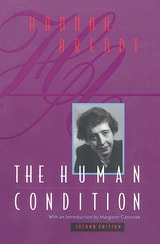
The Human Condition
Second EditionHannah Arendt
University of Chicago Press, 1998
Hannah Arendt (1906-1975) was one of the leading social theorists in the United States. Her Lectures on Kant's Political Philosophy and Love and Saint Augustine are also published by the University of Chicago Press.
The Human Condition
Second EditionHannah Arendt
University of Chicago Press, 2018
The twenty-first century has seen a resurgence of interest in the political thinker Hannah Arendt, “the theorist of beginnings,” whose work probes the logics underlying unexpected transformations—from totalitarianism to revolution.
A work of striking originality, The Human Condition is in many respects more relevant now than when it first appeared in 1958. In her study of the state of modern humanity, Hannah Arendt considers humankind from the perspective of the actions of which it is capable. The problems Arendt identified then—diminishing human agency and political freedom, the paradox that as human powers increase through technological and humanistic inquiry, we are less equipped to control the consequences of our actions—continue to confront us today. This new edition, published to coincide with the sixtieth anniversary of its original publication, contains Margaret Canovan’s 1998 introduction and a new foreword by Danielle Allen.
A classic in political and social theory, The Human Condition is a work that has proved both timeless and perpetually timely.
The Impact of Global Warming on Texas
Second editionEdited by Jurgen Schmandt, Gerald R. North, and Judith Clarkson
University of Texas Press, 2011
When The Impact of Global Warming on Texas was first published in 1995, it discussed climate change as a likely future phenomenon, predicted by scientific studies. This entirely rewritten second edition presents evidence that early climate change impacts can now be observed and identifies the threats climate change will pose to Texas through the year 2050. It also offers the hopeful message that corrective action, if taken now, can avert unmanageable consequences.
The book begins with a discussion of climate science and modeling and the information that can be derived from these sources for Texas. The authors follow this with an analysis of actual climate trends in the various Texas climate regions, including a predicted rise in temperatures of 5.4 degrees F (plus or minus 1.8 F) by the end of the century. This could lead to less rainfall and higher evaporation, especially in regions that are already dry. Other important effects include possible changes in El Niño (climate variability) patterns and hurricane behaviors. Taking into account projected population growth, subsequent chapters explore likely trends with respect to water availability, coastal impacts, and biodiversity.
The authors then look at the issues from a policy perspective, focusing on Texas's importance to the national economy as an energy producer, particularly of oil and gas. They recommend that Texas develop its own climate change policy to serve the goals of reducing greenhouse gas emissions, increasing energy independence, ensuring regional security, and improving management of water, air, land, and wildlife.
The Jobless Future
Second EditionStanley Aronowitz
University of Minnesota Press, 2010
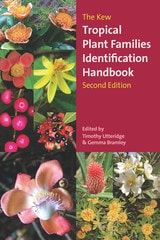
The Kew Tropical Plant Families Identification Handbook
Second EditionEdited by Timothy Utteridge and Gemma Bramley
Royal Botanic Gardens, Kew, 2015
This fully updated second edition adds seventeen new family and subfamily descriptions and includes updated research throughout. Each of the one hundred families is described in detail and richly illustrated with photographs that show important identification characteristics. The book’s emphasis on images and the foundations of identification means that both specialists and nonspecialists alike will be able to use this guide.
The Kew Tropical Plant Families Identification Handbook is a portable, easy-to-use resource, perfect for tropical botanists as well as students and conservation professionals.
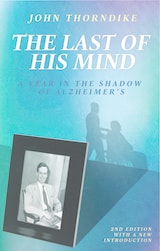
The Last of His Mind, Second Edition
A Year in the Shadow of Alzheimer’sJohn Thorndike
Ohio University Press, 2021
The Many Faces of Political Islam, Second Edition
Religion and Politics in Muslim SocietiesMohammed Ayoob and Danielle N. Lussier
University of Michigan Press, 2020
Analysts and pundits from across the American political spectrum describe Islamic fundamentalism as one of the greatest threats to modern, Western-style democracy. Yet very few non-Muslims would be able to venture an accurate definition of political Islam. Fully revised and updated, The Many Faces of Political Islam thoroughly analyzes the many facets of this political ideology and shows its impact on global relations.
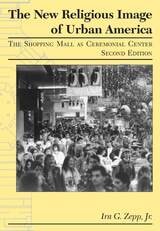
The New Religious Image of Urban America, Second Edition
The Shopping Mall as Ceremonial CenterIra G. Zepp, Jr.
University Press of Colorado, 1997
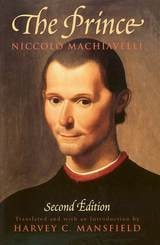
The Prince
Second EditionNiccolò Machiavelli
University of Chicago Press, 1998
The Prince remains as lively and shocking today as when it was written almost five hundred years ago. Initially denounced as a collection of sinister maxims and a recommendation of tyranny, it has more recently been defended as the first scientific treatment of politics as it is practiced rather than as it ought to be practiced. Harvey C. Mansfield's brilliant translation of this classic work, along with the new materials added for this edition, make it the definitive version of The Prince, indispensable to scholars, students, and those interested in the dark art of politics.
This revised edition of Mansfield's acclaimed translation features an updated bibliography, a substantial glossary, an analytic introduction, a chronology of Machiavelli's life, and a map of Italy in Machiavelli's time.
"Of the other available [translations], that of Harvey C. Mansfield makes the necessary compromises between exactness and readability, as well as providing an excellent introduction and notes."—Clifford Orwin, The Wall Street Journal
"Mansfield's work . . . is worth acquiring as the best combination of accuracy and readability."—Choice
"There is good reason to assert that Machiavelli has met his match in Mansfield. . . . [He] is ready to read Machiavelli as he demands to be read—plainly and boldly, but also cautiously."—John Gueguen, The Sixteenth Century Journal
The Prince
Second EditionNiccolò Machiavelli
University of Chicago Press, 1998
The most famous book on politics ever written, The Prince remains as lively and shocking today as when it was written almost five hundred years ago. Initially denounced as a collection of sinister maxims and a recommendation of tyranny, it has more recently been defended as the first scientific treatment of politics as it is practiced rather than as it ought to be practiced. Harvey C. Mansfield's brilliant translation of this classic work, along with the new materials added for this edition, make it the definitive version of The Prince, indispensable to scholars, students, and those interested in the dark art of politics.
This revised edition of Mansfield's acclaimed translation features an updated bibliography, a substantial glossary, an analytic introduction, a chronology of Machiavelli's life, and a map of Italy in Machiavelli's time.
"Of the other available [translations], that of Harvey C. Mansfield makes the necessary compromises between exactness and readability, as well as providing an excellent introduction and notes."—Clifford Orwin, The Wall Street Journal
"Mansfield's work . . . is worth acquiring as the best combination of accuracy and readability."—Choice
"There is good reason to assert that Machiavelli has met his match in Mansfield. . . . [He] is ready to read Machiavelli as he demands to be read—plainly and boldly, but also cautiously."—John Gueguen, The Sixteenth Century Journal
The Right to Be Out
Sexual Orientation and Gender Identity in America's Public Schools, Second EditionStuart Biegel
University of Minnesota Press, 2018
An updated edition of this measured, practical, and timely guide to LGBT rights and issues for educators and school officials
With ongoing battles over transgender rights, bullying cases in the news almost daily, and marriage equality only recently the law of the land, the information in The Right to Be Out could not be more timely or welcome. In an updated second edition that explores the altered legal terrain of LGBT rights for students and educators, Stuart Biegel offers expert guidance on the most challenging concerns in this fraught context.
Taking up the pertinent questions likely to arise regarding curriculum and pedagogy in the classroom, school sports, and transgender issues, Biegel reviews the dramatic legal developments of the past decades, identifies the principles at work, and analyzes the policy considerations that result from these changes. Central to his work is an understanding of the social, political, and personal tensions regarding the nature and extent of the right to be out, which includes both the First Amendment right to express an identity and the Fourteenth Amendment right to be treated equally. Acknowledging that LGBT issues affect people of every sexual orientation and gender identity, Biegel provides a road map of viable strategies for school officials and educators.
The Right to Be Out, informed by the latest research-based findings, advances the proposition that a safe and supportive educational environment, built upon shared values and geared toward a greater appreciation of our pluralistic society, can lead to a better world for everyone.
The Rites of Passage, Second Edition
Arnold van Gennep
University of Chicago Press, 2019
With a new introduction by Pulitzer Prize–winner David I. Kertzer
Arnold van Gennep’s masterwork, The Rites of Passage, has been a staple of anthropological education for more than a century. First published in French in 1909, and translated into English by the University of Chicago Press in 1960, this landmark book explores how the life of an individual in any society can be understood as a succession of transitions: birth, puberty, marriage, parenthood, old age, and, finally, death. Van Gennep’s great insight was discerning a common structure in each of these seemingly different transitions, involving rituals of separation, liminality, and incorporation. With compelling precision, he set out the terms that would both define twentieth-century ritual theory and become a part of our everyday lexicon.
This new edition of his work demonstrates how we can still make use of its enduring critical tools to understand our own social, religious, and political worlds, and even our personal and professional lives. In his new introduction, Pulitzer Prize–winning historian and anthropologist David I. Kertzer sheds new light on van Gennep, on the battles he fought, and on the huge impact the book has had since publication of the first English edition.
The Rules of Golf in Plain English, Second Edition
Jeffrey S. Kuhn and Bryan A. Garner
University of Chicago Press, 2008
The hopes of renowned writer and golfer Henry Longhurst—and millions of golfers before and after him—have finally been realized. In The Rules of Golf in Plain English, Bryan A. Garner, American English language and usage expert, and Jeffrey S. Kuhn, volunteer USGA rules official, have translated the knotty Rules with the encouragement and permission of the United States Golf Association. The result is a modern, readable version that offers, for the first time, clear guidance to both amateurs and professionals.
Based on a 338-word set of thirteen rules written in 1744, the official Rules have grown, over two and a half centuries, to 40,000 words. Numerous contributors and a complex revision process have rendered these Rules so opaque and stylistically inconsistent that a companion volume—the 600-page Decisions on the Rules of Golf—has been published to help golfers navigate them.
Both lawyers and avid golfers, Kuhn and Garner recognized the difficulties that the language of the Rules of Golf created, especially in a sport that expects players to call penalties on themselves. By reworking the Rules line by line, word by word, they have produced an accessible resource that no golfer—from the duffer to the pro—should be without.

The Sensuous Cinema of Wong Kar-wai
Film Poetics and the Aesthetic of Disturbance, Second EditionGary Bettinson
Hong Kong University Press, 2025
The widely acclaimed films of Wong Kar-wai are characterized by their sumptuous yet complex visual and sonic style. This study of Wong’s filmmaking techniques uses a poetics approach to examine how form, music, narration, characterization, genre, and other artistic elements work together to produce certain effects on audiences. Bettinson argues that Wong’s films are permeated by an aesthetic of sensuousness and “disturbance” achieved through techniques such as narrative interruptions, facial masking, opaque cuts, and other complex strategies. The effect is to jolt the viewer out of complete aesthetic absorption. Each of the chapters focuses on a single aspect of Wong’s filmmaking.
This tenth-anniversary edition of The Sensuous Cinema of Wong Kar-wai includes a substantial new afterword bringing the story of Wong’s career up to date (including reflections on the Mainland Chinese drama Blossoms Shanghai). Bettinson revisits and extends the arguments of the first edition, surveys the recent key debates on Wong’s filmmaking, and introduces fresh lines of critical investigation. The book will appeal to all who are interested in authorship and aesthetics in film studies, to scholars in Asian studies, media, and cultural studies, and to anyone with an interest in Hong Kong cinema in general, and Wong’s films in particular.
The Social Medicine Reader, Second Edition
Volume 3: Health Policy, Markets, and MedicineJonathan Oberlander, Larry R. Churchill, Sue E. Estroff, Gail E. Henderson, Nancy M. P. King, and Ronald P. Strauss, eds.
Duke University Press, 2005
Praise for the 3-volume second edition of The Social Medicine Reader:
“A superb collection of essays that illuminate the role of medicine in modern society. Students and general readers are not likely to find anything better.”—Arnold S. Relman, Professor Emeritus of Medicine and Social Medicine, Harvard Medical School
Praise for the first edition:
“This reviewer strongly recommends The Social Medicine Reader to the attention of medical educators.”—Samuel W. Bloom, JAMA: The Journal of the American Medical Association
Volume 3:
Over the past four decades the American health care system has witnessed dramatic changes in private health insurance, campaigns to enact national health insurance, and the rise (and perhaps fall) of managed care. Bringing together seventeen pieces new to this second edition of The Social Medicine Reader and four pieces from the first edition, Health Policy, Markets, and Medicine draws on a broad range of disciplinary perspectives—including political science, economics, history, and bioethics—to consider changes in health care and the future of U.S. health policy. Contributors analyze the historical and moral foundation of today’s policy debates, examine why health care spending is so hard to control in the United States, and explain the political dynamics of Medicare and Medicaid. Selections address the rise of managed care, its impact on patients and physicians, and the ethical implications of applying a business ethos to medical care; they also compare the U.S. health care system to the systems in European countries, Canada, and Japan. Additional readings probe contemporary policy issues, including the emergence of consumer-driven health care, efforts to move quality of care to the top of the policy agenda, and the implications of the aging of America for public policy.
Contributors: Henry J. Aaron, Drew E. Altman, George J. Annas, Robert H. Binstock, Thomas Bodenheimer, Troyen A. Brennan, Robert H. Brook, Lawrence D. Brown, Daniel Callahan, Jafna L. Cox, Victor R. Fuchs, Kevin Grumbach, Rudolf Klein, Robert Kuttner, Larry Levitt, Donald L. Madison, Wendy K. Mariner, Elizabeth A. McGlynn, Jonathan Oberlander, Geov Parrish, Sharon Redmayne, Uwe E. Reinhardt, Michael S. Sparer, Deborah Stone

The Social Medicine Reader, Second Edition
Volume One: Patients, Doctors, and IllnessNancy M. P. King, Ronald P. Strauss, Larry R. Churchill, Sue E. Estroff, Gail E. Henderson, and Jonathan Oberlander, eds.
Duke University Press, 2005
Praise for the 3-volume second edition of The Social Medicine Reader:
“A superb collection of essays that illuminate the role of medicine in modern society. Students and general readers are not likely to find anything better.”—Arnold S. Relman, Professor Emeritus of Medicine and Social Medicine, Harvard Medical School
Praise for the first edition:
“This reviewer strongly recommends The Social Medicine Reader to the attention of medical educators.”—Samuel W. Bloom, JAMA: The Journal of the American Medical Association
Volume 1:
A woman with what is quite probably a terminal illness must choose between courses of treatment based on contradictory diagnoses. A medical student causes acute pain in his patients as he learns to insert a central line. One doctor wonders how to react when a patient asks him to pray with her; another struggles to come to terms with his mistakes. A physician writes in a prominent medical journal about facilitating a dying woman’s wish to end her life on her own terms; letters to the editor reflect passionate responses both in support of and in opposition to his actions. These experiences and many more are vividly rendered in Patients, Doctors, and Illness, which brings together nineteen pieces that appeared in the first edition of The Social Medicine Reader and eighteen pieces new to this edition. This volume examines the roles and training of health care professionals and their relationship with patients, ethics in health care, and end-of-life experiences and decisions. It includes fiction and nonfiction narratives and poetry; definitions and case-based discussions of moral precepts in health care, such as truth telling, informed consent, privacy, and autonomy; and readings that provide legal, ethical, and practical perspectives on many familiar but persistent ethical and social questions raised by illness and care.
Contributors: Yehuda Amichai, Marcia Angell, George J. Annas, Marc D. Basson, Doris Betts, Amy Bloom, Abenaa Brewster, Raymond Carver, Eric J. Cassell, Larry R. Churchill, James Dickey, Gerald Dworkin, James Dwyer, Miles J. Edwards, Charles R. Feldstein, Chris Feudtner, Leonard Fleck, Arthur Frank, Benjamin Freedman, Atul Gawande, Jerome Groopman, Lawrence D. Grouse, David Hilfiker, Nancy M. P. King, Perri Klass, Melvin Konner, Bobbie Ann Mason, Steven H. Miles, Sharon Olds, Katha Pollitt, Timothy E. Quill, David Schenck, Daniel Shapiro, Susan W. Tolle, Alice Stewart Trillin, William Carlos Williams
The Social Medicine Reader, Second Edition
Volume Two: Social and Cultural Contributions to Health, Difference, and InequalityGail E. Henderson, Sue E. Estroff, Larry R. Churchill, Nancy M. P. King, Jonathan Oberlander, and Ronald P. Strauss, eds.
Duke University Press, 2005
Praise for the 3-volume second edition of The Social Medicine Reader:
“A superb collection of essays that illuminate the role of medicine in modern society. Students and general readers are not likely to find anything better.”—Arnold S. Relman, Professor Emeritus of Medicine and Social Medicine, Harvard Medical School
Praise for the first edition:
“This reviewer strongly recommends The Social Medicine Reader to the attention of medical educators.”—Samuel W. Bloom, JAMA: The Journal of the American Medical Association
Volume 2:
Ranging from a historical look at eugenics to an ethnographic description of parents receiving the news that their child has Down syndrome, from analyses of inequalities in the delivery of health services to an examination of the meaning of race in genomics research, and from a meditation on the loneliness of the long-term caregiver to a reflection on what children owe their elderly parents, this volume explores health and illness. Social and Cultural Contributions to Health, Difference, and Inequality brings together seventeen pieces new to this edition of The Social Medicine Reader and five pieces that appeared in the first edition. It focuses on how difference and disability are defined and experienced in contemporary America, how the social categories commonly used to predict disease outcomes—such as gender, race and ethnicity, and social class—have become contested terrain, and why some groups have more limited access to health care services than others. Juxtaposing first-person narratives with empirical and conceptual studies, this compelling collection draws on several disciplines, including cultural and medical anthropology, sociology, and the history of medicine.
Contributors: Laurie K. Abraham, Raj Bhopal, Ami S. Brodoff, Daniel Callahan, David Diamond, Liam Donaldson, Alice Dreger, Sue E. Estroff, Paul Farmer, Anne Fausto-Sterling, Jerome Groopman, Gail E. Henderson, Linda M. Hunt, Barbara A. Koenig, Donald R. Lannin, Sandra Soo-Jin Lee, Carol Levine, Judith Lorber, Nancy Mairs, Holly F. Mathews, James P. Mitchell, Joanna Mountain, Alan R. Nelson, Martin S. Pernick, Rayna Rapp, Sally L. Satel, Robert S. Schwartz, Brian D. Smedley, Adrienne Y. Stith, Sharon Sytsma, Gordon Weaver, Bruce Wilson, Irving Kenneth Zola

The Story of Vermont
A Natural and Cultural History, Second EditionChristopher McGrory Klyza and Stephen C. Trombulak
University Press of New England, 2015
The Subversive Copy Editor, Second Edition
Advice from Chicago (or, How to Negotiate Good Relationships with Your Writers, Your Colleagues, and Yourself)Carol Fisher Saller
University of Chicago Press, 2016
In this second edition, Saller adds new chapters, on the dangers of allegiance to outdated grammar and style rules and on ways to stay current in language and technology. She expands her advice for writers on formatting manuscripts for publication, on self-editing, and on how not to be “difficult.” Saller’s own gaffes provide firsthand (and sometimes humorous) examples of exactly what not to do. The revised content reflects today’s publishing practices while retaining the self-deprecating tone and sharp humor that helped make the first edition so popular. Saller maintains that through carefulness, transparency, and flexibility, editors can build trust and cooperation with writers.
The Subversive Copy Editor brings a refreshingly levelheaded approach to the classic battle between writers and editors. This sage advice will prove useful and entertaining to anyone charged with the sometimes perilous task of improving the writing of others.
The Thinking Person's Guide to Climate Change
Second EditionRobert Henson
American Meteorological Society, 2019
Using global research and written with nonscientists in mind, the Guide breaks down the issues into straightforward categories: “Symptoms” covers signs such as melting ice and extreme weather, while “Science” lays out what we know and how we figured it out. “Debates” tackles the controversy and politics, while “Solutions” and “Actions” discuss what we can do as individuals and communities to create the best possible future. Full-color illustrations offer explanations of everything from how the greenhouse effect traps heat to which activities in everyday life emit the most carbon. Special-feature boxes zoom in on locations across the globe already experiencing the effects of a shifting climate.
The new edition of The Thinking Person's Guide to Climate Change has been thoroughly updated, including content on new global record highs, new research across the spectrum, and the Paris Agreement to cut greenhouse gases. This reference provides the most comprehensive, yet accessible, overview of where climate science stands today, acknowledging controversies but standing strong in its stance that the climate is changing—and something needs to be done.
The Tolerant Populists, Second Edition
Kansas Populism and NativismWalter Nugent
University of Chicago Press, 2013
Historians wrote approvingly of the Populists up into the 1950s. But with time and new voices, led by historian Richard Hofstadter, the Populists were denigrated, depicted as demagogic, conspiratorial, and even anti-Semitic.
In a landmark study, Walter Nugent set out to uncover the truth of populism, focusing on the most prominent Populist state, Kansas. He focused on primary sources, looking at the small towns and farmers that were the foundation of the movement. The result, The Tolerant Populists, was the first book-length, source-based analysis of the Populists. Nugent’s work sparked a movement to undo the historical revisionism and ultimately found itself at the center of a controversy that has been called “one of the bloodiest episodes in American historiography.”
This timely re-release of The Tolerant Populists comes as the term finds new currency—and new scorn—in modern politics. A definitive work on populism, it serves as a vivid example of the potential that political movements and popular opinion can have to change history and affect our future.
The UCL Institute of Education
From Training College to Global Institution, Second EditionRichard Aldrich and Tom Woodin
University College London, 2021
From its founding in 1902 as the London Day Training College to its establishment as a university institute and merger with University College London, the Institute of Education (IOE) has constantly grown into new areas of learning and social research. As a locus for leadership, it has exerted an influence upon the nature and direction of education nationally and internationally. Drawing upon a wide range of sources, the authors carefully develop the connections between the organization’s internal history and external historical developments. The result is an elegantly written history, characterized by substantial scholarship and analysis, and enlivened by illustrations and anecdotes. The pages of this book are studded with appearances by some of the most influential—and at times controversial—figures of education, including Sidney Webb, Cyril Burt, Susan Isaacs, Sophie Bryant, Richard Peters, Basil Bernstein, Ann Oakley, Celia Hoyles, and Stephen Ball. This edition extends Richard Aldrich’s text with two new chapters that speak to the extraordinary years of growth in the last two decades. The IOE is unique in successfully pursuing a world-leading research agenda while also supporting a wide range of teacher education, having an impact in London, across Britain, and the world.
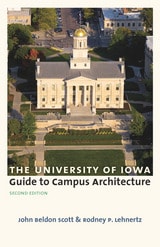
The University of Iowa Guide to Campus Architecture, Second Edition
John Beldon Scott and Rodney P. Lehnertz
University of Iowa Press, 2016
The Uruk World System
The Dynamics of Expansion of Early Mesopotamian Civilization, Second EditionGuillermo Algaze
University of Chicago Press, 2005
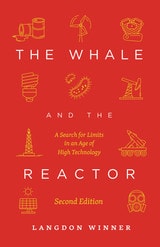
The Whale and the Reactor
A Search for Limits in an Age of High Technology, Second EditionLangdon Winner
University of Chicago Press, 2020
First published to great acclaim in 1988, Langdon Winner’s groundbreaking exploration of the political, social, and philosophical implications of technology is timelier than ever. He demonstrates that choices about the kinds of technical systems we build and use are actually choices about who we want to be and what kind of world we want to create—technical decisions are political decisions, and they involve profound choices about power, liberty, order, and justice. A seminal text in the history and philosophy of science, this new edition includes a new chapter, preface, and postscript by the author.
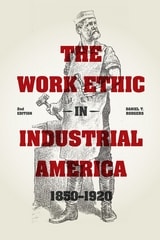
The Work Ethic in Industrial America 1850-1920
Second EditionDaniel T. Rodgers
University of Chicago Press, 2014
Daniel T. Rodgers masterfully explores the ways in which the eclipse of small-scale workshops by mechanized production and mass consumption triggered far-reaching shifts in perceptions of labor, leisure, and personal success. He also shows how the new work culture permeated society, including literature, politics, the emerging feminist movement, and the labor movement.
A staple of courses in the history of American labor and industrial society, Rodgers’s sharp analysis is sure to find a new audience, as twenty-first-century workers face another shift brought about by technology. The Work Ethic in Industrial America 1850–1920 is a classic with critical relevance in today’s volatile economic times.
The World in a Phrase
A Brief History of the Aphorism, Second EditionJames Geary
University of Chicago Press, 2025
Aphorisms are literature’s hand luggage. Light and compact, they contain everything you need to get through a rough day at the office or a dark night of the soul. Aphorisms, the oldest written art form on the planet, have been going viral for thousands of years, delivering the short, sharp shock of old forgotten truths. Today, visual artists are mixing pithy language with compelling imagery and using social media to take the form into the future. In a world of disinformation and deepfakes, aphorisms point to the power of fresh debate over tired dogma and inconvenient truths over comfortable lies.
Starting in ancient China and ending with contemporary meme-makers and street artists, The World in A Phrase tells the story of the aphorism through brief biographies of some of its greatest practitioners: sages like Lao-tzu and the Buddha, philosophers like Schopenhauer and Nietzsche, writers like George Eliot and Marie von Ebner-Eschenbach, humorists like Mark Twain and Dorothy Parker, activists like James Baldwin and Audre Lorde, poets like Langston Hughes and Kay Ryan, and artists like Jenny Holzer and David Byrne.
The World in A Phrase is for lovers of words and seekers of wisdom. This new edition of The New York Times bestseller features 26 additional aphorists and explores the aphorism in the age of social media, showing why these short sentences are the ultimate deep dives in an era when TL;DR has become a cultural catchphrase.
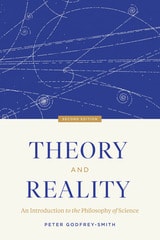
Theory and Reality
An Introduction to the Philosophy of Science, Second EditionPeter Godfrey-Smith
University of Chicago Press, 2021
Like no other text in this field, Theory and Reality combines a survey of recent history of the philosophy of science with current key debates that any beginning scholar or critical reader can follow. The second edition is thoroughly updated and expanded by the author with a new chapter on truth, simplicity, and models in science.