52 books match the query 'Silence' and 12 start with t

cover of The Disappearance: A Novella and Stories

The Disappearance

A Novella and Stories

Ilan Stavans

Northwestern University Press, 2008
Hailed as one of the most important Hispanic writers of his generation, Ilan Stavans is a celebrated storyteller whose work has been translated into a dozen languages and has garnered numerous international awards. The Disappearance: A Novella and Stories contains three masterful gems. The novella, “Morirse está en hebreo,” is a thought-provoking meditation on continuity and tradition among Mexican Jews; “Xerox Man” is an intriguing story about a book thief with a bizarre theological obsession; and the title story, “The Disappearance,” is the resonant tale of a Belgian actor who kidnaps himself in an attempt to respond to neo-Nazi groups. Together, these three pieces offer an unforeseen vista of Jewish-Hispanic relations and confirm Stavans’ reputation as an original literary voice.
[more]
cover of The Feel Of Silence

The Feel Of Silence

Bonnie Tucker

Temple University Press, 1995
[more]
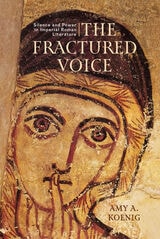
cover of The Fractured Voice: Silence and Power in Imperial Roman Literature

The Fractured Voice

Silence and Power in Imperial Roman Literature

Amy A. Koenig

University of Wisconsin Press, 2023

Imperial Rome privileged the elite male citizen as one of sound mind and body, superior in all ways to women, noncitizens, and nonhumans. One of the markers of his superiority was the power of his voice, both literal (in terms of oratory and the legal capacity to represent himself and others) and metaphoric, as in the political power of having a “voice” in the public sphere. Muteness in ancient Roman society has thus long been understood as a deficiency, both physically and socially.

In this volume, Amy Koenig deftly confronts the trope of muteness in Imperial Roman literature, arguing that this understanding of silence is incomplete. By unpacking the motif of voicelessness across a wide range of written sources, she shows that the Roman perception of silence was more complicated than a simple binary and that elite male authors used muted or voiceless characters to interrogate the concept of voicelessness in ways that would be taboo in other contexts. Paradoxically, Koenig illustrates that silence could in fact be freeing—that the loss of voice permits an untethering from other social norms and expectations, thus allowing a freedom of expression denied to many of the voiced.
[more]
cover of The Other Side of Silence: Sign Language and the Deaf Community in America

The Other Side of Silence

Sign Language and the Deaf Community in America

Arden Neisser

Gallaudet University Press, 1983

Arden Neisser’s classic book on American Sign Language (ASL) and the Deaf community is again available, with a new prologue. The Other Side of Silence explores the Deaf community through telling interviews and research from across the country.

       In widely varying encounters, Neisser heard Deaf individuals recall how their teachers suppressed ASL, how linguists foster conflicting theories, and how various institutions of the deaf dilute ASL to suit hearing patrons. This seminal book reveals the warmth, creativity, and resilience of Deaf people, and offers an update of the community today.
[more]
cover of The Other Side of Silence: Voices from the Partition of India

The Other Side of Silence

Voices from the Partition of India

Urvashi Butalia

Duke University Press, 2000

The partition of India into two countries, India and Pakistan, caused one of the most massive human convulsions in history. Within the space of two months in 1947 more than twelve million people were displaced. A million died. More than seventy-five thousand women were abducted and raped. Countless children disappeared. Homes, villages, communities, families, and relationships were destroyed. Yet, more than half a century later, little is known of the human dimensions of this event. In The Other Side of Silence , Urvashi Butalia fills this gap by placing people—their individual experiences, their private pain—at the center of this epochal event.
Through interviews conducted over a ten-year period and an examination of diaries, letters, memoirs, and parliamentary documents, Butalia asks how people on the margins of history—children, women, ordinary people, the lower castes, the untouchables—have been affected by this upheaval. To understand how and why certain events become shrouded in silence, she traces facets of her own poignant and partition-scarred family history before investigating the stories of other people and their experiences of the effects of this violent disruption. Those whom she interviews reveal that, at least in private, the voices of partition have not been stilled and the bitterness remains. Throughout, Butalia reflects on difficult questions: what did community, caste, and gender have to do with the violence that accompanied partition? What was partition meant to achieve and what did it actually achieve? How, through unspeakable horrors, did the survivors go on? Believing that only by remembering and telling their stories can those affected begin the process of healing and forgetting, Butalia presents a sensitive and moving account of her quest to hear the painful truth behind the silence.
[more]
cover of The Raj Quartet, Volume 3: The Towers of Silence

The Raj Quartet, Volume 3

The Towers of Silence

Paul Scott

University of Chicago Press, 1998

The powerful third volume of Paul Scott's classic account of the final days of British rule in India

India, 1943: In a regimental hill station, the ladies of Pankot struggle to preserve the genteel façade of British society amid the debris of a vanishing empire and World War II. A retired missionary, Barbara Batchelor, bears witness to the connections between many human dramas; the love between Daphne Manner and Hari Kumar; the desperate grief an old teacher feels for an India she cannot rescue; and the cruelty of Captain Ronald Merrick, Susan Layton's future husband.
[more]
cover of The Roar and the Silence: A History of Virginia City and the Comstock Lode

The Roar and the Silence

A History of Virginia City and the Comstock Lode

Ronald M. James

University of Nevada Press, 1998
Nevada’s Comstock Mining District has been the focus of legend since it first burst into international prominence in the late 1850s, and its principal settlement, Virginia City, endures in the popular mind as the West’s quintessential mining camp. But the authentic history of the Comstock is far more complex and interesting than its colorful image. Contrary to legend, Virginia City spent only its first few years as a ramshackle mining camp. The mining boom quickly turned it into a thriving urban center, at its peak one of the largest cities west of the Mississippi, replete with most of the amenities of any large city of its time.
The lure of the area’s fabulous wealth attracted a remarkably heterogenous population from around the world and offered employment to dozens of trades and thousands of people, both men and women, representing every one of the region’s diverse ethnic groups.
Ronald James’s brilliant account of the Comstock’s long and eventful history—the first comprehensive study of the subject in over a century—examines every aspect of the region and employs information gleaned from hundreds of written sources, interviews, archeological research, computer analysis, folklore, gender studies, physical geography, and architectural and art history, as well as over fifty rare photographs, many of them previously unpublished.
[more]
cover of The Silence of Goethe

The Silence of Goethe

Josef Pieper

St. Augustine's Press, 2009

During the last months of the war, Josef Pieper saw the realization of a long-cherished plan to escape from the “lethal chaos” that was the Germany of that time, “plucked,” he writes, “as was Habakkuk, by the hair of his head . . . to be planted into a realm of the most peaceful seclusion, whose borders and exists were, of course, controlled by armed sentries.” There he made contact with a friend close-by, who possessed an amazing library, and Pieper hit upon the idea of reading the letters of Goethe from that library. Soon, however, he decided to read the entire Weimar edition of fifty volumes, which were brought to him in sequence, two or three at a time.
The richness of this life revealing itself over a period of more than sixty years appeared before my gaze in its truly overpowering magnificence, which almost shattered my powers of comprehension – confined, as they had been, to the most immediate and pressing concerns. What a passionate focus on reality in all its forms, what an undying quest to chase down all that is in the world, what strength to affirm life, what ability to take part in it, what vehemence in the way he showed his dedication to it! Of course, too, what ability to limit himself to what was appropriate; what firm control in inhibiting what was purely aimless; what religious respect for the truth of being! I could not overcome my astonishment; and the prisoner entered a world without borders, a world in which the fact of being in prison was of absolutely no significance.
    But no matter how many astonishing things I saw in these unforgettable weeks of undisturbed inner focus, nothing was more surprising or unexpected than this: to realize how much of what was peculiar to this life occurred in carefully preserved seclusion; how much the seemingly communicative man who carried on a world-wide correspondence still never wanted to expose in words the core of his existence.
    It was precisely in the seclusion, the limitation, the silence of Goethe that made the strongest impact on Pieper. Here was modern Germany’s quintessential conversationalist intellectual, but the strength of his words came from the restraint behind them, even to the point of purposeful forgetting:
The culmination is when the eighty-year-old sees forgetting not as a convulsive refusal to think of things, but as what could almost be termed a physiological process of simple forgetting as a function of life. He praises as “a great gift of the gods” . . . “the ethereal stream of forgetfulness” which he “was always able to value, to use, and to heighten.”
    However manifold the forms of this silence and of their unconscious roots and conscious motives may have been, is it not always the possibility of hearing, the possibility of a purer perception of reality that is aimed at? And so, is not Goethe’s type of silence above all the silence of one who listens? . . .
    This listening silence is much deeper than the mere refraining from words and speech in human intercourse. It means a stillness, which, like a breath, has penetrated into the inmost chamber of one’s own soul. It is meant, in the Goethean “maxim,” to “deny myself as much as possible and to take up the object into myself as purely as it is possible to do.” . . .
    The meaning of being silent is hearing – a hearing in which the simplicity of the receptive gaze at things is like the naturalness, simplicity, and purity of one receiving a confidence, the reality of which is creatura, God’s creation. And insofar as Goethe’s silence is in this sense a hearing silence, to that extent it has the status of the model and paradigm – however much, in individual instances, reservations and criticism are justified. One could remain circumspectly silent about this exemplariness after the heroic nihilism of our age has proclaimed the attitude of the knower to be by no means that of a silent listener but rather as that of self-affirmation over against being: insight and knowledge are naked defiance, the severest endangering of existence in the midst of the superior strength of concrete being. The resistance of knowledge opposes the oppressive superior power. However, that the knower is not a defiant rebel against concrete being, but above all else a listener who stays silent and, on the basis of his silence, a hearer – it is here that Goethe represents what, since Pythagoras, may be considered the silence tradition of the West.
Pieper concludes his remarkable find with this summation:
When such talk, which one encounters absolutely everywhere in workshops and in the marketplace – and as a constant temptation – , when such deafening talk, literally out to thwart listening, is linked to hopelessness, we have to ask is there not in silence – listening silence – necessarily a shred of hope? For who could listen in silence to the language of things if he did not expect something to come of such awareness of the truth? And, in a newly founded discipline of silence, is there not a chance not merely to overcome the sterility of everyday talk but also to overcome its brother, hopelessness – possibly if only to the extent that we know the true face of this relationship? I know that here quite different forces come into play which are beyond human control, and perhaps the circulus has to be broken through in a different place. However, one may ask: could not the “quick, strict resolution” to remain silent at the same time serve as a kind of training in hope?
[more]
cover of The Silence of Sodom: Homosexuality in Modern Catholicism

The Silence of Sodom

Homosexuality in Modern Catholicism

Mark D. Jordan

University of Chicago Press, 2000

The past decade has seen homosexual scandals in the Catholic Church becoming ever more visible, and the Vatican's directives on homosexuality becoming ever more forceful, begging the question Mark Jordan tries to answer here: how can the Catholic Church be at once so homophobic and so homoerotic? His analysis is a keen and readable study of the tangled relationship between male homosexuality and modern Catholicism.

"[Jordan] has offered glimpses, anecdotal stories, and scholarly observations that are a whole greater than the sum of its parts. . . . If homosexuality is the guest that refuses to leave the table, Jordan has at least shed light on why that is and in the process made the whole issue, including a conflicted Catholic Church, a little more understandable."—Larry B. Stammer, Los Angeles Times

"[Jordan] knows how to present a case, and with apparently effortless clarity he demonstrates the church's double bind and how it affects Vatican rhetoric, the training of priests, and ecclesiastical protectiveness toward an army of closet cases. . . . [T]his book will interest readers of every faith."—Daniel Blue,
Lambda Book Report


A 2000 Lambda Literary Award Finalist
[more]
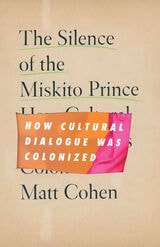
cover of The Silence of the Miskito Prince: How Cultural Dialogue Was Colonized

The Silence of the Miskito Prince

How Cultural Dialogue Was Colonized

Matt Cohen

University of Minnesota Press, 2022

Confronting the rifts created by our common conceptual vocabulary for North American colonial studies 

How can we tell colonial histories in ways that invite intercultural conversation within humanistic fields that are themselves products of colonial domination? Beginning with a famous episode of failed communication from the narrative of the freed slave Olaudah Equiano, The Silence of the Miskito Prince explores this question by looking critically at five concepts frequently used to imagine solutions to the challenges of cross-cultural communication: understanding, cosmopolitanism, piety, reciprocity, and patience. 

Focusing on the first two centuries of North American colonization, Matt Cohen traces how these five concepts of cross-cultural relations emerged from, and continue to evolve within, colonial dynamics. Through a series of revealing archival explorations, he argues the need for a new vocabulary for the analysis of past interactions drawn from the intellectual and spiritual domains of the colonized, and for a historiographical practice oriented less toward the illusion of complete understanding and scholarly authority and more toward the beliefs and experiences of descendant communities. 

The Silence of the Miskito Prince argues for new ways of framing scholarly conversations that use past interactions as a site for thinking about intercultural relations today. By investigating the colonial histories of these terms that were assumed to promote inclusion, Cohen offers both a reflection on how we got here and a model of scholarly humility that holds us to our better or worse pasts.
[more]
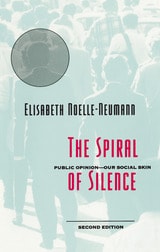
cover of The Spiral of Silence: Public Opinion--Our Social Skin

The Spiral of Silence

Public Opinion--Our Social Skin

Elisabeth Noelle-Neumann

University of Chicago Press, 1993

In this groundbreaking work, Elisabeth Noelle-Neumann examines public opinion as a form of social control in which individuals, almost instinctively sensing the opinions of those around them, shape their behavior to prevailing attitudes about what is acceptable.

For this second edition, Noelle-Neumann has added three new chapters: the first discusses new discoveries in the history of public opinion; the second continues the author's efforts to construct a comprehensive theory of public opinion, addressing criticisms and defenses of her "spiral of silence" theory that have appeared since 1980; the third offers a concise and updated summary of the book's arguments.
[more]
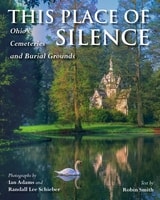
cover of This Place of Silence: Ohio's Cemeteries and Burial Grounds

This Place of Silence

Ohio's Cemeteries and Burial Grounds

Ian Adams; Randall Lee Schieber; Robin L. Smith

Ohio University Press, 2024

This Place of Silence is a photographic portrait of Ohio’s cemeteries and burial grounds by Ohio photographers Ian Adams and Randall Lee Schieber. The text and photo captions by Robin L. Smith provide an overview of the history of burial grounds, from prehistoric mounds through modern “green” cemeteries—and many fascinating details about gravestones, mausoleums, statuary, and cemetery landscapes. The introduction provides an overview of the historical place of burial grounds in our society and of their value today not only as rich sources of history but also as repositories of art, architecture, and nature. Cemeteries record the history of their communities in their names and dates, but they also tell us how a community wanted its history recorded: How did this community see itself? What was important to that community? Who were the prominent people, and what did they accomplish? Graveyards, especially older ones, are also full of quirky names and mysteries. Who would name a child Nimrod, and where did that name come from? Why would two families build identical side-by-side mausoleums? Who would want a grave marker that looks like a pile of stones? Chapters cover prehistoric mounds and early European American burial grounds; the evolution from rural cemeteries in the nineteenth century to modern green burials; art, architecture, and symbolism in cemeteries; cemeteries and nature; military and institutional burial grounds; and distinctive ethnic cemeteries. The authors highlight and showcase these often beautiful but sometimes neglected pieces of history. Cemeteries are not dark, morbid places to be avoided, but historic landscapes that are full of beauty, hope, and honor for those Ohioans who came before us.
[more]