71 books match the query 'Social networks' and 11 start with t
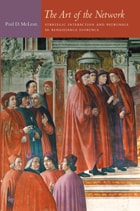
cover of The Art of the Network: Strategic Interaction and Patronage in Renaissance Florence

The Art of the Network

Strategic Interaction and Patronage in Renaissance Florence

Paul D. McLean

Duke University Press, 2007

Writing letters to powerful people to win their favor and garner rewards such as political office, tax relief, and recommendations was an institution in Renaissance Florence; the practice was an important tool for those seeking social mobility, security, and recognition by others. In this detailed study of political and social patronage in fifteenth-century Florence, Paul D. McLean shows that patronage was much more than a pursuit of specific rewards. It was also a pursuit of relationships and of a self defined in relation to others. To become independent in Renaissance Florence, one first had to become connected. With The Art of the Network, McLean fills a gap in sociological scholarship by tracing the historical antecedents of networking and examining the concept of self that accompanies it. His analysis of patronage opens into a critique of contemporary theories about social networks and social capital, and an exploration of the sociological meaning of “culture.”

McLean scrutinized thousands of letters to and from Renaissance Florentines. He describes the social protocols the letters reveal, paying particular attention to the means by which Florentines crafted credible presentations of themselves. The letters, McLean contends, testify to the development not only of new forms of self-presentation but also of a new kind of self to be presented: an emergent, “modern” conception of self as an autonomous agent. They also bring to the fore the importance that their writers attached to concepts of honor, and the ways that they perceived themselves in relation to the Florentine state.

[more]
cover of The Circuit of Apollo: Eighteenth-Century Women’s Tributes to Women

The Circuit of Apollo

Eighteenth-Century Women’s Tributes to Women

Laura Runge

University of Delaware Press, 2019

Written by a combination of established scholars and new critics in the field, the essays collected in Circuit of Apollo attest to the vital practice of commemorating women’s artistic and personal relationships. In doing so, they illuminate the complexity of female friendships and honor as well as the robust creativity and intellectual work contributed by women to culture in the long eighteenth century. Women’s tributes to each other sometimes took the form of critical engagement or competition, but they always exposed the feminocentric networks of artistic, social, and material exchange women created and maintained both in and outside of London. This volume advocates for a new perspective for researching and teaching early modern women that is grounded in admiration.

Published by University of Delaware Press. Distributed worldwide by Rutgers University Press.
 
[more]
cover of The Creation of an Ethnic Identity: Being Swedish American in the Augustana Synod, 1860-1917

The Creation of an Ethnic Identity

Being Swedish American in the Augustana Synod, 1860-1917

Dag Blanck

Southern Illinois University Press, 2006

Analyzing the development of a Swedish American identity

The Creation of an Ethnic Identity: Being Swedish American in the Augustana Synod, 1860–1917 analyzes how Swedish American identity was constructed, maintained, and changed in the late nineteenth and early twentieth centuries. The Augustana Synod, the largest religious-based organization created by Swedish immigrants in the United States, played an important role in establishing what it meant to be Swedish American.

In this study, author Dag Blanck poses three fundamental questions: How did an ethnic identity develop in the Augustana Synod? What was that identity? Why was an ethnic identity formed? Based on primary sources formerly unknown or neglected, The Creation of an Ethnic Identity examines the Lutheran Augustana Synod, Augustana College, and the Augustana Book Concern to provide insights into how ethnic identity is constructed within a major religious body, a central educational institution, and a major publishing house.

Starting from the concept of ethnicity as something created or invented, Blanck goes on to explore how it was possible for a white European immigrant group like the Swedes to use its ethnicity as a tool of integration into American society. The nature of their ethnicity, says Blanck, was both determined by their cultural origins and also the values and nature of American society as they perceived it. Becoming Swedish American was also a way of becoming American.

The volume, which is augmented by illustrations, integrates the most critical scholarship on immigration and ethnicity over the past half century and provides a strong argument about how ethnicity is shaped over time within an immigrant group.

[more]
cover of The Language of Political Incorporation: Chinese Migrants in Europe

The Language of Political Incorporation

Chinese Migrants in Europe

Amy Liu

Temple University Press, 2021

In this groundbreaking study, The Language of Political Incorporation, Amy Liu focuses on Chinese migrants in Central-Eastern Europe and their varying levels of political incorporation in the local community. She examines the linguistic diversity of migrant networks, finding institutional trust and civic engagement depend not on national identity, but on the network’s linguistic diversity—namely, whether the operating language is a migrant’s mother tongue or a lingua franca.

The Language of Political Incorporation uses original survey data to assess when the Chinese engage positively with the authorities and when they become civic minded. The results are surprising. In Hungary, the Chinese community has experienced high levels of political incorporation in part because they have not been targeted by anti-immigrant rhetoric and policies. In contrast, migrants in Romania sought the assistance of the Chinese embassy to fight an effort to collect back taxes. 

Liu also compares the Chinese experiences in Central-Eastern Europe with those of Muslims in the region, as well as how the Chinese are treated in Western Europe. Additionally, she considers how the local communities perceive the Chinese. The Language of Political Incorporation concludes by offering best practices for how governments can help migrants become more trusting of—and have greater involvement with—locals in their host countries. Ultimately, Liu demonstrates the importance of linguistic networks for the incorporation of immigrants.
[more]
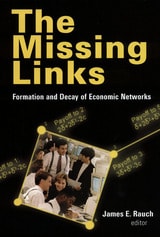
cover of The Missing Links: Formation and Decay of Economic Networks

The Missing Links

Formation and Decay of Economic Networks

James E. Rauch

Russell Sage Foundation, 2007
Half of all workers are hired through personal referrals, and networks of social connections channel the flows of capital, technology, and international trade. Sociologists and economists alike recognize that economic exchange is shaped by social networks, which propagate information and facilitate trust, but each discipline brings a distinct theoretical perspective to the study of networks. Sociologists have focused on how networks shape individual behavior, economists on how individual choices shape networks. The Missing Links is a bold effort by an interdisciplinary group of scholars to synthesize sociological and economic theories of how economic networks emerge and evolve. Interweaving sophisticated theoretical models and concrete case studies, The Missing Links is both an introduction to the study of economic networks and a catalyst for further research. Economists Rachel Kranton and Deborah Minehart illustrate their field's approach to modeling network formation, showing how manufacturers form networks of suppliers in ways that maximize profits. Exemplifying the sociological approach, Ronald Burt analyzes patterns of cooperation and peer evaluations among colleagues at a financial organization. He finds that dense connections of shared acquaintances lead to more stable reputations.  In the latter half of the book, contributors combine the insights of sociology and economics to explore a series of case studies. Ray Reagans, Ezra Zuckerman, and Bill McEvily investigate an R & D firm in which employees participate in overlapping collaborative teams, allowing the authors to disentangle the effects of network structure and individual human capital on team performance. Kaivan Munshi and Mark Rosenzweig examine how economic development and rising inequality in India are reshaping caste-based networks of mutual insurance and job referrals. Their study shows that people's economic decisions today are shaped both by the legacy of the caste hierarchies and by the particular incentives and constraints that each individual faces in an evolving labor market. Economic globalization is forging new connections between people in distant corners of the world, while unsettling long-standing social relations. Anyone interested in understanding the opportunities and challenges of this era of rapid change will find a highly informative guide in The Missing Links.
[more]
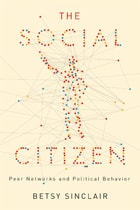
cover of The Social Citizen: Peer Networks and Political Behavior

The Social Citizen

Peer Networks and Political Behavior

Betsy Sinclair

University of Chicago Press, 2012
Human beings are social animals. Yet despite vast amounts of research into political decision making, very little attention has been devoted to its social dimensions. In political science, social relationships are generally thought of as mere sources of information, rather than active influences on one’s political decisions.
 
Drawing upon data from settings as diverse as South Los Angeles and Chicago’s wealthy North Shore, Betsy Sinclair shows that social networks do not merely inform citizen’s behavior, they can—and do—have the power to change it. From the decision to donate money to a campaign or vote for a particular candidate to declaring oneself a Democrat or Republican, basic political acts are surprisingly subject to social pressures. When members of a social network express a particular political opinion or belief, Sinclair shows, others notice and conform, particularly if their conformity is likely to be highly visible.
 
We are not just social animals, but social citizens whose political choices are significantly shaped by peer influence. The Social Citizen has important implications for our concept of democratic participation and will force political scientists to revise their notion of voters as socially isolated decision makers.
[more]
cover of The Trans Midwest: Trans Feminist Coalition Building Since World War II

The Trans Midwest

Trans Feminist Coalition Building Since World War II

Joy Ellison

University of Chicago Press, 2027

A revelatory regional history of trans feminist coalition-building between feminist, queer, and Black communities. 

In the face of heightened transphobia and rising fascism in the United States, Joy Ellison’s TheTrans Midwest recounts the history of Midwestern trans women and femmes as a force in the larger feminist movement in the United States. Facing repression and geographic isolation, trans feminine Midwesterners built, and continue to build, vibrant coalitions with feminist, queer, and Black organizations. 

Drawing on a vast range of archives and oral histories, Ellison shares a detailed and intersectional description of trans life and politics. These historical figures range from the Black trans women who worked in drag shows to the student coalitions that led to the passage of the country’s first trans-inclusive anti-discrimination ordinance and transsexual lesbian feminist activism in the 1990s. Ellison examines community networks and support groups, newsletters and advertisements, and Midwestern cities from Detroit to Kansas City to elucidate how trans regional groups found common interests across different races, classes, abilities, and sexualities, a marked difference from existing historical accounts of similar movements elsewhere. 

Contributing to our understanding of trans history and the impact of intersectional organizing, The Trans Midwest presents new possibilities and critical lessons for trans feminist movements today. 

[more]
cover of The Well-Connected Animal: Social Networks and the Wondrous Complexity of Animal Societies

The Well-Connected Animal

Social Networks and the Wondrous Complexity of Animal Societies

Lee Alan Dugatkin

University of Chicago Press, 2024

“Combines accessible prose with solid science.”—Wall Street Journal • “Demonstrates that whatever creature you are—from a giraffe to a Tasmanian devil—life is all about who you know.”—New Scientist • “Fascinating. . . . Easily the most intriguing, thorough explanation of animal behavior ever produced.”—Library Journal (starred review) • “This book makes a fitting companion to Ed Yong’s An Immense World. An entertaining tour of what we learn as we eavesdrop on the non-human conversations all around us.”—Kirkus Reviews • “Terrific.”—Booklist

An engaging exploration of the wondrous social webs that permeate life in animal societies around the world.

 
It’s all about who you know. Whether vampire bats sharing blood meals for survival, field crickets remembering champion fighters, macaque monkeys forming grooming pacts after a deadly hurricane, or great tit birds learning the best way to steal milk—it pays to be well connected.

In this tour of the animal kingdom, evolutionary biologist Lee Alan Dugatkin reveals a new field of study, uncovering social networks that existed long before the dawn of human social media. He accessibly describes the latest findings from animal behavior, evolution, computer science, psychology, anthropology, genetics, and neurobiology, and incorporates interviews and insights from researchers he finds swimming with manta rays, avoiding pigeon poop, and stopping monkeys from stealing iPads. With Dugatkin as our guide, we investigate social networks in giraffes, elephants, kangaroos, Tasmanian devils, whales, bats, and more. From animal networks in Australia and Asia to Africa, Europe, and the Americas, The Well-Connected Animal is an eye-opening exposé of wild friends, enemies, and everything in between.
[more]
cover of Through the Grapevine: Socially Transmitted Information and Distorted Democracy

Through the Grapevine

Socially Transmitted Information and Distorted Democracy

Taylor N. Carlson

University of Chicago Press, 2024

An enlightening examination of what it means when Americans rely on family and friends to stay on top of politics.

Accurate information is at the heart of democratic functioning. For decades, researchers interested in how information is disseminated have focused on mass media, but the reality is that many Americans today do not learn about politics from direct engagement with the news. Rather, about one-third of Americans learn chiefly from information shared by their peers in conversation or on social media. How does this socially transmitted information differ from that communicated by traditional media? What are the consequences for political attitudes and behavior?

Drawing on evidence from experiments, surveys, and social media, Taylor N. Carlson finds that, as information flows first from the media then person to person, it becomes sparse, more biased, less accurate, and more mobilizing. The result is what Carlson calls distorted democracy. Although socially transmitted information does not necessarily render democracy dysfunctional, Through the Grapevine shows how it contributes to a public that is at once underinformed, polarized, and engaged.

[more]
cover of Tiny Publics: A Theory of Group Action and Culture

Tiny Publics

A Theory of Group Action and Culture

Gary Alan Fine

Russell Sage Foundation, 2012

If all politics is local, then so is almost everything else, argues sociologist Gary Alan Fine. We organize our lives by relying on those closest to us—family members, friends, work colleagues, team mates, and other intimates—to create meaning and order. In this thoughtful and wide-ranging book, Fine argues that the basic building blocks of society itself are forged within the boundaries of such small groups, the "tiny publics" necessary for a robust, functioning social order at all levels. Action, meaning, authority, inequality, organization, and institutions all have their roots in small groups. Yet for the past twenty-five years social scientists have tended to ignore the power of groups in favor of an emphasis on organizations, societies, or individuals. Based on over thirty-five years of Fine's own ethnographic research across an array of small groups, Tiny Publics presents a compelling new theory of the pivotal role of small groups in organizing social life. No social system can thrive without flourishing small groups. They provide havens in an impersonal world, where faceless organizations become humanized. Taking examples from such diverse worlds as Little League baseball teams, restaurant workers, high school debate teams, weather forecasters, and political volunteers, Fine demonstrates how each group has its own unique culture, or idioculture—the system of knowledge, beliefs, behavior, and customs that define and hold a group together. With their dense network of relationships, groups serve as important sources of social and cultural capital for their members. The apparently innocuous jokes, rituals, and nicknames prevalent within Little League baseball teams help establish how teams function internally and how they compete with other teams. Small groups also provide a platform for their members to engage in broader social discourse and a supportive environment to begin effecting change in larger institutions. In his studies of mushroom collectors and high school debate teams, Fine demonstrates the importance of stories that group members tell each other about their successes and frustrations in fostering a strong sense of social cohesion. And Fine shows how the personal commitment political volunteers bring to their efforts is reinforced by the close-knit nature of their work, which in turn has the power to change larger groups and institutions. In this way, the actions and debates begun in small groups can eventually radiate outward to affect every level of society. Fine convincingly demonstrates how small groups provide fertile ground for the seeds of civic engagement. Outcomes often attributed to large-scale social forces originate within such small-scale domains. Employing rich insights from both sociology and social psychology, as well as vivid examples from a revealing array of real-work groups, Tiny Publics provides a compelling examination of the importance of small groups and of the rich vitality they bring to social life. A Volume in the Russell Sage Foundation Series on Trust
[more]
cover of Transatlantic Central Europe: Contesting Geography and Redifining Culture beyond the Nation

Transatlantic Central Europe

Contesting Geography and Redifining Culture beyond the Nation

Jessie Labov

Central European University Press, 2019

While there are still occasional uses of it today, the term "Central Europe" carries little of the charge that it did in the 1980s and early 1990s, and as a political and intellectual project it has receded from the horizon. Proponents of a distinct cultural profile of these countries—all involved now in the process of Transatlantic integration—used "Central European", as a contestation with the geo-political label of Eastern Europe. This book discusses the transnational set of practices connecting journals with other media in the mid-1980s, disseminating the idea of Central Europe simultaneously in East and West. A range of new methodologies, including GIS-mapping visualization, is used, repositing the political-cultural journal as one central node of a much larger cultural system. What has happened to the liberal humanist philosophy that "Central Europe" once evoked? In the early years of the transition era, the liberal humanist perspective shared by Havel, Konrád, Kundera, and Michnik was quickly replaced by an economic liberalism that evolved into neoliberal policies and practices. The author follows the trajectories of the concept into the present day, reading its material and intellectual traces in the postcommunist landscape. She explores how the current use of transnational, web-based media follows the logic and practice of an earlier, 'dissident' generation of writers.
[more]